Overview
Dash interruption is a critical punctuation concept tested frequently in the SAT Reading and Writing (RW) section. This punctuation device uses a pair of em dashes (—) to set off nonessential information within a sentence, creating an interruption that adds detail, emphasis, or clarification without disrupting the sentence's core meaning. Understanding dash interruption is essential because the SAT regularly tests whether students can identify when dashes are used correctly versus when other punctuation marks (commas, parentheses, or colons) would be more appropriate.
The SAT's emphasis on sat dash interruption reflects the exam's broader focus on Standard English Conventions, particularly the ability to recognize and apply punctuation rules in context. Questions involving dash interruption typically appear in the Standard English Conventions domain, where students must choose the correct punctuation to maintain sentence clarity and grammatical correctness. These questions assess not just recognition of dashes but also understanding of how they function differently from similar punctuation marks.
Mastering dash interruption connects directly to broader punctuation principles in the rw section, including the use of commas for nonrestrictive elements, parentheses for asides, and colons for introducing information. Students who understand dash interruption gain insight into how punctuation controls information flow, emphasis, and sentence structure—skills that improve both their performance on direct punctuation questions and their overall reading comprehension. This topic typically appears in 2-4 questions per SAT administration, making it a high-yield area for focused study.
Learning Objectives
- [ ] Identify key features of dash interruption
- [ ] Explain how dash interruption appears on the SAT
- [ ] Apply dash interruption to answer SAT-style questions
- [ ] Distinguish between dash interruption and other punctuation marks (commas, parentheses, colons)
- [ ] Recognize when dash interruption is grammatically required versus stylistically preferred
- [ ] Evaluate whether interruptive information is truly nonessential to sentence meaning
- [ ] Correct improperly punctuated dash interruptions in SAT-style passages
Prerequisites
- Basic sentence structure: Understanding subjects, verbs, and complete sentences is necessary to identify what constitutes the "core" sentence versus interruptive material
- Comma usage fundamentals: Knowledge of how commas set off nonessential elements provides the foundation for understanding when dashes serve a similar function
- Independent and dependent clauses: Recognizing clause types helps determine whether dashes are appropriately separating sentence elements
- Reading comprehension skills: The ability to understand sentence meaning is essential for determining whether interruptive information is truly nonessential
Why This Topic Matters
Dash interruption matters in real-world writing because it allows authors to add emphasis, insert clarifying details, or include relevant asides without creating separate sentences. Professional writers, journalists, and academics use dash interruption to create sophisticated, nuanced prose that maintains reader engagement while conveying complex information. The ability to use and recognize proper dash interruption distinguishes competent writers from those who struggle with punctuation conventions.
On the SAT, dash interruption appears with remarkable consistency. Approximately 15-20% of Standard English Conventions questions involve punctuation choices, and dash interruption represents a significant portion of these. The College Board specifically tests whether students can identify when dashes correctly set off nonessential information and when they're misused. These questions typically appear in passages from various disciplines—science, humanities, social studies, and literature—requiring students to apply punctuation rules across different contexts.
Common SAT appearances include: passages where students must choose between dashes, commas, or parentheses to set off interruptive information; sentences where only one dash appears when two are needed (or vice versa); and contexts where dashes are incorrectly used instead of colons or semicolons. The exam also tests whether students recognize that the sentence must remain grammatically complete if the interruptive material is removed. Understanding these patterns allows students to approach dash interruption questions with confidence and systematic strategies.
Core Concepts
What Is Dash Interruption?
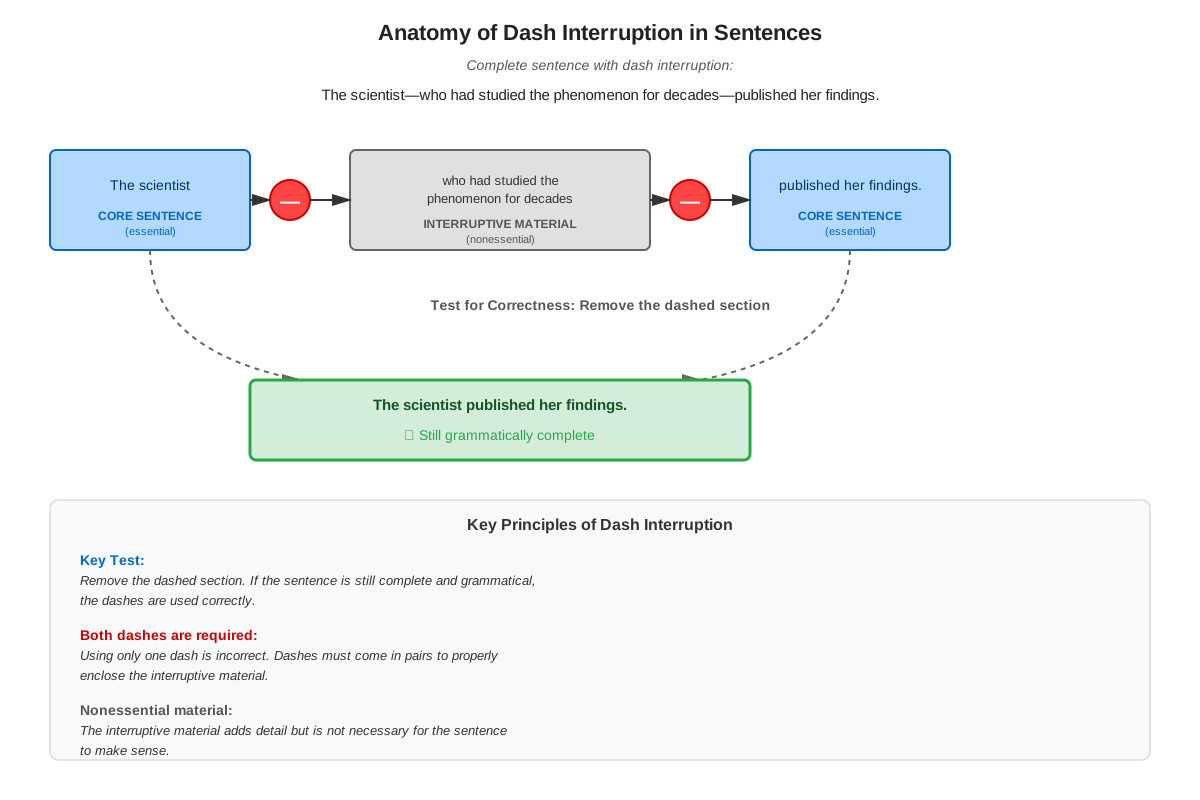
Dash interruption occurs when a pair of em dashes (—) sets off nonessential information within a sentence. The key characteristic is that the material between the dashes can be removed without destroying the sentence's grammatical integrity or core meaning. The dashes function like parentheses or commas but typically provide stronger emphasis or more dramatic interruption.
The em dash (—) differs from the hyphen (-) and en dash (–). The em dash is the longest and is used for interruption, while hyphens connect compound words and en dashes show ranges. On the SAT, only em dashes are tested for interruption purposes.
The Two-Dash Rule
The fundamental principle of dash interruption is that interruptive dashes must come in pairs. When dashes set off nonessential information in the middle of a sentence, one dash must appear before the interruption and another must appear after it. This creates a clear boundary showing where the interruption begins and ends.
Consider this structure:
- Main clause beginning — interruptive information — main clause ending.
If you remove everything between (and including) the dashes, what remains must be a complete, grammatically correct sentence. This "removal test" is the most reliable way to verify correct dash interruption usage.
Nonessential vs. Essential Information
Understanding what qualifies as nonessential information is crucial for dash interruption mastery. Nonessential information adds detail, clarification, or emphasis but isn't required for the sentence's basic meaning. Essential information, by contrast, is necessary for the sentence to convey its intended meaning and cannot be removed.
| Information Type | Can Be Removed? | Punctuation Options | Example |
|---|---|---|---|
| Nonessential | Yes | Dashes, commas, parentheses | The scientist—a Nobel laureate—presented her findings. |
| Essential | No | No punctuation needed | The scientist who won the Nobel Prize presented her findings. |
The SAT frequently tests whether students can distinguish between these types. A common trap involves presenting information that seems like an aside but is actually essential to the sentence's meaning.
Dash Interruption vs. Other Punctuation
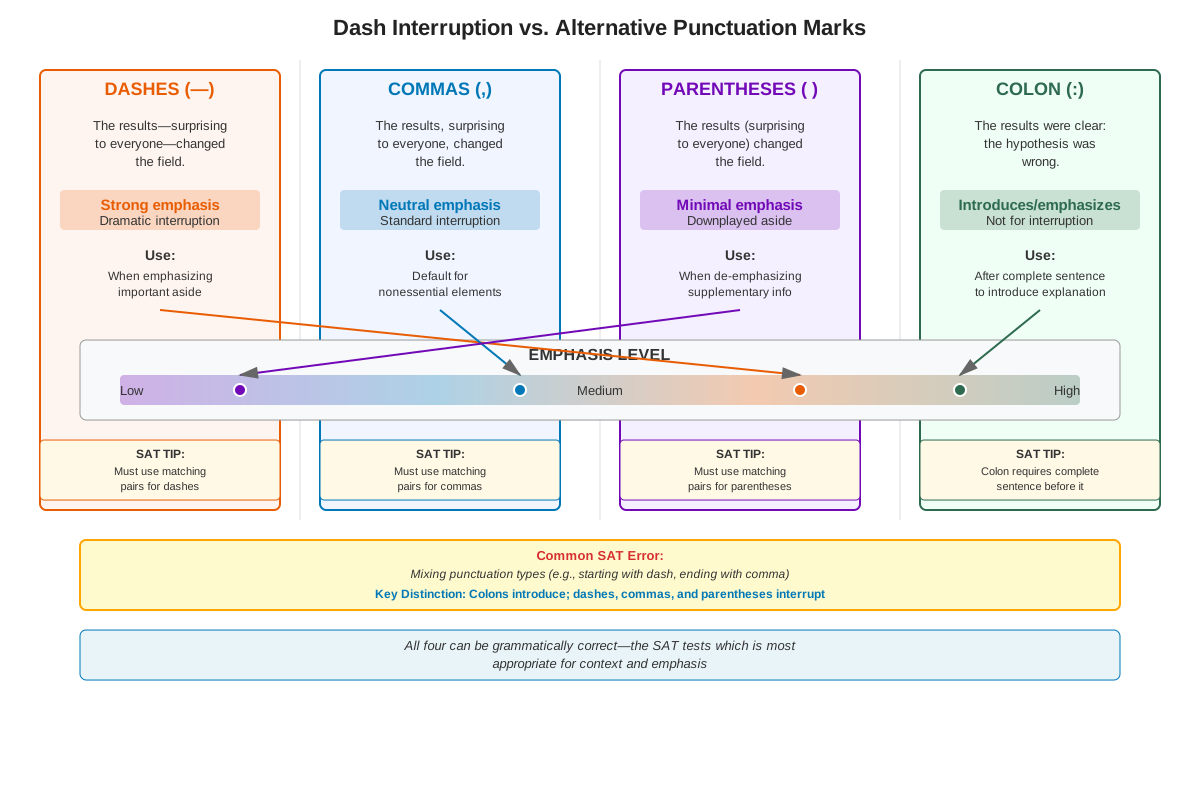
While dashes, commas, and parentheses can all set off nonessential information, they create different effects:
Dashes provide the strongest emphasis and most dramatic interruption. They draw attention to the enclosed information and create a more forceful pause than commas. Writers choose dashes when they want the interruptive information to stand out.
Commas offer a gentler interruption with less emphasis. They're the default choice for nonessential information and create smoother reading flow. Commas are preferred when the interruption shouldn't draw special attention.
Parentheses minimize the importance of enclosed information, treating it as a true aside or supplementary detail. They suggest the information is less important than the main sentence.
The SAT tests whether students recognize these distinctions and can identify when one punctuation mark is clearly preferable to others based on context and emphasis.
Common Dash Interruption Patterns
Several patterns appear repeatedly on the SAT:
- Appositives: A noun phrase that renames or describes another noun (e.g., "My sister—an accomplished pianist—performed last night")
- Clarifying phrases: Additional information that explains or specifies (e.g., "The experiment—conducted over three years—yielded surprising results")
- Contrasting information: Details that provide contrast or qualification (e.g., "The theory—though widely accepted—has significant limitations")
- Examples or lists: Specific instances or enumerations (e.g., "Three countries—France, Germany, and Italy—signed the agreement")
Grammatical Completeness Test
The most reliable strategy for evaluating dash interruption is the grammatical completeness test:
- Identify the dashes in the sentence
- Remove everything between (and including) the dashes
- Read what remains
- Verify that it forms a complete, grammatically correct sentence
If the remaining sentence is incomplete or grammatically incorrect, the dashes are improperly used. This test works because proper dash interruption always preserves the core sentence's integrity.
Single Dash Usage (Not Interruption)
Students must distinguish dash interruption from single dash usage. A single dash can introduce information, show an abrupt break, or emphasize what follows—but this isn't dash interruption. The SAT may include answer choices with single dashes where paired dashes are needed, testing whether students recognize that interruption requires two dashes.
Concept Relationships
Dash interruption connects directly to the broader concept of nonrestrictive elements in grammar. Understanding commas with nonrestrictive clauses provides the foundation for understanding dash interruption, as both punctuation marks can set off the same types of information. The choice between them depends on emphasis and style rather than grammatical rules.
The relationship flows as follows: Sentence structure fundamentals → Understanding essential vs. nonessential information → Comma usage with nonrestrictive elements → Dash interruption as an alternative → Choosing appropriate punctuation based on emphasis.
Dash interruption also relates to parenthetical expressions, another way to include supplementary information. Students who master dash interruption can better understand the full range of options for incorporating additional details without creating run-on sentences or fragments.
Additionally, dash interruption connects to sentence clarity and readability. Proper punctuation ensures readers can distinguish between core meaning and supplementary details, a skill that enhances both writing and reading comprehension. This relationship extends to passage-based reading questions, where understanding sentence structure aids comprehension of complex texts.
High-Yield Facts
⭐ Dash interruption always requires TWO dashes when setting off nonessential information in the middle of a sentence.
⭐ The sentence must remain grammatically complete when everything between (and including) the dashes is removed.
⭐ Dashes provide stronger emphasis than commas but serve the same grammatical function for nonessential information.
⭐ Nonessential information can be removed without destroying the sentence's core meaning or grammatical structure.
⭐ The SAT tests whether students can distinguish between dashes, commas, parentheses, colons, and semicolons in context.
- Dash interruption most commonly sets off appositives, clarifying phrases, and examples.
- A single dash at the end of a sentence is NOT dash interruption—it's emphatic punctuation.
- Mixing punctuation marks (one dash and one comma) to set off the same interruption is always incorrect.
- The em dash (—) is longer than a hyphen (-) and serves different purposes.
- Dash interruption can occur anywhere in a sentence: beginning, middle, or near the end.
- The information between dashes can be a single word, phrase, or even a complete clause.
- Dashes are more common in informal or journalistic writing than in highly formal academic prose.
- The SAT may test dash interruption with complex sentences containing multiple clauses.
- Recognizing dash interruption improves reading speed by helping students identify sentence structure quickly.
- Approximately 2-4 questions per SAT directly test dash interruption or related punctuation choices.
Quick check — test yourself on Dash interruption so far.
Try Flashcards →Common Misconceptions
Misconception: Any dash in a sentence creates an interruption. → Correction: Only paired dashes set off interruptions. A single dash can introduce information or show emphasis but doesn't create an interruption that can be removed while maintaining sentence completeness.
Misconception: Dashes and hyphens are interchangeable. → Correction: Dashes (—) and hyphens (-) serve completely different functions. Hyphens connect compound words (e.g., "well-known"), while em dashes set off interruptions or introduce information. Using a hyphen where a dash is needed is incorrect.
Misconception: You can mix punctuation marks, using one dash and one comma to set off the same interruption. → Correction: Paired punctuation must match. If you begin an interruption with a dash, you must end it with a dash. Mixing marks (dash with comma, dash with parenthesis) is always grammatically incorrect.
Misconception: All information between dashes is unimportant. → Correction: While information between dashes must be nonessential grammatically (removable without destroying sentence structure), it often contains important details the author wants to emphasize. Dashes draw attention to the enclosed information rather than minimizing it.
Misconception: Longer interruptions require dashes while shorter ones need commas. → Correction: The choice between dashes and commas depends on emphasis and style, not length. Even a single word can be set off with dashes if the author wants strong emphasis, while lengthy phrases might use commas for smoother flow.
Misconception: If a sentence has two dashes, they automatically create a proper interruption. → Correction: The dashes must enclose nonessential information, and the remaining sentence must be grammatically complete. Two dashes used for different purposes (e.g., one introducing a list, one showing an abrupt break) don't create proper dash interruption.
Misconception: Dash interruption is always the correct answer on the SAT. → Correction: The SAT tests whether students can choose the most appropriate punctuation for each context. Sometimes commas, parentheses, or no punctuation is correct. Students must evaluate each sentence individually rather than defaulting to dashes.
Worked Examples
Example 1: Identifying Correct Dash Interruption
Question: Which choice correctly punctuates the sentence?
The research team's findings—which contradicted previous studies—were published in a prestigious journal.
A) NO CHANGE
B) findings, which contradicted previous studies—were
C) findings—which contradicted previous studies, were
D) findings which contradicted previous studies were
Solution:
Step 1: Identify the potential interruption. The phrase "which contradicted previous studies" appears to be nonessential information about the findings.
Step 2: Apply the removal test. Remove the phrase and check if the sentence remains complete:
"The research team's findings were published in a prestigious journal."
This is grammatically complete and meaningful, confirming the phrase is nonessential.
Step 3: Evaluate each answer choice.
Choice A uses paired dashes correctly, with one dash before and one after the interruption. The remaining sentence passes the completeness test.
Choice B mixes punctuation (comma before, dash after), which is incorrect. Paired punctuation must match.
Choice C also mixes punctuation (dash before, comma after), which is incorrect.
Choice D uses no punctuation, making "which contradicted previous studies" appear essential. This changes the meaning and creates ambiguity about whether this is a restrictive or nonrestrictive clause.
Answer: A - The paired dashes correctly set off the nonessential information with appropriate emphasis.
This example demonstrates Learning Objective: Apply dash interruption to answer SAT-style questions, specifically testing the two-dash rule and the prohibition against mixing punctuation marks.
Example 2: Choosing Between Punctuation Options
Question: The architect designed three buildings—a museum, a library, and a concert hall—that transformed the city's downtown area.
Which of the following could replace the dashes without changing the sentence's grammatical correctness?
A) Commas
B) Parentheses
C) Colons
D) Both A and B
Solution:
Step 1: Verify the current punctuation is correct. Remove the dashed section:
"The architect designed three buildings that transformed the city's downtown area."
This is complete and grammatical, confirming proper dash interruption.
Step 2: Test each alternative.
Commas: "The architect designed three buildings, a museum, a library, and a concert hall, that transformed the city's downtown area."
This is grammatically correct. Commas can set off nonessential appositives just as dashes can. The sentence remains complete when the commas and enclosed information are removed.
Parentheses: "The architect designed three buildings (a museum, a library, and a concert hall) that transformed the city's downtown area."
This is also grammatically correct. Parentheses can set off nonessential information, though they would minimize its importance compared to dashes.
Colons: "The architect designed three buildings: a museum, a library, and a concert hall: that transformed the city's downtown area."
This is incorrect. A colon introduces information but doesn't come in pairs. You cannot use a colon after the list to "close" the interruption.
Step 3: Determine the answer. Both commas and parentheses could replace the dashes while maintaining grammatical correctness, though each would create a slightly different emphasis.
Answer: D - Both commas and parentheses are grammatically acceptable alternatives to dashes for setting off nonessential information.
This example addresses Learning Objective: Distinguish between dash interruption and other punctuation marks, showing that multiple punctuation options may be grammatically correct while creating different stylistic effects.
Exam Strategy
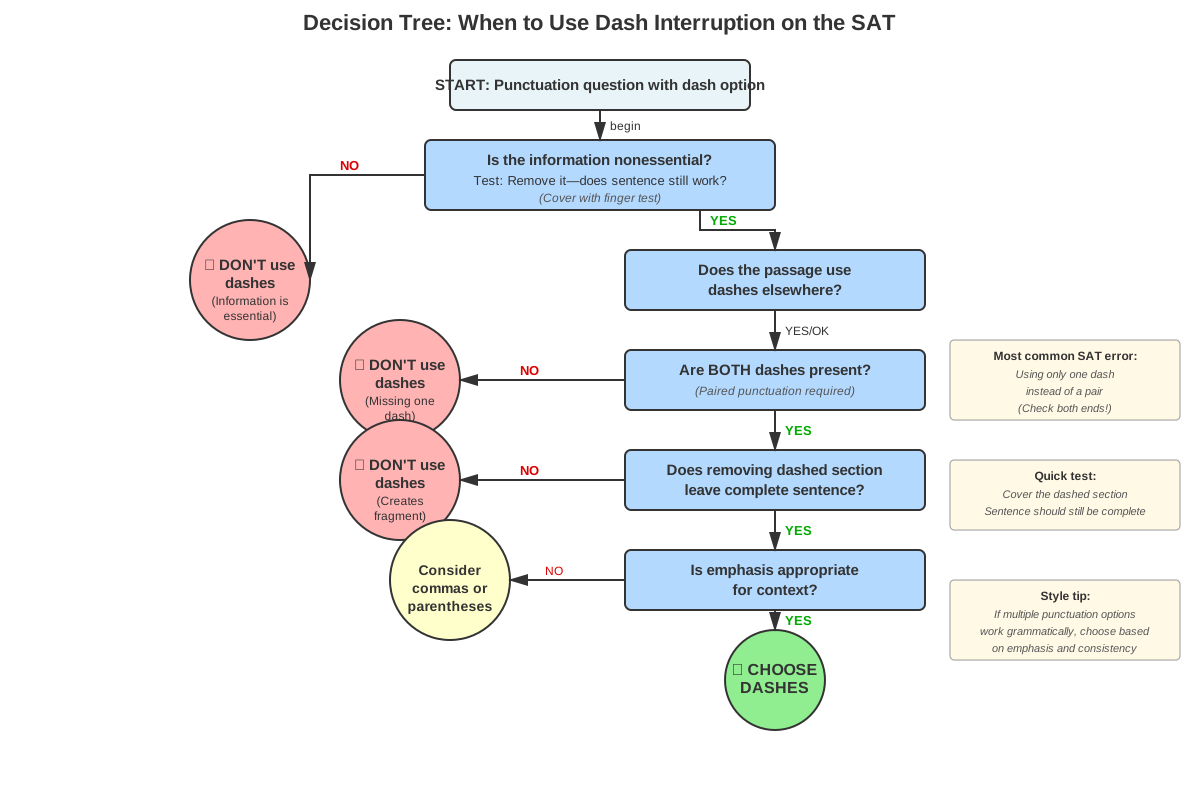
When approaching sat dash interruption questions, follow this systematic process:
Step 1: Identify potential interruptions. Look for information that seems supplementary or parenthetical. Common signals include appositives (noun phrases that rename something), clarifying phrases, examples, or contrasting information.
Step 2: Apply the removal test immediately. This is the most reliable strategy. Remove everything between the dashes (including the dashes themselves) and verify that what remains is a complete, grammatically correct sentence. If it isn't, the dashes are incorrect.
Step 3: Check for paired punctuation. Ensure that if one dash appears, another dash closes the interruption. Watch for answer choices that mix punctuation marks—these are always wrong.
Step 4: Evaluate emphasis and context. If multiple punctuation options are grammatically correct, consider which best fits the passage's tone and the author's apparent intent. Dashes emphasize, commas are neutral, and parentheses minimize.
Exam Tip: The SAT rarely asks you to choose between grammatically correct options based solely on style. If you're torn between two choices, one is likely grammatically incorrect. Reapply the removal test carefully.
Trigger words and phrases to watch for:
- "Which choice correctly punctuates..." signals a direct punctuation question
- Underlined dashes in the passage indicate you need to evaluate their correctness
- Answer choices showing different punctuation marks (dashes vs. commas vs. parentheses) test your understanding of when each is appropriate
- Phrases like "nonessential information" or "interruption" in questions directly reference dash interruption concepts
Process-of-elimination tips:
- Immediately eliminate any choice that mixes punctuation marks (one dash with one comma)
- Eliminate choices where removing the "interruption" leaves an incomplete sentence
- Eliminate single dashes where paired dashes are needed for interruption
- Eliminate choices that use hyphens instead of em dashes
Time allocation: Dash interruption questions should take 30-45 seconds each. The removal test is quick and definitive. If you're spending more than a minute, you're likely overthinking. Trust the removal test and move forward.
Memory Techniques
The "DASH" Acronym for Dash Interruption:
- Double dashes required (always paired)
- Always removable (nonessential information)
- Sentence stays complete (removal test)
- Highlights information (provides emphasis)
Visualization Strategy: Picture dashes as parentheses that have been stretched out for emphasis. Just as parentheses come in pairs and enclose removable information, dashes do the same but with more visual impact. When you see dashes, mentally "collapse" them into parentheses to test if the sentence still works.
The "Sandwich Test" Mnemonic: Think of dash interruption as a sandwich. The two pieces of bread (dashes) hold the filling (interruptive information) together. Remove the entire sandwich (both dashes and what's between them), and you should still have a complete meal (sentence). If you're left hungry (incomplete sentence), the dashes are wrong.
Removal Rhyme: "Take the dashes and what's between, the sentence left must still be clean." This simple rhyme reinforces the removal test, the most important strategy for dash interruption questions.
Emphasis Scale Visualization: Picture a scale from subtle to strong:
- Parentheses (minimize) ← Commas (neutral) → Dashes (emphasize)
This mental image helps you remember that dashes provide the strongest emphasis when setting off nonessential information.
Summary
Dash interruption is a high-yield SAT punctuation concept that uses paired em dashes to set off nonessential information within sentences. The fundamental principle is that interruptive dashes must come in pairs, and the sentence must remain grammatically complete when everything between (and including) the dashes is removed. This "removal test" is the most reliable strategy for evaluating dash interruption on the SAT. While dashes, commas, and parentheses can all set off nonessential information, dashes provide the strongest emphasis and most dramatic interruption. The SAT tests whether students can identify correct dash interruption, distinguish it from other punctuation marks, and recognize common errors such as mixing punctuation marks or using single dashes where pairs are needed. Success on dash interruption questions requires understanding what constitutes nonessential information, applying the removal test systematically, and recognizing that proper dash interruption always preserves the core sentence's grammatical integrity. Mastering this topic improves performance on 2-4 questions per SAT administration and enhances overall understanding of sentence structure and punctuation conventions.
Key Takeaways
- Dash interruption always requires two dashes to set off nonessential information in the middle of a sentence
- The removal test is the most reliable strategy: remove the dashes and everything between them, and the sentence must remain complete
- Nonessential information can be removed without destroying the sentence's core meaning or grammatical structure
- Never mix punctuation marks when setting off the same interruption (e.g., one dash and one comma is always wrong)
- Dashes provide stronger emphasis than commas but serve the same grammatical function for nonessential elements
- The SAT tests dash interruption in approximately 2-4 questions per administration, making it a high-yield topic
- Common patterns include appositives, clarifying phrases, examples, and contrasting information
Related Topics
Comma Usage with Nonrestrictive Elements: Understanding how commas set off nonessential clauses and phrases provides the foundation for dash interruption and helps students choose between commas and dashes based on emphasis.
Parenthetical Expressions: Learning how parentheses function to minimize information completes the understanding of the three main ways to set off nonessential elements (commas, dashes, parentheses).
Colon Usage: While colons don't create interruptions, understanding when to use colons versus dashes helps students distinguish between introducing information (colons) and interrupting with information (dashes).
Semicolon Rules: Mastering semicolons alongside dashes ensures students can distinguish between punctuation that joins independent clauses (semicolons) and punctuation that sets off nonessential information (dashes).
Sentence Structure and Fragments: Deeper understanding of what constitutes a complete sentence enhances the ability to apply the removal test effectively and recognize when dash interruption is used correctly.
Practice CTA
Now that you've mastered the core concepts of dash interruption, it's time to solidify your understanding through practice. Attempt the practice questions to apply the removal test, identify correct dash usage, and distinguish between dashes and other punctuation marks in SAT-style contexts. Use the flashcards to reinforce high-yield facts and test your ability to recall key principles quickly. Remember: dash interruption appears on every SAT, and mastering this topic will directly improve your score. The removal test is your most powerful tool—practice it until it becomes automatic, and you'll approach these questions with confidence on test day.
Sign up free to keep reading
Create a free AnvayaPrep account to finish this SAT guide on Dash interruption — plus flashcards and practice questions.