Overview
The dash is one of the most versatile punctuation marks tested on the SAT Reading and Writing section, yet it remains one of the most misunderstood by students. Dash usage appears regularly throughout the exam, particularly in questions that test a student's ability to recognize proper punctuation for setting off information, creating emphasis, or introducing explanations. Unlike commas or parentheses, dashes create a stronger break in thought and add dramatic emphasis to the material they enclose or introduce.
On the SAT, dash usage questions typically appear in the Standard English Conventions domain, where students must identify grammatically correct sentences or choose the most appropriate punctuation to achieve a specific rhetorical effect. The College Board tests whether students can distinguish between situations requiring single dashes (em dashes) versus paired dashes, and whether they understand when dashes are preferable to other punctuation marks like commas, colons, or semicolons. Mastering dash usage is essential because these questions appear with high frequency—students can expect to encounter 2-4 dash-related questions on any given SAT administration.
Understanding dash usage connects directly to broader concepts in RW (Reading and Writing), including sentence structure, clause relationships, and punctuation hierarchy. Dashes interact with other punctuation marks in predictable ways, and recognizing these patterns enables students to quickly eliminate incorrect answer choices. This topic builds upon foundational knowledge of independent and dependent clauses while preparing students for more advanced punctuation concepts involving colons, semicolons, and parenthetical elements.
Learning Objectives
- [ ] Identify key features of dash usage in SAT passages and questions
- [ ] Explain how dash usage appears on the SAT and what the test makers are assessing
- [ ] Apply dash usage rules to answer SAT-style questions accurately and efficiently
- [ ] Distinguish between situations requiring single dashes versus paired dashes
- [ ] Recognize when dashes are the most appropriate punctuation choice compared to commas, colons, or parentheses
- [ ] Evaluate whether dash placement creates grammatically complete sentences
- [ ] Demonstrate mastery by correctly answering 90% or more of practice questions on this topic
Prerequisites
- Independent and dependent clauses: Understanding clause types is essential because dashes must not create sentence fragments or run-ons
- Basic comma usage: Dashes often serve as stronger alternatives to commas, so recognizing comma rules helps identify when dashes are appropriate
- Sentence structure fundamentals: Knowing subjects, verbs, and complete thoughts enables students to verify that dash placement doesn't disrupt sentence completeness
- Parenthetical elements: Dashes frequently set off non-essential information, similar to parentheses and comma pairs
Why This Topic Matters
In real-world writing, dashes serve critical functions in professional, academic, and creative contexts. They allow writers to insert clarifying information, create dramatic pauses, emphasize key points, and maintain reader engagement through varied sentence rhythm. Journalists use dashes to add context without disrupting narrative flow, while academic writers employ them to introduce examples or elaborate on complex ideas. Understanding dash usage enhances both reading comprehension and writing sophistication.
On the SAT, dash questions appear with remarkable consistency. Statistical analysis of released SATs shows that approximately 8-12% of all Standard English Conventions questions involve dash usage, either directly or in comparison with other punctuation marks. These questions typically appear in two formats: (1) selecting the correct punctuation from four options, where one option uses dashes, or (2) identifying errors in sentences where dashes are misused. The College Board particularly favors testing whether students understand that paired dashes must work together and that single dashes must introduce or follow complete independent clauses.
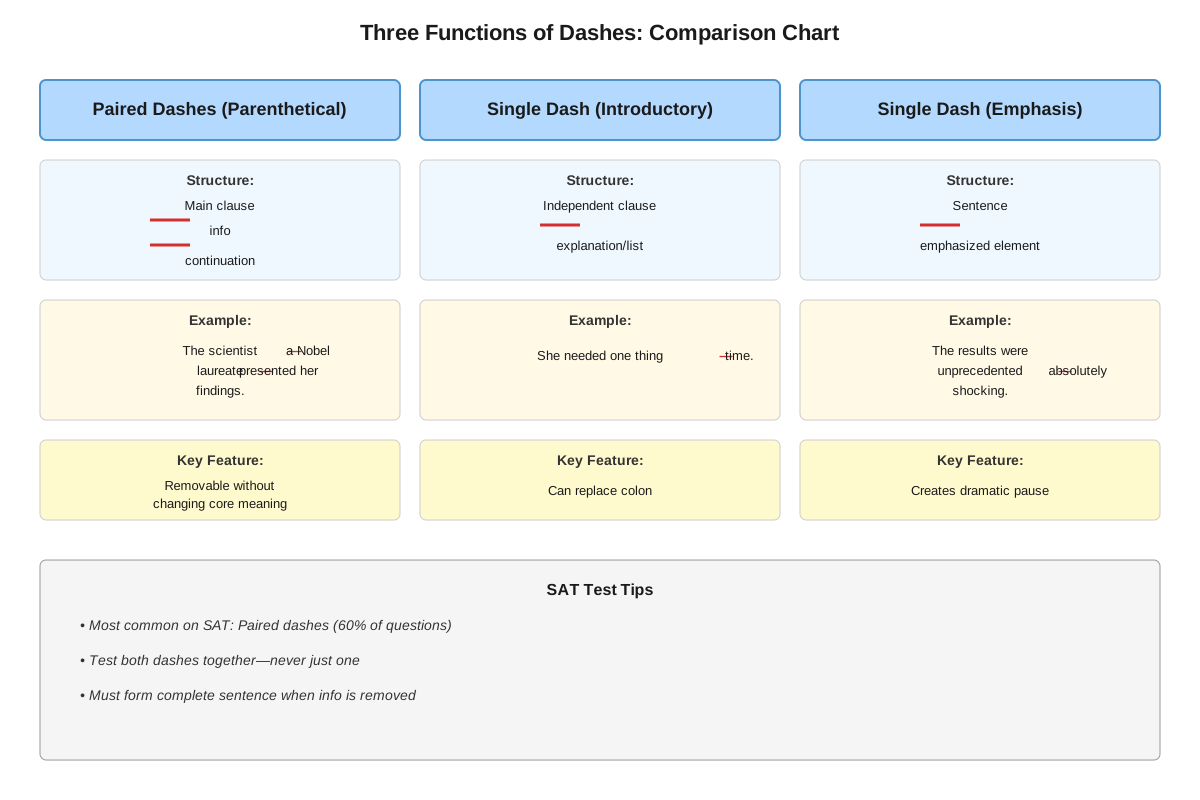
Common manifestations in exam passages include: dashes setting off appositives (renaming phrases), dashes introducing explanatory lists or examples, dashes creating emphasis before a concluding phrase, and paired dashes enclosing non-essential information mid-sentence. The SAT frequently tests whether students recognize that if you remove the material between paired dashes, the remaining sentence must still be grammatically complete. This principle appears in approximately 60% of all dash-related questions.
Core Concepts
The Em Dash: Definition and Function
The em dash (—) is the punctuation mark tested on the SAT when questions reference "dashes." It is longer than a hyphen (-) and serves to create a strong break in thought. The em dash functions in three primary ways: to set off parenthetical information with more emphasis than commas, to introduce explanatory material or examples, and to create dramatic pauses that draw attention to what follows. Unlike hyphens, which join words or parts of words, em dashes separate sentence elements while maintaining grammatical integrity.
Single Dash Usage
A single dash appears in two main contexts on the SAT. First, it can introduce information that explains, elaborates on, or provides examples for what came before. In this usage, the material before the dash must be a complete independent clause—a grammatically complete sentence that could stand alone. For example: "The experiment yielded surprising results—three of the five trials contradicted the hypothesis." The dash here introduces specific information that elaborates on "surprising results."
Second, a single dash can appear after introductory or interrupting material, though this usage is less common on the SAT. The key principle remains: the dash must not create a sentence fragment. If you see a single dash in an answer choice, verify that one side of the dash contains a complete independent clause.
Paired Dashes
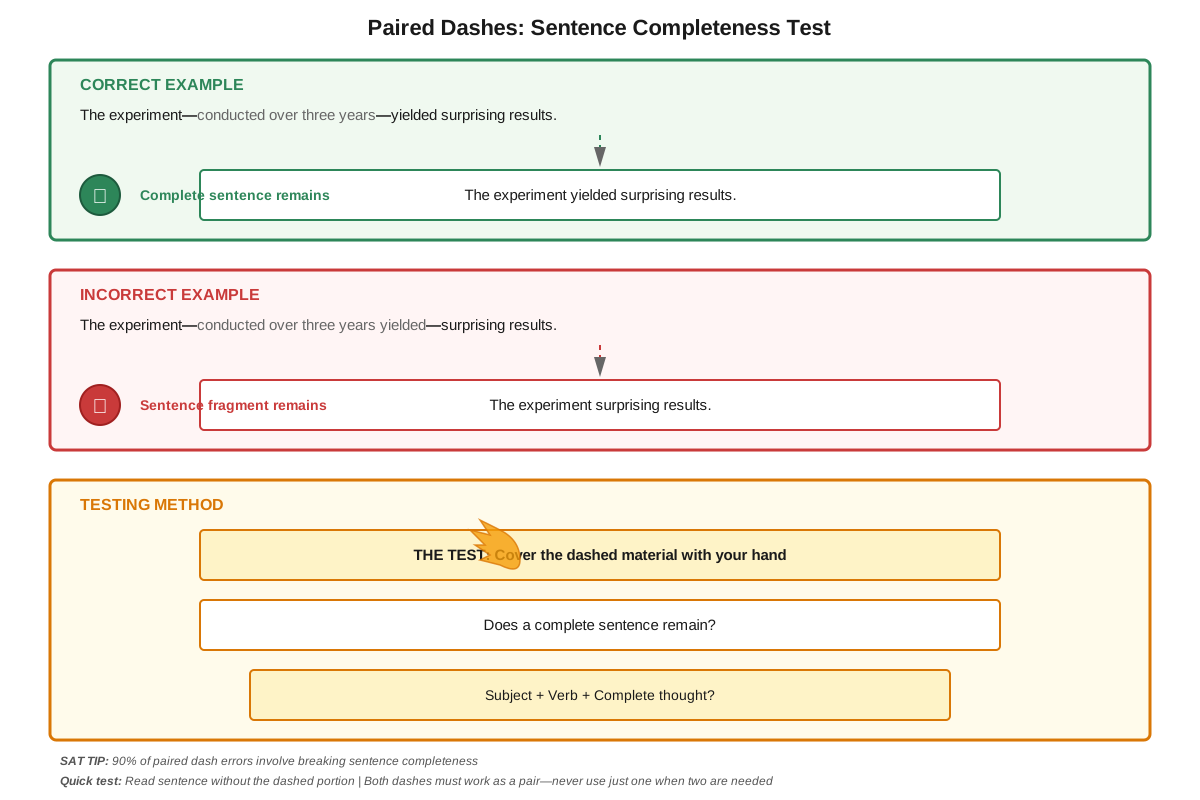
Paired dashes function like parentheses or comma pairs to enclose non-essential information within a sentence. This is the most frequently tested dash concept on the SAT. The critical rule: if you remove everything between the paired dashes, the remaining sentence must be grammatically complete and make logical sense. For example: "The scientist—who had spent twenty years researching the phenomenon—finally published her findings." Removing "who had spent twenty years researching the phenomenon" leaves "The scientist finally published her findings," which is complete.
The SAT tests whether students recognize that paired dashes must actually be paired. A common wrong answer presents a sentence with only one dash where two are needed, or mixes punctuation marks (starting with a dash but ending with a comma). Both dashes in a pair must be present and properly positioned.
Dashes vs. Commas
Understanding when to use dashes instead of commas is crucial for SAT dash usage questions. While both can set off non-essential information, dashes create stronger emphasis and clearer separation. Use dashes when:
- The interrupting information contains internal commas (to avoid confusion)
- The writer wants to emphasize the enclosed information
- The break in thought is more dramatic or abrupt
For example, compare these sentences:
- With commas: "The three cities, Paris, London, and Rome, were on the itinerary."
- With dashes: "The three cities—Paris, London, and Rome—were on the itinerary."
The dash version is clearer because the list items already contain commas. The SAT frequently tests this distinction.
Dashes vs. Colons
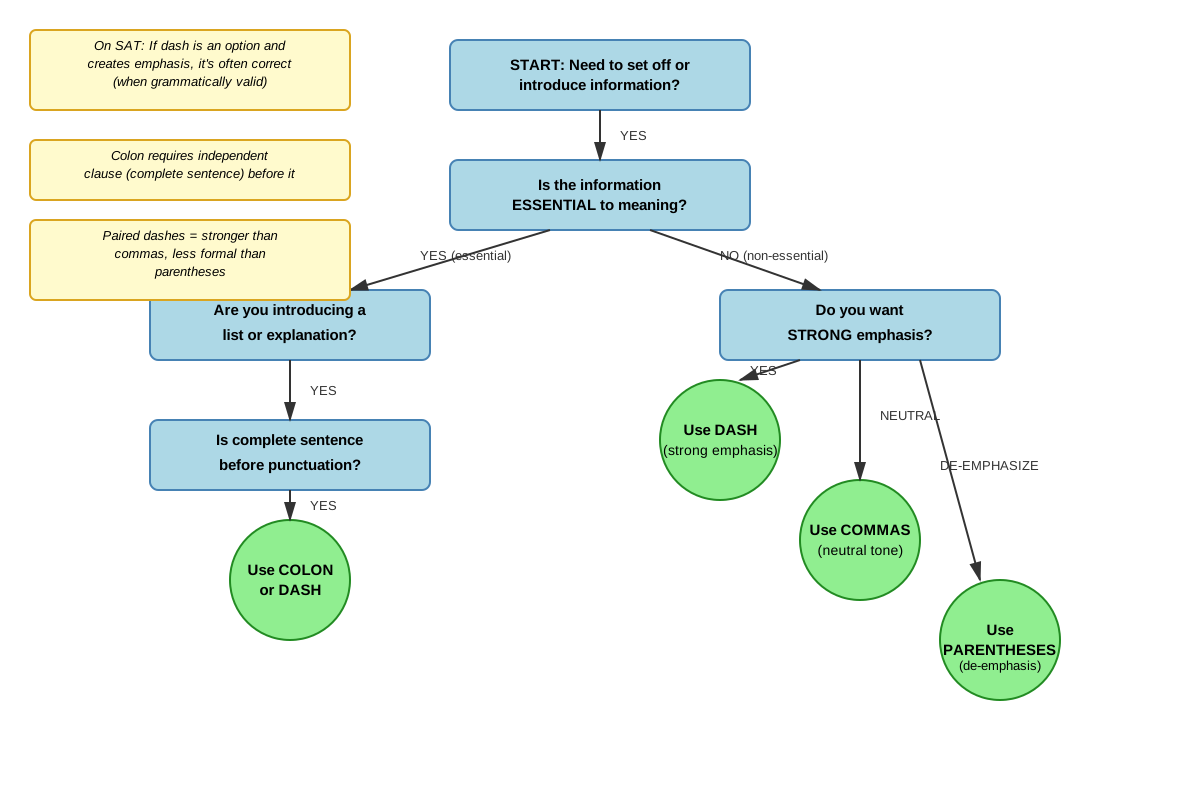
Both dashes and colons can introduce explanatory information, but they function differently. A colon introduces information that directly defines, lists, or explains what precedes it, and what comes before the colon must be an independent clause. A dash is more flexible and can introduce information that's related but not necessarily a direct explanation or list.
| Feature | Colon | Dash |
|---|---|---|
| Formality | More formal | Less formal, more dramatic |
| What it introduces | Lists, definitions, direct explanations | Examples, elaborations, related thoughts |
| Before punctuation | Must be independent clause | Must be independent clause (for single dash) |
| Emphasis level | Moderate | Strong |
On the SAT, if the information after the punctuation is a formal list or direct definition, a colon is typically correct. If it's an elaboration or example with dramatic emphasis, a dash is appropriate.
Dashes vs. Parentheses
Parentheses and paired dashes both enclose non-essential information, but they create opposite effects. Parentheses minimize and de-emphasize the enclosed material, suggesting it's supplementary or tangential. Dashes emphasize and draw attention to the enclosed material, suggesting it's important despite being non-essential to grammatical completeness.
The SAT occasionally tests this distinction in rhetorical skills questions, asking which punctuation best achieves a specific effect. If the question asks for emphasis or dramatic effect, choose dashes. If it asks for de-emphasis or suggests the information is merely supplementary, choose parentheses.
Common Dash Patterns on the SAT
Several patterns appear repeatedly in SAT questions:
- Appositive pattern: "The author—a Nobel Prize winner—spoke at the conference."
- Elaboration pattern: "She achieved her goal—admission to her first-choice university."
- List with internal punctuation: "Three factors—economic instability, political unrest, and social inequality—contributed to the revolution."
- Dramatic conclusion: "After years of research, they finally discovered the answer—it had been there all along."
Recognizing these patterns enables rapid question analysis and answer selection.
Concept Relationships
The concepts within dash usage form a hierarchical relationship: understanding the basic function of em dashes (creating strong breaks) → leads to → recognizing single dash usage (introducing/following complete clauses) → leads to → mastering paired dash usage (enclosing removable information) → leads to → distinguishing dashes from alternative punctuation (commas, colons, parentheses).
Dash usage connects to prerequisite knowledge of independent clauses because verifying grammatical completeness is essential for both single and paired dash questions. The topic also relates to comma usage, as students must understand when dashes are preferable to commas for clarity or emphasis. Additionally, dash usage connects to broader punctuation hierarchy concepts: periods create the strongest separation (ending sentences), semicolons join related independent clauses, colons introduce formal explanations, dashes create dramatic breaks, and commas create the weakest separation.
The relationship map: Clause identification → enables → Dash placement verification → which requires → Understanding removability → which connects to → Punctuation comparison → which enables → Optimal punctuation selection on SAT questions.
High-Yield Facts
- ⭐ If you remove material between paired dashes, the remaining sentence must be grammatically complete
- ⭐ A single dash introducing information must follow a complete independent clause
- ⭐ Paired dashes cannot be mixed with other punctuation marks (no dash-comma combinations)
- ⭐ Dashes create stronger emphasis than commas but serve similar grammatical functions
- ⭐ When a list contains internal commas, use dashes instead of commas to enclose it
- Dashes are less formal than colons but more emphatic than parentheses
- The material enclosed by paired dashes must be non-essential to sentence meaning
- A single dash can introduce examples, explanations, or elaborations
- Dashes should not be overused; the SAT tests appropriate usage, not excessive usage
- Em dashes (—) are different from hyphens (-); the SAT only tests em dashes in punctuation questions
- When choosing between dash and colon, select colon for formal lists/definitions and dash for dramatic elaborations
- Dashes can replace comma pairs when the writer wants to emphasize the interrupting information
Quick check — test yourself on Dash usage so far.
Try Flashcards →Common Misconceptions
Misconception: Dashes and hyphens are interchangeable.
Correction: Hyphens (-) join words or word parts (like "well-known"), while em dashes (—) separate sentence elements. The SAT tests only em dashes in punctuation questions, and using a hyphen where a dash is needed is always incorrect.
Misconception: You can start with a dash and end with a comma when enclosing information.
Correction: Paired punctuation must match. If you begin with a dash, you must end with a dash. Mixing punctuation marks (dash-comma, comma-dash) creates grammatical errors that the SAT will mark as incorrect.
Misconception: Dashes can be used anywhere to create pauses, just like commas.
Correction: Dashes have specific grammatical rules. A single dash must follow or precede a complete independent clause, and paired dashes must enclose removable information. Random dash placement creates fragments and run-ons.
Misconception: The information after a single dash can be a sentence fragment.
Correction: While the information after a single dash doesn't need to be a complete sentence, the information before the dash must be an independent clause. The dash introduces related information, but it doesn't create a new sentence.
Misconception: Dashes and colons are always interchangeable when introducing information.
Correction: Colons are more formal and introduce direct explanations, definitions, or lists. Dashes are more dramatic and flexible, introducing related thoughts or examples. The SAT tests whether students can distinguish these nuances.
Misconception: If a sentence has one dash, it must have two.
Correction: Single dashes are grammatically correct when introducing or following information. Only when enclosing mid-sentence information do you need paired dashes. The SAT tests both single and paired dash usage.
Misconception: Dashes make writing less formal, so they're incorrect on the SAT.
Correction: While dashes are less formal than some punctuation, they're grammatically correct and appear in published writing. The SAT tests proper dash usage, not whether dashes are "too informal." Many correct SAT answers use dashes appropriately.
Worked Examples
Example 1: Paired Dashes
Question: Which choice correctly punctuates the sentence?
The museum's new exhibit—which features artifacts from ancient Egypt—has attracted thousands of visitors since opening last month.
A) NO CHANGE
B) The museum's new exhibit, which features artifacts from ancient Egypt—has attracted
C) The museum's new exhibit—which features artifacts from ancient Egypt, has attracted
D) The museum's new exhibit which features artifacts from ancient Egypt has attracted
Solution:
Step 1: Identify the structure. The sentence contains a main clause ("The museum's new exhibit has attracted thousands of visitors since opening last month") with interrupting information ("which features artifacts from ancient Egypt").
Step 2: Apply the removability test. Remove the interrupting information: "The museum's new exhibit has attracted thousands of visitors since opening last month." This is grammatically complete, confirming the information is non-essential.
Step 3: Evaluate each choice:
- Choice A uses paired dashes correctly, enclosing the non-essential clause
- Choice B mixes comma and dash (incorrect pairing)
- Choice C mixes dash and comma (incorrect pairing)
- Choice D uses no punctuation, making the sentence unclear and potentially creating a restrictive clause where a non-restrictive one is intended
Step 4: Select the answer. Choice A is correct because it properly uses paired dashes to enclose non-essential information, and removing the dashed material leaves a complete sentence.
Connection to learning objectives: This example demonstrates identifying key features of dash usage (paired dashes enclose removable information) and applying dash usage rules to answer SAT-style questions.
Example 2: Single Dash vs. Colon
Question: Which choice most effectively introduces the information that follows?
The research team discovered something unexpected in their data—the correlation between variables was inverse to their hypothesis.
A) NO CHANGE
B) The research team discovered something unexpected in their data: the correlation
C) The research team discovered something unexpected in their data, the correlation
D) The research team discovered something unexpected in their data; the correlation
Solution:
Step 1: Analyze what comes before the punctuation. "The research team discovered something unexpected in their data" is a complete independent clause.
Step 2: Analyze what comes after. "The correlation between variables was inverse to their hypothesis" is also a complete independent clause that explains what was unexpected.
Step 3: Determine the relationship. The second clause elaborates on and specifies "something unexpected," creating an explanatory relationship.
Step 4: Evaluate punctuation options:
- Choice A (dash) creates dramatic emphasis and introduces the elaboration effectively
- Choice B (colon) would also be grammatically correct, as colons can introduce explanations
- Choice C (comma) creates a comma splice (two independent clauses joined only by a comma)
- Choice D (semicolon) is grammatically correct but doesn't emphasize the explanatory relationship
Step 5: Consider rhetorical effect. The question asks what "most effectively" introduces the information. The dash creates more dramatic emphasis on the unexpected discovery than the colon, making it slightly more effective for this context. However, both A and B are grammatically correct.
Step 6: Select the answer. Choice A is the best answer because the dash creates appropriate dramatic emphasis for an unexpected discovery. If the question simply asked for correct punctuation without "most effectively," both A and B would work, but the rhetorical consideration favors the dash.
Connection to learning objectives: This example demonstrates explaining how dash usage appears on the SAT (comparing dashes to other punctuation), identifying when dashes are most appropriate, and applying these principles to answer questions that test both grammar and rhetorical effectiveness.
Exam Strategy
When approaching SAT dash usage questions, follow this systematic process:
Step 1: Identify the dash pattern. Quickly determine whether the question involves a single dash or paired dashes. If you see two dashes in the sentence, you're dealing with paired dashes and should immediately apply the removability test.
Step 2: Apply the removability test for paired dashes. Cover or mentally remove everything between the dashes. Read what remains. If it's not a complete, grammatically correct sentence, the dash placement is wrong. This test eliminates 40-50% of incorrect answers immediately.
Step 3: Verify independent clauses for single dashes. If the question involves a single dash, check that the material before the dash is a complete independent clause. If it's not, the dash is incorrect.
Step 4: Check for mixed punctuation. Scan answer choices for dash-comma or comma-dash combinations. These are always incorrect and can be eliminated immediately.
Trigger words and phrases to watch for:
- "Which choice correctly punctuates..." (tests grammatical correctness)
- "Most effectively introduces..." (tests both grammar and rhetorical effect)
- "Maintains the sentence pattern..." (tests consistency in punctuation)
- Questions showing multiple punctuation options (dash, comma, colon, semicolon) test your ability to distinguish their functions
Process-of-elimination tips:
- Eliminate any answer with mixed punctuation marks (dash-comma combinations)
- Eliminate answers where removing dashed material creates fragments
- Eliminate answers where a single dash follows a fragment
- When choosing between dash and colon, eliminate the colon if the following material isn't a formal list or direct definition
- When choosing between dash and comma, eliminate the comma if the interrupting material contains internal commas
Time allocation: Dash questions should take 30-45 seconds maximum. If you're spending more time, you're overthinking. Apply the removability test, check for complete clauses, and move forward. These questions test pattern recognition, not complex analysis.
Exam Tip: If you're unsure between a dash and another punctuation mark, ask yourself: "Does this need dramatic emphasis?" If yes, choose the dash. If the sentence needs formal introduction of a list or definition, choose the colon. If it needs simple separation, choose the comma.
Memory Techniques
DASH Mnemonic for paired dashes:
- Delete the middle
- Assess completeness
- Sentence must survive
- Have both dashes present
The Removal Rule: "If you can remove it, you can dash it." This reminds you that paired dashes enclose removable (non-essential) information.
The Complete Clause Clue: "Before the dash, complete the task." This reminds you that a single dash must follow a complete independent clause.
Visualization Strategy: Picture dashes as strong arms reaching out to grab information and pull it into emphasis. Commas are gentle hands that lightly separate. Parentheses are hands pushing information into the background. This visual helps you remember that dashes emphasize while parentheses de-emphasize.
The Matching Game: Think of paired dashes like matching socks—they must come in pairs, and you can't mix a dash with a comma any more than you'd wear one sock and one shoe.
Acronym for dash vs. other punctuation (DICE):
- Dash = Dramatic emphasis
- Independent clause before it
- Colon = formal introduction
- Enclose with pairs when interrupting
Summary
Dash usage on the SAT centers on two primary patterns: single dashes that introduce explanatory information after complete independent clauses, and paired dashes that enclose non-essential information within sentences. The fundamental principle for paired dashes is removability—if you delete everything between the dashes, the remaining sentence must be grammatically complete. Single dashes must follow independent clauses and create dramatic emphasis when introducing examples, elaborations, or explanations. The SAT frequently tests whether students can distinguish dashes from alternative punctuation: dashes create stronger emphasis than commas, more dramatic effect than colons, and opposite emphasis from parentheses. Common errors include mixing punctuation marks (dash-comma combinations), placing dashes where they create fragments, and failing to use paired dashes when enclosing mid-sentence information. Success on dash questions requires recognizing these patterns, applying the removability test systematically, and understanding when dashes are the most appropriate punctuation choice for both grammatical correctness and rhetorical effectiveness.
Key Takeaways
- Paired dashes must enclose removable information; the sentence must be complete without the dashed material
- Single dashes must follow complete independent clauses when introducing information
- Never mix punctuation marks—paired dashes must both be dashes, not dash-comma combinations
- Dashes create stronger emphasis than commas and more dramatic effect than colons
- Apply the removability test immediately when you see paired dashes in a question
- Dashes are grammatically correct and appear frequently on the SAT; they're not "too informal"
- When choosing between punctuation marks, consider both grammatical correctness and rhetorical effect (emphasis, formality, clarity)
Related Topics
Comma Usage in Complex Sentences: Understanding when to use commas versus dashes for setting off information builds directly on dash mastery. Students who understand dashes can better recognize when commas are insufficient for clarity.
Colon Usage: Colons and dashes both introduce information, but with different levels of formality and different types of relationships. Mastering dashes enables students to distinguish these subtle differences.
Semicolon Usage: While semicolons join independent clauses, dashes can introduce related clauses with more emphasis. Understanding the full punctuation hierarchy requires mastering both.
Parenthetical Elements: Dashes, commas, and parentheses all handle non-essential information differently. Dash mastery provides the foundation for understanding the full range of options for parenthetical material.
Sentence Structure and Fragments: Dash questions require identifying complete independent clauses, which reinforces broader sentence structure concepts and prepares students for more complex grammar questions.
Practice CTA
Now that you've mastered the core concepts of dash usage, it's time to solidify your understanding through practice. Attempt the practice questions and flashcards to reinforce these patterns and build the automatic recognition skills that lead to quick, confident answers on test day. Remember: dash questions are high-yield and highly predictable—with focused practice, you can master this topic completely and secure these points on every SAT you take. Each practice question you complete strengthens your pattern recognition and brings you closer to your target score.
Sign up free to keep reading
Create a free AnvayaPrep account to finish this SAT guide on Dash usage — plus flashcards and practice questions.