Overview
The possessive plural is a critical punctuation concept tested extensively on the SAT Reading and Writing section. This grammatical construction indicates ownership or association by more than one person, place, or thing, requiring precise apostrophe placement that differs from singular possessive forms. Mastering possessive plural forms is essential because the SAT frequently presents questions where students must distinguish between plural forms, singular possessive forms, and plural possessive forms—each requiring different punctuation.
On the SAT, possessive plural questions appear regularly in the Standard English Conventions domain, which comprises approximately 26% of the Reading and Writing section. These questions test whether students can correctly identify and apply apostrophe rules when multiple entities possess something. The College Board specifically targets this skill because it reveals a student's command of formal written English conventions, a competency essential for college-level academic writing.
Understanding possessive plural forms connects directly to broader punctuation principles within the RW section, including apostrophe usage for contractions, singular possessives, and the distinction between possessive determiners and plural forms. This topic also reinforces grammatical awareness of noun forms and their functions within sentences, skills that support performance across multiple question types in the Reading and Writing section.
Learning Objectives
- [ ] Identify key features of possessive plural forms and distinguish them from other noun forms
- [ ] Explain how possessive plural constructions appear on the SAT in various question formats
- [ ] Apply possessive plural rules to answer SAT-style questions accurately and efficiently
- [ ] Differentiate between regular and irregular plural possessive forms
- [ ] Recognize common errors in possessive plural usage that appear as distractors
- [ ] Construct grammatically correct sentences using possessive plural forms in context
Prerequisites
- Basic apostrophe usage: Understanding that apostrophes indicate possession or contraction is fundamental to distinguishing possessive plural from other forms
- Plural noun formation: Recognizing how regular and irregular plurals are formed enables correct apostrophe placement in possessive constructions
- Parts of speech identification: Identifying nouns and their functions within sentences helps determine when possessive forms are needed
- Singular possessive forms: Mastery of singular possessive construction (adding 's) provides the foundation for understanding plural possessive variations
Why This Topic Matters
In academic and professional writing, possessive plural forms appear constantly when discussing research conducted by multiple scientists, policies affecting various organizations, or characteristics belonging to groups. Incorrect apostrophe placement in possessive plurals signals careless writing and can create ambiguity about whether one or multiple entities possess something. For instance, "the teachers' lounge" (shared by multiple teachers) conveys different meaning than "the teacher's lounge" (belonging to one teacher).
On the SAT, possessive plural questions appear in approximately 2-4 questions per test administration, making this a high-yield topic relative to study time investment. These questions typically appear as part of the Standard English Conventions question type, where students must select the grammatically correct version of an underlined portion. The College Board reports that possessive plural questions have moderate difficulty levels, with approximately 60-70% of test-takers answering them correctly, meaning mastery provides a competitive advantage.
The SAT presents possessive plural challenges in several contexts: scientific passages discussing multiple researchers' findings, historical texts describing various nations' policies, literary analysis examining different authors' techniques, and social science passages exploring communities' characteristics. Questions often include distractors featuring incorrect apostrophe placement (teachers's), missing apostrophes (teachers lounge), or plural forms without possession (teachers).
Core Concepts
Formation of Regular Plural Possessives
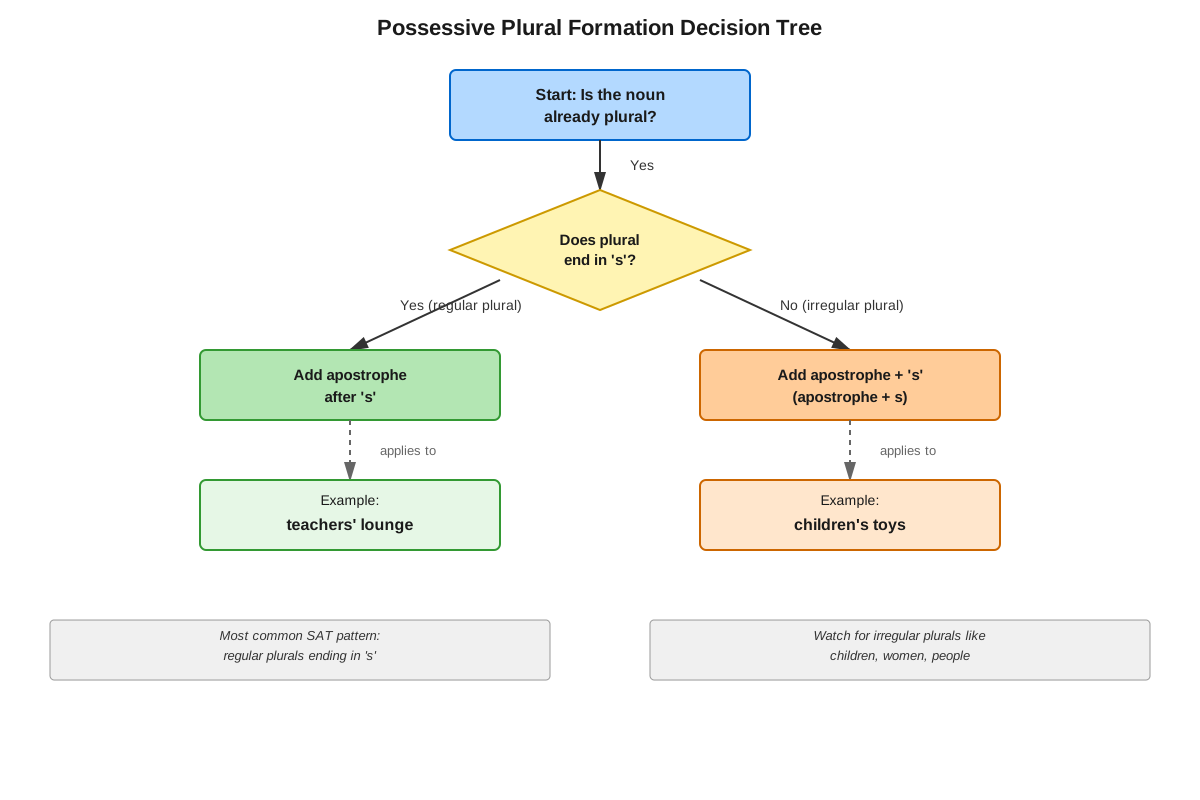
Possessive plural forms indicate that multiple entities possess or are associated with something. For regular plural nouns ending in -s, the possessive is formed by adding only an apostrophe after the existing -s. This rule applies to the vast majority of plural possessives encountered on the sat possessive plural questions.
The formation process follows these steps:
- Form the plural noun (teacher → teachers)
- Add an apostrophe after the final -s (teachers')
- Verify that the resulting form indicates multiple possessors (the teachers' classroom = classroom belonging to multiple teachers)
Examples of regular plural possessives:
- students → students' (the students' test scores)
- doctors → doctors' (the doctors' recommendations)
- countries → countries' (the countries' economies)
- companies → companies' (the companies' profits)
Formation of Irregular Plural Possessives
Irregular plural nouns that do not end in -s form their possessive by adding 's, exactly like singular possessives. This category includes common irregular plurals that appear frequently on the SAT.
Common irregular plural possessives:
- children → children's (the children's playground)
- men → men's (the men's department)
- women → women's (the women's rights movement)
- people → people's (the people's choice)
- mice → mice's (the mice's behavior)
The key distinction is identifying whether the plural form already ends in -s. If it does not, treat it like a singular noun and add 's.
Distinguishing Plural, Singular Possessive, and Plural Possessive
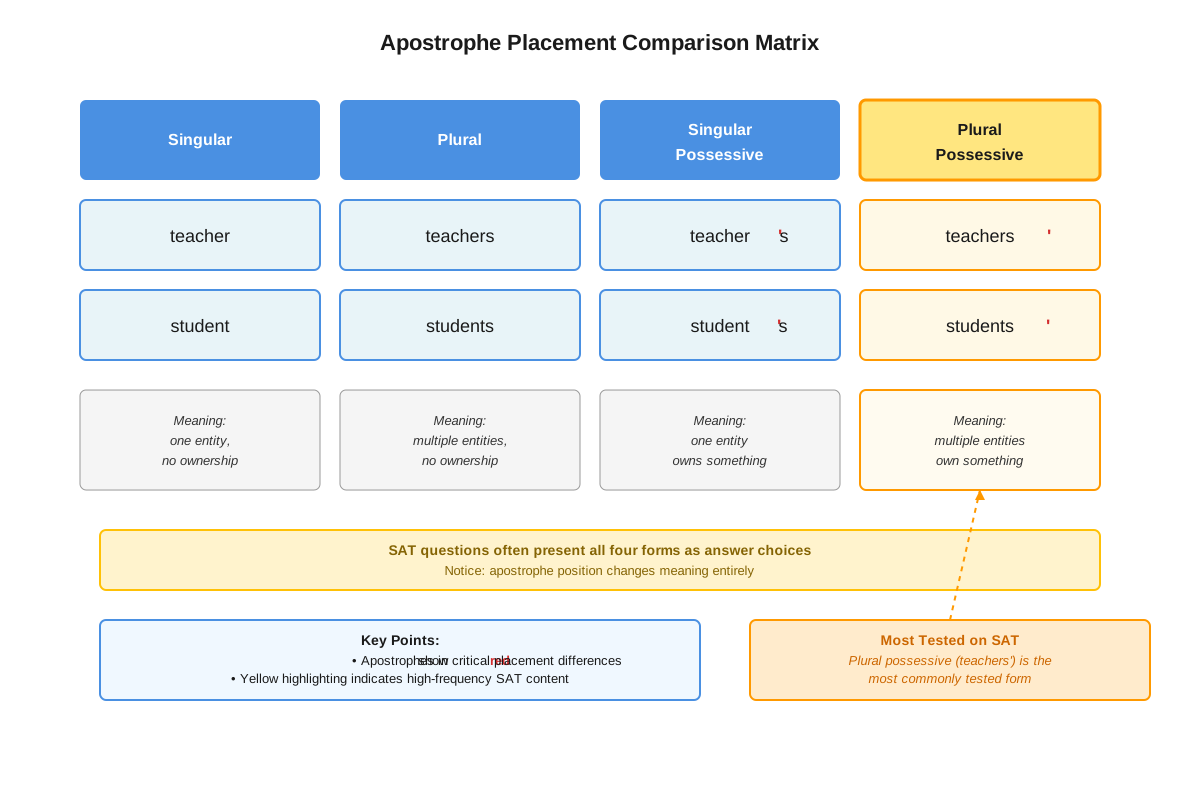
The SAT frequently tests whether students can differentiate between three similar-looking forms. Understanding these distinctions is crucial for sat possessive plural mastery.
| Form | Structure | Example | Meaning |
|---|---|---|---|
| Plural | noun + s | teachers | more than one teacher |
| Singular Possessive | noun + 's | teacher's | belonging to one teacher |
| Plural Possessive | noun + s + ' | teachers' | belonging to multiple teachers |
Context determines which form is correct. If the sentence indicates ownership or association by multiple entities, the plural possessive is required. If multiple entities are mentioned without possession, the simple plural is correct.
Compound Nouns and Joint Possession
When multiple nouns jointly possess something, only the last noun takes the possessive form. This rule applies when two or more entities share ownership of a single item or concept.
Examples:
- Ben and Jerry's ice cream (one company jointly owned)
- my mother and father's house (one house owned by both)
- the CEO and CFO's decision (one decision made jointly)
However, when each entity possesses separate items, both nouns take possessive forms:
- Shakespeare's and Marlowe's plays (separate collections)
- the teachers' and students' perspectives (distinct viewpoints)
Possessive Plural with Time and Money
Time periods and monetary amounts in plural form follow standard plural possessive rules when indicating duration or value associated with something.
Examples:
- two weeks' notice (notice spanning two weeks)
- five dollars' worth (worth equivalent to five dollars)
- three years' experience (experience accumulated over three years)
- ten minutes' walk (walk requiring ten minutes)
These constructions appear regularly in SAT passages discussing historical periods, economic data, or temporal relationships.
Possessive Determiners vs. Possessive Nouns
Students must distinguish between possessive determiners (their, its, your) and possessive nouns. Possessive determiners never take apostrophes, while possessive nouns always require apostrophes.
Correct usage:
- The scientists completed their research (possessive determiner)
- The scientists' research was groundbreaking (plural possessive noun)
- Its findings were significant (possessive determiner)
- The study's findings were significant (singular possessive noun)
This distinction frequently appears as a distractor on the SAT, with incorrect forms like "their's" or "scientists's" offered as answer choices.
Concept Relationships
The possessive plural concept builds directly upon singular possessive formation, extending the apostrophe rules to multiple possessors. Understanding plural noun formation is prerequisite knowledge that determines whether to add only an apostrophe (regular plurals ending in -s) or 's (irregular plurals not ending in -s).
Relationship map:
Plural Noun Formation → determines → Apostrophe Placement Rule → produces → Possessive Plural Form → functions within → Sentence Context → tested through → SAT Question Formats
Possessive plural connects to broader apostrophe usage, including contractions (they're, it's) and singular possessives (student's). The SAT often tests whether students can distinguish these related but distinct uses of apostrophes. Additionally, possessive plural understanding supports pronoun-antecedent agreement, as students must recognize whether possessive forms refer to singular or plural antecedents.
The concept also relates to modifier placement and noun phrase construction, as possessive plurals often function as modifiers describing what follows (the researchers' methodology describes whose methodology). This grammatical function connects possessive plural to sentence structure analysis, another high-yield SAT skill.
High-Yield Facts
⭐ Regular plural nouns ending in -s form possessives by adding only an apostrophe after the -s (students → students')
⭐ Irregular plural nouns not ending in -s form possessives by adding 's (children → children's)
⭐ The SAT tests possessive plural by offering distractors with incorrect apostrophe placement, missing apostrophes, or unnecessary apostrophes
⭐ Context determines whether a plural, singular possessive, or plural possessive form is correct—look for indicators of ownership by multiple entities
⭐ Possessive determiners (their, its, your) never take apostrophes, while possessive nouns always require apostrophes
- Time and money expressions in plural form take possessive apostrophes when indicating duration or value (three weeks' vacation)
- Joint possession requires possessive form only on the last noun (Smith and Jones' report), while separate possession requires possessive forms on all nouns (Smith's and Jones' reports)
- The apostrophe in plural possessives always comes after the -s for regular plurals, never before it (teachers' not teacher's when referring to multiple teachers)
- Plural possessive forms can modify any noun type, including abstract concepts (the nations' policies, the theories' implications)
- Acronyms and abbreviations follow the same plural possessive rules as regular nouns (CEOs' salaries, PhDs' dissertations)
Quick check — test yourself on Possessive plural so far.
Try Flashcards →Common Misconceptions
Misconception: All plural possessives are formed by adding 's to the plural noun → Correction: Regular plural nouns ending in -s form possessives by adding only an apostrophe (teachers'), while only irregular plurals not ending in -s add 's (children's)
Misconception: The apostrophe in plural possessives can be placed before or after the -s interchangeably → Correction: For regular plurals, the apostrophe must come after the -s (teachers' not teacher's when referring to multiple teachers); placement before the -s creates a singular possessive
Misconception: Possessive determiners like "their" need apostrophes to show possession → Correction: Possessive determiners never take apostrophes; only possessive nouns require apostrophes (their research is correct, not their's research)
Misconception: If a word ends in -s, it must be plural possessive → Correction: Words ending in -s might be simple plurals (teachers work hard), singular possessives of names ending in -s (James's book), or plural possessives (teachers' lounge)—context determines the correct form
Misconception: Plural possessives are rare and unimportant for the SAT → Correction: Plural possessive questions appear regularly on the SAT (2-4 per test), making this a high-yield topic that significantly impacts scores
Misconception: Compound nouns always take possessive forms on both words → Correction: For joint possession, only the last noun takes possessive form (Ben and Jerry's), while separate possession requires possessive forms on each noun (Shakespeare's and Marlowe's)
Misconception: Irregular plurals follow the same possessive rules as regular plurals → Correction: Irregular plurals not ending in -s add 's just like singular nouns (children's, not childrens'), while regular plurals ending in -s add only an apostrophe
Worked Examples
Example 1: Regular Plural Possessive in Scientific Context
Question: The researchers conducted multiple experiments to test their hypothesis. The _____ results supported the original theory.
A) experiment's
B) experiments
C) experiments'
D) experiments's
Solution Process:
Step 1: Identify what is being possessed. The results belong to the experiments.
Step 2: Determine how many possessors exist. The passage states "multiple experiments," indicating more than one.
Step 3: Form the plural. Experiment → experiments (regular plural ending in -s)
Step 4: Apply the plural possessive rule. Since "experiments" is a regular plural ending in -s, add only an apostrophe: experiments'
Step 5: Evaluate answer choices:
- A) experiment's = singular possessive (only one experiment)
- B) experiments = plural without possession (doesn't show ownership)
- C) experiments' = plural possessive (multiple experiments possessing results) ✓
- D) experiments's = incorrect form (never add 's after plural -s)
Answer: C) experiments'
Connection to Learning Objectives: This example demonstrates identifying key features of possessive plural (apostrophe after -s for regular plurals) and applying the rule to answer SAT-style questions by eliminating distractors with incorrect apostrophe placement.
Example 2: Irregular Plural Possessive in Social Context
Question: The community center offers various programs for families. The _____ activities include sports, arts, and educational workshops.
A) childrens
B) children's
C) childrens'
D) children
Solution Process:
Step 1: Identify the context. Activities belong to or are designed for children.
Step 2: Determine the noun form needed. "Children" is already plural (irregular plural of child).
Step 3: Check if possession is indicated. Yes—the activities belong to or are associated with children.
Step 4: Apply irregular plural possessive rule. Since "children" is an irregular plural not ending in -s, add 's: children's
Step 5: Evaluate answer choices:
- A) childrens = incorrect plural form (children is already plural)
- B) children's = irregular plural possessive (correct form) ✓
- C) childrens' = incorrect because "childrens" is not a valid word
- D) children = plural without possession (doesn't show association)
Answer: B) children's
Connection to Learning Objectives: This example illustrates differentiating between regular and irregular plural possessive forms and recognizing common errors that appear as distractors (incorrect plural formation, misplaced apostrophes).
Exam Strategy
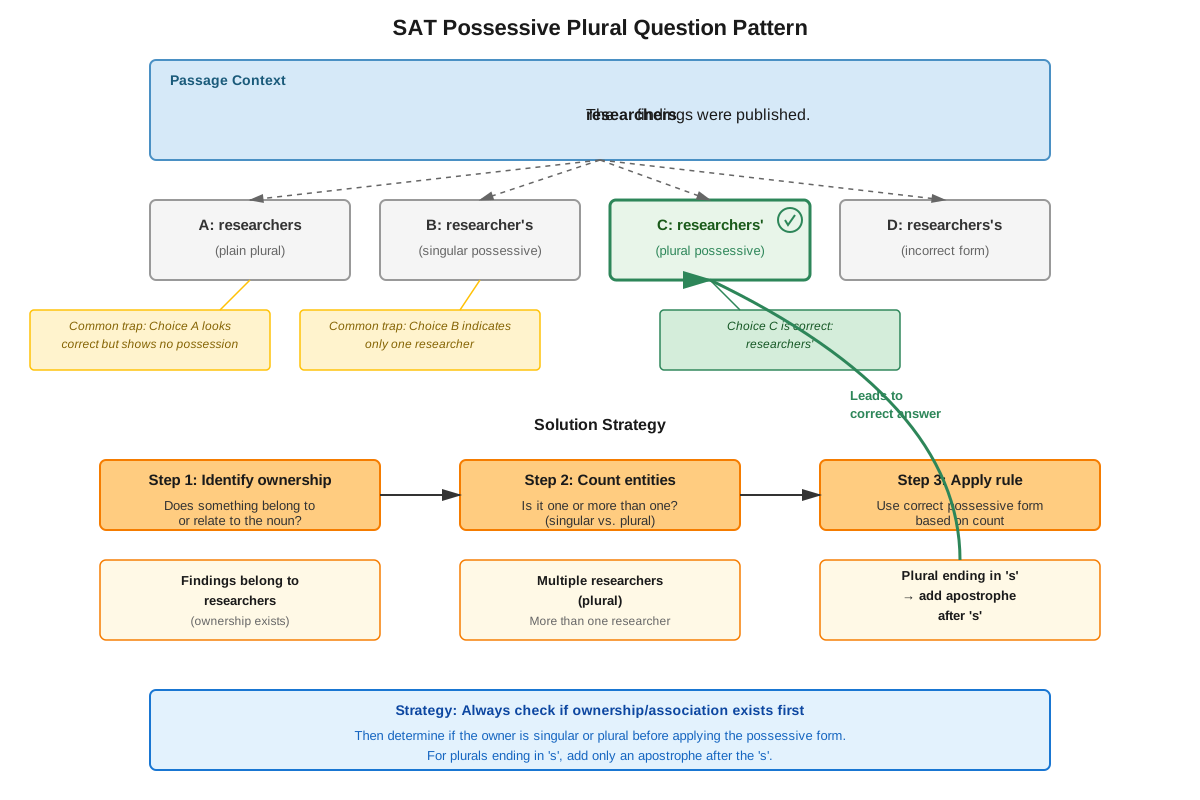
When approaching sat possessive plural questions, follow this systematic process:
Step 1: Identify possession indicators. Look for words suggesting ownership, association, or belonging (of, belonging to, associated with). If no possession is indicated, a simple plural may be correct.
Step 2: Count the possessors. Determine whether one entity or multiple entities possess something. Singular possessors require singular possessive forms (teacher's), while multiple possessors require plural possessive forms (teachers').
Step 3: Form the plural correctly first. Before adding apostrophes, ensure the plural form itself is correct (child → children, not childs). This prevents compounding errors.
Step 4: Apply the appropriate rule. For regular plurals ending in -s, add only an apostrophe. For irregular plurals not ending in -s, add 's.
Exam Tip: The SAT frequently includes "teachers's" or "childrens'" as distractors. These forms are always incorrect—regular plurals never add 's, and irregular plurals must be spelled correctly before adding 's.
Trigger words and phrases to watch for:
- "Multiple," "several," "various," "many" → likely plural possessive needed
- "Belonging to," "associated with," "of the" → possession indicated
- Time periods (weeks, years, months) + duration → possessive form needed
- Names connected by "and" → determine joint vs. separate possession
Process-of-elimination tips:
- Eliminate any answer with apostrophes in possessive determiners (their's, your's)
- Eliminate forms with 's added to regular plurals ending in -s (teachers's)
- Eliminate irregular plurals with apostrophes but no -s (childrens')
- Eliminate simple plurals when possession is clearly indicated
Time allocation: Spend 30-45 seconds on possessive plural questions. These are typically straightforward once you identify the number of possessors and apply the correct rule. If uncertain, mark for review and return after completing easier questions.
Memory Techniques
Apostrophe Placement Mnemonic: "S-apostrophe STOPS" (regular plural possessives end with -s then apostrophe, then STOP—don't add more)
Regular vs. Irregular Mnemonic: "If it ends in S, apostrophe's the guess; if not, add 'S for success" (regular plurals ending in -s get only apostrophe; irregular plurals not ending in -s get 's)
Visualization Strategy: Picture a classroom full of teachers sharing one lounge. The lounge belongs to all of them (teachers'), not just one (teacher's). Visualize the apostrophe sitting on top of the final -s like a roof covering all the teachers.
Three-Column Method: When studying, create three columns labeled "Plural," "Singular Possessive," and "Plural Possessive." Practice writing the same word in all three forms to internalize the differences:
Plural          | Singular Possessive | Plural Possessive
students        | student's          | students'
children        | child's            | children's
companies       | company's          | companies'
Context Clue Acronym: OWNS helps remember when possessive forms are needed:
- Ownership indicated
- Words suggesting belonging
- Number of possessors identified
- Structure follows rules (regular vs. irregular)
Summary
Possessive plural forms indicate ownership or association by multiple entities and require precise apostrophe placement that differs from singular possessive and simple plural forms. Regular plural nouns ending in -s form possessives by adding only an apostrophe after the existing -s (teachers' → belonging to multiple teachers), while irregular plural nouns not ending in -s add 's exactly like singular possessives (children's → belonging to multiple children). The SAT tests this concept by presenting questions where students must distinguish between plural forms without possession, singular possessive forms, and plural possessive forms, often including distractors with incorrect apostrophe placement or missing apostrophes. Success requires identifying whether possession is indicated, determining the number of possessors, forming the plural correctly, and applying the appropriate apostrophe rule. Mastery of possessive plural forms is essential for SAT success because these questions appear regularly in the Standard English Conventions domain and test fundamental command of formal written English conventions required for college-level academic writing.
Key Takeaways
- Regular plural nouns ending in -s form possessives by adding only an apostrophe after the -s (students → students'), never 's
- Irregular plural nouns not ending in -s form possessives by adding 's (children → children's), treating them like singular nouns
- Context determines whether plural, singular possessive, or plural possessive forms are correct—look for indicators of ownership by multiple entities
- The SAT uses predictable distractors including incorrect apostrophe placement (teacher's for multiple teachers), missing apostrophes (teachers lounge), and invalid forms (teachers's, childrens')
- Possessive determiners (their, its, your) never take apostrophes, while possessive nouns always require apostrophes
- Time and money expressions in plural form take possessive apostrophes when indicating duration or value (three weeks' notice, five dollars' worth)
- Systematic question approach—identify possession, count possessors, form plural correctly, apply appropriate rule—ensures accuracy on SAT possessive plural questions
Related Topics
Singular Possessive Forms: Understanding how singular nouns form possessives (including nouns ending in -s like James's) provides the foundation for distinguishing singular from plural possessive constructions and appears in similar SAT question formats.
Apostrophe Usage in Contractions: Mastering the distinction between possessive forms (its, their) and contractions (it's, they're) prevents common errors and supports performance on broader apostrophe usage questions.
Pronoun-Antecedent Agreement: Recognizing whether possessive forms refer to singular or plural antecedents connects to ensuring pronouns agree with their referents, another high-yield SAT grammar skill.
Modifier Placement: Since possessive plurals often function as modifiers, understanding how modifiers relate to the nouns they describe enhances overall sentence structure analysis skills.
Mastering possessive plural forms enables progression to more complex punctuation topics including semicolon usage, comma placement in complex sentences, and advanced apostrophe applications in formal academic writing.
Practice CTA
Now that you understand possessive plural formation and application, attempt the practice questions to reinforce these concepts and build confidence for test day. The practice set includes SAT-style questions with detailed explanations that mirror actual exam formats. Use the flashcards to drill the distinction between regular and irregular plural possessives until the rules become automatic. Consistent practice with these high-yield concepts will translate directly to points on test day—possessive plural mastery is one of the most efficient score improvements you can make in the Reading and Writing section. Start practicing now to cement your understanding and develop the quick recognition skills essential for SAT success!
Sign up free to keep reading
Create a free AnvayaPrep account to finish this SAT guide on Possessive plural — plus flashcards and practice questions.