Overview
The possessive singular is one of the most frequently tested punctuation concepts in the SAT Reading and Writing (RW) section. This grammatical construction shows ownership or association between a singular noun and another element in the sentence. Mastering possessive singular forms is essential because the SAT consistently includes questions that require students to identify correct apostrophe placement, distinguish between possessive and plural forms, and recognize when possessive constructions are appropriate versus incorrect.
Understanding possessive singular rules extends beyond simple memorization of apostrophe placement. Students must develop the ability to quickly identify the owner in a sentence, determine whether that owner is singular or plural, and apply the correct punctuation rule—all within the time constraints of the exam. The SAT tests this concept both directly through standalone punctuation questions and indirectly through questions about sentence structure and clarity. Errors in possessive formation can change meaning entirely, making this a high-stakes topic for achieving a competitive score.
Within the broader context of SAT Reading and Writing, possessive singular forms connect to multiple punctuation and grammar concepts including apostrophe usage, noun identification, and sentence clarity. This topic serves as a foundation for understanding possessive plural forms, contractions, and the distinction between homophones like "its/it's" and "whose/who's." Strong command of possessive singular rules enables students to approach complex sentence structures with confidence and accuracy, making it an indispensable component of SAT preparation.
Learning Objectives
- [ ] Identify key features of possessive singular
- [ ] Explain how possessive singular appears on the SAT
- [ ] Apply possessive singular to answer SAT-style questions
- [ ] Distinguish between possessive singular and plural possessive forms in context
- [ ] Recognize and correct common apostrophe errors in possessive constructions
- [ ] Evaluate sentences to determine when possessive forms are necessary versus when other constructions are appropriate
Prerequisites
- Basic noun identification: Understanding what constitutes a noun is essential because possessive forms modify nouns to show ownership or association.
- Apostrophe fundamentals: Familiarity with the apostrophe as a punctuation mark provides the foundation for understanding its specific use in possessive constructions.
- Singular versus plural distinction: Recognizing whether a noun is singular or plural determines which possessive rule to apply.
- Basic sentence structure: Understanding subject-verb-object relationships helps identify ownership relationships within sentences.
Why This Topic Matters
In real-world writing, possessive forms appear constantly in professional communication, academic writing, and everyday correspondence. Correct possessive usage signals attention to detail and grammatical competence—qualities valued in college admissions essays, workplace communications, and formal writing contexts. Misplaced or missing apostrophes can create confusion about meaning or suggest carelessness to readers.
On the SAT, possessive singular questions appear with remarkable consistency, typically comprising 2-4 questions per test administration. These questions most commonly appear in the Standard English Conventions domain, where students must select the grammatically correct version of an underlined portion. The College Board frequently embeds possessive singular questions within passages about science, history, or literature, requiring students to apply punctuation rules while processing complex content. Questions may present four answer choices that include the possessive singular form, possessive plural form, simple plural form, and occasionally a contraction, testing whether students can distinguish between these similar-looking constructions.
The SAT particularly favors testing possessive singular in contexts where the owner is a proper noun, a noun ending in "s," or a compound noun—scenarios that often confuse test-takers. Additionally, the exam frequently tests possessive singular alongside homophones (its/it's, whose/who's, your/you're) to assess whether students understand both apostrophe placement and word meaning. Understanding these patterns allows students to anticipate question types and respond efficiently.
Core Concepts
Basic Possessive Singular Formation
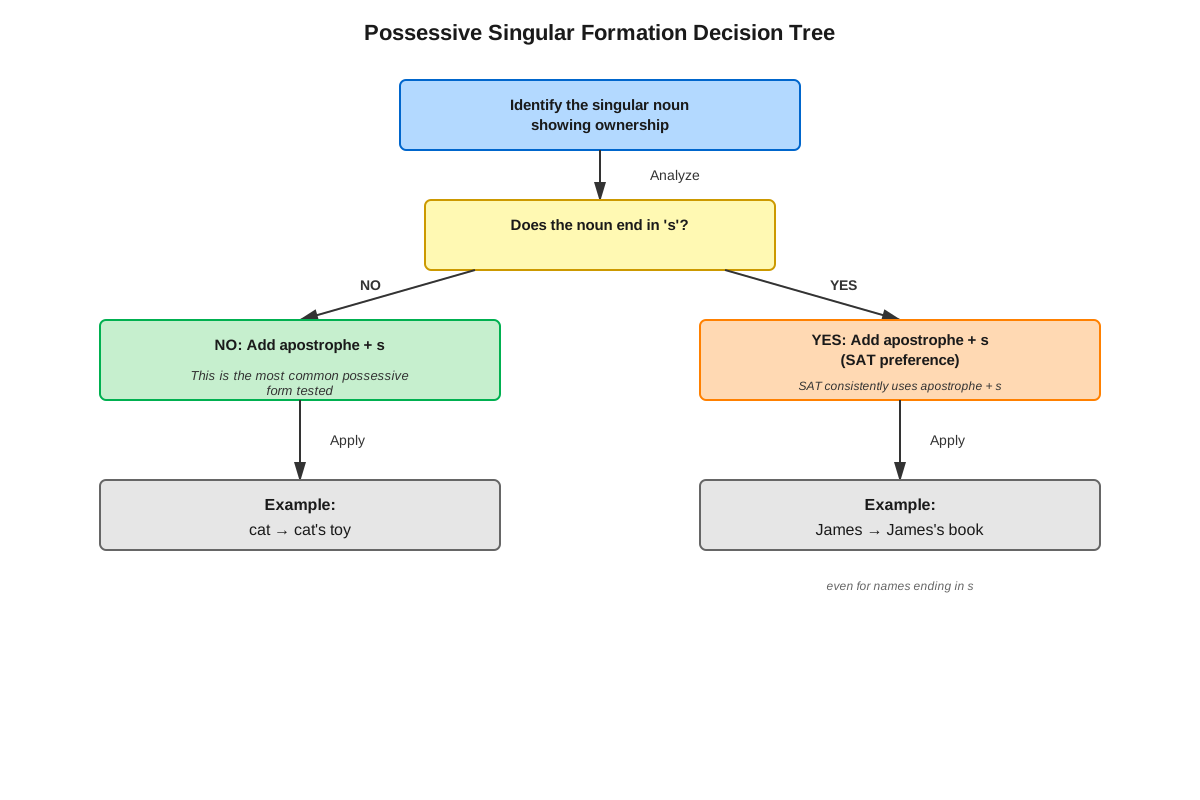
The fundamental rule for creating a possessive singular form is straightforward: add an apostrophe followed by the letter "s" ('s) to the singular noun. This construction indicates that the noun owns, possesses, or is associated with whatever follows. For example, "the student's book" shows that the book belongs to one student. The apostrophe-s combination transforms the base noun "student" into its possessive form.
This rule applies universally to singular nouns regardless of their ending letter. Whether the noun ends in a consonant (dog → dog's), a vowel (llama → llama's), or even the letter "s" (boss → boss's), the standard formation remains consistent. The SAT expects students to recognize this consistency and apply it automatically, even in cases that might "look wrong" to the untrained eye.
Possessive Singular with Nouns Ending in "S"
A particularly high-yield concept for the SAT involves singular nouns that already end in the letter "s." According to standard American English conventions—which the SAT follows—these nouns still take apostrophe-s ('s) to form the possessive. Examples include "James's car," "the class's performance," and "the business's revenue." This rule often surprises students who have encountered alternative style guides that permit apostrophe-only constructions for such nouns.
The SAT consistently tests this specific scenario because it separates students who have mastered the rule from those relying on intuition. When encountering a name like "Charles" or "Alexis," students must resist the temptation to write "Charles' book" and instead recognize that "Charles's book" is the correct SAT answer. The only exception to this rule involves ancient or classical names (Moses, Jesus, Achilles), which may take only an apostrophe, but these rarely appear on the SAT.
Distinguishing Possessive from Plural
A critical skill for SAT success involves distinguishing between possessive singular forms and simple plural forms. Consider these examples:
| Form | Example | Meaning |
|---|---|---|
| Singular | student | one student |
| Plural | students | multiple students |
| Possessive Singular | student's | belonging to one student |
| Possessive Plural | students' | belonging to multiple students |
The SAT frequently presents answer choices that include both "students" (plural) and "student's" (possessive singular) to test whether students can identify the intended meaning from context. If the sentence indicates ownership or association, the possessive form is required. If the sentence simply refers to multiple students without showing possession, the plural form is correct. Reading the complete sentence carefully reveals which form the context demands.
Possessive Singular with Compound Nouns
Compound nouns—nouns formed from two or more words—follow a specific possessive rule: add the apostrophe-s to the final word only. Examples include "my mother-in-law's advice," "the attorney general's decision," and "the editor in chief's column." This rule maintains clarity by marking possession at the end of the complete noun phrase rather than interrupting the compound structure.
The SAT occasionally tests this concept with compound nouns or noun phrases, expecting students to recognize that only the final element takes the possessive marker. Incorrect answers might place the apostrophe after the first word or add multiple apostrophes, both of which violate standard conventions.
Possessive Singular with Indefinite Pronouns
Indefinite pronouns like "someone," "anyone," "everyone," "nobody," and "one" form possessives by adding apostrophe-s, just like regular nouns. Examples include "someone's jacket," "everyone's responsibility," and "one's duty." These constructions appear less frequently on the SAT but represent important edge cases that distinguish high-scoring students.
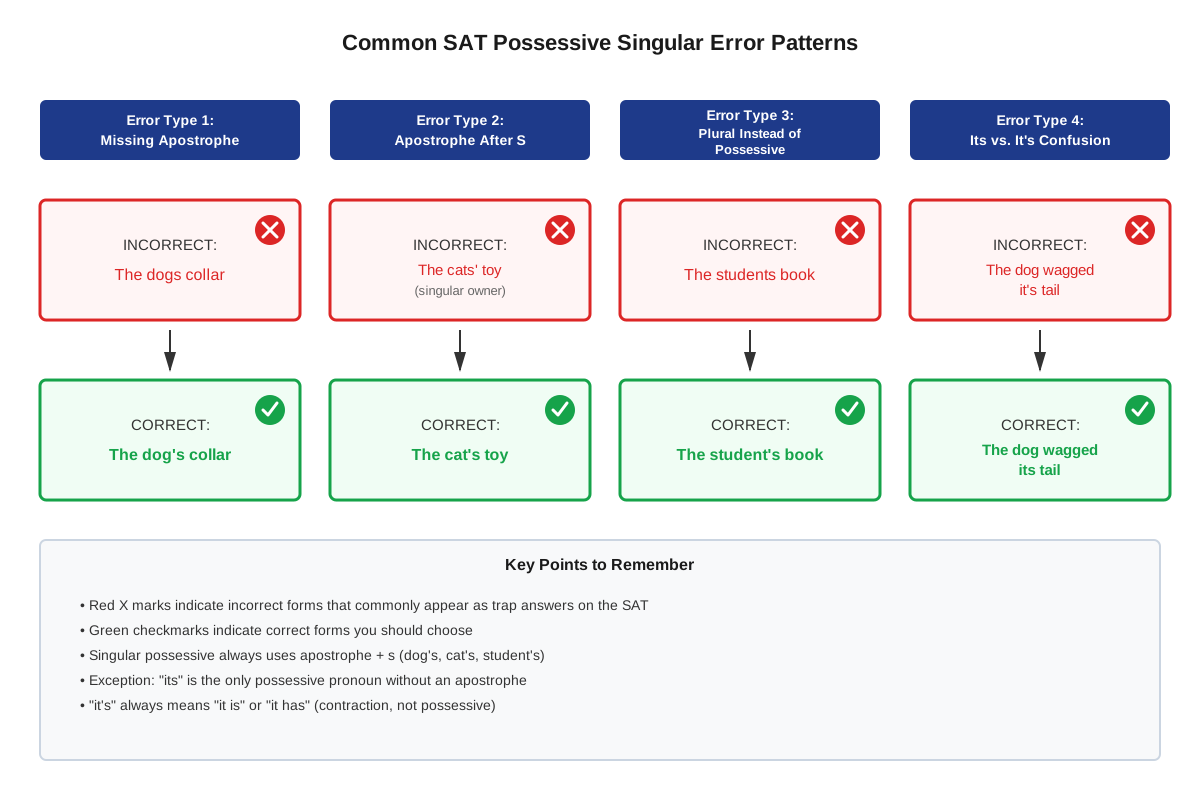
The key distinction here involves recognizing that possessive personal pronouns (his, hers, its, ours, yours, theirs, whose) never take apostrophes, while possessive indefinite pronouns always do. This difference stems from the fact that possessive personal pronouns are already possessive in form, whereas indefinite pronouns require the apostrophe-s to indicate possession.
Common Homophone Confusion
The SAT regularly tests possessive singular forms alongside contractions that sound identical but serve different grammatical functions. The most frequently tested pairs include:
- its (possessive) vs. it's (contraction of "it is" or "it has")
- whose (possessive) vs. who's (contraction of "who is" or "who has")
- your (possessive) vs. you're (contraction of "you are")
- their (possessive) vs. they're (contraction of "they are") vs. there (location)
Understanding that possessive pronouns never use apostrophes while contractions always do provides a reliable decision-making framework. When encountering these words on the SAT, students should mentally substitute the full contraction (e.g., replace "it's" with "it is") to verify whether the contraction makes sense in context. If the substitution creates nonsense, the possessive form is correct.
Concept Relationships
The possessive singular concept serves as the foundation for understanding all possessive constructions in English. Mastering possessive singular → enables understanding of possessive plural → which together form the complete system of possessive noun formation. Both possessive types rely on apostrophe usage → which connects to the broader topic of apostrophe functions including contractions and special plurals.
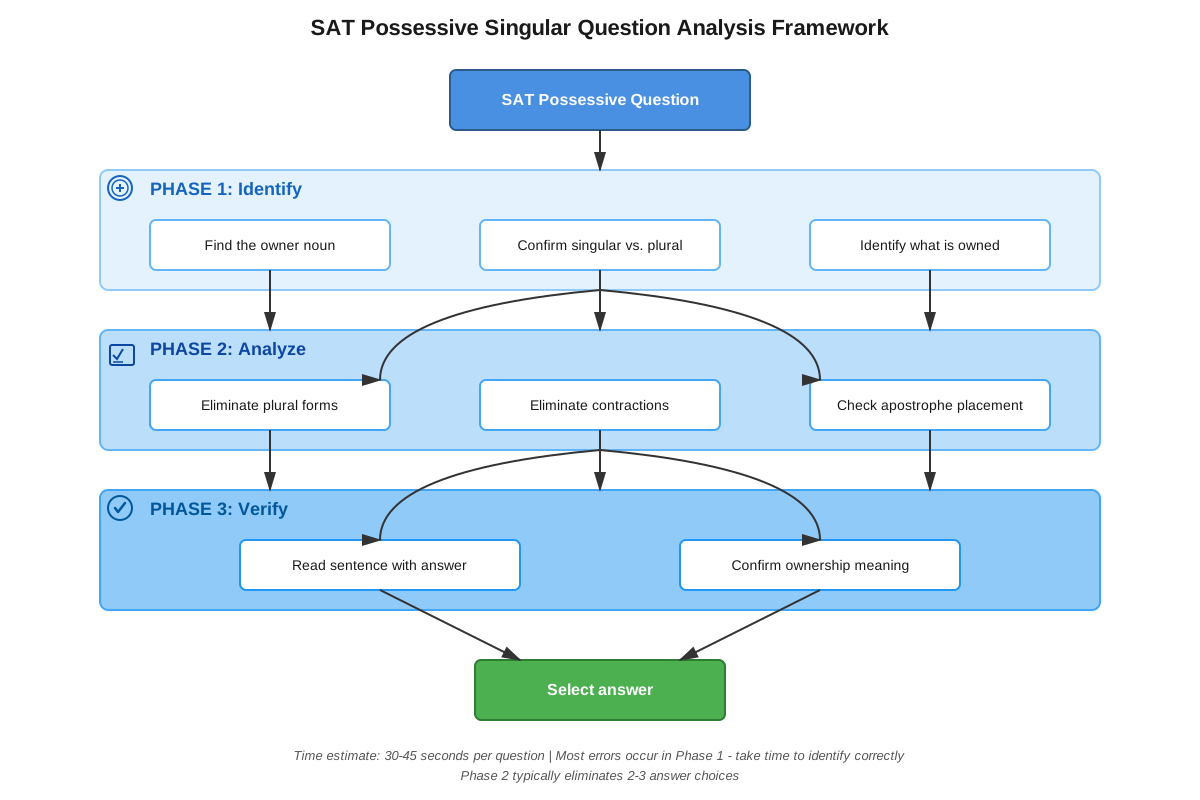
Within the SAT Reading and Writing section, possessive singular connects directly to noun identification skills from basic grammar. Students must first recognize nouns → then determine if they're singular or plural → then assess whether possession is indicated → and finally apply the appropriate possessive rule. This sequential process links possessive singular to sentence structure analysis and meaning comprehension.
The distinction between possessive forms and contractions creates a relationship with pronoun usage and verb conjugation. Understanding "it's" as a contraction requires knowledge of subject-verb agreement and present tense formation, while understanding "its" as possessive requires recognition of pronoun-antecedent relationships. These interconnections mean that possessive singular mastery reinforces and is reinforced by multiple other grammar concepts tested on the SAT.
High-Yield Facts
⭐ The standard possessive singular formation is: singular noun + apostrophe + s ('s)
⭐ Singular nouns ending in "s" still take apostrophe-s ('s) on the SAT: "James's," "the class's," "the boss's"
⭐ Possessive pronouns (its, whose, your, their) never use apostrophes
⭐ Contractions (it's, who's, you're, they're) always use apostrophes and can be expanded to two words
⭐ The SAT tests possessive singular by offering answer choices that include possessive, plural, and contraction forms
- Compound nouns add apostrophe-s only to the final word: "mother-in-law's"
- Indefinite pronouns form possessives with apostrophe-s: "someone's," "everyone's"
- Context determines whether a possessive or plural form is needed—look for ownership relationships
- Possessive singular shows that one entity owns or is associated with something
- The apostrophe in possessive constructions indicates omitted letters from the Old English genitive case ending
- Proper nouns follow the same possessive singular rules as common nouns
- Time periods and measurements can take possessive forms: "a day's work," "a dollar's worth"
Quick check — test yourself on Possessive singular so far.
Try Flashcards →Common Misconceptions
Misconception: Singular nouns ending in "s" should take only an apostrophe without an additional "s" (e.g., "James' book").
Correction: On the SAT, singular nouns ending in "s" take apostrophe-s just like any other singular noun. The correct form is "James's book." While some style guides permit the apostrophe-only form, the SAT consistently follows the apostrophe-s convention for all singular nouns.
Misconception: The possessive pronoun "its" should be written as "it's" when showing possession.
Correction: "Its" (without an apostrophe) is the possessive form, while "it's" (with an apostrophe) is a contraction meaning "it is" or "it has." Possessive pronouns never take apostrophes. To verify correct usage, try substituting "it is" or "it has"—if the substitution doesn't make sense, use "its."
Misconception: Plural nouns and possessive singular nouns are interchangeable.
Correction: Plural nouns (e.g., "students") indicate multiple entities, while possessive singular nouns (e.g., "student's") indicate that one entity owns something. These forms serve completely different grammatical functions. Context determines which is appropriate: if ownership is indicated, use possessive; if quantity is indicated, use plural.
Misconception: All words ending in apostrophe-s are possessive.
Correction: Words ending in apostrophe-s can be either possessive singular forms or contractions. "The dog's bone" uses possessive singular, while "The dog's running" uses a contraction of "dog is." Understanding the sentence's meaning and grammatical structure reveals which function the apostrophe-s serves.
Misconception: Possessive forms are only used with physical ownership.
Correction: Possessive constructions indicate various relationships beyond physical ownership, including association ("the company's reputation"), origin ("Shakespeare's plays"), duration ("a moment's notice"), and description ("women's clothing"). The SAT tests possessive forms in all these contexts, not just literal ownership scenarios.
Misconception: When multiple nouns share ownership, each noun takes apostrophe-s.
Correction: For joint possession (two or more entities owning the same thing), only the final noun takes apostrophe-s: "John and Mary's house" indicates they share one house. For individual possession (each entity owns separately), each noun takes apostrophe-s: "John's and Mary's houses" indicates they each own different houses. The SAT occasionally tests this distinction.
Worked Examples
Example 1: Identifying Correct Possessive Singular Form
Question: The research team analyzed the ___ findings before publishing their conclusions.
A) scientists
B) scientist's
C) scientists'
D) scientist
Step 1: Identify the relationship
The sentence indicates that findings belong to or are associated with someone. This signals that a possessive form is needed, eliminating choices A and D (which are non-possessive).
Step 2: Determine singular versus plural
The context doesn't specify multiple scientists, and the phrase "the research team" suggests a collective unit. However, we need to look at the noun itself. "Scientists" is plural, while "scientist's" is possessive singular. The sentence structure with "the" suggests we're referring to findings from one scientist's work.
Step 3: Apply the possessive singular rule
Since we need possessive singular (one scientist's findings), we add apostrophe-s to the singular noun "scientist," creating "scientist's."
Step 4: Verify the answer
Choice B ("scientist's") correctly shows that the findings belong to one scientist. Choice C ("scientists'") would indicate multiple scientists, which doesn't match the singular context.
Answer: B) scientist's
This question demonstrates how the SAT tests the ability to distinguish between possessive singular, possessive plural, and simple plural forms based on context clues.
Example 2: Distinguishing Possessive from Contraction
Question: The committee reviewed the proposal and determined that ___ recommendations were sound.
A) its
B) it's
C) its'
D) it is
Step 1: Identify the grammatical function needed
The sentence requires a word that shows the recommendations belong to the committee (referred to as "it"). This indicates a possessive function, not a contraction.
Step 2: Test the contraction substitution
Replace "it's" with "it is": "The committee reviewed the proposal and determined that it is recommendations were sound." This creates nonsense, confirming that the contraction is incorrect.
Step 3: Recall the possessive pronoun rule
Possessive pronouns (its, whose, your, their, etc.) never take apostrophes. The possessive form of "it" is simply "its" without any apostrophe.
Step 4: Eliminate incorrect choices
Choice B (it's) is a contraction, not possessive. Choice C (its') doesn't exist in standard English—possessive pronouns never take apostrophes. Choice D (it is) would create an ungrammatical sentence.
Answer: A) its
This example illustrates the high-frequency SAT pattern of testing possessive pronouns against their contraction counterparts. The substitution test provides a reliable verification method.
Exam Strategy
When approaching sat possessive singular questions on the Reading and Writing section, begin by identifying whether the sentence requires a possessive form at all. Look for ownership relationships, associations, or attributions that signal possession. Key trigger phrases include "belonging to," "of the," and contexts where one noun modifies another to show a relationship.
Exam Tip: If you see answer choices that include a word with an apostrophe, a plural form, and a possessive form, immediately identify the noun's owner and determine whether it's singular or plural. This narrows your choices to two options instantly.
Watch for specific trigger words and constructions that signal possessive singular questions:
- Names followed by objects or concepts (e.g., "Maria ___ research")
- Nouns ending in "s" with various apostrophe placements in answer choices
- Possessive pronouns (its, whose, your) paired with contractions (it's, who's, you're)
- Time expressions (a day's work, a year's experience)
- Compound nouns with apostrophe placement variations
For process-of-elimination, first eliminate any choices that are clearly plural when the context requires singular, or vice versa. Next, eliminate possessive forms when no ownership is indicated, or non-possessive forms when ownership is clearly present. Finally, distinguish between remaining possessive options by applying the standard rule: singular noun + apostrophe + s.
Time allocation for possessive singular questions should be approximately 20-30 seconds per question. These are typically straightforward once you've mastered the rules, making them excellent opportunities to bank time for more complex questions. If you find yourself spending more than 45 seconds on a possessive question, mark it for review and move forward—you may be overthinking a straightforward application of the basic rule.
When uncertain between two choices, use the substitution test for contractions: expand the contraction to its full form and read the sentence. If it makes grammatical sense, the contraction might be correct; if it creates nonsense, choose the possessive form. For possessive versus plural decisions, look for words like "of," "belonging to," or other possession indicators in the surrounding context.
Memory Techniques
The "Add 'S" Mnemonic: For possessive singular, remember "Singular Shows ownership with apostrophe-S." This triple-S reminder reinforces that singular possessives always take apostrophe-s, regardless of the noun's ending letter.
The Substitution Test Acronym - CITE: When encountering possessive pronouns versus contractions, use Check by Inserting The Expansion. For "its/it's," insert "it is" or "it has." For "whose/who's," insert "who is" or "who has." If the expansion makes sense, use the contraction; if not, use the possessive.
The Ownership Question Visualization: Before selecting an answer, visualize asking "Whose?" or "Belonging to whom?" If you can answer this question with a singular noun, you need possessive singular. Picture the owner holding or connected to the owned item—this concrete visualization helps cement the possessive relationship.
The "S-Ending Exception" Reminder: Create a mental image of a BOSS (a singular noun ending in "s") holding a sign that says "'S" to remember that even nouns ending in "s" take apostrophe-s in possessive singular form. The visual of "BOSS'S" reinforces this frequently tested rule.
The Pronoun-Apostrophe Rule: Remember "Possessive Pronouns are Perfect without Punctuation." This alliterative phrase reinforces that possessive pronouns (its, whose, your, their) never need apostrophes because they're already possessive in form.
Summary
Possessive singular forms represent a high-yield, frequently tested concept on the SAT Reading and Writing section. The fundamental rule—adding apostrophe-s ('s) to any singular noun—applies consistently across all contexts, including nouns ending in "s," proper nouns, compound nouns, and indefinite pronouns. Success on SAT possessive singular questions requires distinguishing between possessive forms, simple plurals, and contractions, particularly with commonly confused pairs like its/it's and whose/who's. Students must recognize that possessive pronouns never take apostrophes while possessive nouns always do, and that context determines whether possession is indicated. The ability to quickly identify ownership relationships, determine whether the owner is singular or plural, and apply the appropriate punctuation rule enables students to answer these questions accurately and efficiently, typically within 20-30 seconds per question.
Key Takeaways
- Possessive singular formation follows one consistent rule: singular noun + apostrophe + s ('s), regardless of the noun's ending letter
- Singular nouns ending in "s" still take apostrophe-s on the SAT (James's, class's, boss's)
- Possessive pronouns (its, whose, your, their) never use apostrophes; contractions (it's, who's, you're, they're) always do
- Context determines whether possessive or plural forms are needed—look for ownership relationships versus quantity indicators
- The substitution test (expanding contractions to their full forms) reliably distinguishes possessive pronouns from contractions
- Compound nouns add apostrophe-s only to the final word (mother-in-law's, attorney general's)
- Possessive singular questions appear 2-4 times per SAT administration and represent high-yield opportunities for quick, accurate points
Related Topics
Possessive Plural Forms: After mastering possessive singular, students should study possessive plural constructions, which follow different apostrophe placement rules depending on whether the plural ends in "s." This natural progression completes the possessive system.
Apostrophe Usage in Contractions: Understanding how apostrophes function in contractions reinforces the distinction between contractions and possessive forms, particularly for commonly confused pairs tested on the SAT.
Pronoun-Antecedent Agreement: Possessive pronouns must agree with their antecedents in number and gender, connecting possessive singular concepts to broader pronoun usage rules tested throughout the SAT.
Noun Identification and Classification: Strong noun recognition skills enable quick identification of possessive relationships and accurate application of possessive rules across various sentence structures.
Sentence Structure and Modification: Understanding how possessive forms function as modifiers within sentences connects this punctuation topic to broader concepts of sentence clarity and grammatical relationships.
Practice CTA
Now that you've mastered the core concepts of possessive singular forms, reinforce your understanding by completing the practice questions designed specifically for this topic. These questions mirror actual SAT formats and difficulty levels, providing essential experience with the question types you'll encounter on test day. Additionally, use the flashcards to drill the high-yield facts and rules until they become automatic—speed and accuracy with possessive singular questions will boost your overall Reading and Writing score. Consistent practice transforms knowledge into test-day performance, so commit to reviewing these materials until possessive singular questions become your fastest, most confident points on the SAT.
Sign up free to keep reading
Create a free AnvayaPrep account to finish this SAT guide on Possessive singular — plus flashcards and practice questions.