Overview
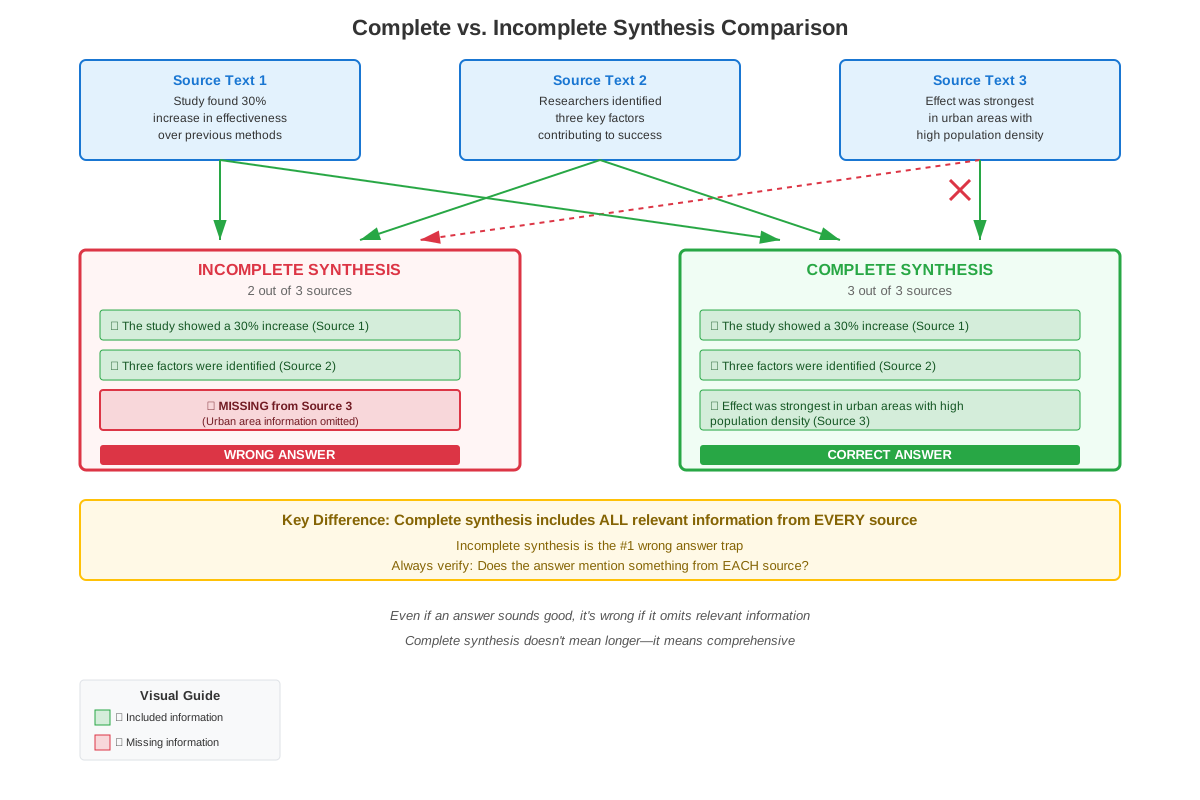
Combining information is a critical skill tested in the SAT Reading and Writing section, specifically within the Rhetorical Synthesis domain. This question type requires students to synthesize information from multiple sources—typically two to four brief texts, notes, or data points—and determine which answer choice most effectively integrates all the relevant information while maintaining logical coherence and accuracy. Unlike traditional reading comprehension questions that focus on a single passage, sat combining information questions assess a student's ability to identify relationships between ideas, recognize complementary or contrasting information, and select a statement that accurately represents the complete picture presented across all sources.
These questions are particularly important because they mirror real-world academic and professional tasks: research synthesis, evidence evaluation, and comprehensive reporting. Students must read multiple texts carefully, track distinct pieces of information, and understand how different sources relate to one another. The SAT typically presents these questions with a prompt such as "Which choice most effectively uses relevant information from the notes to accomplish this goal?" or "Which choice most logically completes the text with information from the notes?"
Within the broader RW (Reading and Writing) section, combining information questions connect directly to skills like identifying main ideas, understanding supporting evidence, and recognizing rhetorical purpose. They build upon foundational reading comprehension abilities while adding an additional layer of complexity: students must not only understand each source independently but also synthesize them into a coherent whole. This topic represents approximately 5-8% of the Reading and Writing section, making it a high-yield area for focused preparation.
Learning Objectives
- [ ] Identify key features of Combining information questions on the SAT
- [ ] Explain how Combining information appears on the SAT and what makes these questions distinct
- [ ] Apply Combining information strategies to answer SAT-style questions accurately
- [ ] Analyze multiple sources simultaneously to identify complementary and contrasting information
- [ ] Evaluate answer choices to determine which option includes all relevant information without adding unsupported claims
- [ ] Recognize common patterns in how information is distributed across multiple sources
Prerequisites
- Basic reading comprehension: Understanding main ideas, supporting details, and author's purpose in individual passages is essential because combining information requires first comprehending each source independently
- Identifying relevant versus irrelevant information: Students must distinguish between important details and extraneous information to avoid selecting answer choices that include accurate but non-essential content
- Understanding logical relationships: Recognizing cause-and-effect, comparison-contrast, and other logical connections helps students see how multiple sources relate to one another
- Vocabulary in context: Since these questions often present technical or academic content, understanding unfamiliar words through context clues ensures accurate comprehension of all sources
Why This Topic Matters
In academic settings, students constantly synthesize information from multiple sources: writing research papers, preparing presentations, and analyzing complex topics all require combining information from various texts, studies, or data sets. This skill extends beyond the classroom into professional environments where reports, proposals, and analyses demand the integration of diverse information sources. The ability to accurately combine information while avoiding misrepresentation or omission is fundamental to critical thinking and effective communication.
On the SAT, combining information questions appear consistently in the Reading and Writing section, typically 2-3 questions per test form. These questions carry the same weight as other question types, making each one valuable for score improvement. The College Board includes these questions because they assess higher-order thinking skills that predict college readiness: synthesis, evaluation, and integration of multiple perspectives or data points.
Common formats include: student notes from research (the most frequent presentation), multiple brief texts about a related topic, data from different studies or sources, or observations from various perspectives. The questions often ask students to complete a sentence in a student's essay, identify which statement best represents findings from multiple sources, or determine which choice most effectively combines the information provided. Understanding these patterns helps students recognize combining information questions immediately and apply appropriate strategies.
Core Concepts
Understanding the Structure of Combining Information Questions
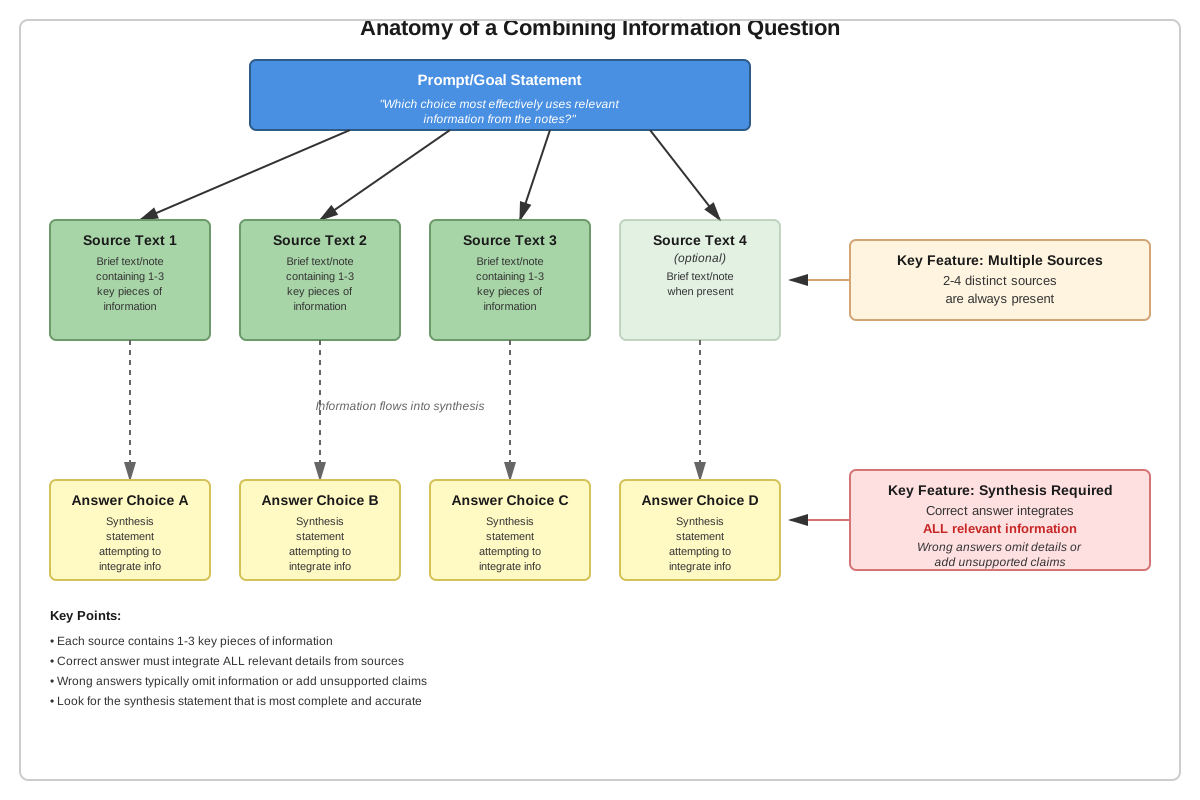
Combining information questions follow a predictable structure that students can learn to recognize quickly. The question stem typically presents a scenario: a student is writing an essay, a researcher is summarizing findings, or a writer is completing a text. Following this setup, the question provides 2-4 brief sources labeled as "notes," "texts," or "sources." Each source contains distinct information, though sources may overlap, complement, or contrast with one another. The question then asks which answer choice most effectively uses relevant information from these sources to accomplish a specific goal.
The key distinguishing feature is the presence of multiple discrete sources rather than a single continuous passage. Each source is self-contained and typically 1-3 sentences long. Students must read all sources before evaluating answer choices, as the correct answer almost always requires information from multiple sources, not just one.
Types of Information Relationships
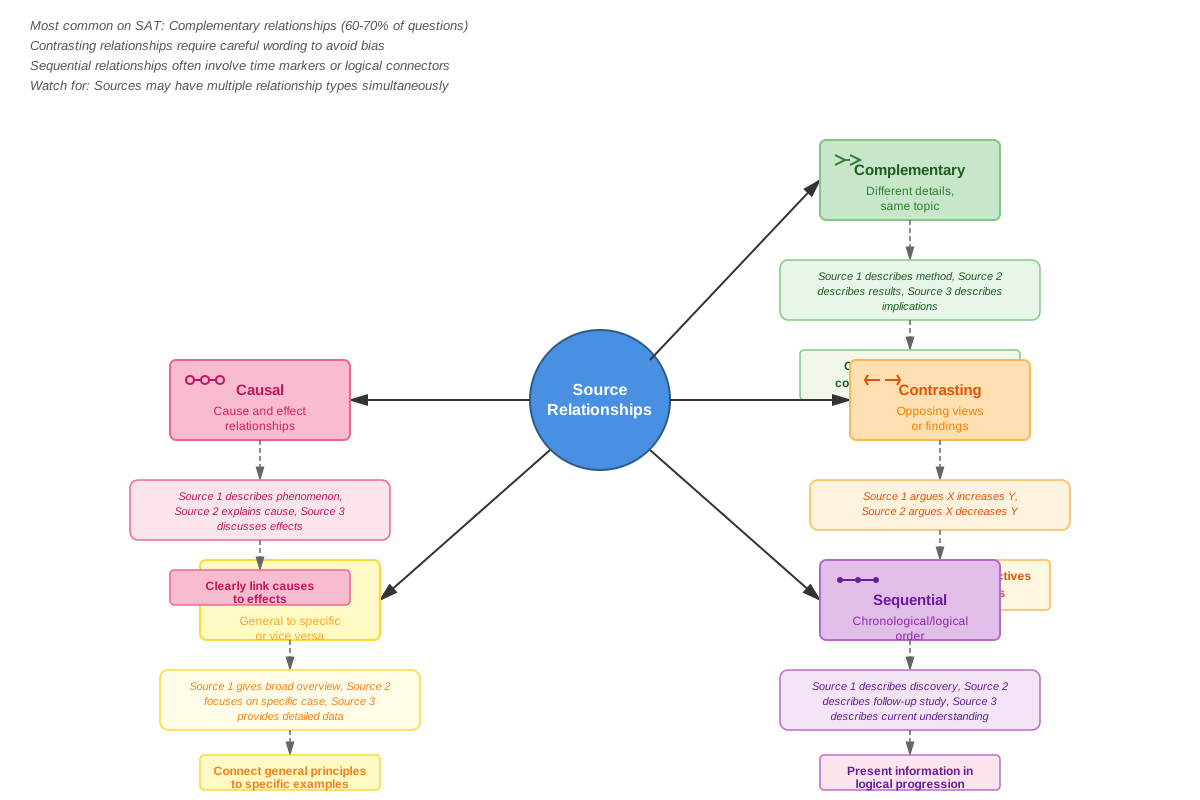
Information across sources can relate in several distinct ways, and recognizing these relationships is crucial for selecting the correct answer:
| Relationship Type | Description | Example |
|---|---|---|
| Complementary | Sources provide different aspects of the same topic without contradiction | Source 1: "The species lives in coastal areas." Source 2: "It feeds primarily on small fish." |
| Contrasting | Sources present different findings, perspectives, or conditions | Source 1: "Study A found increased growth." Source 2: "Study B found decreased growth." |
| Temporal | Sources describe events or findings from different time periods | Source 1: "In 1920, the population was 5,000." Source 2: "By 1950, it had grown to 15,000." |
| Causal | One source describes a cause while another describes an effect | Source 1: "The dam was constructed in 1965." Source 2: "Fish populations declined sharply afterward." |
| Hierarchical | Sources present general and specific information | Source 1: "Many factors contributed." Source 2: "Temperature was the primary factor." |
The Complete Information Principle
The correct answer to a combining information question must include all relevant information from the sources while excluding unsupported claims. This principle has two components:
- Completeness: The answer must not omit important information that appears in the sources. If three sources each provide a distinct finding, the correct answer typically references all three findings (or explains why one is less relevant to the specific goal stated in the question).
- Accuracy: The answer must not add information that doesn't appear in any source, even if that information seems logical or likely. Students often select incorrect answers that make reasonable inferences beyond what the sources actually state.
Identifying the Goal or Purpose
Every combining information question includes a specific goal: "to emphasize the significance of the discovery," "to present the study's methodology," "to explain the change over time," etc. This goal acts as a filter for determining which information is relevant. A detail that appears in the sources may not be relevant if it doesn't serve the stated purpose.
For example, if sources mention both the location of a study and its surprising findings, but the goal is "to emphasize what was unexpected about the results," then the location is less relevant than the findings, even though both appear in the sources.
Common Question Formats
- Completing a student's essay: "A student is writing an essay about [topic]. Which choice most effectively uses relevant information from the notes to accomplish this goal?"
- Summarizing research: "Which choice best describes the findings from the sources?"
- Presenting a claim with support: "Which choice most logically completes the text with information from the notes?"
- Explaining a phenomenon: "Which choice most effectively combines information from the sources to explain [concept]?"
The Process of Elimination Strategy
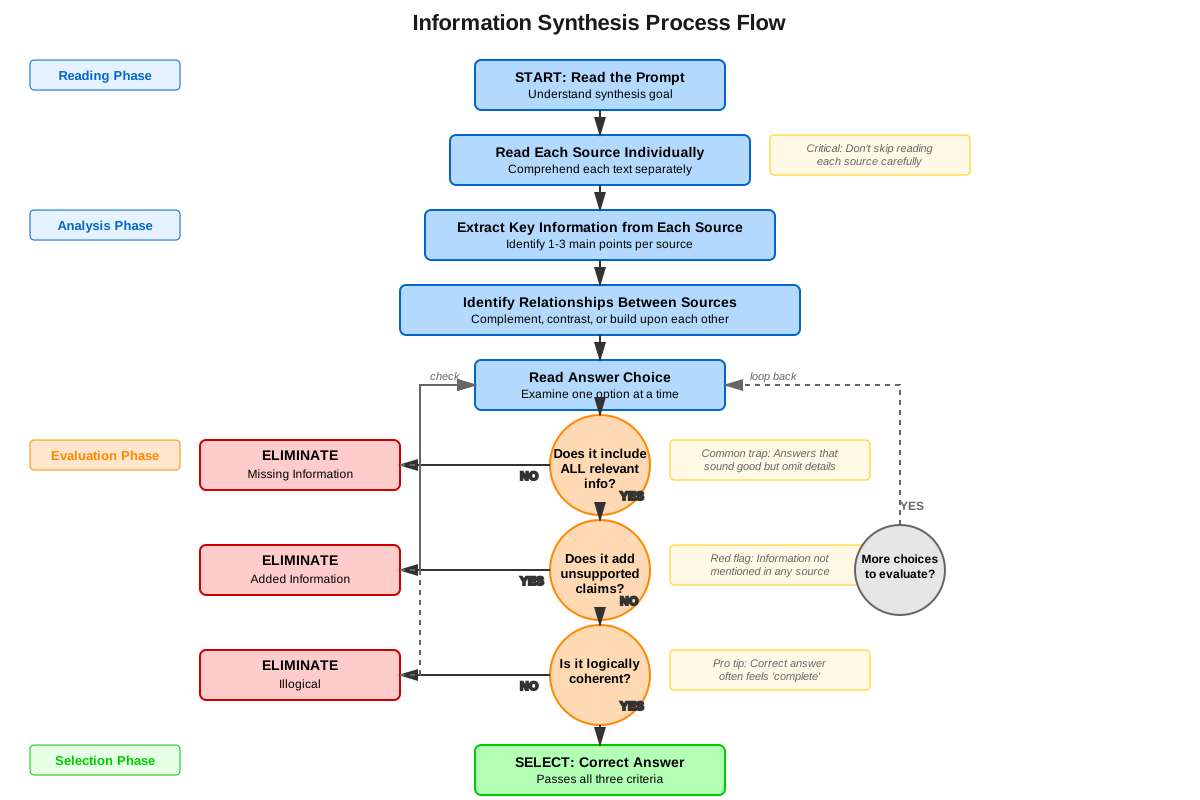
Effective students approach these questions systematically:
- Read all sources carefully, noting distinct pieces of information
- Identify the stated goal or purpose
- Determine which information is relevant to that goal
- Evaluate each answer choice against the sources
- Eliminate choices that omit relevant information or add unsupported claims
- Select the choice that is both complete and accurate
Recognizing Irrelevant Information
Not all information in the sources will be relevant to the stated goal. The SAT includes extraneous details to test whether students can distinguish between what's important and what's not. For instance, if the goal is to describe a scientific discovery, the names of the researchers might be less relevant than the discovery itself, even though both appear in the sources.
Concept Relationships
The core concepts within combining information questions form a logical progression: students must first recognize the question structure (multiple sources + specific goal) → then identify relationships between sources (complementary, contrasting, etc.) → next apply the complete information principle (include all relevant details, exclude unsupported claims) → while focusing on the stated goal (filter for relevance) → and finally use systematic elimination to select the correct answer.
This topic connects to prerequisite skills in important ways: basic reading comprehension provides the foundation for understanding each individual source, while identifying relevant information helps students filter details based on the stated goal. The skill of understanding logical relationships directly enables recognition of how sources relate to one another (complementary, contrasting, causal, etc.).
Combining information also connects forward to other rhetorical synthesis skills. The ability to synthesize multiple sources prepares students for questions about rhetorical purpose, where understanding how different pieces of evidence support a claim is essential. Similarly, this skill relates to inference questions, though combining information questions require less interpretation and more straightforward integration of explicitly stated facts.
High-Yield Facts
⭐ Combining information questions always present 2-4 separate sources, not a single continuous passage
⭐ The correct answer must include all relevant information from the sources without adding unsupported claims
⭐ Every combining information question includes a specific goal or purpose that determines which information is relevant
⭐ Information can be accurate but still incorrect if it doesn't serve the stated purpose
⭐ Sources typically present complementary information, but may also contrast or show temporal progression
- The question stem usually begins with a scenario like "A student is writing an essay about..."
- Answer choices often differ in which sources they reference or how completely they represent the information
- Omitting information from even one source often makes an answer choice incorrect
- Adding reasonable inferences not stated in the sources makes an answer choice incorrect
- The correct answer typically synthesizes information rather than simply listing facts from each source
- Time periods, locations, and specific numbers in the sources often appear in the correct answer
- Qualifiers like "primarily," "mainly," or "most significantly" in sources must be preserved in the correct answer
Quick check — test yourself on Combining information so far.
Try Flashcards →Common Misconceptions
Misconception: The correct answer must mention every single detail from all sources → Correction: The correct answer must include all relevant information based on the stated goal; some details in the sources may be extraneous to that specific purpose
Misconception: If an answer choice sounds reasonable and relates to the topic, it's probably correct → Correction: The correct answer must be directly supported by the sources; logical inferences or general knowledge about the topic don't make an answer correct if that information isn't in the sources
Misconception: Longer, more detailed answer choices are more likely to be correct → Correction: Length doesn't determine correctness; sometimes the correct answer is concise while incorrect answers add unnecessary or unsupported details
Misconception: If information appears in the sources, it must appear in the correct answer → Correction: Only information relevant to the stated goal needs to appear in the correct answer; sources often include details that aren't relevant to the specific purpose
Misconception: Combining information questions are just about summarizing all the sources → Correction: These questions require selective synthesis based on a specific goal, not comprehensive summarization of everything in the sources
Misconception: The sources will always agree with each other → Correction: Sources may present contrasting findings, different time periods, or varying perspectives; recognizing these differences is often key to selecting the correct answer
Worked Examples
Example 1: Complementary Information
Scenario: A student is writing a report about the migration patterns of monarch butterflies. The student wants to emphasize both the distance traveled and the environmental challenges faced during migration.
Source 1: Monarch butterflies migrate up to 3,000 miles from North America to central Mexico each fall.
Source 2: During their journey, monarchs face threats from habitat loss, pesticide exposure, and severe weather events.
Source 3: The butterflies use a combination of environmental cues and an internal compass to navigate across the continent.
Question: Which choice most effectively uses relevant information from the notes to accomplish this goal?
Answer Choices:
A) Monarch butterflies migrate to central Mexico, where they face various environmental challenges.
B) Monarch butterflies travel up to 3,000 miles to Mexico, navigating using environmental cues and an internal compass.
C) Monarch butterflies migrate up to 3,000 miles to Mexico, facing threats including habitat loss, pesticide exposure, and severe weather during their journey.
D) Monarch butterflies face habitat loss and pesticide exposure, which threaten their ability to complete their 3,000-mile migration.
Analysis:
The stated goal is to emphasize both distance and environmental challenges. Let's evaluate each choice:
- Choice A: Mentions migration and challenges but omits the specific distance (3,000 miles), which is relevant to emphasizing the distance traveled. Incomplete.
- Choice B: Includes the distance (3,000 miles) and navigation methods, but completely omits the environmental challenges, which the goal specifically asks to emphasize. Incomplete.
- Choice C: Includes both the distance (3,000 miles from Source 1) and the specific environmental challenges (habitat loss, pesticide exposure, severe weather from Source 2). This directly addresses both parts of the stated goal. Complete and accurate.
- Choice D: Includes both distance and challenges, but the phrasing "threaten their ability to complete" adds an interpretation not stated in the sources. Source 2 says they "face threats," not that these threats prevent completion. Adds unsupported claim.
Correct Answer: C
This example demonstrates the complete information principle: the correct answer must include all information relevant to the stated goal (both distance and challenges) without adding interpretations beyond what the sources state.
Example 2: Contrasting Information with Temporal Context
Scenario: A student is writing an essay about changes in urban planning approaches. The student wants to explain how priorities shifted over time.
Source 1: In the 1950s and 1960s, urban planners prioritized automobile access, designing cities with extensive highway systems and large parking facilities.
Source 2: By the 1990s, many cities began redesigning downtown areas to prioritize pedestrian access, adding bike lanes and reducing car traffic.
Source 3: Recent studies show that pedestrian-friendly urban design correlates with increased local business revenue and improved public health outcomes.
Question: Which choice most effectively uses relevant information from the notes to accomplish this goal?
Answer Choices:
A) Urban planning has evolved from prioritizing automobiles in the mid-20th century to emphasizing pedestrian access in recent decades, with studies showing benefits of pedestrian-friendly design.
B) While 1950s-1960s urban planning focused on automobile access through highways and parking facilities, 1990s approaches prioritized pedestrians through bike lanes and reduced car traffic.
C) Urban planners now recognize that pedestrian-friendly design improves business revenue and public health, leading to reduced car traffic in downtown areas.
D) Urban planning priorities have changed significantly, with modern approaches proving more beneficial for cities than automobile-focused designs of the past.
Analysis:
The goal is to "explain how priorities shifted over time," which requires showing the contrast between earlier and later approaches.
- Choice A: Mentions the temporal shift (mid-20th century to recent decades) and includes information from all three sources, but Source 3's information about benefits isn't directly about the shift in priorities—it's about outcomes of the newer approach. While not wrong, it's less focused on the shift itself. Potentially complete but less focused.
- Choice B: Clearly contrasts the two time periods (1950s-1960s vs. 1990s) with specific details from both Source 1 and Source 2, directly showing how priorities shifted. Omits Source 3, but Source 3 discusses outcomes rather than the shift in priorities, so it's less relevant to the stated goal. Complete and focused.
- Choice C: Focuses only on current approaches and their benefits, omitting the earlier automobile-focused period entirely. Doesn't show the shift over time. Incomplete.
- Choice D: Mentions that priorities changed but provides no specific details about what those priorities were in either period. Too vague and omits the specific information from the sources. Incomplete.
Correct Answer: B
This example illustrates how the stated goal determines relevance: Source 3's information about benefits, while accurate and from the sources, is less relevant to explaining the shift itself than the specific details about what changed from Source 1 and Source 2.
Exam Strategy
When approaching combining information questions on the SAT, follow this systematic process:
Step 1: Identify the question type immediately. Look for multiple labeled sources (notes, texts, sources) and a scenario involving a student writing or a researcher summarizing. This recognition triggers the appropriate strategy.
Step 2: Read the stated goal first, before reading the sources. Understanding what you're looking for (emphasize significance, explain a change, present findings, etc.) helps you read the sources with purpose and identify relevant information more efficiently.
Step 3: Read all sources carefully, making brief mental or physical notes about distinct pieces of information. Don't try to memorize everything, but track what each source contributes. Consider marking or mentally noting: "Source 1 = distance, Source 2 = challenges, Source 3 = navigation."
Step 4: Before looking at answer choices, mentally formulate what a complete answer should include based on the goal. This prevents you from being swayed by attractive but incomplete options.
Step 5: Use aggressive elimination. For each answer choice, ask:
- Does it include all relevant information from the sources?
- Does it add anything not stated in the sources?
- Does it serve the stated goal?
Exam Tip: If you're stuck between two choices, check whether one omits information from a source or adds an unsupported claim. These are the most common reasons an answer is incorrect.
Trigger words and phrases to watch for:
- "Most effectively uses relevant information" = must be complete and focused on the goal
- "Accomplish this goal" = filter information based on the stated purpose
- "From the notes/sources" = must be directly supported, no outside inferences
- "Best describes/explains/presents" = look for the most complete and accurate option
Time allocation: These questions typically take 60-90 seconds. Don't rush through the sources, as misreading one source can lead to selecting an incorrect answer. However, don't over-analyze; the correct answer is directly supported by the sources without requiring complex interpretation.
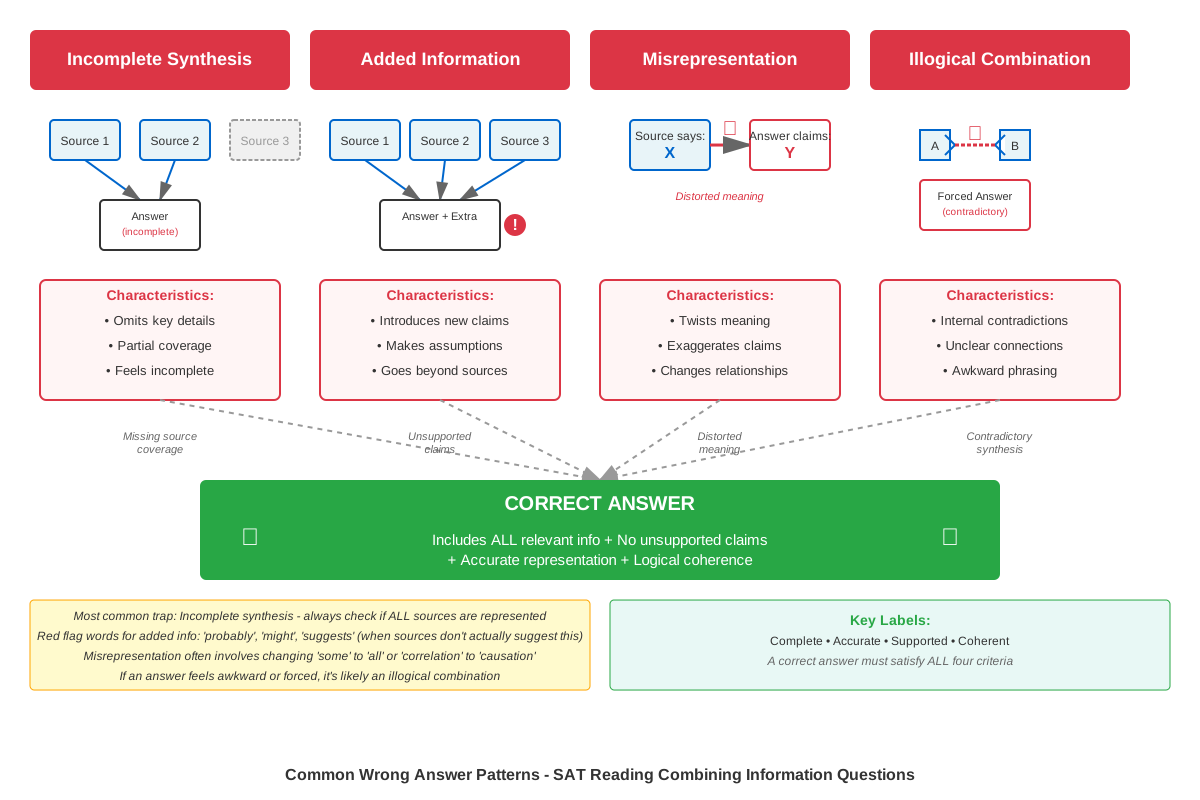
Common trap patterns:
- Answers that include information from only 2 of 3 sources
- Answers that make logical inferences beyond what's stated
- Answers that are accurate but don't serve the stated goal
- Answers that use similar wording to the sources but change the meaning
Memory Techniques
CRAG Acronym for evaluating answer choices:
- Complete: Includes all relevant information
- Relevant: Serves the stated goal
- Accurate: Doesn't add unsupported claims
- Grounded: Directly supported by sources
The "Source Checklist" Visualization: Imagine checking off each source as you verify an answer choice includes its relevant information. If you can't check off all sources (or if the goal makes one less relevant), the answer may be incomplete.
The "No Inference Zone" Reminder: Picture a boundary around the sources. The correct answer stays within that boundary, never stepping outside into logical inferences or general knowledge, even if those inferences seem obvious.
The "Goal Filter" Mental Image: Visualize the stated goal as a filter or sieve. Pour all the information from the sources through it—only information relevant to that specific goal passes through to the correct answer.
Three-Part Question Structure Mnemonic: "Sources + Goal + Synthesis" (SGS). Every combining information question has multiple Sources, a stated Goal, and requires Synthesis in the answer.
Summary
Combining information questions on the SAT Reading and Writing section require students to synthesize information from multiple brief sources (typically 2-4) to select an answer that completely and accurately represents the relevant information while serving a stated goal. These questions test higher-order thinking skills: the ability to read multiple texts, identify relationships between sources, distinguish relevant from irrelevant information, and integrate information without adding unsupported claims. Success requires a systematic approach: reading all sources carefully, understanding the stated goal, identifying which information is relevant to that goal, and eliminating answer choices that are incomplete or add unsupported claims. The correct answer must include all relevant information from the sources without omitting important details or making inferences beyond what's explicitly stated. Students should recognize that information can be accurate but still incorrect if it doesn't serve the stated purpose, and that sources may present complementary, contrasting, or temporally distinct information that must be synthesized appropriately.
Key Takeaways
- Combining information questions present 2-4 separate sources and ask students to synthesize information based on a specific stated goal
- The correct answer must be both complete (including all relevant information) and accurate (not adding unsupported claims)
- The stated goal determines which information from the sources is relevant; not all details need to appear in the correct answer
- Sources may present complementary information, contrasting findings, temporal progressions, or causal relationships
- Systematic elimination is the most effective strategy: check each answer for completeness, relevance to the goal, and accuracy to the sources
- Common incorrect answers omit information from one or more sources or add logical inferences not stated in the sources
- These questions appear 2-3 times per SAT test form and are high-yield for score improvement when approached strategically
Related Topics
Rhetorical Purpose and Function: Understanding why authors include specific information or structure texts in particular ways builds on the synthesis skills developed in combining information questions, as both require analyzing how different elements work together to achieve a goal.
Evidence-Based Reading: Questions that ask students to identify which quotation best supports a claim require similar skills to combining information: evaluating multiple options to find the most complete and relevant support.
Data Interpretation and Integration: Some SAT questions present both textual and graphical information, requiring synthesis across different formats—an extension of the combining information skill.
Transitions and Logical Flow: Understanding how ideas connect within and between sentences relates to recognizing relationships between sources in combining information questions.
Practice CTA
Now that you've mastered the strategies for combining information questions, it's time to put your knowledge into practice! Attempt the practice questions to apply the systematic approach you've learned: read all sources carefully, identify the stated goal, and use the CRAG framework (Complete, Relevant, Accurate, Grounded) to evaluate answer choices. Remember, these questions reward careful reading and methodical elimination rather than speed. The flashcards will help reinforce the key concepts and common patterns you'll encounter. With focused practice, you'll develop the confidence to tackle any combining information question the SAT presents. Each practice question you complete strengthens your synthesis skills and brings you closer to your target score!
Sign up free to keep reading
Create a free AnvayaPrep account to finish this SAT guide on Combining information — plus flashcards and practice questions.