Overview
Contrasting two ideas is a fundamental rhetorical skill tested extensively in the SAT Reading and Writing section, particularly within the Rhetorical Synthesis domain. This skill requires students to recognize, analyze, and articulate the differences between two concepts, perspectives, theories, or findings presented in source materials. On the SAT, students encounter questions that provide multiple brief texts or data points and must synthesize this information by identifying and expressing contrasts in a clear, grammatically correct manner.
The ability to contrast ideas effectively demonstrates critical thinking and analytical reasoning—skills that extend far beyond standardized testing into academic writing, professional communication, and everyday decision-making. On the SAT contrasting two ideas questions, students must not only identify differences but also select answer choices that accurately represent these contrasts using appropriate transition words, logical structure, and precise language. These questions assess both comprehension and expression, making them a bridge between reading analysis and writing proficiency.
Within the broader RW (Reading and Writing) framework, contrasting ideas connects to multiple competencies: understanding authorial purpose, recognizing organizational patterns, evaluating evidence, and constructing coherent arguments. Mastery of this topic strengthens performance across various question types, including those involving synthesis, transitions, and logical relationships. Students who excel at contrasting ideas demonstrate sophisticated reading comprehension and the ability to communicate complex relationships concisely—exactly what colleges seek in successful applicants.
Learning Objectives
- [ ] Identify key features of contrasting two ideas in SAT passages and questions
- [ ] Explain how contrasting two ideas appears on the SAT and what the questions assess
- [ ] Apply contrasting two ideas to answer SAT-style questions accurately and efficiently
- [ ] Recognize appropriate contrast transition words and phrases in context
- [ ] Distinguish between effective and ineffective contrast statements in answer choices
- [ ] Synthesize information from multiple sources to construct accurate contrast statements
- [ ] Evaluate answer choices for logical accuracy, grammatical correctness, and completeness
Prerequisites
- Basic reading comprehension: Understanding main ideas and supporting details in short passages is essential for identifying what aspects of two ideas differ
- Fundamental grammar knowledge: Recognizing sentence structure helps evaluate whether answer choices are grammatically correct and logically sound
- Familiarity with transition words: Understanding how words like "however," "whereas," and "in contrast" function enables recognition of contrast relationships
- Ability to identify main ideas: Extracting central claims from brief texts is necessary before comparing or contrasting them
Why This Topic Matters
Real-World Applications
The skill of contrasting ideas permeates academic and professional life. In college coursework, students constantly compare competing theories, evaluate different research findings, and analyze contrasting interpretations of historical events or literary works. In professional settings, contrasting options, proposals, or strategies forms the foundation of decision-making and persuasive communication. Whether writing a comparative analysis essay, preparing a business recommendation, or simply making informed personal choices, the ability to articulate clear contrasts is indispensable.
Exam Statistics and Frequency
Contrasting two ideas questions appear regularly on every SAT administration, typically 2-4 times per test in the Reading and Writing section. These questions fall within the Rhetorical Synthesis category, which comprises approximately 13-15% of the entire RW section. Given that the digital SAT contains 54 Reading and Writing questions total, students can expect to encounter multiple opportunities to demonstrate this skill. The questions carry the same weight as all other RW questions, making each one valuable for score optimization.
Common Exam Appearances
On the SAT, contrasting two ideas most frequently appears in these formats:
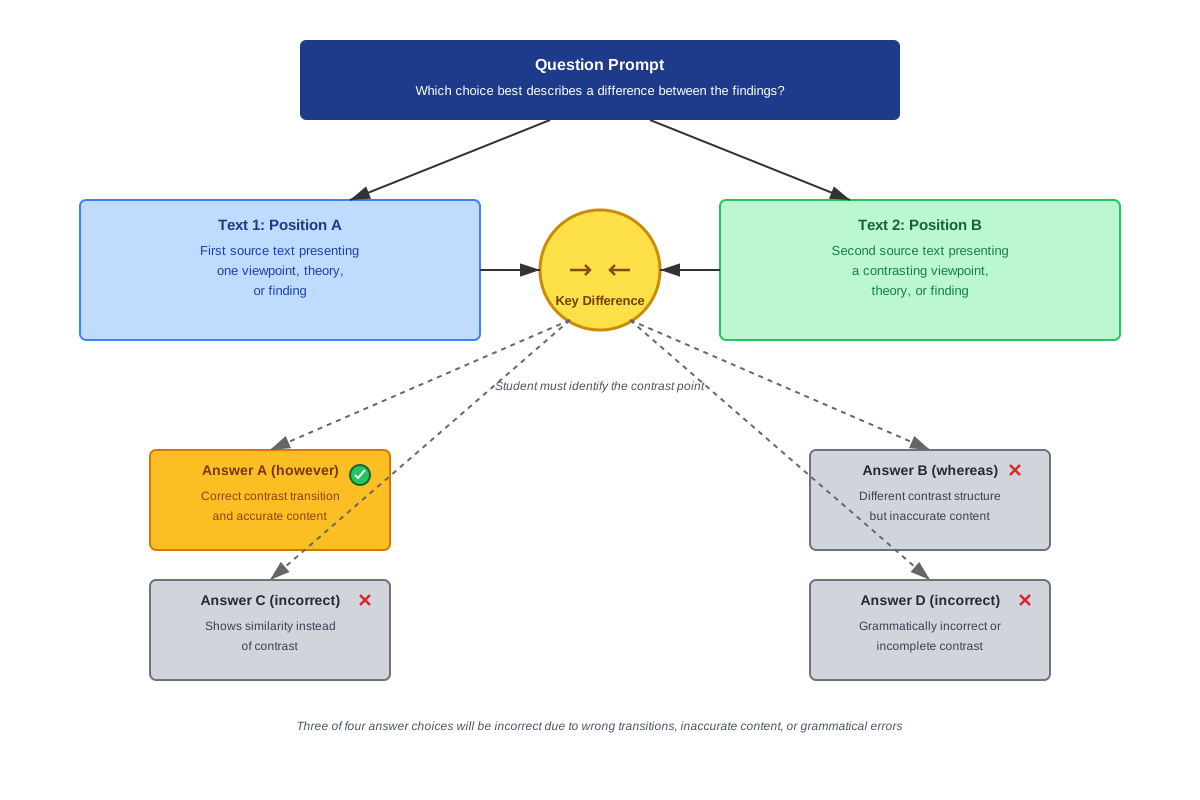
- Synthesis questions presenting two brief texts (Text 1 and Text 2) with different perspectives, findings, or approaches, followed by a prompt asking students to complete a statement that accurately contrasts the texts
- Research scenario questions describing two studies or experiments with different methodologies or conclusions
- Historical or scientific comparison questions presenting two theories, interpretations, or discoveries that differ in significant ways
- Data interpretation questions showing two graphs, charts, or datasets that reveal contrasting trends or patterns
Core Concepts
Understanding Contrast in Rhetorical Context
Contrasting two ideas involves identifying and articulating meaningful differences between concepts, arguments, findings, or perspectives. Unlike simple comparison (which examines both similarities and differences), contrast focuses exclusively on how two things differ. On the SAT, effective contrast statements must be:
- Accurate: Faithfully representing what each source actually states or shows
- Specific: Identifying precise points of difference rather than vague generalities
- Balanced: Giving appropriate attention to both ideas being contrasted
- Clear: Using appropriate transition language to signal the contrast relationship
The cognitive process involves three distinct steps: comprehension (understanding each idea independently), analysis (identifying where they diverge), and synthesis (constructing a statement that captures this divergence accurately).
Key Features of SAT Contrast Questions
SAT contrast questions share several distinctive characteristics that students must recognize:
| Feature | Description | Example Indicator |
|---|---|---|
| Multiple sources | Questions present 2+ brief texts, studies, or data sets | "Text 1" and "Text 2" labels |
| Completion format | Students complete a sentence that begins the contrast | "Based on the texts, how would..." |
| Transition word focus | Answer choices often differ primarily in transition words | "however" vs. "similarly" vs. "for example" |
| Logical relationship | Correct answers must accurately represent the logical relationship | One text supports X while the other challenges X |
Transition Words and Phrases for Contrast
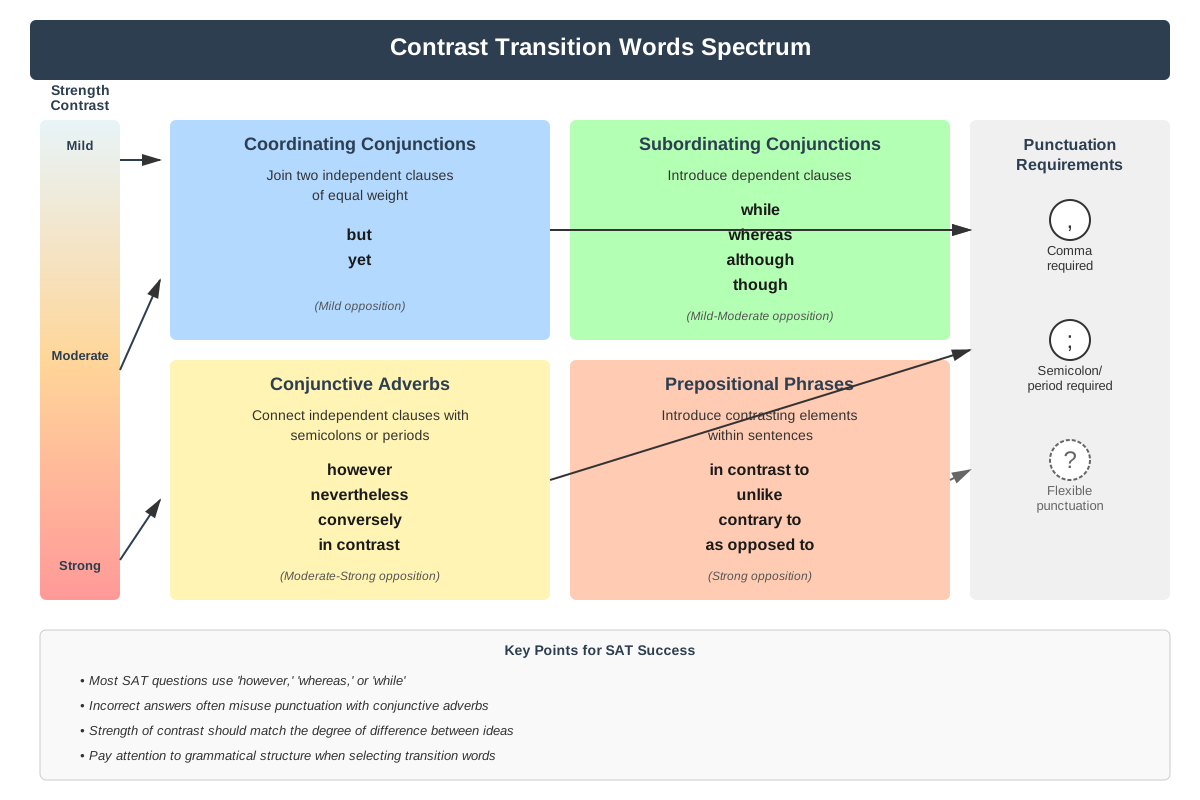
Mastering contrast requires fluency with transition words that signal opposition or difference. These fall into several categories:
Direct opposition transitions:
- however
- in contrast
- on the other hand
- conversely
- nevertheless
- nonetheless
Comparative contrast transitions:
- whereas
- while
- unlike
- rather than
- instead of
Qualifying contrast transitions:
- although
- though
- even though
- despite
- in spite of
Understanding the nuanced differences between these transitions is crucial. For example, "however" suggests a contradiction or unexpected difference, while "whereas" introduces a straightforward comparison of two different characteristics. "Although" acknowledges a contrast while emphasizing one side over the other.
Identifying the Contrast Point
Not all differences between two texts constitute the relevant contrast for SAT questions. Students must identify the contrast point—the specific aspect on which the two ideas diverge. Consider this framework:
- Read each source independently: Understand the main claim or finding of each text
- Identify the common topic: What subject are both texts addressing?
- Locate the divergence: On what specific aspect do they differ?
- Determine the nature of the difference: Is it a contradiction, a different emphasis, a different methodology, or a different conclusion?
For example, two texts about climate change might both discuss carbon emissions but differ on whether technological innovation or policy regulation is more effective at reducing them. The contrast point is the proposed solution, not the existence of the problem.
Evaluating Answer Choices
SAT contrast questions require careful evaluation of answer choices using multiple criteria:
Accuracy check: Does the answer choice correctly represent what each text states? Incorrect answers often misrepresent one or both sources through:
- Overstatement (claiming a text makes a stronger claim than it does)
- Understatement (minimizing what a text actually argues)
- Distortion (twisting the meaning)
- Fabrication (introducing information not present in the source)
Logical relationship check: Does the answer choice accurately capture the relationship between the ideas? Common errors include:
- Presenting a contrast where the texts actually agree
- Suggesting agreement where the texts contrast
- Identifying the wrong contrast point
Grammatical and stylistic check: Is the completed sentence grammatically correct and stylistically appropriate? This includes:
- Subject-verb agreement
- Parallel structure when comparing
- Appropriate transition word usage
- Clear pronoun references
Synthesis vs. Summary
A critical distinction for SAT success is understanding that contrast questions require synthesis (combining information from multiple sources to create new understanding) rather than mere summary (restating what individual sources say). Effective synthesis:
- Integrates information from both sources into a single coherent statement
- Highlights the relationship between the sources
- Creates insight that emerges from considering both sources together
- Uses the sources as evidence for a larger point about their relationship
Weak answers often simply summarize each text separately without clearly articulating how they relate to each other.
Concept Relationships
The skill of contrasting two ideas builds directly on foundational reading comprehension abilities. Students must first understand main ideas in individual texts before they can identify how those ideas differ. This understanding then enables analysis of relationships between texts, which is the core of synthesis.
Within the topic itself, concepts connect in this sequence:
Reading comprehension → Identifying contrast points → Selecting appropriate transitions → Evaluating logical accuracy → Constructing complete contrast statements
Each step depends on the previous one. Without accurate comprehension, students cannot identify genuine contrast points. Without recognizing contrast points, they cannot select appropriate transition words. Without understanding transitions, they cannot evaluate whether answer choices accurately represent the logical relationship.
Contrasting two ideas also connects to other SAT RW topics:
- Transitions questions: Both require understanding logical relationships and appropriate connecting words
- Rhetorical purpose questions: Understanding why authors present contrasting ideas helps identify authorial intent
- Evidence-based questions: Contrasting requires identifying what evidence each text provides for its claims
- Logical reasoning questions: Evaluating whether a contrast is valid requires logical analysis
The relationship map looks like this:
Basic comprehension → Main idea identification → Contrast point recognition → Transition word selection → Synthesis statement construction → Answer choice evaluation
High-Yield Facts
⭐ Contrasting two ideas questions always provide multiple sources (typically two brief texts) that differ on a specific point
⭐ The correct answer must accurately represent BOTH sources—misrepresenting either source makes an answer wrong
⭐ Transition words are crucial: "however," "whereas," and "in contrast" signal opposition, while "similarly" and "likewise" signal agreement
⭐ The contrast point is the specific aspect on which the sources differ, not just any difference between them
⭐ Correct answers synthesize information from both sources rather than simply summarizing each separately
- Contrast questions test both reading comprehension and the ability to express relationships clearly
- Answer choices often differ primarily in their transition words, making transition word knowledge essential
- Common wrong answers include those that reverse which text says what, creating an inaccurate contrast
- Some questions present contrasting data or research findings rather than contrasting arguments or perspectives
- The completion format means students must ensure the entire sentence (prompt + answer choice) is grammatically correct
⭐ Overstatement and understatement are common traps—correct answers match the strength of claims in the original texts
- Contrast questions may involve differences in methodology, conclusions, emphasis, or interpretation
- Time-efficient students read the prompt first to know what kind of contrast to look for
- Parallel structure in answer choices often signals a well-constructed contrast statement
- Some contrasts are direct contradictions (Text 1 says X is true; Text 2 says X is false) while others are differences in emphasis or approach
Quick check — test yourself on Contrasting two ideas so far.
Try Flashcards →Common Misconceptions
Misconception: Any difference between two texts constitutes the relevant contrast for the question.
Correction: The relevant contrast is specifically what the question prompt asks about. Two texts might differ in multiple ways, but the question targets a specific contrast point. Students must identify which difference the question is testing.
Misconception: Longer, more complex answer choices are more likely to be correct because they seem more sophisticated.
Correction: Correct answers are precise and concise, not necessarily lengthy. Wordiness often indicates an answer choice that's hedging or adding irrelevant information. The best answer directly addresses the contrast point without unnecessary elaboration.
Misconception: If two texts discuss different aspects of a topic, they automatically contrast with each other.
Correction: Discussing different aspects doesn't necessarily create a contrast. For example, if Text 1 discusses the causes of a phenomenon and Text 2 discusses its effects, they're addressing different questions, not contrasting on the same question. True contrast requires both texts to address the same aspect but reach different conclusions or take different positions.
Misconception: The word "contrast" or "difference" must appear in the correct answer choice.
Correction: Effective contrast statements often use transition words like "whereas," "while," or "however" without explicitly stating "in contrast." The logical relationship creates the contrast, not specific vocabulary.
Misconception: If Text 1 makes a positive statement and Text 2 makes a negative statement, they automatically contrast.
Correction: The statements must be about the same subject to truly contrast. Text 1 saying "Technology X is beneficial" and Text 2 saying "Technology Y is harmful" doesn't create a meaningful contrast because they're discussing different technologies. The contrast must involve the same topic or claim.
Misconception: Synthesis questions require students to determine which text is correct or more persuasive.
Correction: SAT synthesis questions test the ability to accurately represent what each text says, not to evaluate which is better or more convincing. Students should remain neutral and focus on accurate representation rather than judgment.
Misconception: The correct answer will always use the most sophisticated or academic-sounding transition word.
Correction: The correct transition word is the one that most accurately represents the logical relationship between the ideas, whether that's a simple word like "but" or a more complex phrase like "in contrast to." Sophistication doesn't equal correctness.
Worked Examples
Example 1: Scientific Research Contrast
Text 1
Biologist Maria Chen's research on coral reef resilience found that reefs in marine protected areas showed remarkable recovery after bleaching events, with coral coverage returning to pre-bleaching levels within five years in 78% of studied sites.
Text 2
Marine ecologist James Rodriguez's study of coral reefs examined unprotected reef systems and documented that only 23% of reefs showed significant recovery within five years of bleaching events, with most sites experiencing continued decline in coral coverage.
Question: Based on the texts, how would Rodriguez's findings compare to Chen's?
Answer Choices:
A) Similarly, Rodriguez found that coral reefs demonstrate strong recovery capabilities.
B) However, Rodriguez's research examined reefs without protection and found much lower recovery rates.
C) For example, Rodriguez's study confirmed that marine protected areas enhance coral resilience.
D) In addition, Rodriguez documented that coral bleaching events are becoming more frequent.
Step-by-step solution:
- Identify what each text claims:
- Text 1 (Chen): Protected reefs show high recovery rates (78%)
- Text 2 (Rodriguez): Unprotected reefs show low recovery rates (23%)
- Identify the contrast point: Recovery rates of coral reefs, specifically related to protection status
- Determine the logical relationship: The texts present contrasting findings—high recovery vs. low recovery—based on different conditions (protected vs. unprotected)
- Evaluate each answer choice:
- Choice A: Uses "similarly," which indicates agreement, but the texts show different recovery rates. Incorrect—wrong transition word.
- Choice B: Uses "however" (appropriate for contrast), mentions the key difference (without protection), and accurately states the finding (lower recovery rates). Potentially correct.
- Choice C: Uses "for example," which suggests Rodriguez's work illustrates Chen's point, but Rodriguez studied unprotected reefs, not protected areas. Incorrect—misrepresents Rodriguez's focus.
- Choice D: Uses "in addition," suggesting agreement, and introduces information about bleaching frequency that neither text discusses. Incorrect—wrong relationship and introduces new information.
- Verify the best answer: Choice B accurately captures the contrast (protected vs. unprotected reefs), uses an appropriate transition word ("however"), and correctly represents both studies' findings.
Correct Answer: B
Connection to learning objectives: This example demonstrates identifying the contrast point (protection status and recovery rates), selecting appropriate transition words (however vs. similarly), and evaluating logical accuracy (whether the answer represents both texts correctly).
Example 2: Historical Interpretation Contrast
Text 1
Historian Dr. Patricia Williams argues that the rapid industrialization of the late 19th century was primarily driven by technological innovations such as the Bessemer steel process and the expansion of railroad networks, which created new markets and manufacturing capabilities.
Text 2
Economic historian Dr. Robert Chang contends that while technological advances played a role, the primary driver of late 19th-century industrialization was the availability of massive capital investment from banking institutions and wealthy industrialists who funded large-scale manufacturing operations.
Question: Based on the texts, how would Chang likely respond to Williams's argument?
Answer Choices:
A) By agreeing that technological innovations were the sole cause of industrialization.
B) By emphasizing that financial capital, rather than technology, was the main factor.
C) By arguing that industrialization occurred earlier than Williams suggests.
D) By noting that railroad expansion had no significant economic impact.
Step-by-step solution:
- Identify each historian's main claim:
- Williams: Technology was the primary driver of industrialization
- Chang: Capital investment was the primary driver (though technology played "a role")
- Identify the contrast point: What was the PRIMARY driver of industrialization—technology or capital?
- Note the nuance: Chang doesn't completely reject technology's importance; he just prioritizes capital investment as more important
- Evaluate each answer choice:
- Choice A: States Chang would agree technology was the "sole cause," but Chang explicitly says technology "played a role" while emphasizing capital. Incorrect—misrepresents Chang's nuanced position.
- Choice B: Accurately captures Chang's position—he emphasizes capital "rather than technology" as the main factor, which directly contrasts with Williams's emphasis. Potentially correct.
- Choice C: Introduces timing of industrialization, which neither text discusses. Incorrect—introduces irrelevant information.
- Choice D: Claims Chang would say railroads had "no significant impact," but Chang doesn't discuss railroads specifically, and saying technology "played a role" doesn't mean no impact. Incorrect—overstates Chang's position.
- Confirm the answer: Choice B accurately represents the contrast between Williams's emphasis on technology and Chang's emphasis on capital, while acknowledging the nuance that Chang doesn't completely dismiss technology.
Correct Answer: B
Connection to learning objectives: This example shows how to handle nuanced contrasts where texts don't completely contradict each other but differ in emphasis, and demonstrates the importance of avoiding overstatement (Choice D) and understatement when representing source material.
Exam Strategy
Systematic Approach to Contrast Questions
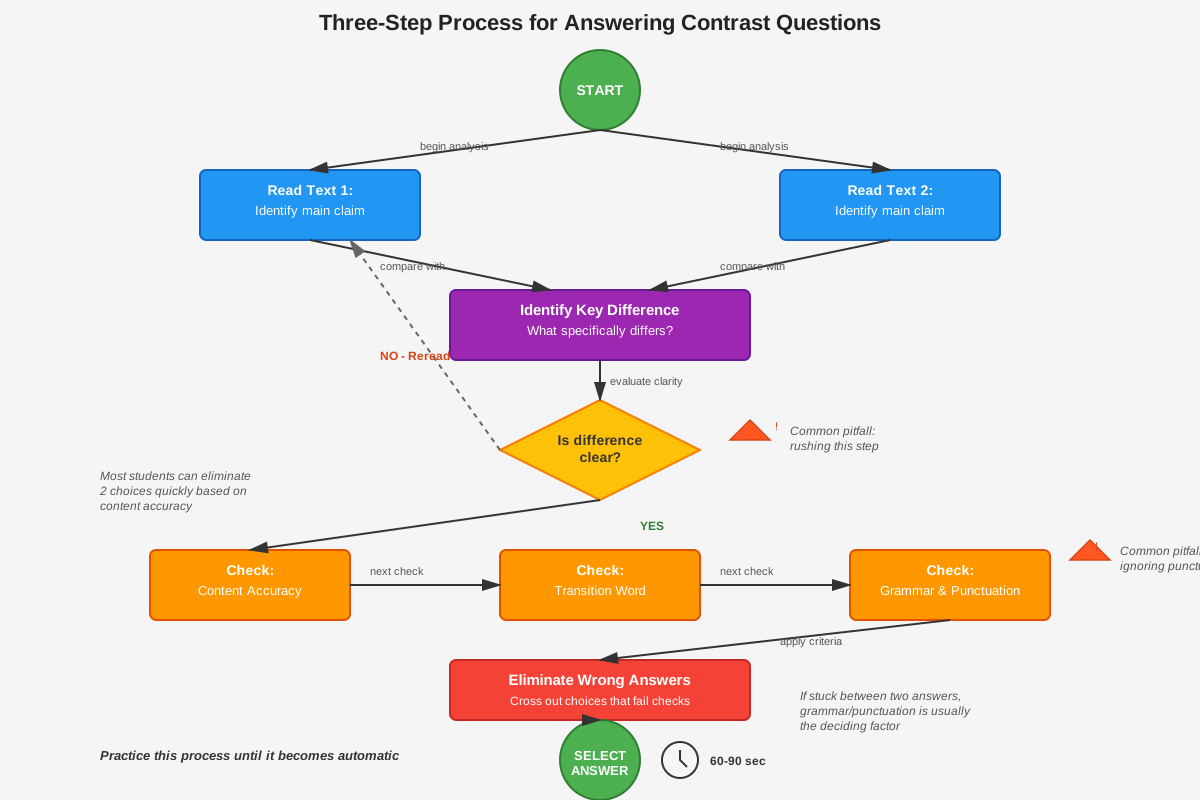
Follow this proven process for maximum accuracy and efficiency:
- Read the prompt first (5-10 seconds): Understand what specific contrast you're looking for before reading the texts
- Read Text 1 actively (20-30 seconds): Identify the main claim, finding, or perspective
- Read Text 2 actively (20-30 seconds): Identify its main claim and note where it differs from Text 1
- Identify the contrast point (5 seconds): Pinpoint the specific aspect on which they differ
- Predict the answer (5-10 seconds): Before looking at choices, mentally formulate what the contrast is
- Evaluate answer choices (20-30 seconds): Eliminate wrong answers and confirm the best choice
- Verify (5-10 seconds): Reread the completed sentence to ensure grammatical correctness and logical accuracy
Total time allocation: 60-90 seconds per question
Trigger Words and Phrases
Watch for these indicators that signal a contrast question:
- "How would [Author 2] respond to [Author 1]?"
- "Based on the texts, what would [Author] most likely claim about..."
- "The findings of [Study 2] differ from [Study 1] in that..."
- "While Text 1 suggests..., Text 2..."
- Any prompt asking you to complete a statement comparing or contrasting two sources
Process of Elimination Strategies
First elimination pass (remove obviously wrong answers):
- Eliminate choices with transition words that indicate agreement (similarly, likewise, additionally) when the texts clearly contrast
- Eliminate choices that misrepresent either text by stating something not mentioned or contradicting what's stated
- Eliminate choices that introduce information not present in either text
Second elimination pass (distinguish between remaining choices):
- Check whether each remaining choice accurately represents the strength of claims (avoid overstatement/understatement)
- Verify that the contrast point matches what the question asks about
- Ensure the transition word precisely matches the logical relationship
Final verification:
- Read the entire completed sentence (prompt + answer choice) aloud mentally
- Confirm grammatical correctness
- Verify that both texts are accurately represented
Time Management Tips
Exam Tip: If you're struggling to identify the contrast point after reading both texts once, reread the prompt to refocus on what specific aspect you should be comparing.
- Don't spend more than 90 seconds on any single contrast question
- If stuck between two answers, check the transition words first—they're often the key difference
- Mark questions where you're uncertain and return if time permits
- Practice reading brief texts quickly while extracting main ideas—this skill is essential for efficiency
Common Traps to Avoid
The reversal trap: Answer choices that accurately describe a contrast but reverse which text says what (e.g., stating Text 1's position as Text 2's position)
The agreement trap: Choices using transition words like "similarly" when texts actually contrast, or vice versa
The overreach trap: Choices that take a text's limited claim and expand it beyond what's stated
The irrelevant difference trap: Choices that identify a true difference between texts but not the difference the question asks about
Memory Techniques
The CONTRAST Acronym
Comprehend each text independently
Observe where they differ
Note the specific contrast point
Transition word must match the relationship
Representation of both texts must be accurate
Avoid overstatement and understatement
Synthesize, don't just summarize
Test the completed sentence for grammar and logic
Transition Word Categories Mnemonic
"HOW NOW" for direct opposition transitions:
- However
- On the other hand
- Whereas
- Nevertheless
- On the contrary
- While
Visualization Strategy
Picture two people having a debate. Text 1 is Person A making their argument. Text 2 is Person B responding. The contrast point is the specific issue they disagree about. The transition word is the signal Person B uses to indicate disagreement ("However, I believe..." or "In contrast to your view..."). This mental image helps clarify that both perspectives must be accurately represented and that the relationship between them must be clear.
The "Both-And-But" Framework
For any contrast question, mentally complete these three phrases:
- Both texts discuss [common topic]
- And Text 1 says [specific claim]
- But Text 2 says [contrasting claim]
This framework ensures you've identified the common ground (what they're both addressing) and the divergence (where they differ).
Summary
Contrasting two ideas is a high-frequency, high-value skill on the SAT Reading and Writing section that requires students to synthesize information from multiple sources and articulate differences clearly and accurately. Success on these questions depends on three core competencies: accurate comprehension of each source, precise identification of the contrast point (the specific aspect on which sources differ), and selection of answer choices that use appropriate transition words while faithfully representing both sources. The most common errors involve misrepresenting sources through overstatement or understatement, selecting transition words that indicate agreement when texts contrast (or vice versa), and identifying irrelevant differences rather than the specific contrast point the question targets. Effective strategy involves reading the prompt first to know what contrast to look for, actively reading each text to extract main claims, predicting the answer before evaluating choices, and systematically eliminating wrong answers while verifying that the correct choice creates a grammatically sound, logically accurate completed sentence. Mastery of this topic strengthens overall synthesis skills and improves performance across multiple question types in the Rhetorical Synthesis domain.
Key Takeaways
- Contrasting two ideas questions require synthesizing information from multiple sources to articulate specific differences, not just summarizing each source separately
- Transition words are critical indicators: "however," "whereas," and "in contrast" signal opposition, while "similarly" and "likewise" signal agreement
- The correct answer must accurately represent BOTH sources—misrepresenting either source makes an answer incorrect regardless of other factors
- The contrast point is the specific aspect on which sources differ; texts may differ in multiple ways, but questions target particular contrasts
- Systematic elimination of wrong answers (checking transition words, accuracy of representation, and relevance to the question) is more efficient than trying to identify the correct answer immediately
- Time allocation should be approximately 60-90 seconds per question, with most time spent on careful reading and evaluation rather than rereading
- Common traps include reversal (switching which text says what), overstatement/understatement, and selecting answers that identify true but irrelevant differences
Related Topics
Rhetorical Synthesis - Supporting a Claim: After mastering contrasting ideas, students can advance to questions requiring synthesis of multiple sources to support rather than contrast claims, building on the same foundational synthesis skills.
Transitions and Logical Flow: Understanding how transition words signal relationships between ideas extends beyond contrast to include cause-effect, example, and emphasis relationships, creating a comprehensive understanding of textual coherence.
Evidence-Based Reading: The skill of accurately representing what texts state (essential for contrast questions) directly supports evidence-based questions that ask students to identify which quotation best supports a claim.
Rhetorical Purpose and Effect: Understanding why authors present contrasting ideas or perspectives deepens comprehension of authorial intent and argumentative strategy, connecting synthesis skills to broader rhetorical analysis.
Practice CTA
Now that you've mastered the core concepts of contrasting two ideas, it's time to apply this knowledge! Work through the practice questions to reinforce your understanding and build the speed and accuracy needed for test day. Each practice question provides an opportunity to implement the CONTRAST framework and refine your systematic approach. The flashcards will help you internalize transition words and common contrast patterns, making recognition automatic during the exam. Remember: synthesis skills improve dramatically with deliberate practice, so commit to working through multiple examples and analyzing both correct and incorrect answer choices. Your investment in mastering this high-yield topic will pay dividends across the entire Reading and Writing section!
Sign up free to keep reading
Create a free AnvayaPrep account to finish this SAT guide on Contrasting two ideas — plus flashcards and practice questions.