Overview
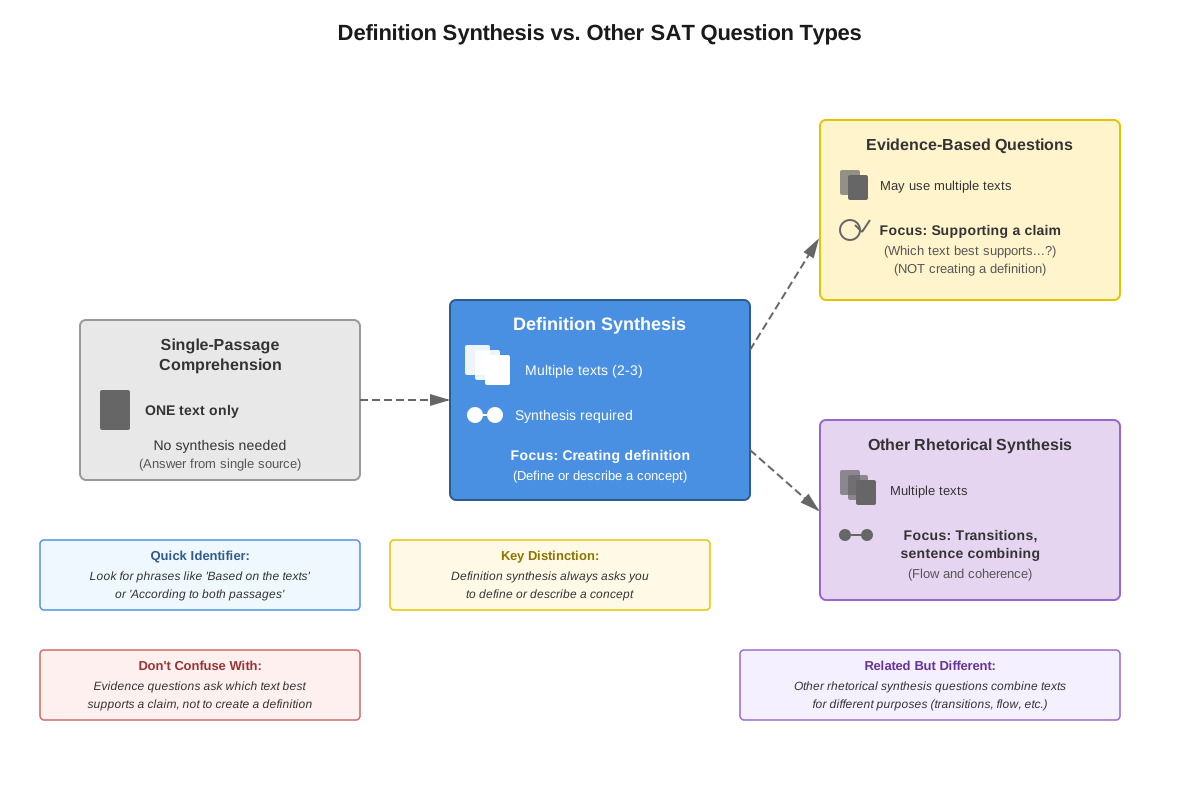
Definition synthesis is a critical question type within the SAT Reading and Writing (RW) section that tests a student's ability to combine information from multiple sources into a coherent, accurate definition of a concept, term, or phenomenon. Unlike traditional comprehension questions that ask students to identify information from a single passage, definition synthesis questions require students to analyze two or more brief texts, extract relevant defining characteristics, and select the answer choice that most accurately synthesizes these elements into a complete definition.
This question type represents a significant portion of the Rhetorical Synthesis questions on the digital SAT, appearing regularly throughout the exam. Students must demonstrate not only reading comprehension but also analytical thinking and the ability to recognize how different sources complement each other to build a fuller understanding of a topic. The skill of synthesizing information from multiple sources mirrors real-world academic and professional tasks, where understanding complex concepts requires integrating perspectives from various authorities, research studies, or explanatory texts.
Mastering sat definition synthesis questions is essential because they assess higher-order thinking skills that form the foundation of college-level reading and writing. These questions connect directly to other rhetorical synthesis tasks, including completing transitions, combining sentences, and integrating evidence. Success with definition synthesis questions demonstrates a student's readiness to engage with the kind of multi-source analysis required in college coursework, research papers, and professional communication. The ability to identify essential versus peripheral information, recognize complementary details, and construct accurate definitions is fundamental to academic success across all disciplines.
Learning Objectives
- [ ] Identify key features of Definition synthesis questions on the SAT
- [ ] Explain how Definition synthesis appears on the SAT and what makes it distinct from other question types
- [ ] Apply Definition synthesis strategies to answer SAT-style questions accurately and efficiently
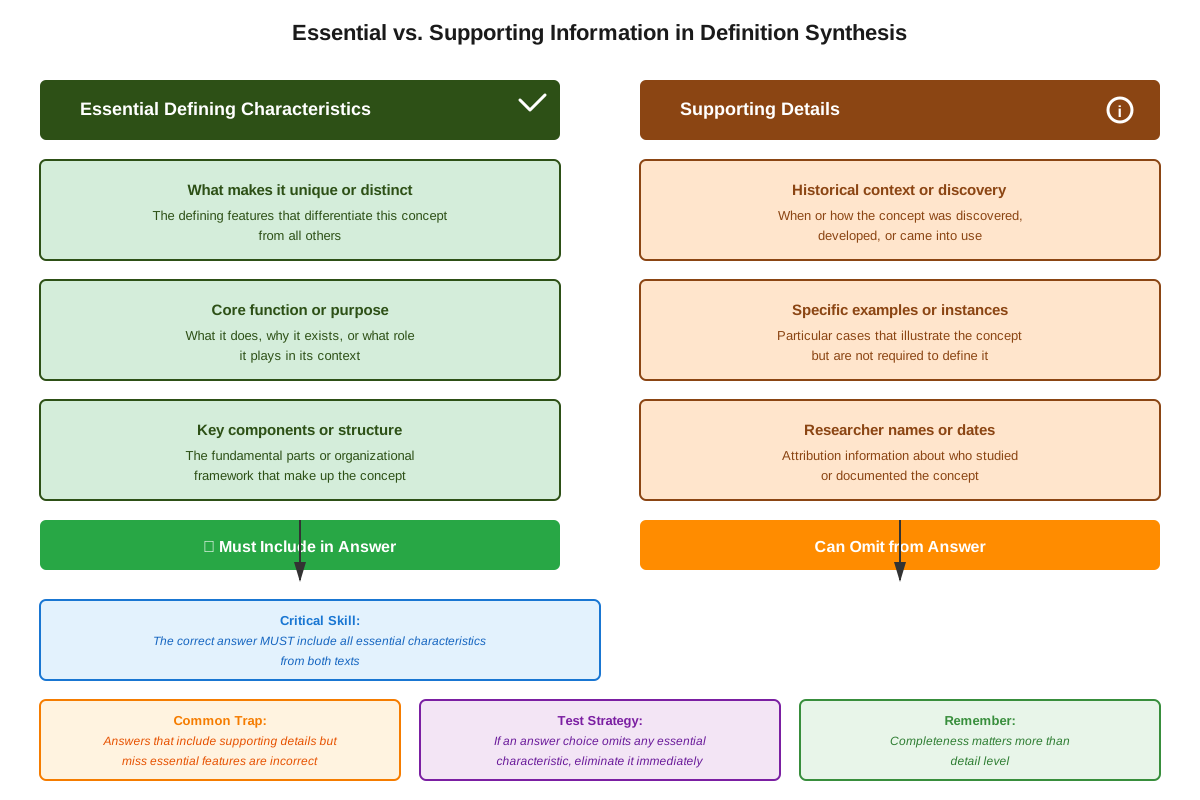
- [ ] Distinguish between essential defining characteristics and supporting details across multiple sources
- [ ] Evaluate answer choices to identify which option most completely and accurately synthesizes information from all provided texts
- [ ] Recognize common patterns in how definition synthesis questions present information across multiple brief passages
Prerequisites
- Basic reading comprehension skills: Students must be able to understand individual passages at the high school level, as definition synthesis builds upon the ability to extract meaning from text before combining information across sources.
- Vocabulary knowledge: Familiarity with academic and domain-specific terminology enables students to recognize when different texts are describing the same concept using varied language.
- Understanding of main ideas versus details: Students need to distinguish between central defining features and peripheral information, as synthesis requires identifying the most important characteristics across texts.
- Familiarity with SAT question formats: Knowledge of how SAT questions are structured helps students quickly identify what the question is asking and how to approach the answer choices systematically.
Why This Topic Matters
Definition synthesis questions appear with high frequency on the digital SAT, typically comprising 2-3 questions per Reading and Writing module. Given that each module contains approximately 27 questions, definition synthesis represents roughly 7-11% of the total rw section score. This consistent presence makes mastering this question type a high-yield investment of study time, as improvement here directly translates to score gains.
In real-world contexts, the ability to synthesize definitions from multiple sources is fundamental to academic research, professional writing, and critical thinking. Students encounter this skill when reading textbooks that present concepts from different angles, when comparing expert opinions in scholarly articles, or when integrating information from lectures and readings. The SAT tests this skill because it predicts success in college-level coursework, where students must regularly combine information from multiple sources to develop comprehensive understanding.
On the exam, definition synthesis questions typically present 2-4 brief texts (usually 1-3 sentences each) that each provide partial information about a concept, phenomenon, scientific process, historical term, or technical vocabulary. The texts might describe different aspects of the same thing, provide complementary details, or offer perspectives from various fields or time periods. Students must read all texts, identify the defining characteristics mentioned in each, and select the answer choice that accurately incorporates the essential information from all sources without introducing inaccuracies or omitting critical details.
Core Concepts
Understanding Definition Synthesis Questions
Definition synthesis questions on the SAT present students with multiple short texts that collectively provide information about a single concept, and then ask students to identify which statement most accurately defines or describes that concept based on all the provided information. The fundamental challenge is recognizing that no single text contains the complete definition—students must mentally combine the key points from each source.
These questions typically follow a consistent format: "Based on the texts, what is [concept/term/phenomenon]?" or "The texts indicate that [concept] is..." The answer choices will all sound plausible, but only one will accurately synthesize information from all texts without adding unsupported claims or omitting essential characteristics mentioned in the sources.
Key Features of Definition Synthesis Questions
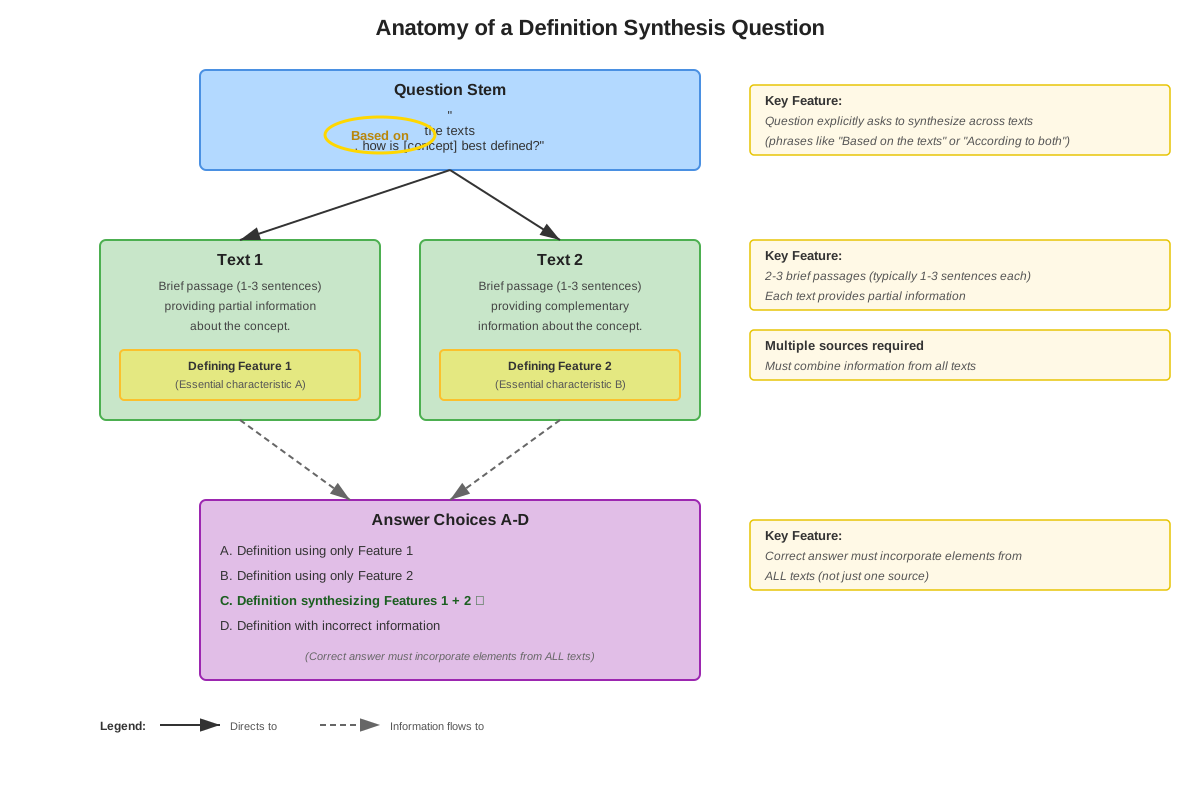
The structure of definition synthesis questions includes several distinctive elements that students should recognize immediately:
| Feature | Description | Strategic Importance |
|---|---|---|
| Multiple brief texts | Usually 2-4 passages, each 1-3 sentences | Each text contributes unique information; all must be considered |
| Numbered or labeled sources | Texts labeled as "Text 1," "Text 2," etc. | Helps track which information comes from which source |
| Synthesis prompt | Asks for a definition or description "based on the texts" | Signals that answer must incorporate all sources |
| Complementary information | Each text adds different details about the same topic | Requires combining, not choosing between sources |
| Answer choices of similar length | All options appear equally plausible at first glance | Demands careful verification against each text |
The Synthesis Process
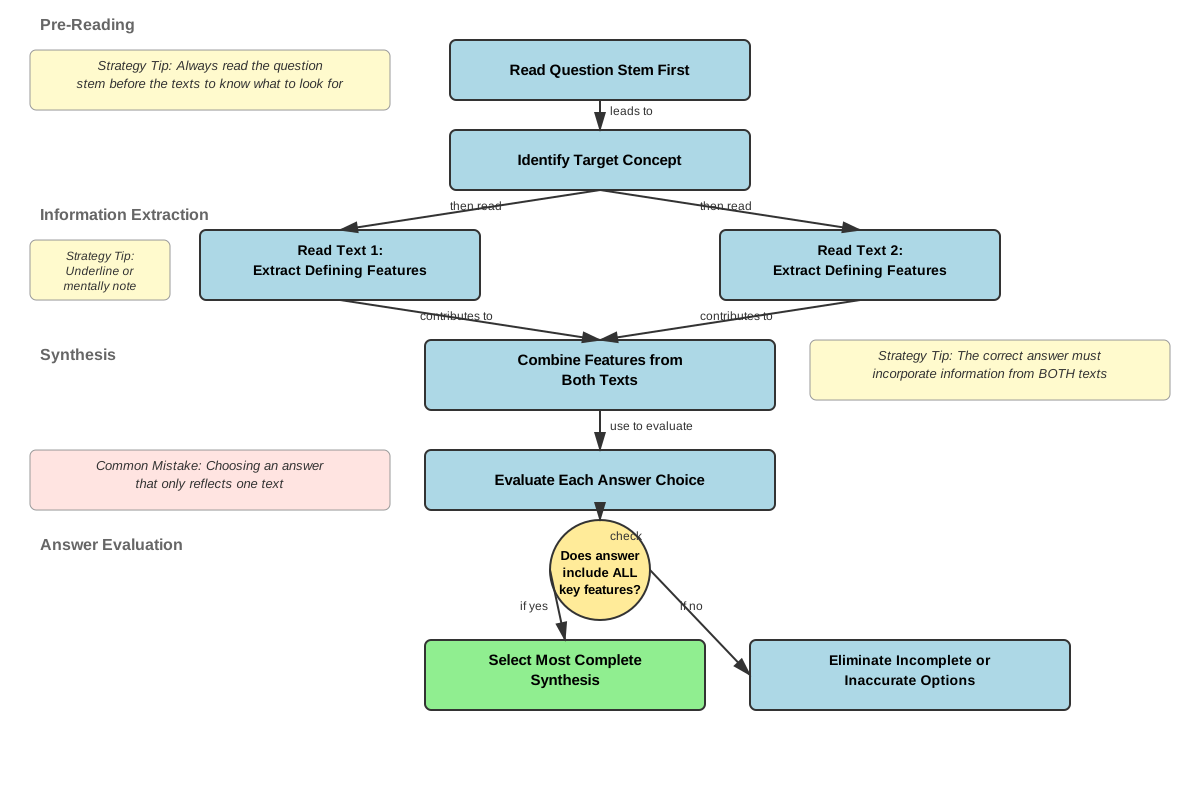
Successfully answering definition synthesis questions requires a systematic approach. First, students must identify the concept being defined—this is usually stated clearly in the question stem. Second, students should read each text actively, noting the specific characteristics, functions, or features mentioned. Third, students must combine the key points mentally, recognizing how the texts complement each other. Finally, students evaluate each answer choice against all texts, eliminating options that contradict any source, omit essential information, or add unsupported details.
The most common error students make is selecting an answer that accurately reflects only one or two of the texts while ignoring information from the others. The correct answer must be faithful to every source provided, incorporating the essential defining characteristics from each without distortion.
Types of Information Presented
Definition synthesis questions can present various types of information across their multiple texts:
- Functional descriptions: What the concept does or its purpose
- Structural characteristics: Physical or organizational features
- Historical context: When or how the concept originated
- Categorical classification: What larger group the concept belongs to
- Distinguishing features: What makes this concept different from similar ones
- Process descriptions: How the concept works or operates
- Examples or applications: Specific instances or uses
A complete synthesis often requires combining different types of information. For instance, one text might describe what something is (classification), another might explain what it does (function), and a third might note when it occurs (temporal context). The correct answer weaves these threads together into a coherent definition.
Evaluating Answer Choices
Each answer choice in a definition synthesis question must be tested against all provided texts. Students should ask three critical questions:
- Does this answer include information from all texts? If an answer only reflects one or two sources while ignoring others, it's incomplete.
- Does this answer contradict any text? Even if an answer sounds good, any contradiction with the source material makes it incorrect.
- Does this answer add information not found in any text? The correct answer synthesizes only what's given; it doesn't introduce new claims, even if they seem reasonable.
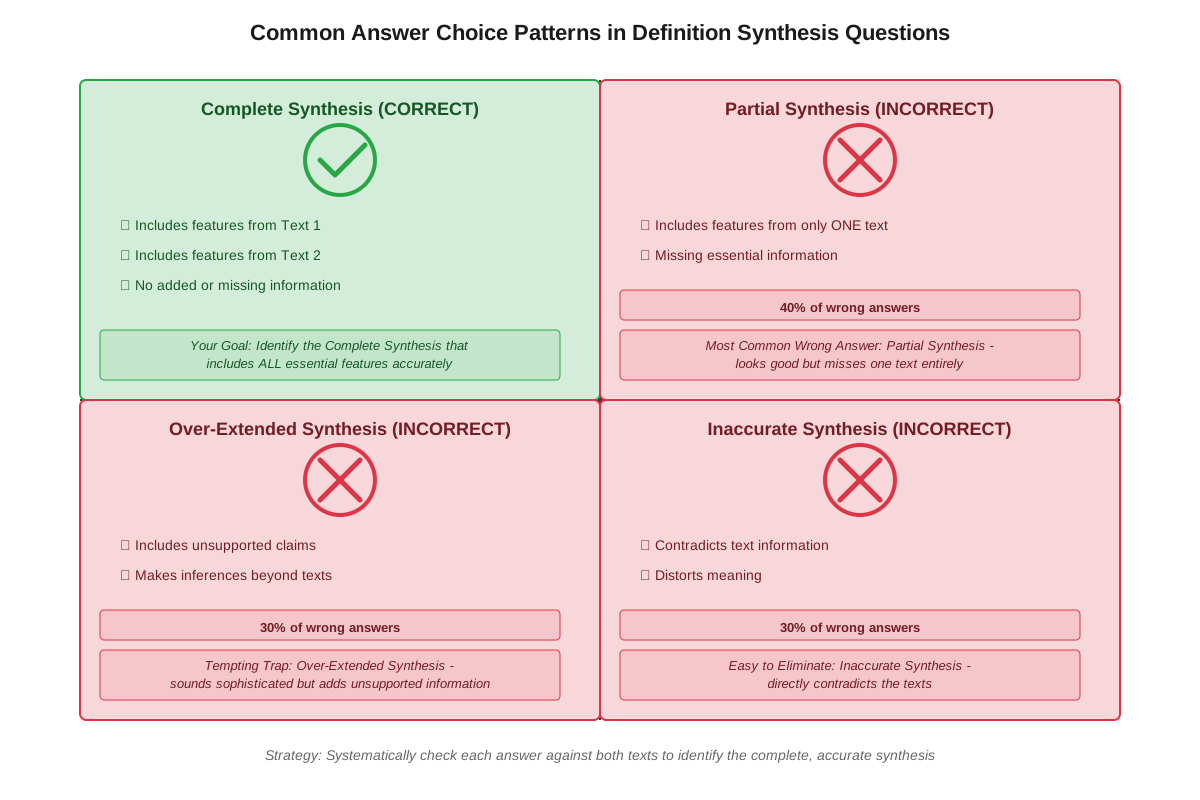
The correct answer will feel like a natural combination of the texts, as if someone read all the sources and then summarized the complete picture in a single statement. Incorrect answers typically fall into predictable categories: too narrow (reflecting only some texts), contradictory (misrepresenting information from one or more texts), or expansive (adding plausible but unsupported details).
Common Text Relationships
Understanding how the multiple texts relate to each other helps students synthesize more effectively. Common patterns include:
- Additive relationships: Each text provides a different characteristic (Text 1: "X is found in oceans"; Text 2: "X has a hard shell"; Text 3: "X filters water for food")
- Perspective relationships: Different experts or fields describe the same phenomenon (Text 1: biological perspective; Text 2: ecological perspective)
- Temporal relationships: Texts describe different time periods or stages (Text 1: historical origin; Text 2: modern application)
- Scale relationships: Texts describe different levels of detail (Text 1: broad category; Text 2: specific mechanism)
Recognizing these relationships helps students understand how to combine the information logically rather than seeing the texts as disconnected or contradictory.
Concept Relationships
Definition synthesis questions build directly on fundamental reading comprehension skills, particularly the ability to identify main ideas and distinguish them from supporting details. This foundational skill enables students to extract the essential defining characteristics from each text rather than getting distracted by examples or elaborations.
The relationship between concepts within definition synthesis follows this progression:
Reading Individual Texts → Identifying Key Characteristics → Recognizing Complementary Information → Mentally Combining Details → Evaluating Synthesis Accuracy
Each step depends on the previous one. Students cannot effectively combine information if they haven't accurately identified what each text contributes, and they cannot evaluate answer choices if they haven't formed a mental picture of what a complete synthesis should include.
Definition synthesis connects to other rhetorical synthesis question types on the SAT. The skills used here—combining information from multiple sources and selecting the most accurate representation—also apply to questions about completing transitions between sentences, choosing the best way to combine sentences, and integrating quotations or data. All these question types assess a student's ability to work with multiple pieces of information and create coherent, accurate connections.
Furthermore, definition synthesis relates to the broader SAT emphasis on evidence-based reading. Just as students must support claims with textual evidence in other question types, definition synthesis requires that every element of the chosen answer be supported by the provided texts. This connection reinforces the SAT's consistent focus on careful, text-based reasoning rather than outside knowledge or assumptions.
High-Yield Facts
⭐ Definition synthesis questions always require information from ALL provided texts—an answer reflecting only some sources is automatically incorrect.
⭐ The correct answer never contradicts any text, even in minor details; any inconsistency eliminates that choice.
⭐ Definition synthesis questions typically present 2-4 brief texts, each contributing unique information about the same concept.
⭐ Answer choices that add plausible but unsupported information are incorrect, even if the added details seem logical or likely true.
⭐ Each text in a definition synthesis question provides complementary rather than redundant information—they work together to build a complete picture.
- Definition synthesis questions appear 2-3 times per Reading and Writing module on the digital SAT, making them a high-frequency question type.
- The texts in definition synthesis questions are always about the same concept, never about different or contrasting topics.
- Correct answers synthesize by combining essential characteristics, not by paraphrasing just one text in detail.
- The question stem typically includes phrases like "based on the texts" or "the texts indicate," signaling the need for synthesis.
- Time-efficient students read all texts before looking at answer choices, forming a mental synthesis first.
- Definition synthesis questions test reading comprehension and analytical thinking simultaneously, making them valuable predictors of college readiness.
- The texts may come from different disciplines (science, history, literature) but always describe the same central concept.
- Incorrect answers often sound sophisticated or academic but fail the test of accurately representing all sources.
Quick check — test yourself on Definition synthesis so far.
Try Flashcards →Common Misconceptions
Misconception: The longest or most detailed answer choice is usually correct because it includes the most information.
Correction: Length doesn't indicate accuracy. The correct answer must be faithful to all texts without adding unsupported details. Sometimes the most concise answer is correct because it efficiently combines only what's stated in the sources.
Misconception: If an answer choice accurately reflects one text very well, it's probably correct.
Correction: The correct answer must synthesize information from ALL texts. An answer that perfectly captures one or two texts while ignoring others is incomplete and therefore incorrect. Every source must be represented.
Misconception: Students should choose the answer that sounds most academic or uses the most sophisticated vocabulary.
Correction: The SAT rewards accuracy, not impressive language. The correct answer is the one that most faithfully represents the combined information from all texts, regardless of how it's worded. Sometimes simpler language is more accurate.
Misconception: If a text mentions something as an example, that example must appear in the correct answer.
Correction: Examples are supporting details, not defining characteristics. The correct answer should capture the general principle or characteristic that the example illustrates, not necessarily the specific example itself.
Misconception: Definition synthesis questions are asking for outside knowledge about the topic being defined.
Correction: These questions test synthesis skills, not prior knowledge. Students should rely exclusively on the information provided in the texts, even if they know additional facts about the topic. The correct answer synthesizes only what's given.
Misconception: The texts will contradict each other, and students must choose which source to trust.
Correction: The texts in definition synthesis questions always provide complementary information that works together. They never genuinely contradict each other. If texts seem contradictory, students are misreading one or more sources.
Misconception: Reading the answer choices first saves time by showing what to look for in the texts.
Correction: Reading answer choices first can create confirmation bias, causing students to see what they expect rather than what's actually stated. It's more effective to read and understand all texts first, then evaluate answer choices against that understanding.
Worked Examples
Example 1: Scientific Concept Synthesis
Text 1
Bioluminescence is the production and emission of light by living organisms. This phenomenon occurs through a chemical reaction involving a light-emitting molecule called luciferin and an enzyme called luciferase.
Text 2
Marine biologists have documented bioluminescence in numerous ocean species, including certain fish, jellyfish, and bacteria. These organisms use their light-producing ability for various purposes, such as attracting prey, deterring predators, and communicating with potential mates.
Text 3
Unlike incandescence, which produces light through heat, bioluminescence is a "cold light" that generates minimal thermal radiation. This efficiency allows organisms to produce light without wasting energy as heat, which would be disadvantageous in their environments.
Question: Based on the texts, what is bioluminescence?
Answer Choices:
A) A chemical reaction found only in marine environments that helps organisms survive by producing heat and light simultaneously.
B) The production of light by living organisms through a chemical reaction involving luciferin and luciferase, used for purposes such as attracting prey and communication, and characterized by minimal heat production.
C) A phenomenon in which certain fish, jellyfish, and bacteria emit light through incandescence to attract mates and deter predators.
D) The emission of cold light by enzymes called luciferase, which marine biologists study to understand how ocean organisms communicate.
Step-by-Step Solution:
First, identify what each text contributes:
- Text 1: Definition (light production by living organisms), mechanism (chemical reaction with luciferin and luciferase)
- Text 2: Examples (marine species), functions (attracting prey, deterring predators, communication)
- Text 3: Distinguishing characteristic (cold light with minimal heat, unlike incandescence)
Now evaluate each answer:
Choice A: INCORRECT. States bioluminescence is "found only in marine environments" (Text 2 gives marine examples but doesn't say it's exclusive to oceans). Also incorrectly states it produces "heat and light simultaneously" (Text 3 explicitly says it produces minimal heat).
Choice B: CORRECT. Includes information from all three texts: production of light by living organisms (Text 1), chemical reaction with luciferin and luciferase (Text 1), purposes like attracting prey and communication (Text 2), and minimal heat production (Text 3). Nothing contradicts any source, and nothing is added.
Choice C: INCORRECT. States organisms emit light "through incandescence," which directly contradicts Text 3's distinction between bioluminescence and incandescence. Also limits the definition to only the specific examples mentioned rather than the broader phenomenon.
Choice D: INCORRECT. Too narrow—focuses only on the enzyme luciferase without mentioning luciferin or that it's a chemical reaction. Omits the functions mentioned in Text 2 and doesn't capture that this is light production by living organisms (the fundamental definition from Text 1).
Answer: B
This example demonstrates how the correct answer weaves together essential information from all three texts without adding unsupported claims or contradicting any source.
Example 2: Historical Term Synthesis
Text 1
The Silk Road was not a single road but rather a network of trade routes connecting East Asia with the Mediterranean region. These routes facilitated the exchange of goods, ideas, and cultural practices across vast distances.
Text 2
Historians note that the Silk Road reached its peak during the Tang Dynasty (618-907 CE) and the Mongol Empire (1206-1368 CE), when political stability and active encouragement of trade made long-distance commerce more feasible and profitable.
Text 3
While silk was indeed a major commodity transported along these routes—giving the network its name—traders also exchanged spices, precious metals, glassware, and technologies such as papermaking and gunpowder.
Question: Based on the texts, what was the Silk Road?
Answer Choices:
A) A single trade route used primarily during the Tang Dynasty to transport silk from East Asia to the Mediterranean.
B) A network of trade routes connecting East Asia and the Mediterranean that facilitated exchange of goods, ideas, and cultural practices, reaching its peak during periods of political stability and carrying diverse commodities beyond silk.
C) A system of roads built by the Mongol Empire to exchange technologies like papermaking and gunpowder between different civilizations.
D) Trade routes that connected Asia and Europe, named after silk, which was the only valuable commodity transported by merchants seeking profit.
Step-by-Step Solution:
Identify each text's contribution:
- Text 1: Structure (network, not single road), geography (East Asia to Mediterranean), function (exchange of goods, ideas, cultural practices)
- Text 2: Historical context (peak during Tang Dynasty and Mongol Empire), conditions (political stability, encouraged trade)
- Text 3: Commodities (silk gave it the name, but also spices, metals, glassware, technologies)
Evaluate each answer:
Choice A: INCORRECT. States it was "a single trade route" (contradicts Text 1's "network of trade routes"). Also says "primarily during the Tang Dynasty" (Text 2 mentions Tang Dynasty as one peak period but also mentions the Mongol Empire). Too narrow overall.
Choice B: CORRECT. Synthesizes all three texts: network of routes (Text 1), connecting East Asia and Mediterranean (Text 1), facilitated exchange of goods, ideas, and cultural practices (Text 1), peaked during periods of political stability (Text 2), carried diverse commodities beyond silk (Text 3). Accurate and complete.
Choice C: INCORRECT. States the Mongol Empire "built" these roads (Text 2 says the Silk Road peaked during the Mongol Empire but doesn't say they built it). Focuses only on technology exchange, omitting the broader exchange of goods and cultural practices mentioned in Text 1.
Choice D: INCORRECT. States silk was "the only valuable commodity" (directly contradicts Text 3, which lists multiple commodities). This single contradiction eliminates this choice regardless of what else it says correctly.
Answer: B
This example shows how students must carefully check each answer against every text, as even one contradiction or significant omission makes an answer incorrect.
Exam Strategy
When approaching definition synthesis questions on the SAT, follow this systematic process to maximize accuracy and efficiency:
Step 1: Identify the concept being defined by reading the question stem carefully. Underline or mentally note the specific term or phenomenon you're defining.
Step 2: Read all texts actively before looking at answer choices. As you read each text, mentally note or jot down the key characteristic or information it provides. Don't try to memorize everything—focus on the main point each text contributes.
Step 3: Form a mental synthesis by combining the key points from all texts. Ask yourself: "If I had to define this concept using all the information I just read, what would I say?"
Step 4: Evaluate answer choices systematically by testing each one against every text. Use this three-part test:
- Does it include information from all texts?
- Does it contradict any text?
- Does it add unsupported information?
Exam Tip: If you're stuck between two answer choices, identify which text or texts each answer reflects. The choice that incorporates all sources is correct; the one that omits a source is wrong.
Trigger words and phrases that signal definition synthesis questions include:
- "Based on the texts..."
- "According to the texts..."
- "The texts indicate that..."
- "What is [concept]?"
- "The texts suggest that [concept] is..."
These phrases tell you immediately that you need to synthesize across all sources rather than focusing on any single text.
Process of elimination strategies specific to definition synthesis:
- Eliminate answers that contradict any text first—these are definitively wrong and easiest to spot.
- Next, eliminate answers that ignore one or more texts—track which texts each answer reflects; incomplete answers are incorrect.
- Then eliminate answers that add unsupported information—even if the addition seems reasonable, if it's not in the texts, it's wrong.
- Finally, choose the answer that most completely and accurately synthesizes all sources—this is your correct answer.
Time allocation: Definition synthesis questions should take approximately 60-75 seconds each. The multiple texts might seem time-consuming, but remember that each text is brief (1-3 sentences). Don't rush through the texts to save time, as misreading even one text can lead to selecting an incorrect answer. The time invested in careful reading pays off in accuracy.
If you're running short on time, definition synthesis questions are actually good candidates to attempt because they're self-contained—all the information you need is provided, unlike some questions that require deeper analysis of longer passages.
Memory Techniques
The "ALL" Mnemonic for evaluating answer choices:
- Accurate to every text (no contradictions)
- Links information from all sources (nothing omitted)
- Limited to what's stated (nothing added)
If an answer meets all three criteria, it's correct.
The "COMBINE" Strategy for reading the texts:
- Concept: Identify what's being defined
- Observe: Read each text carefully
- Main points: Note the key contribution of each text
- Bring together: Mentally synthesize the information
- Inspect: Check each answer against all texts
- Narrow: Eliminate wrong answers systematically
- Evaluate: Choose the most complete synthesis
Visualization Strategy: Picture the texts as puzzle pieces that fit together to create a complete image. Each text is one piece—the correct answer shows the complete puzzle, while wrong answers either show only some pieces, distort pieces, or add pieces that don't belong.
The "Three-Text Test": If there are three texts, use your fingers to track. As you read an answer choice, raise one finger for each text it accurately reflects. If you don't have three fingers up by the end, that answer is incomplete.
Summary
Definition synthesis questions on the SAT require students to combine information from multiple brief texts to identify the most accurate and complete definition of a concept, term, or phenomenon. These high-frequency questions assess both reading comprehension and analytical synthesis skills by presenting 2-4 complementary texts that each contribute unique information about the same topic. Success requires reading all texts carefully, identifying the key characteristic each provides, mentally combining these elements, and selecting the answer choice that accurately incorporates information from all sources without contradicting any text or adding unsupported details. The most common errors involve choosing answers that reflect only some texts, contradict source material, or introduce plausible but unstated information. By following a systematic approach—reading all texts first, forming a mental synthesis, and testing each answer against every source—students can consistently identify correct answers and avoid the predictable traps in incorrect choices.
Key Takeaways
- Definition synthesis questions require combining information from ALL provided texts—answers reflecting only some sources are always incorrect
- The correct answer never contradicts any text, even in minor details, and never adds information not found in the sources
- Read all texts before evaluating answer choices to form an accurate mental synthesis of the complete definition
- Each text provides complementary information that works together; the texts never genuinely contradict each other
- Use systematic elimination: remove answers that contradict texts first, then those that omit sources, then those that add unsupported claims
- These questions appear 2-3 times per module and represent a high-yield opportunity for score improvement
- The skills developed for definition synthesis—careful reading, identifying essential information, and combining sources accurately—apply across the entire Reading and Writing section
Related Topics
Completing Transitions: This rhetorical synthesis question type requires students to choose the best transitional word or phrase to connect ideas between sentences or paragraphs, building on the same multi-source analysis skills used in definition synthesis.
Combining Sentences: Another rhetorical synthesis task where students must select the most effective way to combine two sentences, requiring similar attention to preserving all essential information while creating coherent connections.
Evidence-Based Reading: Throughout the SAT Reading and Writing section, students must support interpretations with textual evidence, a skill that directly relates to ensuring definition synthesis answers are grounded in all provided texts.
Main Ideas and Details: The ability to distinguish between central defining characteristics and supporting examples or elaborations is fundamental to both identifying main ideas in passages and synthesizing definitions from multiple sources.
Mastering definition synthesis creates a strong foundation for these related question types and demonstrates readiness for the kind of multi-source analysis required in college-level academic work.
Practice CTA
Now that you've mastered the concepts and strategies for definition synthesis questions, it's time to put your knowledge into action! Attempt the practice questions to apply these techniques to realistic SAT scenarios, and use the flashcards to reinforce the high-yield facts and strategies you've learned. Remember, definition synthesis is a high-frequency question type that appears multiple times per test—every question you practice brings you closer to mastering this valuable skill and improving your SAT score. You've got this!
Sign up free to keep reading
Create a free AnvayaPrep account to finish this SAT guide on Definition synthesis — plus flashcards and practice questions.