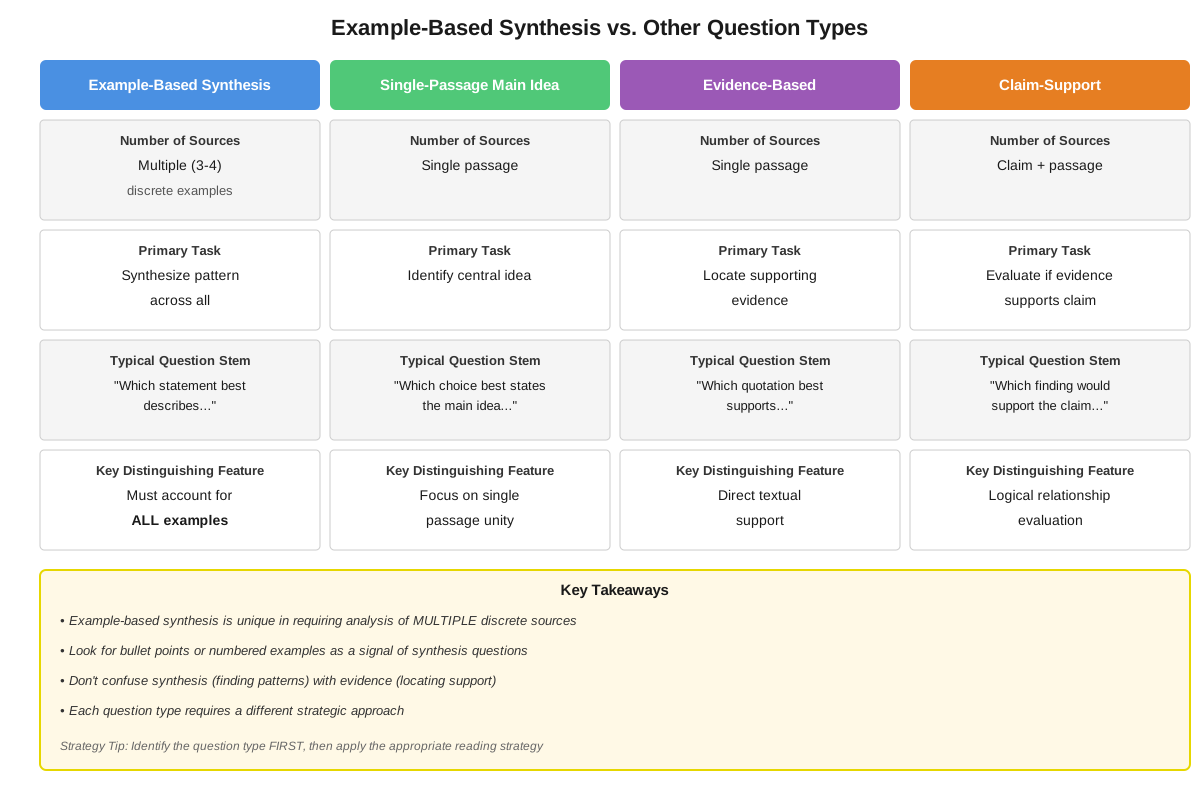
Overview
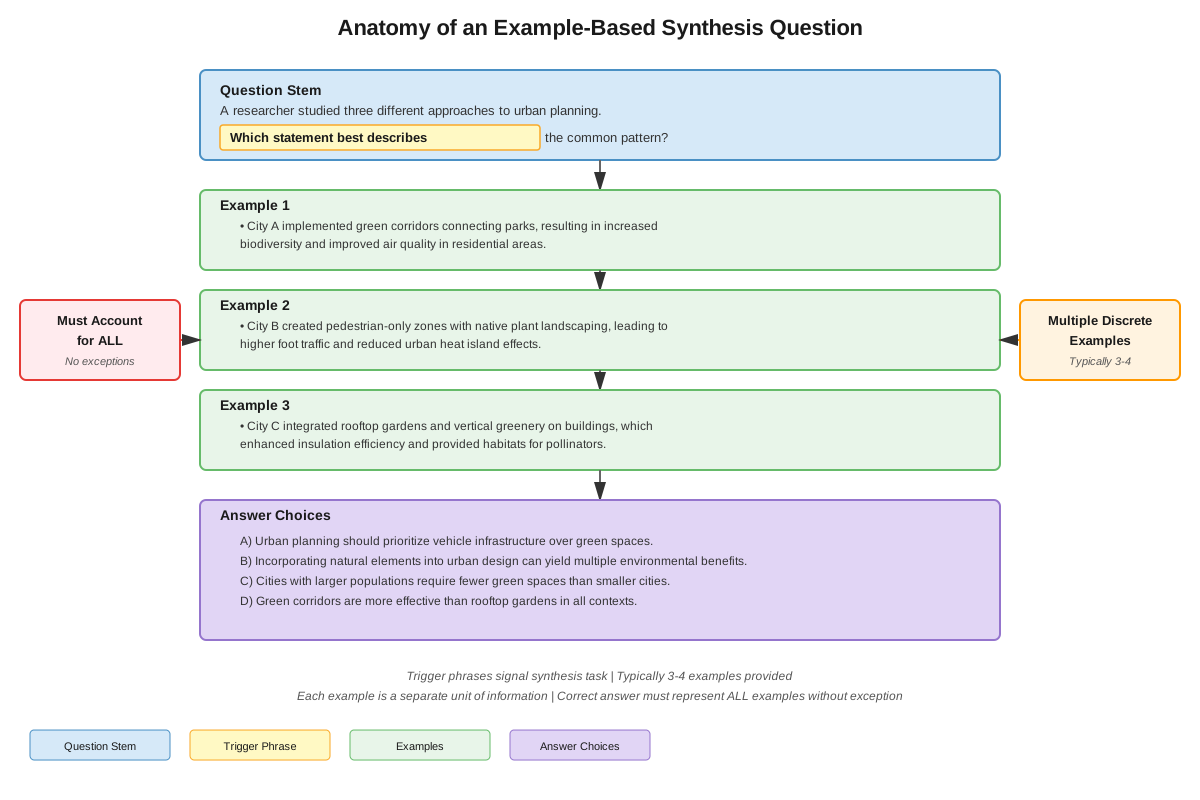
Example-based synthesis is a critical question type on the SAT Reading and Writing section that tests a student's ability to analyze multiple examples and draw a cohesive conclusion that accurately represents all the information presented. Unlike traditional reading comprehension questions that focus on a single passage, sat example-based synthesis questions require students to evaluate several distinct examples—often presented as bullet points or short descriptions—and then select the statement that best synthesizes or summarizes the common thread, pattern, or relationship among them.
This question type appears regularly in the RW (Reading and Writing) section and represents a significant portion of the Rhetorical Synthesis questions students will encounter. The SAT uses example-based synthesis to assess higher-order thinking skills: the ability to identify patterns, recognize relationships, make generalizations, and distinguish between statements that are too broad, too narrow, or inaccurate. Students must demonstrate precision in their thinking, as the correct answer must account for ALL examples provided while avoiding overgeneralization or the inclusion of information not supported by the evidence.
Mastering example-based synthesis is essential not only for SAT success but also for developing critical academic skills. This question type connects directly to other Reading and Writing concepts such as evidence evaluation, claim analysis, and logical reasoning. Students who excel at example-based synthesis demonstrate the ability to move from specific instances to general principles—a fundamental skill in academic writing, research, and analytical thinking across all disciplines.
Learning Objectives
- [ ] Identify key features of Example-based synthesis questions on the SAT
- [ ] Explain how Example-based synthesis appears on the SAT and what makes it distinct from other question types
- [ ] Apply Example-based synthesis strategies to answer SAT-style questions accurately
- [ ] Distinguish between answer choices that are too broad, too narrow, or unsupported by the examples
- [ ] Recognize common patterns and relationships among multiple examples
- [ ] Evaluate whether a synthesis statement accurately represents all provided examples without exception
- [ ] Identify trigger words and phrases that signal example-based synthesis questions
Prerequisites
- Basic reading comprehension skills: Students must be able to understand individual examples and extract key information from short passages or bullet points
- Understanding of main idea vs. supporting details: Example-based synthesis requires distinguishing between specific details in examples and the broader pattern they illustrate
- Familiarity with logical reasoning: Students need to recognize when a conclusion follows logically from evidence and when it makes unsupported leaps
- Knowledge of SAT question format: Understanding how SAT questions are structured helps students navigate the specific presentation of example-based synthesis questions
Why This Topic Matters
Example-based synthesis questions appear with high frequency on the SAT, typically comprising 2-4 questions per test administration. These questions are strategically important because they assess multiple skills simultaneously: reading comprehension, pattern recognition, logical reasoning, and precision in language. The College Board includes these questions to evaluate whether students can synthesize information from multiple sources—a skill essential for college-level research and writing.
In real-world applications, the ability to synthesize multiple examples is fundamental to academic success. Students regularly encounter situations where they must review several case studies, research findings, or historical events and draw meaningful conclusions about patterns or relationships. This skill is crucial in writing research papers, analyzing data, making evidence-based arguments, and understanding complex phenomena across disciplines from science to humanities.
On the SAT, example-based synthesis questions typically appear in a consistent format: students are presented with 3-4 brief examples (often about scientific studies, historical events, literary works, or social phenomena), followed by a prompt that begins with phrases like "Based on the texts, what do the examples have in common?" or "Which statement best describes a pattern shared by all the examples?" The examples are usually presented as numbered bullet points, each containing 1-3 sentences. Students must then select from four answer choices, each offering a different synthesis or generalization about the examples.
Core Concepts
Understanding Example-Based Synthesis Structure
Example-based synthesis questions follow a predictable structure that students can learn to recognize immediately. The question presents multiple discrete examples—typically three or four—each describing a specific instance, study, event, or phenomenon. These examples are carefully selected to share a common characteristic, pattern, or relationship, but they differ in their specific details. The student's task is to identify what unites all the examples without overgeneralizing or ignoring any of the provided information.
The examples themselves are usually parallel in structure, meaning each one provides similar types of information (e.g., all describe scientific studies with methods and findings, or all describe historical figures and their accomplishments). This parallelism helps students compare the examples systematically. However, the SAT deliberately includes varying details to test whether students can distinguish between essential shared features and incidental differences.
The Synthesis Process
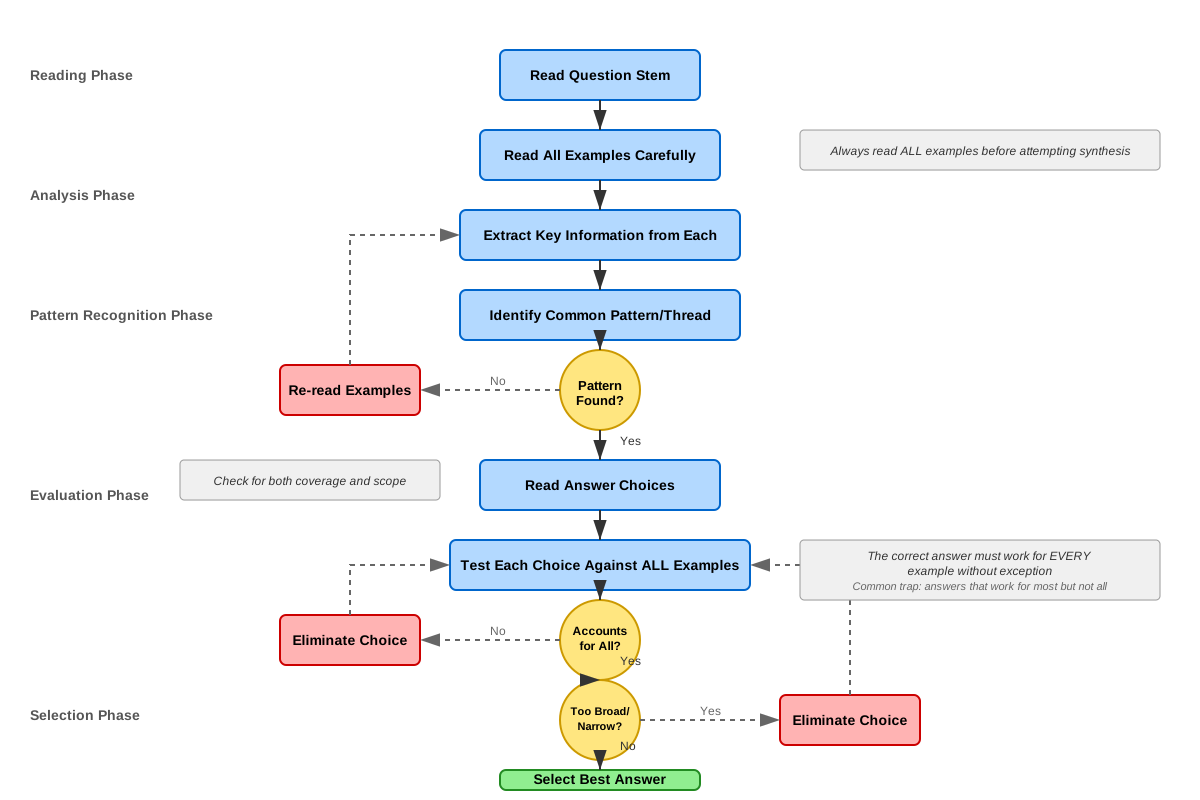
Successful example-based synthesis requires a systematic approach. First, students must read each example carefully and identify its key features—the main subject, action, outcome, or characteristic described. Second, students should look for commonalities across all examples, noting what appears in every single instance. Third, students must evaluate the answer choices against these commonalities, eliminating options that fail to account for even one example or that introduce information not present in any example.
The synthesis statement—the correct answer—must satisfy three critical criteria:
- Universality: It must apply to ALL examples without exception
- Accuracy: It must not introduce information unsupported by the examples
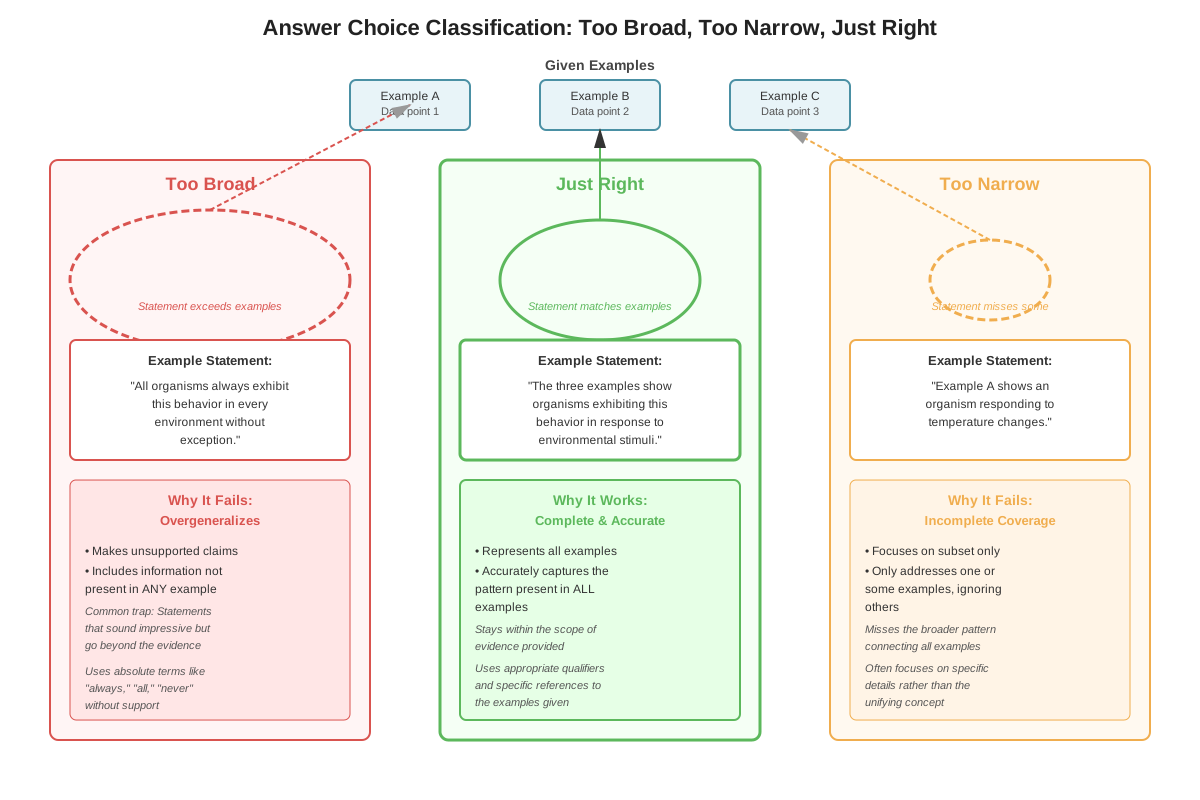
- Appropriate scope: It must be neither too broad (overgeneralizing) nor too narrow (focusing on only some examples)
Types of Patterns in Example-Based Synthesis
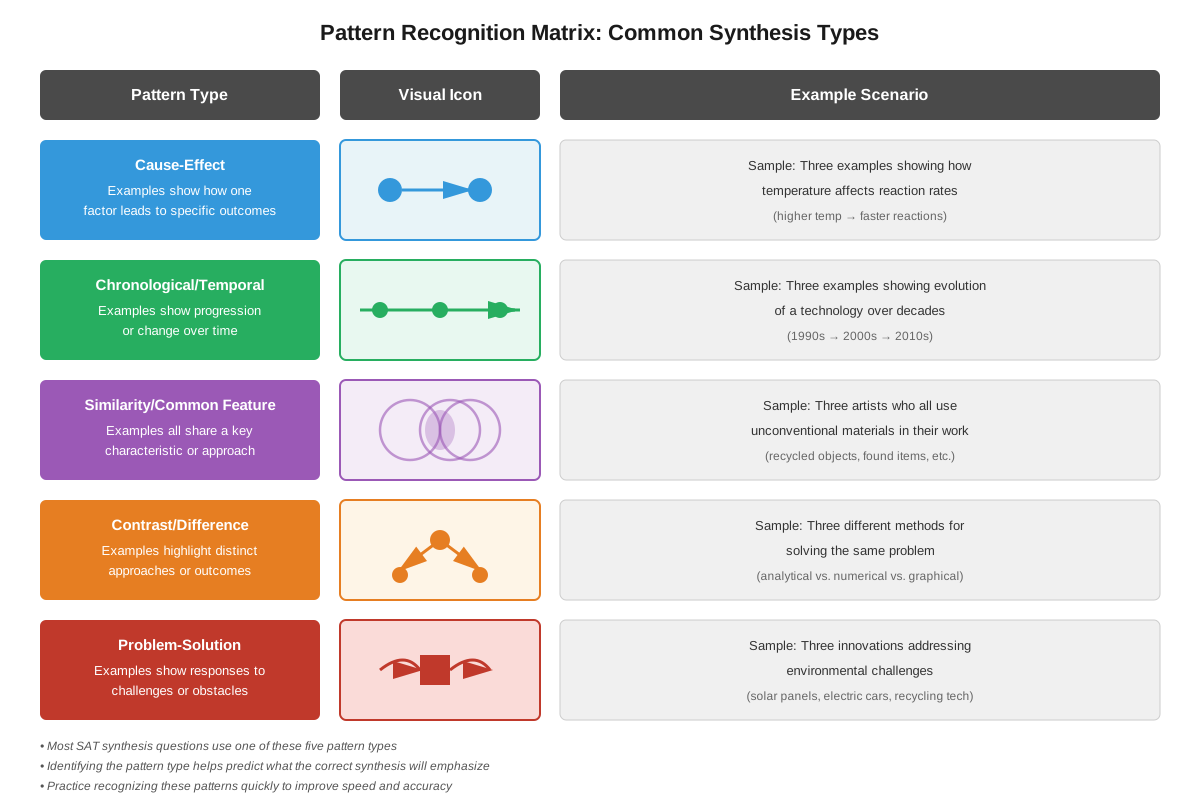
The SAT tests several common types of patterns that students should recognize:
| Pattern Type | Description | Example Signal |
|---|---|---|
| Causal relationships | All examples show a similar cause-and-effect relationship | "Each example demonstrates how X leads to Y" |
| Methodological similarities | All examples use similar approaches or techniques | "All studies employed similar research methods" |
| Outcome patterns | All examples result in comparable outcomes | "In each case, the result was..." |
| Characteristic sharing | All subjects possess a common trait or feature | "All individuals exhibited..." |
| Temporal patterns | All examples occur during similar time periods or sequences | "Each event took place during..." |
| Functional similarities | All examples serve similar purposes or functions | "All mechanisms work by..." |
Evaluating Answer Choices
The answer choices in example-based synthesis questions are carefully crafted to include common errors in reasoning. Understanding these error types helps students eliminate incorrect options efficiently:
Too Broad: These answer choices make claims that extend beyond what the examples support. For instance, if all examples describe mammals that live in water, an answer stating "all aquatic animals" would be too broad because the examples don't include fish, amphibians, or other aquatic animals.
Too Narrow: These answer choices focus on details present in only some examples, not all. If three examples mention nocturnal animals and one mentions a diurnal animal, an answer focusing on nocturnal behavior would be too narrow.
Unsupported: These answer choices introduce information not present in any example. They may sound plausible but lack textual evidence.
Accurate but Incomplete: These answer choices correctly describe some aspect of the examples but miss the most significant or comprehensive pattern.
The Role of Precision in Language
Example-based synthesis questions test students' attention to precise language. Words like "all," "some," "most," "always," "often," and "sometimes" carry significant weight. A synthesis statement using "all" must apply to every single example without exception. Similarly, qualifiers like "primarily," "mainly," or "typically" suggest that the pattern is dominant but may have exceptions—students must verify whether such qualifiers are appropriate given the examples.
The SAT also tests whether students can distinguish between correlation and causation, between description and explanation, and between observation and interpretation. A correct synthesis might describe what all examples have in common (observation), while an incorrect answer might explain why this commonality exists (interpretation not supported by the text).
Concept Relationships
Example-based synthesis builds directly on fundamental reading comprehension skills, particularly the ability to identify main ideas and distinguish them from supporting details. Each individual example contains specific details, but the synthesis process requires students to abstract from these specifics to find the unifying principle—essentially identifying the "main idea" that connects multiple texts.
This topic connects closely to evidence evaluation skills tested elsewhere in the SAT Reading and Writing section. Just as students must determine whether evidence supports a claim in other question types, example-based synthesis requires determining whether a synthesis statement is supported by all the provided examples. The logical reasoning is similar: Does the conclusion follow from the premises?
The relationship flow works as follows:
Individual Example Comprehension → Pattern Recognition Across Examples → Synthesis Statement Evaluation → Elimination of Incorrect Generalizations → Selection of Accurate, Appropriately-Scoped Answer
Example-based synthesis also relates to the broader category of Rhetorical Synthesis questions, which test how information can be combined, summarized, or integrated. While other rhetorical synthesis questions might focus on combining information from different sources or completing a text logically, example-based synthesis specifically emphasizes finding commonalities among parallel examples.
High-Yield Facts
⭐ Example-based synthesis questions always present 3-4 discrete examples that share a common pattern or characteristic
⭐ The correct answer must apply to ALL examples without exception—if even one example doesn't fit, the answer is wrong
⭐ Answer choices that introduce information not present in any example are always incorrect
⭐ Questions typically begin with phrases like "Based on the texts" or "What do these examples have in common?"
⭐ The most common wrong answer types are "too broad," "too narrow," and "unsupported by evidence"
- Examples are usually presented in bullet-point or numbered format for easy comparison
- The correct synthesis statement balances specificity and generalization—it's neither too detailed nor too vague
- Qualifiers like "all," "some," "most," and "always" are critical to evaluate carefully in answer choices
- The examples often come from similar domains (all scientific studies, all historical events, etc.) to facilitate comparison
- Students should check each answer choice against each example systematically, not rely on general impressions
- Time pressure makes it tempting to choose answers that "sound good" rather than verifying them against all examples
- The SAT deliberately includes examples with varying surface details to test whether students can identify deeper patterns
Quick check — test yourself on Example-based synthesis so far.
Try Flashcards →Common Misconceptions
Misconception: The correct answer will mention specific details from the examples → Correction: The correct synthesis statement typically operates at a higher level of abstraction, describing the pattern or commonality rather than listing specific details. Specific details are what make the examples different; the synthesis focuses on what makes them similar.
Misconception: If an answer choice is true for most examples, it's probably correct → Correction: The correct answer must be true for ALL examples without exception. Even if an answer applies to three out of four examples, it's incorrect if it doesn't apply to the fourth. The SAT tests precision in reasoning.
Misconception: The longest or most complex answer choice is usually correct → Correction: Answer length and complexity have no correlation with correctness. Sometimes the correct answer is the simplest and most straightforward statement. Students should evaluate based on accuracy and scope, not sophistication of language.
Misconception: Background knowledge about the topic should guide answer selection → Correction: Students must base their answers solely on the information provided in the examples. Even if background knowledge suggests a different pattern or relationship, the correct answer must be supported by the specific examples given.
Misconception: The examples are presented in order of importance, so later examples matter less → Correction: All examples carry equal weight. The correct synthesis must account for the first example just as much as the last. The SAT does not prioritize examples by position.
Worked Examples
Example 1: Scientific Studies Pattern
Question Stem: A student is researching how animals adapt to extreme environments. The student has found the following examples:
- Arctic foxes develop thick white fur during winter months, which provides insulation and camouflage in snowy environments.
- Desert kangaroo rats have highly efficient kidneys that allow them to survive without drinking water, extracting all necessary moisture from their food.
- Deep-sea anglerfish possess bioluminescent lures that attract prey in the complete darkness of ocean depths where sunlight cannot penetrate.
- Emperor penguins huddle together in large groups and rotate positions to share body heat during Antarctic winters when temperatures drop below -40°F.
Based on the texts, what do these examples have in common?
Answer Choices:
A) All animals develop physical features that help them survive in harsh climates.
B) All animals have evolved specialized adaptations that enable survival in their extreme environments.
C) All animals use camouflage or mimicry to protect themselves from predators.
D) All animals live in environments where temperatures are significantly different from temperate zones.
Step-by-Step Solution:
First, identify the key feature of each example:
- Arctic foxes: physical adaptation (fur) for cold and camouflage
- Kangaroo rats: physiological adaptation (kidney function) for water scarcity
- Anglerfish: physical adaptation (bioluminescence) for darkness
- Emperor penguins: behavioral adaptation (huddling) for extreme cold
Now evaluate each answer:
Choice A: "Physical features" is too narrow. While arctic foxes and anglerfish have physical features, kangaroo rats' kidney efficiency is physiological, and emperor penguins' huddling is behavioral, not a physical feature. Eliminate.
Choice B: Check each example—arctic foxes have specialized fur (✓), kangaroo rats have specialized kidneys (✓), anglerfish have specialized lures (✓), emperor penguins have specialized behavior (✓). All involve "specialized adaptations" and all enable "survival in extreme environments." This applies universally. Keep.
Choice C: Only arctic foxes clearly use camouflage. The other examples don't involve camouflage or mimicry. Eliminate.
Choice D: While this is true for arctic foxes and emperor penguins (cold) and arguably kangaroo rats (hot desert), the deep-sea environment's defining feature is darkness and pressure, not temperature difference. This doesn't capture the essential commonality. Eliminate.
Correct Answer: B
This answer works because it operates at the right level of abstraction—"specialized adaptations" encompasses physical, physiological, and behavioral changes, and "extreme environments" covers all the different types of extremes mentioned (cold, heat, darkness, water scarcity).
Example 2: Historical Figures Pattern
Question Stem: A researcher is studying influential Renaissance figures. The researcher has compiled the following information:
- Leonardo da Vinci created detailed anatomical drawings based on human dissections, designed innovative engineering devices, and painted masterpieces like the Mona Lisa.
- Michelangelo sculpted the David, painted the Sistine Chapel ceiling, and wrote poetry exploring themes of love and spirituality.
- Galileo Galilei made astronomical observations with improved telescopes, wrote treatises on physics and motion, and composed works defending the heliocentric model of the solar system.
Based on the texts, what pattern do these examples illustrate?
Answer Choices:
A) All three figures made their most important contributions in the visual arts.
B) All three figures worked primarily in Italy during the Renaissance period.
C) All three figures demonstrated expertise across multiple disciplines or fields.
D) All three figures faced opposition from religious authorities for their work.
Step-by-Step Solution:
Identify what each example emphasizes:
- Da Vinci: art (drawing, painting) + engineering + anatomy
- Michelangelo: sculpture + painting + poetry
- Galileo: astronomy + physics + writing
Evaluate each answer:
Choice A: While da Vinci and Michelangelo were primarily visual artists, Galileo's most important contributions were in astronomy and physics, not visual arts. Eliminate.
Choice B: This is factually true (all worked in Italy during the Renaissance), but it focuses on biographical details rather than the pattern the examples emphasize. The examples highlight their work across fields, not their location or time period. While not technically wrong, it misses the point. Questionable—hold for comparison.
Choice C: Da Vinci worked in art, engineering, and anatomy (✓). Michelangelo worked in sculpture, painting, and poetry (✓). Galileo worked in astronomy, physics, and writing (✓). All demonstrated "expertise across multiple disciplines." Strong candidate.
Choice D: Only Galileo clearly faced religious opposition (for heliocentrism). While Michelangelo had conflicts with patrons, and da Vinci's dissections were controversial, the examples don't emphasize religious opposition as a common thread. Eliminate.
Correct Answer: C
While Choice B is factually accurate, Choice C better captures the pattern that the examples emphasize—the structure of each example deliberately lists multiple different types of work, highlighting their interdisciplinary nature. This is what the examples "have in common" in terms of the pattern they illustrate.
Exam Strategy
When approaching example-based synthesis questions on the SAT, follow this systematic process:
Step 1: Identify the question type immediately. Look for trigger phrases like "Based on the texts," "What do these examples have in common?", "Which statement best describes," or "What pattern do these examples illustrate?"
Step 2: Read all examples before looking at answer choices. As you read each example, jot down (mentally or on scratch paper) the key feature or main point. Don't get lost in minor details—focus on what seems most important about each example.
Step 3: Look for the common thread. Before reading answer choices, try to articulate in your own words what all the examples share. This prevents answer choices from biasing your thinking.
Step 4: Use the "all examples test". For each answer choice, systematically check it against every single example. Create a mental checklist: Does this apply to Example 1? Example 2? Example 3? Example 4? If the answer is "no" for even one example, eliminate that choice immediately.
Step 5: Watch for scope issues. Ask yourself: Is this answer too broad (claiming more than the examples support)? Is it too narrow (only applying to some examples)? Is it introducing new information not present in the examples?
Exam Tip: The most common trap answers are those that apply to 2-3 examples but not all. The SAT knows students often choose answers that "mostly" work. Train yourself to verify ALL examples.
Trigger words to watch for in questions:
- "Based on the texts" (signals you must use only provided information)
- "Have in common" (signals universal pattern)
- "Pattern" (signals recurring feature)
- "Best describes" (signals you're synthesizing)
- "All examples" (emphasizes universality requirement)
Time allocation: These questions typically take 60-90 seconds. Don't rush the verification process—spending an extra 15 seconds to check each example against your chosen answer prevents careless errors. However, if you're stuck between two answers after checking, make your best choice and move on rather than spending 3+ minutes.
Process of elimination tips:
- Eliminate answers with absolute language ("always," "never," "only") unless every example clearly supports such strong claims
- Eliminate answers that mention specific details from just one or two examples
- Eliminate answers that require background knowledge not provided in the examples
- Keep answers that use appropriately qualified language ("typically," "often," "tend to") when examples show consistent but not identical patterns
Memory Techniques
The "ALL" Mnemonic for checking answers:
- Applies to every example?
- Logically supported by text?
- Level of scope appropriate?
The "SCAN" Method for reading examples:
- Subject: Who or what is each example about?
- Characteristic: What key feature does it describe?
- Action or outcome: What happens or what does it do?
- Note commonalities: What appears in multiple examples?
Visualization Strategy: Picture the examples as overlapping circles in a Venn diagram. The correct answer describes what's in the overlapping center section—what ALL circles share. Wrong answers describe what's only in some circles or what's outside the circles entirely.
The "Three Strikes" Rule: When evaluating an answer choice, if you find even one example it doesn't fit, that answer gets a "strike" and should be eliminated. You don't need three strikes—one is enough. This prevents you from talking yourself into wrong answers.
Acronym for Common Patterns - COMFET:
- Causal (cause-effect relationships)
- Outcome (similar results)
- Method (similar approaches)
- Function (similar purposes)
- Evidence (similar types of support)
- Trait (shared characteristics)
Summary
Example-based synthesis questions on the SAT Reading and Writing section require students to analyze multiple discrete examples and identify the pattern, relationship, or commonality that unites them all. These questions test the ability to move from specific instances to accurate generalizations while avoiding overgeneralization, undergeneralization, or the introduction of unsupported information. Success requires systematic verification that the chosen synthesis statement applies to every single example without exception. Students must distinguish between essential shared features and incidental differences, evaluate the scope of synthesis statements, and recognize when answer choices are too broad, too narrow, or unsupported by the provided examples. The key to mastering this question type lies in methodical comparison of examples, careful attention to precise language and qualifiers, and disciplined verification of each answer choice against all examples before making a selection.
Key Takeaways
- Example-based synthesis questions present 3-4 examples and ask students to identify what they all have in common or what pattern they illustrate
- The correct answer must apply to ALL examples without exception—even one counterexample makes an answer wrong
- Common wrong answer types include statements that are too broad, too narrow, or introduce unsupported information
- Systematic verification is essential: check each answer choice against each example individually
- Focus on the level of abstraction—the synthesis should capture the essential commonality, not specific surface details
- Trigger phrases like "Based on the texts" and "have in common" signal this question type
- Precision in language matters: pay attention to qualifiers like "all," "some," "most," "always," and "typically"
Related Topics
Evidence-Based Reading Questions: Example-based synthesis builds on skills used in evidence-based questions, where students must evaluate whether textual evidence supports a claim. Mastering example-based synthesis strengthens the ability to assess the relationship between specific examples and general conclusions.
Rhetorical Purpose Questions: Understanding why authors include multiple examples and how those examples work together relates directly to rhetorical purpose analysis. Both question types require recognizing patterns in how information is presented.
Main Idea and Summary Questions: The skill of synthesizing multiple examples into a single statement parallels the skill of identifying main ideas or creating summaries. Both require distinguishing essential information from supporting details.
Logical Reasoning and Inference: Example-based synthesis develops logical reasoning skills that transfer to inference questions, where students must draw conclusions supported by textual evidence without overgeneralizing.
Practice CTA
Now that you've mastered the concepts and strategies for example-based synthesis questions, it's time to put your knowledge into practice! Work through the practice questions to apply the systematic verification process you've learned. Use the flashcards to reinforce key concepts and common patterns. Remember, example-based synthesis is a highly learnable skill—with focused practice, you'll develop the pattern recognition and verification habits that lead to consistent success on these questions. Each practice question you complete strengthens your ability to think precisely and synthesize information effectively, skills that will serve you well beyond the SAT!
Sign up free to keep reading
Create a free AnvayaPrep account to finish this SAT guide on Example-based synthesis — plus flashcards and practice questions.