Overview
Explaining a relationship is a critical skill tested in the SAT Reading and Writing (RW) section, specifically within the Rhetorical Synthesis domain. This question type requires students to analyze multiple sources of information and synthesize them into a coherent explanation of how two or more elements relate to each other. Unlike simple comprehension questions that ask "what happened," these questions demand that students understand "how" or "why" things connect, requiring deeper analytical thinking and the ability to recognize causal, correlational, comparative, or contrasting relationships between ideas, data points, or phenomena.
On the SAT, explaining a relationship questions typically present students with brief texts, data tables, graphs, or a combination of sources, then ask them to select the answer choice that most accurately describes the relationship between specific elements. These questions assess whether students can move beyond surface-level reading to identify underlying connections, patterns, and logical relationships. Success requires careful attention to transition words, logical connectors, and the precise language used to describe how concepts interact with one another.
This topic is foundational to the broader Rhetorical Synthesis unit because it bridges pure reading comprehension with analytical reasoning. Students who master explaining relationships develop skills that transfer to other SAT question types, including those involving evidence selection, argument analysis, and data interpretation. The ability to articulate relationships clearly and precisely is also essential for the SAT Essay (when offered) and forms the backbone of college-level academic writing and critical thinking.
Learning Objectives
- [ ] Identify key features of Explaining a relationship questions on the SAT
- [ ] Explain how Explaining a relationship appears on the SAT Reading and Writing section
- [ ] Apply Explaining a relationship strategies to answer SAT-style questions accurately
- [ ] Distinguish between different types of relationships (causal, correlational, comparative, contrastive)
- [ ] Evaluate answer choices for precision and accuracy in describing relationships
- [ ] Synthesize information from multiple sources to construct relationship explanations
Prerequisites
- Basic reading comprehension: Understanding main ideas and supporting details is essential because relationship questions build upon foundational comprehension skills
- Vocabulary knowledge: Familiarity with transition words and logical connectors (however, therefore, although, because) helps identify relationship types
- Data interpretation fundamentals: Basic ability to read tables and graphs is necessary since many relationship questions incorporate visual data
- Sentence structure understanding: Recognizing how clauses connect within complex sentences aids in identifying relationships between ideas
Why This Topic Matters
Understanding how to explain relationships is not merely an academic exercise—it reflects the type of analytical thinking required in college coursework, professional research, and everyday decision-making. When scientists describe how variables interact, when historians explain causes of events, or when business analysts compare market trends, they are all explaining relationships. The SAT tests this skill because it predicts success in higher education, where students must constantly synthesize information from multiple sources and articulate how concepts connect.
On the SAT, explaining a relationship questions appear with high frequency, typically comprising 2-4 questions per test administration in the Reading and Writing section. These questions carry significant weight because they assess higher-order thinking skills rather than simple recall. According to College Board data, students who perform well on Rhetorical Synthesis questions, including relationship explanations, tend to score in the upper percentiles overall, as these questions effectively differentiate between proficient and advanced readers.
These questions commonly appear in passages discussing scientific research (showing cause-and-effect relationships between variables), historical analysis (explaining how events influenced one another), social science studies (comparing different groups or conditions), and literary analysis (contrasting characters or themes). Students might encounter a brief text describing an experiment followed by data, then be asked to explain the relationship between the experimental conditions and the results. Alternatively, they might read two short passages presenting different perspectives and need to articulate how those viewpoints relate to each other.
Core Concepts
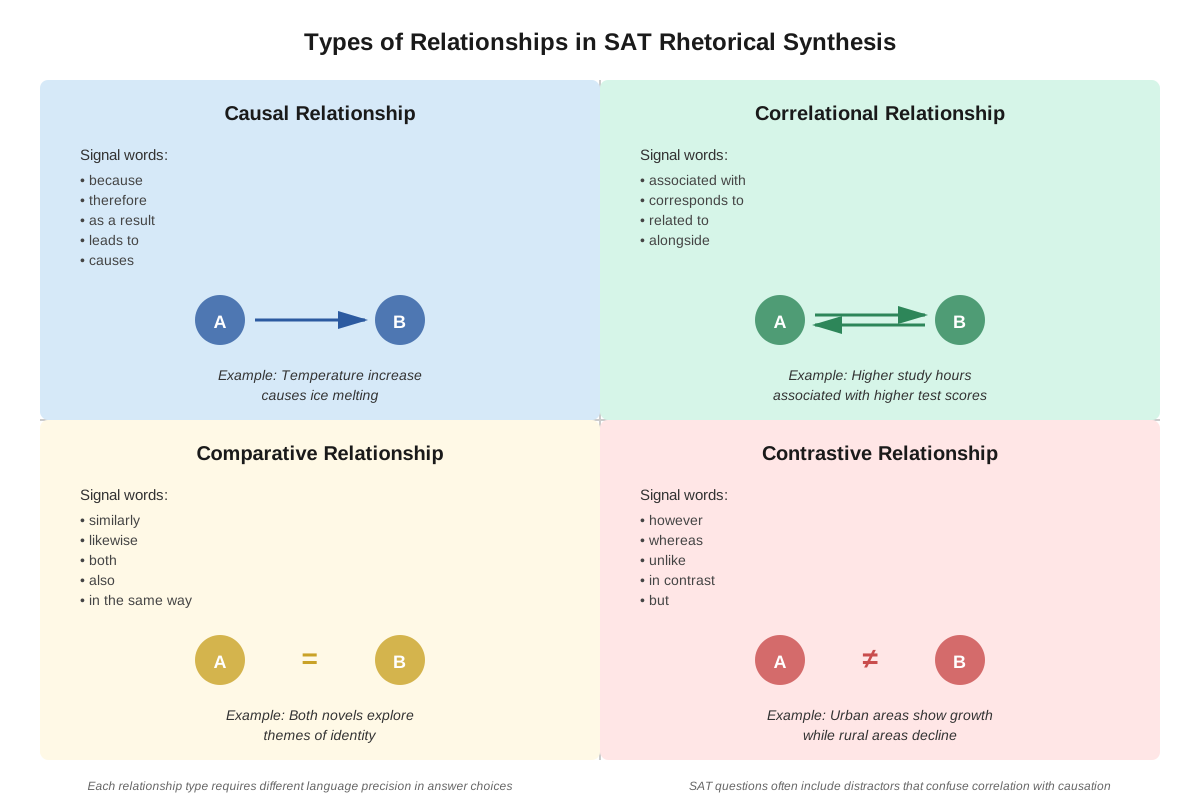
Types of Relationships
The foundation of mastering sat explaining a relationship questions lies in recognizing the distinct types of relationships that appear on the exam. Each relationship type has characteristic language patterns and logical structures.
Causal relationships describe situations where one element directly causes or produces another. These relationships follow an "if X, then Y" logic, where the first element is the cause and the second is the effect. On the SAT, causal relationships often appear in scientific contexts (increased temperature causes faster molecular movement) or historical contexts (economic depression caused social unrest). Key indicator words include "causes," "results in," "leads to," "produces," "brings about," and "triggers."
Correlational relationships indicate that two elements vary together without necessarily implying that one causes the other. This distinction is crucial on the SAT, as test-makers frequently include incorrect answer choices that confuse correlation with causation. Correlational language includes "is associated with," "corresponds to," "relates to," "varies with," and "shows a relationship with." For example, ice cream sales and drowning incidents both increase in summer, showing correlation, but ice cream doesn't cause drowning.
Comparative relationships highlight similarities between two or more elements. These relationships emphasize common features, parallel patterns, or shared characteristics. Comparative language includes "similarly," "likewise," "in the same way," "both," "also," and "equally." SAT passages might compare how two different species adapt to similar environments or how two historical figures responded to comparable challenges.
Contrastive relationships emphasize differences, oppositions, or contradictions between elements. These relationships are signaled by words like "however," "in contrast," "whereas," "unlike," "on the other hand," "conversely," and "nevertheless." The SAT frequently tests whether students can identify when sources present opposing viewpoints or when data shows divergent trends.
Identifying Relationship Indicators
Success in explaining a relationship questions depends on recognizing textual and structural clues that signal how elements connect. These indicators function as signposts guiding readers toward the correct relationship interpretation.
Transition words and phrases serve as the most explicit indicators. Students should train themselves to notice and categorize these markers:
| Relationship Type | Common Indicators |
|---|---|
| Causal | because, since, therefore, thus, consequently, as a result, due to |
| Correlational | associated with, related to, corresponds to, linked with, connected to |
| Comparative | similarly, likewise, also, too, in the same way, equally, just as |
| Contrastive | however, but, although, despite, while, whereas, on the contrary |
Sentence structure also reveals relationships. Complex sentences with subordinate clauses often express causal relationships ("Because the temperature dropped, the reaction slowed"). Compound sentences with coordinating conjunctions may show contrast ("The first group improved, but the second group declined") or comparison ("The first group improved, and the second group also showed gains").
Verb choice provides subtle but important clues. Active verbs like "influences," "affects," "determines," or "shapes" suggest causal relationships. Verbs like "differs from," "contrasts with," or "diverges from" indicate contrastive relationships. Verbs like "mirrors," "parallels," or "resembles" point to comparative relationships.
Synthesizing Multiple Sources
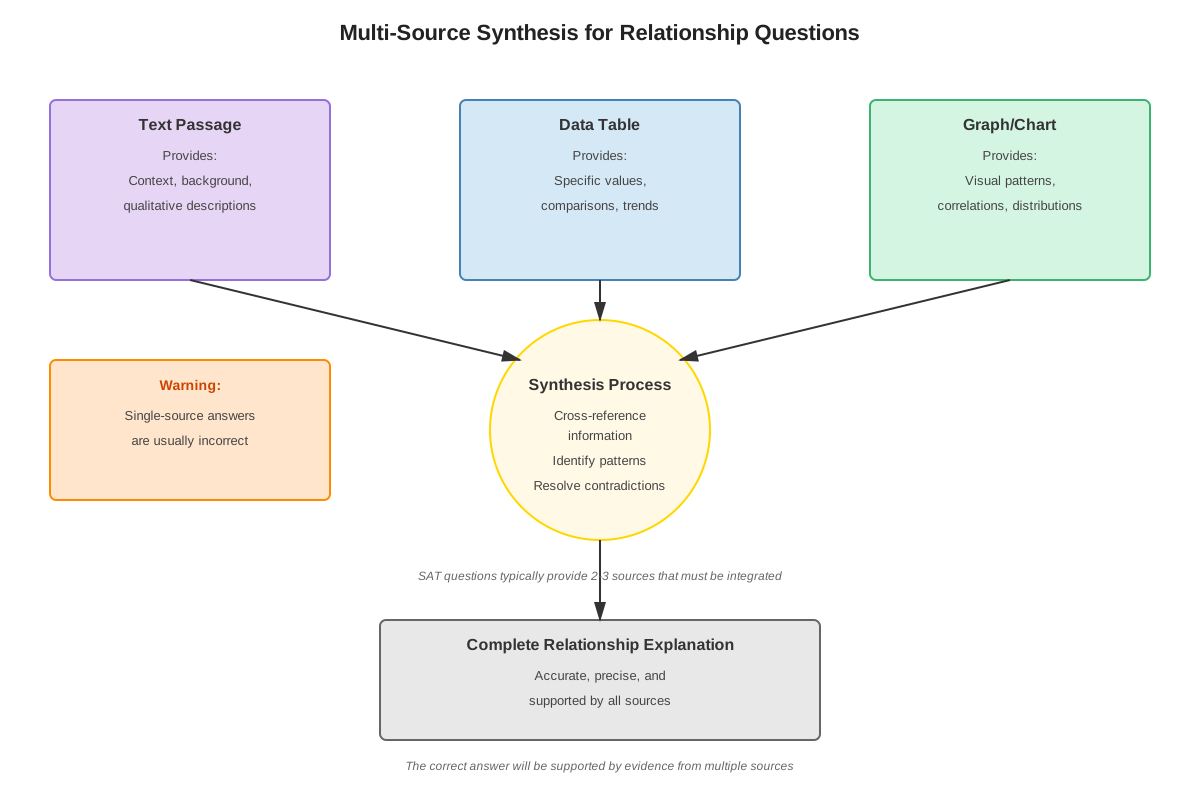
Many SAT explaining a relationship questions require students to integrate information from multiple sources—often a text passage paired with a data table or graph. This synthesis skill separates high-scoring students from average performers.
The synthesis process involves three key steps:
- Extract relevant information from each source: Identify the specific data points, claims, or observations that relate to the question being asked. Avoid getting distracted by interesting but irrelevant details.
- Identify the connection pattern: Determine whether the sources show agreement (supporting the same conclusion), complementarity (providing different types of evidence for the same idea), or tension (presenting conflicting information that requires reconciliation).
- Articulate the relationship precisely: Select language that accurately captures both the type of relationship and the specific elements being related. Precision matters enormously—an answer choice might be partially correct but use imprecise language that makes it wrong.
Precision in Relationship Language
The SAT rewards students who can distinguish between subtly different ways of describing relationships. Answer choices often include options that are close but not quite accurate, testing whether students truly understand the nuances of relationship language.
Consider the difference between "X causes Y" and "X is associated with Y." The first claims a direct causal mechanism, while the second merely notes a correlation. Similarly, "X contrasts with Y" is different from "X contradicts Y"—the first indicates difference, while the second suggests logical incompatibility.
Students must also attend to scope and strength in relationship descriptions. Does the relationship apply to all cases or just some? Is it a strong, direct relationship or a weak, indirect one? Answer choices may be wrong because they overstate or understate the strength of the relationship described in the sources.
Concept Relationships
The concepts within explaining a relationship form a hierarchical structure. At the foundation lies the ability to identify relationship types (causal, correlational, comparative, contrastive), which serves as the prerequisite for all other skills. This foundational knowledge enables students to recognize relationship indicators in text, including transition words, sentence structures, and verb choices.
Recognition of indicators → leads to → accurate synthesis of multiple sources. Once students can spot the signals of different relationship types, they can integrate information from texts, tables, and graphs to construct comprehensive understanding. This synthesis skill → enables → precise articulation of relationships, where students select answer choices that capture both the type and specifics of the relationship with appropriate scope and strength.
The entire process connects back to prerequisite knowledge: basic reading comprehension provides the raw material (understanding what each source says), vocabulary knowledge helps identify relationship indicators, and data interpretation skills allow students to extract relevant information from visual sources. These prerequisites → feed into → the core explaining relationship skills → which support → broader Rhetorical Synthesis abilities tested throughout the SAT rw section.
High-Yield Facts
⭐ Explaining a relationship questions require synthesizing information from multiple sources, not just comprehending a single passage
⭐ Causal relationships (X causes Y) are fundamentally different from correlational relationships (X and Y vary together), and the SAT frequently tests this distinction
⭐ Transition words and phrases are the most reliable indicators of relationship type in SAT passages
⭐ Answer choices in relationship questions often differ only in subtle language choices, making precision critical
⭐ Contrastive relationships are signaled by words like "however," "although," "despite," and "whereas"
- Comparative relationships emphasize similarities using words like "similarly," "likewise," and "also"
- Many relationship questions pair a text passage with data (table or graph) requiring integration of both sources
- Incorrect answer choices frequently confuse the direction of a relationship (claiming A affects B when actually B affects A)
- The scope of a relationship (whether it applies to all cases or just some) is often the key to distinguishing correct from incorrect answers
- Relationship questions typically appear 2-4 times per SAT test administration in the Reading and Writing section
- Students who master relationship explanation tend to score in higher percentiles because these questions test higher-order thinking
- Verb choice in passages provides important clues about relationship type (e.g., "influences" suggests causation)
Quick check — test yourself on Explaining a relationship so far.
Try Flashcards →Common Misconceptions
Misconception: Correlation always implies causation → Correction: Two variables can vary together without one causing the other. The SAT frequently includes wrong answers that claim causation when the passage only establishes correlation. Always check whether the source explicitly describes a causal mechanism or merely notes that variables change together.
Misconception: The longest or most complex answer choice is usually correct → Correction: In relationship questions, the correct answer is the most precise, not necessarily the most elaborate. Wordy answer choices often include extra details that make them inaccurate. Focus on which choice most accurately captures the specific relationship described in the sources.
Misconception: All information in the passage is relevant to the relationship question → Correction: SAT passages often include details that are interesting but not pertinent to the specific relationship being asked about. Students must extract only the information directly relevant to the question, avoiding distraction by tangential facts.
Misconception: If two things are mentioned in the same passage, they must be related → Correction: Proximity in a passage doesn't guarantee a meaningful relationship. The SAT may mention multiple elements in a passage, but the question asks about the relationship between specific elements. Always identify exactly which elements the question asks about before analyzing their relationship.
Misconception: Relationship questions have subjective answers based on interpretation → Correction: Despite requiring synthesis and analysis, relationship questions have objectively correct answers based on what the sources actually state or show. The correct answer must be fully supported by the provided information without requiring outside knowledge or speculation.
Worked Examples
Example 1: Causal Relationship with Data Integration
Passage and Data:
"Researchers investigated whether exposure to natural light affects sleep quality in office workers. They divided 60 participants into two groups: one worked in offices with large windows allowing natural light, while the other worked in offices with only artificial lighting. After four weeks, participants completed sleep quality surveys."
| Group | Average Sleep Quality Score (1-10) |
|---|---|
| Natural Light | 7.8 |
| Artificial Light Only | 6.2 |
Question: Based on the text and table, which statement best explains the relationship between lighting conditions and sleep quality?
Answer Choices:
A) Natural light is associated with better sleep quality scores
B) Natural light causes improved sleep quality in all workers
C) Workers exposed to natural light showed higher sleep quality scores than those exposed only to artificial light
D) Artificial lighting prevents good sleep quality
Analysis:
First, identify what type of relationship the question asks about: the connection between lighting conditions (independent variable) and sleep quality (dependent variable).
Next, examine the passage language. The researchers "investigated whether" natural light "affects" sleep quality—this suggests they're exploring a potential causal relationship, but the passage doesn't definitively establish causation.
Now analyze the data. The natural light group scored 7.8 while the artificial light group scored 6.2—a clear difference, but does this prove causation or just correlation?
Evaluate each answer choice:
Choice A uses "is associated with," which appropriately describes correlation without claiming causation. This is accurate but might be too weak given the experimental design.
Choice B claims causation ("causes") and includes the absolute term "all workers," which overstates the finding. The study shows an average difference, not that every single worker improved.
Choice C precisely describes what the data shows: a comparison between the two groups with the natural light group scoring higher. This doesn't overstate causation but accurately captures the comparative finding.
Choice D uses the strong word "prevents" and makes an absolute claim not supported by the data. The artificial light group still had a score of 6.2, indicating some workers had decent sleep quality.
Correct Answer: C
This answer precisely describes the relationship shown in the data (a comparison between groups) without overstating causation or making unsupported absolute claims. It demonstrates the importance of matching answer language to what the sources actually establish.
Example 2: Contrastive Relationship Between Perspectives
Passage:
"Text 1: Historian Maria Chen argues that the Industrial Revolution's primary driver was technological innovation, particularly the steam engine, which enabled mass production and transformed manufacturing processes fundamentally.
Text 2: Historian James Wilson contends that while technological advances were important, the Industrial Revolution was primarily driven by social and economic factors, including population growth, capital accumulation, and the development of market systems that created demand for mass-produced goods."
Question: Based on the texts, how would Wilson most likely respond to Chen's argument?
Answer Choices:
A) By agreeing that technology was the sole cause of industrialization
B) By arguing that Chen overlooks the importance of social and economic conditions that enabled technological innovations to have impact
C) By contradicting Chen's claim that the steam engine existed
D) By suggesting that technology and social factors were completely unrelated
Analysis:
This question requires understanding a contrastive relationship between two scholarly perspectives. The key is recognizing what each historian emphasizes and how they differ.
Chen's position: Technology (especially steam engine) = primary driver
Wilson's position: Social/economic factors = primary driver, though technology was "important"
Notice that Wilson doesn't completely reject technology's role—he acknowledges it was "important" but argues it wasn't "primary." This is a nuanced contrast, not a complete contradiction.
Evaluate the choices:
Choice A misrepresents Wilson's view entirely. He explicitly states social and economic factors were primary, not technology alone.
Choice B accurately captures Wilson's likely response. He would acknowledge Chen's point about technology but argue she's missing the crucial social and economic context that made technological innovation possible and impactful. The word "overlooks" appropriately describes how one scholar might critique another's emphasis.
Choice C creates a strawman argument. Wilson doesn't deny the steam engine's existence, just its primacy as a causal factor.
Choice D overstates the contrast. Wilson acknowledges technology's importance, so he wouldn't claim the factors were "completely unrelated."
Correct Answer: B
This example demonstrates how explaining a relationship questions can involve contrasting scholarly perspectives rather than just data analysis. The correct answer must capture the nuanced nature of academic disagreement—scholars often differ in emphasis rather than completely contradicting each other.
Exam Strategy
When approaching sat explaining a relationship questions, employ a systematic process that maximizes accuracy while managing time effectively.
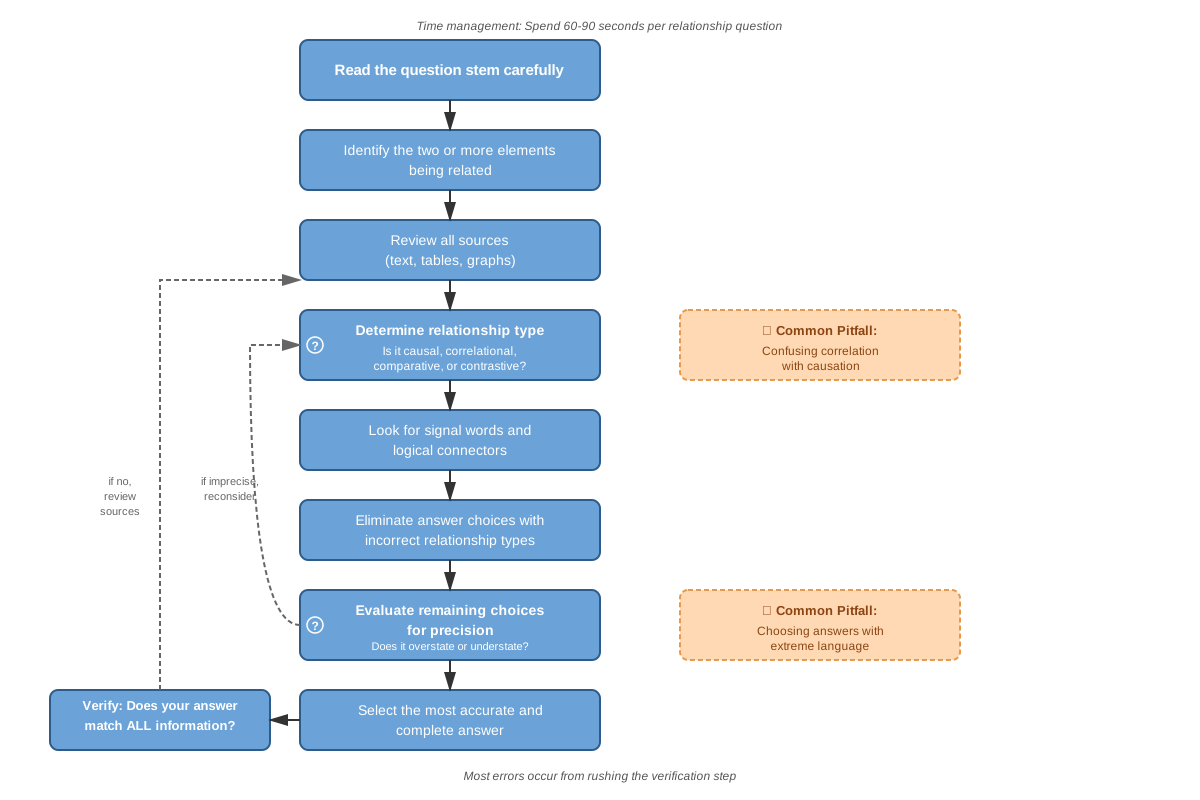
Step 1: Identify the specific elements the question asks about. Relationship questions always ask about the connection between particular things—don't waste time analyzing relationships the question doesn't ask about. Underline or mentally note exactly which elements you need to connect.
Step 2: Determine the relationship type before looking at answer choices. Ask yourself: Is this causal (one thing causes another)? Correlational (things vary together)? Comparative (things are similar)? Contrastive (things differ)? Having a hypothesis about relationship type helps you eliminate wrong answers quickly.
Step 3: Look for relationship indicators in the passage. Circle transition words, note verb choices, and pay attention to sentence structure. These textual clues often directly signal the relationship type.
Step 4: If data is provided, extract the relevant numbers or patterns before reading answer choices. What exactly does the table or graph show about the relationship? Does one variable increase as another increases (positive correlation)? Do groups differ in specific ways (comparison/contrast)?
Step 5: Evaluate answer choices for precision. The SAT loves to include choices that are close but use slightly wrong language. Watch for:
- Overstated claims (using "all," "always," "never" when data shows "most" or "often")
- Confused causation and correlation
- Reversed relationships (claiming A affects B when actually B affects A)
- Wrong scope (claiming a broad relationship when the source describes a narrow one)
Exam Tip: If two answer choices seem very similar, the difference between them is almost certainly the key to the question. Compare them word-by-word to identify the subtle distinction.
Trigger words to watch for in questions:
- "Best explains the relationship" = you need to identify how elements connect
- "How would X respond to Y" = you need to articulate a contrastive or comparative relationship between perspectives
- "Based on the text and table/graph" = you must synthesize multiple sources
- "Most accurately describes" = precision in language is being tested
Time allocation: Spend approximately 60-75 seconds on relationship questions. They require more analysis than simple comprehension questions but shouldn't consume excessive time. If you're stuck after 90 seconds, make your best guess and move on—you can return if time permits.
Process of elimination strategy: First, eliminate answers that describe the wrong type of relationship (e.g., causal when the relationship is correlational). Second, eliminate answers with language that's too strong or too weak for what the sources establish. Finally, choose between remaining options based on which most precisely captures the specific relationship described.
Memory Techniques
CCCC Mnemonic for relationship types: Causal, Correlational, Comparative, Contrastive. When you see a relationship question, mentally run through these four types to categorize what you're looking for.
"Because = Cause" - The word "because" almost always signals a causal relationship. If you see "because" in a passage, you've found a cause-effect connection.
"However = Different" - Contrastive relationships are signaled by "however" and similar words. Train yourself to recognize that "however" means "pay attention to the difference."
The Three-Source Synthesis Strategy: When a question provides text + data, visualize three circles: (1) what the text says, (2) what the data shows, (3) where they overlap. The correct answer lives in the overlap zone.
Precision Checker: Before selecting an answer, ask yourself three questions: (1) Is this the right relationship TYPE? (2) Is this the right relationship DIRECTION? (3) Is this the right relationship STRENGTH? All three must be correct.
The "Too Strong" Red Flag: Words like "always," "never," "all," "none," "proves," "prevents," and "ensures" should trigger extra scrutiny. SAT passages rarely support such absolute claims. If you see these words in an answer choice, verify that the source actually establishes such a strong relationship.
Summary
Explaining a relationship is a high-yield SAT skill that requires students to analyze how elements connect within and across sources. Success depends on recognizing four main relationship types—causal, correlational, comparative, and contrastive—and identifying the textual indicators that signal each type. Students must synthesize information from multiple sources, often combining text with data tables or graphs, to construct accurate relationship explanations. The key challenge lies in selecting answer choices with precise language that matches both the type and strength of the relationship actually established in the sources. Common pitfalls include confusing correlation with causation, selecting answers with overstated claims, and failing to attend to subtle language differences between similar answer choices. By systematically identifying the specific elements in question, determining relationship type, extracting relevant evidence, and evaluating choices for precision, students can consistently answer these questions correctly and efficiently.
Key Takeaways
- Explaining a relationship questions test synthesis and analysis, not just comprehension, making them high-value indicators of SAT performance
- The four main relationship types—causal, correlational, comparative, and contrastive—each have characteristic language patterns and indicators
- Transition words, sentence structure, and verb choice provide crucial clues about relationship type
- Precision in answer choice language is critical; subtle differences in wording often distinguish correct from incorrect answers
- Many relationship questions require synthesizing text with data, demanding integration of verbal and quantitative information
- Confusing correlation with causation is the most common error on these questions
- Systematic evaluation of answer choices for relationship type, direction, and strength maximizes accuracy
Related Topics
Rhetorical Synthesis - Supporting Claims: Building on relationship explanation skills, this topic focuses on selecting evidence that best supports a given claim, requiring similar synthesis abilities but with emphasis on argument structure.
Data Interpretation in Reading and Writing: Mastering relationship explanation provides the foundation for more complex data interpretation questions that require drawing conclusions from graphs, tables, and charts.
Transition Words and Logical Flow: A deeper dive into the transition words and phrases that signal relationships, essential for both understanding passages and improving writing quality.
Argument Analysis: Understanding relationships between ideas is fundamental to analyzing how authors construct arguments, making relationship explanation a gateway skill for argument-focused questions.
Practice CTA
Now that you've mastered the core concepts of explaining relationships, it's time to put your knowledge into action! The practice questions and flashcards are specifically designed to reinforce the strategies you've learned and build the pattern recognition that leads to consistent high performance. Each practice question mirrors actual SAT format and difficulty, giving you authentic preparation. Remember, the difference between knowing these concepts and scoring well is application—so dive into the practice materials and watch your confidence and accuracy grow. You've built the foundation; now it's time to strengthen it through deliberate practice!
Sign up free to keep reading
Create a free AnvayaPrep account to finish this SAT guide on Explaining a relationship — plus flashcards and practice questions.