Overview
Formal synthesis is a critical skill tested in the SAT Reading and Writing (RW) section that requires students to combine information from multiple sources into a coherent, well-structured response. Unlike informal synthesis, which might allow for casual language and personal opinion, formal synthesis demands academic tone, objective analysis, and precise integration of evidence from provided texts. This skill appears in the Rhetorical Synthesis portion of the SAT, where students must demonstrate their ability to understand multiple perspectives, identify relevant information, and construct logical connections between ideas while maintaining appropriate academic register.
The importance of mastering sat formal synthesis cannot be overstated for test-takers aiming for competitive scores. These questions assess not only reading comprehension but also critical thinking, analytical reasoning, and writing sophistication—skills that colleges value highly. Students must navigate between two or more short texts, extract key information, recognize relationships between ideas, and select responses that accurately represent the synthesis of these sources without introducing bias, misrepresentation, or inappropriate tone. The ability to synthesize formally is foundational to academic success beyond the SAT, as it mirrors the research and writing demands of college-level coursework.
Within the broader landscape of SAT rw skills, formal synthesis represents the convergence of multiple competencies: close reading, logical reasoning, evidence evaluation, and rhetorical awareness. It builds upon fundamental comprehension skills while requiring higher-order thinking that distinguishes strong readers from exceptional ones. Mastery of formal synthesis also supports performance in other question types, including Command of Evidence questions and rhetorical analysis tasks, creating a multiplier effect on overall SAT performance.
Learning Objectives
- [ ] Identify key features of formal synthesis
- [ ] Explain how formal synthesis appears on the SAT
- [ ] Apply formal synthesis to answer SAT-style questions
- [ ] Distinguish between appropriate and inappropriate synthesis of multiple sources
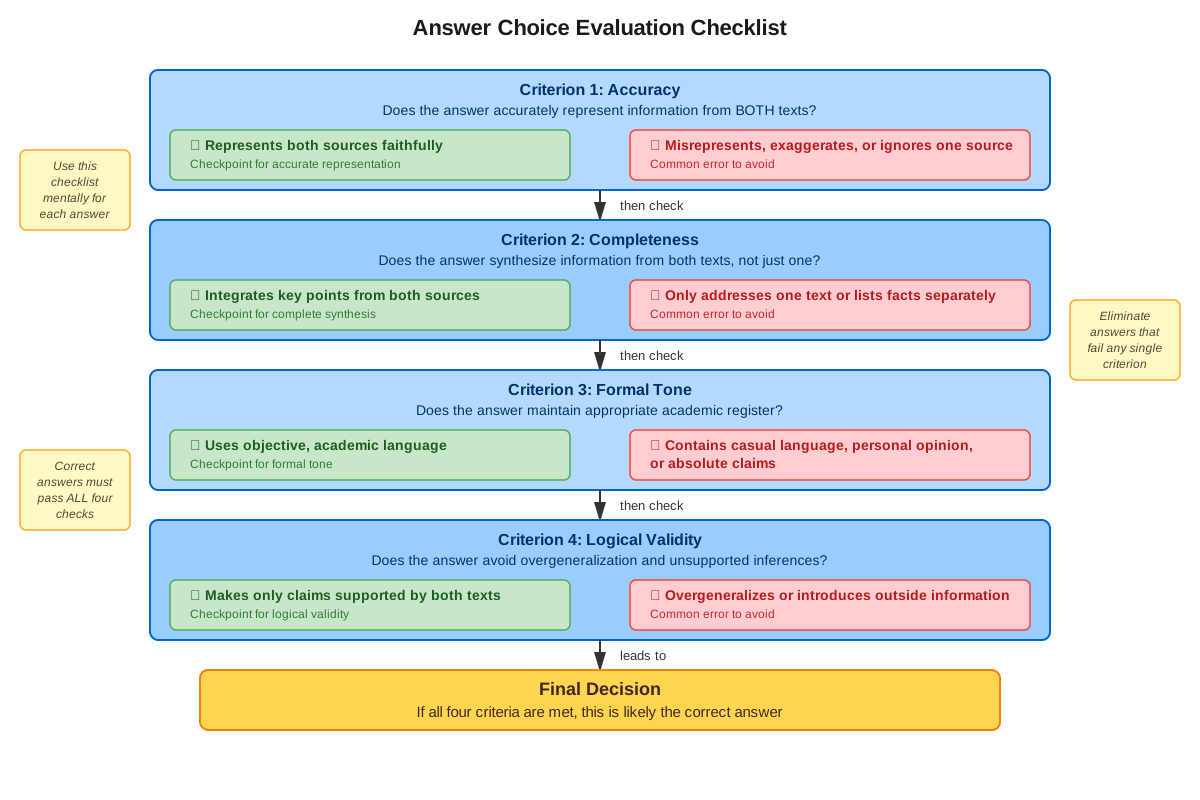
- [ ] Evaluate answer choices for accuracy, completeness, and formal tone
- [ ] Recognize common patterns in how SAT presents synthesis tasks
- [ ] Construct mental frameworks for organizing information from multiple texts efficiently
Prerequisites
- Basic reading comprehension: Understanding main ideas, supporting details, and author's purpose in individual passages is essential before attempting to synthesize multiple sources
- Vocabulary knowledge: Recognizing academic and transitional language helps identify relationships between ideas across texts
- Understanding of formal vs. informal tone: Distinguishing appropriate academic register from casual language ensures selection of properly formal synthesis statements
- Logical reasoning skills: Identifying valid inferences and avoiding overgeneralizations supports accurate synthesis without distortion
Why This Topic Matters
Formal synthesis questions appear with high frequency on the SAT, typically comprising 2-4 questions per test administration in the Reading and Writing section. These questions carry significant weight because they assess multiple competencies simultaneously, making them efficient discriminators between score levels. Students who master formal synthesis often see score improvements of 40-60 points in the Reading and Writing section, as the skills transfer to other question types.
Beyond the exam, formal synthesis represents a cornerstone of academic literacy. College coursework across disciplines—from humanities research papers to scientific literature reviews—requires the ability to integrate multiple sources while maintaining objectivity and academic tone. Professional contexts including business analysis, legal reasoning, and policy development all demand synthesis skills, making this topic relevant far beyond test day.
On the SAT, formal synthesis questions typically present 2-3 short texts (each 1-3 sentences) followed by a prompt asking students to complete a statement that synthesizes information from the sources. Common formats include:
- Comparing or contrasting findings from different studies
- Integrating complementary information from multiple sources
- Presenting a nuanced view that accounts for multiple perspectives
- Summarizing a relationship between ideas across texts
The texts often come from academic or scientific contexts, featuring research findings, historical accounts, or analytical observations. Students must navigate disciplinary vocabulary, understand methodological differences, and recognize how sources relate to one another—all while selecting an answer that maintains formal academic tone.
Core Concepts
Definition and Characteristics of Formal Synthesis
Formal synthesis is the process of combining information, ideas, or evidence from two or more sources into a unified statement that maintains academic tone, objective perspective, and accurate representation of the original materials. Unlike summary, which condenses a single source, synthesis creates new understanding by showing relationships between multiple sources. The "formal" designation indicates adherence to academic conventions: third-person perspective, precise language, absence of colloquialisms, and objective presentation without personal opinion.
Key characteristics of effective formal synthesis include:
- Accuracy: Faithful representation of source material without distortion
- Completeness: Incorporation of relevant information from all provided sources
- Coherence: Logical organization that clarifies relationships between ideas
- Objectivity: Neutral presentation without bias or personal commentary
- Academic register: Formal vocabulary and sentence structures appropriate for scholarly discourse
Types of Synthesis Relationships
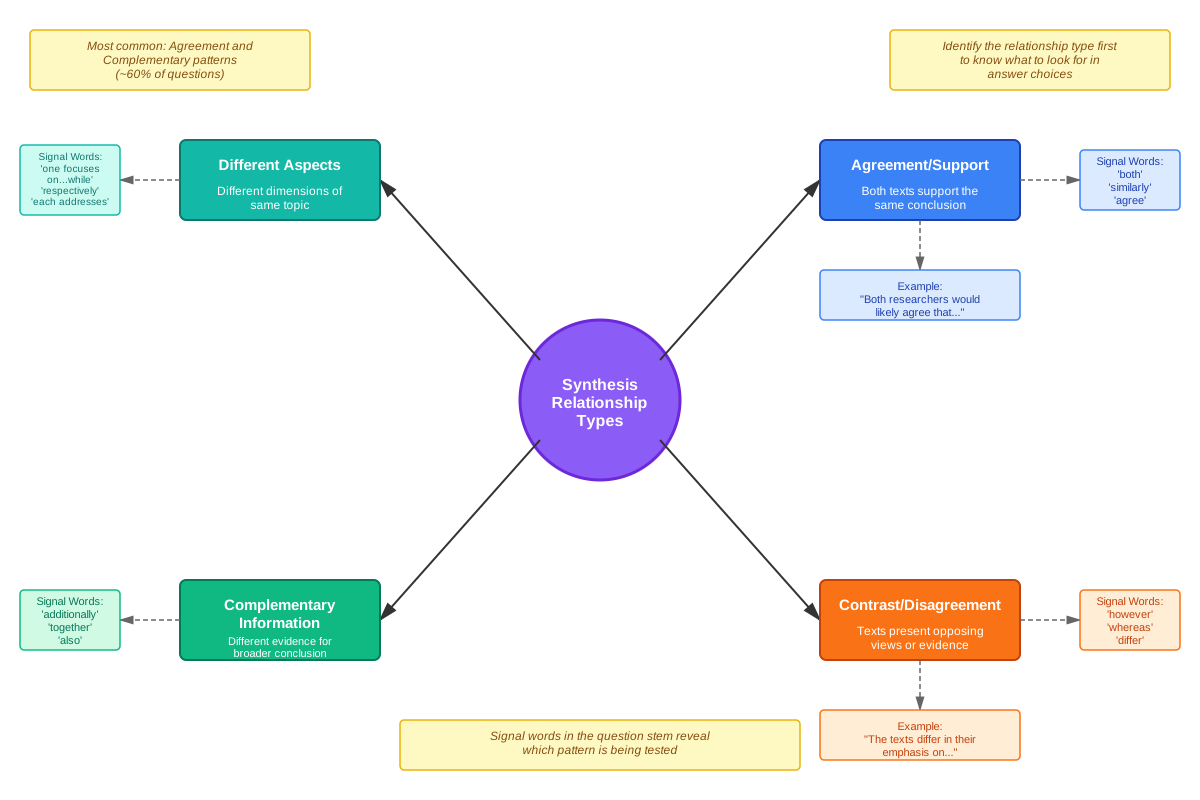
The SAT tests several common relationships between sources that students must recognize and articulate:
| Relationship Type | Description | Signal Words |
|---|---|---|
| Complementary | Sources provide different aspects of the same topic | "Additionally," "Furthermore," "Moreover" |
| Contrasting | Sources present opposing findings or perspectives | "However," "Conversely," "In contrast" |
| Causal | One source explains causes while another describes effects | "Consequently," "As a result," "Therefore" |
| Elaborative | One source provides general claims while another offers specific examples | "Specifically," "For instance," "In particular" |
| Qualifying | One source presents a claim while another adds limitations or conditions | "Although," "While," "Despite" |
Understanding these relationship types enables students to quickly categorize how sources connect and predict the structure of correct synthesis statements.
Components of SAT Formal Synthesis Questions
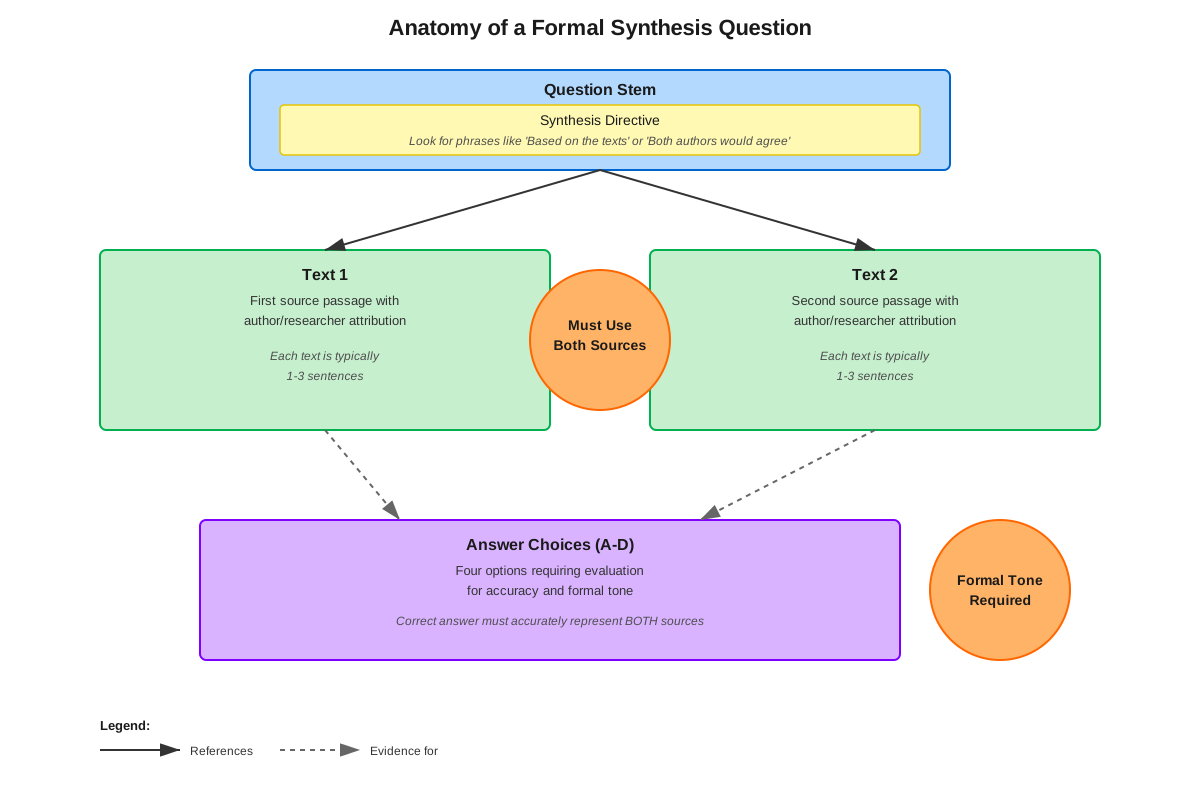
SAT formal synthesis questions follow a predictable structure that students can leverage for efficient problem-solving:
- Source Texts: Typically 2-3 brief passages (labeled Text 1, Text 2, etc.) presenting related information
- Stem/Prompt: An incomplete sentence beginning with a phrase like "Based on the texts..." or "According to the texts..."
- Answer Choices: Four options completing the synthesis statement, varying in accuracy, completeness, and formality
The source texts usually share a common topic but approach it from different angles—different time periods, different methodologies, different scales of analysis, or different aspects of the phenomenon. Students must identify what each text contributes and how those contributions relate.
Formal Tone Requirements
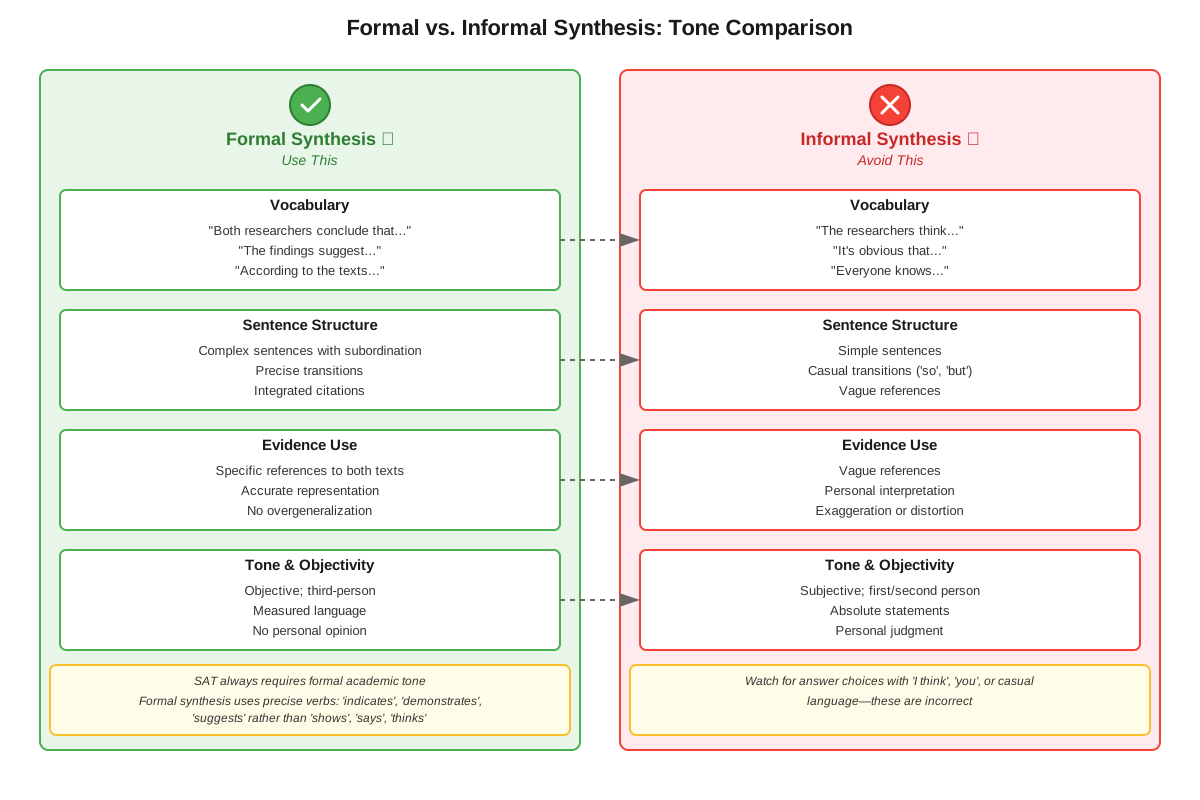
Maintaining formal academic tone is non-negotiable in synthesis questions. The SAT consistently includes incorrect answer choices that accurately synthesize content but use inappropriate language. Formal tone requirements include:
- Third-person perspective: Avoid "I," "you," "we," or "one"
- Precise academic vocabulary: Use disciplinary terms appropriately
- Complete sentences: No fragments or run-ons
- Objective language: Eliminate opinion markers like "clearly," "obviously," "unfortunately"
- Neutral verbs: Prefer "suggests," "indicates," "demonstrates" over "proves," "shows conclusively"
- Absence of colloquialisms: No slang, contractions, or conversational phrases
Information Integration Strategies
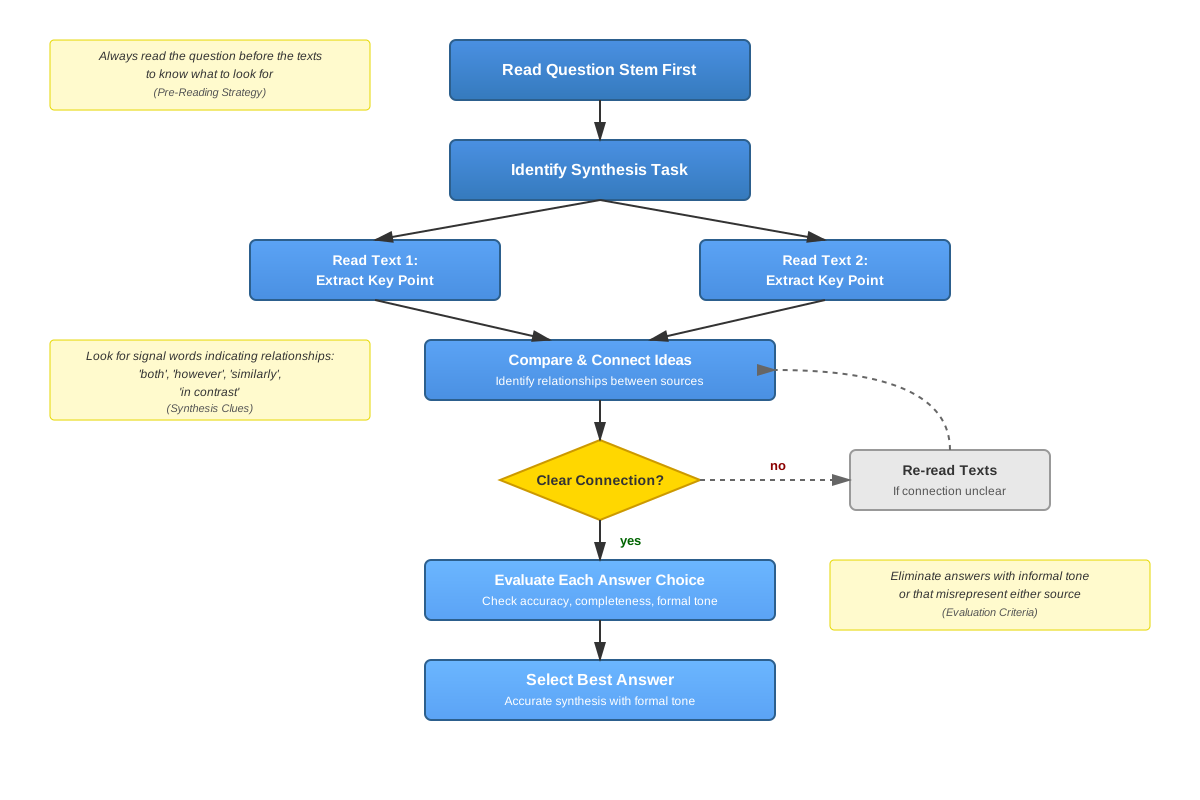
Successful synthesis requires systematic information processing:
- Identify the main claim or finding in each text: What is the central point each source makes?
- Note specific evidence or examples: What details support each main claim?
- Determine the relationship between texts: How do the sources connect—do they agree, disagree, complement, or qualify each other?
- Recognize scope and limitations: What does each source address, and what does it leave out?
- Anticipate synthesis structure: Before reading answer choices, mentally construct how a complete synthesis should sound
This systematic approach prevents common errors like focusing on only one source, misrepresenting relationships, or selecting answers with inappropriate tone.
Concept Relationships
The concepts within formal synthesis form an interconnected system where each element supports the others. Formal tone requirements serve as the foundation, establishing the register within which all synthesis must occur. This foundation supports information integration strategies, which provide the procedural knowledge for combining sources. These strategies depend on recognizing types of synthesis relationships, which function as templates for understanding how sources connect. All three elements converge in the components of SAT formal synthesis questions, where students apply their knowledge under test conditions.
The relationship flows as follows:
Formal Tone Requirements → enables → Appropriate Academic Expression → guides → Information Integration Strategies → reveals → Types of Synthesis Relationships → manifests in → SAT Question Components → produces → Accurate Synthesis Statements
Formal synthesis also connects to prerequisite topics: basic reading comprehension provides the ability to understand individual sources, which is necessary before synthesis can occur. Vocabulary knowledge enables recognition of relationship signals and academic terminology. Logical reasoning skills support the evaluation of how sources relate and whether synthesis statements accurately represent those relationships.
Looking forward, mastery of formal synthesis enables progression to more advanced rhetorical analysis, where students must not only synthesize content but also analyze how authors construct arguments across multiple texts. It also supports Command of Evidence questions, where selecting appropriate textual support requires understanding how different pieces of evidence relate to claims.
High-Yield Facts
⭐ Formal synthesis questions always require information from ALL provided texts—answers using only one source are automatically incorrect.
⭐ The correct answer must maintain formal academic tone—colloquialisms, personal pronouns, and opinion language disqualify otherwise accurate answers.
⭐ Signal words in answer choices indicate relationships between sources—"however," "additionally," "consequently" reveal how the synthesis connects ideas.
⭐ Correct synthesis statements avoid absolute language—words like "proves," "always," "never" are typically found in incorrect answers.
⭐ The SAT tests your ability to recognize accurate representation—distortions, exaggerations, or omissions of source material make answers incorrect.
- Synthesis questions typically appear 2-4 times per SAT administration in the Reading and Writing section.
- Source texts in synthesis questions are usually 1-3 sentences each, totaling 50-100 words combined.
- Incorrect answers often include accurate information from only one text while ignoring the other(s).
- The relationship between texts is often signaled by contrasting time periods, methodologies, or scales of analysis.
- Formal synthesis requires objective presentation—avoid answers that include evaluative language like "unfortunately" or "impressively."
- Answer choices may present information in different orders, but only one will accurately represent the relationship between sources.
- Synthesis statements should be complete thoughts—fragments or incomplete comparisons indicate incorrect answers.
- The correct answer will use precise academic vocabulary appropriate to the discipline discussed in the texts.
Quick check — test yourself on Formal synthesis so far.
Try Flashcards →Common Misconceptions
Misconception: Formal synthesis means using the most complex vocabulary possible.
Correction: Formal synthesis requires appropriate academic language, not unnecessarily complex words. Clarity and precision matter more than vocabulary sophistication. The correct answer uses disciplinary terms accurately but remains accessible.
Misconception: If an answer choice includes information from both texts, it must be correct.
Correction: Merely mentioning both sources is insufficient—the synthesis must accurately represent the relationship between them. An answer might reference both texts but mischaracterize how they connect (e.g., presenting contrasting findings as complementary).
Misconception: The longest answer choice is usually correct because it's most complete.
Correction: Length does not indicate correctness. Longer answers often include extraneous information, distortions, or inappropriate elaboration. The correct answer is complete but concise, including all necessary information without padding.
Misconception: Personal interpretation or inference beyond the texts demonstrates higher-level thinking.
Correction: Formal synthesis requires faithful representation of source material, not creative interpretation. Adding inferences not supported by the texts or imposing external knowledge creates inaccurate synthesis. Stay within the boundaries of what the texts explicitly state or clearly imply.
Misconception: Formal tone means avoiding all simple language.
Correction: Formal tone is about register and objectivity, not complexity. Simple, clear sentences in third person with precise vocabulary constitute excellent formal writing. Contractions, slang, and personal opinion violate formal tone—but straightforward sentence structure does not.
Misconception: If one text is longer or more detailed, it should dominate the synthesis.
Correction: All provided texts deserve equal consideration regardless of length. The SAT deliberately includes texts of varying lengths to test whether students can integrate information equitably. Correct synthesis gives appropriate weight to each source's contribution.
Worked Examples
Example 1: Complementary Synthesis
Text 1: Archaeological excavations at the Mayan site of Tikal have revealed sophisticated water management systems, including reservoirs and channels that collected and distributed rainwater throughout the urban center.
Text 2: Recent analysis of sediment cores from Tikal's reservoirs indicates that the Maya also implemented filtration systems using sand and zeolite minerals to purify water for drinking.
Prompt: Based on the texts, researchers studying Tikal have found evidence that the Maya ________
Answer Choices:
A) created water systems that were more advanced than those of other ancient civilizations.
B) developed both infrastructure for water distribution and methods for water purification.
C) relied primarily on rainwater because other water sources were unavailable.
D) used zeolite minerals, which proves they had sophisticated scientific knowledge.
Analysis:
First, identify what each text contributes:
- Text 1: Water management infrastructure (reservoirs, channels, distribution)
- Text 2: Water purification methods (filtration with sand and zeolite)
The relationship is complementary—both texts describe different aspects of Mayan water technology.
Evaluate each answer:
- Choice A: Introduces comparison to other civilizations not mentioned in either text—adds unsupported information. Incorrect.
- Choice B: Accurately synthesizes both texts, noting infrastructure (Text 1) and purification methods (Text 2) while maintaining formal tone. This is the correct answer.
- Choice C: Focuses only on rainwater from Text 1, ignoring Text 2 entirely. Also introduces unsupported claim about unavailability of other sources. Incorrect.
- Choice D: Uses absolute language ("proves") inappropriate for formal synthesis and overstates what the evidence shows. While it references Text 2, it distorts the finding. Incorrect.
Correct Answer: B
This example demonstrates complementary synthesis where each text provides distinct information that combines into a fuller picture. The correct answer uses neutral language ("developed"), includes both contributions, and maintains formal academic tone.
Example 2: Contrasting Synthesis
Text 1: A 2019 study of urban heat islands found that cities with extensive tree canopy coverage experienced average temperatures 3-5°C lower than those with minimal vegetation during summer months.
Text 2: However, research conducted in arid climate cities shows that increased vegetation can sometimes raise local humidity levels to uncomfortable ranges, potentially offsetting the cooling benefits of shade.
Prompt: Based on the texts, the relationship between urban vegetation and temperature comfort is ________
Answer Choices:
A) simple: more trees always create cooler, more comfortable urban environments.
B) clear from the research, which shows that trees reduce temperatures in all climates.
C) complex, as vegetation's cooling effects may be influenced by regional climate conditions.
D) still unknown because scientists disagree about whether trees actually lower temperatures.
Analysis:
Identify each text's contribution:
- Text 1: Trees reduce temperatures in cities (general finding)
- Text 2: In arid climates, vegetation may create humidity issues (qualification/limitation)
The relationship is qualifying—Text 2 doesn't contradict Text 1 but adds important conditions that limit its generalizability.
Evaluate each answer:
- Choice A: Uses absolute language ("always") contradicted by Text 2. Ignores the qualification. Incorrect.
- Choice B: Claims universal application ("all climates") directly contradicted by Text 2's arid climate findings. Incorrect.
- Choice C: Accurately captures the qualifying relationship—acknowledges cooling effects (Text 1) while noting climate-dependent variations (Text 2). Uses appropriate formal language ("complex," "influenced by"). This is the correct answer.
- Choice D: Mischaracterizes the relationship as disagreement when Text 2 actually qualifies rather than contradicts Text 1. Incorrect.
Correct Answer: C
This example illustrates qualifying synthesis, where one source presents a general finding and another adds nuance or limitations. The correct answer acknowledges both the main finding and its qualifications without overstating disagreement or ignoring complexity.
Exam Strategy
Systematic Approach to Synthesis Questions
Follow this step-by-step process for every formal synthesis question:
- Read all source texts first (30-45 seconds): Understand each text independently before attempting synthesis
- Identify the main point of each text (10-15 seconds): What is the central claim or finding?
- Determine the relationship between texts (10 seconds): Complementary, contrasting, causal, elaborative, or qualifying?
- Read the prompt carefully (5 seconds): Note exactly what the synthesis statement should address
- Predict the answer (10 seconds): Before reading choices, mentally construct what a correct synthesis should include
- Evaluate each answer choice (30-40 seconds): Check for accuracy, completeness, and formal tone
- Verify your selection (10 seconds): Confirm it includes all texts and maintains appropriate register
Exam Tip: If you're running short on time, prioritize eliminating answers with informal tone or those that ignore one of the texts—these are quick eliminations that narrow your options efficiently.
Trigger Words and Phrases
Watch for these signals in answer choices:
Red flags (usually indicate incorrect answers):
- Absolute language: "proves," "always," "never," "completely," "entirely"
- Personal pronouns: "we," "you," "one"
- Opinion markers: "clearly," "obviously," "unfortunately," "impressively"
- Colloquialisms: "a lot," "kind of," "pretty much"
- Contractions: "don't," "can't," "won't"
Green flags (often indicate correct answers):
- Qualified language: "suggests," "indicates," "may," "can"
- Relationship signals: "however," "additionally," "consequently," "while"
- Precise academic verbs: "demonstrates," "reveals," "illustrates"
- Neutral descriptors: "significant," "notable," "substantial"
Process of Elimination Strategy
Use this hierarchy to eliminate incorrect answers:
First pass—eliminate answers that:
- Use informal tone or inappropriate language
- Reference only one text while ignoring others
- Introduce information not present in any text
Second pass—eliminate answers that:
- Mischaracterize the relationship between texts
- Distort or exaggerate findings from the sources
- Use absolute language unsupported by the evidence
Final evaluation—select the answer that:
- Accurately represents all texts
- Correctly identifies the relationship between sources
- Maintains formal academic tone throughout
Time Allocation
Allocate approximately 90-120 seconds per synthesis question:
- 45 seconds: Reading and analyzing source texts
- 40 seconds: Evaluating answer choices
- 15 seconds: Verification and final selection
If a question exceeds 2 minutes, mark it for review and move forward—synthesis questions are worth the same as other questions, so don't sacrifice time that could be used elsewhere.
Memory Techniques
CRAFT Acronym for Formal Synthesis
Use CRAFT to remember essential elements:
- Complete: Include information from all provided texts
- Relationship: Identify how sources connect (complement, contrast, etc.)
- Academic: Maintain formal tone throughout
- Faithful: Accurately represent source material without distortion
- Third-person: Use objective perspective, avoiding personal pronouns
The "Three-Text Test"
Visualize a three-legged stool: if any leg is missing, the stool collapses. Similarly, if your synthesis ignores any provided text, the answer is incorrect. Before selecting an answer, mentally check: "Does this reference Text 1? Text 2? Text 3 (if present)?"
Relationship Signal Wheel
Memorize common signal words by category:
Addition (Complementary): Additionally, Furthermore, Moreover, Also
Contrast: However, Conversely, In contrast, Nevertheless, While
Cause-Effect: Consequently, Therefore, As a result, Thus
Example (Elaborative): Specifically, For instance, In particular, Such as
Qualification: Although, Despite, While, Even though
Visualize these as spokes on a wheel, with "Synthesis" at the center—each spoke represents a different way sources can relate.
Tone Check Mnemonic: "No COPS"
Remember what to avoid for formal tone with "No COPS":
- Colloquialisms (slang, casual phrases)
- Opinion language (evaluative terms)
- Personal pronouns (I, you, we)
- Slang and contractions
If an answer contains any COPS, eliminate it immediately.
Summary
Formal synthesis represents a high-value skill on the SAT Reading and Writing section, requiring students to combine information from multiple sources while maintaining academic tone and accurate representation. Success depends on systematic analysis: understanding each source independently, identifying relationships between texts (complementary, contrasting, causal, elaborative, or qualifying), and selecting answers that faithfully integrate all provided information. The SAT consistently tests whether students can distinguish appropriate formal register from informal language, making tone awareness as critical as content accuracy. Effective synthesis avoids absolute language, personal perspective, and unsupported inferences while using precise academic vocabulary and neutral presentation. By following structured approaches—reading all texts first, determining relationships, predicting answers, and systematically eliminating incorrect choices—students can efficiently navigate these questions. The skills developed through formal synthesis practice extend far beyond the SAT, forming the foundation for college-level research writing and professional analytical communication.
Key Takeaways
- Formal synthesis questions require accurate integration of information from ALL provided texts—ignoring any source makes an answer incorrect
- Maintaining formal academic tone is non-negotiable: avoid personal pronouns, colloquialisms, opinion language, and absolute claims
- Identify the relationship between sources (complementary, contrasting, qualifying, etc.) to understand how information should be combined
- Use systematic elimination: first remove answers with tone violations or missing texts, then evaluate remaining choices for accuracy
- Signal words in answer choices ("however," "additionally," "consequently") reveal how the synthesis connects ideas and indicate relationship types
- Correct answers represent sources faithfully without distortion, exaggeration, or unsupported inference
- Allocate 90-120 seconds per synthesis question and follow the CRAFT framework: Complete, Relationship, Academic, Faithful, Third-person
Related Topics
Command of Evidence: Builds on synthesis skills by requiring students to select specific textual support for claims, extending the ability to work with multiple pieces of information systematically.
Rhetorical Analysis: Advances synthesis by adding analysis of how authors construct arguments, requiring synthesis of both content and rhetorical strategies across texts.
Transitions and Cohesion: Connects to synthesis through the use of signal words and phrases that indicate relationships between ideas, supporting clearer integration of multiple sources.
Tone and Style Analysis: Deepens understanding of formal register by examining how authors create different tones, helping students recognize and maintain appropriate academic voice.
Argument Evaluation: Extends synthesis skills to assess the strength and validity of claims across multiple sources, building critical thinking alongside integration abilities.
Practice CTA
Now that you've mastered the core concepts of formal synthesis, it's time to apply your knowledge! Work through the practice questions to reinforce your understanding of how sources relate, how to maintain formal tone, and how to identify accurate synthesis statements. The flashcards will help you internalize key terminology and relationship signals. Remember: synthesis questions are high-yield opportunities to demonstrate multiple skills simultaneously—investing time in practice now will pay dividends on test day. You've built a strong foundation; now strengthen it through application!
Sign up free to keep reading
Create a free AnvayaPrep account to finish this SAT guide on Formal synthesis — plus flashcards and practice questions.