Overview
Informal synthesis is a critical skill tested in the SAT Reading and Writing (RW) section that requires students to combine information from multiple sources into a coherent, unified response. Unlike formal academic synthesis that demands rigid citation formats and extensive documentation, sat informal synthesis questions ask test-takers to integrate ideas, evidence, and perspectives from two or more brief texts to support a specific claim or complete a statement. This skill mirrors real-world reading scenarios where individuals must draw connections across articles, reports, or viewpoints to form comprehensive understanding.
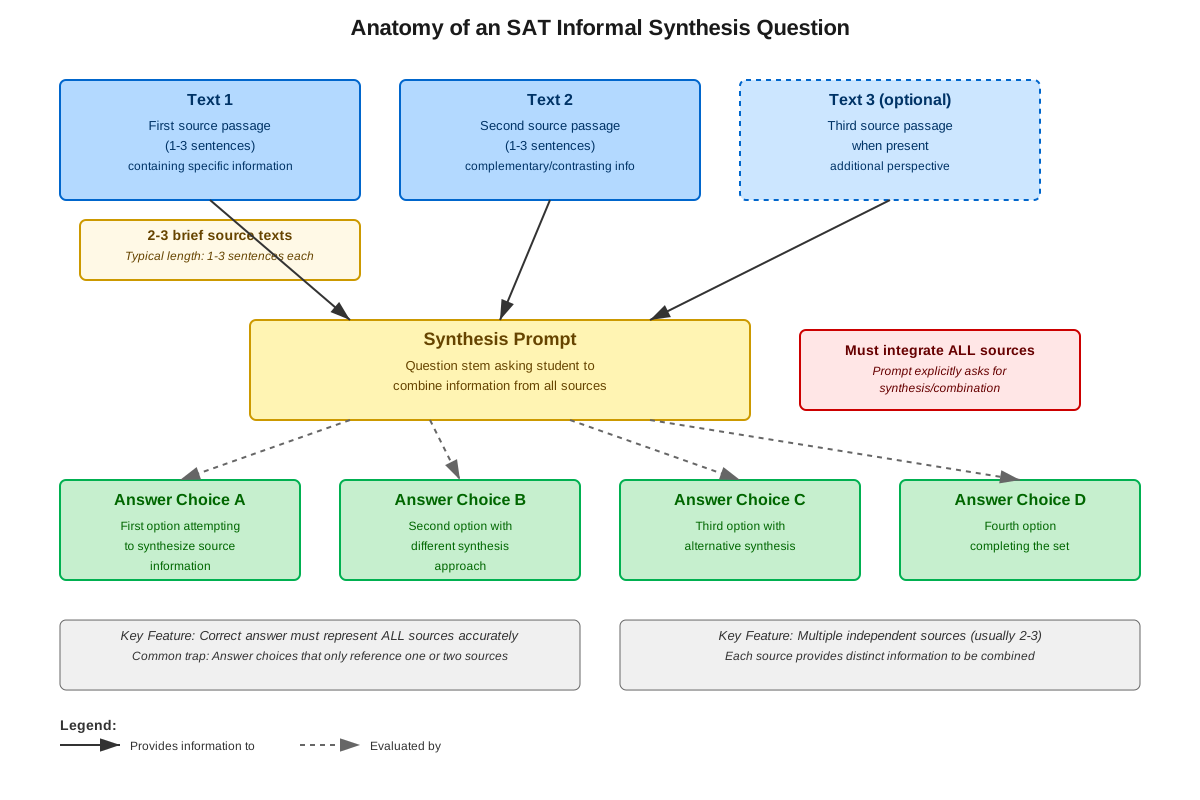
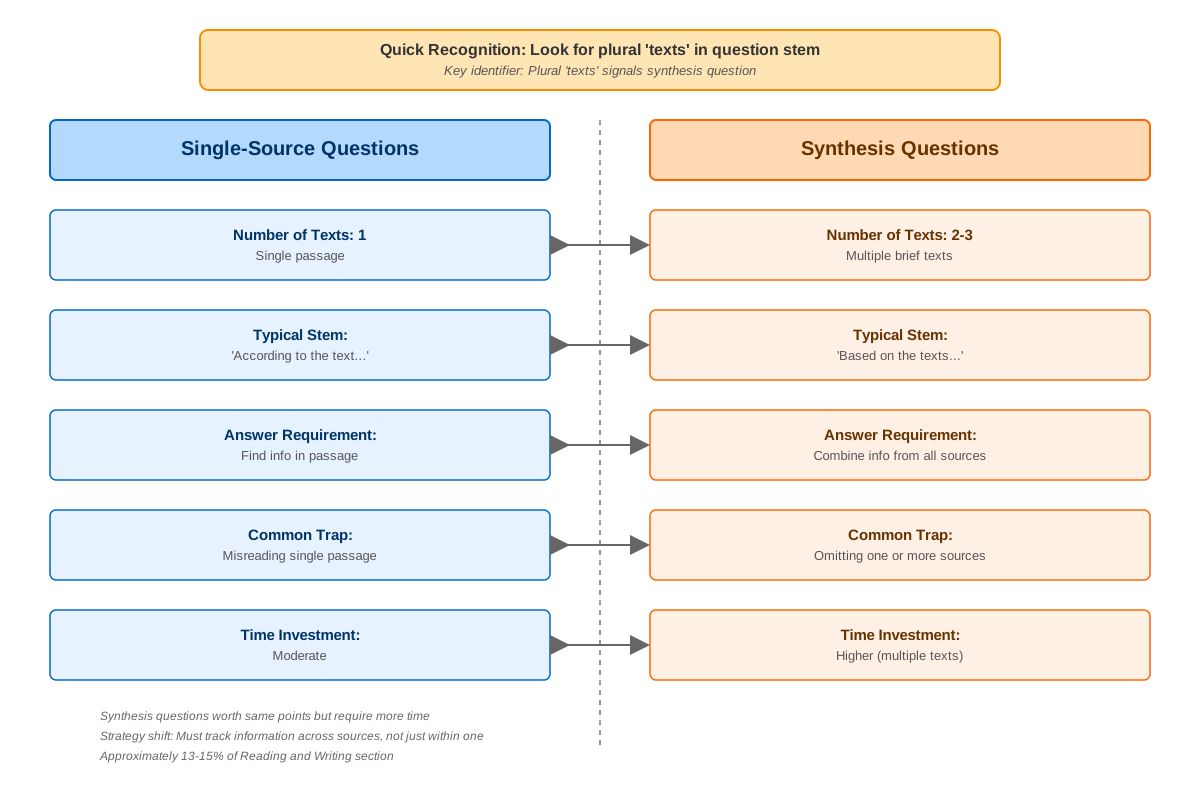
The SAT tests informal synthesis through questions that present students with multiple short passages (typically 1-3 sentences each) followed by a prompt asking them to identify which answer choice best combines or represents information from all sources. These questions assess whether students can recognize complementary information, identify patterns across texts, and synthesize details without losing the nuance of individual sources. Success requires careful reading, note-taking, and the ability to distinguish between information that appears in one source versus information supported by multiple sources.
Mastering informal synthesis is essential because it represents approximately 13-15% of the Reading and Writing section, making it one of the highest-yield question types. This topic builds upon fundamental reading comprehension skills while preparing students for the analytical thinking required in college-level coursework. Informal synthesis connects directly to other rhetorical skills tested on the SAT, including understanding purpose, evaluating evidence, and recognizing logical relationships between ideas. Students who excel at synthesis questions demonstrate sophisticated reading abilities that extend beyond simple recall to genuine integration of complex information.
Learning Objectives
- [ ] Identify key features of informal synthesis questions on the SAT
- [ ] Explain how informal synthesis appears on the SAT and what makes it distinct from other question types
- [ ] Apply informal synthesis strategies to answer SAT-style questions accurately and efficiently
- [ ] Distinguish between information that appears in individual sources versus information supported by multiple sources
- [ ] Evaluate answer choices to determine which option best represents all provided texts without overgeneralizing or omitting key details
- [ ] Recognize common patterns in how the SAT structures synthesis questions and the types of relationships between source texts
Prerequisites
- Basic reading comprehension: Understanding main ideas, supporting details, and author's purpose in individual passages is essential because synthesis builds upon the ability to extract meaning from text
- Vocabulary in context: Recognizing how words function within sentences helps students accurately interpret the nuances of each source before combining information
- Logical reasoning: Understanding cause-effect relationships, comparisons, and contrasts enables students to identify how multiple sources relate to one another
- Note-taking skills: The ability to quickly annotate or mentally track key information from each source prevents confusion when evaluating answer choices
Why This Topic Matters
Informal synthesis represents a fundamental academic and professional skill that extends far beyond standardized testing. In college courses, students regularly synthesize information from lectures, textbooks, and research articles to write papers and participate in discussions. In professional contexts, employees must combine data from multiple reports, integrate feedback from various stakeholders, and draw conclusions based on diverse information sources. The SAT tests this skill because it predicts college readiness and intellectual flexibility.
On the SAT, synthesis questions appear with high frequency—students can expect to encounter 3-5 synthesis questions per Reading and Writing section, making this one of the most commonly tested rhetorical skills. These questions typically appear in the "Rhetorical Synthesis" category and are worth the same point value as any other question, but they often take slightly longer to complete because they require reading and processing multiple texts rather than a single passage.
Synthesis questions commonly appear in several formats: students might see two research findings that need to be combined into a single conclusion, multiple historical perspectives that must be integrated into one statement, or several examples that collectively support a broader claim. The passages themselves cover diverse topics including science, history, literature, and social studies, requiring students to apply synthesis skills flexibly across content areas. Unlike some SAT question types that follow predictable patterns, synthesis questions demand genuine reading and thinking rather than formula-based approaches.
Core Concepts
Definition and Structure of Informal Synthesis
Informal synthesis on the SAT refers to the process of combining information from two or more brief texts to create a unified understanding or complete a statement that accurately represents all sources. The term "informal" distinguishes these questions from formal academic synthesis that requires citations, quotations, and extensive documentation. Instead, SAT synthesis questions focus on the cognitive skill of integration itself—can the student recognize what information appears across sources and how those pieces fit together?
The typical structure of an SAT synthesis question includes:
- A brief introductory statement or context-setting sentence
- Two to four numbered texts (usually 1-3 sentences each)
- A prompt that begins with "Based on the texts..." or similar language
- Four answer choices that attempt to synthesize the information in different ways
Each source text is clearly labeled (Text 1, Text 2, etc.) and presents distinct but related information. The texts might offer complementary evidence, different perspectives on the same topic, or examples that collectively illustrate a broader principle.
Types of Relationships Between Source Texts
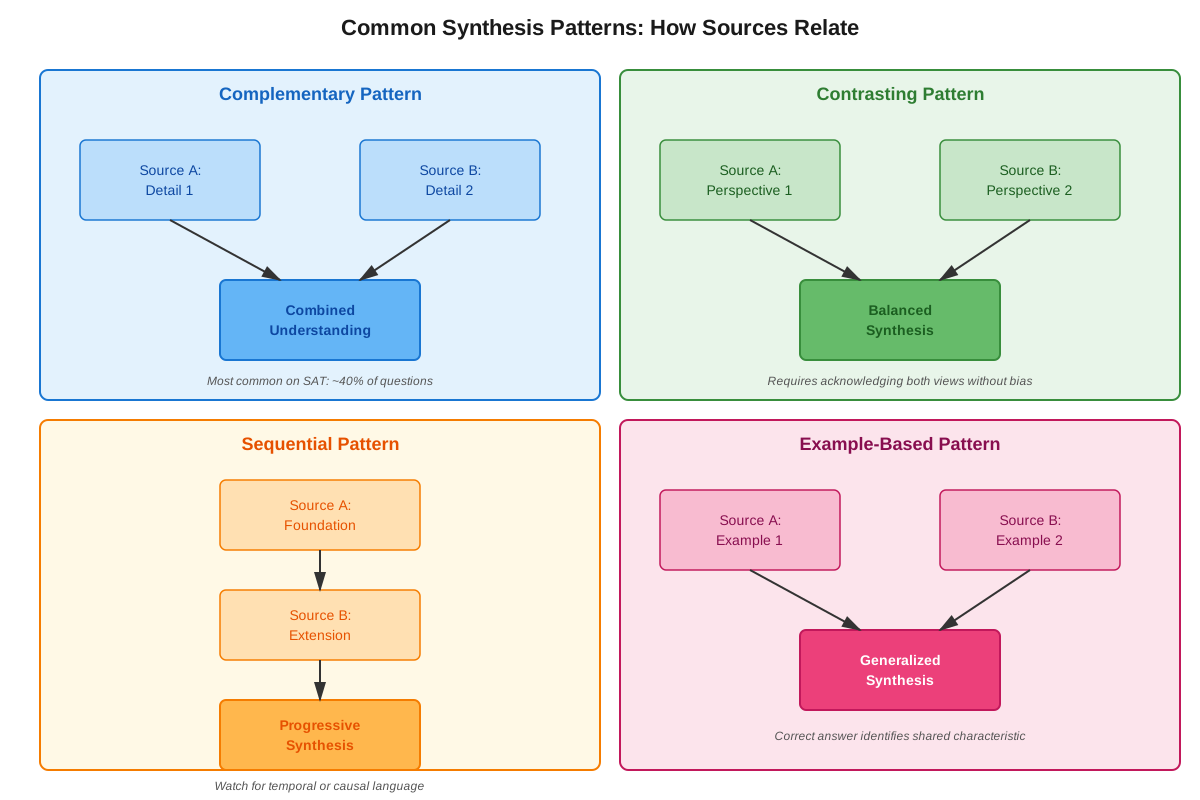
Understanding how source texts relate to one another is crucial for successful synthesis. The SAT employs several common relationship patterns:
Complementary Information: The most frequent pattern involves texts that provide different pieces of information about the same topic, all supporting a common conclusion. For example, Text 1 might describe a scientist's early research, Text 2 might explain her later discoveries, and Text 3 might discuss the impact of her work. The correct synthesis would acknowledge all three dimensions.
Contrasting Perspectives: Some synthesis questions present texts with different viewpoints or findings on the same issue. Students must identify an answer that acknowledges both perspectives without falsely suggesting agreement or ignoring one viewpoint. For instance, Text 1 might argue that a historical event had positive consequences while Text 2 emphasizes negative outcomes. The synthesis must represent both views accurately.
Specific Examples Supporting General Claims: Certain questions provide multiple specific examples or cases in the source texts, and the correct answer identifies the broader pattern or principle they collectively illustrate. Text 1 might describe one species' adaptation, Text 2 another species' adaptation, and the synthesis would recognize the general adaptive strategy both demonstrate.
Cause and Effect Across Sources: Sometimes different texts describe different parts of a causal chain. Text 1 might explain a cause, Text 2 might describe an intermediate step, and Text 3 might present the ultimate effect. Successful synthesis requires recognizing the complete causal sequence.
Key Features of Correct Synthesis Answers
Correct answers to synthesis questions share several identifying characteristics:
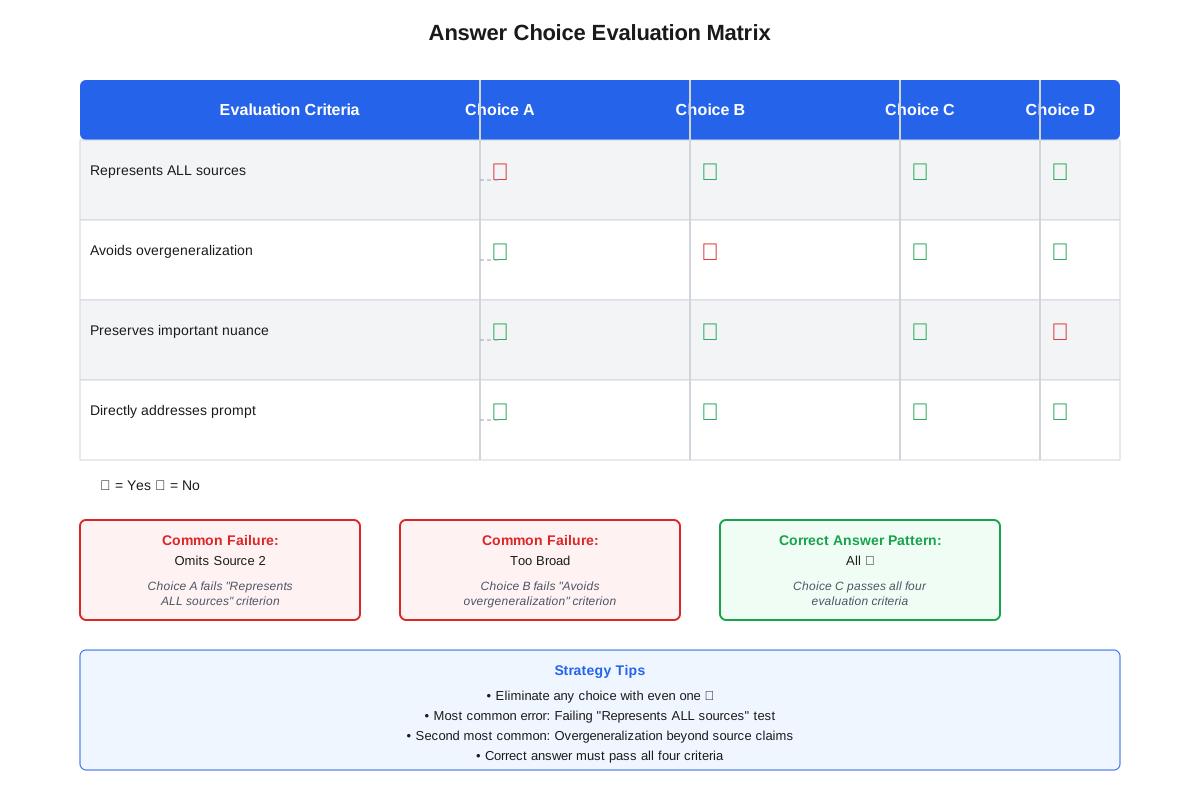
Completeness: The answer must incorporate information from ALL provided texts. If a question presents three sources, the correct answer will reflect content from all three, not just two. This is the most common way the SAT distinguishes correct from incorrect answers.
Accuracy: The synthesis must faithfully represent what each source actually states without distorting meaning, overgeneralizing, or adding information not present in the texts. Even if an answer sounds plausible or includes information from all sources, it's incorrect if it misrepresents any source's content.
Appropriate Specificity: The correct answer balances general and specific information appropriately. It shouldn't be so vague that it loses the meaningful content of the sources, nor so specific that it focuses on minor details while missing main points.
Logical Coherence: The synthesis should present information in a way that makes logical sense, with appropriate connecting language that shows relationships between ideas (e.g., "while," "additionally," "in contrast").
Common Incorrect Answer Patterns
Understanding how wrong answers are constructed helps students eliminate them efficiently:
| Incorrect Answer Type | Description | Example Signal |
|---|---|---|
| Incomplete Synthesis | Includes information from only some sources, not all | "Text 1 and Text 2 show..." when Text 3 exists |
| Overgeneralization | Makes broader claims than the sources support | "All scientists agree..." when texts show limited examples |
| Distortion | Misrepresents what a source actually states | Claiming a text shows causation when it only shows correlation |
| Irrelevant Addition | Includes plausible information not present in any source | Adding background knowledge not stated in the texts |
| False Agreement | Suggests sources agree when they actually present different views | "Both texts support..." when they offer contrasting perspectives |
The Synthesis Process: Step-by-Step Approach
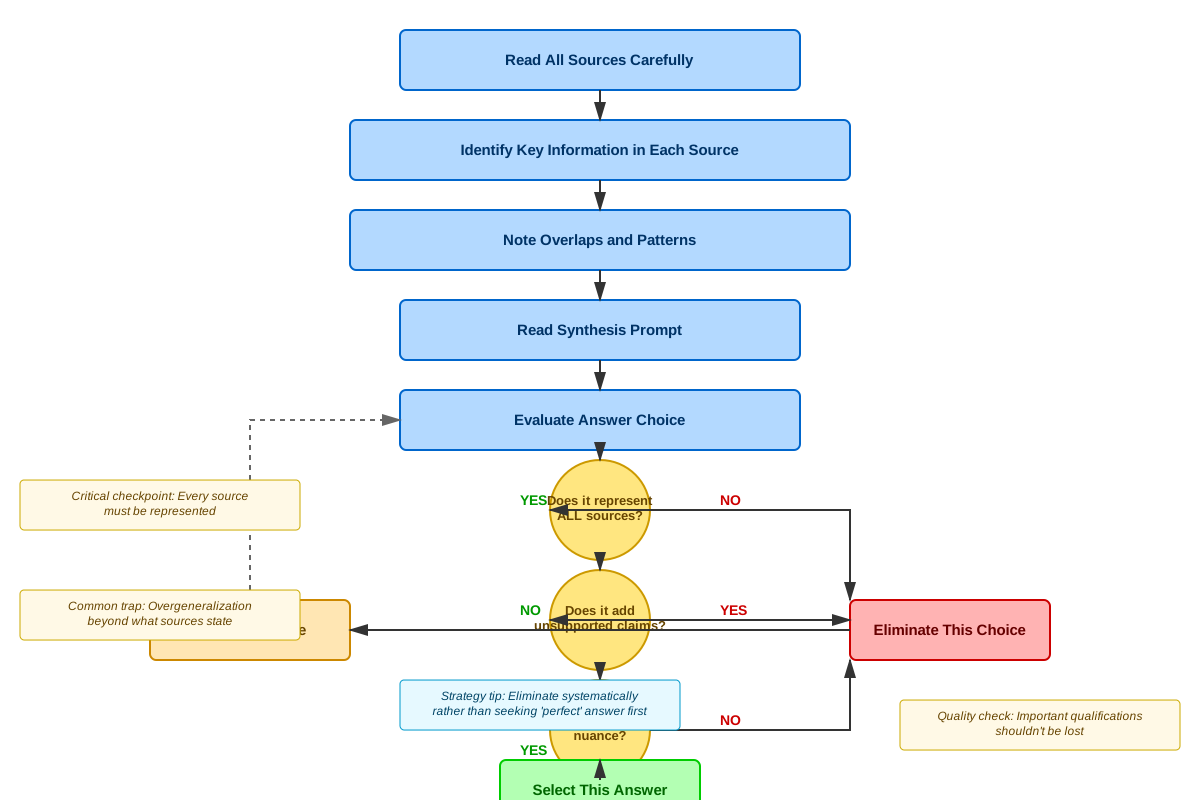
Successful synthesis follows a systematic process:
- Read the prompt first: Understanding what type of synthesis is required (a conclusion, a summary, a comparison) focuses your reading of the sources
- Read each text individually: Process each source separately, noting its main point or key information
- Identify the relationship: Determine how the texts connect—do they complement, contrast, or provide examples?
- Predict the synthesis: Before looking at answer choices, mentally formulate what a complete synthesis should include
- Evaluate each answer systematically: Check each option against all sources, eliminating those that fail to represent any text accurately or completely
- Verify completeness: Ensure your selected answer incorporates information from every provided source
Concept Relationships
The concepts within informal synthesis are hierarchically organized and interdependent. At the foundation lies the ability to comprehend individual texts accurately—without understanding what each source states, synthesis becomes impossible. This foundational comprehension → enables recognition of relationships between texts (complementary, contrasting, exemplifying) → which allows identification of what information appears across multiple sources versus in single sources → leading to evaluation of answer choices for completeness and accuracy → ultimately resulting in selection of the correct synthesis.
Informal synthesis connects directly to prerequisite reading comprehension skills. Students must first extract main ideas and supporting details from individual passages before they can combine information across passages. The logical reasoning skills developed through understanding cause-effect relationships and comparisons within single texts transfer directly to recognizing these same relationships between multiple texts.
This topic also relates closely to other SAT Reading and Writing skills. The evidence-based reading questions that ask students to identify which quotation best supports a claim require similar analytical thinking—determining what information is relevant and how it connects to a broader point. Similarly, questions about rhetorical purpose and author's intent prepare students for synthesis by developing awareness of how different texts might serve different functions while addressing the same topic.
Looking forward, mastering informal synthesis prepares students for more advanced rhetorical analysis and argumentation questions. The ability to integrate multiple perspectives becomes essential when evaluating complex arguments that incorporate counterarguments or when analyzing how authors build cases using varied types of evidence. Synthesis skills also transfer directly to the essay portions of college applications and college-level writing assignments.
High-Yield Facts
⭐ Synthesis questions always require information from ALL provided texts—if an answer choice ignores even one source, it's incorrect regardless of how well it represents the others
⭐ The correct answer will not add information beyond what the texts explicitly state—bringing in outside knowledge or making logical leaps beyond the sources leads to wrong answers
⭐ Approximately 3-5 synthesis questions appear per Reading and Writing section, making this one of the highest-frequency question types
⭐ Source texts in synthesis questions are typically 1-3 sentences each, requiring efficient reading and note-taking strategies
⭐ The most common wrong answer type is incomplete synthesis—answers that accurately represent some but not all sources
- Synthesis questions appear in the "Rhetorical Synthesis" category of the SAT Reading and Writing section
- Source texts may present complementary information, contrasting perspectives, or specific examples of general principles
- Correct answers balance appropriate specificity with general claims—neither too vague nor too focused on minor details
- The prompt typically begins with "Based on the texts..." or similar language that signals synthesis is required
- Overgeneralization is a common trap—claiming "all" or "every" when sources provide limited examples
- Synthesis questions test reading comprehension, logical reasoning, and integration skills simultaneously
- Time management is crucial—synthesis questions often take 60-90 seconds due to multiple texts requiring processing
Quick check — test yourself on Informal synthesis so far.
Try Flashcards →Common Misconceptions
Misconception: Synthesis questions only require reading the first and last sentences of each text to save time → Correction: Every sentence in the brief source texts contains essential information. Since texts are only 1-3 sentences each, skipping any content will likely result in missing information needed for correct synthesis. The SAT deliberately keeps texts short enough that complete reading is both necessary and feasible.
Misconception: The correct answer will always explicitly mention all source texts (e.g., "Text 1 shows X, Text 2 shows Y") → Correction: While correct answers must incorporate information from all sources, they often integrate this information smoothly without explicitly labeling which text contributed which detail. The synthesis should read as a unified statement, not a list of what each text says.
Misconception: If an answer choice sounds sophisticated or uses advanced vocabulary, it's more likely to be correct → Correction: The SAT tests synthesis ability, not vocabulary recognition. Correct answers are determined solely by whether they accurately and completely represent all source texts. Simple, clear language that faithfully synthesizes the sources is always preferable to complex language that distorts or omits information.
Misconception: When texts present contrasting views, the correct answer will identify a compromise or middle ground between them → Correction: Synthesis of contrasting perspectives requires acknowledging both views, not finding compromise. The correct answer will typically use language like "while Text 1 suggests X, Text 2 indicates Y" rather than attempting to reconcile incompatible positions.
Misconception: Outside knowledge about the topic should be used to evaluate answer choices → Correction: Synthesis questions must be answered based exclusively on the provided texts. Even if outside knowledge suggests an answer is factually correct, it's wrong if it includes information not present in the sources. Students should ignore their background knowledge and focus solely on what the texts state.
Misconception: All information from each text must appear in the correct answer → Correction: The correct synthesis incorporates the main point or key information from each text but doesn't necessarily include every minor detail. The goal is accurate representation of each source's contribution to the overall topic, not exhaustive summary of every fact mentioned.
Worked Examples
Example 1: Complementary Information Synthesis
Prompt and Texts:
While researching the history of urban planning, a student found information about Frederick Law Olmsted's contributions to American cities.
Text 1: Frederick Law Olmsted designed Central Park in New York City in the 1850s, creating a naturalistic landscape that provided urban residents with access to green space.
Text 2: Olmsted's design philosophy emphasized the psychological benefits of nature, arguing that parks could reduce stress and improve mental health for city dwellers.
Text 3: Beyond Central Park, Olmsted designed park systems in Boston, Chicago, and other major cities, establishing a model for urban green spaces that influenced city planning for generations.
Based on the texts, which statement best synthesizes the information about Olmsted's work?
A) Frederick Law Olmsted designed Central Park, which became a model for other cities seeking to create green spaces.
B) Olmsted's park designs were based on his belief that natural landscapes could improve urban residents' mental health, and his work in multiple cities established influential principles for urban planning.
C) Central Park in New York City was designed in the 1850s to provide psychological benefits to city residents.
D) Frederick Law Olmsted believed that parks could reduce stress, which is why he designed naturalistic landscapes in several American cities.
Analysis:
Let's evaluate each answer against all three texts:
Answer A includes information from Text 1 (Central Park design) and Text 3 (model for other cities) but completely omits Text 2's information about psychological benefits and design philosophy. This is an incomplete synthesis—eliminate.
Answer B incorporates Text 2's information about mental health beliefs and design philosophy, Text 3's information about work in multiple cities and influence on urban planning, and implicitly includes Text 1's information about his park design work. This represents all three sources accurately and completely.
Answer C combines information from Text 1 (Central Park, 1850s) and Text 2 (psychological benefits) but ignores Text 3's crucial information about his broader influence and work in multiple cities. This is incomplete—eliminate.
Answer D includes Text 2 (stress reduction belief) and Text 3 (designed in several cities) but omits Text 1's specific information about Central Park and the naturalistic landscape approach. Additionally, the causal relationship suggested ("which is why") slightly distorts the information by oversimplifying the connection between his beliefs and design choices.
Correct Answer: B — This answer successfully synthesizes all three texts by acknowledging his design philosophy (Text 2), his work across multiple cities (Text 3), and his role as a park designer (Text 1), while accurately representing the significance of his contributions.
Example 2: Contrasting Perspectives Synthesis
Prompt and Texts:
A student researching the effects of social media on adolescent development found the following perspectives from recent studies.
Text 1: A 2022 study published in the Journal of Adolescent Health found that teenagers who spent more than three hours daily on social media platforms showed increased rates of anxiety and depression compared to peers with limited social media use.
Text 2: Research by psychologist Mitch Prinstein suggests that the effects of social media depend heavily on how adolescents use these platforms—passive scrolling correlates with negative outcomes, while active engagement with close friends shows neutral or even positive effects on wellbeing.
Based on the texts, which statement best synthesizes the research findings?
A) Social media use consistently harms adolescent mental health, with studies showing increased anxiety and depression among teenage users.
B) While some research indicates that extensive social media use correlates with increased anxiety and depression in teenagers, other research suggests that the type of social media engagement may determine whether effects are negative, neutral, or positive.
C) Teenagers should limit social media use to prevent mental health problems, though active engagement with friends is acceptable.
D) A 2022 study found negative effects of social media on adolescents, but Mitch Prinstein's research contradicts these findings by showing positive effects.
Analysis:
Answer A accurately represents Text 1 but completely ignores Text 2's important nuance about different types of use having different effects. It also overgeneralizes by claiming social media "consistently harms" when Text 2 explicitly describes conditions where effects might be neutral or positive. This is both incomplete and inaccurate—eliminate.
Answer B incorporates Text 1's finding about correlation between extensive use and negative mental health outcomes while also including Text 2's crucial distinction about different types of engagement producing different effects. The language "while...other research suggests" appropriately presents these as complementary rather than contradictory findings. This represents both texts accurately and completely.
Answer C makes a prescriptive recommendation ("should limit") that neither text provides—both texts describe research findings, not recommendations. This adds information beyond the sources—eliminate.
Answer D incorrectly characterizes the relationship between the texts as contradictory when they're actually complementary. Text 2 doesn't contradict Text 1; rather, it provides additional nuance by distinguishing between types of use. The word "contradicts" misrepresents the relationship between sources—eliminate.
Correct Answer: B — This synthesis accurately represents both texts while correctly identifying their relationship as complementary (one providing general findings, the other adding important nuance) rather than contradictory.
Exam Strategy
When approaching synthesis questions on the SAT, implement this strategic process to maximize accuracy and efficiency:
Step 1: Identify the question type immediately. Look for trigger phrases like "Based on the texts," "According to the texts," or "Which statement best synthesizes" in the prompt. These signals indicate you're dealing with a synthesis question requiring information from all sources.
Step 2: Read the prompt before the texts. Understanding what type of synthesis is required (a conclusion, a comparison, a general principle) focuses your reading and helps you identify relevant information in each source. The prompt tells you what to look for.
Step 3: Annotate each text briefly. As you read each source, jot down or mentally note its main point in 3-5 words. For example: "Text 1: Central Park design," "Text 2: mental health benefits," "Text 3: influence on other cities." This prevents confusion when evaluating answers.
Step 4: Identify the relationship between texts. Before looking at answer choices, determine whether texts provide complementary information, contrasting perspectives, or specific examples of a general principle. This relationship guides what the correct synthesis should look like.
Step 5: Use systematic elimination. Check each answer choice against each text individually. Ask: "Does this answer accurately represent Text 1? Text 2? Text 3?" Eliminate any answer that fails to represent even one source accurately or completely.
Exam Tip: The most efficient elimination strategy is checking for completeness first. Quickly scan each answer to see if it incorporates information from all sources. This often eliminates 2-3 options immediately, leaving fewer choices to evaluate in detail.
Watch for these trigger words that signal incorrect answers:
- "All," "every," "always," "never": These absolute terms often indicate overgeneralization beyond what limited sources support
- "Proves," "demonstrates conclusively": These suggest stronger claims than research findings typically make
- "Should," "must," "ought to": Prescriptive language that adds recommendations not present in descriptive research texts
- "Contradicts," "disproves": Often mischaracterizes complementary sources as contradictory
Time allocation advice: Synthesis questions typically require 60-90 seconds—slightly longer than single-passage questions because you're processing multiple texts. However, don't exceed 90 seconds. If you're stuck, eliminate answers that clearly omit sources, make your best guess from remaining options, and move forward. You can always return if time permits.
Process-of-elimination specific tips:
- First pass: Eliminate answers that obviously omit one or more sources
- Second pass: Eliminate answers that distort or overgeneralize information
- Third pass: Choose between remaining options by checking which most accurately represents the relationship between sources
Memory Techniques
The "ALL" Mnemonic for Synthesis Questions:
- All sources must be represented
- Logical relationships between texts matter
- Limit yourself to what texts actually state (no outside knowledge)
The "CARE" Process for Evaluating Answers:
- Completeness: Does it include all sources?
- Accuracy: Does it faithfully represent each source?
- Relationship: Does it correctly show how sources connect?
- Exactness: Does it avoid overgeneralization and added information?
Visualization Strategy: Picture each source text as a puzzle piece. The correct synthesis is the completed puzzle showing how all pieces fit together. If an answer choice leaves out a piece (source) or forces pieces together incorrectly (distorts relationships), the puzzle is incomplete or wrong.
The "Three-Check" Rule: Before selecting an answer, physically or mentally check it against each source individually. For three sources, that's three checks. If you can't confirm the answer represents a source, it's likely wrong.
Acronym for Common Wrong Answer Types: Remember DIODE to avoid common traps:
- Distortion of source content
- Incomplete synthesis (missing sources)
- Overgeneralization beyond sources
- Different information (adding content not in texts)
- Erroneous relationships (mischaracterizing how sources connect)
Summary
Informal synthesis represents a critical SAT Reading and Writing skill that requires students to integrate information from multiple brief texts into a unified, accurate statement. Unlike formal academic synthesis requiring citations, SAT synthesis questions focus on the cognitive ability to recognize complementary information, contrasting perspectives, or specific examples across sources and combine them coherently. Success depends on reading each source carefully, identifying relationships between texts, and selecting answers that completely and accurately represent all provided sources without distortion, overgeneralization, or added information. The most common error is incomplete synthesis—choosing answers that represent only some sources while ignoring others. Effective strategy involves reading the prompt first to understand what synthesis is required, annotating each text's main point, identifying the relationship pattern between sources, and systematically eliminating answers that fail to represent any source accurately or completely. With 3-5 synthesis questions per Reading and Writing section, mastering this skill significantly impacts overall scores and prepares students for college-level reading and writing demands.
Key Takeaways
- Synthesis questions require information from ALL provided texts—incomplete answers are the most common wrong answer type
- The correct answer never adds information beyond what sources explicitly state—avoid bringing in outside knowledge or making unsupported logical leaps
- Source relationships matter: texts may provide complementary information, contrasting perspectives, or specific examples of general principles
- Read the prompt before the texts to understand what type of synthesis is required and focus your reading accordingly
- Systematic elimination is more efficient than trying to identify the correct answer immediately—check each option against each source
- Watch for overgeneralization trigger words like "all," "every," "always," and "never" that often signal incorrect answers
- Allocate 60-90 seconds per synthesis question to allow adequate time for processing multiple texts while maintaining overall pacing
Related Topics
Evidence-Based Reading Questions: These questions ask students to identify which quotation from a passage best supports a given claim, requiring similar skills in evaluating how specific information relates to broader statements. Mastering synthesis prepares students for recognizing relevant evidence.
Rhetorical Purpose and Function: Understanding why authors include specific information and how different parts of texts work together builds the analytical foundation needed for recognizing relationships between multiple texts in synthesis questions.
Argument Analysis: More advanced questions about evaluating arguments, identifying assumptions, and recognizing logical fallacies extend synthesis skills by requiring students to integrate and critically evaluate complex reasoning across sources.
Cross-Text Connections in Literature: Some SAT questions ask students to compare themes, techniques, or perspectives across paired literary passages, applying synthesis skills to more nuanced textual analysis.
Practice CTA
Now that you've mastered the core concepts of informal synthesis, it's time to put your knowledge into action! Complete the practice questions to reinforce your understanding and build confidence with this high-yield question type. The flashcards will help you internalize key concepts and common patterns, making synthesis questions feel automatic on test day. Remember: synthesis questions appear frequently on the SAT, so every practice question you complete is a direct investment in your score. You've learned the strategies—now apply them and watch your accuracy improve!
Sign up free to keep reading
Create a free AnvayaPrep account to finish this SAT guide on Informal synthesis — plus flashcards and practice questions.