Overview
Maintaining focus is a critical skill tested in the SAT Reading and Writing section, specifically within the Rhetorical Synthesis domain. This concept evaluates a student's ability to identify which sentence, phrase, or detail best supports the main purpose or central claim of a passage while eliminating information that strays from the primary focus. On the SAT, maintaining focus questions require students to recognize when additional information enhances an argument versus when it introduces tangential or irrelevant details that distract from the writer's intended message.
The ability to maintain focus is fundamental to effective communication and analytical reading. In the context of SAT maintaining focus questions, students must demonstrate sophisticated comprehension by evaluating how each potential addition to a passage either strengthens or weakens its coherence. These questions typically present a brief passage followed by a sentence with a blank or a choice point, asking students to select the option that best maintains the passage's established focus. The incorrect answers often contain factually accurate information that nonetheless fails to align with the passage's specific purpose or argumentative direction.
This topic connects directly to broader RW (Reading and Writing) skills including main idea identification, purpose analysis, and rhetorical effectiveness. Mastering maintaining focus questions strengthens a student's ability to evaluate relevance, assess supporting evidence, and understand how writers construct focused, purposeful arguments. These skills transfer not only to other SAT question types but also to college-level writing and critical reading tasks where distinguishing between relevant and tangential information is essential.
Learning Objectives
- [ ] Identify key features of maintaining focus in SAT passages
- [ ] Explain how maintaining focus appears on the SAT and what question formats to expect
- [ ] Apply maintaining focus principles to answer SAT-style questions accurately
- [ ] Distinguish between relevant supporting details and tangential information in a passage
- [ ] Evaluate whether additional information strengthens or weakens a passage's coherence
- [ ] Recognize common distractors that contain accurate but irrelevant information
- [ ] Analyze the relationship between a passage's stated purpose and appropriate supporting details
Prerequisites
- Main idea identification: Understanding the central claim or purpose of a passage is essential because maintaining focus requires evaluating whether information supports that main idea
- Reading comprehension fundamentals: The ability to understand passage content and structure provides the foundation for assessing relevance and coherence
- Basic rhetorical awareness: Recognizing that writers make deliberate choices about what to include helps students evaluate whether specific details serve the passage's purpose
- Vocabulary in context: Understanding the meaning of words and phrases ensures accurate interpretation of both the passage and answer choices
Why This Topic Matters
Maintaining focus questions appear with high frequency on the SAT, typically comprising 2-4 questions per test administration. These questions are classified as medium difficulty but often challenge students because they require nuanced judgment rather than simple fact retrieval. The College Board emphasizes these questions because they assess skills directly applicable to college writing and research: the ability to stay on topic, support claims with relevant evidence, and construct coherent arguments.
In real-world applications, maintaining focus is essential for effective academic writing, professional communication, and critical analysis. Students who master this skill produce more coherent essays, conduct more focused research, and communicate ideas more persuasively. In professional contexts, the ability to distinguish relevant from irrelevant information improves report writing, presentation development, and strategic decision-making.
On the SAT, maintaining focus questions typically appear in passages spanning various subjects including science, history, literature, and social studies. The passages are usually 50-150 words long and present an argument, explanation, or description. Students must then select which sentence or phrase best maintains the passage's established focus, often from four options that may all contain factually accurate information. The challenge lies not in identifying true statements but in recognizing which true statement best serves the passage's specific purpose.
Core Concepts
Understanding Focus in Writing
Focus in writing refers to the consistent development of a single main idea, purpose, or argument throughout a passage. A well-focused passage maintains clear direction by including only information that directly supports, explains, or develops its central claim. Every sentence, detail, and example should contribute to the reader's understanding of the main point without introducing distracting tangents or unrelated information.
In SAT passages, focus manifests through several key characteristics:
- A clear central claim or purpose statement
- Supporting details that directly relate to that claim
- Logical progression of ideas that build upon each other
- Absence of tangential information, even if interesting or factually accurate
- Consistent scope that neither narrows too much nor broadens beyond the intended topic
Types of Focus Violations
Understanding how passages lose focus helps students identify correct answers. Common focus violations include:
| Violation Type | Description | Example Context |
|---|---|---|
| Scope shift | Information that addresses a related but distinct topic | Passage about solar panel efficiency that shifts to wind energy |
| Excessive detail | Overly specific information that doesn't serve the main purpose | Passage about climate change that includes specific dates of minor conferences |
| Tangential facts | Accurate information that connects loosely but doesn't support the claim | Passage about Shakespeare's influence that mentions his birthplace's tourism industry |
| Premature expansion | Information that broadens the topic before fully developing the main point | Passage establishing one theory that jumps to comparing multiple theories |
| Contradictory focus | Details that undermine or distract from the established argument | Passage arguing for a policy that extensively discusses opposing viewpoints |
Identifying Passage Purpose
Before evaluating whether information maintains focus, students must accurately identify the passage's purpose. SAT passages typically serve one of these purposes:
- Argumentative: Advancing a specific claim or position
- Explanatory: Clarifying how something works or why something occurs
- Descriptive: Characterizing features, qualities, or attributes
- Comparative: Analyzing similarities or differences between concepts
- Narrative: Recounting events or developments chronologically
The passage purpose determines what information is relevant. For example, in an explanatory passage about photosynthesis, details about the chemical process maintain focus, while information about plant classification systems does not, even though both relate to plants.
Evaluating Relevance
Relevance is the degree to which information directly supports or develops the passage's stated purpose. To evaluate relevance, students should ask:
- Does this information directly support the main claim?
- Does this detail help readers better understand the central concept?
- Would removing this information weaken the passage's argument or explanation?
- Does this information answer questions raised by the passage's purpose?
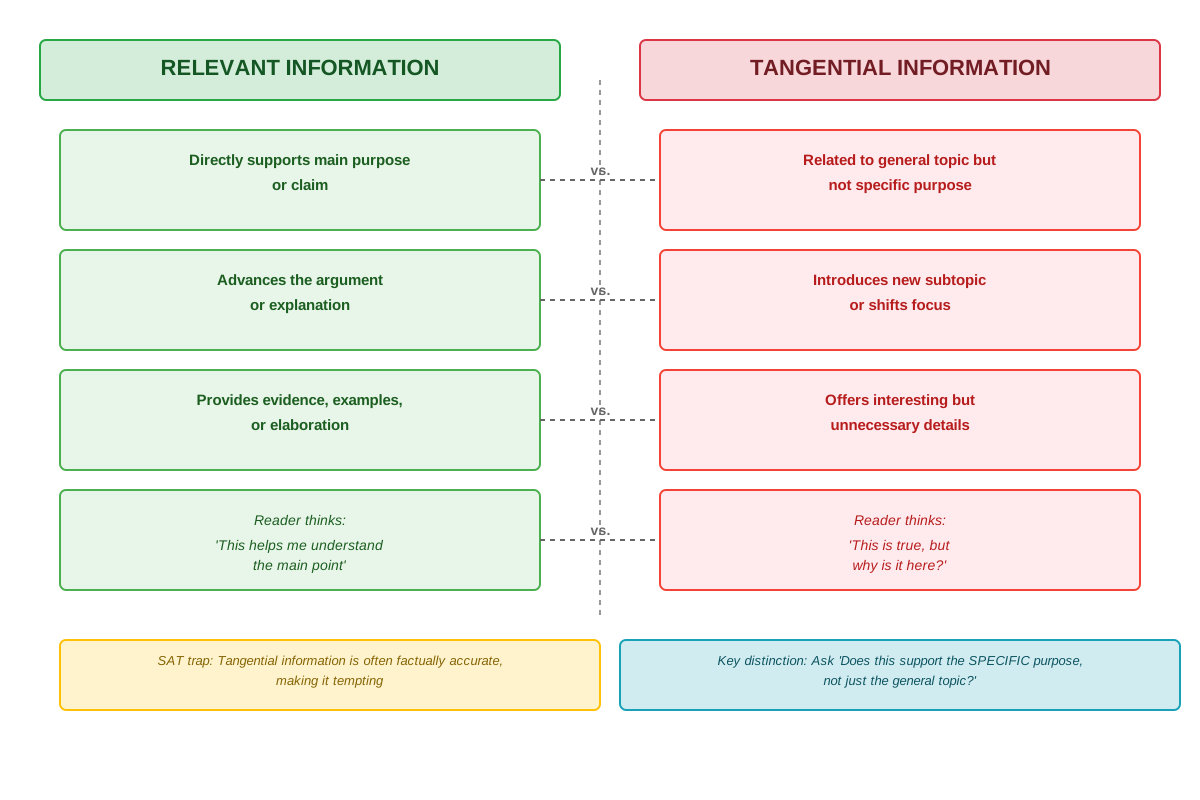
Highly relevant information is both accurate and purposeful—it serves the specific needs of the passage. Irrelevant information may be accurate, interesting, or related to the general topic but fails to advance the passage's particular focus.
The Role of Context Clues
SAT maintaining focus questions provide crucial context clues that signal the passage's direction:
- Transition words: "Furthermore," "however," "specifically" indicate how new information should relate to existing content
- Purpose statements: Explicit declarations like "This essay examines..." or "The primary factor is..."
- Scope indicators: Words like "particularly," "mainly," or "specifically" narrow the focus
- Concluding signals: Phrases like "therefore" or "as a result" indicate the passage is drawing conclusions from established information
These clues help students predict what type of information would maintain focus and what would constitute a distraction.
Concept Relationships
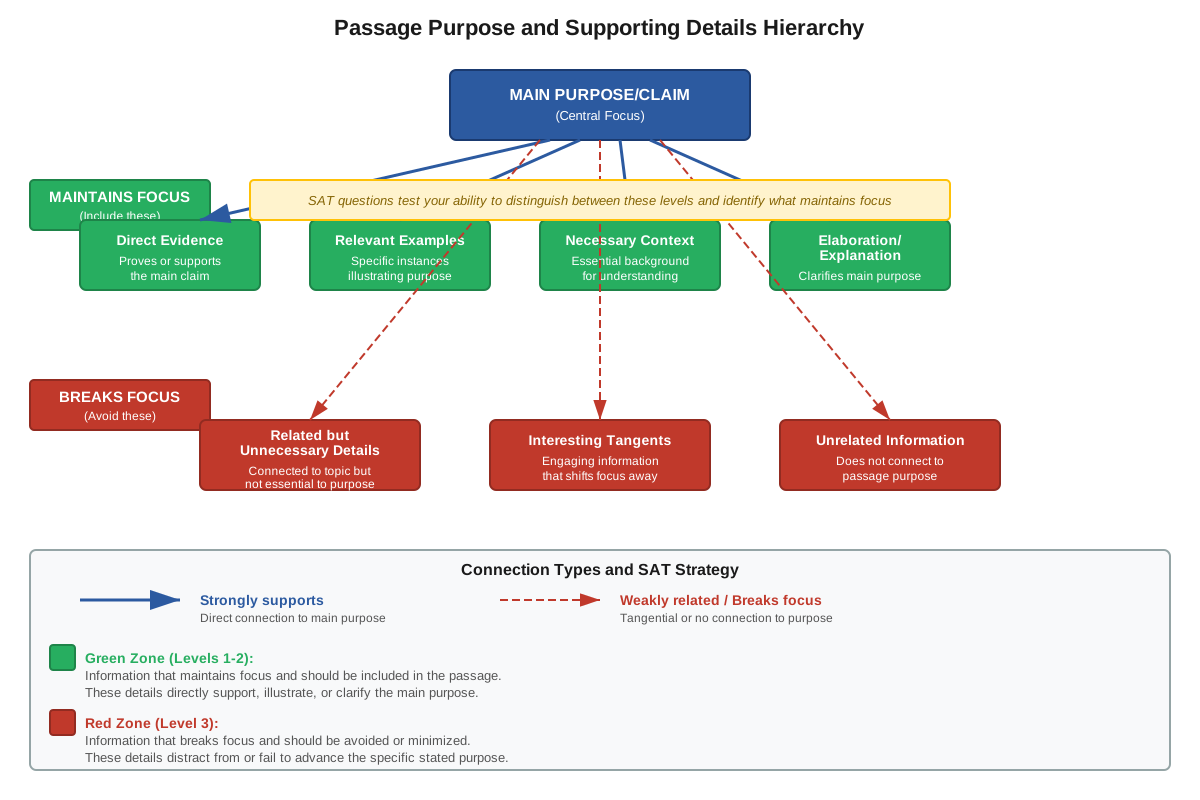
The concepts within maintaining focus build upon each other hierarchically. Understanding focus in writing serves as the foundation, establishing what focused writing looks like. This understanding enables students to identify passage purpose, which is essential because purpose determines relevance. Once purpose is clear, students can evaluate relevance of specific details by comparing them against the established purpose. Throughout this process, students must recognize types of focus violations to eliminate incorrect answers, while using context clues to confirm their understanding of the passage's direction.
This topic connects to prerequisite knowledge of main idea identification—students cannot maintain focus without first recognizing what the focus should be. It also relates to broader rhetorical synthesis skills, as maintaining focus is one component of effective rhetorical construction alongside tone, style, and organization. The skill progresses naturally into more advanced topics like evaluating argument strength and analyzing rhetorical choices, where students must assess not just whether information is relevant but how effectively it serves persuasive or explanatory purposes.
Relationship map: Main Idea Identification → Understanding Focus → Identifying Passage Purpose → Evaluating Relevance → Recognizing Focus Violations → Selecting Correct Answers → Advanced Rhetorical Analysis
High-Yield Facts
⭐ Maintaining focus questions require selecting information that directly supports the passage's specific purpose, not just information related to the general topic
⭐ Correct answers often contain less interesting or less detailed information than distractors, but they better serve the passage's focus
⭐ The passage's opening sentence or explicit purpose statement is the most reliable guide for determining what maintains focus
⭐ Information can be factually accurate and topically related but still violate focus if it doesn't serve the passage's specific purpose
⭐ Transition words and phrases in the passage provide critical clues about what type of information should follow
- Maintaining focus questions typically appear 2-4 times per SAT test administration
- These questions often present four factually accurate answer choices, making relevance judgment crucial
- Scope shifts are the most common type of focus violation in incorrect answer choices
- The correct answer will always align with both the passage's purpose and its level of specificity
- Questions may ask students to complete a sentence, add a sentence, or select which detail to include
- Passages in maintaining focus questions are typically 50-150 words long
- The skill of maintaining focus applies to both reading comprehension and writing tasks on the SAT
Quick check — test yourself on Maintaining focus so far.
Try Flashcards →Common Misconceptions
Misconception: If information is factually accurate and relates to the passage's general topic, it maintains focus → Correction: Maintaining focus requires information to serve the passage's specific purpose, not just relate to the broad topic. A passage about renewable energy efficiency that discusses the history of coal mining includes topically related but unfocused information.
Misconception: More detailed or interesting information is always better for maintaining focus → Correction: Excessive detail can violate focus if it doesn't serve the passage's purpose. A passage establishing a basic principle doesn't need highly technical specifications that would be appropriate in a more advanced discussion.
Misconception: Maintaining focus means never introducing new information → Correction: Focused passages regularly introduce new information, but that information must develop or support the established purpose. The key is relevance, not familiarity.
Misconception: If a passage mentions multiple topics, any information about those topics maintains focus → Correction: Even when passages discuss multiple elements, they do so for a specific purpose. Information about mentioned topics only maintains focus if it serves that purpose. A passage comparing two theories to establish one's superiority should not include extensive neutral description of the weaker theory.
Misconception: The longest or most complex answer choice is usually correct → Correction: Correct answers in maintaining focus questions are often simpler and more direct than distractors. Complexity doesn't indicate relevance.
Misconception: Maintaining focus questions test factual knowledge about the passage topic → Correction: These questions test analytical reading skills—the ability to evaluate relevance and coherence—not subject matter expertise. Students don't need prior knowledge of the topic to answer correctly.
Worked Examples
Example 1: Scientific Explanation Passage
Passage: Bioluminescence, the production of light by living organisms, occurs through a chemical reaction involving the molecule luciferin and the enzyme luciferase. When these substances interact in the presence of oxygen, they produce light with minimal heat generation. This efficient light production has evolved independently in numerous species, from deep-sea fish to fireflies. Scientists study bioluminescence not only to understand its evolutionary advantages but also _______.
Question: Which choice most effectively maintains the focus of the passage?
A) because fireflies use bioluminescence in complex mating rituals that vary by species
B) to develop practical applications such as medical imaging technologies
C) since the deepest parts of the ocean remain largely unexplored by researchers
D) given that luciferin molecules have different structures in different organisms
Analysis:
First, identify the passage's purpose: This is an explanatory passage that describes what bioluminescence is and establishes that scientists study it for multiple reasons. The blank follows "not only... but also," indicating it should provide a second reason scientists study bioluminescence, parallel to "understand its evolutionary advantages."
Evaluate each option:
Option A: Discusses firefly mating rituals. While fireflies are mentioned in the passage, this detail focuses on one specific species' behavior rather than providing a broad reason for scientific study. This represents a scope shift from general scientific interest to specific behavioral details. ❌
Option B: Presents practical applications as a research motivation. This directly answers why scientists study bioluminescence and parallels "evolutionary advantages" by providing another category of research motivation. This maintains the passage's focus on scientific study purposes. ✓
Option C: Discusses ocean exploration. While deep-sea fish are mentioned, this shifts focus to ocean exploration generally rather than maintaining focus on bioluminescence research. This is tangential information. ❌
Option D: Provides technical detail about luciferin structure. While accurate, this represents excessive detail that doesn't answer the question of why scientists study bioluminescence. It describes a characteristic rather than a research motivation. ❌
Correct Answer: B
This example demonstrates how the correct answer maintains focus by directly serving the passage's established purpose (explaining research motivations) while distractors introduce related but unfocused information.
Example 2: Historical Argument Passage
Passage: The construction of the transcontinental railroad fundamentally transformed American commerce by reducing cross-country shipping time from months to days. This dramatic improvement in transportation efficiency enabled businesses to access national markets, fundamentally changing economic relationships between regions. _______ The railroad's completion in 1869 marked the beginning of truly integrated national commerce.
Question: Which choice most logically completes the passage's discussion of the railroad's economic impact?
A) The Central Pacific and Union Pacific railroad companies employed thousands of workers, including many Chinese immigrants who faced discrimination.
B) Railroad construction required innovative engineering solutions to traverse mountain ranges and desert terrain.
C) Agricultural producers in the Midwest could now ship grain to Eastern cities while remaining competitive on price.
D) The golden spike ceremony at Promontory Summit, Utah, attracted significant media attention and public celebration.
Analysis:
Identify the passage's purpose: This is an argumentative passage claiming that the transcontinental railroad "fundamentally transformed American commerce" by improving shipping efficiency and enabling national markets. The blank should provide a specific example that illustrates this economic transformation.
Evaluate each option:
Option A: Discusses labor and discrimination. While historically accurate and important, this shifts focus from economic impact to labor history and social issues. This represents a scope shift away from the passage's commercial focus. ❌
Option B: Describes engineering challenges. This is relevant to railroad construction but doesn't address the passage's focus on economic transformation and commercial impact. This is tangential information. ❌
Option C: Provides a concrete example of how improved shipping enabled national markets—Midwestern grain reaching Eastern cities competitively. This directly illustrates the economic transformation described in the passage, maintaining focus on commercial impact. ✓
Option D: Discusses the completion ceremony. While the passage mentions the 1869 completion, this detail focuses on the ceremonial event rather than economic impact. This represents excessive detail about a mentioned fact without serving the passage's argumentative purpose. ❌
Correct Answer: C
This example shows how maintaining focus requires selecting information that develops the passage's specific argument (economic transformation) rather than exploring related but distinct aspects of the topic (labor, engineering, or ceremonial events).
Exam Strategy
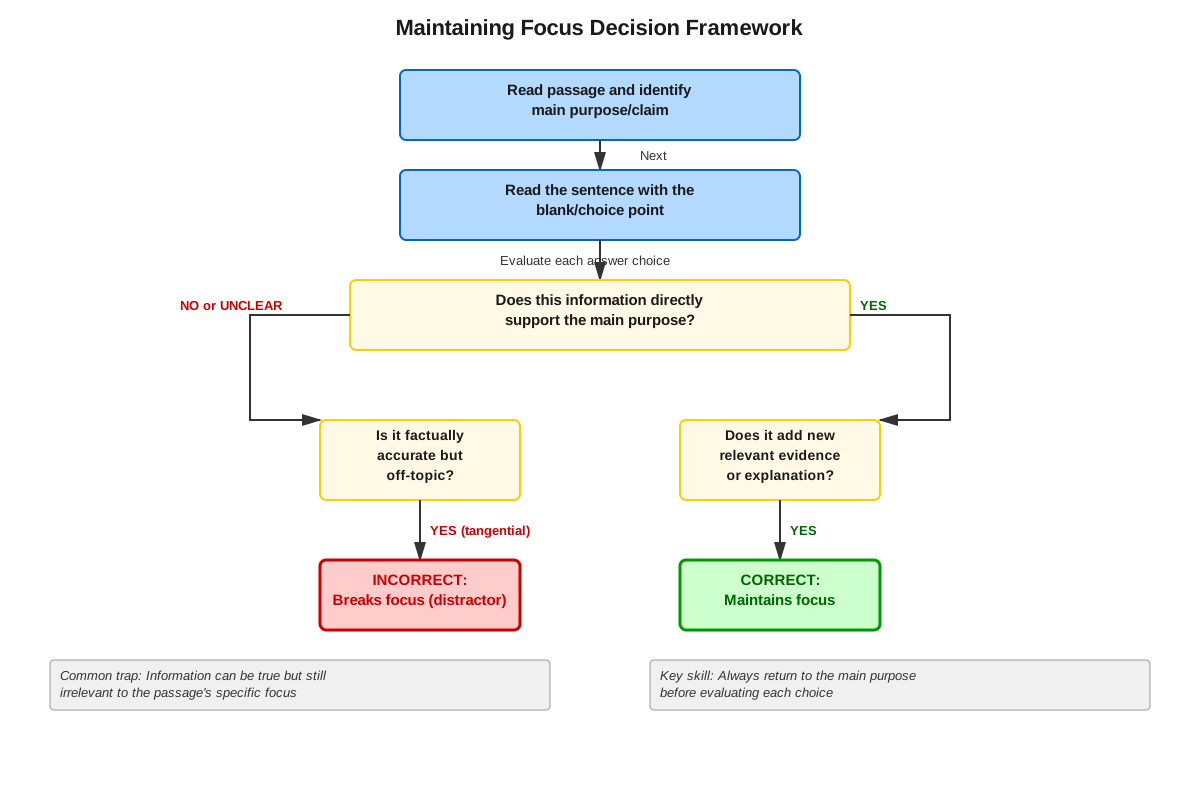
When approaching SAT maintaining focus questions, follow this systematic process:
Step 1: Read the entire passage carefully before looking at answer choices. Identify the main purpose or claim in the opening sentence or explicit purpose statement. Underline or mentally note this purpose.
Step 2: Determine the passage type (argumentative, explanatory, descriptive, comparative, or narrative). This helps predict what information would be relevant.
Step 3: Identify the specific function the blank or addition should serve. Look for transition words, parallel structure, or explicit signals about what should follow.
Step 4: Predict the type of information needed before reading answer choices. Ask: "What would logically develop this idea?" or "What example would support this claim?"
Step 5: Eliminate answers that violate focus by identifying scope shifts, tangential facts, excessive details, or contradictory information. Often, 2-3 answers can be eliminated quickly.
Step 6: Compare remaining answers by asking which one most directly serves the passage's specific purpose. The correct answer will feel like a natural continuation of the passage's direction.
Exam Tip: Watch for these trigger phrases that signal maintaining focus questions: "most effectively maintains the focus," "most logically completes," "best supports the main idea," or "which choice stays most closely aligned with the passage's purpose."
Time allocation: Spend approximately 60-75 seconds per maintaining focus question. These questions require careful reading but don't demand extensive analysis once you've identified the passage's purpose.
Process of elimination strategies:
- Eliminate answers that introduce new topics not mentioned in the passage
- Eliminate answers that provide background information when the passage is drawing conclusions
- Eliminate answers that discuss specific examples when the passage is making general claims
- Eliminate answers that seem interesting but don't answer the question of what serves the passage's purpose
Common trap patterns:
- The "interesting fact" trap: Distractors often contain fascinating information that tempts students but doesn't maintain focus
- The "related topic" trap: Information about a mentioned subject that doesn't serve the passage's specific purpose
- The "too specific" trap: Excessive detail that narrows focus beyond the passage's scope
- The "too broad" trap: Information that expands scope before the passage has fully developed its main point
Memory Techniques
FOCUS Acronym for evaluating answer choices:
- Function: Does this serve the passage's purpose?
- On-topic: Does this address the specific claim, not just the general subject?
- Consistent: Does this match the passage's scope and level of detail?
- Unified: Does this connect logically to surrounding sentences?
- Supporting: Does this develop or strengthen the main idea?
The "Purpose First" Mantra: Before evaluating any answer choice, mentally state: "This passage's purpose is to [explain/argue/describe] _____." This keeps focus evaluation grounded in the passage's actual goal.
Visualization Strategy: Imagine the passage as a path through a forest. The main idea is the destination. Relevant information keeps you on the path toward that destination. Irrelevant information, even if interesting, leads you off the path into the woods. Ask: "Does this answer keep me on the path?"
The Relevance Test: For each answer choice, complete this sentence: "This information helps the passage [achieve its purpose] by _____." If you cannot complete the sentence convincingly, the answer violates focus.
Scope Spectrum: Visualize a spectrum from "too narrow" to "just right" to "too broad." The correct answer matches the passage's established scope, while distractors often fall on either extreme.
Summary
Maintaining focus is a high-frequency SAT Reading and Writing skill that tests students' ability to identify information that directly supports a passage's specific purpose while eliminating tangential or irrelevant details. Success requires first identifying the passage's main purpose—whether argumentative, explanatory, descriptive, comparative, or narrative—and then evaluating whether potential additions serve that purpose. The key challenge is recognizing that factually accurate, topically related information may still violate focus if it doesn't advance the passage's particular argument or explanation. Common focus violations include scope shifts, excessive detail, tangential facts, and premature expansion. Students must use context clues like transition words, purpose statements, and scope indicators to predict what information would maintain focus. The correct answer in maintaining focus questions directly develops the established purpose and matches the passage's scope, while distractors often contain interesting but unfocused information. Mastering this skill requires moving beyond simple topic recognition to sophisticated evaluation of relevance and coherence.
Key Takeaways
- Maintaining focus requires selecting information that serves the passage's specific purpose, not just relates to its general topic
- Always identify the passage's main purpose before evaluating answer choices—this is the foundation for all relevance judgments
- Factually accurate information can still be incorrect if it doesn't advance the passage's particular focus
- The passage's opening sentence and transition words provide crucial clues about what maintains focus
- Correct answers often feel simpler or less interesting than distractors but better serve the passage's coherent development
- Common distractors include scope shifts, tangential facts, and excessive details that don't support the main purpose
- Use the FOCUS acronym (Function, On-topic, Consistent, Unified, Supporting) to systematically evaluate answer choices
Related Topics
Rhetorical Purpose and Effect: Building on maintaining focus, this topic examines how writers make deliberate choices to achieve specific effects on readers. Mastering focus provides the foundation for understanding why writers include or exclude particular information.
Transitions and Logical Flow: This topic explores how writers connect ideas coherently. Understanding maintaining focus helps students recognize when transitions successfully link relevant ideas versus when they introduce unfocused tangents.
Main Idea and Supporting Details: This foundational skill connects directly to maintaining focus, as identifying main ideas enables students to evaluate which details appropriately support those ideas.
Argument Evaluation: Advanced analysis of argument strength builds on maintaining focus by examining not just whether information is relevant but how effectively it supports claims.
Synthesis Questions: These questions require combining information from multiple sources while maintaining focus on a specific purpose, directly applying the skills developed in single-passage focus questions.
Practice CTA
Now that you've mastered the core concepts of maintaining focus, it's time to apply these skills to authentic SAT-style questions. The practice questions and flashcards will reinforce your ability to identify passage purposes, evaluate relevance, and select answers that maintain coherent focus. Remember: every practice question you complete strengthens your pattern recognition and builds the confidence you need to excel on test day. Approach each practice question systematically using the FOCUS acronym and the strategies outlined in this guide. You've built a strong foundation—now demonstrate your mastery through deliberate practice!
Sign up free to keep reading
Create a free AnvayaPrep account to finish this SAT guide on Maintaining focus — plus flashcards and practice questions.