Overview
Selecting relevant notes is a critical skill tested in the SAT Reading and Writing section, specifically within the Rhetorical Synthesis domain. This question type presents students with a research scenario where a student has gathered multiple notes on a topic and must complete a text that achieves a specific rhetorical goal. The task requires identifying which note or combination of notes best supports the intended purpose of the passage, whether that purpose is to illustrate a claim, provide evidence, introduce a contrast, or accomplish another rhetorical objective.
This topic is essential for the SAT because it assesses multiple interconnected skills simultaneously: reading comprehension, critical thinking, rhetorical awareness, and the ability to synthesize information from multiple sources. Unlike traditional reading comprehension questions that focus on a single passage, sat selecting relevant notes questions mirror authentic academic writing tasks where students must evaluate source material and determine which information best serves their argumentative or explanatory purpose. These questions typically appear 1-2 times per SAT administration and are considered medium-to-high difficulty because they require students to move beyond simple comprehension to analytical evaluation.
Within the broader RW (Reading and Writing) section, selecting relevant notes connects to fundamental skills in evidence-based reasoning, argument construction, and rhetorical analysis. Success on these questions demonstrates a student's ability to think like a writer making deliberate choices about which information to include based on purpose and audience—a skill that extends far beyond standardized testing into college-level academic writing and professional communication.
Learning Objectives
- [ ] Identify key features of selecting relevant notes questions on the SAT
- [ ] Explain how selecting relevant notes appears on the SAT and what makes it distinct from other question types
- [ ] Apply selecting relevant notes strategies to answer SAT-style questions accurately and efficiently
- [ ] Analyze the relationship between a stated rhetorical goal and the content of provided notes
- [ ] Evaluate multiple notes to determine which best fulfills a specific purpose or claim
- [ ] Distinguish between notes that are tangentially related versus directly relevant to a given objective
- [ ] Synthesize information from multiple sources to understand how notes work together or independently
Prerequisites
- Basic reading comprehension skills: Understanding main ideas, supporting details, and explicit information in short passages is necessary to process both the prompt and the notes efficiently
- Familiarity with rhetorical purpose: Recognizing common purposes in writing (to inform, persuade, illustrate, contrast, etc.) helps students match notes to stated goals
- Understanding of evidence and claims: Knowing how evidence supports claims is fundamental to evaluating whether a note accomplishes its intended rhetorical function
- Vocabulary at grade level: Students must understand academic and domain-specific vocabulary that appears in both the scenario and the notes
Why This Topic Matters
In real-world academic and professional contexts, the ability to select relevant information from multiple sources is indispensable. College students regularly face research assignments requiring them to sift through numerous articles, studies, and sources to find information that directly supports their thesis. Professionals in fields from journalism to scientific research must evaluate data and determine what information is pertinent to their specific communication goals. The selecting relevant notes question type directly mirrors these authentic tasks, making it one of the most practically applicable skills tested on the SAT.
From an exam perspective, selecting relevant notes questions appear with consistent frequency on the SAT, typically 1-2 questions per test administration. These questions are classified as medium difficulty but often prove challenging because they require multi-step reasoning: students must understand the rhetorical goal, comprehend each note's content, evaluate relevance, and eliminate options that are partially but not fully appropriate. According to College Board data, these questions have a lower average accuracy rate than straightforward comprehension questions, making them high-yield targets for score improvement.
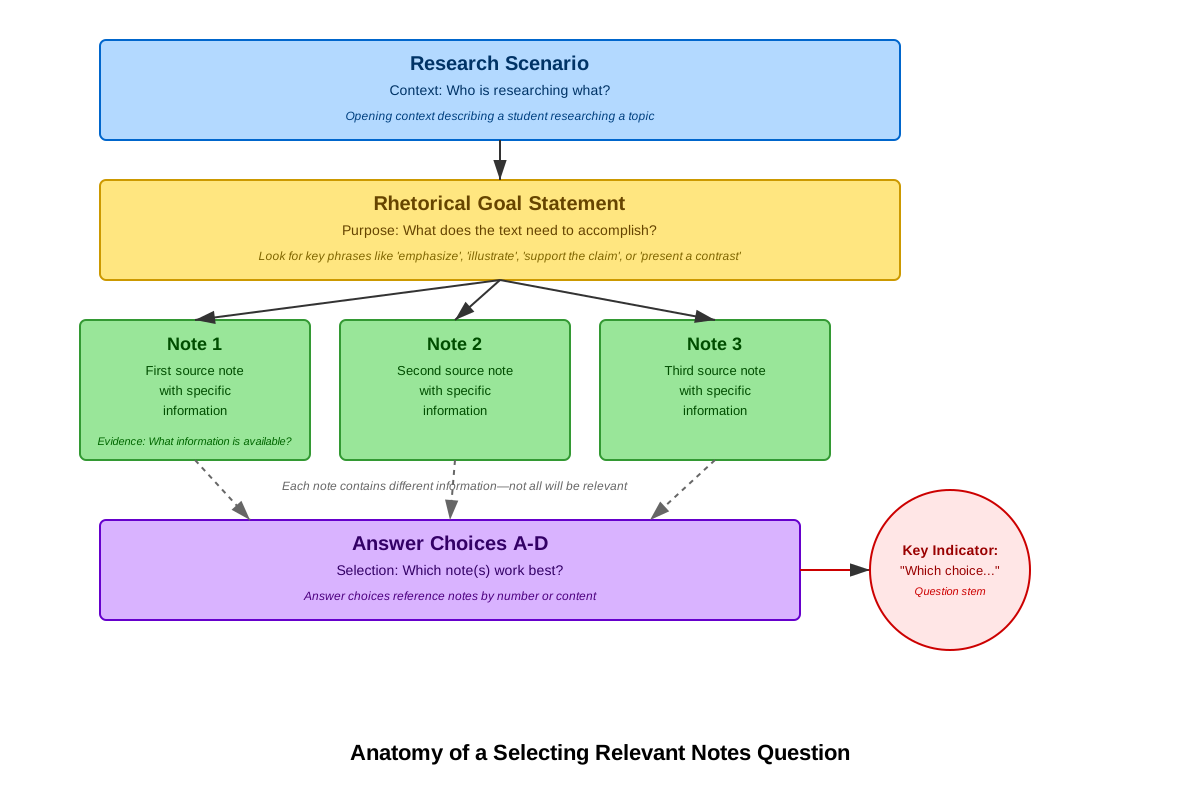
On the SAT, this topic appears in a standardized format: students encounter a brief scenario describing a student researching a topic, followed by 3-4 numbered notes containing information from various sources. The question stem presents a specific sentence or claim the student wants to complete or support, then asks which note most effectively accomplishes a stated goal. The notes may contain statistical data, historical facts, expert quotations, examples, or explanatory information. Common rhetorical goals include emphasizing a particular aspect, providing a specific example, illustrating a contrast, supporting a generalization, or introducing a qualification.
Core Concepts
Understanding the Question Structure
Every selecting relevant notes question follows a predictable structure that students can learn to navigate efficiently. The question begins with a scenario establishing context: "While researching a topic, a student has taken the following notes:" This introduction signals that students should prepare to evaluate multiple pieces of information against a specific criterion. The notes themselves are numbered (typically 1-4) and presented as bullet points, each containing distinct information from the student's research. These notes may vary in content type—some might present statistics, others might offer examples, and still others might provide expert opinions or historical context.
The critical component is the question stem, which always specifies a rhetorical goal. This goal might be phrased as: "The student wants to emphasize..." or "The student wants to present..." or "The student wants to make a generalization about..." Understanding this stated purpose is absolutely essential because relevance is always determined relative to this specific goal, not based on general importance or interest of the information.
Identifying Rhetorical Goals
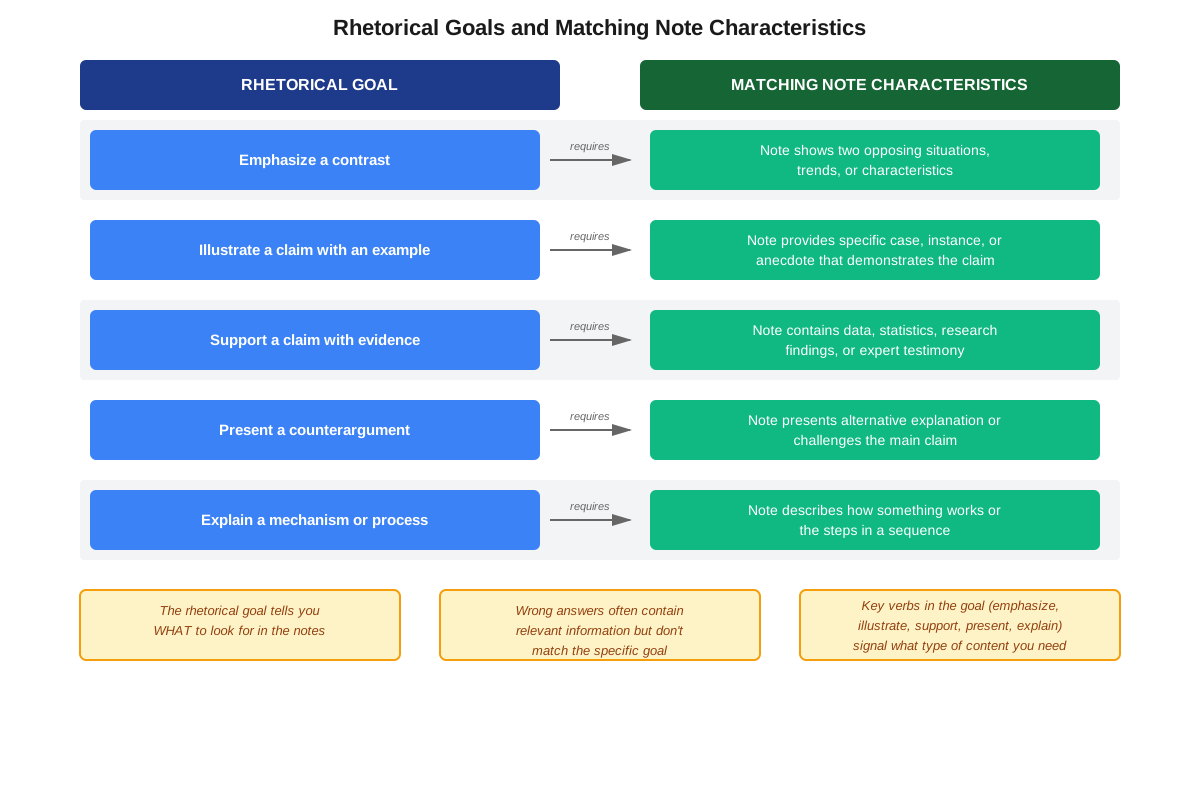
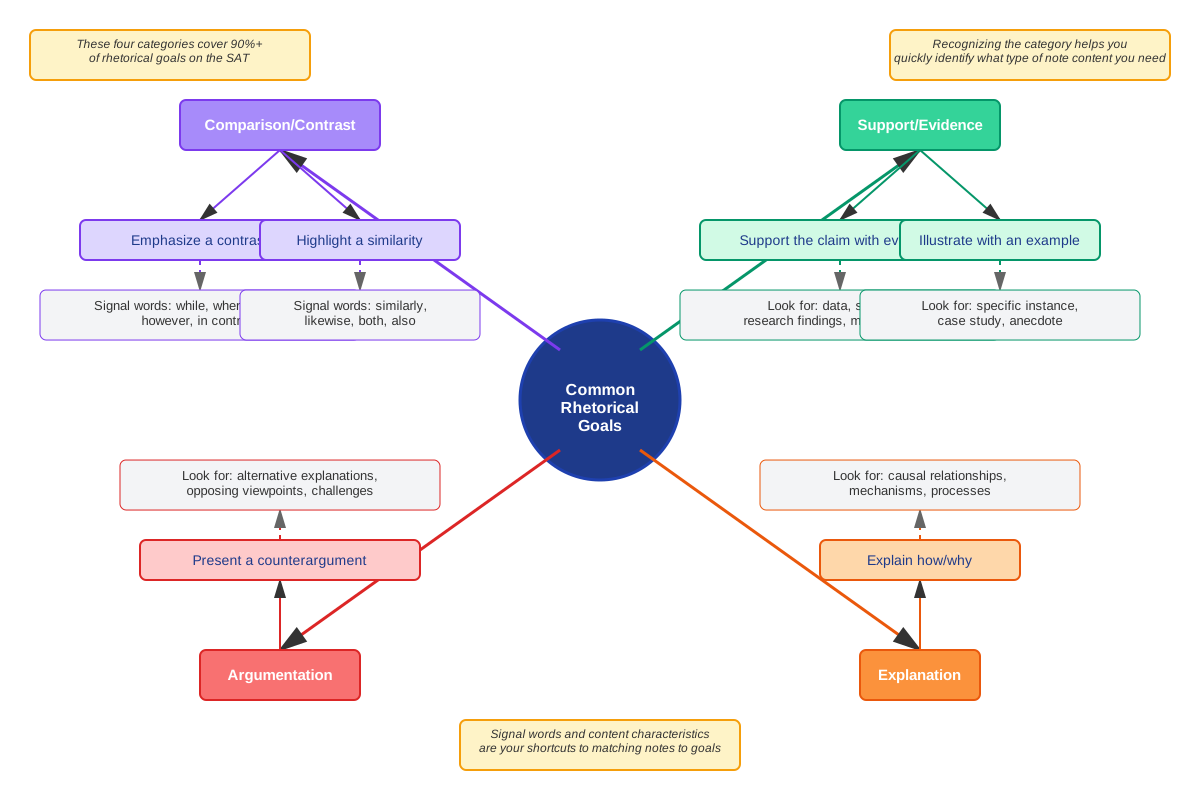
The rhetorical goal stated in the question determines what counts as "relevant." Common rhetorical goals on the SAT include:
Emphasizing a specific aspect: When the goal is to emphasize a particular feature, characteristic, or dimension of the topic, the correct note will highlight that specific element rather than providing general information. For example, if the goal is to emphasize the speed of a process, a note about how quickly it occurs is relevant, while a note about its importance or history is not.
Providing a specific example: When the goal is to illustrate a concept with a concrete instance, the correct note will present a particular case, specimen, or occurrence rather than general principles or statistics. The example must directly instantiate the concept mentioned in the prompt.
Presenting a contrast or comparison: When the goal involves showing differences or similarities, the correct note will explicitly contain comparative information or present information about two or more items that can be contrasted.
Supporting a generalization: When the goal is to support a broad claim, the correct note will provide evidence (data, examples, expert testimony) that substantiates that claim rather than presenting exceptions, qualifications, or unrelated information.
Introducing a qualification or limitation: When the goal is to add nuance or acknowledge exceptions, the correct note will present information that modifies, limits, or adds complexity to a claim rather than simply supporting it.
Evaluating Note Relevance
Determining relevance requires a systematic evaluation process. Students must read each note and ask: "Does this note accomplish the specific stated goal?" This evaluation involves several considerations:
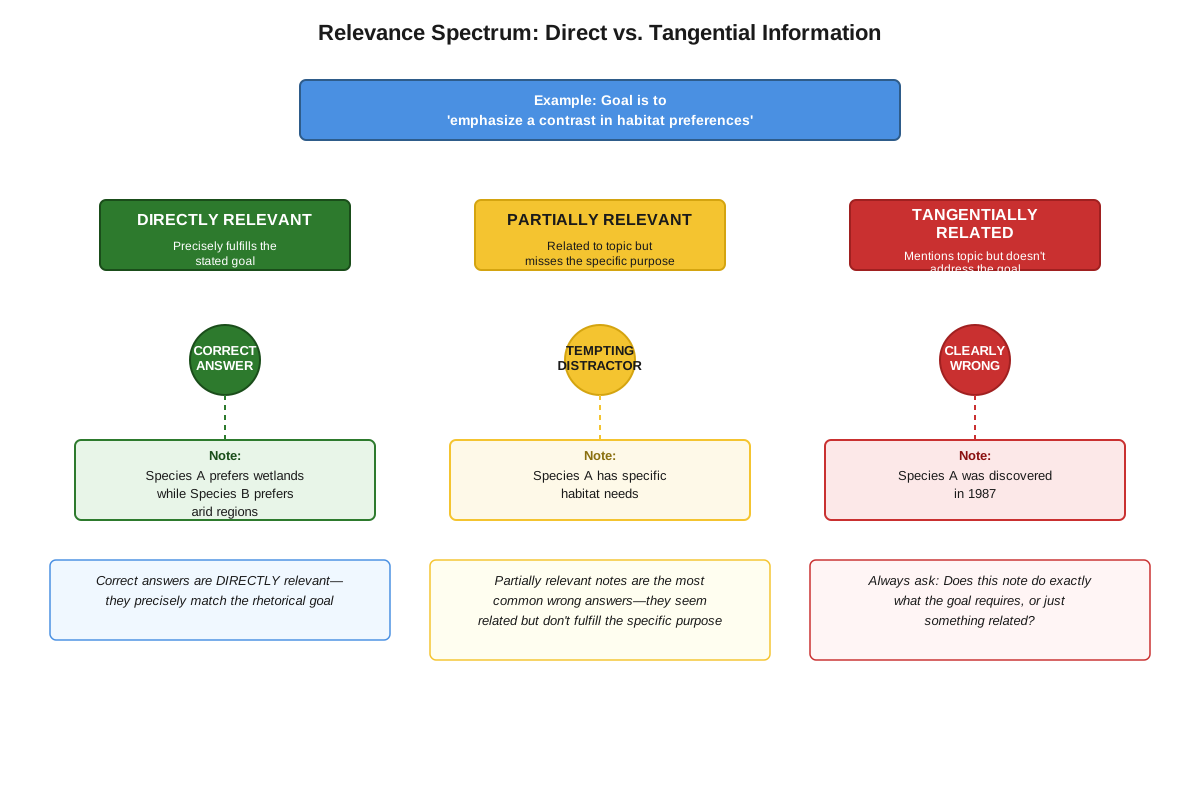
Direct versus indirect relevance: A note might be related to the general topic but not directly accomplish the stated goal. For instance, if the goal is to emphasize the economic impact of a phenomenon, a note about its environmental impact is topically related but not directly relevant to the specific goal.
Completeness of support: The correct note must fully accomplish the stated goal, not partially address it. If the goal is to support a claim about "both the physical and psychological benefits" of something, a note addressing only physical benefits is incomplete.
Specificity match: The level of specificity in the note must match the goal. If the goal requires a specific example, a general statement won't suffice. Conversely, if the goal is to make a broad generalization, a single narrow example may be insufficient.
Common Note Types and Their Functions
Understanding the typical content and function of different note types helps students quickly categorize information:
| Note Type | Content Characteristics | Best Used For |
|---|---|---|
| Statistical/Quantitative | Numbers, percentages, measurements, data | Supporting generalizations, emphasizing magnitude, providing evidence |
| Example/Illustration | Specific instances, particular cases, concrete specimens | Illustrating concepts, providing specific examples |
| Expert Opinion/Quotation | Statements from authorities, researchers, or specialists | Supporting claims with authority, introducing perspectives |
| Historical/Contextual | Background information, timeline details, historical facts | Providing context, establishing background |
| Comparative | Information about multiple subjects, explicit comparisons | Presenting contrasts, showing relationships |
| Definitional/Explanatory | Descriptions of what something is or how it works | Introducing concepts, clarifying terms |
The Process of Elimination Strategy
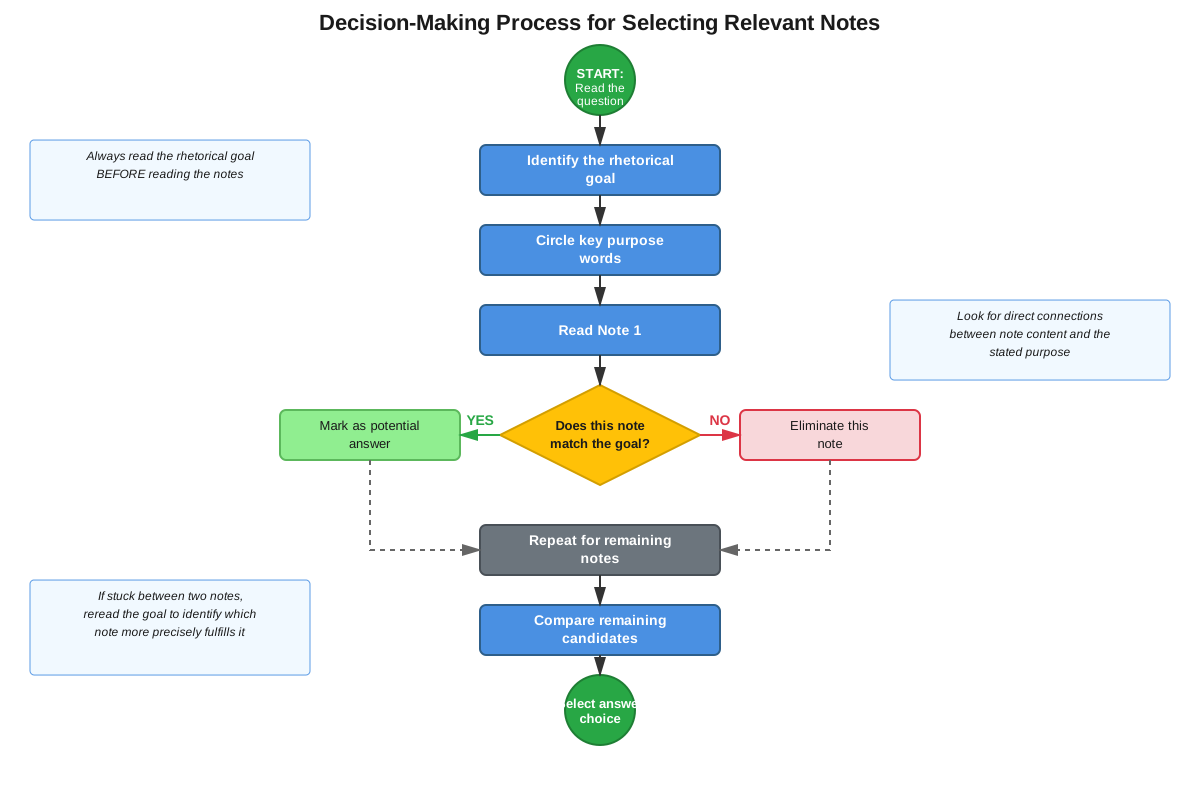
Because selecting relevant notes questions are multiple choice with four options (each corresponding to a note), strategic elimination is highly effective. Students should:
- Read the rhetorical goal first before examining the notes in detail
- Identify the key requirement in the goal (What specific aspect? What kind of example? What claim needs support?)
- Scan each note for content that matches this requirement
- Eliminate notes that are topically related but don't fulfill the specific goal
- Compare remaining options if multiple notes seem relevant, looking for which most directly and completely accomplishes the goal
Recognizing Distractors
Test makers design incorrect answer choices (distractors) with predictable characteristics:
Topically related but functionally irrelevant: These notes discuss the same general subject but don't accomplish the specific rhetorical goal. This is the most common distractor type.
Partially relevant: These notes address part of the goal but not all of it, or they accomplish a related but different rhetorical purpose.
Overly general or overly specific: When the goal requires a specific level of detail, notes that are too broad or too narrow won't work, even if the content is related.
Contradictory or complicating: When the goal is to support a claim, notes that introduce exceptions, contradictions, or complications are incorrect, even though they might be valuable in other rhetorical contexts.
Concept Relationships
The core concepts within selecting relevant notes are hierarchically organized and interdependent. Understanding the question structure is foundational—students must recognize the format before they can effectively engage with the content. This structural understanding leads directly to identifying rhetorical goals, which is the pivotal skill that determines all subsequent analysis. Once the rhetorical goal is clear, students can proceed to evaluating note relevance, which requires applying the goal as a criterion for judgment.
The relationship can be mapped as: Question Structure Recognition → Rhetorical Goal Identification → Note Content Comprehension → Relevance Evaluation → Answer Selection
Understanding common note types supports the relevance evaluation process by helping students quickly categorize information and predict its potential functions. This knowledge works in parallel with recognizing distractors, as understanding what makes notes relevant simultaneously clarifies what makes them irrelevant.
The process of elimination strategy integrates all other concepts, serving as the procedural framework that organizes the application of content knowledge. This strategy is not separate from understanding rhetorical goals and note types; rather, it's the systematic method for applying that understanding efficiently under timed conditions.
These concepts connect to broader SAT Reading and Writing skills, particularly evidence-based reasoning (used throughout the reading section), rhetorical analysis (tested in other question types about purpose and function), and synthesis (the ability to integrate information from multiple sources). Mastering selecting relevant notes strengthens these related skills and vice versa.
High-Yield Facts
⭐ Selecting relevant notes questions always specify a rhetorical goal that determines what counts as relevant—relevance is never absolute but always relative to the stated purpose.
⭐ The correct answer must completely fulfill the stated goal, not just partially address it or relate to the general topic—partial relevance is a common distractor characteristic.
⭐ These questions typically appear 1-2 times per SAT administration and are classified as medium difficulty with below-average accuracy rates.
⭐ The most common distractor type is information that is topically related but functionally irrelevant to the specific rhetorical goal stated in the question.
⭐ Reading the rhetorical goal before carefully analyzing the notes is more efficient than reading all notes first and then determining the goal.
- Notes are always numbered (1-4) and presented as bullet points, with answer choices corresponding to these numbers.
- Common rhetorical goals include emphasizing a specific aspect, providing a specific example, supporting a generalization, presenting a contrast, and introducing a qualification.
- The scenario always begins with "While researching a topic, a student has taken the following notes:" or similar phrasing.
- Statistical notes are most effective for supporting generalizations and emphasizing magnitude or scale.
- Example notes must be specific instances that directly illustrate the concept mentioned in the rhetorical goal.
- When a goal requires supporting a claim about multiple aspects (e.g., "both X and Y"), the correct note must address all mentioned aspects.
- Expert opinions and quotations are most relevant when the goal involves presenting a perspective or supporting a claim with authority.
- Comparative notes are necessary only when the rhetorical goal explicitly involves contrast, comparison, or showing relationships between multiple subjects.
Quick check — test yourself on Selecting relevant notes so far.
Try Flashcards →Common Misconceptions
Misconception: The most interesting or important note is the correct answer.
Correction: Relevance is determined solely by the stated rhetorical goal, not by general importance, interest, or comprehensiveness. A note containing fascinating information may be completely irrelevant if it doesn't accomplish the specific stated purpose.
Misconception: If a note relates to the general topic, it's relevant to the rhetorical goal.
Correction: Topical relatedness is necessary but not sufficient for relevance. The note must specifically accomplish the stated rhetorical function. A note about the history of a phenomenon is topically related but irrelevant if the goal is to emphasize its current economic impact.
Misconception: Longer or more detailed notes are more likely to be correct.
Correction: Length and detail don't determine relevance. Sometimes the correct note is the shortest one because it directly and concisely accomplishes the goal, while longer notes may contain extraneous information that, while interesting, doesn't serve the specific purpose.
Misconception: All information in the correct note must be directly mentioned in the rhetorical goal.
Correction: The note must accomplish the goal, but it may contain additional contextual information. What matters is that the note's primary function aligns with the stated purpose, even if it includes some supplementary details.
Misconception: If two notes seem relevant, choose the one with more specific or detailed information.
Correction: When multiple notes appear relevant, the correct answer is the one that most directly and completely accomplishes the specific stated goal. Sometimes the more general note is correct if the goal requires breadth rather than depth, or vice versa.
Misconception: Expert opinions are always stronger evidence than statistics or examples.
Correction: The strength of evidence depends on the rhetorical goal. Statistics are stronger for supporting quantitative claims, specific examples are stronger for illustrating concepts, and expert opinions are stronger for presenting perspectives or interpretations. The goal determines which type of evidence is most relevant.
Misconception: The correct note must use similar vocabulary or phrasing to the rhetorical goal.
Correction: While vocabulary overlap can be a helpful signal, it's not required. The correct note must accomplish the function described in the goal, even if it uses different terminology. Conversely, vocabulary overlap can be a distractor technique when a note uses similar words but doesn't fulfill the actual function.
Worked Examples
Example 1: Emphasizing a Specific Aspect
Scenario: While researching a topic, a student has taken the following notes:
- The monarch butterfly (Danaus plexippus) is known for its distinctive orange and black wing pattern.
- Monarch butterflies undergo a multi-generational migration spanning up to 3,000 miles from North America to Mexico.
- The monarch butterfly population has declined by approximately 80% over the past two decades due to habitat loss.
- Monarch butterflies feed primarily on milkweed plants, which contain toxins that make the butterflies poisonous to predators.
The student wants to emphasize the remarkable distance covered during monarch butterfly migration. Which note most effectively accomplishes this goal?
Step 1: Identify the rhetorical goal
The goal is to "emphasize the remarkable distance covered during monarch butterfly migration." The key requirement is information about migration distance that highlights how far these butterflies travel.
Step 2: Evaluate each note against this goal
- Note 1: Discusses wing pattern—topically related (it's about monarch butterflies) but doesn't address migration distance at all. Eliminate.
- Note 2: Directly addresses migration and provides a specific distance measurement (up to 3,000 miles). This accomplishes the goal of emphasizing distance. Strong candidate.
- Note 3: Discusses population decline—topically related but doesn't address migration distance. Eliminate.
- Note 4: Discusses feeding habits and defense mechanisms—topically related but doesn't address migration distance. Eliminate.
Step 3: Confirm the answer
Note 2 is the only option that addresses migration distance, and it does so with a specific, impressive measurement (3,000 miles) that effectively emphasizes the remarkable nature of this distance. The phrase "multi-generational migration spanning up to 3,000 miles" directly accomplishes the stated goal.
Answer: Note 2
Connection to learning objectives: This example demonstrates how to identify the key feature of a selecting relevant notes question (the specific rhetorical goal), evaluate notes systematically, and eliminate distractors that are topically related but functionally irrelevant.
Example 2: Supporting a Generalization with Evidence
Scenario: While researching a topic, a student has taken the following notes:
- The ancient city of Petra in Jordan was carved directly into rose-colored sandstone cliffs by the Nabataean people.
- Archaeological evidence suggests that ancient civilizations developed sophisticated water management systems to support urban populations in arid environments.
- The Nabataean civilization constructed an elaborate network of dams, cisterns, and channels to collect and store rainwater in Petra.
- Petra served as a major trading hub connecting Arabia, Egypt, and the Mediterranean from approximately 400 BCE to 106 CE.
The student wants to support the generalization that ancient civilizations in arid regions developed advanced water management technologies. Which note most effectively accomplishes this goal?
Step 1: Identify the rhetorical goal
The goal is to "support the generalization that ancient civilizations in arid regions developed advanced water management technologies." This requires evidence of sophisticated water management in ancient arid civilizations.
Step 2: Evaluate each note against this goal
- Note 1: Describes how Petra was built (carved into cliffs) but doesn't address water management. Eliminate.
- Note 2: This note directly states the generalization itself—that ancient civilizations developed sophisticated water management systems in arid environments. However, it doesn't provide specific evidence or examples to support this claim; it simply restates it. Questionable—may be too general.
- Note 3: Provides a specific example of advanced water management (dams, cisterns, channels) by an ancient civilization (Nabataeans) in an arid location (Petra). This is concrete evidence that supports the generalization. Strong candidate.
- Note 4: Discusses Petra's role as a trading hub—topically related but doesn't address water management. Eliminate.
Step 3: Compare Notes 2 and 3
Note 2 states the generalization but doesn't provide supporting evidence. Note 3 provides a specific, concrete example that serves as evidence for the generalization. Since the goal is to "support" the generalization (not merely state it), evidence is required. Note 3 accomplishes this by offering a specific instance that exemplifies the general claim.
Answer: Note 3
Connection to learning objectives: This example illustrates the difference between stating a claim and supporting it with evidence, demonstrates how to distinguish between general statements and specific examples, and shows how to evaluate which note type (general vs. specific) best accomplishes a particular rhetorical goal.
Exam Strategy
When approaching selecting relevant notes questions on the SAT, employ a systematic strategy that maximizes accuracy while managing time effectively:
Read the rhetorical goal first and identify the key requirement. Before examining the notes in detail, read the question stem carefully to understand exactly what the student wants to accomplish. Underline or mentally note the specific aspect, type of example, or claim that needs support. This focused reading prevents wasting time on irrelevant information.
Look for trigger words and phrases in the rhetorical goal that signal what type of note will be relevant:
- "Emphasize [specific aspect]" → Look for notes that highlight that particular feature
- "Provide a specific example" → Look for concrete instances, not general statements
- "Support the claim that" → Look for evidence (data, examples, expert testimony)
- "Present a contrast" → Look for comparative information or differences
- "Make a generalization about" → Look for broad patterns or multiple examples
Scan notes strategically rather than reading every word initially. Look for content that matches the key requirement identified in the goal. Once you find a promising candidate, read it carefully to confirm it fully accomplishes the goal.
Eliminate aggressively using the "topically related but functionally irrelevant" principle. Many incorrect answers will discuss the same general subject but won't accomplish the specific rhetorical purpose. Don't be distracted by interesting information that doesn't serve the stated goal.
Watch for partial relevance traps. If a goal mentions multiple aspects (e.g., "both the environmental and economic impacts"), the correct note must address all mentioned aspects. Notes addressing only one aspect are incomplete and incorrect.
Time allocation: These questions should take approximately 60-75 seconds. If you find yourself spending more than 90 seconds, make your best educated guess and move on. The systematic strategy outlined above should allow for efficient answering within the time limit.
Process of elimination checklist:
- Does this note address the topic? (If no, eliminate immediately)
- Does this note accomplish the specific stated goal? (If no, eliminate)
- Does this note completely fulfill the goal, or only partially? (Partial = eliminate)
- If multiple notes seem relevant, which most directly accomplishes the goal?
Confidence markers: You can be confident in your answer when the note you've selected directly addresses the key requirement in the rhetorical goal and the other three notes clearly don't accomplish that specific purpose. If you're torn between two options, reread the rhetorical goal to identify which aspect you might be overlooking.
Memory Techniques
The GRAPE Method for evaluating notes:
- Goal: What is the stated rhetorical goal?
- Requirement: What specific requirement must the note fulfill?
- Analyze: What does each note actually contain?
- Purpose: Does this note accomplish the stated purpose?
- Eliminate: Remove notes that don't fulfill the requirement
The "Function Over Fashion" principle: Remember that the correct note is determined by its function (what it accomplishes) not its fashion (how interesting, detailed, or well-written it is). Visualize yourself as a writer making a deliberate choice about which information serves your specific purpose, not which information is generally most impressive.
The Three R's of Relevance:
- Related: Is it about the topic? (Necessary but not sufficient)
- Responsive: Does it respond to the specific goal? (Essential)
- Robust: Does it completely fulfill the goal? (Confirms correctness)
Acronym for common rhetorical goals - ESCAPE:
- Emphasize a specific aspect
- Support a generalization
- Contrast or compare
- Add a specific example
- Present a perspective
- Explain or introduce a qualification
Visualization technique: Picture yourself as the student writer with a specific sentence to complete. Imagine which note would fit naturally into your sentence to accomplish your stated purpose. This mental simulation helps clarify functional relevance.
Summary
Selecting relevant notes questions on the SAT assess students' ability to evaluate multiple pieces of information and determine which best accomplishes a specific rhetorical goal. These questions present a research scenario with 3-4 numbered notes and ask students to identify which note most effectively fulfills a stated purpose, such as emphasizing a particular aspect, providing a specific example, supporting a generalization, or presenting a contrast. Success requires understanding that relevance is always relative to the stated goal, not determined by general importance or topical relatedness. The most common challenge is distinguishing between notes that are topically related but functionally irrelevant and notes that directly accomplish the specific purpose. Effective strategy involves reading the rhetorical goal first, identifying the key requirement, systematically evaluating each note against that requirement, and aggressively eliminating distractors. These questions appear 1-2 times per test and are high-yield targets for score improvement because they have below-average accuracy rates despite being classified as medium difficulty. Mastery requires practice in matching note content to rhetorical functions and recognizing that the correct answer must completely, not partially, fulfill the stated goal.
Key Takeaways
- Relevance in selecting relevant notes questions is always determined by the specific rhetorical goal stated in the question, not by general importance or interest of the information
- The most common distractor type is information that is topically related to the subject but does not accomplish the specific rhetorical function required
- Reading and understanding the rhetorical goal before carefully analyzing the notes is the most efficient approach and prevents wasting time on irrelevant information
- The correct note must completely fulfill the stated goal; partial relevance or addressing only some aspects of a multi-part goal is insufficient
- Common rhetorical goals include emphasizing specific aspects, providing specific examples, supporting generalizations, presenting contrasts, and introducing qualifications—each requires a different type of note content
- Strategic elimination using the principle "topically related but functionally irrelevant" quickly narrows options and improves accuracy
- These questions test synthesis skills that mirror authentic academic writing tasks, making them both practically valuable and high-yield for SAT score improvement
Related Topics
Evidence-Based Reading: Selecting relevant notes builds directly on skills in identifying and evaluating evidence, which are tested throughout the SAT Reading and Writing section. Mastering note selection strengthens the ability to assess whether evidence supports claims in traditional reading passages.
Rhetorical Analysis: Understanding rhetorical goals and purposes is fundamental to both selecting relevant notes and answering questions about author's purpose, function of sentences, and effectiveness of arguments in other SAT question types.
Synthesis Questions: The SAT includes other synthesis-oriented questions that require integrating information from multiple sources, including questions about combining sentences and organizing information. Skills developed in selecting relevant notes transfer directly to these related question types.
Argument Construction: In the SAT Writing section, questions about adding, deleting, or revising sentences to accomplish specific purposes rely on the same principle of matching content to rhetorical function that underlies selecting relevant notes questions.
Research and Citation Skills: While not directly tested on the SAT, the ability to evaluate sources and select relevant information is foundational for college-level research papers and academic writing, making this topic valuable beyond test preparation.
Practice CTA
Now that you've mastered the core concepts and strategies for selecting relevant notes questions, it's time to put your knowledge into practice! Attempt the practice questions designed specifically for this topic to reinforce your understanding and build confidence. Work through each question systematically using the GRAPE method and the elimination strategies you've learned. Review the flashcards to cement high-yield facts and common rhetorical goals in your memory. Remember, these questions have below-average accuracy rates, which means they're excellent opportunities for score improvement—students who master this skill gain a significant competitive advantage. Your investment in understanding how to match notes to rhetorical goals will pay dividends not only on test day but throughout your academic career as you develop into a more strategic and effective writer and researcher.
Sign up free to keep reading
Create a free AnvayaPrep account to finish this SAT guide on Selecting relevant notes — plus flashcards and practice questions.