Overview
Student notes questions represent one of the most distinctive and high-stakes question types in the SAT Reading and Writing section. These questions present students with a set of research notes, observations, or data points that a hypothetical student has gathered, followed by a claim or conclusion that the student wants to make. The test-taker must then select which choice most effectively uses relevant information from the notes to accomplish a specific rhetorical goal—whether that's illustrating a claim, supporting an argument, or emphasizing a particular aspect of the research.
This question type is essential for the SAT because it directly assesses rhetorical synthesis skills: the ability to evaluate multiple pieces of information, determine their relevance to a specific purpose, and select the most effective way to integrate evidence into writing. Unlike traditional reading comprehension questions that ask about a single passage, sat student notes questions require students to work with fragmented information and make strategic decisions about how to use that information rhetorically. This mirrors the real-world academic task of conducting research and synthesizing findings into coherent arguments.
Within the broader RW (Reading and Writing) section, student notes questions connect directly to skills in evidence evaluation, rhetorical purpose, and effective communication. They bridge the gap between pure reading comprehension and writing skills, requiring students to think like both a researcher evaluating sources and a writer crafting persuasive prose. Mastering this question type strengthens overall performance across the Rhetorical Synthesis unit and prepares students for the kind of evidence-based writing they'll encounter in college coursework.
Learning Objectives
- [ ] Identify key features of Student notes questions
- [ ] Explain how Student notes questions appears on the SAT
- [ ] Apply Student notes questions to answer SAT-style questions
- [ ] Evaluate the relevance of multiple pieces of evidence to a specific rhetorical goal
- [ ] Distinguish between choices that accurately use notes versus those that misrepresent or omit key information
- [ ] Analyze how different answer choices emphasize different aspects of the same set of notes
Prerequisites
- Basic reading comprehension skills: Understanding main ideas and supporting details is necessary to extract information from the student notes accurately
- Familiarity with rhetorical purpose: Recognizing what it means to "illustrate," "emphasize," "support," or "explain" helps identify what the question is asking
- Understanding of evidence and claims: Distinguishing between factual information and conclusions drawn from that information is crucial for these questions
- Sentence structure awareness: Recognizing how information is integrated into complete sentences helps evaluate answer choices effectively
Why This Topic Matters
Student notes questions matter because they assess a fundamental academic skill: the ability to synthesize research findings into coherent written arguments. In college and professional settings, individuals constantly gather information from multiple sources and must decide which details best support their specific purposes. This question type directly evaluates that practical skill in a standardized format.
On the SAT, student notes questions appear with high frequency—typically 1-2 questions per test form in the Reading and Writing section. They are considered medium-to-high difficulty questions, and because they require careful attention to multiple details and rhetorical purpose, they often separate high-scoring students from those in the middle ranges. These questions typically appear in the Rhetorical Synthesis domain, which comprises a significant portion of the overall RW score.
In exam passages, this topic appears in a distinctive format: a bulleted or numbered list of "notes" followed by a sentence with a blank and four answer choices. The notes might include research findings, historical facts, observations about a text or artwork, or data from studies. The question stem typically asks students to choose the option that accomplishes a specific goal "while using relevant information from the notes." Common rhetorical goals include emphasizing a particular finding, illustrating a comparison, supporting a generalization, or explaining a specific aspect of the research.
Core Concepts
Structure of Student Notes Questions
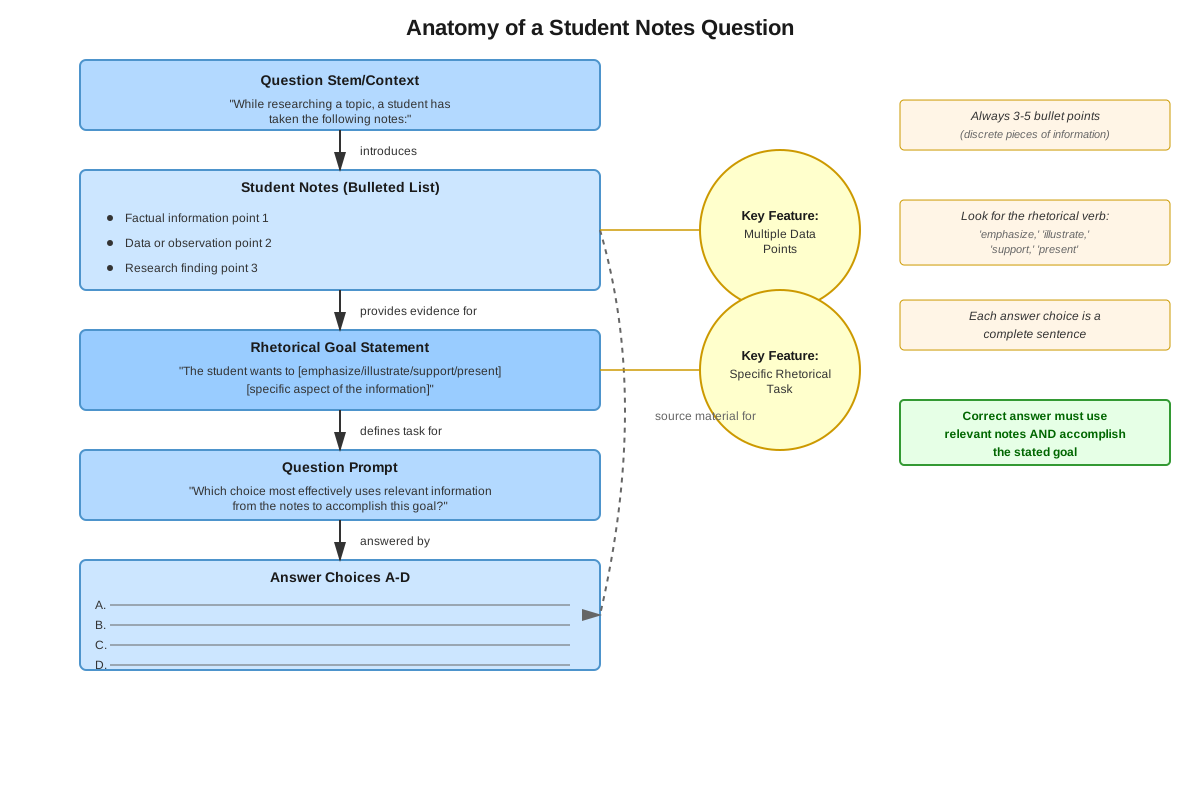
Student notes questions follow a consistent and recognizable format on the SAT. The question begins with a scenario: "While researching a topic, a student has taken the following notes:" This introduction signals that the information presented is raw research material, not a polished passage. The notes themselves appear as a bulleted or numbered list, typically containing 3-5 discrete pieces of information. These notes might include:
- Factual statements about a subject
- Research findings with specific data or measurements
- Historical information with dates and events
- Observations about texts, artworks, or phenomena
- Comparisons between different subjects or time periods
Following the notes, the question presents a statement of intent: "The student wants to [specific rhetorical goal]. Which choice most effectively uses relevant information from the notes to accomplish this goal?" The four answer choices are complete sentences that integrate information from the notes in different ways.
Types of Rhetorical Goals
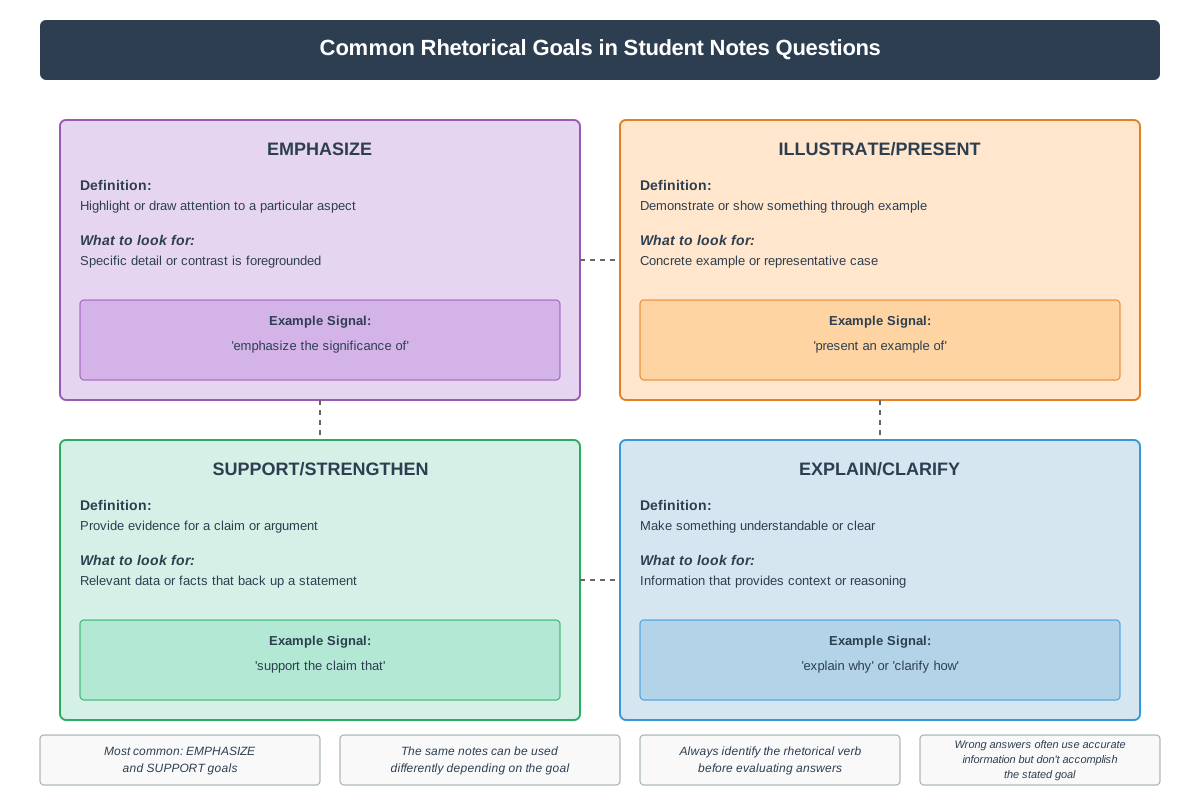
Understanding the specific rhetorical goal is crucial for selecting the correct answer. Common goals include:
Emphasizing a specific aspect: The student wants to highlight one particular detail, finding, or characteristic from among several presented in the notes. The correct answer will foreground that specific information while potentially mentioning other details as context.
Illustrating a comparison or contrast: The student wants to show how two or more subjects differ or resemble each other. The correct answer will explicitly present both subjects and the basis for comparison.
Supporting a generalization: The student wants to make a broad claim and back it up with specific evidence. The correct answer will include both the general statement and concrete details from the notes that substantiate it.
Explaining a relationship: The student wants to show how different pieces of information connect, such as cause and effect, chronological sequence, or part-to-whole relationships.
Evaluating Answer Choices
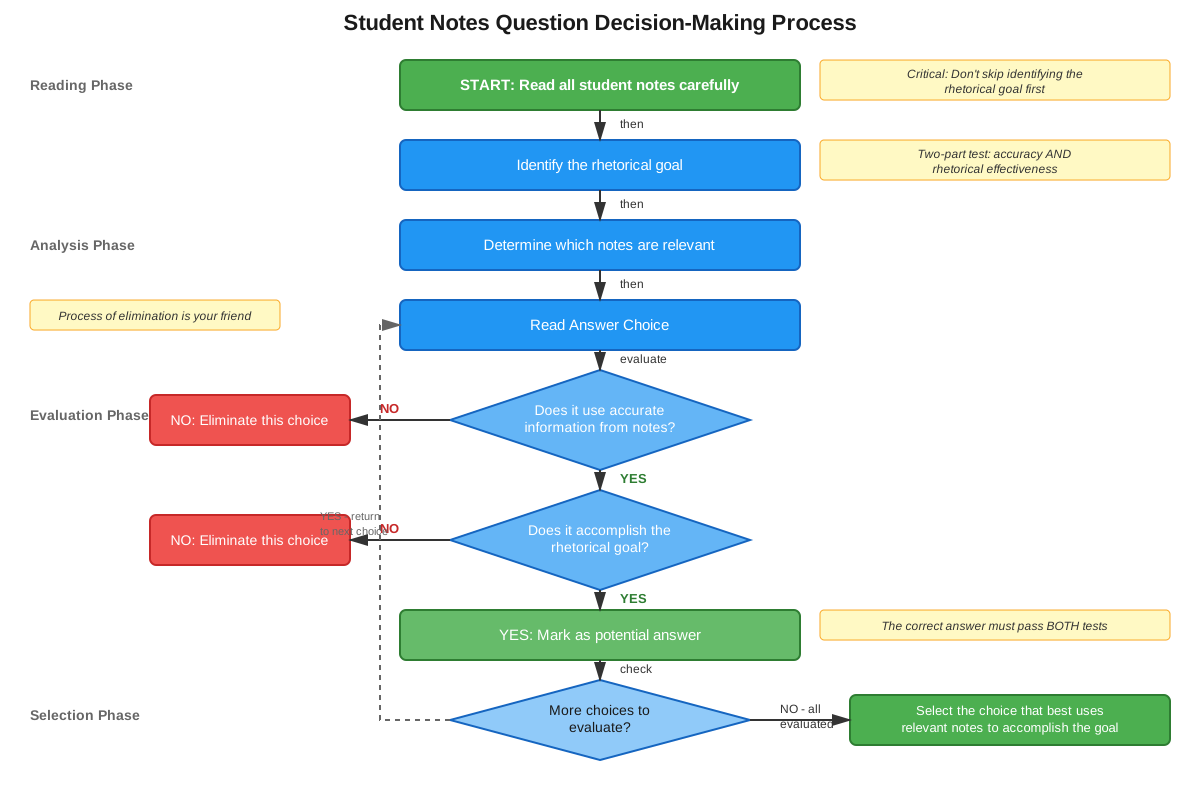
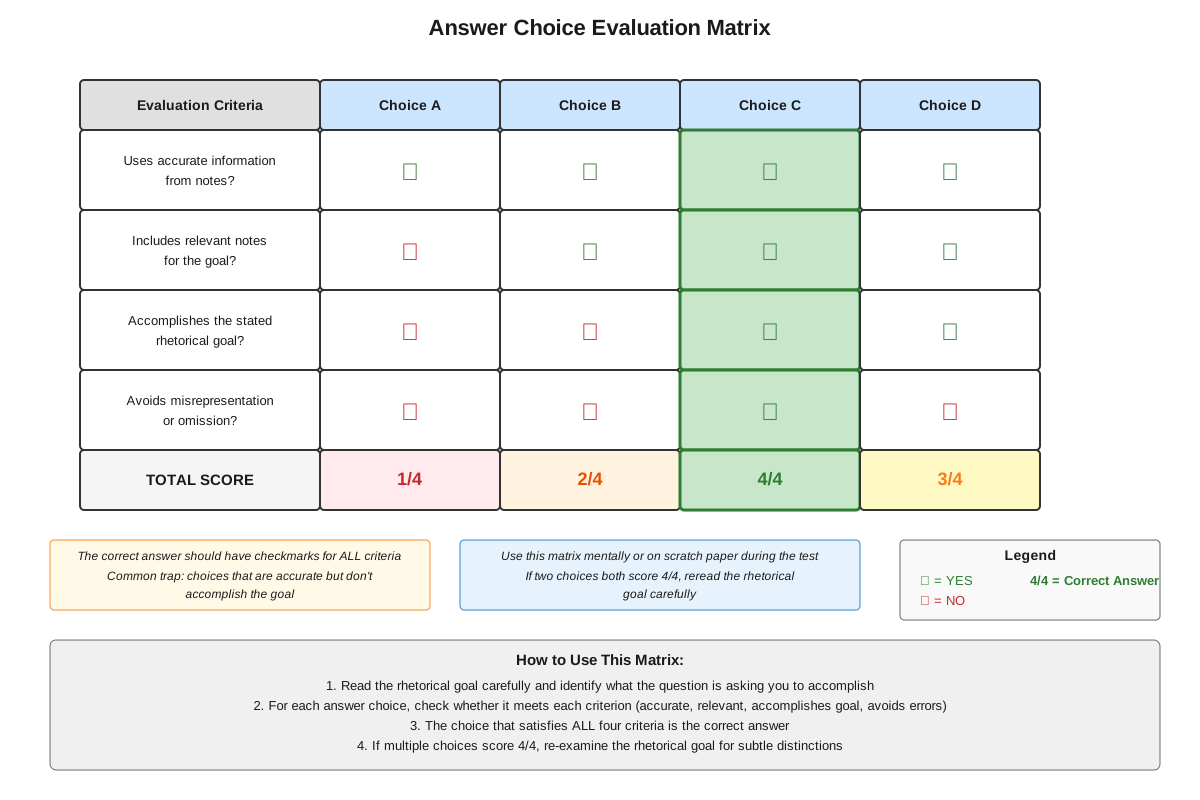
Each answer choice in student notes questions must be evaluated on two primary criteria:
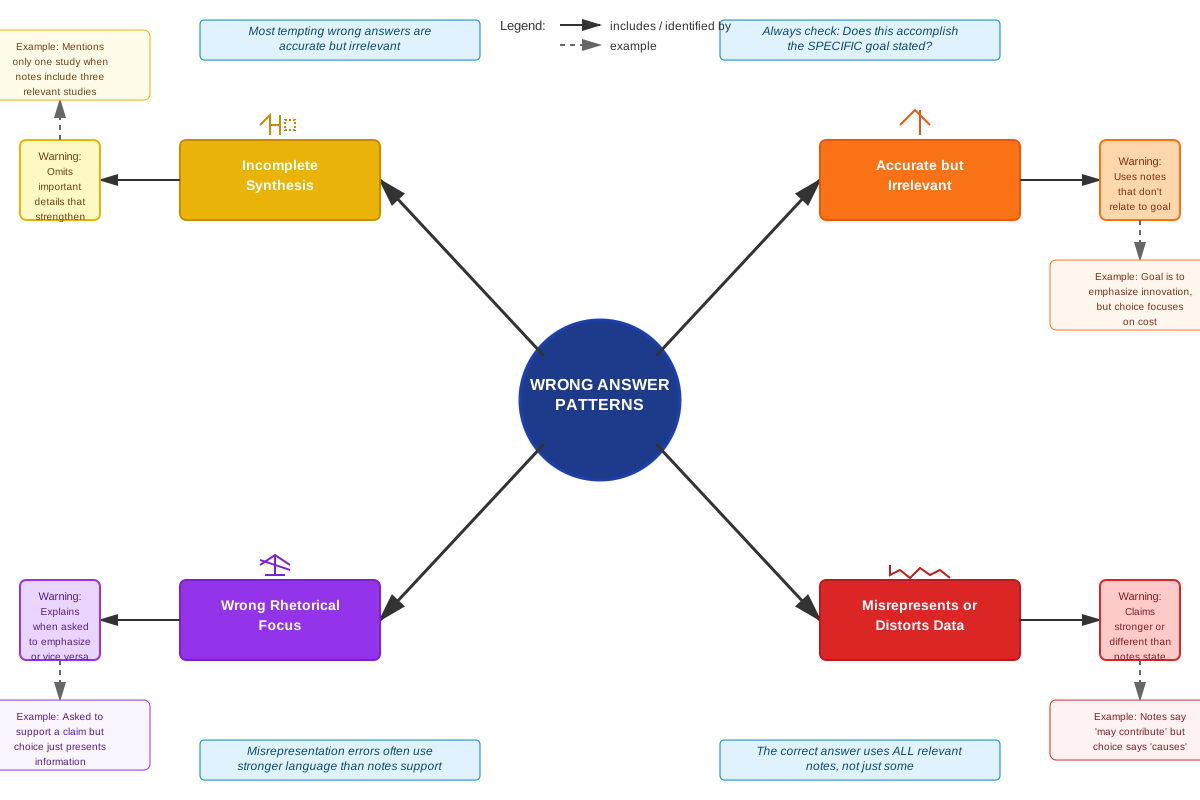
Accuracy: Does the choice correctly represent information from the notes? Incorrect choices often distort facts, combine information inappropriately, or make claims not supported by the notes. Students must verify that every factual statement in an answer choice has direct support in the notes.
Relevance to the rhetorical goal: Does the choice accomplish what the question asks? An answer might be factually accurate but fail to address the specific purpose. For example, if the goal is to emphasize a comparison, a choice that only discusses one subject—even accurately—doesn't fulfill the rhetorical purpose.
Information Selection and Integration
The core skill tested by these questions is determining which information from the notes is most relevant to the stated purpose. The notes always contain more information than any single answer choice can incorporate, so students must:
- Identify the rhetorical goal clearly
- Scan the notes for information directly relevant to that goal
- Eliminate information that, while accurate, doesn't serve the specific purpose
- Evaluate how each answer choice integrates the relevant information
For example, if notes contain information about three different studies but the goal is to emphasize the findings of one specific study, the correct answer will focus on that study while potentially acknowledging the others exist, but incorrect answers might give equal weight to all three studies or focus on the wrong study entirely.
Common Patterns in Note Organization
Notes in these questions often follow predictable organizational patterns:
| Pattern Type | Description | Example Content |
|---|---|---|
| Chronological | Information presented in time order | Historical events, development stages, publication dates |
| Comparative | Multiple subjects with parallel information | Two artists, different species, competing theories |
| Hierarchical | General information followed by specifics | Overview of a field, then specific study findings |
| Categorical | Information grouped by type or theme | Different aspects of a single subject |
Recognizing these patterns helps students quickly locate relevant information and understand relationships between different notes.
Concept Relationships
The concepts within student notes questions form an interconnected system. The structure of the question (notes + rhetorical goal + answer choices) determines the evaluation process students must follow. Understanding the rhetorical goal directly influences which information selection strategy is appropriate. The accuracy criterion and relevance criterion work together—both must be satisfied for an answer to be correct.
This topic connects to prerequisite knowledge of rhetorical purpose by applying those general concepts to a specific question format. It builds on evidence evaluation skills by requiring students to assess not just whether evidence is valid, but whether it's appropriate for a particular argumentative purpose. The skills developed here transfer to synthesis questions more broadly and to the essay writing students will do in college.
The relationship map flows as follows:
Question Structure → identifies → Rhetorical Goal → guides → Information Selection → evaluated through → Accuracy and Relevance Criteria → produces → Correct Answer Choice
High-Yield Facts
- ⭐ Student notes questions always include a specific rhetorical goal that must be accomplished; the correct answer must fulfill this exact purpose
- ⭐ All factual information in the correct answer must have direct support in the notes—no inferences or outside knowledge
- ⭐ The correct answer uses "relevant" information, meaning other accurate details from the notes may be intentionally excluded if they don't serve the stated purpose
- ⭐ Answer choices that combine information from multiple notes in ways that create new, unsupported claims are incorrect
- ⭐ When the goal is to "emphasize" something specific, the correct answer will make that element the focus or most prominent feature
- The notes always contain more information than can fit in a single answer choice
- Incorrect answers often include accurate information but fail to address the specific rhetorical goal
- Questions typically present 3-5 notes in a bulleted or numbered list format
- The rhetorical goal appears immediately before the answer choices and begins with "The student wants to..."
- Answer choices are always complete sentences that could stand alone as statements
- Chronological order in the notes doesn't necessarily indicate which information is most important
- When comparing subjects, the correct answer typically mentions both subjects explicitly
- Quantitative data in the notes (numbers, measurements, dates) often appears in the correct answer when precision is relevant to the goal
- The word "relevant" in the question stem is crucial—it signals that not all note information needs to be included
- Answer choices that make the strongest or most extreme claims are often incorrect unless the notes fully support that level of certainty
Quick check — test yourself on Student notes questions so far.
Try Flashcards →Common Misconceptions
Misconception: The correct answer must include information from all the notes provided.
Correction: The correct answer only needs to include information relevant to the specific rhetorical goal. Some notes may contain accurate but irrelevant information that should be excluded.
Misconception: The longest or most detailed answer choice is usually correct.
Correction: Length doesn't indicate correctness. The correct answer is the one that most effectively accomplishes the stated goal with relevant information, which might be concise or detailed depending on the situation.
Misconception: If an answer choice contains only accurate information from the notes, it must be correct.
Correction: Accuracy is necessary but not sufficient. The answer must also fulfill the specific rhetorical purpose stated in the question. An accurate answer that doesn't accomplish the goal is incorrect.
Misconception: The notes are presented in order of importance, so information in the first note is most important.
Correction: The order of notes doesn't indicate importance. Students must determine relevance based on the rhetorical goal, not the sequence of presentation.
Misconception: Students should use outside knowledge about the topic to evaluate answer choices.
Correction: Student notes questions test synthesis skills, not content knowledge. All necessary information is in the notes, and answers must be based solely on what's provided, not external knowledge.
Misconception: When the goal is to "emphasize" something, the correct answer will only mention that one thing.
Correction: Emphasizing something means making it prominent or central, but the answer may include other information as context. The key is that the emphasized element is clearly the focus.
Misconception: If two answer choices seem equally good, it's acceptable to guess randomly between them.
Correction: There is always one best answer. If two choices seem equal, re-examine the specific rhetorical goal and check whether each choice truly accomplishes it. Often one will have a subtle accuracy issue or won't quite fulfill the purpose.
Worked Examples
Example 1: Emphasizing a Specific Finding
While researching a topic, a student has taken the following notes:
- Marine biologist Dr. Sarah Chen studies coral reef ecosystems in the Pacific Ocean.
- In 2019, Chen's team surveyed coral reefs near Fiji and documented 312 fish species.
- In 2021, the team returned to the same reefs and documented 298 fish species.
- Chen attributes the decline primarily to rising ocean temperatures.
- The team also noted increased coral bleaching during the 2021 survey.
The student wants to emphasize the change in fish species diversity between the two surveys. Which choice most effectively uses relevant information from the notes to accomplish this goal?
Step 1: Identify the rhetorical goal
The goal is to "emphasize the change in fish species diversity between the two surveys." This means the correct answer must highlight the difference between the 2019 and 2021 findings.
Step 2: Locate relevant information
- 2019 survey: 312 fish species
- 2021 survey: 298 fish species
- The change: a decline from 312 to 298
Step 3: Evaluate what "emphasize" means
To emphasize the change, the answer should make the numerical difference prominent and clear, likely presenting both numbers to show the decline.
Step 4: Consider what might appear in incorrect answers
- Choices that mention only one survey's findings
- Choices that focus on coral bleaching or temperature instead of fish diversity
- Choices that mention the change but don't make it prominent
Correct Answer Pattern: "Dr. Sarah Chen's team documented 312 fish species in 2019 but only 298 species when they returned to the same Fijian reefs in 2021."
This answer emphasizes the change by presenting both numbers in a contrasting structure ("312...but only 298"), making the decline the sentence's focus. Information about Chen being a marine biologist, the cause of the decline, and coral bleaching, while accurate, isn't relevant to emphasizing the species count change.
Example 2: Supporting a Generalization
While researching a topic, a student has taken the following notes:
- Architect Maya Lin designed the Vietnam Veterans Memorial in Washington, D.C., completed in 1982.
- The memorial features a black granite wall inscribed with the names of over 58,000 service members.
- Lin was a 21-year-old undergraduate student at Yale when her design was selected.
- Her design was chosen from 1,421 submissions in a national competition.
- The memorial has become one of the most visited sites in Washington, D.C.
The student wants to make a generalization about the memorial's design selection and support it with evidence. Which choice most effectively uses relevant information from the notes to accomplish this goal?
Step 1: Identify the rhetorical goal
Make a generalization about the design selection and support it with evidence. This requires both a general claim and specific details that back it up.
Step 2: Identify what makes the design selection notable
- Selected from 1,421 submissions (highly competitive)
- Designer was only 21 and still an undergraduate (unusual for such a significant project)
Step 3: Formulate possible generalizations
The selection was competitive, unconventional, or remarkable in some way.
Step 4: Determine supporting evidence
The number of submissions and Lin's age/student status both support a generalization about the selection being notable or unconventional.
Correct Answer Pattern: "The selection of Maya Lin's design for the Vietnam Veterans Memorial was remarkable: Lin was only a 21-year-old undergraduate student when her design was chosen from among 1,421 submissions."
This answer provides a generalization ("was remarkable") and supports it with two specific pieces of evidence (her age/status and the competition size). Information about the black granite wall and the memorial's popularity, while accurate, doesn't support a claim about the design selection process.
Exam Strategy
When approaching student notes questions on the SAT, follow this systematic process:
Step 1: Read the rhetorical goal first (before reading the notes). Understanding what the student wants to accomplish helps you read the notes strategically, identifying relevant information immediately.
Step 2: Read the notes actively, marking or mentally noting which pieces of information relate to the stated goal. Don't try to memorize everything—focus on relevance.
Step 3: Predict what the answer should include before looking at choices. Based on the goal, what information from the notes must appear in the correct answer?
Step 4: Eliminate choices systematically:
- First, eliminate any choice with factual inaccuracies or unsupported claims
- Second, eliminate choices that don't address the specific rhetorical goal
- Third, compare remaining choices to see which most effectively accomplishes the purpose
Trigger words to watch for:
- "Emphasize" → the correct answer makes one element prominent
- "Illustrate a comparison" → both subjects must appear with a basis for comparison
- "Support" → requires both a claim and evidence
- "Explain" → requires showing a relationship or providing reasoning
- "Relevant information" → signals that not all notes need to be used
Process-of-elimination tips:
- Choices that include information not in the notes are always wrong
- Choices that ignore the specific rhetorical goal are wrong even if accurate
- When two choices seem close, check which one makes the goal element more prominent or explicit
- Be suspicious of choices that combine information from multiple notes in ways that create new implications
Time allocation:
Spend approximately 60-75 seconds on these questions. They require careful reading but shouldn't consume excessive time. If you're stuck between two choices, verify each against the notes and the specific goal rather than guessing.
Memory Techniques
RARE Acronym for Evaluation:
- Rhetorical goal - What does the student want to accomplish?
- Accuracy - Is all information in the choice supported by the notes?
- Relevance - Does the choice address the specific goal?
- Effectiveness - Does the choice accomplish the goal better than alternatives?
The "Spotlight" Visualization:
When the goal is to "emphasize" something, visualize a spotlight on a stage. The emphasized element should be in the spotlight (most prominent), while other information might be visible but in the background.
The "Building Blocks" Method:
Think of the notes as building blocks. The rhetorical goal tells you what structure to build. You don't need to use every block—only the ones that fit the specific structure you're creating.
NOTES Acronym for the Question Format:
- Notes are provided in a list
- Objective (rhetorical goal) is stated
- Test each choice against the notes
- Eliminate inaccurate or irrelevant options
- Select the choice that best accomplishes the goal
Summary
Student notes questions on the SAT assess the critical skill of rhetorical synthesis—the ability to evaluate multiple pieces of information and select the most effective way to use that information for a specific purpose. These questions present 3-5 research notes followed by a statement of what the student wants to accomplish, then ask test-takers to choose which sentence best uses relevant information from the notes to achieve that goal. Success requires understanding the specific rhetorical purpose (emphasizing, comparing, supporting, or explaining), identifying which notes are relevant to that purpose, and evaluating answer choices based on both accuracy and effectiveness. The correct answer must contain only information supported by the notes and must accomplish the stated goal better than alternatives. Common pitfalls include selecting answers that are accurate but don't address the specific purpose, or assuming all notes must be incorporated when only relevant information should be used.
Key Takeaways
- Student notes questions test your ability to synthesize information for a specific rhetorical purpose, not just comprehend individual facts
- Always read the rhetorical goal before reading the notes to focus your attention on relevant information
- The correct answer must satisfy two criteria: factual accuracy (supported by the notes) and rhetorical effectiveness (accomplishes the stated goal)
- "Relevant information" means you should exclude accurate details that don't serve the specific purpose
- When the goal is to "emphasize" something, the correct answer makes that element the clear focus or most prominent feature
- Incorrect answers often contain accurate information but fail to address the specific rhetorical goal stated in the question
- Systematic elimination based on accuracy first, then relevance, then effectiveness leads to the correct answer efficiently
Related Topics
Rhetorical Purpose Questions: Understanding why authors make specific choices in their writing connects directly to evaluating rhetorical goals in student notes questions. Mastering student notes questions strengthens your ability to recognize and analyze rhetorical strategies.
Evidence-Based Reading: Selecting appropriate textual evidence to support claims is a parallel skill to choosing relevant information from notes. Both require evaluating which details best serve a specific argumentative purpose.
Synthesis Essay Writing: The skills practiced in student notes questions—evaluating multiple sources and integrating information purposefully—directly transfer to synthesis writing tasks in college composition courses.
Data Interpretation Questions: Some student notes questions include quantitative data, connecting to broader skills in reading and interpreting numerical information in context.
Practice CTA
Now that you've mastered the core concepts of student notes questions, it's time to put your knowledge into practice! Work through the practice questions to apply the RARE evaluation method and test your ability to identify rhetorical goals and select relevant information. Use the flashcards to reinforce key concepts and common question patterns. Remember: these questions reward systematic thinking and careful attention to the specific rhetorical goal. With practice, you'll develop the confidence to approach any student notes question efficiently and accurately. Your ability to synthesize information purposefully is a skill that will serve you not just on test day, but throughout your academic career!
Sign up free to keep reading
Create a free AnvayaPrep account to finish this SAT guide on Student notes questions — plus flashcards and practice questions.