Overview
The function of a paragraph is a critical skill tested extensively in the SAT Reading and Writing section. This concept requires students to analyze how individual paragraphs contribute to the overall structure, argument, or narrative of a passage. Rather than focusing on what a paragraph says, questions about paragraph function ask students to identify why the author included that specific paragraph and how it serves the passage's larger purpose.
Understanding paragraph function is essential because it demonstrates reading comprehension at a sophisticated level—moving beyond literal understanding to analytical thinking. On the SAT, these questions assess whether students can recognize organizational patterns, identify rhetorical strategies, and understand how authors build arguments or narratives through deliberate structural choices. Students must evaluate whether a paragraph introduces a concept, provides supporting evidence, presents a counterargument, offers a transition, or serves another specific purpose within the passage's architecture.
This topic sits at the intersection of multiple RW skills, including main idea identification, author's purpose analysis, and text structure recognition. Mastering paragraph function enables students to approach passages strategically, understanding not just individual components but how those components work together to create meaning. This skill transfers directly to other question types on the SAT, including questions about transitions, logical sequence, and overall passage organization, making it a high-yield area of study that strengthens performance across the entire Reading and Writing section.
Learning Objectives
- [ ] Identify key features of function of a paragraph
- [ ] Explain how function of a paragraph appears on the SAT
- [ ] Apply function of a paragraph to answer SAT-style questions
- [ ] Distinguish between different types of paragraph functions (introductory, supporting, contrasting, transitional, concluding)
- [ ] Analyze the relationship between a paragraph's function and the passage's overall structure
- [ ] Evaluate answer choices by eliminating options that mischaracterize a paragraph's role or scope
Prerequisites
- Main idea identification: Understanding the central point of a paragraph is necessary before determining how that paragraph functions within the larger passage
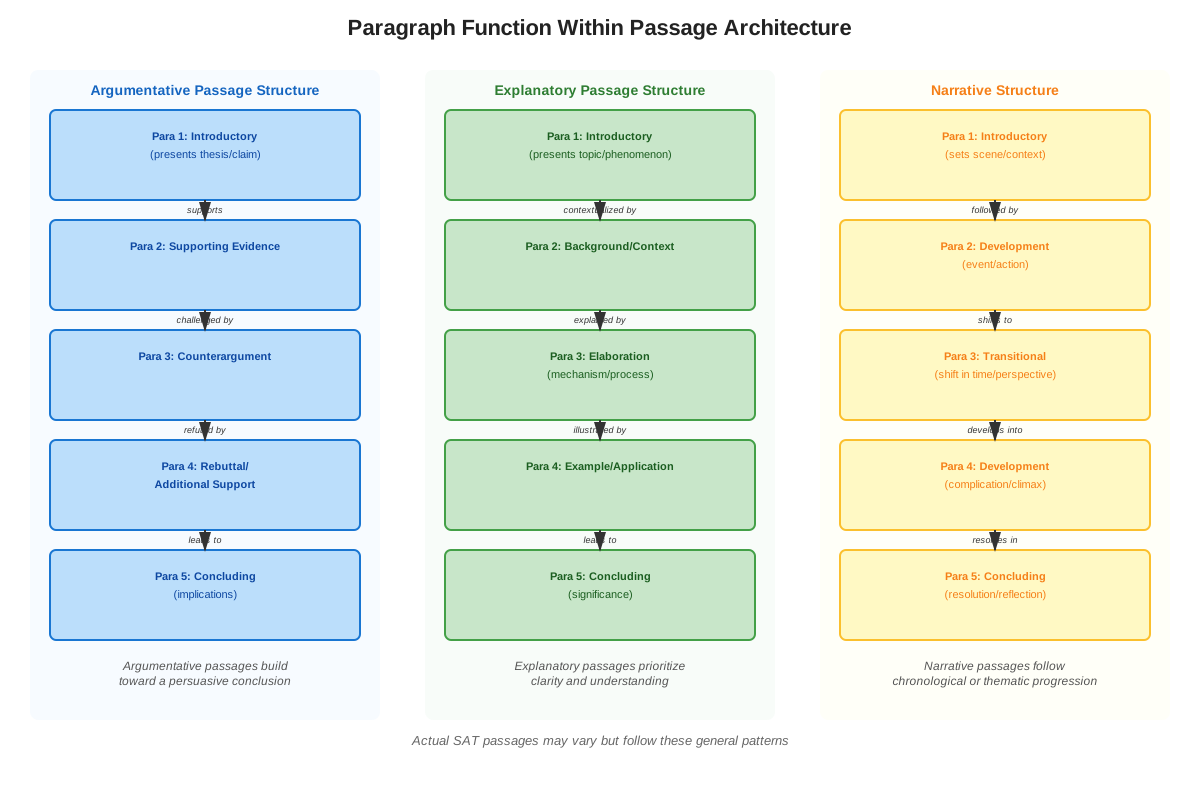
- Passage structure awareness: Recognizing how passages are organized (chronologically, compare-contrast, problem-solution, etc.) provides context for individual paragraph functions
- Author's purpose recognition: Knowing whether an author aims to inform, persuade, or entertain helps identify why specific paragraphs were included
- Basic rhetorical awareness: Familiarity with concepts like evidence, claims, and counterarguments enables recognition of how paragraphs support argumentative structures
Why This Topic Matters
In real-world reading contexts, understanding paragraph function is essential for efficient comprehension of complex texts. Professionals across fields—from legal briefs to scientific papers to business reports—must quickly identify how sections of documents contribute to overall arguments or narratives. This skill enables readers to navigate lengthy texts strategically, focusing attention where it matters most and understanding how authors construct persuasive or informative communications.
On the SAT, sat function of a paragraph questions appear with high frequency, typically 2-4 times per test administration. These questions are considered medium-to-high difficulty and often distinguish between students scoring in the mid-600s versus those achieving scores above 700. The College Board consistently includes these questions because they assess sophisticated reading comprehension that predicts college readiness.
Function of a paragraph questions commonly appear in several formats: direct questions asking "What is the main purpose of the third paragraph?", questions about how a paragraph relates to surrounding paragraphs, and questions asking students to identify what role a paragraph plays in developing the passage's argument. These questions appear across all passage types—literary narratives, historical documents, scientific explanations, and argumentative essays—making this a universally applicable skill that cannot be avoided through selective preparation.
Core Concepts
Understanding Paragraph Function
The function of a paragraph refers to the specific role that paragraph plays in advancing the passage's overall purpose, structure, or argument. Unlike summarizing what a paragraph says (its content), identifying function requires analyzing why the author included it and how it contributes to the passage as a whole. A paragraph might contain fascinating details about marine biology, but its function could be to provide evidence for a claim made earlier, to introduce a complication to a theory, or to transition between two contrasting viewpoints.
Every paragraph in a well-constructed passage serves a deliberate purpose. Authors don't include paragraphs randomly; each one advances their communication goal. Recognizing these purposes requires stepping back from the details and viewing the paragraph in context—what comes before it, what follows it, and how it fits into the passage's architecture.
Common Paragraph Functions
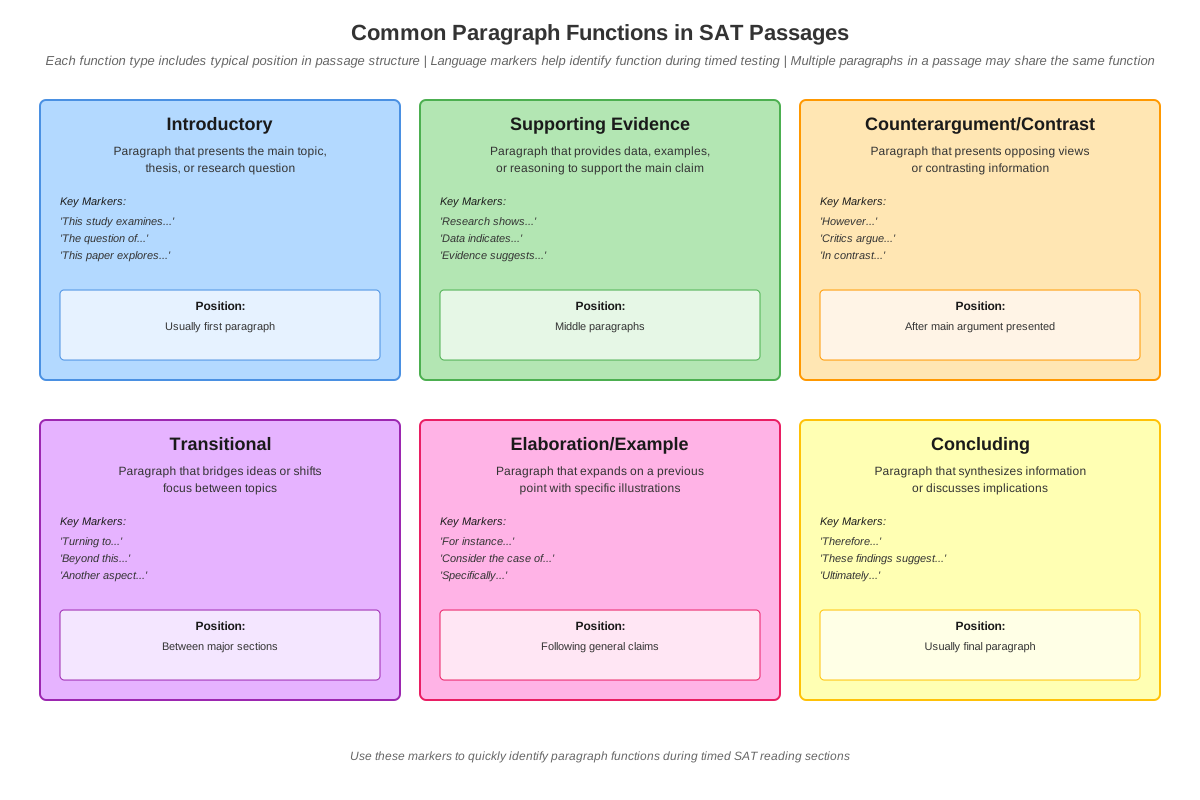
Different paragraphs serve different roles depending on their position and content. Understanding these common functions helps students quickly categorize paragraphs and predict answer choices:
| Function Type | Purpose | Typical Location | Key Indicators |
|---|---|---|---|
| Introductory | Establish topic, context, or thesis | Beginning of passage | General statements, background information, thesis statements |
| Supporting/Elaborating | Provide evidence, examples, or details | Body paragraphs | Specific examples, data, quotations, detailed descriptions |
| Contrasting/Qualifying | Present alternative views or limitations | Middle sections | "However," "On the other hand," "Critics argue," "Despite" |
| Transitional | Connect ideas or shift focus | Between major sections | "Furthermore," "In addition," "Turning to," topic shifts |
| Concluding | Summarize, synthesize, or provide implications | End of passage | "Therefore," "Thus," "Ultimately," restatements of main ideas |
| Explanatory | Clarify complex concepts or terms | After introducing new ideas | Definitions, analogies, simplified restatements |
Analyzing Function Through Context
Determining paragraph function requires examining three contextual layers:
- Preceding context: What has the author established before this paragraph? Does this paragraph build on, challenge, or shift away from previous ideas?
- Internal content: What does the paragraph actually contain? Is it primarily factual evidence, personal narrative, theoretical explanation, or critical analysis?
- Following context: How does the passage continue after this paragraph? Does the next paragraph build on this one, contrast with it, or move to an entirely new topic?
For example, a paragraph describing a failed experiment might function as:
- Supporting evidence (if it proves that a method doesn't work)
- Transitional content (if it sets up discussion of a successful alternative)
- Contrasting information (if it challenges an earlier claim about the experiment's success)
The function depends entirely on how the paragraph relates to surrounding content.
Distinguishing Content from Function
A critical skill for SAT function of a paragraph questions is separating what a paragraph discusses (content) from what it accomplishes (function). Consider this example:
Content: A paragraph describes how dolphins use echolocation to navigate murky waters, including specific frequencies they emit and how they interpret returning sound waves.
Possible Functions:
- Providing an example of sophisticated animal communication (if the passage discusses animal intelligence)
- Explaining a mechanism mentioned earlier (if previous paragraphs introduced echolocation without detail)
- Contrasting with human navigation methods (if surrounding paragraphs discuss human sonar technology)
- Supporting a claim about marine mammal adaptations (if the passage argues that marine mammals evolved specialized survival mechanisms)
Students often select answers that accurately describe content but misidentify function. The correct answer must capture both what the paragraph discusses AND why that discussion matters to the passage's overall purpose.
Scope and Specificity in Function
Function answers must match the paragraph's scope—neither too broad nor too narrow. A paragraph that provides one example of renewable energy doesn't function to "explain all environmental solutions" (too broad) or to "define solar panels" (too narrow if it discusses multiple renewable sources). It functions to "illustrate types of renewable energy" or "provide examples supporting the viability of alternatives to fossil fuels."
Evaluating scope requires asking:
- Does this answer capture everything the paragraph does, or only part of it?
- Does this answer claim the paragraph does more than it actually accomplishes?
- Is this answer specific enough to distinguish this paragraph from others in the passage?
Signal Words and Structural Markers
Certain words and phrases signal paragraph function:
Evidence/Support indicators: "For example," "Research shows," "Studies indicate," "In one case," "Specifically"
Contrast indicators: "However," "Nevertheless," "On the contrary," "Despite," "Conversely," "Yet"
Addition indicators: "Moreover," "Furthermore," "Additionally," "Similarly," "Likewise"
Conclusion indicators: "Therefore," "Thus," "Consequently," "As a result," "In conclusion"
Explanation indicators: "In other words," "That is," "To clarify," "Put simply"
These markers aren't definitive—a paragraph beginning with "However" doesn't automatically function as pure contrast—but they provide valuable clues about the author's organizational intent.
Concept Relationships
The concepts within paragraph function analysis form an interconnected system. Understanding common paragraph functions provides a framework for categorizing paragraphs, but this categorization only works when students can distinguish content from function—recognizing that the same content could serve different functions depending on context. This distinction requires analyzing function through context, examining what comes before and after the paragraph in question.
Scope and specificity acts as a quality control mechanism, helping students evaluate whether their function identification is accurate. Even when students correctly identify that a paragraph provides support, they must ensure their answer captures the right scope—what specifically is being supported and how. Signal words and structural markers serve as diagnostic tools throughout this process, offering quick clues about function that students can verify through deeper contextual analysis.
This topic connects directly to prerequisite knowledge: main idea identification provides the foundation for understanding what a paragraph accomplishes, while passage structure awareness helps predict what functions different paragraphs might serve. The skill builds toward more advanced topics like transitions (which depend on understanding how adjacent paragraphs relate functionally) and overall passage organization (which requires synthesizing the functions of multiple paragraphs).
The relationship map flows as follows:
Main Idea Identification → Understanding Paragraph Content → Distinguishing Content from Function → Analyzing Function Through Context → Identifying Common Functions → Evaluating Scope and Specificity → Mastering SAT Function Questions
High-Yield Facts
- ⭐ Paragraph function describes WHY a paragraph exists and HOW it contributes to the passage, not WHAT it says
- ⭐ The same content can serve different functions depending on surrounding context and passage purpose
- ⭐ Function answers must match the paragraph's scope—neither too broad nor too narrow
- ⭐ Signal words (however, for example, therefore) provide clues about function but don't definitively determine it
- ⭐ Most wrong answers on function questions accurately describe content but misidentify the paragraph's role
- Supporting paragraphs provide evidence, examples, or elaboration for claims made elsewhere in the passage
- Contrasting paragraphs present alternative viewpoints, limitations, or complications to ideas presented earlier
- Transitional paragraphs connect major sections or shift the passage's focus to a new aspect of the topic
- Introductory paragraphs establish context, background, or the passage's main argument
- Concluding paragraphs synthesize information, restate main ideas, or discuss implications
- A paragraph can serve multiple functions simultaneously (e.g., providing support while also transitioning)
- Function questions often ask about paragraphs in the middle of passages, where context is most complex
- Reading the paragraph before and after the target paragraph is essential for determining function
- Explanatory paragraphs clarify or define concepts introduced earlier without necessarily providing new evidence
Quick check — test yourself on Function of a paragraph so far.
Try Flashcards →Common Misconceptions
Misconception: The function of a paragraph is the same as its main idea.
Correction: Main idea describes what the paragraph is about (content), while function describes what role it plays in the passage (purpose). A paragraph's main idea might be "dolphins use echolocation," but its function could be "providing an example of animal adaptation" or "supporting the claim that marine mammals have sophisticated sensory systems."
Misconception: If a paragraph contains examples, its function is always "to provide examples."
Correction: Examples can serve various functions depending on context. Examples might support an argument, illustrate a concept being explained, contrast with other cases, or demonstrate a problem that needs solving. The function depends on why the author included those specific examples.
Misconception: Signal words like "however" or "for example" definitively determine a paragraph's function.
Correction: Signal words provide clues but don't guarantee function. A paragraph beginning with "however" might primarily function to elaborate on a previous point while acknowledging a minor limitation, rather than functioning purely as contrast. Always verify signal word suggestions against the full context.
Misconception: Every paragraph has only one function.
Correction: Paragraphs often serve multiple functions simultaneously. A paragraph might provide supporting evidence while also transitioning to a new aspect of the topic. The correct answer will capture the paragraph's primary or most significant function, but recognizing multiple roles helps eliminate answers that are partially correct but incomplete.
Misconception: The longest or most detailed paragraph in a passage must have the most important function.
Correction: Length doesn't determine importance of function. A brief transitional paragraph might be crucial for the passage's logical flow, while a lengthy descriptive paragraph might simply elaborate on a point already established. Function relates to structural role, not word count.
Worked Examples
Example 1: Scientific Passage
Passage Context: A passage discusses the history of vaccine development. The first two paragraphs describe early vaccination attempts in the 18th century. The third paragraph reads:
"Modern vaccine development follows a rigorous process that would be unrecognizable to early practitioners. Before any vaccine reaches the public, it must pass through multiple phases of clinical trials, each designed to test different aspects of safety and efficacy. Phase I trials involve small groups and focus primarily on safety. Phase II trials expand to larger populations and begin measuring immune response. Phase III trials, involving thousands of participants, provide the comprehensive data needed for regulatory approval."
The fourth paragraph discusses recent advances in mRNA vaccine technology.
Question: What is the primary function of the third paragraph?
Analysis Process:
- Identify content: The paragraph describes the modern vaccine development process, specifically the phases of clinical trials.
- Examine preceding context: The first two paragraphs discussed early, less systematic vaccination attempts. The third paragraph begins with "Modern vaccine development," signaling a shift in time period.
- Examine following context: The fourth paragraph discusses recent advances, building on the modern context established in paragraph three.
- Determine function: This paragraph contrasts modern systematic approaches with the earlier informal methods, while also providing necessary background for understanding recent advances. It serves a transitional function, moving from historical to contemporary discussion, while also explaining the current standard process.
Correct Answer: "To describe the contemporary approach to vaccine development, contrasting it with earlier methods and establishing context for discussion of recent innovations."
Why other answers fail:
- "To provide an example of vaccine development" (too vague; doesn't capture the contrast with earlier methods or transitional role)
- "To explain Phase III clinical trials" (too narrow; the paragraph covers all phases, not just Phase III)
- "To argue that modern vaccines are safer than historical ones" (misidentifies purpose; the paragraph describes process, not argues for superiority)
Example 2: Argumentative Passage
Passage Context: A passage argues that cities should invest more in public transportation. The first paragraph introduces the thesis. The second paragraph provides statistics about traffic congestion and pollution. The third paragraph reads:
"Critics of expanded public transportation often cite the high initial costs of building new rail lines or bus rapid transit systems. These concerns are legitimate—infrastructure projects require substantial public investment, sometimes running into billions of dollars. However, this perspective fails to account for the long-term economic benefits that efficient public transportation generates."
The fourth paragraph details these long-term economic benefits with specific examples.
Question: What is the main function of the third paragraph?
Analysis Process:
- Identify content: The paragraph acknowledges critics' concerns about costs, validates those concerns, then suggests they miss important considerations.
- Examine preceding context: Previous paragraphs have built the case for public transportation investment. This paragraph shifts to address opposition.
- Examine following context: The next paragraph provides the economic benefits mentioned at the end of paragraph three, directly continuing this line of reasoning.
- Determine function: This paragraph acknowledges and addresses a counterargument. It doesn't simply present an opposing view—it validates the concern, then begins to refute it by suggesting the criticism is incomplete. This is a classic "acknowledge and refute" structure in argumentative writing.
Correct Answer: "To acknowledge a common objection to the author's argument and begin addressing it by suggesting critics overlook important factors."
Why other answers fail:
- "To present the opposing viewpoint on public transportation funding" (incomplete; doesn't capture that the author begins refuting this view)
- "To explain why public transportation is expensive" (misses the argumentative function; the paragraph isn't neutrally explaining costs)
- "To transition from discussing problems to discussing solutions" (inaccurate; the paragraph addresses counterarguments, not solutions)
- "To provide evidence that public transportation costs billions of dollars" (confuses a conceded point with the paragraph's main function)
Exam Strategy
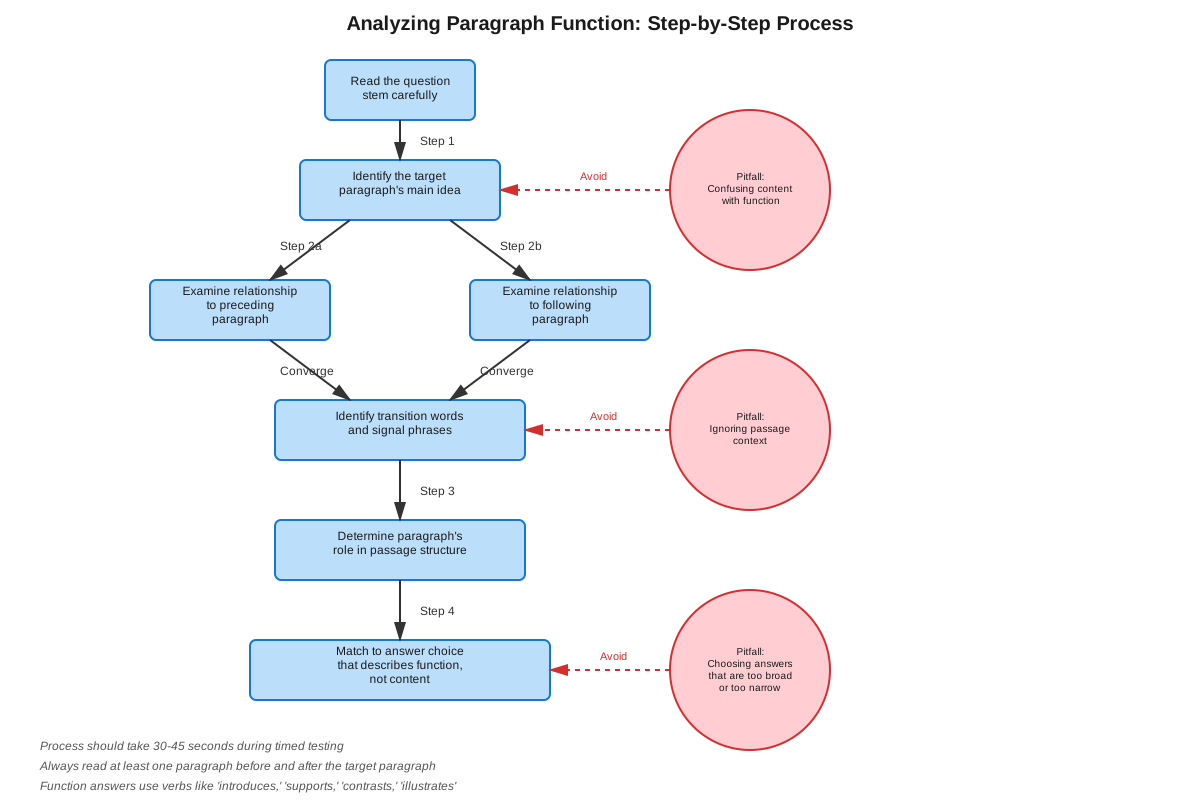
When approaching SAT function of a paragraph questions, follow this systematic process:
Step 1: Read strategically (30-45 seconds)
- Read the paragraph before the target paragraph
- Read the target paragraph carefully
- Read the paragraph after the target paragraph
- Note any signal words or transitional phrases
Step 2: Identify in your own words (15 seconds)
Before looking at answer choices, mentally articulate the paragraph's function in simple terms: "This paragraph gives an example of..." or "This paragraph contrasts with the previous idea by..." Having your own answer prevents you from being swayed by attractive but incorrect options.
Step 3: Eliminate systematically (30-45 seconds)
Exam Tip: Wrong answers typically fall into predictable categories. Eliminate answers that: - Describe content without capturing function ("discusses dolphins" vs. "provides an example of marine adaptation") - Are too broad (claiming the paragraph does more than it actually accomplishes) - Are too narrow (focusing on one detail when the paragraph does more) - Mischaracterize the relationship to other paragraphs - Use extreme language ("proves," "completely refutes") when the paragraph is more moderate
Trigger words to watch for in questions:
- "Main purpose" or "primary function" (focus on the most important role, even if the paragraph does multiple things)
- "In relation to" or "in the context of" (emphasizes how the paragraph connects to surrounding content)
- "Serves to" (asking about the paragraph's action or contribution)
Time allocation: Spend approximately 90 seconds total on function questions. They require more contextual reading than some other question types, so don't rush, but also don't reread the entire passage. The three-paragraph window (before, target, after) provides sufficient context.
Process of elimination tip specific to this topic: If you're stuck between two answers, check whether each answer could apply to other paragraphs in the passage. The correct answer should be specific enough that it clearly applies to the target paragraph but not to others. If an answer like "provides supporting evidence" could describe three different paragraphs, it's probably too vague.
Memory Techniques
CRISP Acronym for Common Functions:
- Contrast (presenting alternative views or limitations)
- Reinforce (providing support or evidence)
- Introduce (establishing topics or context)
- Shift (transitioning between ideas)
- Prove (concluding or synthesizing)
The "Why-How" Check:
When identifying function, ask yourself: "WHY did the author include this paragraph?" and "HOW does it help the passage?" If you can answer both questions, you understand the function. If you can only describe what the paragraph says, you're still focused on content.
The Three-Window Visualization:
Picture three windows side by side: [Before] [Target] [After]. The target paragraph's function is determined by how it connects these windows. Does it build on the "before" window? Contrast with it? Set up the "after" window? This visual reminds you to always check context.
Function vs. Content Mnemonic:
"Content = WHAT it says; Function = WHY it's there"
The rhyme helps distinguish these commonly confused concepts.
Signal Word Categories (TEACH):
- Transition words (furthermore, additionally)
- Evidence words (for example, research shows)
- Alternative words (however, on the other hand)
- Conclusion words (therefore, thus)
- Help words (in other words, to clarify)
Summary
Understanding the function of a paragraph requires analyzing why an author included that paragraph and how it contributes to the passage's overall structure or argument, rather than simply identifying what the paragraph discusses. This skill demands reading paragraphs in context—examining what precedes and follows them—and distinguishing between content (what is said) and function (why it's said). Common paragraph functions include introducing topics, providing supporting evidence, presenting contrasting viewpoints, transitioning between ideas, and concluding arguments. Success on SAT function questions depends on matching answers to appropriate scope (neither too broad nor too narrow), recognizing that the same content can serve different functions in different contexts, and systematically eliminating answers that accurately describe content but misidentify purpose. Signal words provide valuable clues about function, but students must verify these suggestions through comprehensive contextual analysis. Mastering this topic strengthens performance across multiple question types in the SAT Reading and Writing section.
Key Takeaways
- Paragraph function describes the role a paragraph plays in the passage's structure, not what the paragraph discusses
- Always read the paragraphs immediately before and after the target paragraph to understand context
- The correct answer must match the paragraph's scope—specific enough to distinguish it from other paragraphs but broad enough to capture its full contribution
- Most incorrect answers accurately describe content but fail to identify the paragraph's actual function or purpose
- Signal words like "however," "for example," and "therefore" provide clues about function but must be verified through contextual analysis
- Common functions include supporting claims, contrasting ideas, transitioning between topics, introducing concepts, and concluding arguments
- Distinguish between what a paragraph says (content) and why the author included it (function) to avoid the most common error pattern on these questions
Related Topics
Transitions and Logical Flow: After mastering paragraph function, students can advance to analyzing how specific transitional words and phrases connect ideas within and between paragraphs. Understanding function provides the foundation for recognizing why particular transitions are effective or necessary.
Overall Passage Structure: Synthesizing the functions of multiple paragraphs enables students to understand how entire passages are organized—whether they follow problem-solution, chronological, compare-contrast, or other structural patterns.
Author's Purpose and Tone: Recognizing paragraph function deepens understanding of why authors make specific rhetorical choices, connecting structural analysis to questions about authorial intent and attitude.
Evidence and Support: Many paragraphs function to provide evidence for claims. Mastering function identification helps students recognize different types of evidence and evaluate how effectively they support arguments.
Practice CTA
Now that you've mastered the core concepts of paragraph function, it's time to apply this knowledge! Work through the practice questions to test your ability to identify functions in various passage types and contexts. The flashcards will help you internalize common function types and the signal words associated with them. Remember: understanding paragraph function isn't just about memorizing categories—it's about developing the analytical skill to see how authors construct meaning through deliberate structural choices. Each practice question you complete strengthens this essential reading comprehension skill. You've got this!
Sign up free to keep reading
Create a free AnvayaPrep account to finish this SAT guide on Function of a paragraph — plus flashcards and practice questions.