Overview
Passage organization is a fundamental skill tested throughout the SAT Reading and Writing section. This topic requires students to understand how authors structure their texts to convey ideas, develop arguments, and guide readers through complex information. On the SAT, questions about sat passage organization assess whether students can identify the function of specific sentences or paragraphs, recognize structural patterns, and understand how different parts of a passage work together to achieve the author's purpose.
Mastering passage organization is essential because approximately 15-20% of SAT RW questions directly test this skill. These questions ask students to determine what role a particular sentence plays, identify the overall structure of a passage, or recognize how ideas progress from one paragraph to another. Unlike questions that focus solely on comprehension or vocabulary, organization questions require students to step back from the content and analyze the architectural blueprint of the text itself.
Understanding passage organization connects deeply to other Reading and Writing concepts, particularly main idea identification, purpose analysis, and rhetorical strategy. When students can recognize organizational patterns—such as problem-solution, cause-effect, chronological sequence, or compare-contrast—they gain a powerful framework for predicting content, locating information quickly, and understanding the author's reasoning. This skill serves as a foundation for analyzing argumentative structure, evaluating evidence placement, and understanding how transitions guide readers through complex ideas.
Learning Objectives
- [ ] Identify key features of passage organization
- [ ] Explain how passage organization appears on the SAT
- [ ] Apply passage organization to answer SAT-style questions
- [ ] Recognize and categorize common organizational patterns in SAT passages
- [ ] Analyze the function of specific sentences or paragraphs within a larger text structure
- [ ] Evaluate how transitions and structural elements signal organizational relationships
- [ ] Synthesize understanding of multiple organizational elements to determine overall passage structure
Prerequisites
- Basic reading comprehension: Understanding literal meaning is necessary before analyzing how that meaning is structured and presented
- Paragraph structure awareness: Recognizing topic sentences and supporting details provides the foundation for understanding how paragraphs function within larger passages
- Transition word familiarity: Knowledge of words like "however," "furthermore," and "consequently" helps identify relationships between ideas
- Main idea identification: Determining what a passage is about enables students to understand how the author organizes information to support that central point
Why This Topic Matters
In real-world contexts, understanding passage organization is crucial for academic success, professional communication, and critical thinking. College students must navigate complex textbook chapters, research articles, and scholarly arguments—all of which rely on clear organizational structures. Professionals in every field must write reports, proposals, and analyses that follow logical organizational patterns. The ability to recognize how information is structured enables readers to extract key points efficiently, evaluate argument quality, and synthesize information from multiple sources.
On the SAT, passage organization questions appear in approximately 4-6 questions per test, making them a high-yield topic for score improvement. These questions typically take two forms: (1) questions asking about the function of a specific sentence or paragraph within the passage, and (2) questions asking students to identify the overall organizational structure. The College Board consistently includes these questions because they assess critical reading skills that predict college readiness—specifically, the ability to analyze how authors construct arguments and present information.
Common manifestations of this topic on the SAT include passages from natural sciences that follow problem-solution structures, historical texts organized chronologically, social science passages using compare-contrast frameworks, and literary texts that employ narrative or descriptive organization. Questions might ask: "Which choice best describes the overall structure of the passage?" or "The primary purpose of the third paragraph is to..." Understanding these patterns allows students to approach passages strategically rather than passively reading word-by-word.
Core Concepts
Fundamental Organizational Patterns
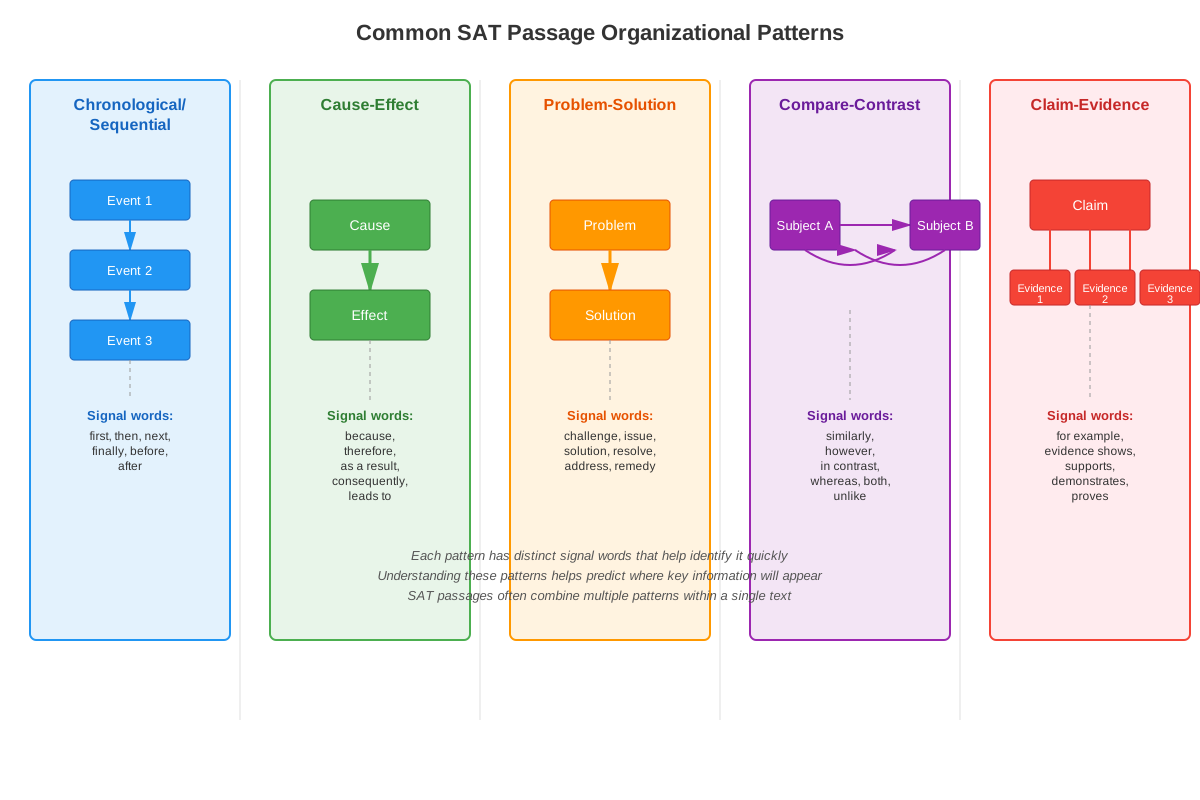
Authors employ several standard organizational patterns to structure their passages, and recognizing these patterns is essential for SAT success. The most common patterns include:
Chronological organization presents events, developments, or processes in time order. This pattern frequently appears in historical passages, biographical sketches, and scientific descriptions of processes. Signal words include "first," "then," "subsequently," "finally," "before," and "after." On the SAT, chronological passages often describe the development of a scientific theory, the life of a historical figure, or the sequence of events leading to a significant outcome.
Cause-and-effect organization explains why something happened or what resulted from a particular event or condition. This pattern is prevalent in scientific and social science passages. Authors may present a cause and then explore multiple effects, or describe an effect and trace it back to various causes. Signal words include "because," "therefore," "as a result," "consequently," "leads to," and "due to."
Compare-and-contrast organization examines similarities and differences between two or more subjects. This pattern appears frequently in passages discussing competing theories, different approaches to a problem, or contrasting perspectives. The structure may alternate between subjects (discussing all aspects of Subject A, then all aspects of Subject B) or alternate by criteria (comparing both subjects on one criterion, then another). Signal words include "similarly," "likewise," "in contrast," "however," "whereas," and "on the other hand."
Problem-solution organization presents a challenge, issue, or question and then describes one or more solutions or responses. This pattern is common in scientific and social science passages. The structure typically includes: (1) introduction of the problem, (2) explanation of why it matters, (3) presentation of solution(s), and (4) evaluation of effectiveness. Signal words include "problem," "challenge," "issue," "solution," "address," and "resolve."
Classification/categorical organization divides a topic into categories, types, or groups and explains each. This pattern helps authors manage complex topics by breaking them into manageable parts. Signal words include "types," "categories," "kinds," "groups," "classified as," and "divided into."
Paragraph and Sentence Functions
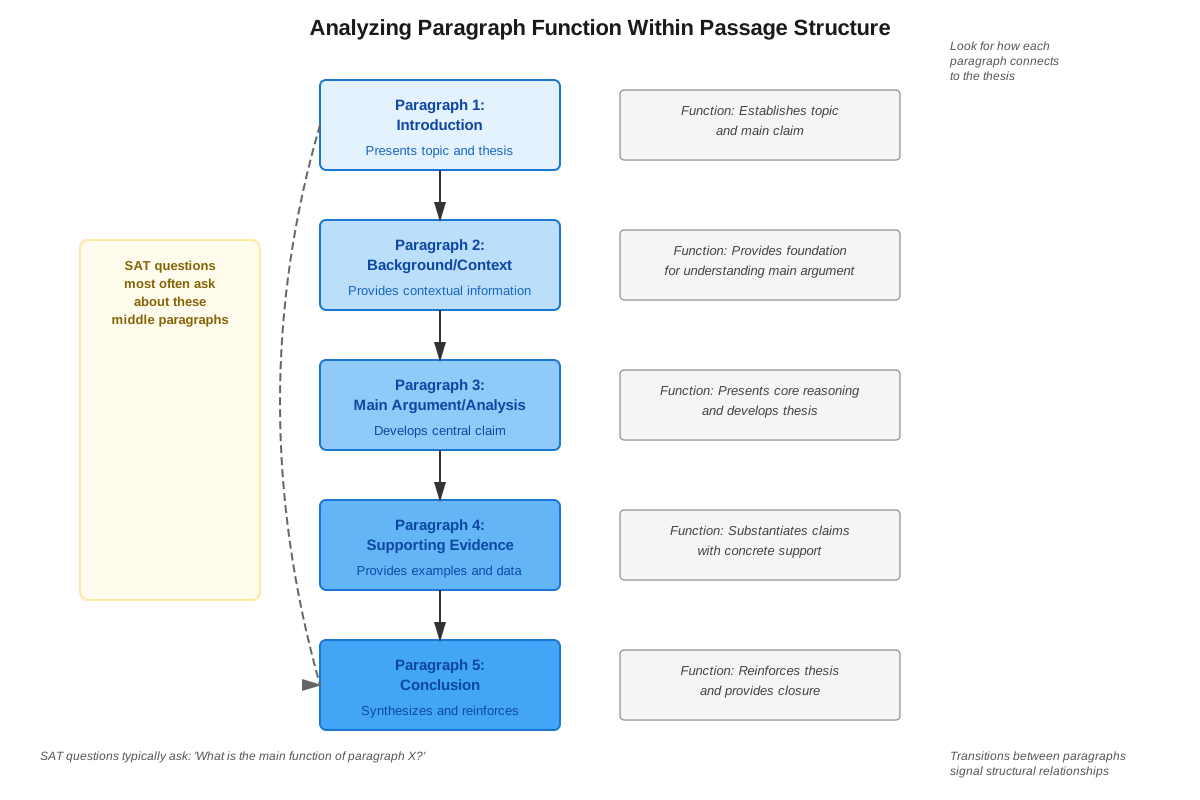
Understanding the function of individual paragraphs and sentences within a passage is crucial for SAT organization questions. Each paragraph serves a specific purpose in advancing the author's overall goal:
Introductory paragraphs typically establish context, present the main topic, state a thesis or central claim, or pose a question the passage will address. On the SAT, recognizing that an opening paragraph sets up what follows helps students predict the passage's direction.
Body paragraphs develop the main idea through various functions: providing evidence or examples, explaining a concept in detail, presenting a counterargument, describing a process or sequence, comparing or contrasting ideas, or analyzing causes and effects. Each body paragraph should connect clearly to the passage's central purpose.
Transitional paragraphs bridge major sections of a passage, shifting from one aspect of the topic to another. These paragraphs often begin with transitional phrases and may briefly summarize what came before while introducing what comes next.
Concluding paragraphs synthesize information, restate the main point in light of the evidence presented, discuss implications or significance, or suggest future directions. SAT passages may not always have formal conclusions, especially in excerpted texts.
Individual sentences within paragraphs also serve specific functions: topic sentences state the paragraph's main idea, supporting sentences provide evidence or elaboration, transitional sentences connect ideas within or between paragraphs, and concluding sentences summarize or emphasize the paragraph's point.
Structural Signals and Transitions
Authors use various structural signals to guide readers through their organization. Recognizing these signals helps students identify organizational patterns quickly:
Transition words and phrases explicitly indicate relationships between ideas. These fall into categories:
- Addition: furthermore, moreover, additionally, also
- Contrast: however, nevertheless, conversely, in contrast
- Cause-effect: therefore, consequently, as a result, thus
- Example: for instance, specifically, such as, to illustrate
- Sequence: first, next, then, finally, subsequently
- Emphasis: indeed, in fact, certainly, undoubtedly
Parallel structure uses repeated grammatical patterns to signal that ideas are related or of equal importance. When authors list items, present multiple examples, or describe several steps, parallel structure helps readers recognize the organizational framework.
Rhetorical questions can signal transitions between ideas or introduce new sections. When an author poses a question, the following text typically answers it, creating a clear organizational relationship.
Repetition and reference create cohesion by linking sentences and paragraphs. Repeated key terms, pronouns referring to earlier nouns, and synonyms all signal that ideas are connected within the organizational structure.
Overall Passage Structure
Beyond individual patterns, students must recognize overall passage structure—how the entire text is architected to achieve its purpose. Common SAT passage structures include:
| Structure Type | Description | Common in |
|---|---|---|
| Thesis-support | States a claim, then provides evidence | Argumentative passages |
| Question-answer | Poses a question, then explores answers | Scientific passages |
| General-to-specific | Introduces broad concept, narrows to details | Explanatory passages |
| Specific-to-general | Presents examples, builds to broader principle | Inductive reasoning passages |
| Narrative | Tells a story or describes events in sequence | Literary and historical passages |
| Descriptive | Presents characteristics or features of a subject | Informational passages |
Understanding overall structure helps students answer questions about the passage's primary purpose, the author's approach, or how different sections relate to the whole.
Concept Relationships
The concepts within passage organization form an interconnected system. Organizational patterns (chronological, cause-effect, compare-contrast, problem-solution, classification) serve as the macro-level framework, determining how the entire passage or major sections are structured. Within these patterns, paragraph functions (introductory, body, transitional, concluding) create the mid-level architecture, with each paragraph playing a specific role in advancing the organizational pattern. At the micro level, structural signals (transitions, parallel structure, repetition) connect individual sentences and ideas, making the organizational pattern explicit and guiding readers through the structure.
This hierarchy flows from large to small: Overall passage structure → Organizational pattern → Paragraph functions → Sentence functions → Structural signals. However, the relationship is also reciprocal: recognizing structural signals helps identify paragraph functions, which reveals the organizational pattern, which clarifies the overall structure.
These concepts connect to prerequisite knowledge in important ways. Understanding main idea enables recognition of organizational patterns because the pattern serves the main idea—an author chooses chronological organization to show development over time, or compare-contrast to highlight differences that support the main point. Transition word familiarity directly supports identification of structural signals, which in turn reveals organizational relationships. Paragraph structure awareness provides the foundation for understanding paragraph functions within larger passages.
Passage organization also connects forward to more advanced skills: recognizing rhetorical strategies (how authors use organizational choices to persuade), analyzing argumentative structure (how claims, evidence, and reasoning are arranged), and evaluating text effectiveness (whether the organizational choices successfully achieve the author's purpose).
High-Yield Facts
⭐ The SAT most frequently tests problem-solution, cause-effect, and compare-contrast organizational patterns in science and social science passages.
⭐ Questions asking about paragraph or sentence function typically include answer choices describing purposes like "introduce," "provide evidence," "present a counterargument," or "emphasize a point."
⭐ Transition words at the beginning of paragraphs are crucial signals for understanding how that paragraph relates to what came before.
⭐ The first and last sentences of paragraphs often reveal the paragraph's function within the overall passage structure.
⭐ When a passage presents two perspectives or theories, it almost always uses compare-contrast organization, even if other patterns appear within sections.
- Chronological organization is most common in passages about historical developments, biographical information, or scientific processes that unfold over time.
- Classification organization often appears in passages that define a concept by breaking it into types, categories, or components.
- The phrase "for example" or "for instance" signals that the following content provides evidence or illustration for a previously stated claim.
- Rhetorical questions in passages typically signal a transition to a new idea or introduce a problem that the passage will address.
- Parallel structure (repeated grammatical patterns) often indicates that the author is presenting items of equal importance or related ideas.
- Passages that begin with a surprising fact, anecdote, or question typically use that opening to introduce the main topic or problem.
- The word "however" or "but" at the start of a paragraph signals a contrast with or qualification of the previous paragraph's ideas.
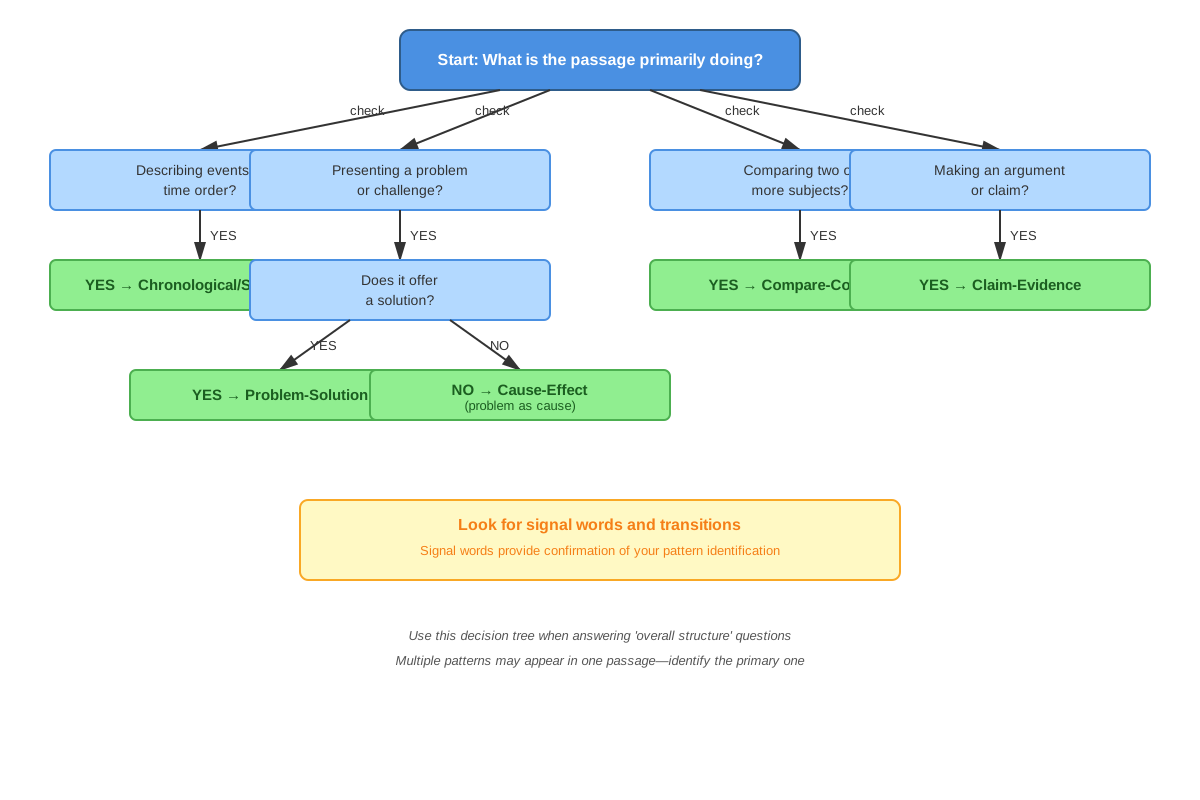
- When a passage describes a problem in early paragraphs and then shifts to discussing responses or solutions, it follows problem-solution organization.
- Passages about scientific studies often follow a predictable structure: background/problem, methodology, results, implications.
- The overall structure of a passage can usually be determined by identifying the function of each paragraph and noting how they connect sequentially.
Quick check — test yourself on Passage organization so far.
Try Flashcards →Common Misconceptions
Misconception: Passage organization only refers to the order of paragraphs.
Correction: Passage organization encompasses multiple levels—overall structure, organizational patterns, paragraph functions, sentence relationships, and structural signals. It's about how all elements work together to convey meaning, not just the sequence of parts.
Misconception: Every passage follows only one organizational pattern throughout.
Correction: Passages frequently combine multiple organizational patterns. For example, a passage might use overall problem-solution structure while employing cause-effect organization within one paragraph and compare-contrast in another. The key is identifying the dominant pattern and recognizing how subsidiary patterns support it.
Misconception: Transition words always appear at the beginning of sentences or paragraphs.
Correction: While transitions often appear at the start of sentences for emphasis, they can appear anywhere. Words like "however," "therefore," and "moreover" may appear mid-sentence, and some transitions are implicit rather than explicit, requiring readers to infer relationships from context.
Misconception: The introduction always appears in the first paragraph and the conclusion in the last.
Correction: SAT passages are often excerpts from longer works, so they may begin mid-argument or end before the original conclusion. Additionally, some passages integrate introductory material throughout early paragraphs or weave concluding thoughts into the final body paragraph rather than having a distinct conclusion.
Misconception: If a passage describes events in time order, every paragraph must be chronological.
Correction: Even in primarily chronological passages, individual paragraphs might pause the timeline to provide background information, explain causes, compare situations, or analyze significance. The overall pattern may be chronological while specific sections use different organizational approaches.
Misconception: Identifying passage organization is about memorizing patterns rather than understanding function.
Correction: While recognizing common patterns is helpful, true mastery comes from understanding why authors choose specific organizational structures and how those choices serve the passage's purpose. Focus on function—what each part accomplishes—rather than just labeling patterns.
Misconception: Longer paragraphs are always more important to the passage's organization than shorter ones.
Correction: Paragraph length doesn't determine importance. A brief transitional paragraph might be crucial for understanding how major sections connect, while a lengthy paragraph might simply provide extended examples for a point already established.
Worked Examples
Example 1: Identifying Paragraph Function
Passage excerpt:
[Paragraph 1] For decades, scientists believed that the human brain stopped producing new neurons after early childhood. This assumption shaped neuroscience research and clinical approaches to brain injury and disease.
[Paragraph 2] However, groundbreaking research in the 1990s challenged this long-held belief. Studies by Elizabeth Gould and others demonstrated that neurogenesis—the formation of new neurons—continues in specific brain regions throughout adult life, particularly in the hippocampus, which is crucial for learning and memory.
[Paragraph 3] This discovery has profound implications. If the adult brain can generate new neurons, then interventions promoting neurogenesis might help treat conditions like depression, cognitive decline, and neurodegenerative diseases. Researchers are now investigating how factors like exercise, diet, and environmental enrichment influence adult neurogenesis.
Question: The primary function of the second paragraph is to:
A) Provide historical context for current neuroscience research
B) Present evidence that contradicts a previously accepted theory
C) Explain the methodology used in neurogenesis studies
D) Describe the structure and function of the hippocampus
Solution:
Step 1: Identify the organizational pattern. The passage follows a problem-solution or old view-new view structure, presenting an outdated belief and then introducing research that challenges it.
Step 2: Analyze the second paragraph's content. It begins with "However," a strong contrast transition, signaling that this paragraph will present information that differs from Paragraph 1. The paragraph introduces "groundbreaking research" that "challenged this long-held belief" and provides specific evidence (studies by Elizabeth Gould) showing that neurogenesis continues in adults.
Step 3: Determine the function. The paragraph's role is to present new evidence that contradicts the old assumption described in Paragraph 1. It doesn't merely provide context (A), explain methodology in detail (C), or focus on describing the hippocampus (D)—though it mentions it briefly.
Step 4: Select the answer. Choice B accurately describes the paragraph's function: it presents evidence (the 1990s research) that contradicts a previously accepted theory (that neurogenesis stops after childhood).
Connection to learning objectives: This example demonstrates how to identify paragraph function by recognizing organizational patterns (old view-new view), analyzing structural signals (the transition "However"), and understanding how the paragraph advances the passage's overall purpose.
Example 2: Determining Overall Passage Structure
Passage excerpt:
[Paragraph 1] Urban heat islands—metropolitan areas significantly warmer than surrounding rural regions—pose increasing challenges for cities worldwide. These temperature differences, which can exceed 10°F, result from heat-absorbing surfaces like asphalt and concrete, reduced vegetation, and waste heat from vehicles and buildings.
[Paragraph 2] The consequences of urban heat islands extend beyond mere discomfort. Elevated temperatures increase energy consumption for cooling, worsen air quality by accelerating smog formation, and disproportionately affect vulnerable populations including the elderly and low-income residents who may lack air conditioning.
[Paragraph 3] Cities are implementing various strategies to combat this phenomenon. Green roofs covered with vegetation can reduce building temperatures by up to 5°F while absorbing stormwater. Cool pavements made with reflective materials lower surface temperatures significantly. Urban tree planting programs provide shade and cooling through evapotranspiration.
[Paragraph 4] While no single solution eliminates urban heat islands entirely, combining multiple approaches shows promise. Singapore's comprehensive strategy integrating green roofs, vertical gardens, and urban forests has reduced temperatures in targeted areas by 4-5°F, demonstrating that coordinated interventions can meaningfully address this challenge.
Question: Which choice best describes the overall structure of the passage?
A) It presents a chronological account of how urban heat islands developed over time
B) It compares different types of urban heat islands and their characteristics
C) It describes a problem, explains its effects, and discusses potential solutions
D) It argues for one specific solution to urban heat issues over alternative approaches
Solution:
Step 1: Identify each paragraph's function.
- Paragraph 1: Introduces and defines the problem (urban heat islands) and explains causes
- Paragraph 2: Describes negative effects/consequences of the problem
- Paragraph 3: Presents multiple solutions being implemented
- Paragraph 4: Evaluates solutions and provides evidence of effectiveness
Step 2: Recognize the organizational pattern. The passage follows a clear problem-solution structure: problem introduction → problem effects → solutions → solution evaluation.
Step 3: Eliminate incorrect answers.
- Choice A is incorrect because the passage doesn't trace historical development; it focuses on current challenges and responses.
- Choice B is incorrect because the passage doesn't compare different types of heat islands; it focuses on one phenomenon.
- Choice D is incorrect because the passage presents multiple solutions without arguing that one is superior; it actually suggests combining approaches.
Step 4: Confirm the correct answer. Choice C accurately captures the passage's structure: it describes a problem (urban heat islands), explains its effects (energy consumption, air quality, vulnerable populations), and discusses potential solutions (green roofs, cool pavements, tree planting, combined approaches).
Connection to learning objectives: This example shows how to determine overall passage structure by analyzing each paragraph's function, recognizing the dominant organizational pattern, and understanding how the parts work together to achieve the author's purpose of explaining a problem and exploring solutions.
Exam Strategy
When approaching SAT questions about passage organization, follow this systematic process:
Step 1: Preview the question before reading. If you know you'll need to identify paragraph function or overall structure, read with that purpose in mind. Look for structural signals and note each paragraph's role as you read.
Step 2: Identify trigger words in questions. Questions about organization typically include phrases like:
- "The primary function of [paragraph/sentence] is to..."
- "Which choice best describes the structure of the passage?"
- "The author includes [sentence/paragraph] primarily to..."
- "The passage is best described as..."
- "The main purpose of the [second/third/fourth] paragraph is to..."
Step 3: For paragraph function questions, read the paragraph before and after. Understanding how a paragraph connects to surrounding text reveals its function. A paragraph that begins with "However" or "In contrast" likely presents an opposing view or qualification. One starting with "For example" probably illustrates a previous claim.
Step 4: Focus on the first and last sentences. These often reveal a paragraph's purpose. The first sentence typically introduces the paragraph's focus; the last often emphasizes its main point or transitions to what follows.
Step 5: Use process of elimination strategically. For organization questions, eliminate answers that:
- Describe content rather than function (e.g., "discusses photosynthesis" instead of "provides evidence for the previous claim")
- Are too narrow (focusing on one detail when the paragraph does more)
- Are too broad (claiming the paragraph does something the entire passage does)
- Misrepresent the relationship to other paragraphs
Step 6: Match answer choices to organizational patterns. If you've identified the passage as problem-solution, look for answer choices using language like "introduces a challenge," "presents a response," or "evaluates a solution." For cause-effect passages, expect "explains the consequences" or "identifies factors leading to."
Time allocation advice: Spend 15-20 seconds identifying the overall organizational pattern when you first read the passage. This investment pays dividends when answering multiple questions. For individual paragraph function questions, spend 30-45 seconds re-reading the relevant paragraph and its context before evaluating answer choices.
Exam Tip: When stuck between two answer choices, ask yourself: "Does this paragraph introduce something new, develop something already mentioned, or transition between ideas?" This question often clarifies the correct answer.
Memory Techniques
PACES Mnemonic for Common Organizational Patterns:
- Problem-solution
- Argument (thesis-support)
- Cause-effect
- Example-based (general-to-specific)
- Sequence (chronological)
TIDE Mnemonic for Paragraph Functions:
- Transition (connecting ideas)
- Introduce (presenting new concepts)
- Develop (elaborating with evidence)
- Emphasize (highlighting key points)
Visualization Strategy for Overall Structure:
Draw a simple diagram as you read, using boxes for paragraphs and arrows showing relationships:
- → for sequence/chronology
- ⇄ for compare-contrast
- ↓ for cause-effect
- ? → ! for problem-solution
The "Function First" Rule:
When analyzing organization, always ask "What does this DO?" before "What does this SAY?" This mental habit shifts focus from content to structure, which is what organization questions test.
Transition Word Categories - "CASTE":
- Contrast: however, nevertheless, conversely
- Addition: furthermore, moreover, additionally
- Sequence: first, next, then, finally
- Therefore (cause-effect): thus, consequently, as a result
- Example: for instance, specifically, such as
Summary
Passage organization is a high-yield SAT skill that requires students to analyze how authors structure texts to convey ideas effectively. Mastery involves recognizing common organizational patterns (chronological, cause-effect, compare-contrast, problem-solution, classification), understanding paragraph and sentence functions within the larger structure, and identifying structural signals like transitions that reveal relationships between ideas. SAT questions test this skill by asking students to determine the function of specific paragraphs or sentences, identify overall passage structure, or explain how different parts of a passage relate to each other. Success requires moving beyond content comprehension to architectural analysis—understanding not just what the passage says, but how it's built. The most effective approach combines pattern recognition with functional analysis: identify the organizational framework, determine each paragraph's role within that framework, and use structural signals to confirm relationships. This skill appears in 15-20% of SAT Reading and Writing questions, making it essential for achieving top scores.
Key Takeaways
- Passage organization questions test your ability to analyze structure and function, not just comprehend content
- The five most common organizational patterns on the SAT are problem-solution, cause-effect, compare-contrast, chronological, and classification
- Transition words at paragraph beginnings are crucial signals for understanding how paragraphs relate to each other and function within the overall structure
- Each paragraph serves a specific function: introducing, developing, transitioning, or emphasizing ideas
- To answer organization questions effectively, focus on what each part does (its function) rather than what it says (its content)
- The first and last sentences of paragraphs typically reveal the paragraph's purpose and connections to surrounding text
- Overall passage structure can be determined by identifying each paragraph's function and noting how they connect sequentially to achieve the author's purpose
Related Topics
Main Idea and Purpose: Understanding passage organization directly supports identifying main ideas, as the organizational structure reveals what the author emphasizes and how they develop their central point. Mastering organization helps you distinguish between the main idea and supporting details.
Rhetorical Strategy and Technique: Once you understand how passages are organized, you can analyze why authors choose specific organizational patterns and how those choices enhance persuasiveness, clarity, or engagement—the foundation of rhetorical analysis.
Evidence and Support: Recognizing organizational patterns helps you identify where authors place evidence, how they connect claims to support, and whether their evidence effectively advances their argument—skills essential for evidence-based questions.
Transitions and Cohesion: Deepening your understanding of how transitions create cohesion within and between paragraphs builds directly on organizational analysis, helping you understand how authors guide readers through complex ideas.
Argumentative Structure: Advanced analysis of how authors construct arguments—including claim placement, counterargument integration, and reasoning development—extends organizational skills to specifically argumentative contexts.
Practice CTA
Now that you've mastered the core concepts of passage organization, it's time to apply this knowledge! Work through the practice questions to test your ability to identify organizational patterns, determine paragraph functions, and analyze passage structure under timed conditions. Use the flashcards to reinforce key terminology and organizational signals. Remember: recognizing passage organization isn't just about memorizing patterns—it's about understanding how authors build texts to achieve their purposes. Each practice question you complete strengthens your ability to see the architecture behind the words, a skill that will serve you not only on the SAT but throughout your academic career. You've got this!
Sign up free to keep reading
Create a free AnvayaPrep account to finish this SAT guide on Passage organization — plus flashcards and practice questions.