Overview
The role of explanation is a critical text structure concept tested on the SAT Reading and Writing section. This topic requires students to identify how authors use explanatory passages to clarify, elaborate, or provide reasoning for claims, phenomena, or concepts within a text. Understanding the sat role of explanation means recognizing when a sentence or passage functions specifically to make something clearer or more understandable to the reader, rather than to introduce new claims, provide evidence, or draw conclusions.
On the SAT, questions about the role of explanation typically ask students to determine why an author included a particular sentence or how a specific portion of text functions within the larger passage. These questions assess whether students can distinguish explanatory content from other textual purposes such as argumentation, description, or narration. The ability to identify explanatory elements is fundamental to comprehending complex academic and informational texts, which form the backbone of SAT rw passages.
Mastering this topic connects directly to broader Reading and Writing skills including understanding text structure, identifying author's purpose, and analyzing how ideas develop throughout a passage. The role of explanation intersects with concepts like supporting evidence, logical reasoning, and coherence—all essential for achieving high scores on the SAT. Students who can quickly identify explanatory functions will read more efficiently and answer structure-based questions with greater accuracy.
Learning Objectives
- [ ] Identify key features of Role of explanation
- [ ] Explain how Role of explanation appears on the SAT
- [ ] Apply Role of explanation to answer SAT-style questions
- [ ] Distinguish explanatory text from other textual purposes (argumentation, evidence, description)
- [ ] Analyze how explanatory sentences support main ideas and claims
- [ ] Evaluate the effectiveness of explanatory strategies in academic passages
Prerequisites
- Basic reading comprehension: Understanding main ideas and supporting details is essential because explanations typically clarify or expand upon these elements
- Sentence function awareness: Recognizing that sentences serve different purposes (claim, evidence, transition) provides the foundation for identifying explanatory roles
- Vocabulary knowledge: Familiarity with academic vocabulary helps students recognize explanatory signal words and phrases
- Paragraph structure understanding: Knowing how paragraphs organize information helps identify where explanations typically appear in relation to claims
Why This Topic Matters
Understanding the role of explanation has significant real-world applications beyond standardized testing. In academic settings, students must comprehend complex textbooks, research articles, and scholarly arguments where explanatory passages clarify difficult concepts. Professional communication—from technical documentation to business reports—relies heavily on clear explanations to ensure audience understanding. The ability to identify and construct effective explanations is fundamental to critical thinking and effective communication across all disciplines.
On the SAT, questions about the role of explanation appear with high frequency, typically 2-4 times per test in the Reading and Writing section. These questions often appear in the "Craft and Structure" category, which comprises approximately 28% of the Reading and Writing questions. Students can expect to encounter these questions across various passage types, including science, social studies, humanities, and literature passages.
The role of explanation commonly appears in SAT passages in several ways: clarifying technical terminology, elaborating on complex processes, providing reasoning for counterintuitive findings, illustrating abstract concepts with concrete examples, and breaking down cause-and-effect relationships. Passages discussing scientific phenomena, historical events, or theoretical concepts frequently include explanatory sentences that help readers understand specialized information. Recognizing these explanatory functions allows students to navigate complex passages more effectively and answer questions about text structure with confidence.
Core Concepts
Defining Explanatory Function
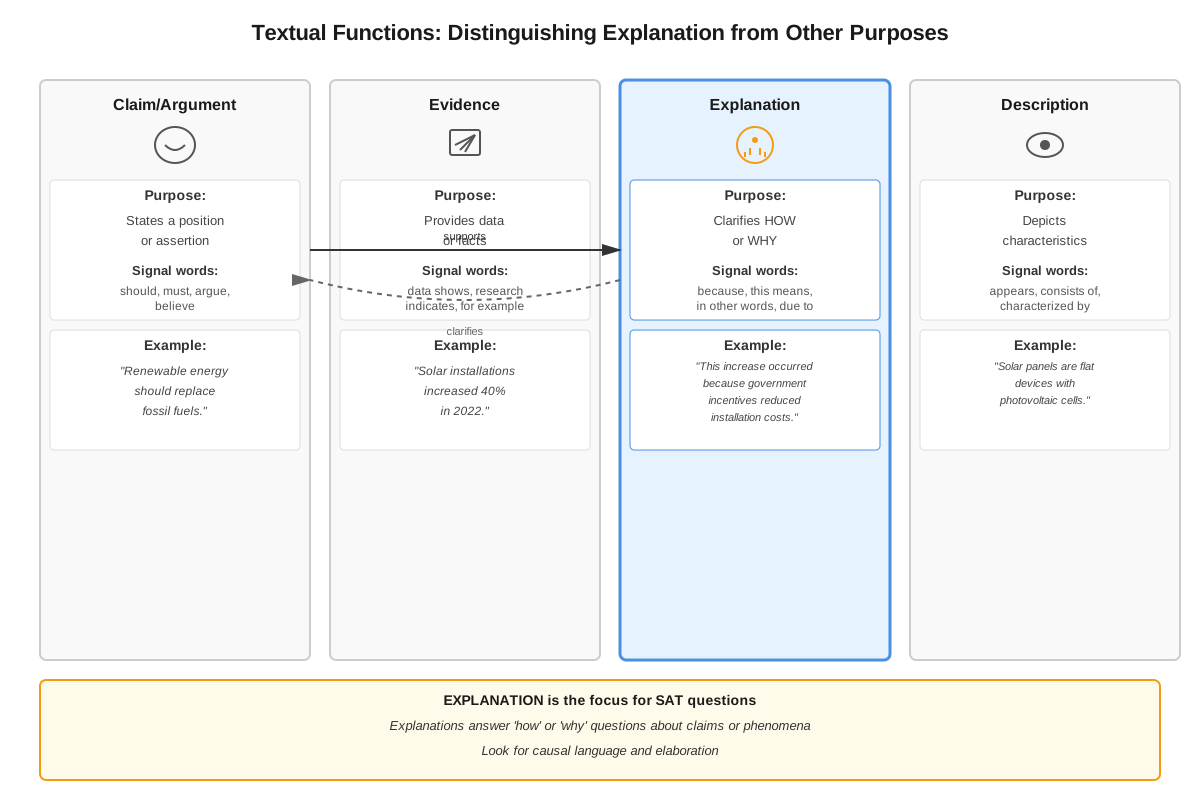
The role of explanation refers to the specific function that a sentence, clause, or passage serves when it clarifies, elaborates, or provides reasoning for information presented in a text. An explanatory element makes something more understandable by breaking down complex ideas, defining terms, providing context, or illustrating concepts. Unlike evidence (which supports a claim with facts or data) or argumentation (which persuades through reasoning), explanation focuses on enhancing comprehension.
Explanatory text answers implicit questions readers might have: "What does this mean?" "How does this work?" "Why is this the case?" When an author anticipates reader confusion or recognizes that a concept requires additional clarification, they include explanatory content. This function is particularly common in academic and informational texts where specialized knowledge or complex relationships need to be made accessible to a general audience.
Key Features of Explanatory Text
Explanatory passages exhibit several distinctive characteristics that help readers identify them:
| Feature | Description | Example Signal |
|---|---|---|
| Clarification | Makes a previous statement clearer or more specific | "In other words," "That is," "Specifically" |
| Elaboration | Expands on an idea with additional detail | "Furthermore," "Additionally," "More precisely" |
| Definition | Provides the meaning of a term or concept | "refers to," "is defined as," "means that" |
| Illustration | Offers concrete examples of abstract ideas | "For instance," "Such as," "To illustrate" |
| Process breakdown | Describes steps or mechanisms | "First," "Then," "This process involves" |
| Causal reasoning | Explains why something occurs | "Because," "Due to," "As a result of" |
Distinguishing Explanation from Other Functions
Understanding what explanation is requires recognizing what it is not. Several textual functions can appear similar to explanation but serve different purposes:
Explanation vs. Evidence: Evidence provides factual support for a claim (statistics, research findings, expert testimony), while explanation clarifies how or why something works. Evidence answers "Is this true?" while explanation answers "How does this work?" For example, "Studies show 70% of participants improved" is evidence, while "This improvement occurs because the treatment targets specific neural pathways" is explanation.
Explanation vs. Argumentation: Argumentation attempts to persuade readers to accept a position through logical reasoning and evidence, while explanation aims to increase understanding without necessarily advocating for a viewpoint. "We should adopt this policy because it reduces costs" is argumentation, while "This policy reduces costs by eliminating redundant processes" is explanation.
Explanation vs. Description: Description provides sensory details or characteristics of something, while explanation reveals mechanisms, reasons, or relationships. "The cell membrane is thin and flexible" is description, while "The cell membrane's flexibility allows it to regulate what enters and exits the cell" is explanation.
Types of Explanatory Strategies
Authors employ various strategies when crafting explanatory content:
- Definitional explanation: Provides precise meanings for technical or specialized terms
- Analogical explanation: Uses familiar concepts to clarify unfamiliar ones through comparison
- Causal explanation: Reveals cause-and-effect relationships and underlying mechanisms
- Process explanation: Breaks down sequences of events or steps in a procedure
- Contrastive explanation: Clarifies by showing what something is not or how it differs from similar concepts
- Example-based explanation: Uses specific instances to illuminate general principles
Structural Placement of Explanations
Explanatory content typically appears in predictable locations within passages:
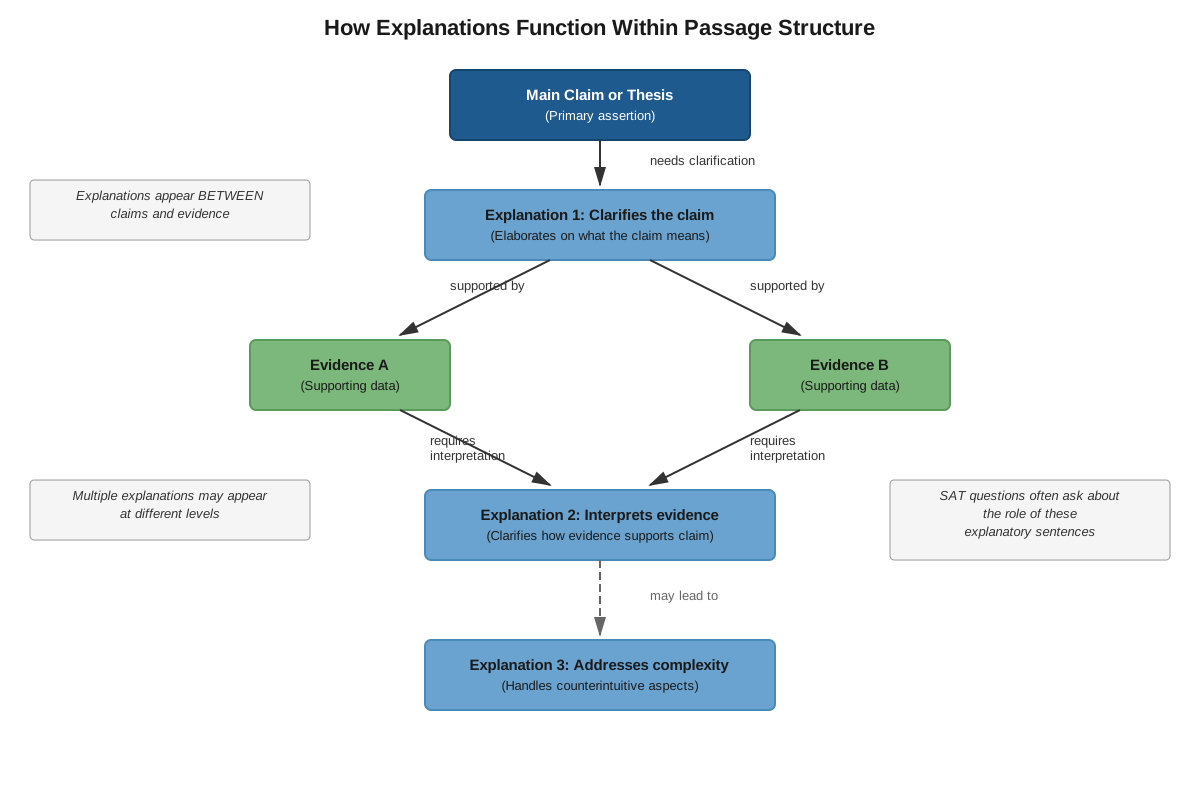
- Immediately following complex claims: When authors introduce sophisticated or counterintuitive ideas, they often follow with explanatory sentences
- After technical terminology: Specialized vocabulary frequently triggers explanatory clarification
- Within parenthetical remarks: Authors use parentheses, dashes, or commas to insert brief explanations
- In transitional passages: Between major sections, authors may explain connections or provide context
- Following data presentation: After presenting statistics or research findings, authors explain their significance
Signal Words and Phrases
Recognizing signal words helps students quickly identify explanatory functions. Common explanatory signals include:
- Clarification: "in other words," "that is to say," "put simply," "to clarify"
- Elaboration: "more specifically," "in particular," "namely," "especially"
- Causation: "because," "since," "due to," "as a result," "consequently"
- Illustration: "for example," "for instance," "such as," "to illustrate," "consider"
- Definition: "refers to," "means," "is defined as," "indicates," "denotes"
However, not all explanations include explicit signals. Students must also recognize explanatory function through context and logical relationships between sentences.
Concept Relationships
The role of explanation connects intimately with other text structure concepts. Main ideas often require explanation to be fully understood, creating a relationship where explanatory sentences support and clarify central claims. This relationship flows as: Main Idea → triggers need for → Explanation → enhances → Reader Comprehension.
Explanatory content also relates to supporting evidence but serves a different function. While evidence proves or supports claims, explanation clarifies how that evidence relates to the claim or what it means. The relationship follows: Claim → supported by → Evidence → clarified through → Explanation → leads to → Understanding.
Within the broader context of text structure and purpose, explanation represents one of several functional elements authors use to achieve their communicative goals. The hierarchy operates as: Author's Purpose → determines → Text Structure → includes → Various Functions (explanation, argumentation, description, narration) → work together to → Achieve Purpose.
The role of explanation also connects to logical reasoning and coherence. Explanatory passages help readers follow an author's logic by making implicit connections explicit and ensuring that complex ideas flow logically from one to another. This creates a chain: Complex Idea A → connected through → Explanation → enables understanding of → Complex Idea B → maintains → Textual Coherence.
Understanding prerequisite concepts like sentence function and paragraph structure enables students to identify explanatory roles more effectively. These foundational skills provide the framework: Basic Comprehension → enables → Function Recognition → allows → Explanation Identification → improves → SAT Performance.
High-Yield Facts
⭐ Explanatory sentences clarify or elaborate on information rather than introducing new claims or providing direct evidence
⭐ Signal words like "in other words," "that is," and "specifically" often indicate explanatory function
⭐ Explanations typically appear immediately after complex claims, technical terms, or counterintuitive findings
⭐ The role of explanation differs from evidence: evidence supports claims while explanation clarifies meaning
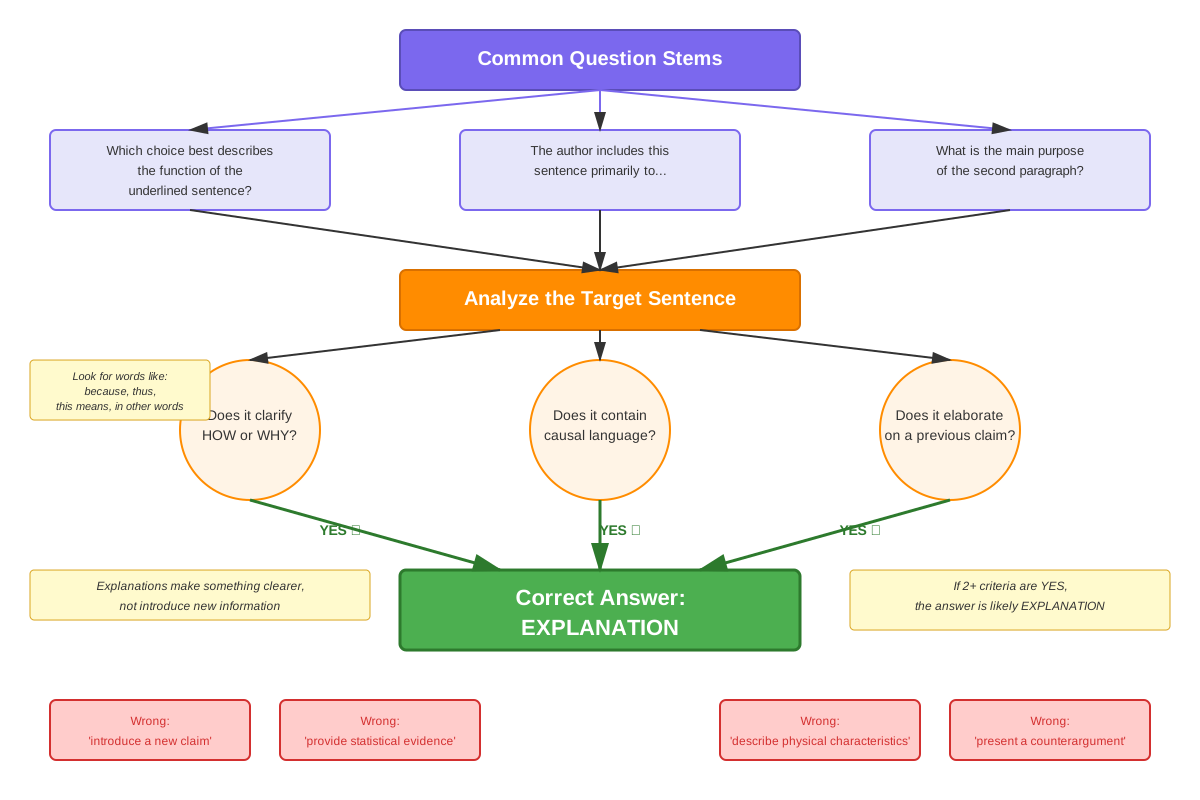
⭐ SAT questions about explanation often ask "Which choice best describes the function of the underlined sentence?"
- Explanatory content answers implicit reader questions about "how" or "why" something works
- Authors use analogies, examples, and definitions as common explanatory strategies
- Parenthetical remarks frequently serve explanatory functions within sentences
- Explanations enhance coherence by making logical connections between ideas explicit
- Identifying explanatory function requires understanding the relationship between adjacent sentences
- Not all explanations include explicit signal words; context determines function
- Explanatory passages are particularly common in science and social science SAT passages
- The ability to distinguish explanation from description improves answer accuracy on structure questions
Quick check — test yourself on Role of explanation so far.
Try Flashcards →Common Misconceptions
Misconception: Any sentence that comes after a claim must be evidence supporting that claim.
Correction: Sentences following claims can serve multiple functions including explanation, evidence, or elaboration. Explanation clarifies the claim's meaning while evidence provides factual support. Students must analyze the specific relationship between sentences rather than assuming position determines function.
Misconception: Explanatory sentences always include signal words like "because" or "in other words."
Correction: While signal words help identify explanatory function, many explanations lack explicit markers. The explanatory role emerges from the logical relationship between sentences and the clarifying purpose the sentence serves, not solely from transitional phrases.
Misconception: Explanation and evidence are the same thing because both support understanding.
Correction: Evidence provides factual support proving a claim is true (data, studies, expert testimony), while explanation clarifies how or why something works. Evidence answers "Is this true?" while explanation answers "What does this mean?" or "How does this work?"
Misconception: If a sentence provides an example, it cannot be serving an explanatory role.
Correction: Examples frequently serve explanatory functions by illustrating abstract concepts with concrete instances. Example-based explanation is a common and effective explanatory strategy. The key is whether the example clarifies understanding rather than merely describing or providing evidence.
Misconception: Longer, more complex sentences are more likely to be explanatory than shorter ones.
Correction: Sentence length does not determine function. Brief sentences can serve powerful explanatory roles, while lengthy sentences might provide evidence, description, or argumentation. Function depends on purpose and relationship to surrounding text, not complexity or length.
Misconception: Explanatory content only appears in science passages where technical concepts need clarification.
Correction: While scientific passages frequently include explanations, all passage types—including humanities, social studies, and literature—use explanatory content. Any time an author needs to clarify meaning, provide context, or enhance understanding, explanation serves that purpose regardless of subject matter.
Worked Examples
Example 1: Identifying Explanatory Function
Passage excerpt:
"Recent studies have demonstrated that urban green spaces significantly improve mental health outcomes among city residents. This improvement occurs because exposure to natural environments reduces cortisol levels, the hormone associated with stress. When cortisol decreases, individuals experience lower anxiety and improved mood regulation."
Question: The primary function of the second sentence ("This improvement occurs...") is to:
A) Provide statistical evidence supporting the claim about mental health
B) Explain the biological mechanism behind the mental health improvement
C) Introduce a contrasting viewpoint about urban green spaces
D) Describe the physical characteristics of cortisol
Solution:
Step 1: Identify what the first sentence does. It makes a claim: urban green spaces improve mental health.
Step 2: Analyze what the second sentence accomplishes. It doesn't provide statistics or research data (ruling out A). It doesn't contrast or disagree (ruling out C). It doesn't describe cortisol's physical properties (ruling out D).
Step 3: Recognize the relationship. The second sentence answers the implicit question "How does this improvement happen?" It reveals the biological mechanism—the causal pathway from green space exposure to reduced cortisol to improved mental health.
Step 4: Identify signal words. "This improvement occurs because" explicitly signals causal explanation.
Answer: B - The sentence explains the biological mechanism, clarifying HOW the improvement mentioned in the first sentence actually works. This is a classic explanatory function: taking a claim and making the underlying process clear to readers.
Connection to learning objectives: This example demonstrates how to identify explanatory function by analyzing sentence relationships and recognizing that explanation clarifies mechanisms rather than providing evidence or making new claims.
Example 2: Distinguishing Explanation from Evidence
Passage excerpt:
"Photosynthesis allows plants to convert light energy into chemical energy. In this process, chlorophyll molecules absorb photons from sunlight, initiating a series of electron transfers. Research conducted by Chen et al. (2019) found that plants exposed to optimal light conditions showed 40% higher glucose production than those in low-light environments."
Question: Which sentence primarily serves an explanatory function?
Solution:
Step 1: Analyze each sentence's function.
- Sentence 1: States what photosynthesis does (definitional/introductory claim)
- Sentence 2: Describes HOW the process works at the molecular level
- Sentence 3: Provides research findings with specific data
Step 2: Apply the explanation criteria. Which sentence clarifies or elaborates on how something works rather than proving it or stating it?
Step 3: Distinguish explanation from evidence. Sentence 3 provides empirical evidence (research study, specific percentage) that supports the importance of light in photosynthesis. This is evidence, not explanation.
Step 4: Identify the explanatory sentence. Sentence 2 breaks down the mechanism of photosynthesis, explaining the process from light absorption to electron transfer. It answers "How does photosynthesis work?" rather than "Is photosynthesis effective?"
Answer: The second sentence serves the primary explanatory function. It clarifies the mechanism described in the first sentence by breaking down the process into understandable steps.
Key distinction: Evidence (sentence 3) proves something is true with data; explanation (sentence 2) clarifies how something works through process description. Both support understanding but serve different rhetorical purposes.
Connection to learning objectives: This example shows how to distinguish explanatory text from evidence, a critical skill for SAT questions that ask about sentence function within passages.
Exam Strategy
When approaching SAT questions about the role of explanation, follow this systematic process:
Step 1: Read the surrounding context - Never evaluate a sentence in isolation. Read at least one sentence before and after the sentence in question to understand its relationship to adjacent ideas.
Step 2: Identify what precedes the sentence - Determine whether the previous sentence introduces a claim, presents data, describes something, or serves another function. Explanatory sentences typically follow claims, technical terms, or complex concepts.
Step 3: Ask the clarification question - Does this sentence answer "What does this mean?" "How does this work?" or "Why is this the case?" If yes, it likely serves an explanatory function.
Step 4: Check for signal words - Look for explanatory markers like "in other words," "that is," "because," "this occurs when," or "specifically." However, remember that absence of signals doesn't eliminate explanatory function.
Step 5: Eliminate wrong answer types - Rule out answers suggesting the sentence provides evidence (look for data, studies, statistics), makes a new claim (introduces a different idea), or describes (focuses on characteristics rather than mechanisms).
Exam Tip: When answer choices include "provides evidence" and "explains," ask yourself: Does this sentence give me facts/data to prove something (evidence) or does it clarify how/why something works (explanation)?
Trigger words to watch for in questions:
- "The primary function of the sentence is to..."
- "The author includes this sentence in order to..."
- "Which choice best describes the role of the underlined portion?"
- "The sentence serves mainly to..."
Process-of-elimination strategy specific to explanation questions:
- Eliminate "introduces a new claim" if the sentence relates directly to the previous sentence rather than shifting topics
- Eliminate "provides evidence" if the sentence lacks specific data, research citations, or factual support
- Eliminate "describes" if the sentence focuses on mechanisms or reasons rather than characteristics
- Eliminate "argues" if the sentence clarifies rather than persuades
Time allocation advice: Spend 45-60 seconds on role of explanation questions. These questions require careful reading of context but don't demand extensive analysis. If you find yourself re-reading multiple times, you may be overthinking—trust your initial assessment of the sentence relationship.
Memory Techniques
CREAM Mnemonic for identifying explanatory functions:
- Clarifies previous statements
- Reveals mechanisms or processes
- Elaborates on complex ideas
- Answers "how" or "why" questions
- Makes implicit connections explicit
The "Teacher Test": Imagine the author is a teacher and the reader is a student who just asked "I don't understand—can you explain that?" If the sentence in question would be a natural response to that request, it's serving an explanatory function.
Signal Word Categories - Remember these three main types:
- Clarification signals: "In other words" (IOW)
- Causation signals: "Because" (B)
- Illustration signals: "For example" (FE)
Acronym: IOW-B-FE (sounds like "I owe beef")
The Question Method: For each potentially explanatory sentence, insert an implicit question before it:
- If "What does this mean?" fits → Definitional explanation
- If "How does this work?" fits → Process explanation
- If "Why is this so?" fits → Causal explanation
Visualization Strategy: Picture explanation as a bridge between a complex island (difficult concept) and the mainland (reader understanding). The bridge doesn't prove the island exists (that's evidence) or describe what the island looks like (that's description)—it provides a pathway to reach and understand it.
Summary
The role of explanation is a fundamental text structure concept that requires students to identify when sentences or passages function to clarify, elaborate, or provide reasoning for information in a text. Explanatory content differs from evidence, argumentation, and description by focusing specifically on enhancing reader comprehension rather than proving claims, persuading audiences, or providing sensory details. On the SAT Reading and Writing section, questions about explanatory function appear frequently, asking students to determine why authors included specific sentences or how textual elements function within passages. Success requires recognizing signal words, understanding sentence relationships, and distinguishing explanation from similar but distinct textual purposes. Explanatory passages typically follow complex claims or technical terminology and answer implicit reader questions about how processes work or why phenomena occur. Mastering this concept improves overall reading comprehension, enables more efficient passage navigation, and increases accuracy on structure-based SAT questions across all passage types.
Key Takeaways
- Explanatory text clarifies meaning and reveals mechanisms rather than providing evidence or making new claims
- Signal words like "in other words," "because," and "specifically" often indicate explanatory function, but context matters more than markers
- Explanation differs from evidence: evidence proves claims with data while explanation clarifies how or why something works
- SAT questions about explanation typically ask about sentence function and appear 2-4 times per test
- Explanatory content commonly follows complex claims, technical terms, or counterintuitive findings in passages
- Distinguishing explanation from description, evidence, and argumentation is essential for answering structure questions correctly
- Reading surrounding context is crucial—never evaluate a sentence's function in isolation
Related Topics
Text Structure and Organization: Understanding how authors organize entire passages builds on recognizing individual sentence functions like explanation. Mastering explanation helps students see how clarifying content contributes to overall passage coherence.
Author's Purpose and Tone: Identifying why authors include explanatory content connects to broader questions about authorial intent. Explanation often reveals an author's desire to make complex information accessible.
Supporting Evidence and Claims: Distinguishing explanation from evidence requires understanding how different textual elements support main ideas. This topic deepens comprehension of argumentative structure.
Rhetorical Strategies: Explanation represents one rhetorical strategy among many. Understanding various strategies helps students analyze how authors achieve communicative goals.
Transition Words and Coherence: Signal words that indicate explanation connect to broader study of how transitions create textual flow and logical connections between ideas.
Practice CTA
Now that you understand the role of explanation and how it appears on the SAT, it's time to apply this knowledge! Work through the practice questions to test your ability to identify explanatory functions in various passage types. Use the flashcards to reinforce signal words and key distinctions between explanation and other textual purposes. Remember: recognizing explanatory function becomes intuitive with practice. Each question you answer strengthens your ability to navigate complex passages efficiently and accurately. You've built a solid foundation—now demonstrate your mastery!
Sign up free to keep reading
Create a free AnvayaPrep account to finish this SAT guide on Role of explanation — plus flashcards and practice questions.