Overview
The role of summary is a critical skill tested in the SAT Reading and Writing (RW) section that requires students to identify, evaluate, and understand how summaries function within texts. On the SAT, questions about the role of summary assess whether students can distinguish between effective and ineffective summaries, recognize what information should be included or excluded, and understand how summaries serve different purposes depending on context. These questions typically present a passage followed by four potential summaries, asking students to select the one that best captures the essential information while maintaining accuracy and appropriate scope.
Understanding the role of summary is essential for SAT success because it tests multiple interconnected skills: reading comprehension, information synthesis, detail discrimination, and purpose recognition. The College Board includes these questions to evaluate whether students can distill complex information into its most important elements—a skill fundamental to academic success at the college level. Summary questions appear regularly throughout the digital SAT, making them high-yield content that directly impacts scores.
This topic connects deeply to broader Reading and Writing concepts including main idea identification, supporting detail recognition, text structure analysis, and purpose determination. Mastering the role of summary strengthens overall comprehension skills and provides a foundation for understanding how authors organize and present information across various text types, from scientific articles to literary passages.
Learning Objectives
- [ ] Identify key features of Role of summary
- [ ] Explain how Role of summary appears on the SAT
- [ ] Apply Role of summary to answer SAT-style questions
- [ ] Distinguish between effective and ineffective summaries based on accuracy, completeness, and scope
- [ ] Evaluate whether a summary appropriately captures the main idea while excluding unnecessary details
- [ ] Recognize common patterns in incorrect summary answer choices
- [ ] Analyze how summary requirements differ based on passage type and purpose
Prerequisites
- Main idea identification: Understanding the central point of a passage is essential because summaries must capture this main idea without distortion or omission
- Supporting detail recognition: Distinguishing between major and minor details helps determine what belongs in a summary versus what can be excluded
- Reading comprehension fundamentals: Basic ability to understand written passages at grade level ensures students can accurately process the source material before evaluating summaries
- Paragraph structure awareness: Recognizing how paragraphs organize information aids in identifying which elements are most important for summary inclusion
Why This Topic Matters
The role of summary appears frequently on the SAT, with summary-related questions constituting approximately 10-15% of the Reading and Writing section. These questions test essential academic skills that extend far beyond standardized testing: the ability to synthesize information, identify core arguments, and communicate complex ideas concisely. In college and professional contexts, summarization skills enable students to take effective notes, write literature reviews, prepare presentations, and communicate research findings.
On the SAT, summary questions typically appear in several formats: selecting the best summary of a passage, identifying which statement best completes a summary with missing information, or determining which detail should be included or excluded from a summary. The passages used for these questions span diverse subjects including science, history, literature, and social studies, requiring students to apply summarization skills flexibly across content areas.
Common question stems include: "Which choice best states the main idea of the text?", "Which choice most logically completes the text?", and "Which choice best describes the overall structure of the text?" Understanding the role of summary directly improves performance on these high-frequency question types, making this topic one of the highest-yield areas for focused study. Students who master summary evaluation can quickly eliminate incorrect answers and confidently select the best choice, improving both accuracy and time management.
Core Concepts
What Constitutes an Effective Summary
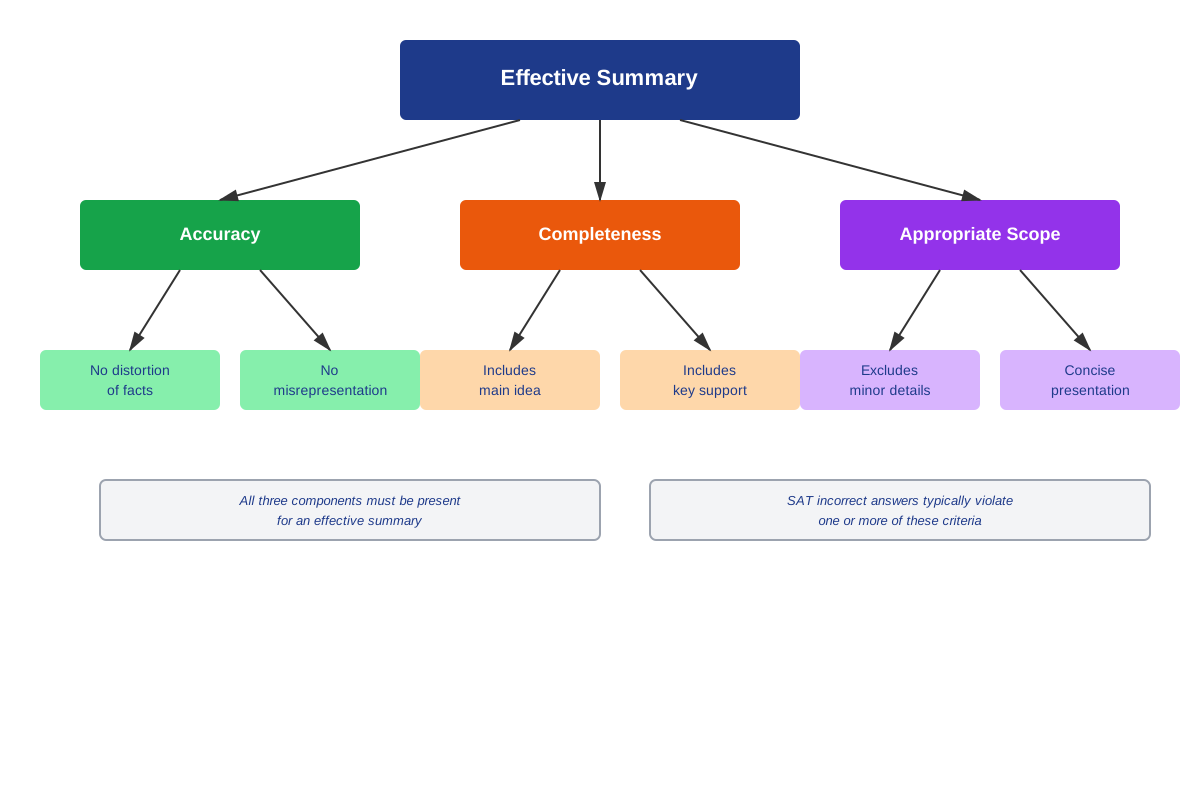
An effective summary captures the essential information from a source text while omitting unnecessary details, maintaining accuracy, and preserving the author's intended meaning. On the SAT role of summary questions, the correct answer must satisfy multiple criteria simultaneously. First, it must include the passage's main idea or central claim without distortion. Second, it should represent the appropriate scope—neither too broad (overgeneralizing) nor too narrow (focusing on a minor detail). Third, it must maintain factual accuracy, avoiding any statements that contradict or misrepresent the source material.
The College Board designs these questions to test whether students understand that summaries serve as condensed versions of longer texts, requiring judgment about what information is most important. An effective summary typically includes the subject of the passage, the main action or claim, and any essential context needed for understanding. It excludes examples, minor supporting details, tangential information, and stylistic elements that don't contribute to core meaning.
Key Features of Summary Questions
Summary questions on the RW section follow predictable patterns that students can learn to recognize. These questions present a passage (typically 50-150 words) followed by four answer choices that purport to summarize or complete the text. The passage itself may be informational, argumentative, or narrative in nature, drawn from authentic sources across academic disciplines.
The correct answer demonstrates three essential qualities:
- Completeness: Includes all major points without significant omissions
- Accuracy: Contains no factual errors or misrepresentations
- Appropriate scope: Matches the level of generality or specificity appropriate to the passage
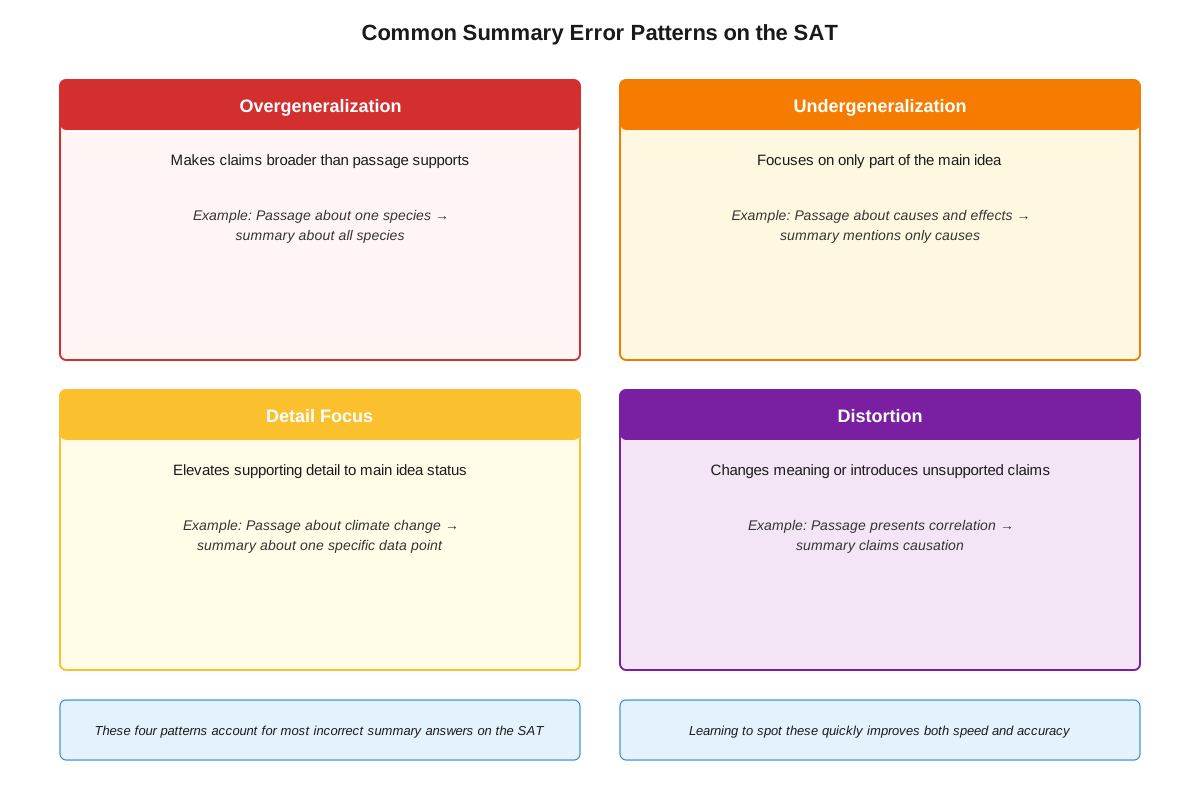
Incorrect answers typically fail in one or more of these areas. They may focus on a minor detail while ignoring the main point, introduce information not present in the passage, misrepresent the author's claims, or provide an overly broad statement that could apply to many texts beyond the specific passage.
Types of Information in Summaries
Understanding what belongs in a summary requires distinguishing between different types of information. The following table illustrates this distinction:
| Information Type | Include in Summary? | Example |
|---|---|---|
| Main claim/thesis | Yes | "The study found that urban green spaces improve mental health" |
| Supporting major points | Usually yes | "Benefits included reduced stress and increased social connection" |
| Specific examples | Usually no | "One participant, Maria, reported feeling calmer after park visits" |
| Statistical evidence | Sometimes | "Mental health scores improved by 23%" (if central to the claim) |
| Background context | If essential | "Previous research had focused only on physical health benefits" |
| Minor details | No | "The parks included benches and walking paths" |
| Author's methodology | If the focus | "Researchers surveyed 500 participants over six months" |
The decision to include or exclude information depends on the passage's purpose and emphasis. A passage primarily about research findings would summarize the results, while a passage about research methodology would summarize the methods used.
Summary Scope and Generality
One of the most challenging aspects of evaluating summaries involves determining appropriate scope. A summary that is too specific focuses on a minor detail or single example, failing to capture the passage's broader point. Conversely, a summary that is too general makes claims so broad they could apply to many different texts, losing the specific contribution of the passage in question.
Consider a passage about how honeybees communicate the location of food sources through waggle dances. An overly specific summary might state: "Honeybees move in figure-eight patterns." This focuses on a detail without explaining its significance. An overly general summary might state: "Honeybees have interesting behaviors." This could apply to countless passages about bees. An appropriately scoped summary would state: "Honeybees use specific dance movements to communicate food source locations to other bees in their hive."
Common Summary Question Formats
The SAT presents summary questions in several distinct formats:
Format 1: Complete Summary Selection
Students read a passage and select which of four choices best summarizes the entire text. This format tests comprehensive understanding and the ability to distinguish main ideas from supporting details.
Format 2: Summary Completion
The question provides a partial summary with a blank, and students select which choice most logically completes it. This format tests understanding of how ideas connect and what information is necessary for a complete summary.
Format 3: Main Idea Identification
While technically asking for the "main idea," these questions function as summary questions because the correct answer must capture the passage's essential point in condensed form.
Format 4: Text Structure Description
These questions ask students to identify which choice best describes how the text is organized or what the text accomplishes, requiring summary-level understanding of the passage's overall purpose and structure.
Evaluating Summary Accuracy
Accuracy in summaries means more than avoiding obvious factual errors. Subtle misrepresentations frequently appear in incorrect answer choices on the SAT. These include:
- Degree shifts: Changing "may contribute to" into "causes" or "suggests" into "proves"
- Scope shifts: Changing "some species" to "all species" or "in this study" to "universally"
- Causal confusion: Implying causation where the passage only describes correlation
- Temporal distortion: Misrepresenting the timing or sequence of events
- Attribution errors: Misidentifying who made a claim or conducted research
Students must read both the passage and answer choices carefully, checking that every claim in the summary has clear support in the source text and that the relationship between ideas is preserved accurately.
Concept Relationships
The role of summary connects to multiple Reading and Writing concepts in a hierarchical relationship. At the foundation lies reading comprehension, which enables students to understand the passage content. This comprehension feeds into main idea identification, which determines what the summary should focus on. Simultaneously, supporting detail recognition helps students distinguish what to include versus exclude from the summary.
The relationship flows as follows:
Reading Comprehension → enables → Main Idea Identification + Supporting Detail Recognition → combine to inform → Summary Evaluation → which requires → Scope Determination + Accuracy Verification → leading to → Correct Answer Selection
Additionally, understanding the role of summary enhances performance on related question types. Text structure questions often require summary-level understanding of how a passage is organized. Purpose questions benefit from the ability to summarize what an author is trying to accomplish. Synthesis questions that ask students to combine information from multiple sources rely heavily on summarization skills.
The concept also connects forward to more advanced skills. Mastering summary evaluation prepares students for inference questions, where they must go beyond what's explicitly stated, and rhetorical analysis questions, where they must understand not just what a text says but how and why it says it.
High-Yield Facts
⭐ The correct summary must include the passage's main idea without focusing exclusively on supporting details or examples
⭐ Incorrect summaries often focus on a minor detail mentioned in the passage while ignoring the central point
⭐ Summaries should not introduce information that doesn't appear in the source text, even if that information is factually true
⭐ The correct summary matches the passage's scope—neither too broad nor too narrow
⭐ Effective summaries maintain the author's intended meaning without distorting claims or relationships between ideas
- Summary questions appear across all passage types: scientific, historical, literary, and social science texts
- The correct answer often paraphrases the passage rather than using identical wording
- Incorrect answers may contain accurate statements that don't capture the passage's main point
- Summaries should preserve the author's tone and perspective (e.g., if the author is tentative, the summary shouldn't be definitive)
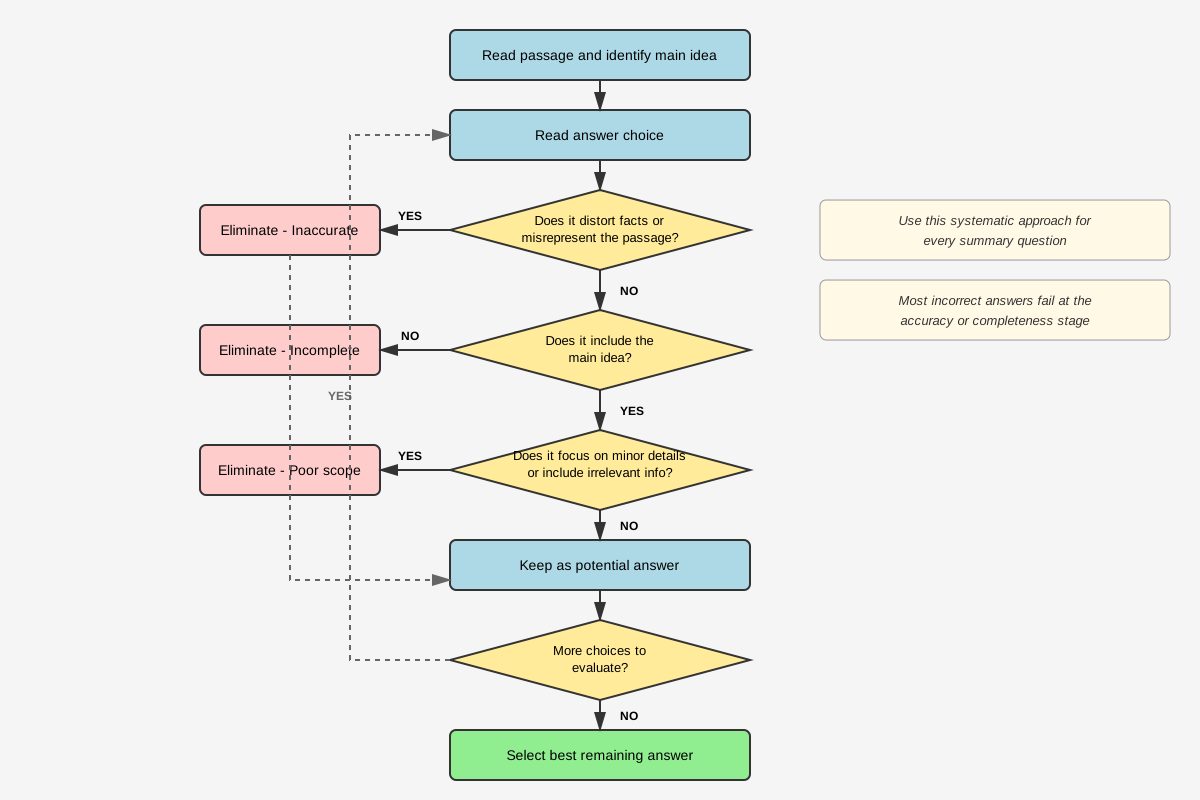
- Time-efficient students read the passage first, identify the main idea, then evaluate answer choices against that understanding
- Answer choices that use extreme language ("always," "never," "all," "none") are often incorrect unless the passage itself uses such language
- The correct summary typically appears in the same order as information in the passage (beginning, middle, end)
Quick check — test yourself on Role of summary so far.
Try Flashcards →Common Misconceptions
Misconception: A good summary includes specific examples and evidence from the passage.
Correction: While summaries must be based on the passage, they typically exclude specific examples unless those examples ARE the main point. Summaries focus on general claims and major points rather than illustrative details.
Misconception: The longest or most detailed answer choice is usually correct because it includes more information.
Correction: Effective summaries are concise and focused. Longer answer choices often include unnecessary details or tangential information. The correct answer includes all essential information but nothing extraneous.
Misconception: If an answer choice contains true information related to the topic, it's a good summary.
Correction: A summary must specifically capture what THIS passage says, not general knowledge about the topic. An answer can be factually accurate but still incorrect if it doesn't represent the passage's specific content and emphasis.
Misconception: The summary should use the same words and phrases as the passage.
Correction: Effective summaries typically paraphrase the passage using different words while maintaining the same meaning. The SAT often tests whether students understand concepts well enough to recognize them when expressed differently.
Misconception: All information in the passage is equally important and should be represented in the summary.
Correction: Passages contain hierarchical information with main ideas, supporting points, and minor details. Summaries prioritize main ideas and major supporting points while excluding minor details and examples.
Misconception: If a summary mentions something from the beginning and end of the passage, it must be complete.
Correction: A summary can mention information from multiple parts of the passage but still miss the main point or misrepresent the relationships between ideas. Completeness requires capturing the central claim, not just touching on various parts.
Worked Examples
Example 1: Scientific Passage
Passage:
"Recent research on octopus cognition has revealed surprising problem-solving abilities. In laboratory experiments, octopuses have demonstrated the capacity to open childproof containers, navigate mazes, and even use tools—behaviors previously thought to require vertebrate-level intelligence. Dr. Jennifer Mather's studies show that octopuses can learn through observation, watching other octopuses solve problems and then applying those solutions themselves. These findings challenge traditional assumptions about the neural requirements for complex cognition, as octopuses possess a fundamentally different nervous system structure than vertebrates, with neurons distributed throughout their arms rather than centralized in a brain."
Question: Which choice best summarizes the passage?
A) Octopuses can open containers and navigate mazes in laboratory settings.
B) Dr. Jennifer Mather has conducted important research on octopus behavior.
C) Research reveals that octopuses possess unexpected cognitive abilities despite having a nervous system structure different from vertebrates.
D) Scientists previously believed that only vertebrates could demonstrate complex intelligence.
Analysis:
Choice A focuses exclusively on specific examples (opening containers, navigating mazes) while ignoring the passage's main point about challenging assumptions regarding cognition and neural structure. This is too narrow and misses the significance of the findings. Incorrect.
Choice B mentions Dr. Mather but makes her the focus rather than the research findings. The passage uses Dr. Mather as a source but emphasizes the discoveries about octopus cognition, not the researcher herself. Incorrect.
Choice C captures the main idea (octopuses have surprising cognitive abilities), includes the key context (different nervous system structure), and reflects the passage's emphasis on challenging previous assumptions. This matches the passage's scope and includes all essential information. Correct.
Choice D focuses on what scientists previously believed rather than what the research revealed. While the passage mentions previous assumptions, the main point is the new findings, not the old beliefs. This reverses the emphasis. Incorrect.
Connection to Learning Objectives: This example demonstrates how to identify key features of effective summaries (completeness, accuracy, appropriate scope) and apply those features to eliminate incorrect choices and select the best answer.
Example 2: Historical Passage
Passage:
"The Harlem Renaissance of the 1920s represented more than an artistic movement; it was a fundamental reimagining of African American identity and cultural expression. Writers like Langston Hughes and Zora Neale Hurston, musicians like Duke Ellington, and visual artists like Aaron Douglas created works that celebrated Black culture while challenging racist stereotypes. The movement emerged partly in response to the Great Migration, which brought hundreds of thousands of African Americans from the rural South to Northern cities, creating concentrated communities where Black cultural institutions could flourish. Though centered in Harlem, the movement's influence extended nationally and internationally, reshaping American culture and laying groundwork for the Civil Rights Movement decades later."
Question: Which choice best states the main idea of the text?
A) The Great Migration brought African Americans from the South to Northern cities in the 1920s.
B) Langston Hughes, Zora Neale Hurston, and Duke Ellington were important Harlem Renaissance figures.
C) The Harlem Renaissance was a cultural movement that redefined African American identity and influenced American culture broadly.
D) The Harlem Renaissance laid the groundwork for the Civil Rights Movement.
Analysis:
Choice A identifies a contributing factor (the Great Migration) but treats it as the main point. The passage mentions the Great Migration as context for why the Harlem Renaissance emerged, not as the central topic. Incorrect.
Choice B lists specific artists but focuses on who participated rather than what the movement accomplished or represented. This is too narrow, emphasizing examples over the main idea. Incorrect.
Choice C captures the passage's central claim (the movement redefined African American identity), includes its broader significance (influenced American culture), and matches the passage's scope without being too narrow or too broad. Correct.
Choice D focuses exclusively on the final sentence about the Civil Rights Movement. While this is mentioned as part of the movement's legacy, it's presented as one consequence among many, not the main point. Incorrect.
Connection to Learning Objectives: This example shows how summary questions require distinguishing between main ideas, supporting points, and contextual information, and how incorrect answers often elevate supporting details to main-idea status.
Exam Strategy
When approaching SAT role of summary questions, employ a systematic process that maximizes accuracy while managing time effectively:
Step 1: Read the passage actively (30-45 seconds)
As you read, identify the main idea by asking: "What is this passage primarily about?" and "What point is the author making?" Underline or mentally note the thesis or central claim.
Step 2: Predict the answer (10-15 seconds)
Before looking at choices, formulate your own one-sentence summary. This prevents answer choices from influencing your understanding and provides a benchmark for evaluation.
Step 3: Evaluate each choice systematically (45-60 seconds)
For each answer choice, ask three questions:
- Does it include the main idea?
- Is everything stated accurate to the passage?
- Is the scope appropriate (not too narrow or broad)?
Step 4: Eliminate and select (15-20 seconds)
Eliminate choices that fail any of the three criteria. If multiple choices remain, compare them directly to identify which best captures the passage's emphasis.
Trigger words and phrases to watch for:
In question stems:
- "best summarizes"
- "main idea"
- "most logically completes"
- "overall structure"
- "primarily about"
In incorrect answer choices:
- Extreme language: "always," "never," "all," "only," "must"
- Specific examples or names without broader context
- Information not mentioned in the passage
- Reversed cause-and-effect relationships
- Degree shifts: "proves" instead of "suggests"
Process-of-elimination tips:
Eliminate first: Choices that focus on minor details or examples. These are often easiest to identify and eliminate quickly.
Eliminate second: Choices that introduce information not in the passage or that misrepresent relationships between ideas.
Eliminate third: Choices that are too broad or too narrow in scope.
Time allocation:
Spend approximately 90-120 seconds total on summary questions. If you're stuck between two choices after two minutes, make your best judgment and move on. These questions reward careful reading but don't require extensive analysis—the correct answer should feel clearly better once you understand the passage's main point.
Memory Techniques
MAIN Acronym for Summary Evaluation:
Main idea included
Accurate to source
Information complete
Not too narrow or broad
When evaluating answer choices, mentally check each element of MAIN to ensure the summary meets all criteria.
The "Zoom Lens" Visualization:
Imagine a camera lens that can zoom in (focus on details) or zoom out (see the big picture). Incorrect summaries are often "zoomed" incorrectly—either too far in (focusing on a minor detail) or too far out (making overly broad claims). The correct summary has the lens adjusted to capture the whole scene (passage) clearly without including irrelevant background or missing important elements.
The "Elevator Pitch" Technique:
Think of the summary as an elevator pitch: if you had 10 seconds to tell someone what the passage is about, what would you say? This mental exercise helps identify the core message and distinguish it from supporting details.
The Three-Question Filter:
Before selecting an answer, filter it through three questions:
- Would this summary make sense to someone who hasn't read the passage? (Tests completeness)
- Does this summary accurately represent what the passage actually says? (Tests accuracy)
- Is this summary at the right level of detail? (Tests scope)
If the answer to all three is "yes," you've likely found the correct choice.
The "Headline" Method:
Imagine you're writing a newspaper headline for the passage. Headlines capture the main point concisely without including every detail. This mindset helps identify what's truly essential versus what's supplementary.
Summary
The role of summary on the SAT tests students' ability to identify, evaluate, and select effective summaries that capture a passage's essential information while maintaining accuracy and appropriate scope. Effective summaries include the main idea and major supporting points while excluding minor details, specific examples, and tangential information. On the SAT RW section, summary questions appear frequently across diverse passage types, requiring students to distinguish between summaries that are too narrow (focusing on details), too broad (overgeneralizing), or inaccurate (misrepresenting the source). Success requires systematic evaluation: reading actively to identify the main idea, predicting an answer before viewing choices, and eliminating options that fail to meet the criteria of completeness, accuracy, and appropriate scope. Common incorrect answers focus on minor details, introduce unsupported information, or misrepresent relationships between ideas. Mastering this topic improves performance not only on explicit summary questions but also on related question types involving main idea identification, text structure, and purpose analysis.
Key Takeaways
- Effective summaries must include the passage's main idea, maintain factual accuracy, and match appropriate scope—neither too narrow nor too broad
- The most common incorrect answer type focuses on a specific detail or example while ignoring the passage's central point
- Summary questions require distinguishing between main ideas (include), major supporting points (sometimes include), and minor details (exclude)
- Read the passage first to identify the main idea before evaluating answer choices; this prevents incorrect options from influencing your understanding
- Incorrect summaries often introduce information not in the passage, misrepresent degree or causation, or reverse the passage's emphasis
- Use systematic elimination: remove choices that focus on details, then those with inaccuracies, then those with inappropriate scope
- Summary skills connect to and enhance performance on main idea, text structure, purpose, and synthesis questions throughout the RW section
Related Topics
Main Idea and Supporting Details: Understanding how to identify the central claim of a passage and distinguish it from supporting information directly builds on summary skills and appears in closely related question types.
Text Structure and Organization: Recognizing how authors organize information (chronologically, compare-contrast, cause-effect, problem-solution) helps determine what elements are most important for summary inclusion.
Purpose and Function Questions: These questions ask why an author includes certain information or what a passage accomplishes, requiring summary-level understanding of the text's overall goals.
Synthesis Across Multiple Texts: Advanced questions that require combining information from two passages rely heavily on the ability to summarize each passage accurately before identifying connections.
Inference and Implication: While summaries focus on explicit information, inference questions require going beyond what's stated, building on the foundation of accurate comprehension that summary questions test.
Practice CTA
Now that you've mastered the core concepts of the role of summary, it's time to apply this knowledge! Work through the practice questions to reinforce your understanding and build confidence with SAT-style summary questions. Use the flashcards to memorize key features of effective summaries and common patterns in incorrect answers. Remember: summary questions are high-yield and appear frequently on the SAT, so time invested in practice directly translates to score improvement. Approach each practice question systematically using the strategies you've learned, and review any mistakes to understand why incorrect answers were tempting. You've got this!
Sign up free to keep reading
Create a free AnvayaPrep account to finish this SAT guide on Role of summary — plus flashcards and practice questions.