Overview
Text organization is a critical skill tested throughout the SAT Reading and Writing section, requiring students to understand how authors structure their ideas, arguments, and information within passages. This topic assesses the ability to recognize organizational patterns, identify the function of specific sentences or paragraphs, and understand how different parts of a text work together to achieve the author's purpose. On the SAT, sat text organization questions ask students to analyze structural choices, determine logical placement of sentences, and evaluate how transitions and organizational strategies contribute to overall coherence.
Mastering text organization is essential because approximately 15-20% of SAT rw questions directly test this skill, making it one of the highest-yield topics for score improvement. These questions appear in various formats: some ask students to choose the best placement for a new sentence within a passage, others require identifying the primary organizational pattern, and still others test understanding of how specific paragraphs function within the larger text structure. Unlike content-based questions that focus on what a passage says, text organization questions focus on how information is arranged and why that arrangement matters.
Understanding text organization connects deeply to other Reading and Writing concepts, particularly main idea identification, purpose analysis, and transition usage. When students can recognize organizational patterns—such as chronological order, cause-and-effect relationships, comparison-contrast structures, or problem-solution frameworks—they gain insight into author's purpose and can more effectively navigate complex passages. This skill also supports critical reading comprehension by helping students anticipate what information might come next and understand the logical relationships between ideas, ultimately improving both speed and accuracy on test day.
Learning Objectives
- [ ] Identify key features of text organization
- [ ] Explain how text organization appears on the SAT
- [ ] Apply text organization to answer SAT-style questions
- [ ] Distinguish between different organizational patterns (chronological, spatial, compare-contrast, cause-effect, problem-solution)
- [ ] Evaluate the most logical placement for sentences within a paragraph or passage
- [ ] Analyze how transitions and structural elements contribute to textual coherence
- [ ] Determine the function of specific paragraphs within a multi-paragraph passage
Prerequisites
- Basic paragraph structure: Understanding topic sentences, supporting details, and concluding sentences is essential because text organization builds on these foundational elements to create larger structural patterns.
- Transition word knowledge: Familiarity with transitional phrases and their functions (contrast, addition, causation) is necessary because these signal organizational relationships between ideas.
- Main idea identification: The ability to identify central claims and supporting points is relevant because organizational structure serves to present and develop these main ideas effectively.
- Reading comprehension fundamentals: General ability to understand written passages at grade level is required because analyzing organization depends on first comprehending content.
Why This Topic Matters
Text organization skills extend far beyond standardized testing into academic and professional contexts. In college, students must navigate complex textbooks and scholarly articles where understanding organizational structure helps identify key arguments, follow complex reasoning, and synthesize information efficiently. Professional writing in virtually every field—from business reports to scientific papers—relies on clear organizational patterns to communicate effectively. The ability to recognize and utilize organizational structures is fundamental to critical thinking and effective communication.
On the SAT, text organization questions appear with high frequency, typically comprising 3-5 questions per test administration. These questions appear in two primary formats: sentence placement questions (which ask where a new sentence would most logically fit within a passage) and structural function questions (which ask about the role or purpose of a specific paragraph or section). According to College Board data, text organization questions have a moderate difficulty level with approximately 60% of students answering them correctly, meaning they represent significant score improvement opportunities for prepared students.
Common manifestations in exam passages include scientific articles organized by problem-solution structure, historical narratives following chronological order, argumentative essays using claim-evidence-counterclaim patterns, and comparative analyses employing point-by-point or block comparison methods. The SAT deliberately selects passages with clear organizational frameworks, then tests whether students can recognize these patterns and understand how individual components contribute to the overall structure. Questions often focus on transition points, paragraph boundaries, and the logical flow of ideas—areas where understanding organizational principles directly translates to correct answers.
Core Concepts
Fundamental Organizational Patterns
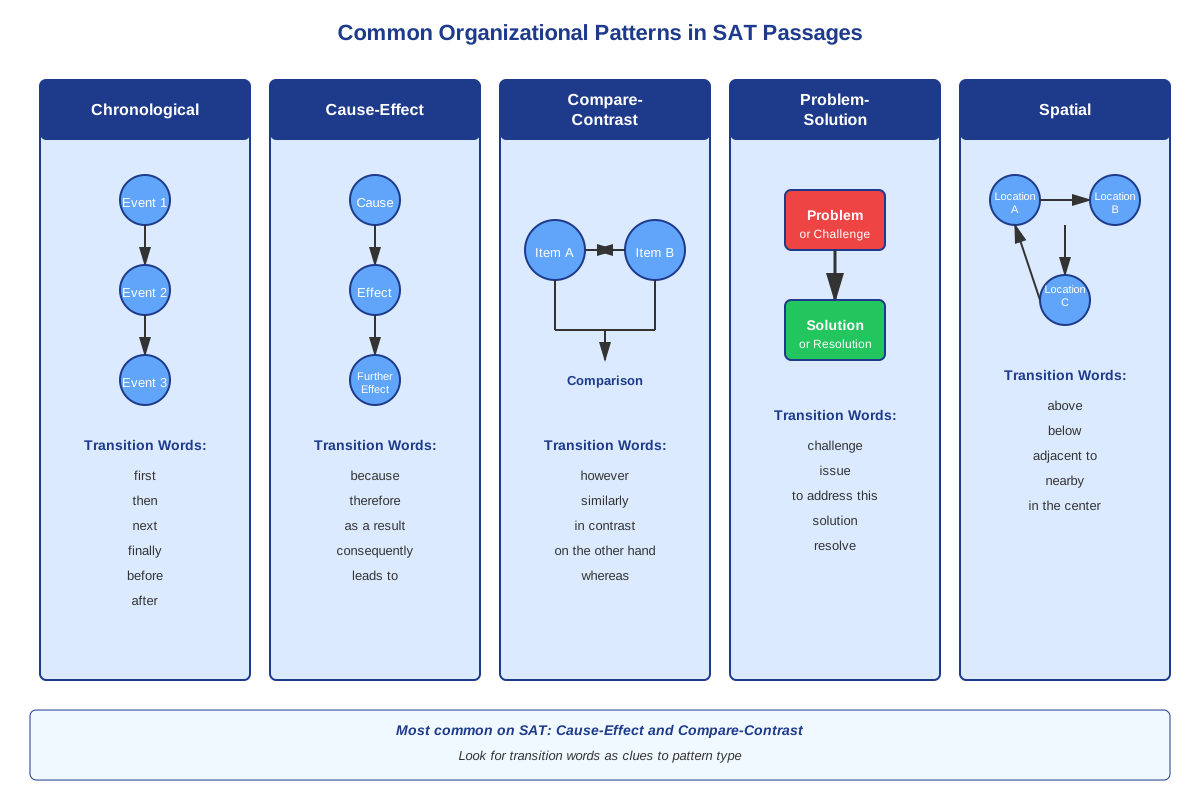
Authors employ several standard organizational patterns to structure their writing, each serving specific rhetorical purposes. Understanding these patterns enables students to predict information flow and identify structural relationships between ideas.
Chronological organization arranges information according to time sequence, moving from earlier to later events. This pattern appears frequently in historical narratives, biographical sketches, and process descriptions. Signal words include "first," "then," "subsequently," "finally," "before," and "after." On the SAT, chronological passages often test whether students can identify temporal relationships and recognize when information is presented out of sequence for rhetorical effect.
Cause-and-effect organization establishes relationships between events, actions, or phenomena and their consequences. This pattern may present a single cause with multiple effects, multiple causes leading to one effect, or causal chains where one effect becomes the cause of subsequent effects. Transition words signaling this pattern include "because," "therefore," "consequently," "as a result," "leads to," and "due to." SAT passages using this structure often appear in scientific or social science contexts.
Compare-and-contrast organization examines similarities and differences between two or more subjects. This pattern manifests in two primary forms: block organization (discussing all aspects of Subject A, then all aspects of Subject B) and point-by-point organization (alternating between subjects for each characteristic being compared). Signal words include "similarly," "likewise," "however," "in contrast," "whereas," and "on the other hand."
Problem-solution organization presents a challenge or issue followed by proposed remedies or resolutions. This pattern often appears in persuasive or argumentative writing and may include multiple solutions or evaluate the effectiveness of different approaches. Transitions include "the problem is," "one solution," "to address this," and "this approach resolves."
Spatial organization arranges information according to physical location or position, moving systematically through space (top to bottom, left to right, near to far). While less common on the SAT than other patterns, spatial organization appears in descriptive passages and scientific observations. Signal words include "above," "below," "adjacent to," "in the foreground," and "surrounding."
Paragraph Function and Purpose
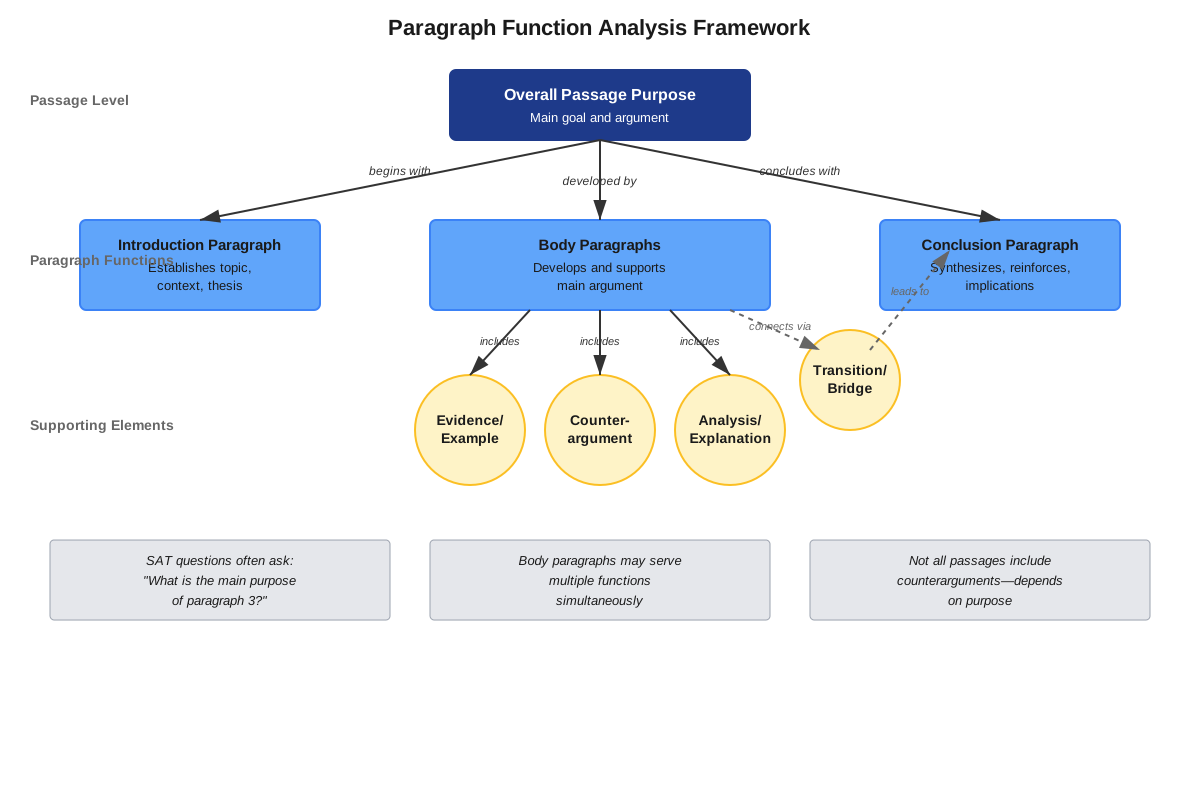
Within longer passages, individual paragraphs serve specific structural functions that contribute to the overall organizational framework. Recognizing these functions helps students understand how parts relate to the whole.
Introductory paragraphs establish context, present the main topic, and often include a thesis statement or central claim. On the SAT, questions may ask students to identify which sentence best introduces a passage or to recognize how an opening paragraph sets up subsequent discussion.
Body paragraphs develop the main idea through various means: providing evidence, offering examples, explaining processes, presenting counterarguments, or elaborating on specific aspects of the topic. Each body paragraph typically focuses on one main point that supports the overall thesis.
Transitional paragraphs bridge major sections of a text, helping readers move from one main idea to another. These paragraphs may summarize previous points before introducing new ones, or they may explicitly signal a shift in focus or perspective.
Concluding paragraphs synthesize information, restate main points in light of evidence presented, or suggest implications and future directions. SAT questions may test whether students recognize how conclusions relate back to introductory claims.
Sentence Placement and Logical Flow
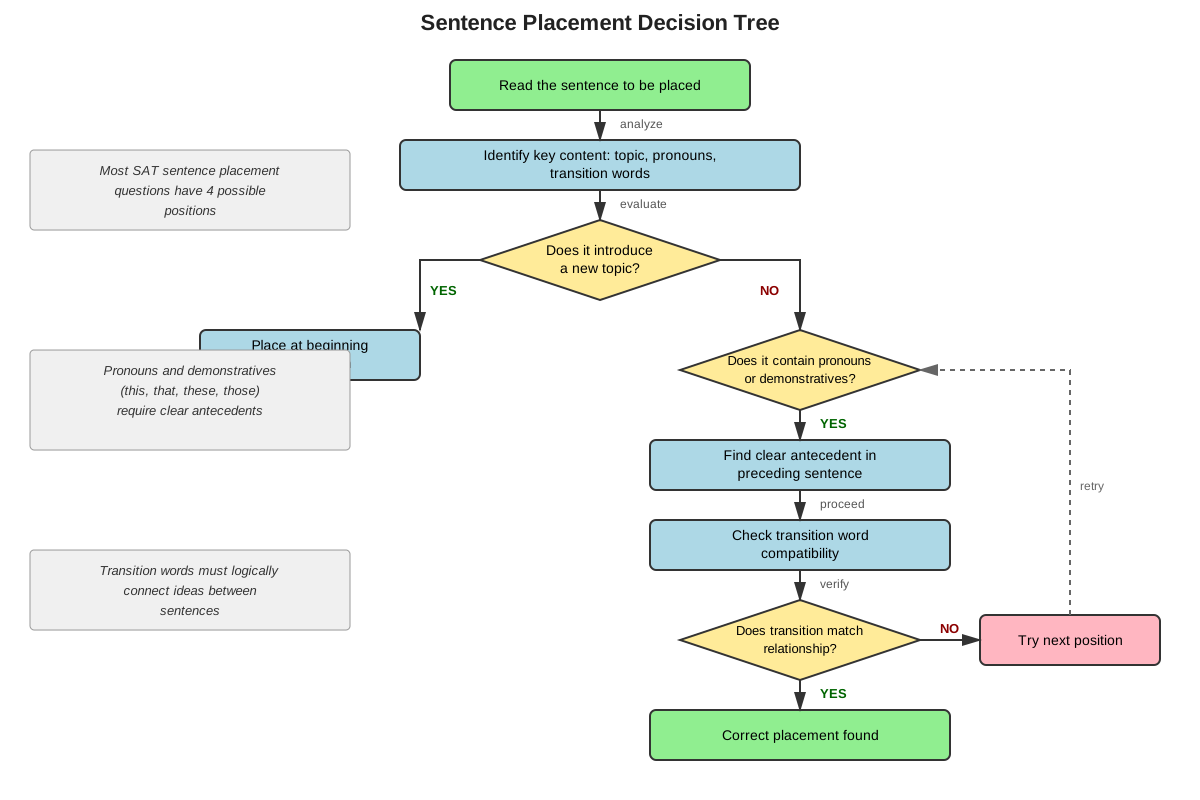
A significant category of SAT text organization questions involves determining the most logical placement for a sentence within a paragraph. These questions test understanding of logical flow—how ideas connect sequentially to create coherent meaning.
Effective sentence placement depends on several factors:
| Factor | Description | Example Signals |
|---|---|---|
| Pronoun reference | Sentences containing pronouns must follow sentences that establish clear antecedents | "This discovery," "These results," "Such approaches" |
| Transitional logic | Transition words in a sentence indicate its relationship to surrounding sentences | "However" signals contrast; "Furthermore" signals addition |
| Topic continuity | Sentences should connect to the topic of surrounding sentences | Specific examples follow general claims |
| Chronological sequence | Time-based information should follow temporal logic | Events described in order of occurrence |
| Logical progression | Ideas should build from simple to complex or general to specific | Definitions before applications |
When evaluating sentence placement options, students should examine what comes immediately before and after each potential position, checking for coherent pronoun references, logical transitions, and topical connections.
Transitions and Coherence Devices
Transitions are words, phrases, or sentences that establish relationships between ideas and guide readers through a text's organizational structure. Understanding transition types helps students recognize organizational patterns and evaluate textual coherence.
Additive transitions signal that information is being added or expanded: "additionally," "moreover," "furthermore," "also," "in addition." These indicate continuation of the same line of thought.
Contrastive transitions indicate opposition or difference: "however," "nevertheless," "conversely," "on the contrary," "despite," "although." These signal shifts to opposing viewpoints or contradictory information.
Causal transitions show cause-effect relationships: "therefore," "consequently," "thus," "as a result," "because," "since." These indicate logical connections between events or ideas.
Sequential transitions mark progression through time or steps: "first," "next," "then," "finally," "subsequently," "meanwhile." These structure chronological or procedural information.
Illustrative transitions introduce examples or clarification: "for example," "for instance," "specifically," "to illustrate," "namely." These signal that concrete evidence or explanation follows.
Beyond individual transition words, authors use other coherence devices including repetition of key terms (using the same important words across sentences), parallel structure (repeating grammatical patterns), and demonstrative pronouns ("this," "that," "these," "those") that point back to previous ideas.
Concept Relationships
The concepts within text organization form an interconnected system where understanding one element enhances comprehension of others. Organizational patterns serve as the overarching framework, determining how information flows through a passage. Within this framework, paragraph functions represent the building blocks—each paragraph playing a specific role (introduction, evidence, transition, conclusion) that supports the overall pattern. For instance, a cause-and-effect organizational pattern might include an introductory paragraph establishing the cause, multiple body paragraphs detailing various effects, and a concluding paragraph synthesizing the causal relationship.
Transitions and coherence devices act as the connective tissue linking these structural elements, making organizational patterns explicit and guiding readers through the text's logic. A comparison-contrast passage, for example, relies heavily on contrastive transitions ("however," "whereas") to signal shifts between subjects being compared. Similarly, sentence placement depends on understanding both the paragraph's function within the larger organizational pattern and the specific transitional logic connecting individual sentences.
This relationship map illustrates the hierarchy:
Organizational Pattern (overall structure) → Paragraph Functions (major sections) → Transitions (connections between ideas) → Sentence Placement (micro-level coherence)
These text organization concepts connect to prerequisite knowledge of basic paragraph structure by expanding single-paragraph principles to multi-paragraph passages. They also relate to other SAT Reading and Writing topics: understanding organizational structure supports purpose analysis (recognizing how structure serves rhetorical goals), enhances main idea identification (seeing how structure emphasizes central claims), and improves inference skills (using organizational cues to predict upcoming information).
High-Yield Facts
⭐ Sentence placement questions require checking pronoun references, transitions, and topic continuity before and after each potential position.
⭐ The five main organizational patterns tested on the SAT are chronological, cause-effect, compare-contrast, problem-solution, and spatial.
⭐ Transition words explicitly signal organizational relationships: "however" indicates contrast, "therefore" indicates causation, "furthermore" indicates addition.
⭐ Introductory paragraphs establish context and present main claims; concluding paragraphs synthesize information and restate key points.
⭐ Compare-contrast organization appears in two forms: block method (all of A, then all of B) and point-by-point method (alternating between A and B for each characteristic).
- Body paragraphs in well-organized passages typically focus on one main point that supports the overall thesis.
- Chronological organization uses time-based transitions like "first," "subsequently," "finally," and "before."
- Cause-effect passages may present single cause/multiple effects, multiple causes/single effect, or causal chains.
- Transitional paragraphs bridge major sections by summarizing previous points and introducing new ones.
- Demonstrative pronouns ("this," "these," "that," "those") create coherence by referring back to previously mentioned ideas.
- Parallel structure (repeated grammatical patterns) reinforces organizational relationships between ideas.
- Spatial organization arranges information by physical location using transitions like "above," "adjacent to," and "surrounding."
- Problem-solution passages often evaluate multiple potential solutions or discuss implementation challenges.
- Effective sentence placement creates logical progression from general to specific or simple to complex.
- Repetition of key terms across sentences and paragraphs strengthens textual coherence and emphasizes important concepts.
Quick check — test yourself on Text organization so far.
Try Flashcards →Common Misconceptions
Misconception: Text organization questions only test whether students can identify the overall pattern (chronological, cause-effect, etc.).
Correction: While recognizing organizational patterns is important, SAT questions more frequently test specific applications—determining where a sentence fits, understanding how a particular paragraph functions, or recognizing how transitions create coherence. Students must apply pattern knowledge to answer detailed structural questions.
Misconception: The correct placement for a sentence is always immediately after the sentence that introduces its topic.
Correction: Sentence placement depends on multiple factors including pronoun references, transitional logic, and the progression of ideas. A sentence might need to appear several sentences after its topic is introduced if intervening sentences provide necessary context or if the sentence contains transitions indicating it should follow contrasting information.
Misconception: Transition words always appear at the beginning of sentences.
Correction: While transitions frequently open sentences, they can appear mid-sentence or even be implied through context rather than explicit words. Students should look for transitional logic throughout sentences, not just in opening words.
Misconception: All paragraphs in a passage serve the same basic function of providing information.
Correction: Paragraphs serve distinct structural functions—introducing topics, providing evidence, presenting counterarguments, transitioning between ideas, or concluding. Recognizing these different functions is essential for understanding how passages are organized and how individual parts contribute to the whole.
Misconception: Compare-contrast passages always discuss similarities before differences.
Correction: Compare-contrast organization varies significantly. Some passages discuss all similarities then all differences; others alternate point-by-point; still others focus primarily on differences with minimal attention to similarities. The organizational pattern depends on the author's rhetorical purpose.
Misconception: Longer paragraphs are always more important than shorter ones in a passage's organizational structure.
Correction: Paragraph length doesn't determine structural importance. A brief transitional paragraph or concise conclusion may be structurally crucial despite being shorter than body paragraphs containing detailed evidence.
Misconception: Cause-effect organization always presents causes before effects.
Correction: Authors may present effects first to create interest or urgency, then explore causes. Some passages begin with a puzzling phenomenon (effect) and investigate what produced it (causes). The organizational pattern is cause-effect regardless of presentation order.
Worked Examples
Example 1: Sentence Placement Question
Passage excerpt with numbered positions:
[1] The development of CRISPR gene-editing technology has revolutionized biological research. [2] Scientists can now modify DNA sequences with unprecedented precision, enabling experiments that were impossible just a decade ago. [3] The technique works by using a guide RNA to direct an enzyme to specific genetic locations. [4] These advances have accelerated research in agriculture, medicine, and evolutionary biology.
Question: Where would the following sentence most logically be placed?
"This precision has reduced both the time and cost associated with genetic modifications."
Options:
- Position [1]
- Position [2]
- Position [3]
- Position [4]
Solution Process:
First, identify what the sentence discusses: it describes a benefit ("reduced time and cost") resulting from "precision." The demonstrative pronoun "This precision" requires an antecedent—a previous mention of precision.
Examining each position:
Position [1]: The sentence would come before any discussion of CRISPR's capabilities. "This precision" would have no clear antecedent. ❌
Position [2]: The previous sentence mentions scientists can "modify DNA sequences with unprecedented precision." This establishes the antecedent for "This precision." The sentence would logically follow by explaining a benefit of that precision. ✓
Position [3]: The previous sentence explains the technical mechanism of CRISPR. While related to precision, it doesn't explicitly mention precision, making "This precision" a weak reference. The sentence would also interrupt the flow from mechanism (sentence at position 2) to applications (sentence at position 3). ❌
Position [4]: Placing the sentence here would separate it from the mention of precision and would come after the discussion of applications, disrupting the logical progression from capability to benefit to applications. ❌
Answer: Position [2]
Key reasoning: The sentence contains a demonstrative pronoun ("This precision") requiring a clear antecedent in the immediately preceding sentence. Only position [2] follows a sentence explicitly mentioning precision. Additionally, the logical flow moves from capability (precision) → benefit (reduced time/cost) → applications (agriculture, medicine, biology).
Example 2: Organizational Pattern Analysis
Passage excerpt:
The urban heat island effect occurs when cities experience significantly higher temperatures than surrounding rural areas. Several factors contribute to this phenomenon. First, dark surfaces like asphalt and roofing materials absorb more solar radiation than natural landscapes. Second, the concentration of buildings reduces airflow, trapping heat within urban canyons. Third, human activities such as vehicle operation and air conditioning release additional heat into the environment. Finally, cities typically have less vegetation, eliminating the cooling effect of plant transpiration. These combined factors can raise urban temperatures by 5-7 degrees Fahrenheit compared to nearby rural areas.
Question: What organizational pattern does this passage primarily use?
Solution Process:
Identify structural signals in the passage:
- The opening sentence defines a phenomenon (urban heat island effect)
- The second sentence announces that "several factors contribute"
- The following sentences use sequential transitions: "First," "Second," "Third," "Finally"
- Each numbered point describes a different factor that produces the heat island effect
- The concluding sentence describes the result of these combined factors
Analysis of patterns:
Chronological? No—the passage doesn't describe events in time sequence. The factors don't occur in temporal order. ❌
Compare-contrast? No—the passage doesn't examine similarities and differences between two subjects. While it contrasts urban and rural temperatures, this serves to define the phenomenon, not to organize the entire passage. ❌
Problem-solution? Partially—the passage identifies a problem (heat island effect) but doesn't propose solutions. ❌
Cause-effect? Yes—the passage presents multiple causes (dark surfaces, reduced airflow, human activities, less vegetation) that produce a single effect (elevated urban temperatures). The structure moves from effect (heat island phenomenon) to causes (contributing factors) to magnitude of effect (5-7 degree increase). ✓
Spatial? No—while the passage mentions urban versus rural areas, it doesn't organize information by physical location. ❌
Answer: Cause-and-effect organization (specifically, multiple causes leading to a single effect)
Key reasoning: The passage explicitly states "several factors contribute to this phenomenon," then systematically presents each contributing factor before describing the resulting temperature difference. The sequential transitions ("First," "Second," etc.) organize the multiple causes, but the overarching pattern is causal, not chronological, because the factors don't occur in time sequence—they operate simultaneously to produce the heat island effect.
Exam Strategy
When approaching SAT text organization questions, employ a systematic process that maximizes accuracy while managing time effectively. Begin by identifying the question type: sentence placement questions require different strategies than questions asking about paragraph function or overall organizational pattern.
For sentence placement questions:
- Read the sentence to be placed carefully, identifying key elements: pronouns (especially demonstrative pronouns like "this," "these," "such"), transition words, and the main topic
- Examine each potential position, reading the sentence immediately before and after
- Check for pronoun antecedents—pronouns must have clear references in preceding sentences
- Verify transitional logic—words like "however" require preceding information to contrast with
- Confirm topic continuity—the sentence should connect naturally to surrounding content
- Eliminate positions that create logical gaps or awkward pronoun references
Trigger words and phrases to watch for:
- Demonstrative pronouns ("this," "that," "these," "those") signal the sentence must follow something specific
- Transition words ("however," "furthermore," "therefore") indicate required relationships with surrounding sentences
- Specific references (names, dates, technical terms) must follow sentences that introduce these elements
- Pronouns ("it," "they," "he," "she") require clear antecedents in previous sentences
For organizational pattern questions:
- Skim the passage for structural signals: transition words, paragraph breaks, topic sentences
- Identify the main topic and how information relates to it (causes? effects? comparisons? sequence?)
- Look for explicit organizational cues like "several factors," "in contrast," or "first... second... third"
- Consider the passage's purpose—is it explaining a process (chronological), analyzing causes (cause-effect), or evaluating options (problem-solution)?
Process-of-elimination tips:
- Eliminate positions that create pronoun reference errors—this is often the fastest way to narrow options
- Rule out placements that disrupt chronological or logical sequences
- Reject positions where transition words don't match the relationship between ideas
- Eliminate organizational patterns that don't account for the passage's main structural features
Time allocation:
Text organization questions typically require 45-60 seconds each. Sentence placement questions may take slightly longer (60-75 seconds) because they require checking multiple positions. If a question exceeds 90 seconds, mark your best answer and move on—these questions are worth the same points as faster questions, so time management matters. Practice identifying structural signals quickly during preparation to build speed without sacrificing accuracy.
Exam Tip: For sentence placement questions, wrong answers often create pronoun reference errors or disrupt logical flow. Checking these two elements first eliminates most incorrect options efficiently.
Memory Techniques
CCCPS Mnemonic for Organizational Patterns:
Remember the five main organizational patterns with CCCPS:
- Chronological (time sequence)
- Cause-effect (relationships between events)
- Compare-contrast (similarities and differences)
- Problem-solution (challenges and remedies)
- Spatial (physical arrangement)
PITT Strategy for Sentence Placement:
Use PITT to check sentence placement systematically:
- Pronouns: Check for clear antecedents
- Idea flow: Verify logical progression
- Transitions: Confirm transitional logic matches
- Topic: Ensure topic continuity
Transition Word Categories - "ACCES":
Remember transition types with ACCES:
- Additive (furthermore, moreover, additionally)
- Contrastive (however, nevertheless, conversely)
- Causal (therefore, consequently, thus)
- Example (for instance, specifically, namely)
- Sequential (first, next, finally)
Visualization for Paragraph Functions:
Picture a building to remember paragraph functions:
- Foundation = Introduction (establishes base)
- Floors = Body paragraphs (main content)
- Stairways = Transitional paragraphs (connections between levels)
- Roof = Conclusion (caps everything)
Block vs. Point-by-Point Comparison:
Visualize block comparison as two separate blocks: [AAAA][BBBB]
Visualize point-by-point comparison as alternating: [AB][AB][AB][AB]
This mental image helps quickly identify which compare-contrast method a passage uses.
Summary
Text organization encompasses the structural principles and patterns authors use to arrange ideas, arguments, and information within passages. The SAT tests this skill through sentence placement questions, organizational pattern identification, and paragraph function analysis. Students must recognize five primary organizational patterns—chronological, cause-effect, compare-contrast, problem-solution, and spatial—and understand how transition words signal relationships between ideas. Effective analysis requires checking pronoun references, verifying transitional logic, and ensuring topic continuity. Individual paragraphs serve distinct functions (introduction, body, transition, conclusion) within the larger organizational framework, and understanding these functions helps students navigate complex passages efficiently. Success on text organization questions depends on systematic analysis of structural signals, careful attention to coherence devices, and recognition of how individual sentences and paragraphs contribute to overall textual structure. Mastering these concepts enables students to answer high-frequency SAT questions accurately while building critical reading skills applicable to academic and professional contexts.
Key Takeaways
- Text organization questions comprise 15-20% of SAT Reading and Writing questions, making this a high-yield topic for score improvement
- The five main organizational patterns are chronological, cause-effect, compare-contrast, problem-solution, and spatial—each signaled by specific transition words
- Sentence placement questions require checking pronoun references, transitional logic, and topic continuity before and after each potential position
- Paragraphs serve distinct structural functions (introduction, body, transition, conclusion) that contribute to overall passage organization
- Transition words explicitly signal relationships: additive (furthermore), contrastive (however), causal (therefore), illustrative (for example), and sequential (first, next)
- Demonstrative pronouns ("this," "these") require clear antecedents in immediately preceding sentences
- Systematic analysis using strategies like PITT (Pronouns, Idea flow, Transitions, Topic) improves accuracy and efficiency on text organization questions
Related Topics
Transition Words and Phrases: Deeper exploration of how specific transitional expressions create coherence and signal organizational relationships. Mastering text organization provides the foundation for understanding why particular transitions work in specific contexts.
Purpose and Function Questions: Analysis of why authors make specific structural choices and how organizational patterns serve rhetorical goals. Text organization skills directly support identifying author's purpose.
Main Idea and Supporting Details: Understanding how organizational structure emphasizes central claims and arranges evidence. Recognizing organizational patterns helps students distinguish main ideas from supporting information.
Rhetorical Synthesis: Combining multiple sources with different organizational structures into coherent written responses. Text organization mastery enables effective synthesis of diverse materials.
Advanced Paragraph Development: Techniques for constructing well-organized paragraphs in student writing, applying organizational principles learned through analysis. Understanding how published authors organize passages improves student writing structure.
Practice CTA
Now that you've mastered the core concepts of text organization, it's time to apply this knowledge through deliberate practice. Attempt the practice questions to test your ability to identify organizational patterns, determine logical sentence placement, and analyze paragraph functions. Use the flashcards to reinforce key terminology and transition words until recognizing structural signals becomes automatic. Remember: text organization questions represent significant score improvement opportunities because they test learnable skills rather than background knowledge. Every practice question you complete builds pattern recognition that translates directly to test-day success. Approach each practice item systematically, using the strategies outlined in this guide, and review both correct and incorrect answers to understand the structural principles at work. Your investment in mastering text organization will pay dividends across the entire Reading and Writing section!
Sign up free to keep reading
Create a free AnvayaPrep account to finish this SAT guide on Text organization — plus flashcards and practice questions.