Overview
Transition words and phrases serve as the connective tissue of written communication, guiding readers smoothly from one idea to the next. Among these linguistic bridges, in addition stands as one of the most frequently tested transition types on the SAT Reading and Writing section. This additive transition signals that the writer is building upon a previous point by introducing supplementary information, additional evidence, or further examples that support and expand the existing argument.
Understanding how in addition functions—and recognizing its various synonyms and contextual applications—is crucial for SAT success. The College Board consistently includes transition questions that require students to select the most logical connector between sentences or paragraphs. These questions assess whether students can identify the relationship between ideas and choose transitions that accurately reflect that relationship. Additive transitions like "in addition" appear in approximately 15-20% of all transition questions, making this a high-yield topic that directly impacts your score.
Mastery of additive transitions connects to broader RW (Reading and Writing) skills including logical flow, paragraph organization, and rhetorical effectiveness. When you understand how "in addition" operates within a passage, you simultaneously develop your ability to analyze argument structure, identify supporting evidence, and evaluate the coherence of written discourse—skills that extend beyond transition questions to benefit your performance across the entire Reading and Writing section.
Learning Objectives
- [ ] Identify key features of in addition and recognize its function as an additive transition
- [ ] Explain how in addition appears on the SAT and the question formats that test this concept
- [ ] Apply in addition to answer SAT-style questions accurately and efficiently
- [ ] Distinguish between additive transitions and other transition types (contrast, causation, illustration)
- [ ] Evaluate context clues that signal when additive transitions are appropriate
- [ ] Analyze incorrect answer choices that use non-additive transitions in additive contexts
- [ ] Synthesize understanding of multiple transition types to improve overall passage comprehension
Prerequisites
- Basic sentence structure: Understanding subjects, predicates, and independent clauses helps identify where transitions connect ideas
- Paragraph organization: Recognizing topic sentences and supporting details enables identification of relationships between sentences
- Logical reasoning fundamentals: Distinguishing between different types of relationships (addition, contrast, cause-effect) forms the foundation for transition selection
- SAT question format familiarity: Knowing how the digital SAT presents questions helps focus attention on relevant textual features
Why This Topic Matters
Transition questions constitute a significant portion of the SAT Reading and Writing section, appearing in approximately 3-5 questions per test. Among transition types, additive transitions like in addition represent one of the most common categories tested. Students who master this topic gain an immediate advantage because these questions are highly predictable and follow consistent patterns—making them some of the most "winnable" points on the exam.
Beyond test performance, understanding additive transitions develops critical reading skills applicable to college-level academic work. University courses across disciplines require students to follow complex arguments where authors layer multiple pieces of evidence, examples, and supporting points. Recognizing when writers add information versus when they contrast, illustrate, or establish causation enables deeper comprehension and more effective note-taking.
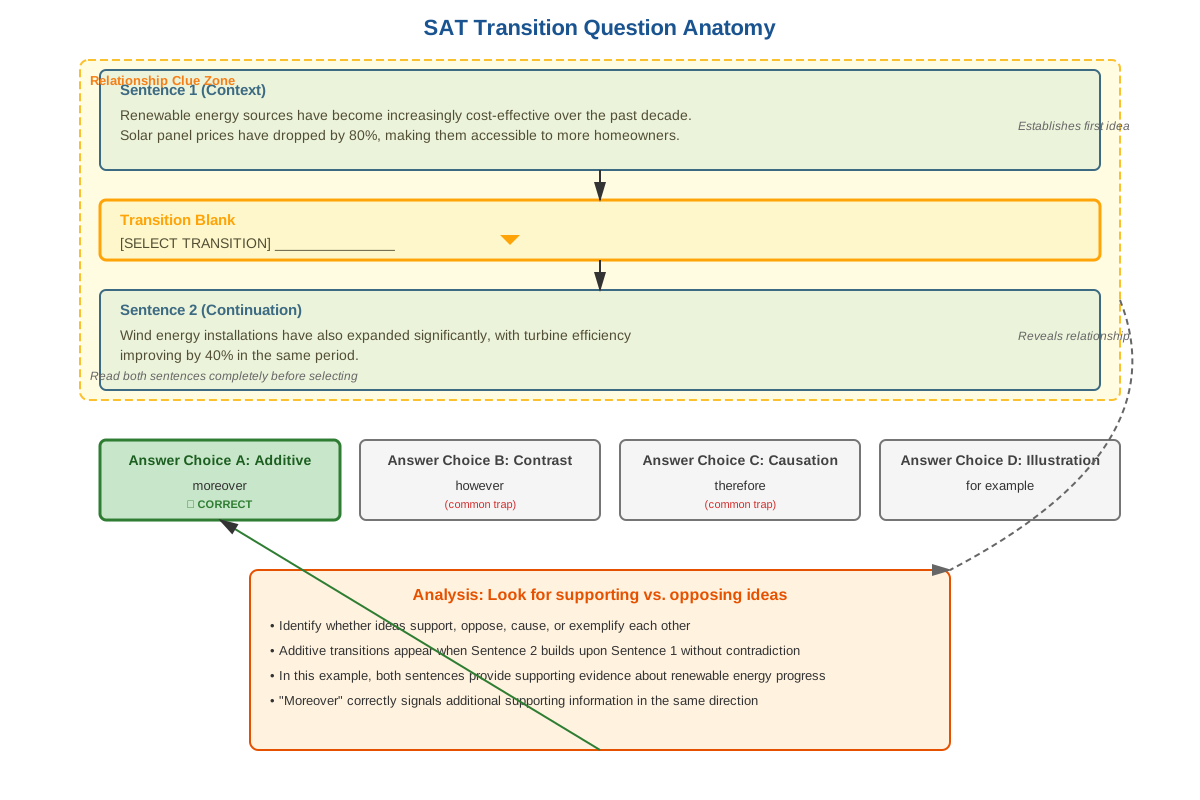
On the SAT, additive transitions most commonly appear in passages discussing scientific research (where multiple studies support a conclusion), historical analysis (where various factors contribute to an outcome), and argumentative writing (where authors accumulate evidence for their position). The College Board typically presents these questions by removing a transition from a passage and asking students to select the most logical replacement from four options. Incorrect answers often include transitions that signal contrast, causation, or illustration—relationships that don't match the additive context.
Core Concepts
The Function of Additive Transitions
Additive transitions signal that the writer is introducing information that supplements, reinforces, or expands upon a previously stated idea. Unlike contrastive transitions that signal opposition or causal transitions that indicate cause-and-effect relationships, additive transitions maintain the same direction of thought while building upon it. When you encounter "in addition" or its synonyms, the sentence following the transition should provide information that is compatible with and supportive of the preceding content.
The core function operates on a simple principle: if Sentence A makes a claim or provides information, and Sentence B begins with an additive transition, then Sentence B must offer related information that adds to rather than contradicts, explains, or exemplifies Sentence A. This relationship can take several forms: additional evidence for the same claim, another example of the same phenomenon, a related benefit or consequence, or a supplementary detail that enriches the initial point.
Common Additive Transitions on the SAT
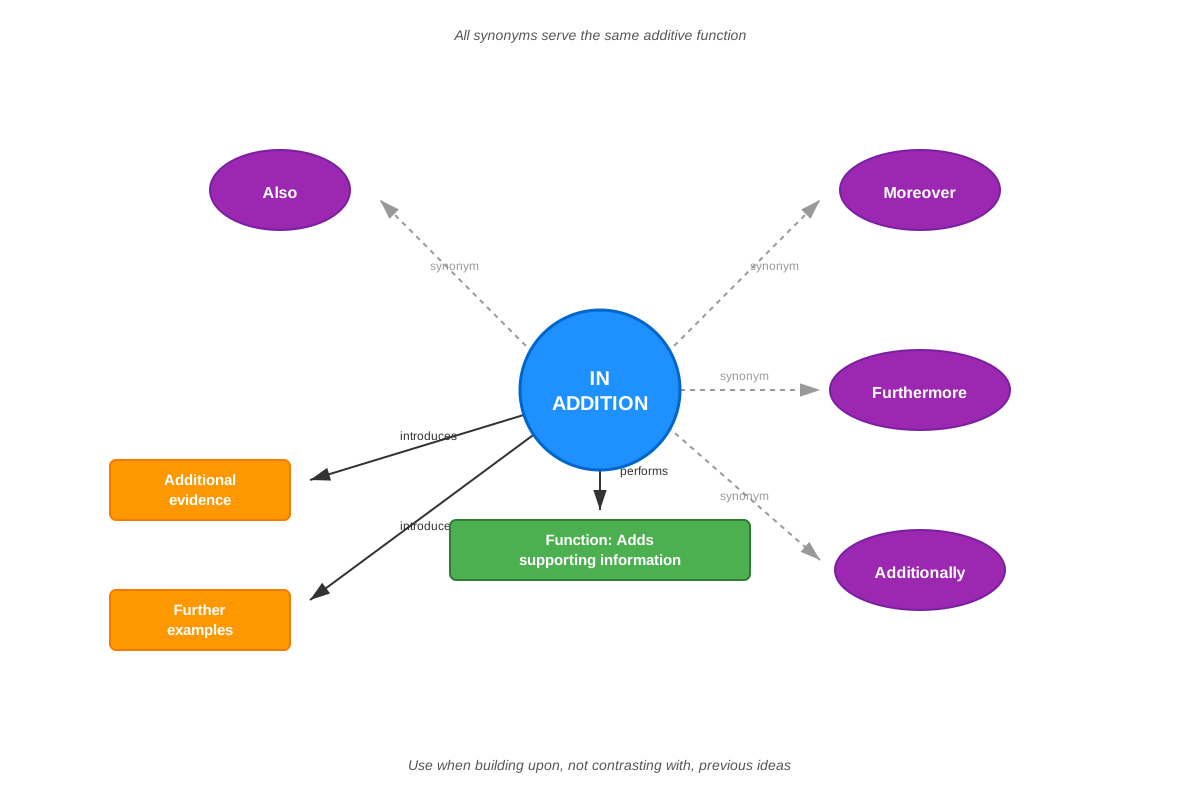
The SAT tests various additive transitions, and recognizing the full family of these connectors is essential. While in addition is the focus of this topic, the exam frequently includes synonymous transitions that serve identical functions:
| Transition | Formality Level | Common SAT Usage |
|---|---|---|
| In addition | Formal | Academic passages, scientific writing |
| Moreover | Formal | Argumentative essays, analysis |
| Furthermore | Formal | Research discussions, complex arguments |
| Additionally | Formal | All passage types |
| Also | Neutral | Conversational and formal contexts |
| Besides | Informal | Rarely on SAT (less formal) |
| As well | Neutral | Often appears at end of sentences |
Understanding that these transitions are functionally equivalent allows you to recognize additive relationships even when "in addition" doesn't appear. The SAT may present a passage using "moreover" and include "in addition" as a correct answer choice, or vice versa.
Identifying Additive Contexts
Recognizing when additive transitions are appropriate requires analyzing the relationship between adjacent sentences. Several textual patterns signal additive contexts:
Pattern 1: Multiple Examples or Instances
When a passage presents one example of a phenomenon and then introduces another example of the same phenomenon, an additive transition is appropriate. For instance: "The Renaissance saw remarkable advances in painting. [Additive transition], sculpture flourished during this period."
Pattern 2: Accumulating Evidence
Scientific and argumentative passages often present multiple pieces of evidence supporting a single claim. Each new piece of evidence requires an additive transition: "Study A found that exercise improves memory. [Additive transition], Study B demonstrated enhanced cognitive function in active participants."
Pattern 3: Listing Related Benefits, Features, or Characteristics
When describing something with multiple positive (or negative) attributes, additive transitions connect these parallel points: "The new policy reduced costs. [Additive transition], it improved efficiency."
Pattern 4: Expanding on a Topic
Sometimes writers introduce a topic broadly and then add more specific or detailed information. This expansion requires additive transitions: "Climate change affects ecosystems globally. [Additive transition], rising temperatures threaten polar habitats specifically."
Distinguishing Additive from Other Transition Types
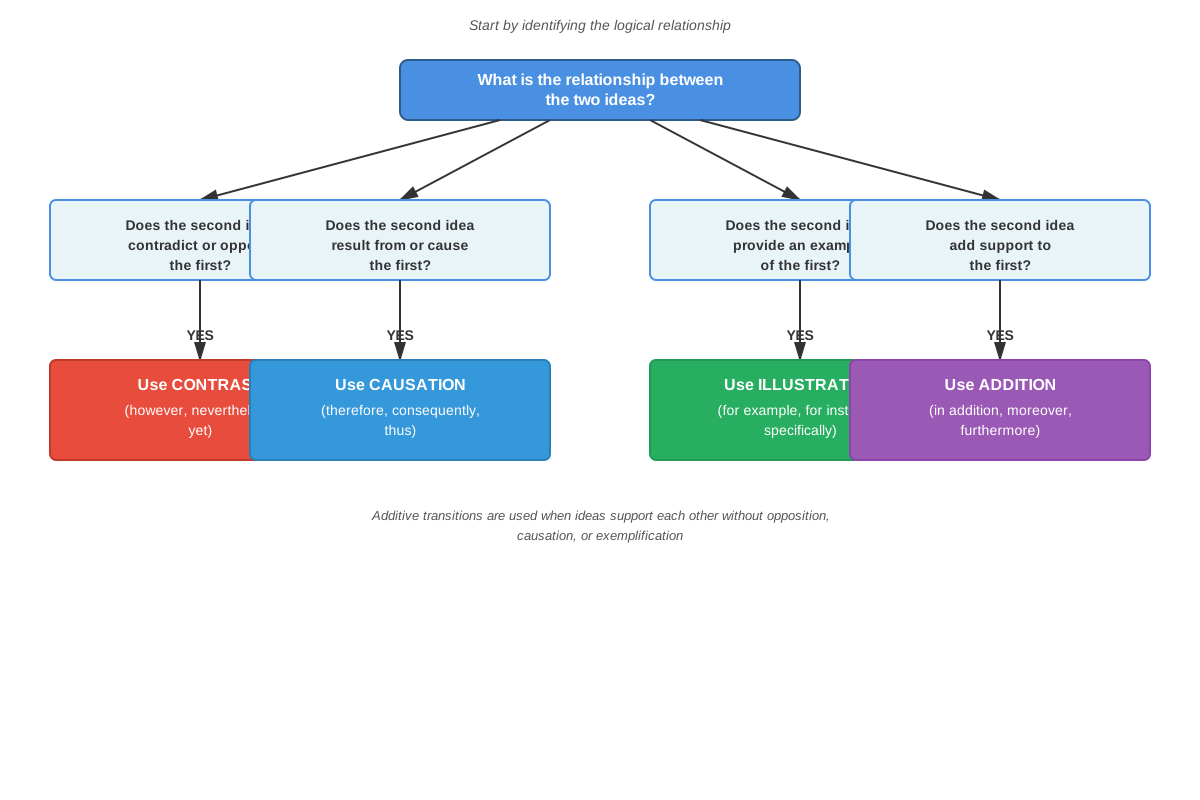
Success on SAT transition questions depends on distinguishing additive transitions from other categories. The most common incorrect answer choices involve these alternative transition types:
Contrastive Transitions (however, nevertheless, on the other hand, in contrast): These signal opposition or difference. If the second sentence contradicts, qualifies, or presents an opposing viewpoint to the first sentence, a contrastive transition is needed—not an additive one.
Causal Transitions (therefore, consequently, as a result, thus): These indicate cause-and-effect relationships. If the second sentence presents a result, conclusion, or consequence of the first sentence, a causal transition is appropriate.
Illustrative Transitions (for example, for instance, specifically, namely): These signal that the following content will provide a specific example or illustration of a general statement made previously.
Temporal Transitions (then, next, subsequently, meanwhile): These indicate time relationships and sequence.
The key distinction: additive transitions maintain parallel structure (both sentences contribute similar types of information at the same level of generality), while other transitions change the relationship between ideas.
Structural Positioning of Additive Transitions
On the SAT, additive transitions typically appear in three positions:
- Beginning of a sentence: "The experiment yielded promising results. In addition, the methodology proved replicable."
- After a semicolon: "The experiment yielded promising results; in addition, the methodology proved replicable."
- Mid-sentence with commas: "The experiment yielded promising results and, in addition, the methodology proved replicable."
Understanding these positions helps you recognize transition questions even before reading the answer choices. The SAT typically presents the transition at the beginning of a sentence, making it easier to evaluate the relationship between complete thoughts.
Concept Relationships
The concept of additive transitions exists within a hierarchical system of transition types. At the broadest level, all transitions serve the function of coherence—creating logical flow between ideas. Within this category, transitions divide into several types based on the relationships they signal: additive, contrastive, causal, illustrative, temporal, and emphatic.
Additive transitions → connect to → parallel structure in writing, where multiple sentences or clauses contribute equivalent types of information. This relationship means that mastering additive transitions simultaneously improves your ability to recognize parallel construction, a concept tested in other SAT grammar questions.
Additive transitions → contrast with → contrastive transitions, creating a binary that appears frequently in wrong answer choices. Understanding one type requires understanding its opposite, as the SAT often tests whether students can distinguish between adding to an idea versus contradicting it.
Additive transitions → support → argument structure analysis, a broader reading skill. When you identify additive transitions in a passage, you're simultaneously mapping how an author builds their case through accumulated evidence—a skill valuable for main idea questions, purpose questions, and structure questions.
Context clues → determine → appropriate transition selection. The relationship between sentences (whether they present parallel information, contrasting ideas, or causal connections) dictates which transition type is correct. This means that transition questions fundamentally test reading comprehension, not just vocabulary knowledge.
High-Yield Facts
⭐ Additive transitions signal that the following sentence provides information that supplements or reinforces the previous sentence without contradicting it.
⭐ "In addition," "moreover," "furthermore," and "additionally" are functionally equivalent on the SAT and can be substituted for one another in additive contexts.
⭐ The most common wrong answers for additive transition questions are contrastive transitions (however, nevertheless) and causal transitions (therefore, consequently).
⭐ Additive transitions appear most frequently in passages that present multiple examples, accumulate evidence, or list parallel benefits or characteristics.
⭐ To verify an additive transition is correct, confirm that both sentences contribute similar types of information at comparable levels of generality.
- Additive transitions maintain the direction of an argument while building upon it, unlike contrastive transitions that change direction.
- The SAT typically presents 3-5 transition questions per test, with additive transitions appearing in approximately 15-20% of these questions.
- Additive transitions can connect sentences within a paragraph or link entire paragraphs when the second paragraph extends the topic of the first.
- "Also" is less formal than "in addition" but serves the same function and appears as both correct and incorrect answers depending on context.
- When two sentences present different examples of the same phenomenon, an additive transition is almost always correct.
- Additive transitions never introduce conclusions or results—those require causal transitions instead.
- The phrase "in addition to" (with "to") is not a transition but a prepositional phrase with different grammatical function.
- Recognizing additive contexts requires reading both the sentence before and after the transition blank.
Quick check — test yourself on In addition so far.
Try Flashcards →Common Misconceptions
Misconception: "In addition" can be used whenever you want to add any new information to a passage.
Correction: "In addition" specifically signals that the new information is parallel to and compatible with the previous information. If the new sentence introduces a contrasting point, a result, or a specific example of a general statement, different transitions are required.
Misconception: Additive transitions and causal transitions are interchangeable because both involve one idea following another.
Correction: Additive transitions connect parallel ideas at the same logical level, while causal transitions indicate that the second idea is a consequence or result of the first. "The program was expensive. In addition, it was time-consuming" (two parallel drawbacks) differs fundamentally from "The program was expensive. Therefore, it was cancelled" (cause and effect).
Misconception: If both sentences are positive (or both negative), an additive transition is automatically correct.
Correction: While additive transitions often connect sentences with similar tones, the relationship must be parallel accumulation, not cause-effect or contrast. "The treatment was effective. However, it required multiple sessions" presents two positive facts but uses a contrastive transition because the second sentence qualifies the first.
Misconception: "For example" and "in addition" serve similar functions since both add information.
Correction: "For example" introduces a specific instance that illustrates a general statement, moving from abstract to concrete. "In addition" connects two ideas at the same level of generality. "Birds migrate seasonally. For example, geese fly south in winter" (general to specific) versus "Birds migrate seasonally. In addition, they navigate using Earth's magnetic field" (two parallel facts about birds).
Misconception: The longest or most formal-sounding transition is usually correct.
Correction: The SAT tests logical relationships, not vocabulary sophistication. "Furthermore" is not inherently better than "also"—the correct answer depends entirely on whether the context requires an additive transition. Sometimes the simplest option is correct.
Misconception: Additive transitions can only connect sentences that discuss identical topics.
Correction: Additive transitions can connect related but distinct points that both support a broader claim or describe different aspects of the same subject. "The policy reduced pollution. In addition, it created jobs" connects different benefits of the same policy, not identical information.
Worked Examples
Example 1: Scientific Research Passage
Passage Context:
"Recent studies have demonstrated that regular meditation reduces stress hormones in the bloodstream. _____ researchers have found that meditation improves focus and concentration in academic settings."
Answer Choices:
A) However,
B) Therefore,
C) For instance,
D) Moreover,
Step 1: Analyze the relationship between sentences
The first sentence presents a finding about meditation's effect on stress hormones. The second sentence presents a finding about meditation's effect on focus and concentration. Both sentences describe positive research findings about meditation—they are parallel discoveries, not contrasting ideas, cause-effect relationships, or general-to-specific progressions.
Step 2: Eliminate non-additive transitions
- Choice A (However) signals contrast, but the sentences don't contradict each other—both present benefits of meditation. Eliminate.
- Choice B (Therefore) signals causation, suggesting that improved focus is a result of reduced stress hormones. While this might be true scientifically, the passage structure presents these as separate research findings, not as cause and effect. Eliminate.
- Choice C (For instance) signals that the second sentence will provide a specific example of the first sentence's general claim. But the second sentence doesn't exemplify reduced stress hormones—it introduces a different benefit entirely. Eliminate.
Step 3: Confirm the additive transition
Choice D (Moreover) is an additive transition synonymous with "in addition." It correctly signals that the second sentence adds another research finding to the first, accumulating evidence about meditation's benefits. Both sentences contribute parallel types of information (research findings about meditation benefits) at the same level of generality.
Answer: D) Moreover
Connection to Learning Objectives: This example demonstrates how to identify additive contexts (Pattern 2: Accumulating Evidence) and distinguish additive transitions from contrastive, causal, and illustrative alternatives.
Example 2: Historical Analysis Passage
Passage Context:
"The Industrial Revolution transformed manufacturing processes, replacing hand production with machine-based methods. _____ this period saw unprecedented urbanization as workers migrated to factory cities."
Answer Choices:
A) In addition,
B) As a result,
C) In contrast,
D) Specifically,
Step 1: Analyze the relationship between sentences
The first sentence describes one aspect of the Industrial Revolution (transformation of manufacturing). The second sentence describes another aspect (urbanization and migration). We must determine whether urbanization is presented as an additional feature of the period or as a consequence of manufacturing changes.
Step 2: Consider causal versus additive relationships
This example is more challenging because urbanization could logically be presented as either:
- A consequence of industrialization (workers moved to cities because factories were there)
- A parallel feature of the same historical period (the era saw both manufacturing changes and urbanization)
The key is the phrase "this period saw," which frames urbanization as another characteristic of the era rather than as a result of the manufacturing changes. The passage structure presents two parallel observations about the Industrial Revolution.
Step 3: Evaluate each choice
- Choice A (In addition) correctly signals that urbanization is another feature of the Industrial Revolution being added to the discussion of manufacturing changes.
- Choice B (As a result) would be correct if the sentence read "workers migrated to factory cities" without "this period saw," directly linking migration to manufacturing changes as cause and effect.
- Choice C (In contrast) is incorrect because urbanization doesn't contradict manufacturing transformation.
- Choice D (Specifically) is incorrect because urbanization isn't a specific example of manufacturing transformation—it's a separate phenomenon.
Answer: A) In addition
Connection to Learning Objectives: This example illustrates how subtle phrasing differences affect transition selection and demonstrates the importance of distinguishing between causal and additive relationships—a common source of confusion on the SAT.
Exam Strategy
Systematic Approach to Transition Questions
When you encounter a transition question on the SAT in addition to other question types, follow this four-step process:
Step 1: Read before and after the blank (15 seconds)
Read the complete sentence containing the blank plus the sentence immediately before it. Sometimes you'll need to read the sentence after as well, but the before-and-blank sentence pair is essential.
Step 2: Identify the relationship (10 seconds)
Ask yourself: "What is the relationship between these ideas?" Categorize it as additive (parallel information), contrastive (opposing ideas), causal (result or consequence), illustrative (example of general statement), or temporal (time sequence).
Step 3: Predict the transition type (5 seconds)
Before looking at answer choices, mentally note what type of transition is needed. This prevents answer choices from influencing your analysis.
Step 4: Eliminate and confirm (10 seconds)
Eliminate choices that signal different relationships, then verify that your selected answer creates logical flow when you read the sentences together.
Trigger Words and Phrases for Additive Contexts
Watch for these patterns that signal additive transitions are likely correct:
- Multiple examples: "One study found... [transition] another study showed..."
- Listing benefits/drawbacks: "The policy reduced costs... [transition] it improved efficiency..."
- Parallel facts: "X has characteristic A... [transition] X has characteristic B..."
- Expanding scope: "The problem affects cities... [transition] rural areas face similar challenges..."
Red Flags for Non-Additive Contexts
These patterns indicate that "in addition" and similar additive transitions are likely incorrect:
- Qualifying statements: Words like "although," "despite," or "while" in the second sentence suggest contrast, not addition
- Result language: Phrases like "this led to," "the outcome was," or "consequently" indicate causation
- Specificity shifts: Moving from general to specific suggests illustration, not addition
- Contradiction indicators: Words like "actually," "instead," or "rather" signal contrast
Time Management
Transition questions should take approximately 40-45 seconds each. They're among the fastest questions on the RW section because they follow predictable patterns. If you find yourself spending more than one minute on a transition question, you're likely overthinking it. Trust your initial analysis of the relationship between sentences and move forward.
Process of Elimination Specific to Additive Transitions
When "in addition" or a synonym appears as an answer choice:
- First, eliminate obvious opposites: If "however" or "in contrast" appears, quickly check whether the sentences actually contradict each other. If not, eliminate these immediately.
- Second, check for causation: If "therefore" or "consequently" appears, verify whether the second sentence is truly a result of the first. If the sentences present parallel information rather than cause-effect, eliminate causal transitions.
- Third, test the additive transition: Read the sentences with "in addition" inserted. Do they present parallel, compatible information? If yes, this is likely correct.
- Finally, verify against illustration: If "for example" appears, confirm whether the second sentence is a specific instance of the first sentence's general claim. If the sentences are at the same level of generality, eliminate illustrative transitions.
Memory Techniques
The "PARALLEL" Mnemonic for Additive Contexts
Use PARALLEL to remember when additive transitions are appropriate:
- Presenting multiple examples
- Accumulating evidence
- Related benefits or features
- Adding to (not contradicting) previous point
- Listing characteristics
- Layering information
- Expanding on the same topic
- Linking similar ideas
Visualization Strategy: The Building Blocks
Imagine additive transitions as building blocks stacking on top of each other. Each sentence adds another block to the structure, building upward. Contrastive transitions would be blocks placed side-by-side (showing difference), causal transitions would be dominoes (one causing the next to fall), and illustrative transitions would be a magnifying glass zooming in on one block. This visual helps distinguish transition types quickly.
The "Same Direction" Rule
Create a mental image of arrows pointing the same direction for additive transitions. Both sentences move in the same argumentative or informational direction. If the arrows would point in opposite directions (contrast) or if one arrow leads to another (causation), an additive transition is wrong.
Acronym: MAMA for Common Additive Transitions
Remember the four most common formal additive transitions with MAMA:
- Moreover
- Additionally
- More (as in "in addition")
- Also
When you see any MAMA word as an answer choice, immediately check whether the context is additive.
Summary
Additive transitions, particularly in addition and its synonyms (moreover, furthermore, additionally), signal that a writer is building upon a previous point by introducing supplementary, parallel information. These transitions maintain the direction of an argument while expanding it, distinguishing them from contrastive transitions that signal opposition, causal transitions that indicate results, and illustrative transitions that provide specific examples. On the SAT Reading and Writing section, additive transition questions appear regularly and follow predictable patterns: they typically connect multiple examples of the same phenomenon, accumulate evidence for a claim, list parallel benefits or characteristics, or expand on a topic with related information. Success requires analyzing the relationship between adjacent sentences to determine whether they present compatible, parallel information at the same level of generality. The most common errors involve confusing additive contexts with causal relationships or failing to recognize that both sentences must contribute similar types of information rather than contradicting or exemplifying each other. By systematically identifying the relationship between ideas before examining answer choices, students can efficiently and accurately answer these high-yield questions.
Key Takeaways
- Additive transitions signal parallel, compatible information that builds upon rather than contradicts, results from, or exemplifies the previous sentence
- "In addition," "moreover," "furthermore," and "additionally" are functionally equivalent and interchangeable in additive contexts on the SAT
- The most common wrong answers are contrastive transitions (however, nevertheless) and causal transitions (therefore, consequently), making it essential to distinguish between adding to, contrasting with, and resulting from
- Additive contexts typically involve multiple examples, accumulated evidence, listed benefits/features, or expanded discussion of the same topic
- Verify additive transitions by confirming both sentences contribute similar types of information at comparable levels of generality—neither should be a result, contradiction, or specific example of the other
- Read the sentence before and the sentence containing the blank to identify the relationship before looking at answer choices
- Transition questions should take 40-45 seconds and are among the most predictable, high-yield questions on the Reading and Writing section
Related Topics
Contrastive Transitions (However, Nevertheless): Understanding how contrastive transitions signal opposition or qualification helps distinguish them from additive transitions. Mastering additive transitions provides the foundation for learning contrastive transitions, as these two types are frequently tested against each other in answer choices.
Causal Transitions (Therefore, Consequently): Learning how causal transitions indicate results and conclusions enables more sophisticated analysis of argument structure. Students who master additive transitions can more easily progress to causal transitions by understanding the distinction between parallel information and cause-effect relationships.
Illustrative Transitions (For Example, Specifically): These transitions signal movement from general to specific, a relationship distinct from the parallel structure of additive transitions. Understanding additive transitions first makes it easier to recognize when information is at the same level of generality versus when it exemplifies a broader claim.
Paragraph Organization and Topic Sentences: Transition mastery connects directly to understanding how paragraphs are structured, with topic sentences introducing main ideas and supporting sentences adding details. This broader skill enhances performance on structure and purpose questions.
Argument Analysis: Recognizing how authors accumulate evidence through additive transitions develops the ability to map argument structure, a skill valuable for main idea questions, author's purpose questions, and critical reasoning tasks throughout the Reading and Writing section.
Practice CTA
Now that you've mastered the core concepts of additive transitions and understand how in addition functions on the SAT, it's time to apply this knowledge. Complete the practice questions to reinforce your ability to identify additive contexts, distinguish them from other transition types, and select correct answers efficiently. Use the flashcards to memorize the key distinctions between transition types and internalize the patterns that signal additive relationships. Remember: transition questions are among the most predictable and winnable points on the SAT—consistent practice with these high-yield questions will directly improve your score. Every transition question you answer correctly brings you closer to your target score, so approach practice with focus and confidence!
Sign up free to keep reading
Create a free AnvayaPrep account to finish this SAT guide on In addition — plus flashcards and practice questions.