Overview
Denotation is one of the most fundamental concepts tested in the SAT Reading and Writing (RW) section, appearing consistently across multiple question types in the "Words in Context" domain. At its core, denotation refers to the literal, dictionary definition of a word—the explicit, objective meaning that remains constant regardless of context or emotional associations. Understanding denotation is essential because the SAT frequently tests whether students can identify the precise meaning of words as they are used in specific passages, requiring test-takers to distinguish between multiple definitions of the same word and select the one that best fits the author's intended meaning.
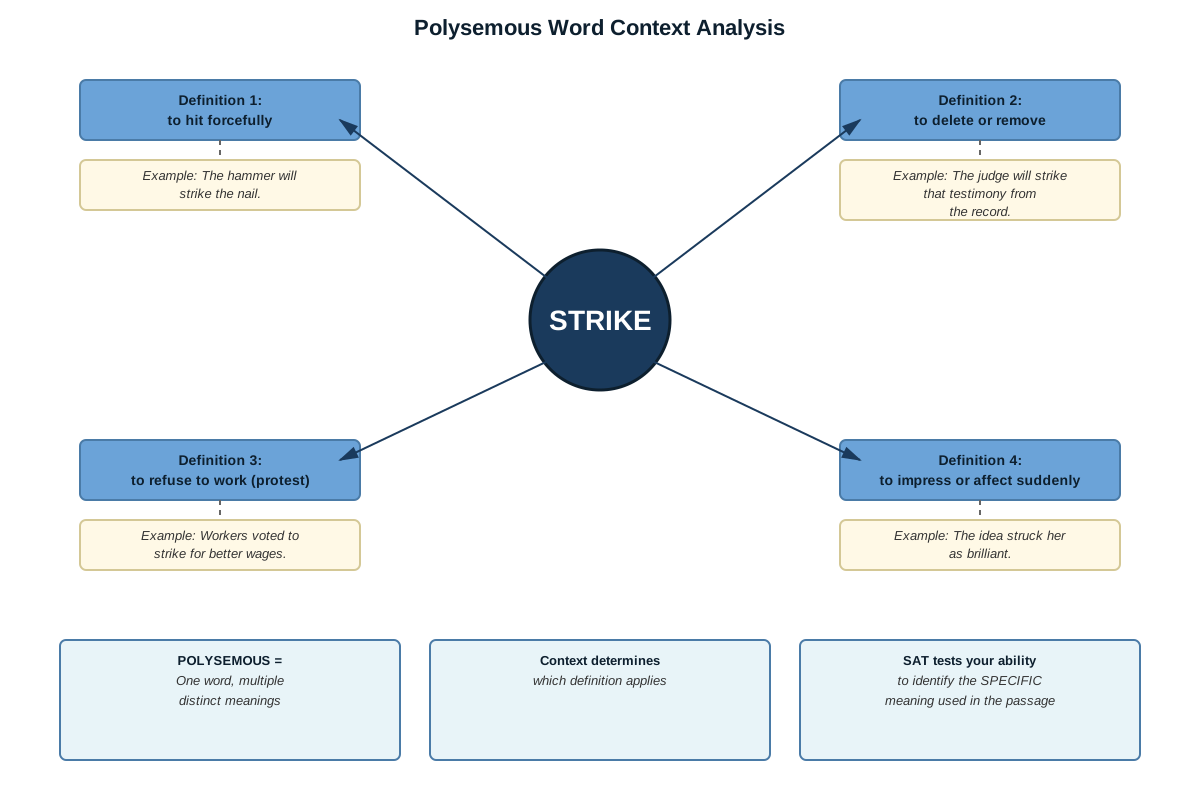
The importance of mastering sat denotation questions cannot be overstated. These questions typically present a word from the passage and ask students to choose which word or phrase could replace it without changing the meaning. Unlike vocabulary questions that simply test whether students know a word's definition, denotation questions assess the ability to understand how context determines which specific meaning of a word applies. This skill is critical because many English words are polysemous—they have multiple distinct meanings—and the SAT exploits this characteristic to create challenging questions that separate students who truly understand contextual meaning from those who merely recognize familiar words.
Within the broader landscape of SAT Reading and Writing, denotation serves as a foundational skill that supports comprehension across all question types. Strong denotation skills enable students to parse complex sentences accurately, understand an author's precise claims, and avoid misinterpretation of passages. This topic connects directly to other "Words in Context" concepts and supports success in rhetoric, synthesis, and inference questions throughout the rw section. Mastering denotation provides students with a systematic approach to understanding language precision, which is essential for achieving top scores on the SAT.
Learning Objectives
- [ ] Identify key features of Denotation
- [ ] Explain how Denotation appears on the SAT
- [ ] Apply Denotation to answer SAT-style questions
- [ ] Distinguish between multiple dictionary definitions of polysemous words based on context
- [ ] Recognize common SAT patterns in denotation question construction
- [ ] Evaluate answer choices by testing substitution within the original sentence context
- [ ] Analyze how grammatical function and surrounding words constrain word meaning
Prerequisites
- Basic vocabulary knowledge: Understanding common English words and their general meanings provides the foundation for recognizing when words have multiple definitions
- Reading comprehension skills: The ability to understand sentences and paragraphs in context is necessary to determine which specific meaning of a word applies
- Parts of speech recognition: Knowing whether a word functions as a noun, verb, adjective, or adverb helps narrow down which definition is contextually appropriate
- Sentence structure understanding: Recognizing subjects, objects, and modifiers enables students to see how words relate to each other and constrain meaning
Why This Topic Matters
Denotation questions appear with remarkable consistency on the SAT, typically comprising 13-15% of all Reading and Writing questions. In practical terms, students can expect to encounter approximately 4-6 denotation questions across the two RW modules on test day. This frequency makes denotation one of the highest-yield topics for focused study, as mastering this question type can directly translate to multiple correct answers and significant score improvements.
Beyond test performance, understanding denotation has profound real-world applications. Precise word choice is essential in academic writing, professional communication, legal documents, scientific papers, and any context where clarity and accuracy matter. The ability to distinguish between subtle differences in word meanings—such as "imply" versus "infer," or "affect" versus "effect"—prevents miscommunication and demonstrates intellectual sophistication. Students who master denotation develop a heightened sensitivity to language precision that serves them throughout their academic and professional careers.
On the SAT, denotation questions most commonly appear in passages from natural science, social science, and humanities texts. The College Board deliberately selects words that have multiple legitimate definitions, then asks students to identify which meaning the author intended. These questions often feature words that students recognize but may not fully understand in all their nuances. For example, a passage might use "appreciate" to mean "increase in value" rather than "be grateful for," or "realize" to mean "make real" rather than "become aware of." The exam rewards students who read carefully and think critically about how context determines meaning.
Core Concepts
What is Denotation?
Denotation refers to the literal, explicit, dictionary definition of a word—the objective meaning that can be found in reference materials and remains consistent across contexts. This stands in contrast to connotation (the emotional associations and implied meanings of words), though the SAT focuses primarily on denotation in its "Words in Context" questions. When working with denotation, students must identify the specific, precise meaning a word carries in a particular usage, which may be just one of several possible definitions.
The key characteristic of denotation is its objectivity. While connotations vary based on personal experience and cultural context, denotations are standardized meanings that speakers of a language agree upon. For instance, the word "home" denotes a place where someone lives (objective definition), while it connotes warmth, safety, and belonging (subjective associations). On the SAT, questions focus exclusively on the denotative meaning—which dictionary definition applies in the given context.
Polysemy and Context-Dependent Meaning
Most SAT denotation questions exploit polysemy—the phenomenon where a single word has multiple distinct but related meanings. Consider the word "run," which can mean to move quickly on foot, to operate (a machine), to extend in a direction, to manage (a business), or to flow (like water). Each of these is a legitimate denotation of "run," and context determines which meaning applies.
The SAT tests whether students can use contextual clues to identify the correct denotation among multiple possibilities. These clues include:
- Grammatical function: Whether the word serves as a noun, verb, adjective, or adverb
- Surrounding words: The objects, subjects, and modifiers that accompany the target word
- Sentence meaning: The overall idea the sentence conveys
- Passage topic: The subject matter and domain of the text
For example, in "The scientist will conduct the experiment," the word "conduct" means "carry out" or "perform." In "Copper is an excellent conductor," the related word "conductor" means "a material that transmits electricity." Context makes the distinction clear.
SAT Denotation Question Format
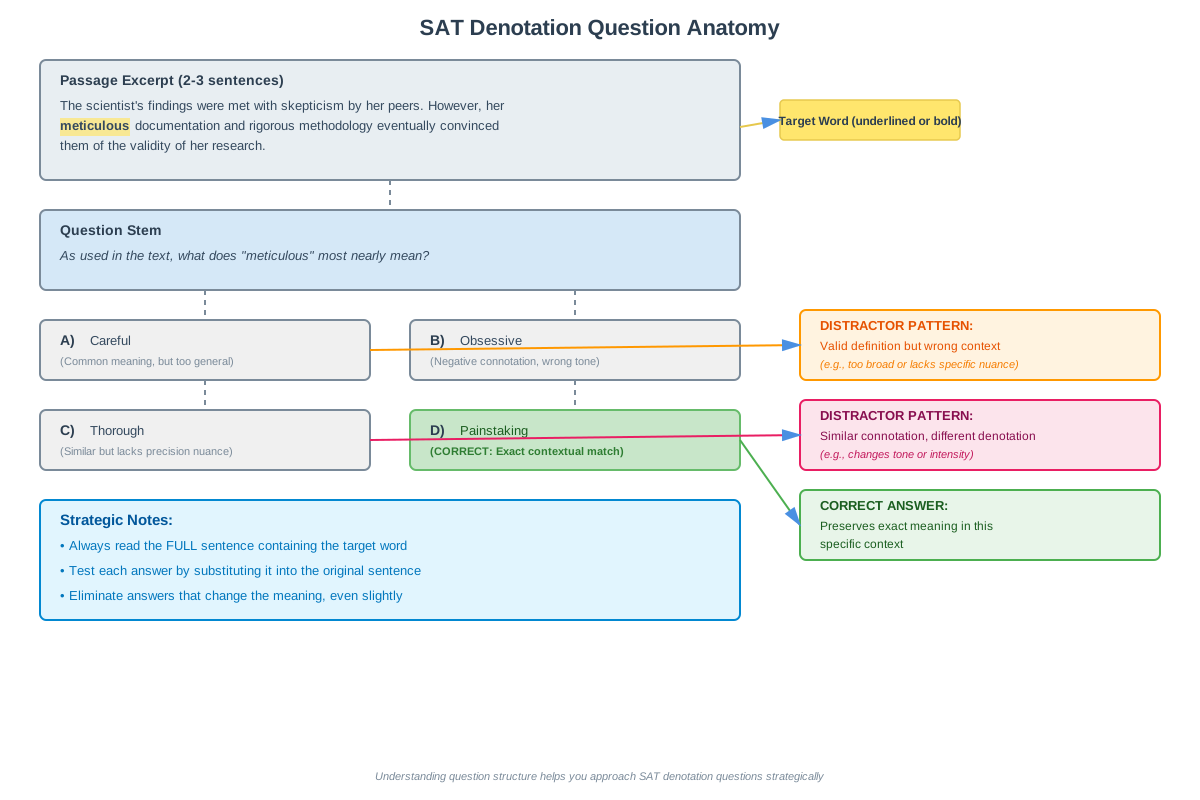
SAT denotation questions follow a consistent format that students should recognize immediately. The question stem typically reads: "As used in line X, '[word]' most nearly means:" or "Which choice most logically completes the text?" when the blank requires selecting a word with the correct denotation.
The four answer choices usually include:
- The correct denotation: The meaning that fits the specific context
- An alternative denotation: Another valid dictionary definition of the same word that doesn't fit this context
- A related word: A synonym of one meaning that doesn't work in this sentence
- A distractor: A word that might seem related but doesn't match the meaning
This structure means students cannot simply select a word they recognize as "a meaning" of the target word—they must verify that the specific meaning fits the context perfectly.
The Substitution Test
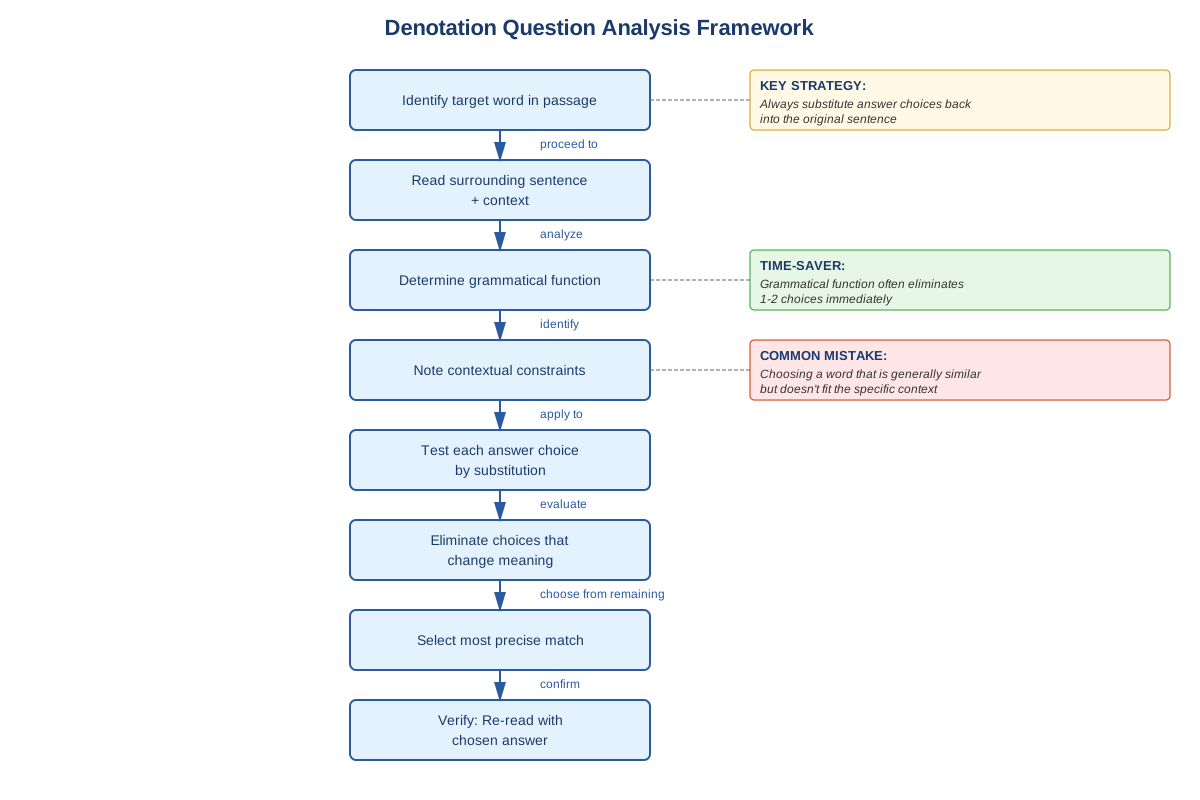
The most reliable strategy for answering denotation questions is the substitution test. This involves replacing the original word in the sentence with each answer choice and determining which one preserves the sentence's meaning without creating awkwardness or changing the author's intent.
The substitution test follows these steps:
- Read the sentence containing the target word carefully
- Understand what the sentence is communicating
- Temporarily remove the target word
- Insert each answer choice into the blank
- Evaluate whether the sentence still makes sense and conveys the same idea
- Select the choice that works best
This systematic approach prevents students from falling for trap answers that represent valid definitions of the word but don't fit the specific context.
Common Word Categories Tested
The SAT tends to test certain categories of words repeatedly in denotation questions:
| Word Category | Examples | Why Tested |
|---|---|---|
| Academic verbs | establish, demonstrate, appreciate, realize | Multiple technical meanings in different fields |
| Transition words | while, since, as, though | Can indicate time, cause, contrast, or comparison |
| Common verbs with multiple meanings | run, hold, draw, bear, strike | Everyday words with surprising variety |
| Abstract nouns | interest, value, power, force | Different meanings in different academic domains |
| Adjectives with intensity variations | significant, substantial, considerable | Subtle differences in degree |
Understanding these patterns helps students anticipate which words are likely to appear in denotation questions and prepare accordingly.
Denotation vs. Synonymy
A critical distinction for SAT success is understanding that denotation questions are not simply synonym questions. While synonyms share similar meanings, denotation questions require identifying the exact meaning in context. Two words might be synonyms in one context but not in another.
Consider "observe" and "watch." These are often synonyms, but "observe" can also mean "remark" or "comply with," as in "observe the rules." An SAT question might use "observe" in this latter sense, making "watch" an incorrect answer despite being a common synonym. Students must focus on the specific denotation required by the context, not just general synonymy.
Concept Relationships
The concepts within denotation form a logical progression: understanding that denotation refers to literal meaning leads to recognizing polysemy (multiple meanings), which necessitates using context clues to determine the correct meaning, which is verified through the substitution test. This sequence represents the cognitive process students should follow when encountering denotation questions.
Denotation connects to prerequisite knowledge of vocabulary and reading comprehension—students must know words generally before they can distinguish between specific meanings. It also relates to grammar knowledge, as parts of speech often determine which definition applies. Looking forward, mastering denotation enables success with more complex "Words in Context" topics like connotation, tone, and rhetorical effect, where understanding precise word meaning becomes the foundation for analyzing author's purpose and stylistic choices.
The relationship map flows as follows: Basic vocabulary knowledge → enables recognition of → Polysemous words → which require → Context analysis → verified through → Substitution testing → resulting in → Correct denotation identification → which supports → Advanced reading comprehension and Rhetorical analysis.
Quick check — test yourself on Denotation so far.
Try Flashcards →High-Yield Facts
- ⭐ Denotation refers to the literal, dictionary definition of a word, independent of emotional associations or implied meanings
- ⭐ SAT denotation questions test whether students can identify which specific meaning of a polysemous word fits a particular context
- ⭐ The substitution test—replacing the target word with each answer choice—is the most reliable strategy for denotation questions
- ⭐ Context clues including grammatical function, surrounding words, and sentence meaning determine which denotation applies
- ⭐ Approximately 13-15% of SAT Reading and Writing questions test denotation, making it one of the highest-yield topics
- Trap answers often include valid dictionary definitions of the target word that don't fit the specific context
- Common SAT denotation targets include academic verbs, transition words, and everyday words with multiple technical meanings
- The correct answer preserves both the meaning and grammatical structure of the original sentence
- Students should never select an answer simply because it's "a meaning" of the target word without testing it in context
- Denotation questions appear across all passage types but are especially common in science and social science texts
- The SAT deliberately chooses words that students recognize but may not know in all their nuances
- Reading the full sentence (not just the immediate phrase) is essential for understanding context
- Answer choices are designed to test whether students understand subtle distinctions between related meanings
- Time-efficient students can often eliminate two answer choices quickly by recognizing they create nonsensical sentences
Common Misconceptions
Misconception: Any synonym of the target word is a correct answer → Correction: The correct answer must fit the specific context and preserve the exact meaning intended by the author. A word might be a synonym in one context but not in the context of the passage.
Misconception: The most common or familiar meaning of a word is always correct → Correction: The SAT frequently tests less common definitions of familiar words. Students must use context to determine which specific meaning applies, even if it's not the first definition they think of.
Misconception: Denotation questions are just vocabulary tests → Correction: These questions test reading comprehension and contextual analysis, not just vocabulary knowledge. Students who know all the words can still answer incorrectly if they don't analyze how context determines meaning.
Misconception: The correct answer will "sound smart" or be the most sophisticated word → Correction: The correct answer is simply the one that best matches the meaning in context. Sometimes the simplest, most straightforward choice is correct.
Misconception: If an answer choice is a valid definition of the target word, it must be correct → Correction: Trap answers often include legitimate definitions that don't fit the specific context. Students must verify that the meaning works in the actual sentence, not just in general.
Misconception: Reading just the phrase around the target word is sufficient → Correction: Understanding the full sentence and often the surrounding sentences is necessary to grasp the complete context that determines meaning.
Misconception: Denotation and connotation are the same thing → Correction: Denotation is the literal, objective definition, while connotation refers to emotional associations and implied meanings. SAT "Words in Context" questions focus on denotation.
Worked Examples
Example 1: Academic Verb with Multiple Meanings
Passage excerpt: "The researchers sought to establish a correlation between sleep duration and academic performance by analyzing data from over 10,000 students."
Question: As used in the text, "establish" most nearly means:
A) found
B) prove
C) settle
D) institute
Solution:
Step 1: Understand the sentence meaning. The researchers are trying to show or demonstrate that a correlation exists through data analysis.
Step 2: Apply the substitution test for each answer choice:
- A) "found a correlation" - This could work, but "found" suggests discovering something that already exists, whereas the sentence implies creating evidence for the correlation's existence
- B) "prove a correlation" - This fits well; the researchers are using data to demonstrate the correlation exists
- C) "settle a correlation" - This doesn't make grammatical or logical sense; you don't "settle" a correlation
- D) "institute a correlation" - This means to begin or set up, which doesn't fit; you can't create a correlation, only discover or demonstrate it
Step 3: Evaluate context clues. The phrase "by analyzing data" indicates the researchers are demonstrating or showing something through evidence, which aligns with "prove."
Answer: B) prove
This question demonstrates how "establish" has multiple valid definitions (found an organization, prove something, settle into a place, institute a practice), but only one fits this scientific context. The trap answer (A) represents another common meaning of "establish" that doesn't quite capture the precise meaning here.
Example 2: Common Word with Surprising Technical Meaning
Passage excerpt: "The novel's protagonist must bear the consequences of her earlier decisions, facing social ostracism and financial hardship throughout the second half of the narrative."
Question: As used in the text, "bear" most nearly means:
A) carry
B) endure
C) produce
D) support
Solution:
Step 1: Identify what the sentence is saying. The protagonist must face or deal with negative consequences.
Step 2: Test each answer through substitution:
- A) "carry the consequences" - This is metaphorically possible but awkward; "carry" typically refers to physical objects
- B) "endure the consequences" - This fits perfectly; enduring means experiencing or suffering through something difficult
- C) "produce the consequences" - This reverses the meaning; the protagonist is experiencing consequences, not creating them
- D) "support the consequences" - This doesn't make logical sense; you don't support consequences
Step 3: Consider the context of "facing social ostracism and financial hardship." These are clearly negative experiences the character must go through, which aligns with "endure."
Answer: B) endure
This example shows how "bear" has multiple meanings (carry physically, endure/tolerate, give birth to, support weight), and students must use context—particularly the negative consequences mentioned—to identify that "endure" is the correct denotation here. The trap answer (A) represents the most common physical meaning of "bear" that doesn't fit this abstract, emotional context.
Exam Strategy
When approaching SAT denotation questions, students should follow a systematic process that maximizes accuracy while managing time efficiently. First, always read the complete sentence containing the target word, and often the sentence before and after, to fully understand the context. Many students make the mistake of reading only the immediate phrase, which can lead to misunderstanding the author's intent.
Trigger phrases that signal denotation questions include:
- "As used in line X, [word] most nearly means"
- "Which choice completes the text with the most logical and precise word?"
- "In the context of the passage, [word] refers to"
When these phrases appear, immediately activate your denotation strategy rather than treating the question as a general vocabulary test.
Exam Tip: Before looking at answer choices, try to predict what the word means in context. This prevents answer choices from biasing your interpretation and helps you recognize the correct answer more quickly.
For process of elimination, start by identifying answer choices that create grammatically incorrect or nonsensical sentences when substituted. These can usually be eliminated in seconds. Next, eliminate choices that represent valid definitions of the target word but clearly don't fit the context. Finally, choose between the remaining options by determining which one most precisely captures the author's intended meaning.
Time allocation for denotation questions should be approximately 45-60 seconds per question. These questions are generally faster than inference or rhetoric questions because they focus on a specific word rather than requiring analysis of entire paragraphs. If you find yourself spending more than 75 seconds on a denotation question, make your best educated guess and move on—these questions should be score-builders, not time-drains.
A powerful strategy is to cover the answer choices initially, read the sentence, and articulate to yourself what the word means in this context. Then uncover the choices and look for the one that matches your prediction. This approach prevents trap answers from seeming more attractive than they should.
Memory Techniques
The CONTEXT Acronym for analyzing denotation:
- Consider the complete sentence
- Observe grammatical function (noun, verb, adjective, etc.)
- Note surrounding words and phrases
- Test each answer by substitution
- Eliminate nonsensical options
- Xamine which choice preserves meaning exactly
- Trust the context over your first instinct
Visualization Strategy: Picture denotation as a spotlight that illuminates one specific meaning among many possibilities. When you encounter a polysemous word, visualize multiple definitions arranged in a circle, with context acting as a spotlight that shines on only one correct meaning. This mental image reinforces that context determines which definition applies.
The "Dictionary Test" Mnemonic: Remember that denotation = dictionary definition. Both words start with "D" and both refer to literal, objective meaning. When you see a denotation question, think "Which dictionary definition fits this context?"
Substitution Mantra: Before selecting an answer, mentally repeat: "Does this word work here? Does it preserve the meaning? Does it sound natural?" This three-question check catches most errors.
Summary
Denotation represents the literal, dictionary definition of words and is tested extensively on the SAT through "Words in Context" questions that require students to identify which specific meaning of a polysemous word fits a particular passage. Success with denotation questions depends on understanding that many common words have multiple distinct meanings, and context—including grammatical function, surrounding words, and sentence meaning—determines which definition applies. The most effective strategy is the substitution test, where students replace the target word with each answer choice to determine which one preserves the sentence's meaning without creating awkwardness or logical inconsistencies. Trap answers typically include valid definitions of the target word that don't fit the specific context, making it essential to verify that an answer works in the actual sentence rather than simply recognizing it as "a meaning" of the word. With approximately 13-15% of Reading and Writing questions testing denotation, mastering this topic provides a high-yield opportunity for score improvement and builds foundational skills for all other reading comprehension tasks on the SAT.
Key Takeaways
- Denotation refers to literal, dictionary definitions, and SAT questions test whether students can identify the correct meaning in context
- Always use the substitution test—replace the target word with each answer choice to verify which one preserves meaning
- Context clues including grammatical function, surrounding words, and overall sentence meaning determine which definition applies
- Trap answers often include legitimate definitions of the target word that don't fit the specific context
- Denotation questions comprise 13-15% of SAT Reading and Writing questions, making this a high-yield topic for focused study
- Read the complete sentence (and often surrounding sentences) to fully understand context before selecting an answer
- Never choose an answer simply because it's "a meaning" of the target word without verifying it works in the actual sentence
Related Topics
Connotation: While denotation covers literal meanings, connotation explores the emotional associations and implied meanings of words. Mastering denotation provides the foundation for understanding how authors use connotation to create tone and mood.
Rhetorical Synthesis: Understanding precise word meanings enables students to analyze how authors combine ideas and choose specific language to achieve rhetorical purposes. Denotation skills support synthesis questions that ask about word choice effects.
Transition Words and Phrases: Many transition words have multiple denotations (e.g., "while" can indicate time or contrast), making denotation skills essential for understanding logical relationships between ideas.
Vocabulary in Context: This broader category includes both denotation and connotation questions, and mastering denotation provides the foundation for all vocabulary-related SAT questions.
Practice CTA
Now that you understand the key concepts and strategies for SAT denotation questions, it's time to put your knowledge into action. Complete the practice questions to reinforce these skills and identify any areas that need additional review. Use the flashcards to build familiarity with commonly tested words and their multiple meanings. Remember, denotation questions are highly predictable and respond well to systematic practice—every question you practice increases your accuracy and speed on test day. You've built a strong foundation; now strengthen it through deliberate practice!
Sign up free to keep reading
Create a free AnvayaPrep account to finish this SAT guide on Denotation — plus flashcards and practice questions.