Overview
Connotation is one of the most frequently tested concepts in the SAT Reading and Writing (RW) section, appearing in the "Words in Context" question type. Unlike denotation, which refers to a word's literal dictionary definition, connotation encompasses the emotional associations, cultural implications, and subtle shades of meaning that words carry. On the SAT, understanding connotation is essential because test-makers frequently ask students to identify which word best fits a passage's tone, purpose, or the author's intended meaning—not just which word is technically correct by definition.
Mastering sat connotation questions requires more than vocabulary knowledge; it demands sensitivity to nuance, context, and rhetorical purpose. A passage describing someone as "confident" versus "arrogant" conveys dramatically different attitudes, even though both words relate to self-assurance. The SAT exploits these distinctions to test reading comprehension at a sophisticated level. Students who can distinguish between words with similar denotations but different connotations gain a significant advantage, as these questions appear in nearly every test administration and often determine score differences in the competitive 650-750 range.
Within the broader RW framework, connotation connects intimately with other critical skills: understanding author's purpose, analyzing tone, interpreting rhetorical choices, and evaluating evidence. When an author chooses "whispered" over "said" or "mansion" over "house," these choices reveal attitude, create atmosphere, and guide reader interpretation. The SAT tests whether students recognize these deliberate word choices and can select alternatives that preserve or appropriately shift the passage's meaning and tone.
Learning Objectives
- [ ] Identify key features of Connotation
- [ ] Explain how Connotation appears on the SAT
- [ ] Apply Connotation to answer SAT-style questions
- [ ] Distinguish between positive, negative, and neutral connotations in context
- [ ] Evaluate how connotative word choices affect passage tone and meaning
- [ ] Analyze the relationship between connotation and author's purpose
Prerequisites
- Basic vocabulary knowledge: Understanding common word meanings provides the foundation for recognizing subtle differences in connotation
- Reading comprehension skills: The ability to understand passage context is essential for determining which connotation fits appropriately
- Familiarity with tone and mood: Recognizing whether a passage is formal, informal, critical, or supportive helps identify appropriate connotative choices
Why This Topic Matters
Connotation questions appear with remarkable consistency on the SAT, typically comprising 3-5 questions per test administration. These questions fall under the "Words in Context" category, which represents approximately 13-15% of the Reading and Writing section. Unlike pure vocabulary questions that test whether students know definitions, connotation questions assess sophisticated reading skills: Can students detect subtle differences in meaning? Do they understand how word choice shapes reader perception? Can they identify which synonym best matches the passage's rhetorical purpose?
Beyond the exam, connotation literacy has profound real-world applications. In professional communication, choosing words with appropriate connotations prevents misunderstandings and conveys intended tone. In media literacy, recognizing connotative language helps identify bias and persuasive techniques. In academic writing, selecting words with precise connotations strengthens arguments and demonstrates intellectual maturity. The ability to decode and deploy connotation effectively is a hallmark of advanced literacy.
On the SAT, connotation questions typically appear in two formats: First, students encounter a passage with an underlined word and must select the best replacement from four options that are roughly synonymous but carry different connotations. Second, students must identify which word from a set of options best completes a sentence based on the surrounding context's tone and meaning. These questions commonly appear in passages discussing scientific discoveries, historical events, literary analysis, and social commentary—any context where precise word choice matters.
Core Concepts
Understanding Connotation vs. Denotation
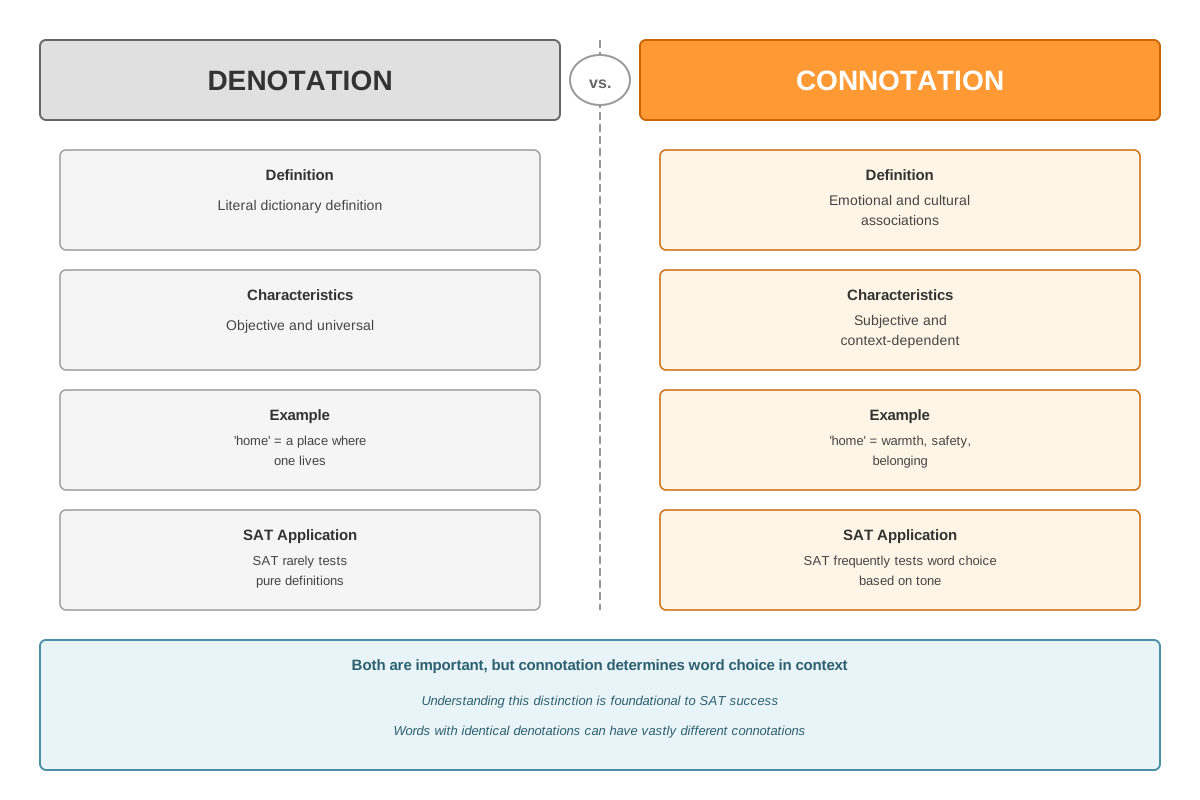
Denotation refers to a word's literal, dictionary definition—its explicit, objective meaning. Connotation, by contrast, encompasses the emotional associations, cultural implications, and subjective feelings that a word evokes. While "home" and "residence" share similar denotations (a place where someone lives), their connotations differ significantly: "home" suggests warmth, belonging, and emotional connection, while "residence" sounds formal, detached, and bureaucratic.
The SAT exploits this distinction by presenting answer choices that are denotatively similar but connotationally distinct. Consider these synonyms for "thin": slender, skinny, gaunt, svelte, and emaciated. All denote lack of body mass, but their connotations range from positive (slender, svelte) to neutral (thin) to negative (skinny, gaunt, emaciated). The correct answer depends entirely on context: Is the passage complimentary, critical, or neutral? Understanding this spectrum is fundamental to success.
The Connotation Spectrum
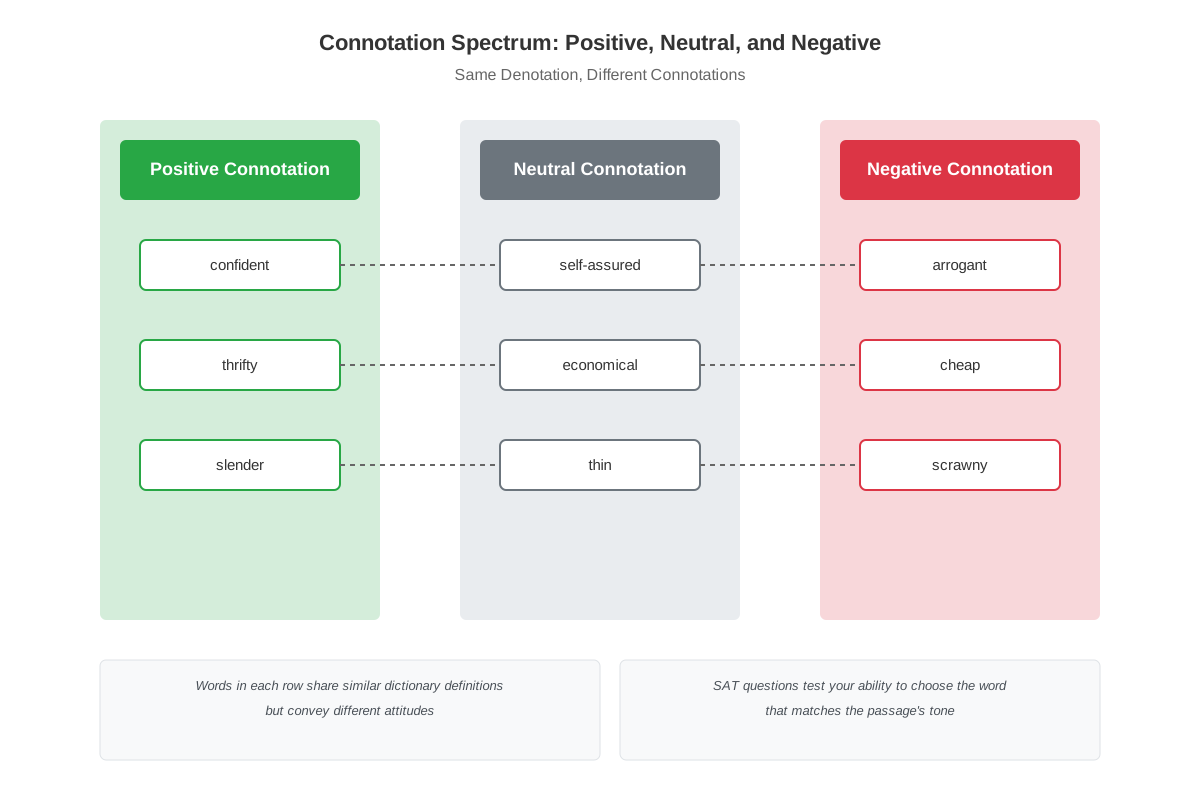
Connotations exist along a spectrum from positive to negative, with neutral occupying the middle ground:
| Positive Connotation | Neutral Connotation | Negative Connotation |
|---|---|---|
| Youthful | Young | Immature |
| Vintage | Old | Decrepit |
| Assertive | Direct | Pushy |
| Thrifty | Economical | Cheap |
| Unique | Different | Weird |
On the SAT, recognizing where a word falls on this spectrum—and where the passage's context demands placement—is crucial. A passage praising someone's spending habits would use "thrifty," while a passage criticizing them would use "cheap." The denotation (spending little money) remains constant, but the connotation transforms the meaning entirely.
Context as the Determining Factor
Context is the ultimate arbiter of appropriate connotation. The same word can be appropriate or inappropriate depending on surrounding sentences, the author's purpose, and the passage's overall tone. SAT passages provide multiple context clues:
- Surrounding descriptive language: If a passage uses words like "unfortunately," "problematic," or "concerning," negative connotations are likely appropriate
- Author's stated or implied attitude: Does the author admire, criticize, or neutrally observe the subject?
- Passage genre and formality: Academic passages favor neutral or formal connotations; opinion pieces may use stronger positive or negative connotations
- Logical consistency: The chosen word must create coherent meaning with adjacent sentences
Intensity and Degree
Beyond positive/negative valence, connotations vary in intensity. Consider these words for "angry": annoyed, irritated, furious, livid, enraged. All are negative, but they represent escalating degrees of anger. The SAT tests whether students can match intensity to context. If a passage describes a "minor disagreement," "furious" would be too intense; "annoyed" fits better. Conversely, if the passage describes a "devastating betrayal," "annoyed" would be too weak.
This intensity dimension applies across connotative categories:
- Happiness: pleased → delighted → ecstatic → euphoric
- Sadness: disappointed → unhappy → miserable → despondent
- Intelligence: smart → brilliant → genius → prodigious
Formality and Register
Words also carry connotations of formality or register—the level of language appropriate to a situation. "Intoxicated" (formal), "drunk" (neutral), and "wasted" (informal/slang) all denote the same state but suit different contexts. SAT passages typically employ formal or neutral register, making informal or slang choices incorrect even if denotatively accurate.
Understanding register helps eliminate answer choices quickly. In an academic passage about historical economics, "folks" would be inappropriately informal compared to "people" or "individuals." In a passage quoting casual dialogue, however, "folks" might be perfectly appropriate.
Cultural and Historical Connotations
Some words carry connotations rooted in cultural or historical associations. "Propaganda" technically means information used to promote a viewpoint, but it connotes manipulation and dishonesty due to historical usage. "Regime" denotes a government or system but connotes authoritarianism. The SAT occasionally tests awareness of these loaded terms, requiring students to recognize when a word's cultural baggage makes it inappropriate for neutral contexts.
Concept Relationships
Connotation serves as a foundational concept connecting multiple aspects of SAT Reading and Writing. The relationship map flows as follows:
Vocabulary Knowledge → Connotation Awareness → Tone Recognition → Author's Purpose Analysis → Rhetorical Effect Evaluation
Understanding individual word meanings (vocabulary) enables recognition of connotative differences. This awareness, in turn, allows students to identify passage tone (critical, supportive, neutral, etc.). Recognizing tone facilitates understanding the author's purpose (to persuade, inform, entertain, criticize). Finally, analyzing how specific word choices create rhetorical effects demonstrates advanced comprehension.
Connotation also connects laterally to other "Words in Context" skills. Precision questions ask which word most accurately conveys meaning; connotation is often the deciding factor between precise and imprecise choices. Transition questions require understanding how words like "however" or "furthermore" create logical relationships; these transitions carry connotative weight about the relationship between ideas.
Within the connotation concept itself, the sub-concepts interrelate hierarchically: Understanding the denotation/connotation distinction provides the foundation. Recognizing the positive/negative/neutral spectrum builds on this foundation. Appreciating intensity gradations and formality levels adds sophistication. Finally, awareness of cultural connotations represents advanced mastery.
High-Yield Facts
⭐ Connotation refers to the emotional associations and implied meanings of words, while denotation refers to literal dictionary definitions
⭐ Words with similar denotations can have dramatically different connotations (e.g., "childlike" vs. "childish")
⭐ Context clues in surrounding sentences determine which connotation is appropriate for SAT questions
⭐ Connotations exist on a spectrum from positive to negative, with neutral in the middle
⭐ The SAT tests whether students can match word intensity to context (e.g., "annoyed" vs. "furious")
- Formality level (register) is a type of connotation; informal words are usually incorrect in formal SAT passages
- Author's tone and purpose provide crucial clues for determining appropriate connotations
- Words can be denotatively correct but connotatively wrong, making them incorrect SAT answers
- Cultural and historical associations affect connotation (e.g., "propaganda" has negative connotations despite neutral denotation)
- Eliminating answer choices with inappropriate connotations is often easier than identifying the perfect choice
- Connotation questions typically provide four synonyms or near-synonyms as answer choices
- Reading the sentence with each answer choice inserted helps identify which "sounds right" in context
Quick check — test yourself on Connotation so far.
Try Flashcards →Common Misconceptions
Misconception: If a word's definition fits the sentence, it must be the correct answer.
Correction: Denotative accuracy is necessary but insufficient; the word must also have the appropriate connotation for the context. "Cheap" and "economical" both mean spending little money, but only one fits a positive context.
Misconception: Connotation is subjective and varies from person to person, so there's no definitively correct answer.
Correction: While individual associations vary slightly, connotations have broadly shared cultural meanings. The SAT tests widely recognized connotations, and context makes one answer clearly superior to others.
Misconception: Neutral words are always the safest choice.
Correction: Neutral connotations are appropriate for neutral contexts, but many passages require positive or negative connotations to match the author's tone. Choosing neutral when the passage is clearly critical or praising creates a mismatch.
Misconception: More sophisticated or complex words are better answers.
Correction: The best answer matches the passage's tone and meaning, regardless of word complexity. A simple word with the right connotation beats a sophisticated word with the wrong connotation.
Misconception: Connotation only matters in literature or creative writing passages.
Correction: Connotation appears across all passage types on the SAT, including scientific, historical, and social science texts. Even factual passages use words with specific connotative choices to convey attitude and perspective.
Misconception: If you don't know a word's connotation, you should guess based on how it sounds.
Correction: While word roots and sounds sometimes provide clues, this strategy is unreliable. Instead, use process of elimination based on words you do know, and consider context clues about whether positive, negative, or neutral connotation is needed.
Worked Examples
Example 1: Identifying Appropriate Connotation
Passage: "The scientist's meticulous research methods and careful attention to detail earned her widespread respect in the field. Her colleagues particularly admired her _______ approach to data collection, which ensured highly reliable results."
Answer Choices:
A) obsessive
B) thorough
C) nitpicky
D) excessive
Step 1: Analyze Context
The passage is clearly positive—words like "meticulous," "careful," "earned respect," and "admired" establish a complimentary tone. We need a word with positive connotation.
Step 2: Evaluate Each Choice's Connotation
- "Obsessive" (A): Negative connotation—suggests unhealthy fixation
- "Thorough" (B): Positive/neutral connotation—suggests completeness and care
- "Nitpicky" (C): Negative connotation—suggests excessive focus on trivial details
- "Excessive" (D): Negative connotation—suggests going too far
Step 3: Eliminate Mismatches
Choices A, C, and D all have negative connotations, contradicting the passage's admiring tone. Only "thorough" maintains the positive assessment.
Step 4: Verify in Context
Reading the sentence with "thorough" inserted: "Her colleagues particularly admired her thorough approach to data collection, which ensured highly reliable results." This maintains logical and tonal consistency.
Answer: B) thorough
Learning Objective Connection: This example demonstrates applying connotation to answer SAT-style questions by distinguishing between words with similar denotations (all relate to attention to detail) but different connotations.
Example 2: Matching Intensity to Context
Passage: "When the city council announced plans to demolish the historic theater, community members expressed their disagreement at a town hall meeting. Several residents spoke about their concerns, though the discussion remained civil and productive. The council members acknowledged the _______ response and agreed to reconsider their decision."
Answer Choices:
A) furious
B) concerned
C) apathetic
D) militant
Step 1: Identify Context Clues
Key phrases: "expressed their disagreement," "spoke about their concerns," "remained civil and productive." The response was negative (disagreement) but moderate in intensity (civil, productive).
Step 2: Assess Intensity of Each Choice
- "Furious" (A): Very high intensity, suggests anger—too strong for "civil and productive"
- "Concerned" (B): Moderate intensity, matches "concerns" mentioned in passage
- "Apathetic" (C): No intensity, suggests lack of interest—contradicts "expressed disagreement"
- "Militant" (D): Very high intensity, suggests aggressive action—contradicts "civil"
Step 3: Match Intensity to Context
The passage describes moderate opposition, not extreme anger or indifference. "Concerned" matches this moderate intensity perfectly.
Step 4: Check Logical Consistency
"The council members acknowledged the concerned response and agreed to reconsider" makes logical sense—moderate concern prompted reconsideration. Extreme fury or apathy would create logical inconsistencies.
Answer: B) concerned
Learning Objective Connection: This example illustrates how connotation includes intensity dimensions and how context determines appropriate intensity levels, key features of connotation on the SAT.
Exam Strategy
Systematic Approach to Connotation Questions
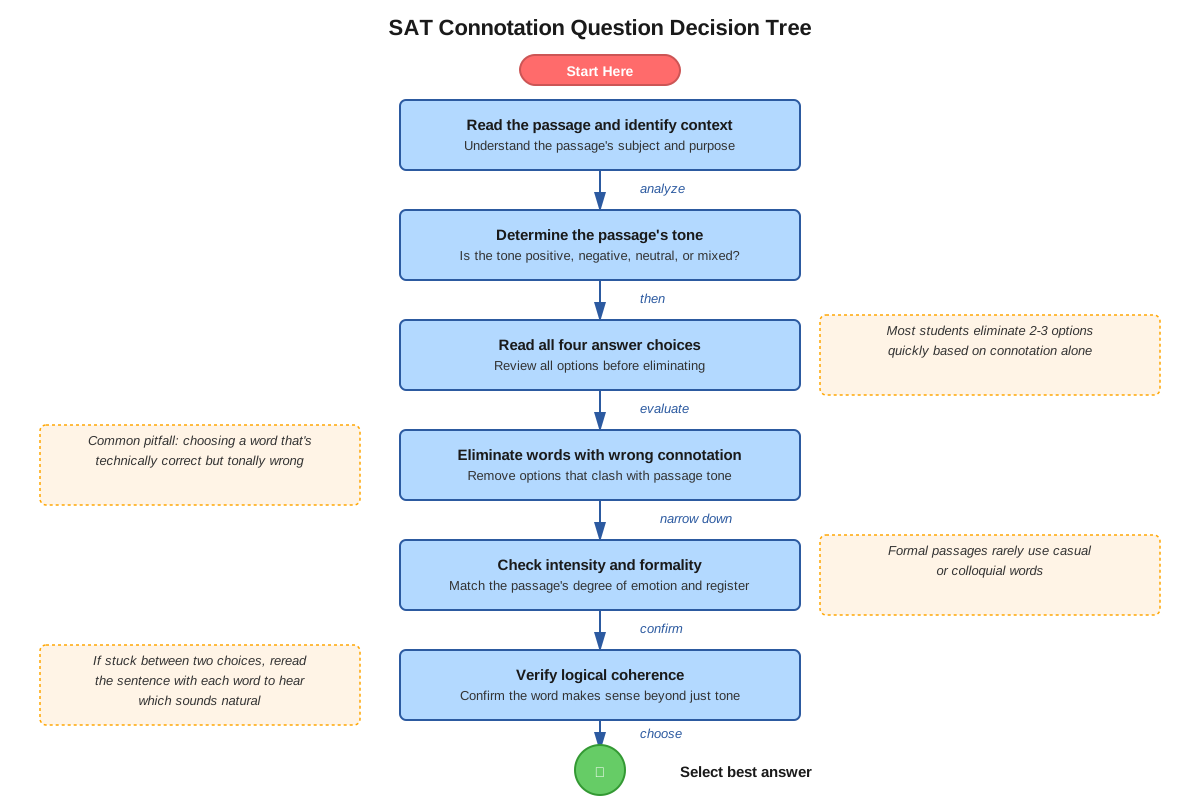
- Read the entire sentence or paragraph before looking at answer choices—context is essential
- Identify the passage's tone: positive, negative, neutral, formal, informal
- Determine what type of connotation is needed: positive/negative valence and intensity level
- Evaluate each answer choice's connotation independently before comparing
- Eliminate choices with inappropriate connotations first—this is often easier than finding the perfect answer
- Insert remaining choices into the sentence and read aloud mentally to test fit
- Verify the answer maintains logical consistency with surrounding sentences
Trigger Words and Phrases
Watch for these context clues that signal connotation requirements:
Positive Context Indicators: "admired," "praised," "successful," "beneficial," "fortunately," "improved"
Negative Context Indicators: "criticized," "unfortunately," "problematic," "declined," "harmful," "failed"
Intensity Indicators: "slightly," "somewhat," "extremely," "devastatingly," "minor," "significant"
Formality Indicators: Academic vocabulary, complex sentence structures, and technical terminology suggest formal register; conversational passages may accept less formal connotations
Process of Elimination Tips
- Eliminate extremes first when context suggests moderation
- Remove informal choices in formal passages (and vice versa)
- Cross out opposite valence (positive when negative is needed, or vice versa)
- Eliminate words that create logical contradictions with surrounding sentences
- Remove words you don't know only after eliminating words you know are wrong
Time Allocation
Connotation questions should take 30-45 seconds each. If you're spending more than one minute, you're overthinking. Trust your instinctive sense of which word "sounds right" in context—your language intuition is often correct. If stuck between two choices, pick the one that matches the passage's overall tone and move on.
Exam Tip: When two answer choices seem equally correct, the distinguishing factor is usually intensity or formality level. Reread the context to determine whether the passage calls for stronger or weaker language, more formal or less formal register.
Memory Techniques
The "Tone Triangle" Mnemonic
Remember PNN for the three connotation categories:
- Positive (complimentary, favorable)
- Negative (critical, unfavorable)
- Neutral (objective, balanced)
Visualize a triangle with these three points. Every word exists at one of these points or along the edges between them.
The "MATCH" Strategy
Meaning: Does the denotation fit?
Attitude: What's the author's attitude?
Tone: What's the passage's overall tone?
Context: What do surrounding sentences suggest?
How intense: What intensity level is appropriate?
Intensity Ladder Visualization
For common concepts, memorize intensity ladders from weak to strong:
Anger Ladder: annoyed → irritated → angry → furious → enraged
Happiness Ladder: content → pleased → happy → delighted → ecstatic
Sadness Ladder: disappointed → sad → miserable → devastated → despondent
When you encounter these concepts on the SAT, mentally place answer choices on the appropriate ladder and select the rung matching the context.
The "Synonym Spectrum" Technique
For high-frequency concepts, create mental spectrums:
NEGATIVE ← → NEUTRAL ← → POSITIVE
childish ← → young ← → youthful
cheap ← → economical ← → thrifty
stubborn ← → determined ← → resolute
Memorizing these spectrums for common SAT concepts accelerates answer selection.
Summary
Connotation represents the emotional associations, cultural implications, and subtle shades of meaning that words carry beyond their literal definitions. On the SAT Reading and Writing section, connotation questions test whether students can distinguish between synonyms or near-synonyms based on their appropriateness to context, tone, and author's purpose. Success requires understanding that words exist on spectrums from positive to negative, from weak to intense, and from informal to formal. Context clues in surrounding sentences—particularly words indicating the author's attitude and the passage's overall tone—determine which connotation is appropriate. The systematic approach involves identifying the passage's tone, determining what type of connotation is needed, evaluating each answer choice's connotative qualities, eliminating mismatches, and verifying logical consistency. Mastering connotation is essential for SAT success because these questions appear consistently across test administrations and often differentiate between good and excellent scores.
Key Takeaways
- Connotation encompasses emotional associations and implied meanings beyond literal definitions, while denotation refers to dictionary meanings
- Context is the ultimate determinant of appropriate connotation—surrounding sentences reveal whether positive, negative, or neutral connotation is needed
- Words with similar denotations can have dramatically different connotations, making context analysis essential for correct answers
- Connotations vary along multiple dimensions: positive/negative valence, intensity level, and formality register
- Systematic elimination of inappropriate connotations is often more efficient than immediately identifying the perfect answer
- The SAT consistently tests connotation awareness across all passage types, making this a high-yield topic for score improvement
- Matching word intensity to context intensity is a frequent distinguishing factor between answer choices
Related Topics
Tone and Mood Analysis: Understanding connotation directly enables accurate identification of passage tone, as authors create tone through deliberate connotative word choices. Mastering connotation provides the foundation for more sophisticated tone analysis.
Author's Purpose and Rhetorical Strategies: Recognizing how connotative language serves persuasive, informative, or entertainment purposes deepens comprehension of authorial intent. This topic builds naturally on connotation mastery.
Precision in Word Choice: While connotation focuses on emotional associations, precision questions test whether words accurately convey intended meanings. These concepts overlap significantly and are often tested together.
Transition Words and Logical Relationships: Transition words carry connotative weight about relationships between ideas. Understanding connotation enhances ability to select appropriate transitions.
Evidence and Support Analysis: Authors use connotative language to characterize evidence as strong or weak, reliable or questionable. Connotation awareness improves evidence evaluation skills.
Practice CTA
Now that you've mastered the core concepts of connotation, it's time to apply this knowledge! Work through the practice questions to test your ability to distinguish between words with similar denotations but different connotations. The flashcards will help you internalize common connotation patterns and build the intuitive sense of word appropriateness that leads to quick, confident answers on test day. Remember: connotation questions reward careful attention to context and tone—skills that improve rapidly with focused practice. You've built the foundation; now strengthen it through application!
Sign up free to keep reading
Create a free AnvayaPrep account to finish this SAT guide on Connotation — plus flashcards and practice questions.