Overview
Register and formality refers to the level of language formality and stylistic appropriateness used in writing and speech. On the SAT Reading and Writing section, understanding register is crucial for answering questions that ask students to identify which word, phrase, or sentence best matches the tone and style of a given passage. The concept encompasses everything from highly formal academic language to casual conversational expressions, and students must develop the ability to recognize subtle differences in word choice that signal different levels of formality.
The SAT frequently tests register through "Words in Context" questions that require students to select vocabulary or phrasing that maintains consistency with the passage's established tone. These questions assess whether students can distinguish between synonymous expressions that differ in formality—for example, choosing between "children" (neutral), "kids" (informal), or "juveniles" (formal/technical). Success on these questions depends not just on vocabulary knowledge but on understanding the rhetorical situation: the audience, purpose, and context that determine appropriate language choices.
Mastery of sat register and formality connects directly to broader rw (Reading and Writing) skills, including rhetorical synthesis, author's purpose analysis, and effective communication. Register awareness underpins many SAT question types, from selecting appropriate transitions to evaluating the effectiveness of evidence presentation. Students who understand register can better analyze how authors craft their messages for specific audiences and purposes, a skill that extends beyond standardized testing into academic writing, professional communication, and critical reading across all disciplines.
Learning Objectives
- [ ] Identify key features of Register and formality
- [ ] Explain how Register and formality appears on the SAT
- [ ] Apply Register and formality to answer SAT-style questions
- [ ] Distinguish between formal, informal, and neutral register in written passages
- [ ] Evaluate whether word choices and sentence structures match a passage's established tone
- [ ] Analyze how audience and purpose influence appropriate register selection
Prerequisites
- Basic vocabulary knowledge: Understanding common word meanings is essential because register questions often present synonyms with different formality levels
- Reading comprehension skills: Students must grasp the overall tone and purpose of passages to determine appropriate register
- Context clue recognition: Identifying surrounding textual evidence helps determine which register level fits the passage
- Sentence structure awareness: Different registers often employ distinct grammatical patterns and sentence complexity
Why This Topic Matters
Understanding register and formality has profound real-world applications beyond the SAT. In academic settings, students must adjust their writing style for lab reports (formal), personal essays (less formal), and research papers (highly formal). Professional communication requires similar flexibility—crafting emails to supervisors demands different language than messages to peers. The ability to code-switch between registers demonstrates linguistic sophistication and social awareness, skills valued in college admissions and career advancement.
On the SAT, register and formality questions appear with high frequency, typically comprising 2-4 questions per test administration in the Reading and Writing section. These questions most commonly appear in the "Words in Context" and "Expression of Ideas" categories, where students must select vocabulary or revise sentences to maintain stylistic consistency. The College Board has increasingly emphasized these questions in recent test versions, recognizing that register awareness reflects genuine college-readiness skills.
Register questions typically appear in several formats: selecting a word that matches the passage's tone, choosing between sentence options with varying formality levels, or identifying which revision maintains stylistic consistency. Passages span diverse subjects—from scientific research articles (formal) to personal narratives (informal) to journalistic pieces (neutral)—requiring students to quickly assess and adapt to different rhetorical contexts. The ability to recognize register mismatches often separates high-scoring students from those who struggle with nuanced language questions.
Core Concepts
Defining Register and Formality
Register refers to the variety of language used in specific social contexts, determined by factors including audience, purpose, subject matter, and medium. Formality represents one dimension of register, existing on a spectrum from highly formal to highly informal. On the SAT, register encompasses not just individual word choices but also sentence structure, tone, and stylistic conventions that signal the appropriate level of language for a given context.
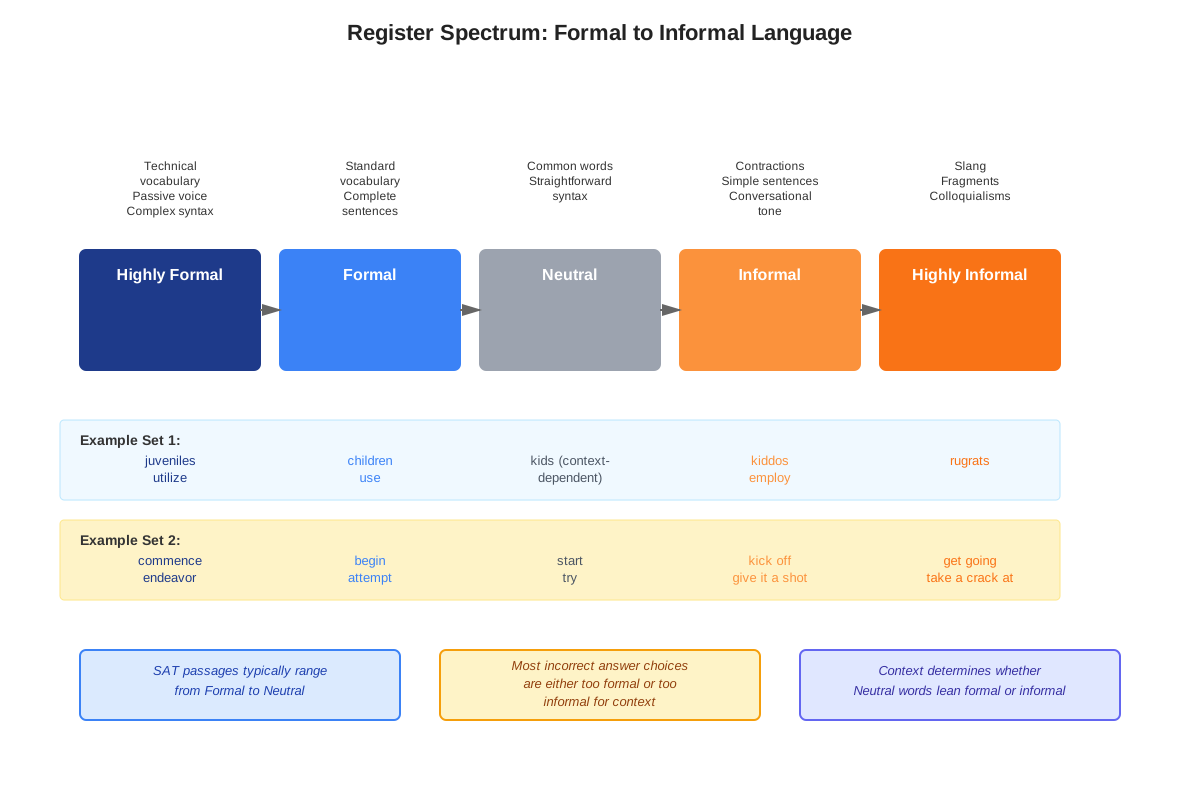
The formality spectrum includes several distinct levels:
| Register Level | Characteristics | Example Contexts | Sample Vocabulary |
|---|---|---|---|
| Highly Formal | Technical terminology, complex syntax, impersonal tone, passive voice | Academic journals, legal documents, official reports | utilize, commence, subsequent, endeavor |
| Formal | Precise vocabulary, complete sentences, objective tone | Textbooks, professional correspondence, news articles | use, begin, following, attempt |
| Neutral | Clear and direct, standard grammar, balanced tone | General informational writing, most SAT passages | use, start, next, try |
| Informal | Conversational language, contractions, personal tone | Personal emails, blogs, casual speech | use, kick off, after that, give it a shot |
| Highly Informal | Slang, fragments, colloquialisms | Text messages, intimate conversations | use, get going, then, take a crack at it |
Key Features of Register
Several linguistic features signal different register levels:
Vocabulary Selection: Formal registers favor Latinate words (commence, terminate, facilitate) while informal registers prefer Anglo-Saxon alternatives (start, end, help). Technical jargon appears in specialized formal contexts, while colloquialisms and idioms characterize informal language.
Sentence Structure: Formal writing employs longer, more complex sentences with subordinate clauses and sophisticated punctuation. Informal writing uses shorter, simpler sentences and may include fragments for emphasis. Passive voice ("The experiment was conducted") signals formality, while active voice ("We conducted the experiment") appears across registers but dominates informal contexts.
Tone and Voice: Formal registers maintain objective, impersonal tone, often avoiding first-person pronouns. Informal registers embrace subjective perspectives and personal engagement with readers. Neutral registers balance these approaches, using clear, direct language without excessive personality or detachment.
Contractions and Abbreviations: Contractions (can't, won't, it's) rarely appear in formal writing but frequently occur in informal contexts. Abbreviations follow similar patterns—formal writing spells out terms while informal writing uses shortcuts.
Register Consistency in SAT Passages
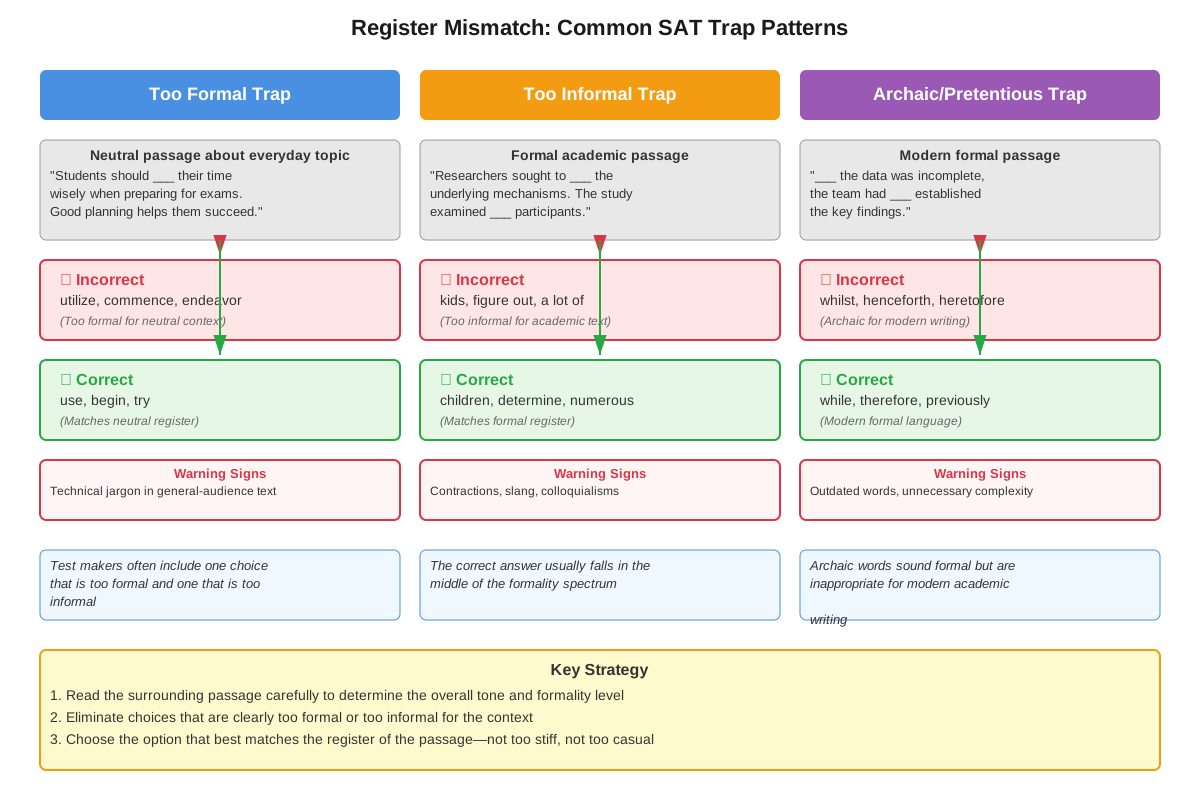
The SAT tests whether students recognize when language choices disrupt a passage's established register. A scientific article discussing "kids" instead of "children" or "juveniles" creates a register mismatch. Similarly, a personal narrative using "endeavor to ascertain" instead of "try to find out" sounds inappropriately formal.
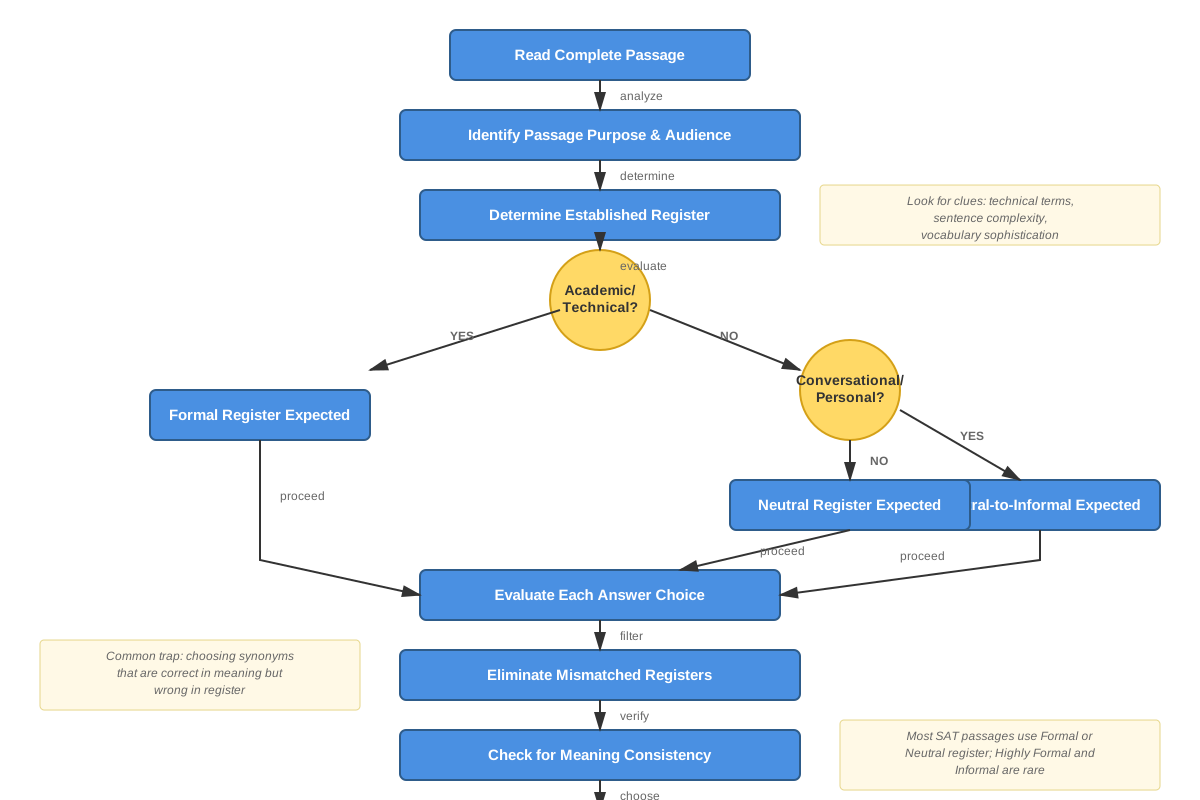
Successful register analysis requires three steps:
- Establish the baseline register: Read enough of the passage to determine its overall formality level, noting vocabulary choices, sentence patterns, and tone
- Identify the rhetorical context: Consider the passage's purpose (inform, persuade, entertain), audience (general public, specialists, students), and subject matter (technical, personal, general)
- Evaluate consistency: Assess whether the questioned word, phrase, or sentence maintains the established register or creates a jarring shift
Audience and Purpose Considerations
Register selection depends heavily on audience expectations and communicative purpose. Academic audiences expect formal register with precise terminology and objective analysis. General audiences prefer neutral to slightly informal register with accessible vocabulary and engaging presentation. Specialized audiences (scientists, lawyers, historians) anticipate field-specific jargon and conventions.
Purpose also influences register: persuasive writing may adopt more personal, engaging language than purely informative writing. Explanatory passages typically maintain neutral register to maximize clarity, while argumentative passages might shift toward formal register to establish authority.
Concept Relationships
Register and formality concepts interconnect in a hierarchical structure: Register (the broadest concept) encompasses formality levels (a specific dimension), which manifest through linguistic features (vocabulary, syntax, tone) that create stylistic consistency (the ultimate goal for SAT passages).
The relationship flows as follows:
Rhetorical Context (audience + purpose + subject) → Determines → Appropriate Register → Manifests through → Linguistic Features (vocabulary, syntax, tone) → Creates → Stylistic Consistency
Register awareness connects to prerequisite topics: vocabulary knowledge enables recognition of formality differences between synonyms; reading comprehension allows students to grasp overall passage tone; context clues help identify appropriate word choices within specific sentences.
Register also relates to other SAT Reading and Writing topics: transitions must match passage register (however vs. but); rhetorical synthesis requires maintaining consistent tone across combined sources; effective language use depends on register-appropriate word choices. Understanding register enhances performance on author's purpose questions, as purpose often determines appropriate formality level.
High-Yield Facts
⭐ Register questions typically ask students to select words or phrases that maintain stylistic consistency with the passage's established tone
⭐ Formal register features Latinate vocabulary, complex syntax, passive voice, and objective tone
⭐ Informal register includes contractions, colloquialisms, simpler sentence structures, and personal tone
⭐ The SAT most commonly tests neutral-to-formal register, as most passages are informational or academic
⭐ Context clues in surrounding sentences reveal the appropriate register level for questioned portions
- Scientific and technical passages almost always require formal register with specialized terminology
- Personal narratives and opinion pieces may appropriately use less formal register
- Register mismatches create jarring tonal shifts that disrupt passage coherence
- Synonyms can have identical denotations but vastly different connotations and formality levels
- The same word may be appropriate in one register but inappropriate in another (e.g., "kids" in informal contexts, "children" in formal)
- Audience awareness is crucial: writing for specialists allows technical jargon; writing for general audiences requires accessible language
- Register consistency extends beyond individual words to entire phrases and sentence structures
- Historical and literary passages may use archaic or elevated language that represents formal register for their time period
- Journalistic writing typically maintains neutral register to appeal to broad audiences
Quick check — test yourself on Register and formality so far.
Try Flashcards →Common Misconceptions
Misconception: Formal language is always better or more correct than informal language → Correction: Register appropriateness depends on context; informal language is correct and effective in appropriate situations (personal narratives, casual correspondence). The SAT tests whether language matches the passage's established tone, not whether it's "fancy" enough.
Misconception: Longer, more complex words always indicate higher formality → Correction: While formal register often employs sophisticated vocabulary, true formality depends on appropriateness to context. Using unnecessarily complex words in simple contexts creates pretentious, not formal, writing. The SAT rewards precision and consistency, not vocabulary showing off.
Misconception: All SAT passages require formal register → Correction: SAT passages span various formality levels depending on source and purpose. Some passages appropriately use conversational tone or personal voice. Students must identify each passage's specific register rather than defaulting to formal choices.
Misconception: Register only concerns individual word choices → Correction: Register encompasses vocabulary, sentence structure, tone, punctuation, and overall stylistic approach. A single formal word doesn't create formal register if surrounding sentences use informal structures and tone.
Misconception: Scientific or academic topics always require the most formal language possible → Correction: Modern academic and scientific writing increasingly values clarity and accessibility. Many contemporary passages use neutral register with clear, direct language rather than unnecessarily complex formal constructions. The SAT reflects this trend toward accessible academic writing.
Misconception: Contractions are always wrong in formal writing → Correction: While contractions typically signal informal register, some modern formal writing accepts them for readability. The key is consistency—if a passage uses contractions throughout, maintaining that pattern is appropriate. However, highly formal academic or technical writing still avoids contractions.
Worked Examples
Example 1: Vocabulary Register Matching
Passage Context: "The archaeological team spent three years excavating the ancient settlement. Their meticulous documentation of artifacts provided unprecedented insights into daily life during the Bronze Age. The researchers were particularly excited about pottery fragments that _______ trade networks extending across the Mediterranean."
Question: Which choice completes the text with the most logical and precise word or phrase?
A) showed
B) revealed
C) pointed to
D) made clear
Solution Process:
Step 1 - Establish baseline register: The passage uses formal academic language: "archaeological," "excavating," "meticulous documentation," "unprecedented insights." The sentence structure is complex with sophisticated vocabulary. This indicates formal register.
Step 2 - Analyze each option's formality:
- "showed" - neutral, simple, common in all registers
- "revealed" - formal, precise, common in academic writing
- "pointed to" - informal phrasal verb, conversational
- "made clear" - neutral to slightly informal, less precise
Step 3 - Evaluate consistency: The passage's formal academic tone requires vocabulary that matches its sophistication. "Revealed" maintains the formal register while providing precise meaning appropriate to archaeological research. "Showed" is too simple for the established tone. "Pointed to" introduces inappropriate informality. "Made clear" lacks the precision expected in academic contexts.
Answer: B) revealed
Connection to Learning Objectives: This example demonstrates identifying register features (formal academic vocabulary) and applying register awareness to select appropriate word choices that maintain stylistic consistency.
Example 2: Sentence-Level Register Consistency
Passage Context: "Climate scientists have documented significant changes in Arctic ice coverage over the past five decades. Satellite imagery reveals accelerating ice loss, particularly during summer months. These observations align with predictive models of global temperature increases."
Question: The writer wants to add a sentence that maintains the passage's formal, objective tone. Which choice best accomplishes this goal?
A) It's pretty obvious that things are getting worse up there in the Arctic.
B) The data clearly shows we need to do something about this problem right away.
C) The findings underscore the urgent need for comprehensive climate policy responses.
D) Basically, the ice is melting way faster than anyone thought it would.
Solution Process:
Step 1 - Identify passage register: The passage employs formal scientific register with characteristics including:
- Technical vocabulary: "documented," "satellite imagery," "predictive models"
- Objective tone: no personal pronouns or emotional language
- Complex sentence structure with precise terminology
- Passive and active voice used appropriately for scientific writing
Step 2 - Evaluate each option:
Option A: "It's pretty obvious" uses contraction and colloquial expression; "things" is vague; "up there" is conversational. Register: Highly informal - eliminates this choice.
Option B: "The data clearly shows" has subject-verb agreement error (data show); "we need to do something" introduces personal pronouns and vague language; "right away" is conversational. Register: Informal - eliminates this choice.
Option C: "The findings underscore" uses formal academic vocabulary; "comprehensive climate policy responses" employs precise, sophisticated terminology; maintains objective tone without personal pronouns; sentence structure matches passage complexity. Register: Formal - matches passage.
Option D: "Basically" is a conversational filler word; "way faster" is colloquial intensifier; "anyone thought" introduces informal speculation. Register: Informal - eliminates this choice.
Answer: C) The findings underscore the urgent need for comprehensive climate policy responses.
Connection to Learning Objectives: This example requires explaining how register appears on the SAT (sentence-level consistency questions), identifying register features across multiple options, and applying register principles to select the appropriate choice.
Exam Strategy
Approaching Register Questions
When encountering register and formality questions on the SAT, follow this systematic approach:
- Read broadly first: Don't focus immediately on the blank or questioned portion. Read at least 2-3 sentences before and after to establish the passage's overall tone and formality level.
- Identify register markers: Note specific vocabulary choices, sentence structures, and tone indicators that signal the passage's register. Look for patterns: Does the passage use technical terms? Contractions? Personal pronouns? Complex or simple sentences?
- Eliminate obvious mismatches: Before selecting the "best" answer, eliminate choices that clearly clash with the established register. This often removes 2-3 options immediately.
- Compare remaining choices: Among options that seem potentially appropriate, select the one that most precisely matches the passage's specific formality level and stylistic approach.
Trigger Words and Phrases
Watch for these question stems that signal register testing:
- "Which choice completes the text so that it conforms to the conventions of Standard English?"
- "Which choice best maintains the style and tone of the passage?"
- "The writer wants to maintain a formal/informal tone. Which choice best accomplishes this goal?"
- "Which choice most effectively combines the sentences while maintaining the passage's style?"
Passage-level triggers indicating formal register:
- Technical terminology and jargon
- Passive voice constructions
- Abstract nouns (implementation, facilitation, optimization)
- Latinate vocabulary (utilize, commence, terminate)
- Complex sentence structures with multiple clauses
Passage-level triggers indicating informal register:
- Contractions (can't, won't, it's)
- Colloquial expressions and idioms
- Personal pronouns (I, we, you)
- Simple, direct sentences
- Conversational vocabulary
Process of Elimination Tips
Eliminate choices that:
- Use contractions in formal passages or avoid them in informal passages
- Employ slang or colloquialisms in academic/technical contexts
- Use unnecessarily complex vocabulary in straightforward passages
- Introduce personal tone in objective, informational writing
- Shift from active to passive voice (or vice versa) without reason
- Include phrasal verbs (look into, figure out) in formal contexts where single-word alternatives exist
Keep choices that:
- Match the passage's vocabulary sophistication level
- Maintain consistent sentence complexity
- Preserve the established tone (objective vs. personal)
- Use terminology appropriate to the subject matter and audience
Time Allocation
Register questions typically require 30-45 seconds each. Spend:
- 10-15 seconds reading context and establishing baseline register
- 10-15 seconds evaluating all four options
- 5-10 seconds confirming your selection and eliminating alternatives
- 5 seconds marking your answer
If uncertain, mark the question for review but make your best selection before moving on. Register questions reward careful reading but don't require extensive analysis—trust your ear for language consistency.
Memory Techniques
The FAST Mnemonic for Register Analysis
Formality level - Identify whether the passage is formal, neutral, or informal
Audience awareness - Consider who the intended readers are
Style consistency - Ensure the choice matches established patterns
Tone maintenance - Preserve the passage's objective or personal voice
The Formality Ladder Visualization
Visualize formality as a ladder with five rungs:
Top Rung (Highly Formal): Legal documents, academic journals - "utilize," "commence," "endeavor"
Fourth Rung (Formal): Textbooks, professional writing - "use," "begin," "attempt"
Middle Rung (Neutral): News articles, general information - "use," "start," "try"
Second Rung (Informal): Personal blogs, casual emails - "use," "kick off," "give it a shot"
Bottom Rung (Highly Informal): Text messages, slang - "use," "get going," "take a crack at it"
When answering questions, identify which rung the passage occupies, then select the answer choice from the same rung.
The CLAP Acronym for Register Features
Contractions - Present in informal, absent in formal
Latinate vocabulary - Common in formal, rare in informal
Active vs. passive voice - Passive signals formality
Personal pronouns - Avoided in formal, embraced in informal
The Synonym Spectrum Technique
For vocabulary questions, arrange synonyms by formality:
Informal → Neutral → Formal
kids → children → juveniles
show → demonstrate → elucidate
help → assist → facilitate
end → finish → terminate
Memorizing these common progressions helps quickly identify appropriate register matches.
Summary
Register and formality represent crucial concepts for SAT Reading and Writing success, testing students' ability to recognize and maintain appropriate language levels across diverse contexts. Register encompasses the variety of language used in specific situations, determined by audience, purpose, and subject matter, while formality represents one key dimension of register, ranging from highly formal academic language to casual conversational expression. The SAT tests register primarily through Words in Context questions that require students to select vocabulary, phrases, or sentences matching a passage's established tone and style. Success demands recognizing linguistic features that signal different formality levels—including vocabulary sophistication, sentence complexity, tone objectivity, and structural patterns—then applying this awareness to maintain stylistic consistency. Students must quickly establish a passage's baseline register by noting patterns in word choice and sentence structure, then evaluate answer options for appropriate matches while eliminating choices that create jarring tonal shifts. Mastering register awareness extends beyond test performance to essential college and career skills, enabling effective communication across academic, professional, and personal contexts.
Key Takeaways
- Register refers to language variety appropriate to specific contexts, with formality representing a key dimension ranging from highly formal to highly informal
- SAT register questions test whether students can maintain stylistic consistency by selecting words, phrases, or sentences matching a passage's established tone
- Formal register features include Latinate vocabulary, complex syntax, passive voice, objective tone, and absence of contractions
- Informal register characteristics include colloquialisms, contractions, simpler sentences, personal tone, and conversational vocabulary
- Successful register analysis requires establishing baseline formality, identifying rhetorical context (audience and purpose), and evaluating consistency
- Most SAT passages employ neutral-to-formal register, though some appropriately use less formal language depending on source and purpose
- Register awareness connects to broader Reading and Writing skills including rhetorical synthesis, author's purpose analysis, and effective communication
Related Topics
Rhetorical Synthesis: Building on register awareness, rhetorical synthesis questions require students to combine information from multiple sources while maintaining consistent tone and style across integrated passages.
Transitions and Logical Flow: Understanding register helps select transitions appropriate to passage formality—formal passages use "however" and "consequently" while informal contexts accept "but" and "so."
Author's Purpose and Tone: Register analysis directly supports identifying author's purpose, as formal register often signals informative intent while personal register suggests persuasive or narrative purposes.
Effective Language Use: Register mastery enables broader effective language skills, including precision, concision, and style, all tested throughout the SAT Reading and Writing section.
Standard English Conventions: While register focuses on stylistic appropriateness, it connects to grammar conventions that vary by formality level, such as pronoun usage and sentence structure preferences.
Practice CTA
Now that you've mastered the core concepts of register and formality, it's time to apply your knowledge! Work through the practice questions to test your ability to identify formality levels, maintain stylistic consistency, and select register-appropriate vocabulary. The flashcards will help reinforce key distinctions between formal and informal language features. Remember: register awareness is a skill that improves with practice—each question you analyze strengthens your ear for language consistency and prepares you for test-day success. You've built a strong foundation; now demonstrate your mastery!
Sign up free to keep reading
Create a free AnvayaPrep account to finish this SAT guide on Register and formality — plus flashcards and practice questions.