Overview
Scientific terms in context represent a critical category of vocabulary questions on the SAT Reading and Writing section. These questions assess a student's ability to determine the precise meaning of specialized terminology as it appears within scientific passages, rather than testing memorization of dictionary definitions. The SAT frequently presents passages from natural sciences, social sciences, and technical fields that contain domain-specific vocabulary, and students must use contextual clues to identify which meaning of a term best fits the author's intended use.
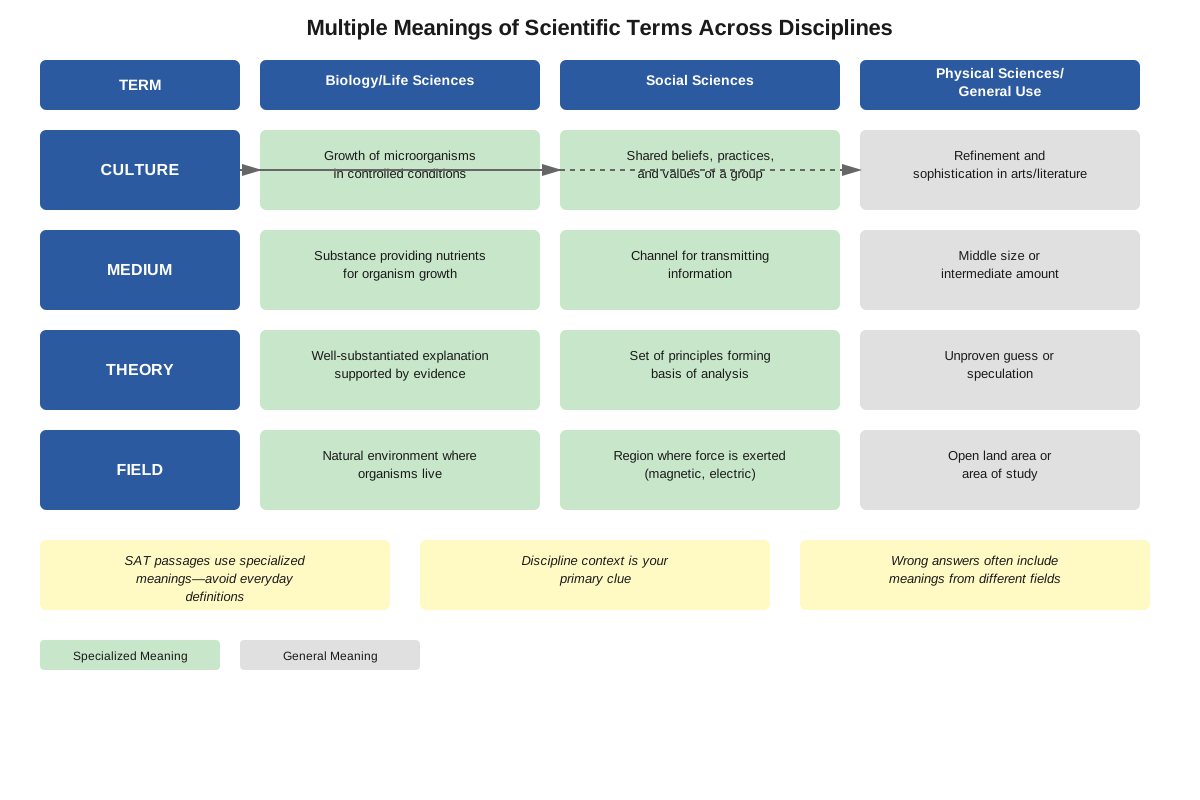
Understanding how to approach sat scientific terms in context questions is essential because they appear consistently across multiple test administrations and account for a significant portion of the Words in Context question type. Unlike everyday vocabulary, scientific terms often carry multiple meanings depending on the discipline or context in which they appear. For example, the word "culture" means something entirely different in biology (a controlled growth of microorganisms) than in anthropology (shared beliefs and practices of a group). The SAT specifically tests whether students can distinguish between these specialized meanings based on surrounding textual evidence.
This topic connects directly to broader rw (Reading and Writing) skills, particularly close reading, evidence-based reasoning, and the ability to synthesize information from complex texts. Mastering scientific terms in context strengthens overall reading comprehension abilities and prepares students for the academic vocabulary they will encounter in college-level coursework across all disciplines. Success with these questions requires both strategic reading techniques and an understanding of how scientific language functions within different fields of study.
Learning Objectives
- [ ] Identify key features of Scientific terms in context
- [ ] Explain how Scientific terms in context appears on the SAT
- [ ] Apply Scientific terms in context to answer SAT-style questions
- [ ] Distinguish between common and specialized meanings of scientific vocabulary
- [ ] Use contextual clues to determine the precise meaning of technical terms in passages
- [ ] Recognize discipline-specific vocabulary patterns across natural sciences, social sciences, and technical fields
- [ ] Evaluate answer choices by matching them to the specific context provided in the passage
Prerequisites
- Basic vocabulary skills: Understanding of how context clues work in general reading comprehension provides the foundation for analyzing more specialized scientific terminology
- Familiarity with SAT question formats: Knowledge of how the SAT structures multiple-choice questions helps students recognize the specific patterns used in scientific terms questions
- Reading comprehension fundamentals: Ability to identify main ideas, supporting details, and author's purpose enables students to understand the broader context in which scientific terms appear
- Exposure to various academic disciplines: General awareness of different fields (biology, psychology, geology, etc.) helps students recognize when a term is being used in a specialized versus general way
Why This Topic Matters
Scientific terms in context questions appear with remarkable consistency on the SAT, typically comprising 3-5 questions per test administration within the Reading and Writing section. These questions are considered high-yield because they follow predictable patterns and can be mastered through systematic practice. The College Board includes these questions to assess college readiness, as undergraduate coursework across all majors requires students to navigate specialized vocabulary in textbooks, research articles, and lectures.
In real-world applications, the ability to decode scientific terminology from context is essential for informed citizenship. Understanding scientific reporting in news media, evaluating health information, comprehending environmental policy discussions, and making evidence-based decisions all require facility with technical vocabulary. Students who master this skill gain access to a broader range of information sources and can engage more meaningfully with contemporary issues that involve scientific concepts.
On the SAT, scientific terms in context questions most commonly appear in passages drawn from natural sciences (biology, chemistry, physics, earth science), social sciences (psychology, sociology, economics, anthropology), and occasionally technical or applied sciences. The passages typically range from 25-150 words and present a term that has both a common everyday meaning and a specialized scientific meaning. Students must select the answer choice that matches the term's specific use within the passage, not simply its most familiar definition.
Core Concepts
Understanding Scientific Terms in Context
Scientific terms in context refers to specialized vocabulary used within academic and technical disciplines that may differ from everyday usage. These terms function as precise tools for communicating complex ideas within specific fields. The SAT tests whether students can identify the correct meaning of such terms by analyzing how they function within a particular passage, rather than relying on memorized definitions.
The key principle underlying these questions is that context determines meaning. A single word can serve multiple functions across different disciplines or even within the same field. For example, "theory" in everyday conversation often means "a guess," but in scientific contexts, it refers to a well-substantiated explanation supported by extensive evidence. The SAT specifically targets these distinctions to assess reading sophistication.
Types of Scientific Terms Tested
The SAT focuses on several categories of scientific vocabulary:
Discipline-specific technical terms: Words that have precise meanings within particular fields, such as "mitosis" in biology, "precipitation" in chemistry or meteorology, or "stratification" in sociology or geology. These terms may be completely unfamiliar outside their specialized contexts.
Cross-disciplinary terms with varying meanings: Words used across multiple fields but with different specific meanings in each, such as "culture" (biology vs. anthropology), "field" (physics vs. agriculture), or "depression" (psychology vs. meteorology vs. economics).
Common words with specialized scientific meanings: Everyday vocabulary that takes on precise technical meanings in scientific contexts, such as "work" (physics), "positive" (mathematics or medicine), "family" (biology), or "significant" (statistics).
Process and methodology terms: Vocabulary describing scientific methods and procedures, such as "control," "variable," "hypothesis," "correlation," or "observation."
How Context Clues Function in Scientific Passages
Scientific passages provide several types of contextual information that help readers determine precise meanings:
Definitional context: The passage may directly define or explain the term, often using phrases like "refers to," "means," "is defined as," or "consists of." This is the most straightforward type of context clue.
Example-based context: The passage provides specific examples or applications of the concept, allowing readers to infer meaning from concrete instances. For example, a passage might list several species that exhibit a particular behavior, helping readers understand what that behavior entails.
Contrast and comparison context: The passage distinguishes the term from related concepts or compares it to something familiar, using words like "unlike," "whereas," "in contrast to," or "similar to."
Functional context: The passage describes what the term does, its purpose, or its effects, allowing readers to understand its meaning through its role or function within a system or process.
The Structure of SAT Scientific Terms Questions
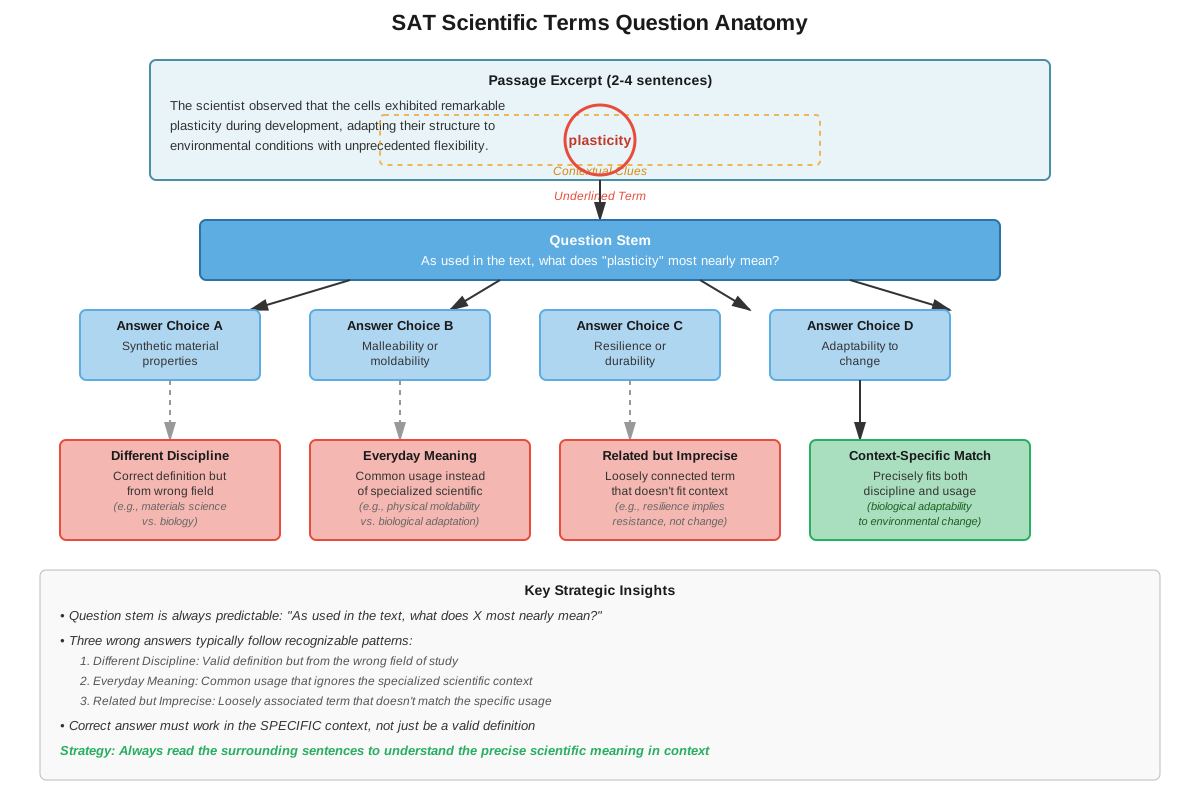
These questions follow a consistent format. The passage appears first, typically 1-3 paragraphs containing the target term in bold or underlined. The question stem asks: "As used in the text, what does the word [term] most nearly mean?" Four answer choices follow, each presenting a different possible meaning.
The answer choices are carefully constructed to include:
- The correct answer matching the passage's specific context
- The term's most common everyday meaning (if different from the scientific meaning)
- Related but incorrect scientific meanings from other contexts
- Plausible-sounding but inaccurate interpretations
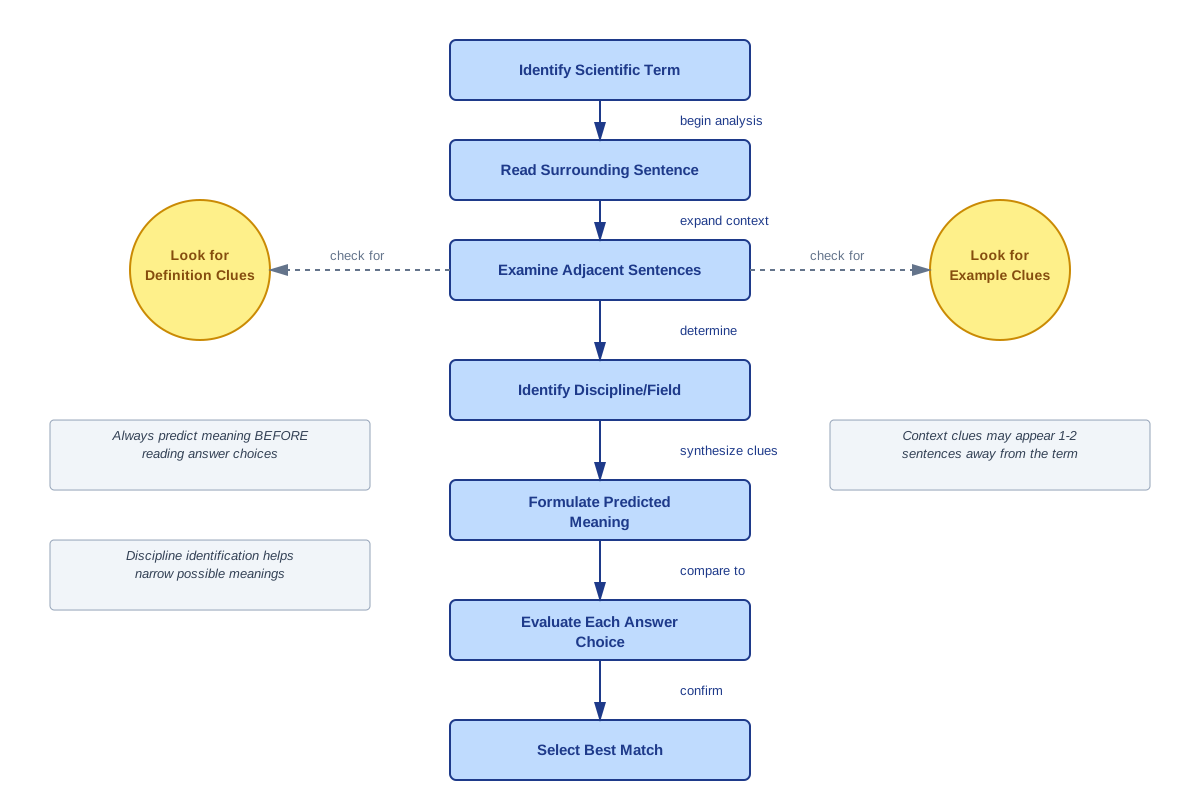
Reading Strategies for Scientific Terms
Successful students employ systematic approaches when encountering these questions:
- Read the entire passage first before looking at answer choices, focusing on understanding the overall topic and how the term functions within the discussion
- Identify the sentence containing the term and read the sentences immediately before and after for additional context
- Substitute each answer choice into the original sentence to test which creates the most logical and coherent meaning
- Look for explicit clues such as definitions, examples, or explanatory phrases that directly illuminate the term's meaning
- Consider the discipline being discussed, as this often signals whether a common word is being used in a specialized way
Concept Relationships
The ability to determine scientific terms in context builds directly upon fundamental reading comprehension skills, particularly the use of context clues to determine word meaning. This foundational skill, typically developed in earlier education, becomes more sophisticated when applied to specialized academic vocabulary. The relationship flows: basic context clue skills → recognition of specialized vocabulary → analysis of discipline-specific meanings → precise interpretation of scientific terms.
Within the broader SAT Reading and Writing section, scientific terms in context questions connect closely to other Words in Context questions involving literary or general academic vocabulary. All these question types share the same underlying skill: using textual evidence to determine precise meaning. However, scientific terms questions add the additional layer of recognizing when common words carry specialized meanings or when unfamiliar technical terms must be decoded from surrounding information.
Scientific terms in context also relates to the SAT's Information and Ideas questions, particularly those asking about main ideas, supporting details, and author's purpose. Understanding technical vocabulary is often essential for comprehending the central argument or findings presented in scientific passages. The relationship works bidirectionally: understanding main ideas → helps interpret specific terms, and understanding specific terms → enables comprehension of main ideas.
Furthermore, this topic connects to the Command of Evidence questions on the SAT, as students must identify which textual details support their interpretation of a term's meaning. The skill of citing evidence for vocabulary interpretations mirrors the broader skill of citing evidence for claims about passage content.
High-Yield Facts
⭐ Scientific terms in context questions appear 3-5 times per SAT test, making them one of the most frequent question types in the Words in Context category
⭐ The correct answer always matches the specific way the term is used in the passage, not necessarily its most common or familiar meaning
⭐ Wrong answer choices typically include the term's everyday meaning when the passage uses a specialized scientific meaning
⭐ Context clues appear most frequently in the same sentence as the term or in the immediately surrounding sentences
⭐ The SAT favors terms that have both common everyday meanings and specialized scientific meanings, creating opportunities for confusion
- Scientific passages on the SAT draw from natural sciences, social sciences, and technical fields with roughly equal frequency
- Definitional context clues (where the passage explicitly explains the term) are the most reliable type of context clue
- Reading the entire passage before examining answer choices improves accuracy by providing fuller context
- The term being tested is always used correctly within the passage; students must identify what that correct usage means
- Substituting answer choices back into the original sentence is an effective verification strategy
- Cross-disciplinary terms (used in multiple fields with different meanings) are especially common on the SAT
- The difficulty of these questions comes from the answer choices, not from the passages themselves, which always provide sufficient context
- Scientific terms questions test reading comprehension, not prior knowledge of scientific facts
Quick check — test yourself on Scientific terms in context so far.
Try Flashcards →Common Misconceptions
Misconception: Students should select the most familiar or common definition of a term → Correction: The correct answer must match how the term is specifically used in the passage, which may be a specialized meaning rather than the everyday definition. Always prioritize textual evidence over prior knowledge.
Misconception: Scientific terms questions require extensive background knowledge in science → Correction: These questions are designed to be answerable using only the information provided in the passage. The SAT tests reading comprehension, not science content knowledge. All necessary context appears within the passage itself.
Misconception: The longest or most complex answer choice is usually correct → Correction: Answer choice length has no correlation with correctness. The right answer is simply the one that best matches the passage's specific usage, whether that answer is simple or complex.
Misconception: If a term appears in a biology passage, students should automatically choose the biology-related answer → Correction: While discipline provides helpful context, students must still verify that the chosen answer matches the specific way the term functions in the passage. Not every term in a science passage is being used in its technical sense.
Misconception: Students can skip reading the passage and just look at the sentence containing the term → Correction: The broader passage context is often essential for understanding how a term is being used. The topic, main idea, and surrounding discussion all contribute to determining precise meaning.
Misconception: Scientific terms are always difficult, unfamiliar words → Correction: The SAT frequently tests common, everyday words that take on specialized meanings in scientific contexts (like "work," "positive," or "culture"). These familiar words can be more challenging because students must override their automatic understanding of the common meaning.
Worked Examples
Example 1: Cross-Disciplinary Term
Passage: "In geological studies, the term 'plate' refers to massive sections of Earth's lithosphere that move slowly over the underlying asthenosphere. These plates interact at their boundaries, creating earthquakes, volcanic activity, and mountain formation. The Pacific Plate, for instance, is one of the largest tectonic plates, covering much of the Pacific Ocean floor."
Question: As used in the text, what does the word "plate" most nearly mean?
Answer Choices:
A) A flat dish used for serving food
B) A thin, flat sheet of metal
C) A large, rigid section of Earth's outer layer
D) A flat piece of glass used in microscopy
Solution Process:
Step 1: Read the entire passage to understand the context. The passage discusses geological studies and Earth's structure, immediately signaling that "plate" is being used in a specialized geological sense, not its everyday meaning.
Step 2: Examine the sentence containing "plate" and surrounding context. The passage explicitly states that plates are "massive sections of Earth's lithosphere" that "move slowly" and "interact at their boundaries." This is a definitional context clue.
Step 3: Evaluate each answer choice:
- Choice A represents the everyday meaning of "plate" but has no connection to the geological context
- Choice B describes a general flat object but doesn't capture the specific geological meaning
- Choice C directly matches the passage's description of plates as large sections of Earth's outer layer
- Choice D represents a scientific use of "plate" but from a different field (microscopy, not geology)
Step 4: Verify by substitution. Replacing "plate" with "large, rigid section of Earth's outer layer" in the original sentence creates a coherent, logical meaning that aligns with the passage's discussion.
Correct Answer: C
Connection to Learning Objectives: This example demonstrates how to identify the specialized meaning of a cross-disciplinary term (plate appears in multiple contexts) and use definitional context clues to determine the precise meaning intended in a specific passage.
Example 2: Common Word with Scientific Meaning
Passage: "In statistical analysis, researchers must determine whether their findings are significant before drawing conclusions. A result is considered significant when the probability that it occurred by chance alone is sufficiently low, typically less than 5%. This threshold helps scientists distinguish between meaningful patterns and random variation in their data. Without establishing significance, researchers cannot confidently claim that their observations reflect true relationships."
Question: As used in the text, what does the word "significant" most nearly mean?
Answer Choices:
A) Important or meaningful in a general sense
B) Large in size or amount
C) Unlikely to have occurred by random chance
D) Worthy of attention or notice
Solution Process:
Step 1: Identify the discipline and context. The passage discusses statistical analysis and research methodology, indicating that "significant" is being used in its technical statistical sense rather than its everyday meaning.
Step 2: Locate context clues. The passage provides a definitional context clue: "A result is considered significant when the probability that it occurred by chance alone is sufficiently low." This directly explains what "significant" means in this context.
Step 3: Analyze answer choices:
- Choice A represents the common everyday meaning but lacks the specific statistical definition
- Choice B is another common meaning but doesn't relate to the statistical context
- Choice C precisely captures the statistical definition provided in the passage
- Choice D is similar to Choice A, representing general importance rather than statistical significance
Step 4: Verify using the passage's own definition. The passage explicitly states that significance relates to low probability of chance occurrence, which matches Choice C exactly.
Correct Answer: C
Connection to Learning Objectives: This example illustrates how common words can have precise technical meanings in scientific contexts and demonstrates the importance of recognizing definitional context clues that explicitly explain terms.
Exam Strategy
Approaching Scientific Terms Questions Systematically
When encountering a scientific terms in context question, follow this strategic sequence:
First, read the passage completely before looking at the question or answer choices. This prevents premature conclusions and ensures full contextual understanding. Note the general topic and discipline being discussed.
Second, identify the specific sentence containing the term and read it carefully. Then read the sentence before and the sentence after to capture the immediate context. Look for explicit clues like definitions, examples, or explanatory phrases.
Third, before examining answer choices, try to predict the meaning based on context. Ask: "What would make sense here given what the passage is discussing?" This prediction serves as an anchor for evaluating choices.
Fourth, systematically evaluate each answer choice by substituting it into the original sentence. The correct answer should create a logical, coherent meaning that aligns with the passage's overall discussion.
Trigger Words and Phrases
Certain phrases signal that the passage is providing context clues:
- Definitional triggers: "refers to," "means," "is defined as," "consists of," "is known as," "describes"
- Example triggers: "such as," "for instance," "for example," "including," "like"
- Contrast triggers: "unlike," "whereas," "in contrast to," "rather than," "instead of"
- Explanation triggers: "because," "since," "as a result," "therefore," "thus"
Exam Tip: When you see these trigger phrases near the term being tested, pay extra attention—they often provide direct clues to the term's meaning.
Process of Elimination Strategies
Eliminate everyday meanings first when the passage clearly discusses a specialized topic. If a biology passage uses the word "culture," the answer about shared beliefs and practices can typically be eliminated immediately.
Eliminate answers from wrong disciplines. If the passage discusses psychology, eliminate answer choices that define terms from chemistry or physics, even if those are legitimate scientific meanings of the word.
Eliminate answers that don't fit grammatically or logically when substituted into the original sentence. The correct answer must create a coherent sentence that makes sense within the passage's argument.
Be cautious with partially correct answers. Some choices may contain elements of truth but don't fully capture the specific meaning used in the passage. The correct answer must be completely accurate for the given context.
Time Allocation
Scientific terms in context questions should take approximately 45-60 seconds each. The passages are relatively short, and the questions follow predictable patterns. If a question is taking longer than 90 seconds, employ these time-saving strategies:
- Focus on the immediate context (the sentence with the term plus one before and one after) rather than analyzing every detail
- Eliminate obviously wrong answers quickly to narrow choices
- Trust definitional context clues when they appear—they provide direct answers
- Mark the question and return to it if needed, but these questions are generally more straightforward than inference or main idea questions
Memory Techniques
The CONTEXT Acronym
Use CONTEXT to remember the systematic approach:
- Check the discipline (What field is being discussed?)
- Observe the sentence (Read the sentence with the term carefully)
- Note surrounding sentences (Read before and after for additional clues)
- Test each answer (Substitute choices into the original sentence)
- Eliminate wrong meanings (Remove everyday definitions if specialized meaning is indicated)
- Xamine for explicit clues (Look for definitions, examples, or explanations)
- Trust the passage (The answer is always supported by textual evidence)
Visualization Strategy
Picture scientific terms as chameleons that change color (meaning) depending on their environment (context). Just as a chameleon on a leaf looks different from one on bark, the word "culture" in a biology passage means something different from "culture" in an anthropology passage. This mental image reinforces that context determines meaning.
The "Three-Sentence Rule"
Remember: The sentence before, the sentence with, the sentence after. The answer to scientific terms questions almost always appears within this three-sentence window. This focuses attention on the most relevant textual evidence.
Mnemonic for Common Trap Answers
FEED helps remember what wrong answers typically include:
- Familiar everyday meanings (when specialized meaning is correct)
- Extraneous discipline definitions (scientific meanings from wrong fields)
- Exaggerated or extreme interpretations
- Dictionary definitions that don't match passage usage
Summary
Scientific terms in context questions assess the ability to determine precise meanings of specialized vocabulary by analyzing how terms function within specific passages. These high-yield questions appear consistently on the SAT and test reading comprehension rather than prior scientific knowledge. Success requires recognizing that context determines meaning, particularly when common words carry specialized scientific definitions or when technical terms must be decoded from surrounding textual evidence. The most effective approach involves reading passages completely, identifying context clues (especially definitional, example-based, and contrast clues), and systematically evaluating answer choices by substituting them into original sentences. Students must prioritize textual evidence over familiar definitions and recognize that wrong answers typically include everyday meanings when specialized meanings are correct, or definitions from incorrect disciplines. Mastering these questions strengthens overall reading comprehension and prepares students for the academic vocabulary demands of college coursework across all fields.
Key Takeaways
- Scientific terms in context questions test reading comprehension using textual evidence, not memorized scientific knowledge
- The correct answer always matches the specific way a term is used in the passage, which may differ from its most common meaning
- Context clues—especially definitions, examples, and contrasts—appear within the same sentence or immediately surrounding sentences
- Common words with specialized scientific meanings are frequently tested and require careful attention to context
- Systematic strategies (reading full passages, substituting answers, eliminating wrong disciplines) significantly improve accuracy
- These questions are high-yield, appearing 3-5 times per test with predictable patterns that can be mastered through practice
- Cross-disciplinary terms that have different meanings in different fields are especially common on the SAT
Related Topics
Words in Context - Literary Terms: Similar to scientific terms questions but focusing on vocabulary from literature, history, and humanities passages. Mastering scientific terms provides transferable skills for analyzing how context determines meaning across all disciplines.
Information and Ideas - Main Idea Questions: Understanding technical vocabulary is often essential for identifying the central claims in scientific passages. Strong vocabulary skills enable more accurate comprehension of passage arguments.
Command of Evidence Questions: These questions require citing textual support for interpretations, a skill directly related to identifying context clues that support vocabulary meanings.
Cross-Text Connections: Some SAT questions ask students to synthesize information across paired passages, which may require understanding how the same scientific term is used differently in each passage.
Standard English Conventions - Precision: Understanding precise word choice in scientific contexts connects to broader skills in recognizing appropriate vocabulary for specific purposes and audiences.
Practice CTA
Now that you understand the strategies and patterns for scientific terms in context questions, it's time to apply these skills! Work through the practice questions to reinforce your ability to identify context clues, eliminate wrong answers, and select precise meanings. The flashcards will help you internalize common scientific terms and their various meanings across disciplines. Remember: these questions are highly predictable and masterable—consistent practice with the systematic approaches outlined in this guide will build both confidence and accuracy. Every practice question you complete strengthens your ability to decode specialized vocabulary and improves your overall SAT Reading and Writing score!
Sign up free to keep reading
Create a free AnvayaPrep account to finish this SAT guide on Scientific terms in context — plus flashcards and practice questions.