Overview
The distinction between affect versus effect represents one of the most frequently tested grammar concepts on the ACT English section. These two words sound nearly identical when spoken, creating confusion that test makers deliberately exploit to assess students' command of standard written English. Understanding when to use each word correctly requires mastering both their grammatical functions and their subtle meaning differences.
This topic appears consistently across multiple ACT English passages, typically embedded within sentences where context clues may be minimal. The ACT tests this concept because it evaluates a student's ability to distinguish between parts of speech—specifically, recognizing when a sentence requires a verb versus a noun. Mastery of ACT affect versus effect questions directly impacts scores because these questions appear in the Usage/Mechanics subscore category, which comprises approximately 40% of the English section. Students who can quickly and accurately identify the correct usage gain a significant advantage in both speed and accuracy.
Beyond its isolated application, the affect/effect distinction connects to broader grammar concepts including verb identification, noun recognition, and sentence structure analysis. This topic reinforces understanding of how words function within sentences and how meaning shifts based on grammatical role. Students who master this distinction develop stronger overall grammar intuition, which transfers to other challenging ACT English concepts such as subject-verb agreement, pronoun case, and modifier placement.
Learning Objectives
- [ ] Identify when affect versus effect is being tested in ACT passages
- [ ] Explain the core rule or strategy behind affect versus effect usage
- [ ] Apply affect versus effect to ACT-style questions accurately
- [ ] Distinguish between the primary and secondary uses of both "affect" and "effect"
- [ ] Recognize context clues that signal which word is grammatically appropriate
- [ ] Evaluate answer choices by determining the required part of speech in context
- [ ] Demonstrate mastery by achieving 90%+ accuracy on practice questions involving this distinction
Prerequisites
- Parts of speech identification: Understanding the difference between nouns and verbs is essential because "affect" primarily functions as a verb while "effect" primarily functions as a noun
- Basic sentence structure: Recognizing subjects, verbs, and objects helps determine which grammatical role a word must fill in context
- Context clue analysis: The ability to use surrounding words to determine meaning supports correct word choice when both options seem plausible
- Article recognition: Knowing that articles (a, an, the) typically precede nouns helps identify when "effect" is the correct choice
Why This Topic Matters
In real-world writing, the affect/effect distinction matters because using the wrong word undermines credibility and clarity. Professional communication, academic writing, and formal correspondence all require precise word choice. Readers notice these errors, and in contexts like college applications, scholarship essays, or workplace documents, such mistakes can negatively impact how the writer is perceived.
On the ACT specifically, affect versus effect questions appear in approximately 2-4 questions per test administration, making this a high-yield topic relative to study time investment. These questions typically appear as "word choice" or "usage" questions within the Usage/Mechanics category. The ACT presents these questions in several formats: standalone sentences requiring word substitution, paragraph-level questions where context determines correctness, and questions where all answer choices are grammatically structured but only one uses the correct word.
The frequency and predictability of this topic make it an excellent target for score improvement. Unlike more complex grammar concepts that require extensive analysis, affect/effect questions can be answered quickly once the core rule is mastered. Students who confidently handle these questions gain both points and time—time that can be allocated to more challenging rhetorical skills questions later in the section.
Core Concepts
The Primary Rule: Affect as Verb, Effect as Noun
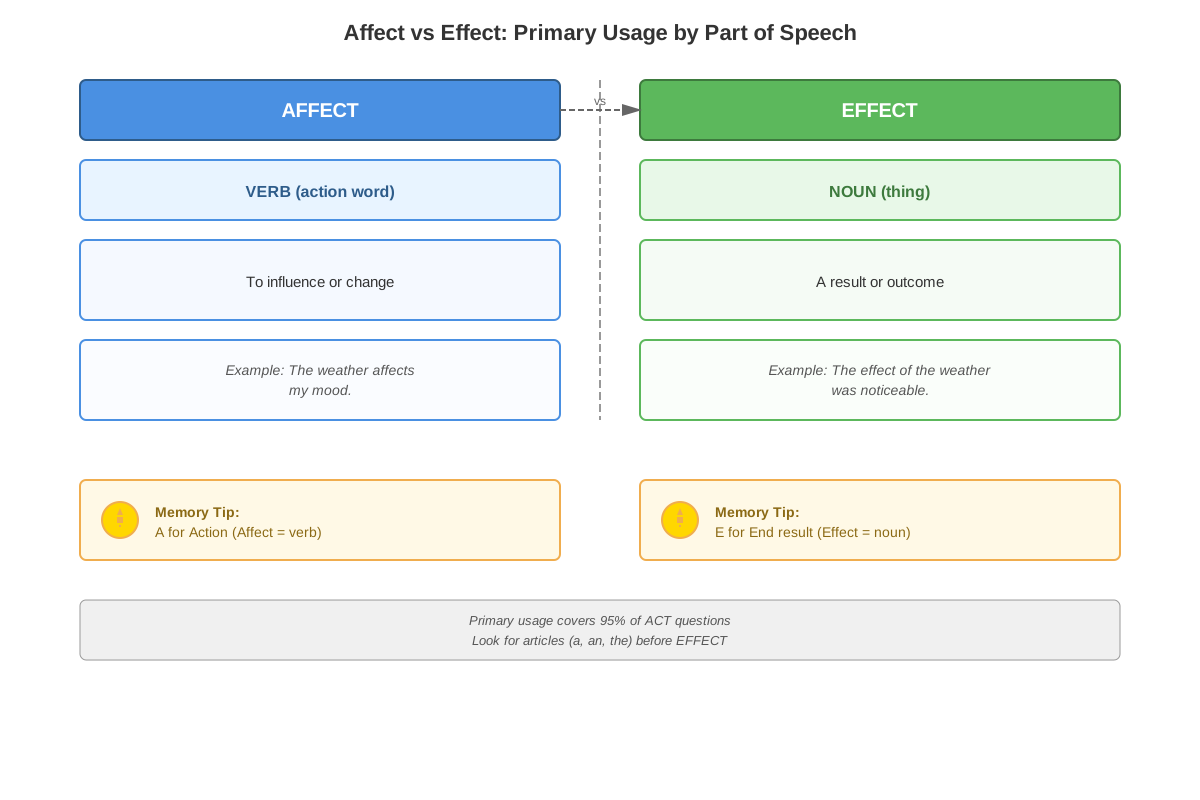
The fundamental distinction that solves approximately 95% of ACT questions on this topic is straightforward: affect functions primarily as a verb meaning "to influence" or "to produce a change in," while effect functions primarily as a noun meaning "a result" or "a consequence." This core rule provides the foundation for rapid question analysis.
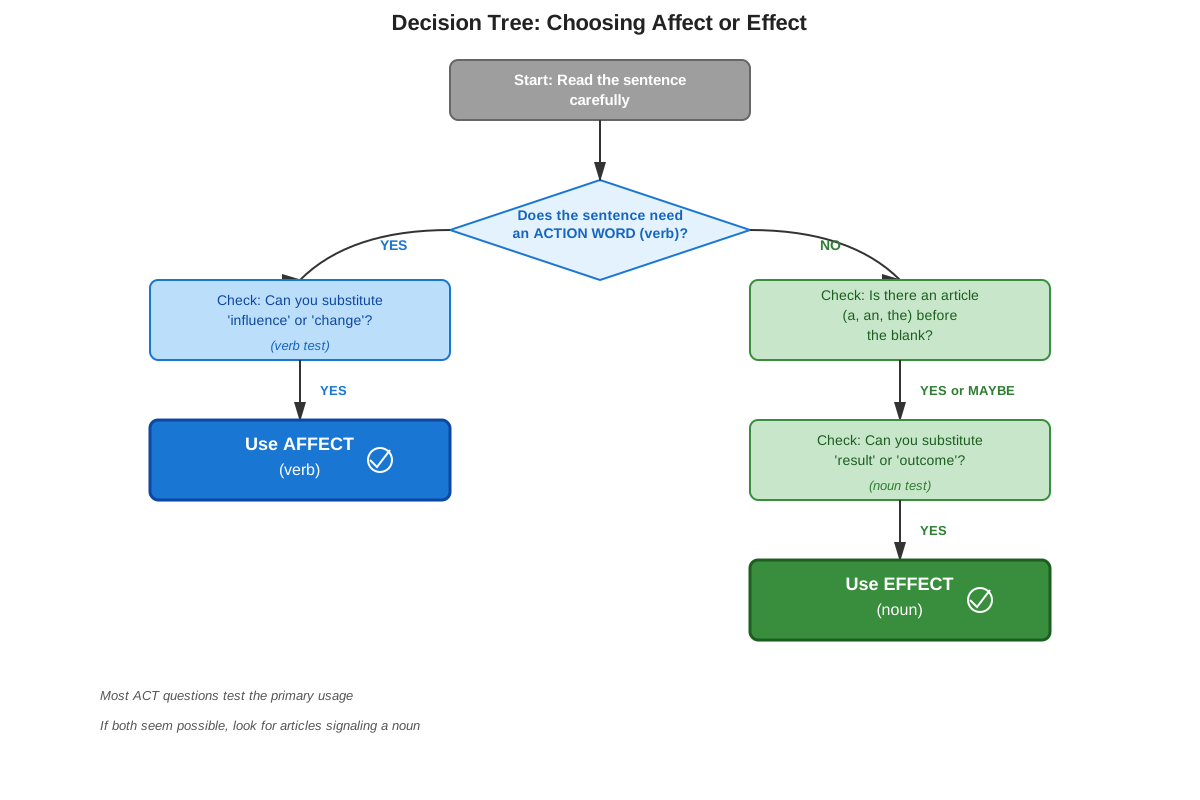
When encountering a sentence with affect/effect, the first step is determining what part of speech the sentence requires. If the sentence needs a verb—an action word that shows what the subject is doing—then "affect" is almost always correct. If the sentence needs a noun—a thing, concept, or result—then "effect" is almost always correct.
Consider this example: "The weather will _____ our travel plans." The sentence structure shows that "weather" is the subject and needs a verb to show what action the weather performs. Since a verb is required, "affect" is correct: "The weather will affect our travel plans."
Conversely: "The _____ of the weather on our travel plans was significant." Here, the sentence needs a noun to serve as the subject. The structure "The _____ of" signals that a noun must fill the blank. Therefore, "effect" is correct: "The effect of the weather on our travel plans was significant."
Identifying the Required Part of Speech
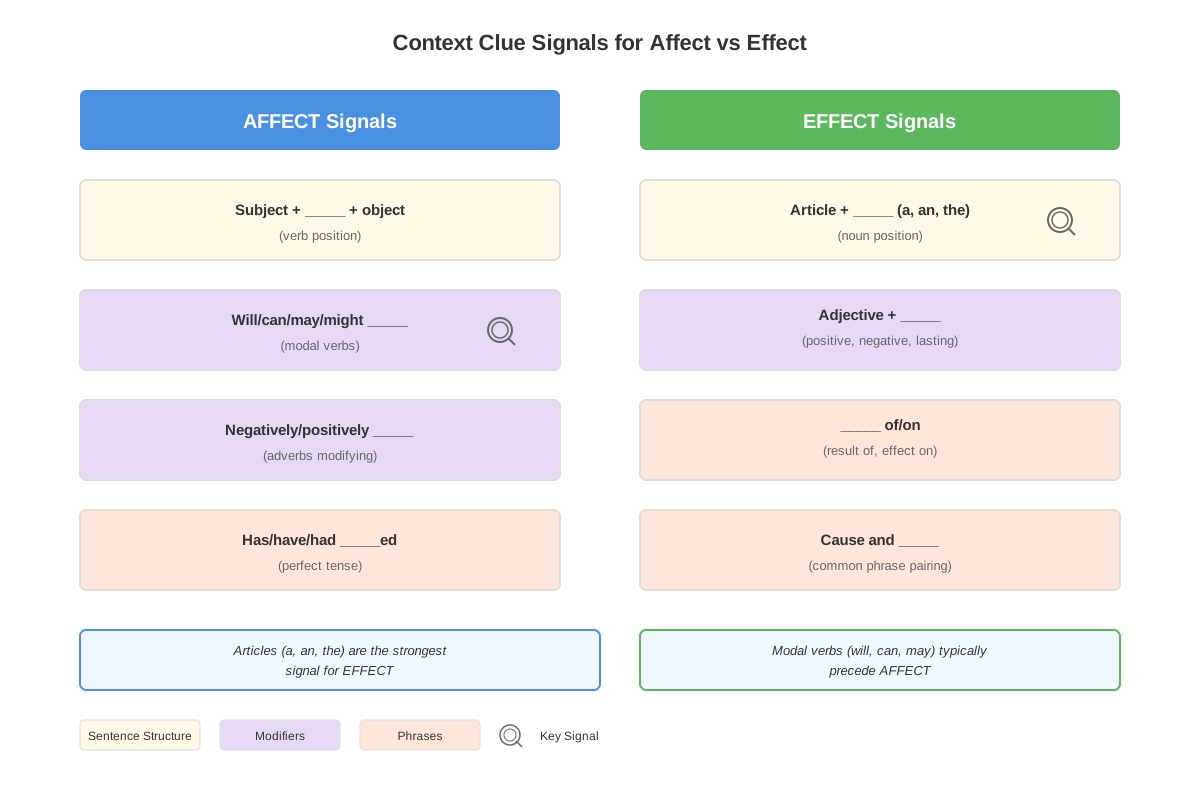
The ACT tests whether students can analyze sentence structure to determine grammatical requirements. Several reliable signals indicate which part of speech is needed:
Noun indicators (suggesting "effect"):
- Articles preceding the blank: "the," "an," "a"
- Possessive pronouns: "its," "their," "his," "her"
- Adjectives modifying the word: "positive," "negative," "significant," "lasting"
- Prepositions following the word: "of," "on," "upon"
Verb indicators (suggesting "affect"):
- Modal verbs preceding the blank: "will," "can," "could," "should," "might"
- Subject-verb structure requiring action: "The policy _____ everyone"
- Auxiliary verbs: "has," "have," "had," "is," "was," "were"
- Infinitive structure: "to _____"
Secondary Meanings and Exceptions
While the primary rule covers most ACT questions, understanding secondary uses prevents errors on more sophisticated questions. Effect can function as a verb meaning "to bring about" or "to cause to happen," typically used in formal contexts. For example: "The new president will effect significant changes in policy." This usage is rare on the ACT but occasionally appears in challenging questions.
Similarly, affect can function as a noun in psychology, referring to observable emotional expression. This technical usage is extremely rare on the ACT and typically appears only in science-related passages where the context makes the meaning clear.
For ACT purposes, students should focus 95% of their attention on the primary rule and only consider secondary meanings when the primary rule produces an answer that seems contextually illogical.
The VANE Strategy
A practical approach for ACT questions uses the acronym VANE:
Verb = Affect
Noun = Effect
This simple mnemonic reinforces the primary rule and provides a quick mental check during timed testing conditions. When encountering an affect/effect question, students should think "VANE" and immediately analyze whether the sentence requires a verb or noun.
Comparison Table
| Word | Primary Function | Meaning | Example | ACT Frequency |
|---|---|---|---|---|
| Affect | Verb | To influence, to change | "Stress affects performance." | 90% of uses |
| Effect | Noun | A result, a consequence | "The effect was dramatic." | 90% of uses |
| Effect | Verb | To bring about, to cause | "The law will effect change." | 5% of uses |
| Affect | Noun | Emotional expression | "The patient showed flat affect." | 1% of uses |
Concept Relationships
The affect versus effect distinction connects directly to fundamental grammar concepts. Understanding parts of speech serves as the foundation: recognizing that words function differently based on their grammatical role enables students to apply the primary rule effectively. This concept reinforces that meaning and function are interconnected—the same spelling can represent different words with different meanings depending on context.
The relationship flows as follows:
Sentence Structure Analysis → Part of Speech Identification → Affect/Effect Selection → Meaning Verification
This topic also connects to verb tense and agreement because when "affect" is used as a verb, it must be conjugated correctly (affects, affected, affecting, will affect). Students who struggle with verb forms may select "affect" correctly but then fail to use the appropriate tense, creating a different error.
Additionally, the affect/effect distinction relates to word choice and diction questions more broadly. The ACT frequently tests whether students can select the precise word that fits both grammatically and contextually. Mastering affect/effect builds skills for handling similar word pairs like "accept/except," "than/then," and "principal/principle."
The concept also reinforces context clue usage. Even when students know the primary rule, they must read surrounding sentences to verify that their choice makes logical sense. This connects to reading comprehension skills and the integration of grammar knowledge with meaning-making.
High-Yield Facts
⭐ Affect is primarily a verb meaning "to influence" or "to produce a change in"
⭐ Effect is primarily a noun meaning "a result" or "a consequence"
⭐ Articles (a, an, the) before the word signal that effect (noun) is needed
⭐ Modal verbs (will, can, could, should) before the word signal that affect (verb) is needed
⭐ The phrase "have an effect on" is always correct; "have an affect on" is always wrong
- Adjectives modifying the word (positive, negative, significant) indicate effect is correct
- The preposition "of" following the word typically indicates effect is correct ("the effect of")
- "Effect" as a verb means "to bring about" and appears rarely on the ACT
- "Affect" as a noun refers to emotional expression and appears extremely rarely on the ACT
- The VANE mnemonic (Verb = Affect, Noun = Effect) provides quick recall under time pressure
- Approximately 2-4 questions per ACT test administration involve affect versus effect
- These questions appear in the Usage/Mechanics subscore category
- Reading the complete sentence is essential; the surrounding context confirms the correct choice
- When both words seem grammatically possible, the primary meanings (verb/noun) are almost always correct
- Substituting "influence" for "affect" or "result" for "effect" helps verify the correct choice
Quick check — test yourself on Affect versus effect so far.
Try Flashcards →Common Misconceptions
Misconception: "Effect" and "affect" are interchangeable because they sound similar and relate to cause-and-result relationships.
Correction: While both words relate to causation, they serve different grammatical functions. "Affect" is the action (verb) of influencing, while "effect" is the outcome (noun) of that influence. They cannot be substituted for each other without changing the sentence's grammatical structure.
Misconception: If a sentence discusses results or consequences, "effect" is always correct.
Correction: The topic of the sentence doesn't determine correctness—grammatical function does. A sentence about results might still need the verb "affect." For example: "These results will affect future research" uses "affect" even though the sentence discusses results.
Misconception: "Effect" with an article (the effect, an effect) is the only way to identify when "effect" is correct.
Correction: While articles are strong indicators, "effect" can appear without articles, especially in plural form ("The changes had several effects") or with possessive pronouns ("Its effect was minimal").
Misconception: The less common uses of these words (effect as verb, affect as noun) appear frequently enough on the ACT to warrant equal study time.
Correction: The secondary meanings appear in fewer than 5% of ACT questions on this topic. Students should master the primary rule first and only consider exceptions when the primary rule produces an illogical answer.
Misconception: Memorizing example sentences is sufficient for mastering this distinction.
Correction: While examples help, students must understand the underlying grammatical principle. The ACT creates novel sentences that don't match memorized examples, so students need the analytical skill to determine part of speech requirements in unfamiliar contexts.
Misconception: If "affect" sounds wrong when reading the sentence aloud, it must be incorrect.
Correction: Because these words sound nearly identical in speech, the "sounds right" test is unreliable. Students must rely on grammatical analysis rather than phonetic intuition.
Misconception: Complex sentences with multiple clauses make affect/effect questions impossible to solve quickly.
Correction: Even in complex sentences, the immediate grammatical context around the word determines correctness. Students should focus on the specific clause containing the word rather than analyzing the entire sentence structure.
Worked Examples
Example 1: Basic Application
Question: The new policy will _____ all employees in the organization.
A) effect
B) affect
C) have an effect
D) be affecting
Step 1: Identify what part of speech the sentence requires.
The sentence structure is: Subject (policy) + modal verb (will) + _____ + object (employees). The blank needs a verb to complete the predicate.
Step 2: Apply the VANE rule.
Verb = Affect. Since a verb is needed, "affect" should be correct.
Step 3: Evaluate the answer choices.
- A) "effect" - This is primarily a noun, but could be a verb meaning "to bring about." However, "bring about employees" doesn't make logical sense.
- B) "affect" - This is a verb meaning "to influence." "The policy will influence all employees" makes perfect sense.
- C) "have an effect" - This creates "will have an effect," which is grammatically correct but changes the sentence structure unnecessarily.
- D) "be affecting" - This creates "will be affecting," which is grammatically correct but uses progressive tense without justification.
Step 4: Verify with substitution.
Replace "affect" with "influence": "The new policy will influence all employees." This confirms the meaning is correct.
Answer: B) affect
Connection to Learning Objectives: This example demonstrates identifying when the concept is tested (modal verb + blank + object structure), explaining the core rule (verb needed = affect), and applying it accurately to reach the correct answer.
Example 2: Advanced Application with Distractors
Question: The committee studied the _____ of the budget cuts on student services before making their recommendation.
A) affect
B) effect
C) effects
D) affecting
Step 1: Identify the grammatical context.
The sentence structure includes "the _____," where the article "the" precedes the blank. Articles precede nouns, not verbs.
Step 2: Apply the VANE rule.
Noun = Effect. The sentence requires a noun, so "effect" should be correct.
Step 3: Analyze each answer choice.
- A) "affect" - This is primarily a verb. "The affect" would only work if using the rare psychological noun meaning, which doesn't fit this context about budget cuts.
- B) "effect" - This is a noun meaning "result." "The result of the budget cuts" makes logical sense.
- C) "effects" - This is the plural noun form. "The results of the budget cuts" also makes sense and might be more natural since budget cuts could have multiple consequences.
- D) "affecting" - This is a gerund (verb form functioning as noun), but "the affecting of" is awkward and non-standard.
Step 4: Choose between B and C.
Both "effect" and "effects" are grammatically correct. The ACT would typically make one clearly better through context. In this case, "effects" (plural) is more natural because budget cuts typically have multiple consequences. However, if both appeared as options, additional context would clarify which is better.
Step 5: Verify with substitution.
Replace "effect" with "result": "The committee studied the result of the budget cuts." This confirms the meaning works.
Answer: B) effect (or C if both are options and context suggests multiple results)
Connection to Learning Objectives: This example shows how to identify testing through article usage, apply the core rule even with distractors present, and use context clues to verify the answer makes logical sense.
Exam Strategy
Rapid Identification Approach
When approaching ACT English questions, students should develop a systematic process for affect/effect questions:
- Scan for trigger words: Look for "affect" or "effect" in the underlined portion or answer choices
- Identify the grammatical slot: Determine what comes immediately before and after the word
- Apply VANE: Decide whether a verb or noun is needed
- Verify with context: Ensure the choice makes logical sense in the sentence
- Move forward confidently: These questions should take 15-20 seconds maximum
Trigger Words and Phrases
Certain words and structures reliably signal which choice is correct:
Signals for "effect" (noun):
- "the effect"
- "an effect"
- "this effect"
- "positive/negative/significant effect"
- "effect of"
- "effect on"
- "have an effect"
- "produce an effect"
Signals for "affect" (verb):
- "will affect"
- "can affect"
- "might affect"
- "to affect"
- "directly affect"
- "greatly affect"
- "adversely affect"
- "positively affect"
Process of Elimination
When multiple answer choices seem plausible, use these elimination strategies:
- Eliminate based on part of speech first: If the sentence clearly needs a noun, immediately eliminate any answer choice using "affect" as a verb
- Check for article agreement: If an article precedes the word, eliminate verb forms
- Test the primary meaning: Substitute "influence" for affect or "result" for effect—if the substitution creates nonsense, eliminate that choice
- Consider naturalness: The ACT prefers standard, natural phrasing over awkward constructions
Time Allocation
Affect versus effect questions should be among the fastest to answer on the ACT English section. Allocate no more than 20 seconds per question. If a question requires more time, mark it and return later—these questions rarely require extended analysis, so prolonged confusion usually indicates a need to reset and reread rather than to think harder.
Exam Tip: If you find yourself debating between "affect" and "effect" for more than 10 seconds, you're overthinking. Return to the VANE rule, identify the part of speech needed, and commit to your answer.
Memory Techniques
The VANE Mnemonic
Verb = Affect
Noun = Effect
This four-letter acronym provides instant recall. Visualize a weather vane (the device that shows wind direction) with the letters V-A-N-E written on its directional arrows. When you see an affect/effect question, picture the weather vane "pointing" you toward the correct answer.
The RAVEN Extension
For students who want additional reinforcement, extend VANE to RAVEN:
Result = Effect (noun)
Action = Affect (verb)
Verb = Affect
Noun = Effect
The image of a raven (a smart bird) helps recall that smart test-takers use this strategy.
The Substitution Trick
Create a mental habit of substitution:
- When you see "affect," mentally substitute "influence"
- When you see "effect," mentally substitute "result"
If the substitution makes sense, the original word is correct. This technique works because "influence" is clearly a verb and "result" is clearly a noun, removing the ambiguity.
The Article Alert
Train yourself to notice articles instantly. Whenever you see "the," "a," or "an" before the blank, mentally hear an alarm sound. This "article alert" triggers the automatic response: "Article = Noun = Effect."
Visualization: The Cause-Effect Chain
Picture a chain with two links:
- The first link (the cause/action) is labeled "AFFECT" in red
- The second link (the result/outcome) is labeled "EFFECT" in blue
When reading a sentence, visualize which link you're discussing. If you're talking about the action of influencing (first link), use "affect." If you're talking about the result (second link), use "effect."
Summary
The affect versus effect distinction represents a high-yield, predictable ACT English topic that rewards focused study. The core principle is straightforward: affect functions primarily as a verb meaning "to influence," while effect functions primarily as a noun meaning "a result." Mastering this distinction requires understanding parts of speech and developing the ability to analyze sentence structure rapidly to determine whether a verb or noun is needed. The VANE mnemonic (Verb = Affect, Noun = Effect) provides quick recall under testing conditions. While secondary meanings exist—effect as a verb meaning "to bring about" and affect as a noun referring to emotional expression—these appear rarely on the ACT and should be considered only when the primary rule produces illogical results. Success on these questions depends on recognizing trigger words (articles signal nouns/effect, modal verbs signal verbs/affect), applying the core rule systematically, and verifying that the chosen word makes contextual sense. With approximately 2-4 questions per test involving this concept, students who master affect versus effect gain both points and confidence, enabling faster progression through the English section.
Key Takeaways
- Affect is primarily a verb (to influence); effect is primarily a noun (a result)
- Use the VANE mnemonic for instant recall: Verb = Affect, Noun = Effect
- Articles (the, a, an) before the word signal that effect is correct
- Modal verbs (will, can, should) before the word signal that affect is correct
- The phrase "have an effect on" is always correct; substitute "influence" or "result" to verify your choice
- These questions appear 2-4 times per ACT and should take no more than 20 seconds to answer
- Focus 95% of study time on the primary rule; secondary meanings appear in fewer than 5% of questions
Related Topics
Subject-Verb Agreement: Understanding how verbs must match their subjects in number and person builds on the ability to identify verbs, which is essential for recognizing when "affect" is needed. Mastering affect/effect strengthens verb identification skills that transfer to agreement questions.
Word Choice and Diction: The ACT tests numerous word pairs that sound similar but have different meanings or functions (accept/except, than/then, principal/principle). The analytical approach used for affect/effect—identifying grammatical function and using context clues—applies to all word choice questions.
Commonly Confused Words: Beyond affect/effect, the ACT tests other frequently confused pairs. Students who master the systematic approach to affect/effect develop transferable skills for handling any word confusion question.
Verb Tense and Form: Once students correctly identify that "affect" is needed, they must use the appropriate tense (affects, affected, affecting). This topic extends affect/effect mastery into broader verb usage.
Noun Functions and Cases: Understanding how nouns function in sentences (as subjects, objects, or objects of prepositions) reinforces why "effect" appears in certain grammatical positions and helps students recognize noun indicators more quickly.
Practice CTA
Now that you've mastered the core concepts, trigger words, and strategies for affect versus effect questions, it's time to solidify your knowledge through active practice. Complete the practice questions to test your ability to identify, explain, and apply this concept under timed conditions. Use the flashcards to reinforce the VANE mnemonic and key trigger phrases until your responses become automatic. Remember: the ACT rewards speed and accuracy, and affect/effect questions offer an excellent opportunity to gain both. These are points within your reach—claim them through deliberate practice. Your investment of 20 minutes studying this guide can translate directly into correct answers and a higher English subscore. Approach the practice with confidence, knowing you now possess the tools to handle any affect/effect question the ACT presents.
Sign up free to keep reading
Create a free AnvayaPrep account to finish this ACT guide on Affect versus effect — plus flashcards and practice questions.