Overview
Verb tense is one of the most frequently tested grammar concepts on the ACT verb tense section of the English test. Understanding verb tense means recognizing how verbs change form to indicate when an action occurs—whether in the past, present, or future—and ensuring that verb forms remain consistent and logical throughout a passage. The ACT English test dedicates approximately 15-20% of its grammar questions to verb-related issues, making this a high-yield topic that directly impacts your score.
Mastering verb tense requires more than memorizing conjugation tables. Students must develop the ability to recognize temporal clues within sentences and paragraphs, understand how different tenses relate to one another, and identify when shifts in tense are appropriate versus when they represent errors. The ACT specifically tests whether students can maintain logical consistency in verb usage while also recognizing when context demands a tense change. This skill extends beyond isolated sentences—the exam frequently presents passages where verb tense must align with surrounding sentences and the overall narrative timeline.
Verb tense connects intimately with other grammar concepts tested on the ACT, including subject-verb agreement, pronoun consistency, and logical sentence structure. A strong command of verb tense enables students to tackle complex questions involving parallel structure, where multiple verbs must maintain consistent forms, and questions about verb mood and voice. Additionally, understanding verb tense improves reading comprehension, as recognizing temporal relationships helps students follow the logic and sequence of ideas in passages across all ACT sections.
Learning Objectives
- [ ] Identify when verb tense is being tested in ACT English questions
- [ ] Explain the core rule or strategy behind verb tense consistency and appropriateness
- [ ] Apply verb tense rules to ACT-style questions accurately
- [ ] Distinguish between appropriate tense shifts and tense errors in context
- [ ] Recognize temporal clues and time markers that signal correct verb tense
- [ ] Evaluate verb tense choices in multi-sentence contexts and full paragraphs
- [ ] Correct verb tense errors efficiently under timed conditions
Prerequisites
- Basic verb conjugation: Understanding how regular and irregular verbs change forms across tenses is essential for recognizing correct and incorrect usage
- Subject-verb agreement: Verb tense questions often combine with agreement issues, requiring students to match both number and time
- Sentence structure fundamentals: Identifying main clauses and dependent clauses helps determine which verb establishes the primary timeframe
- Reading comprehension skills: Understanding passage context is necessary to determine whether a tense shift is logical or erroneous
Why This Topic Matters
Verb tense mastery directly translates to real-world communication effectiveness. In academic writing, professional correspondence, and formal presentations, maintaining appropriate verb tense demonstrates clarity of thought and attention to detail. Inconsistent or illogical verb tense confuses readers about when events occur and how they relate temporally, undermining the writer's credibility and message.
On the ACT English test, verb tense questions appear in approximately 10-15 questions per exam, representing roughly 13-20% of the 75 total English questions. These questions manifest in several formats: some present underlined verbs with four tense options, while others embed tense issues within broader revision questions. The ACT particularly favors testing verb tense in narrative passages describing sequences of events, scientific passages explaining processes, and argumentative essays discussing historical context alongside present-day implications.
Common ACT passage scenarios include: biographical narratives switching between a subject's past actions and present legacy; scientific explanations moving between established facts (present tense) and specific experiments (past tense); historical essays connecting past events to contemporary relevance; and personal narratives maintaining consistent past tense while incorporating reflective present-tense commentary. Recognizing these patterns helps students anticipate where tense questions will appear and what the correct answer will likely accomplish.
Core Concepts
The Six Primary Verb Tenses
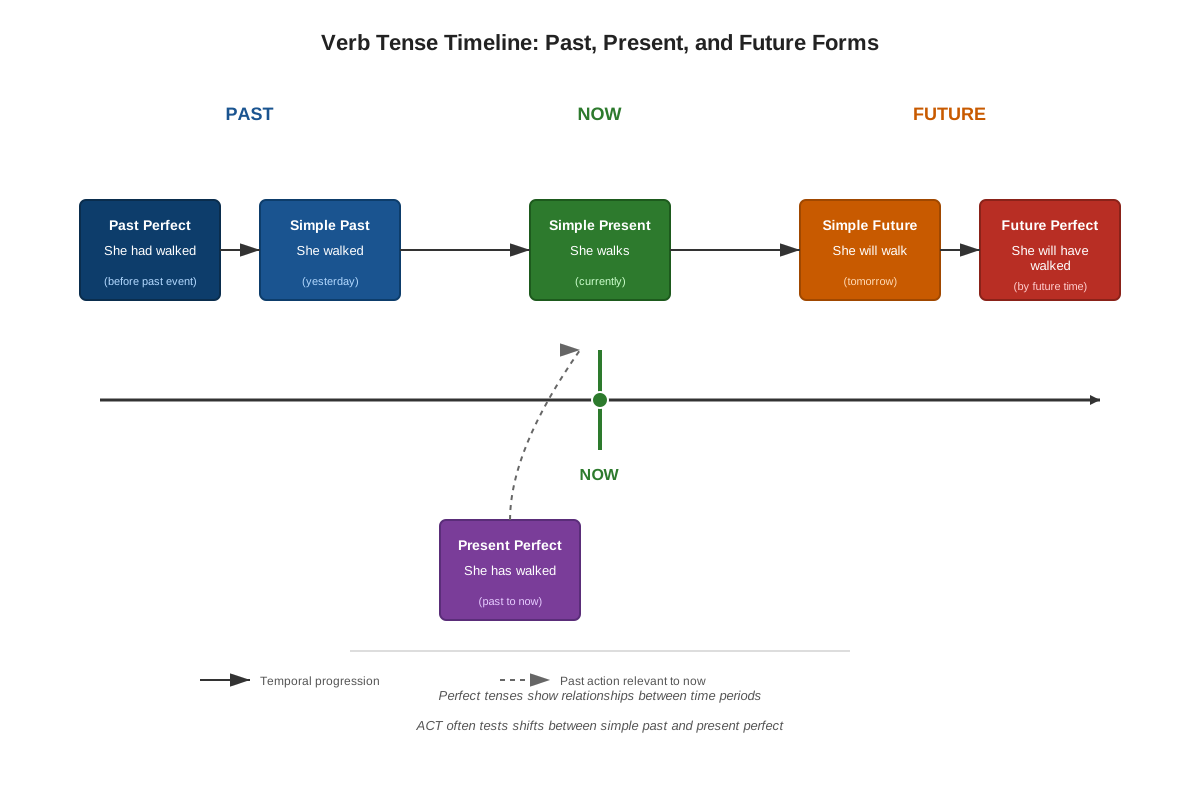
English employs six fundamental tenses that students must recognize and apply correctly on the ACT. Each tense serves a specific temporal function:
Simple Present expresses habitual actions, general truths, and current states. Examples include "The Earth revolves around the sun" and "She walks to school daily." The ACT uses simple present for scientific facts, universal truths, and ongoing situations.
Simple Past indicates completed actions at specific past times. Examples include "Columbus sailed in 1492" and "They finished the project yesterday." This tense dominates narrative passages and historical discussions.
Simple Future describes actions that will occur later. Examples include "The conference will begin tomorrow" and "Scientists will discover new solutions." The ACT tests whether students recognize when future tense is necessary versus when present tense suffices.
Present Perfect connects past actions to the present moment, using "has" or "have" plus the past participle. Examples include "She has lived here for five years" (and still does) and "They have completed three experiments" (with present relevance). This tense frequently appears in ACT questions testing subtle temporal relationships.
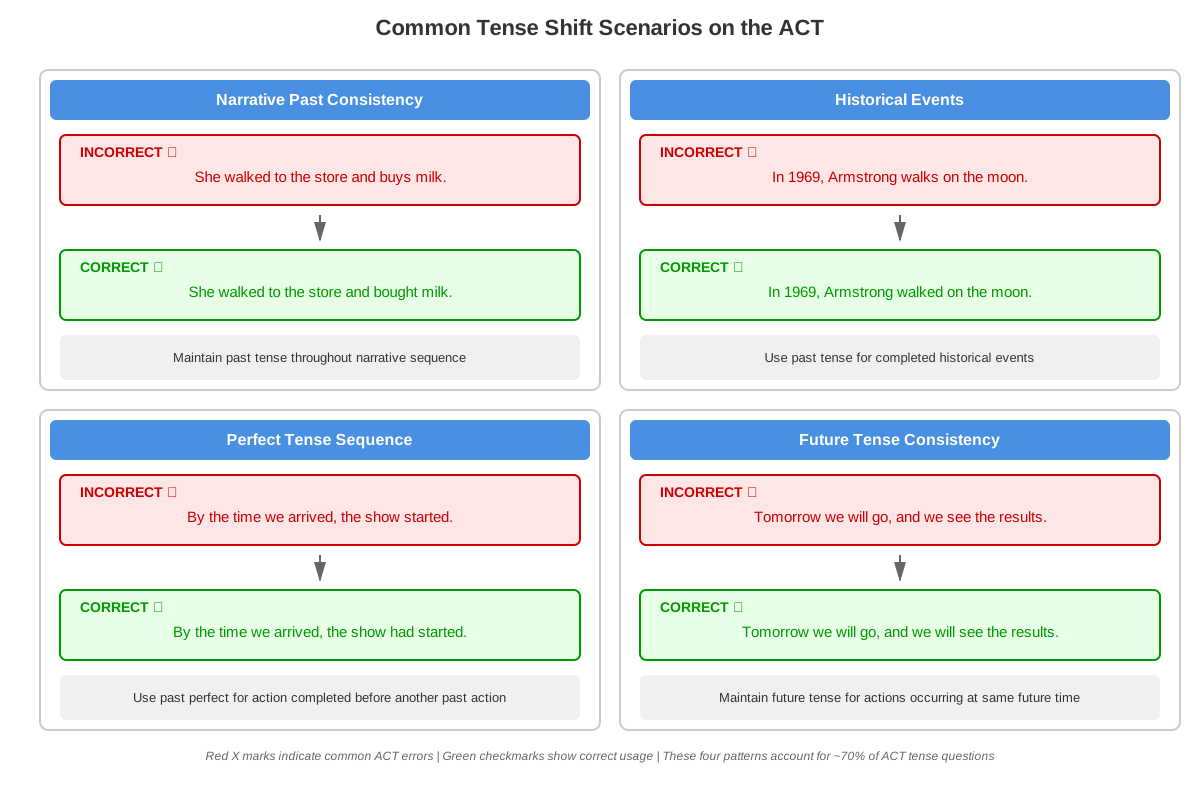
Past Perfect establishes which of two past actions occurred first, using "had" plus the past participle. Example: "By the time we arrived, the movie had started." The ACT heavily tests past perfect in passages describing sequences of past events.
Future Perfect indicates an action that will be completed before a specific future time, using "will have" plus the past participle. Example: "By next year, she will have graduated." This tense appears less frequently but tests sophisticated temporal understanding.
Verb Tense Consistency
The principle of verb tense consistency requires maintaining the same tense throughout a passage unless the meaning demands a shift. The ACT tests whether students can identify unjustified tense changes that disrupt temporal logic.
Consider this example: "Last summer, Maria traveled to Italy. She visits Rome, Florence, and Venice before returning home." The shift from past tense ("traveled") to present tense ("visits") creates an error. The correction maintains consistency: "She visited Rome, Florence, and Venice before returning home."
However, consistency does not mean rigidity. Appropriate tense shifts occur when the temporal context genuinely changes. Example: "Shakespeare wrote his plays in the 16th century, but they remain popular today." The shift from past ("wrote") to present ("remain") is correct because the sentence discusses both historical fact and current reality.
Temporal Clues and Time Markers
Temporal clues are words and phrases that signal which tense is appropriate. Recognizing these markers helps students select correct verb forms quickly:
| Time Marker | Appropriate Tense | Example |
|---|---|---|
| yesterday, last week, in 1995 | Simple Past | "She graduated in 2020." |
| now, currently, these days | Simple Present | "He currently works in Boston." |
| tomorrow, next year, soon | Simple Future | "They will arrive tomorrow." |
| since, for, already, yet | Present Perfect | "I have known her since 2015." |
| by the time, before, after | Past Perfect | "Before he called, I had left." |
| always, never, usually | Simple Present | "She always arrives early." |
Sequence of Tenses in Complex Sentences
When sentences contain multiple clauses, verbs must maintain logical temporal relationships. The sequence of tenses principle governs these relationships:
In sentences with dependent clauses, the main clause verb establishes the primary timeframe, and the dependent clause verb adjusts accordingly. Example: "She believes (present) that the experiment was (past) successful." The present-tense belief exists now, while the experiment occurred earlier.
When using past perfect, it must relate to another past action: "After she had studied (past perfect) for three hours, she took (simple past) the test." The past perfect establishes the earlier action in a past sequence.
Present Tense for Timeless Truths
The ACT frequently tests whether students recognize that timeless truths and general facts require present tense, even within past-tense narratives. Scientific principles, mathematical facts, and universal observations remain in present tense regardless of surrounding context.
Example: "Galileo discovered that the Earth revolves around the sun." Despite Galileo's past discovery, the scientific fact uses present tense ("revolves") because it remains true today.
Historical Present
The historical present tense describes past events using present tense to create immediacy and drama. While acceptable in creative writing, the ACT generally treats historical present as incorrect in formal passages unless the entire passage consistently employs this style. Students should default to past tense for historical narratives unless clear stylistic reasons justify present tense.
Progressive and Perfect Progressive Tenses
While less frequently tested, progressive tenses (using "to be" + verb-ing) indicate ongoing actions. The ACT occasionally tests whether students recognize when progressive forms are appropriate:
- Present Progressive: "She is studying" (happening now)
- Past Progressive: "She was studying" (was happening at a past moment)
- Future Progressive: "She will be studying" (will be happening at a future time)
Perfect progressive tenses combine perfect and progressive aspects but rarely appear on the ACT. Students should focus on the six primary tenses for maximum efficiency.
Concept Relationships
The concepts within verb tense form an interconnected system where understanding one element strengthens comprehension of others. Simple tenses (present, past, future) serve as the foundation upon which perfect tenses build, adding layers of temporal complexity. Mastering simple tenses enables students to recognize when perfect tenses are necessary to clarify temporal relationships.
Verb tense consistency depends directly on recognizing temporal clues, which signal when tense shifts are appropriate versus erroneous. This relationship flows as: Temporal Clues → Determine Appropriate Tense → Evaluate Consistency. Students who identify time markers quickly can assess whether verb forms match the intended timeframe.
The sequence of tenses concept integrates all other verb tense principles, requiring students to coordinate multiple verbs across clauses while maintaining logical temporal relationships. This advanced skill builds upon: Simple Tenses → Perfect Tenses → Consistency Rules → Sequence Coordination.
Connections to prerequisite knowledge include: Subject-verb agreement ensures verbs match their subjects in both number and tense; sentence structure understanding helps identify which verb establishes the main timeframe versus which verbs follow in dependent clauses; reading comprehension enables students to grasp passage context necessary for determining appropriate tense choices.
Related topics that build on verb tense mastery include: parallel structure (requiring consistent verb forms in lists and comparisons), verb mood (indicative, subjunctive, imperative), and active versus passive voice (which affects verb construction while maintaining tense).
Quick check — test yourself on Verb tense so far.
Try Flashcards →High-Yield Facts
⭐ The ACT tests verb tense consistency more frequently than any other verb issue—always check whether surrounding sentences justify a tense change.
⭐ Past perfect ("had" + past participle) is required when describing the earlier of two past actions—if only one past action exists, simple past is correct.
⭐ Present tense is always correct for scientific facts, mathematical truths, and universal principles, even within past-tense narratives.
⭐ Time markers like "since," "for," "already," and "yet" signal present perfect tense, not simple past.
⭐ When a passage begins in one tense, that tense should continue unless context clearly demands a shift—unjustified tense changes are always wrong.
- Present perfect connects past actions to the present moment, while simple past indicates completed actions with no present connection.
- Future tense is often unnecessary when present tense can express future meaning (e.g., "The train leaves tomorrow" is preferable to "will leave").
- In conditional sentences, the "if" clause typically uses simple past or past perfect, not "would" (e.g., "If I were rich" not "If I would be rich").
- Progressive tenses emphasize ongoing action, but simple tenses are often more concise and preferred in formal writing.
- Verb tense errors often appear in the middle of passages where students have lost track of the established timeframe—always check surrounding sentences.
- The ACT rarely tests future perfect or perfect progressive tenses—focus study time on the six primary tenses.
- When two answer choices differ only in tense, the correct answer will match temporal clues in the passage.
Common Misconceptions
Misconception: All verbs in a passage must use the same tense. → Correction: Verb tense should remain consistent unless the meaning requires a shift. Passages discussing multiple time periods appropriately use multiple tenses. The key is ensuring each tense shift has a logical reason based on temporal context.
Misconception: Present perfect and simple past are interchangeable. → Correction: Present perfect ("has/have" + past participle) indicates actions with present relevance or continuing effects, while simple past describes completed actions. "I have lived here for five years" (still living here) differs from "I lived here for five years" (no longer living here).
Misconception: Past perfect should be used for any action that occurred in the past. → Correction: Past perfect is only necessary when distinguishing between two past actions, showing which occurred first. If only one past action is mentioned, simple past is correct. "She had eaten breakfast" requires context about another past action; otherwise, "She ate breakfast" suffices.
Misconception: Time markers always appear in the same sentence as the verb they affect. → Correction: Temporal clues often appear in previous sentences or even earlier paragraphs. Students must read surrounding context to determine the appropriate timeframe, not just examine the sentence containing the underlined verb.
Misconception: Formal writing should avoid present tense in favor of past tense. → Correction: Present tense is appropriate and often preferred for discussing literature ("Hamlet contemplates revenge"), stating current facts ("The study shows"), and explaining ongoing situations ("The company produces"). Tense choice depends on meaning, not formality level.
Misconception: "Would" can be used in "if" clauses. → Correction: Conditional sentences use simple past or past perfect in the "if" clause, reserving "would" for the main clause. Correct: "If I were president, I would change the law." Incorrect: "If I would be president, I would change the law."
Worked Examples
Example 1: Identifying Appropriate Tense Shifts
Passage Context: "Marie Curie conducted groundbreaking research on radioactivity in the early 1900s. She discovered polonium and radium, elements that [are/were/have been/had been] crucial to modern medicine. Her work earned her two Nobel Prizes, making her the first woman to receive this honor."
Analysis Process:
Step 1: Identify the primary timeframe. The passage discusses Curie's past actions ("conducted," "discovered," "earned"), establishing past tense as the dominant timeframe.
Step 2: Examine the underlined verb's context. The sentence discusses elements that Curie discovered in the past, but the phrase "crucial to modern medicine" indicates present-day relevance.
Step 3: Evaluate temporal clues. "Modern medicine" signals current time, suggesting the elements' importance continues today, not just in the past.
Step 4: Consider each option:
- "are" (present): Indicates current importance—matches "modern medicine"
- "were" (past): Would suggest the elements are no longer important
- "have been" (present perfect): Could work but is unnecessarily complex
- "had been" (past perfect): Incorrect—requires two past actions with one earlier
Step 5: Select the answer. "Are" is correct because the elements remain crucial today. The tense shift from past (Curie's actions) to present (current importance) is appropriate and necessary.
Correct Answer: "are"
Learning Objective Connection: This example demonstrates identifying when verb tense is being tested (objective 1), explaining the core rule about appropriate tense shifts (objective 2), and applying tense rules to ACT-style questions (objective 3).
Example 2: Past Perfect in Sequential Actions
Passage Context: "By the time the rescue team arrived at the site, the survivors [waited/had waited/have waited/wait] for over twelve hours in freezing conditions. The delay occurred because the storm prevented earlier access."
Analysis Process:
Step 1: Identify multiple past actions. The passage describes two past events: (1) survivors waiting, and (2) rescue team arriving.
Step 2: Determine temporal sequence. The survivors' waiting occurred before the team's arrival—the waiting was already in progress when arrival happened.
Step 3: Apply the past perfect rule. When two past actions have a clear sequence, the earlier action uses past perfect ("had" + past participle) while the later action uses simple past.
Step 4: Evaluate options:
- "waited" (simple past): Doesn't establish which action occurred first
- "had waited" (past perfect): Correctly shows waiting preceded arrival
- "have waited" (present perfect): Incorrect—connects to present, but passage is entirely past
- "wait" (present): Incorrect—doesn't match past timeframe
Step 5: Confirm with context. "By the time" is a key phrase signaling past perfect—it indicates one action was completed before another past action occurred.
Correct Answer: "had waited"
Learning Objective Connection: This example illustrates recognizing temporal clues (objective 5), distinguishing appropriate tense shifts from errors (objective 4), and evaluating verb tense in context (objective 6).
Exam Strategy
Approaching ACT Verb Tense Questions
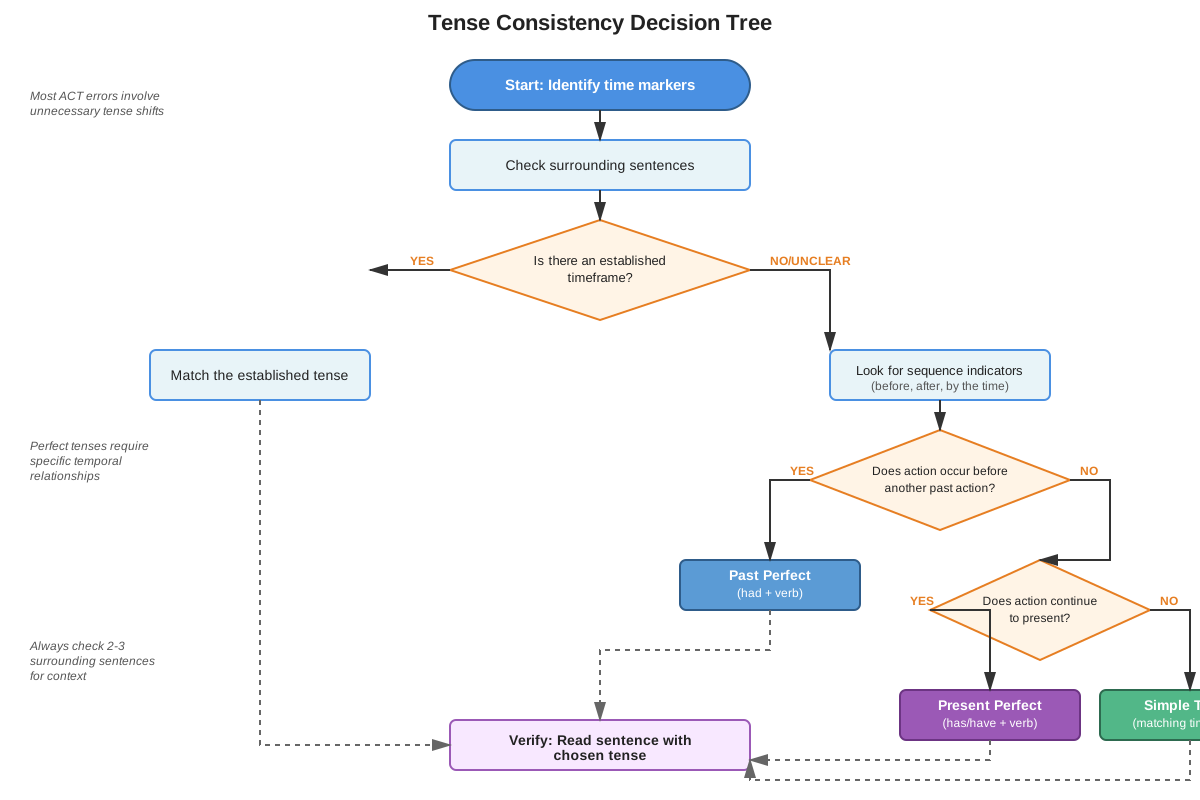
When encountering an underlined verb, immediately scan the surrounding sentences for temporal clues. Read at least one sentence before and one sentence after the question to establish the passage's timeframe. The ACT deliberately places tense questions where students who read only the immediate sentence will miss crucial context.
Trigger Words and Phrases
Watch for these high-yield indicators:
Past Perfect Triggers: "by the time," "before," "after," "already," "when" (followed by simple past)
Present Perfect Triggers: "since," "for" (duration), "recently," "already," "yet," "so far"
Simple Past Triggers: specific dates, "yesterday," "last [time period]," "ago"
Present Tense Triggers: "always," "never," "usually," "currently," "now," scientific contexts
Process of Elimination Strategy
- Eliminate tenses that don't match temporal clues: If the passage says "in 1995," eliminate present and future options immediately.
- Check for unnecessary complexity: Between simple past and past perfect, choose simple past unless two past actions require sequence clarification.
- Verify consistency: If three surrounding sentences use past tense and no temporal shift is indicated, eliminate present and future options.
- Test the "still true" principle: For present perfect versus simple past, ask whether the action's effects continue to the present. If yes, present perfect; if no, simple past.
Time Allocation
Verb tense questions should take 15-20 seconds each. If you spend more than 30 seconds, mark the question and return later. The correct answer typically becomes obvious once you identify the relevant temporal clues, so if you're struggling, you likely haven't found the key context yet.
Exam Tip: When answer choices differ only in verb tense, the question is testing tense exclusively. Focus entirely on temporal context and ignore other grammatical considerations.
Common Trap Patterns
The ACT frequently presents these deceptive scenarios:
- The "sounds right" trap: An incorrect tense may sound natural in isolation but violates consistency with surrounding sentences.
- The "overthinking" trap: Students choose complex tenses (perfect, progressive) when simple tenses are correct and more concise.
- The "local context" trap: The immediate sentence suggests one tense, but earlier paragraphs establish a different timeframe.
Memory Techniques
The PAST Acronym for Past Perfect
Preceding action (the earlier of two past events)
Already completed (before another past action)
Sequence matters (distinguishing order)
Two past actions (required for past perfect)
The PRESENT PERFECT Formula
"Has/Have + Past Participle = Past Action + Present Connection"
Visualize a bridge connecting past to present: the action started in the past but the bridge extends to now.
Tense Timeline Visualization
Create a mental timeline:
PAST ←——— PRESENT ———→ FUTURE
  |           |            |
Simple Past  Simple Present  Simple Future
  |           |            |
Past Perfect Present Perfect Future Perfect
(earlier past) (past→now)   (future→later)
The "Since/For" Rule Rhyme
"Since a point, for a span—present perfect is the plan."
- "Since 2015" (point in time) → present perfect
- "For five years" (duration) → present perfect
The Scientific Truth Shortcut
"Science stays present"—any scientific fact, mathematical principle, or universal truth uses present tense, regardless of surrounding narrative tense.
Summary
Verb tense mastery is essential for ACT English success, accounting for 10-15 questions per exam. The core principle requires maintaining logical temporal consistency while recognizing when context demands appropriate tense shifts. Students must distinguish between the six primary tenses—simple present, past, and future, plus present perfect, past perfect, and future perfect—and understand each tense's specific temporal function. Past perfect is required only when distinguishing the earlier of two past actions, while present perfect connects past actions to present relevance. Temporal clues like "since," "by the time," and specific dates signal which tense is appropriate. Scientific facts and universal truths always use present tense, even within past-tense narratives. Success requires reading surrounding sentences for context, not just the immediate sentence containing the underlined verb. The ACT rewards students who can quickly identify temporal markers, apply consistency rules, and recognize when tense shifts serve logical purposes versus when they represent errors.
Key Takeaways
- Verb tense questions require reading surrounding sentences for temporal context—never evaluate tense in isolation
- Past perfect ("had" + past participle) is only correct when distinguishing between two past actions, showing which occurred first
- Present perfect ("has/have" + past participle) connects past actions to the present moment, while simple past indicates completed actions
- Scientific facts, mathematical truths, and universal principles always use present tense, regardless of surrounding narrative tense
- Temporal clues like "since," "for," "by the time," and specific dates are the most reliable indicators of correct tense
- Verb tense consistency is the default—maintain the established tense unless context clearly demands a shift
- When answer choices differ only in tense, focus exclusively on temporal markers and ignore other grammatical considerations
Related Topics
Subject-Verb Agreement: Building on verb tense mastery, this topic ensures verbs match their subjects in number and person while maintaining correct tense. Understanding tense first makes agreement issues easier to identify and correct.
Parallel Structure: This advanced topic requires maintaining consistent verb forms when listing actions or making comparisons. Verb tense knowledge is prerequisite to recognizing parallelism errors involving verbs.
Verb Mood and Voice: After mastering tense, students can tackle subjunctive mood (expressing wishes or hypotheticals) and active versus passive voice, which affect verb construction while maintaining temporal accuracy.
Modifier Placement: Understanding verb tense helps students recognize when modifying phrases create temporal confusion, such as misplaced time markers that suggest incorrect temporal relationships.
Practice CTA
Now that you've mastered the core concepts of verb tense, it's time to solidify your understanding through active practice. Attempt the practice questions to apply these strategies to ACT-style problems, and use the flashcards to reinforce high-yield facts and temporal clues. Remember, verb tense questions are among the most predictable on the ACT—consistent practice will make these points automatic, boosting your score efficiently. Every verb tense question you answer correctly is a point earned through learnable, testable patterns. You've got this!
Sign up free to keep reading
Create a free AnvayaPrep account to finish this ACT guide on Verb tense — plus flashcards and practice questions.