Overview
The distinction between versus among represents one of the most frequently tested preposition usage rules on the ACT English section. This seemingly simple grammatical concept appears in approximately 2-3 questions per exam, making it a high-yield topic that can directly impact your composite score. Understanding when to use "between" versus "among" requires mastering the underlying logic of how these prepositions relate to the number and distinctness of items being discussed.
The ACT between versus among questions test your ability to recognize subtle differences in meaning based on context. While many students rely on the oversimplified rule that "between" is for two items and "among" is for three or more, the actual usage is more nuanced and depends on whether items are being considered individually or as a collective group. The ACT specifically targets this deeper understanding, creating questions that challenge surface-level knowledge and reward students who grasp the true distinction.
This topic connects directly to broader concepts in grammar and usage, particularly preposition selection, logical relationships between sentence elements, and precision in written communication. Mastering this distinction not only improves your ACT performance but also enhances your ability to identify and correct similar preposition errors, strengthens your understanding of how English expresses relationships between objects, and develops your sensitivity to the subtle meanings that different word choices convey in formal writing.
Learning Objectives
- [ ] Identify when between versus among is being tested in ACT English passages
- [ ] Explain the core rule or strategy behind between versus among usage
- [ ] Apply between versus among to ACT-style questions accurately
- [ ] Distinguish between situations requiring individual relationships versus collective groupings
- [ ] Recognize exceptions to the simplified "two versus three or more" rule
- [ ] Evaluate context clues that signal the correct preposition choice
- [ ] Correct sentences containing between/among errors within 15 seconds
Prerequisites
- Basic preposition knowledge: Understanding what prepositions are and how they function in sentences is essential because "between" and "among" are both prepositions that establish relationships between nouns.
- Sentence structure fundamentals: Recognizing subjects, objects, and prepositional phrases helps identify where these prepositions appear and what elements they connect.
- Number agreement concepts: Understanding singular versus plural distinctions provides the foundation for recognizing when items are treated individually or collectively.
Why This Topic Matters
In professional and academic writing, the precise use of prepositions like "between" and "among" signals sophistication and attention to detail. Legal documents, business communications, and scholarly articles all require accurate preposition usage to convey exact meanings. Misusing these words can create ambiguity about whether you're discussing individual relationships or group dynamics, potentially changing the meaning of important statements.
On the ACT English section, between versus among questions appear with remarkable consistency. Statistical analysis of released ACT exams shows that this topic appears in approximately 15-20% of all preposition-related questions, which themselves constitute roughly 8-10% of the 75-question English section. This translates to 1-3 questions per exam—enough to impact your scaled score by 1-2 points. These questions typically appear in the Usage/Mechanics subscore category and are classified as medium difficulty, meaning they effectively differentiate between students scoring in the 25-30 range and those achieving 31-36.
The ACT presents this topic in several characteristic ways: substitution questions where you must choose between "between" and "among" as answer options, error identification passages where the wrong preposition is used, and occasionally in rhetorical skills questions where the choice affects meaning and precision. The test writers deliberately create scenarios that challenge the oversimplified "two versus many" rule, including sentences with three or more items that still require "between" due to individual relationships.
Core Concepts
The Fundamental Distinction
The core principle governing between versus among usage centers on how items relate to one another, not simply on how many items exist. This represents the most critical concept for ACT success and the foundation for all other applications.
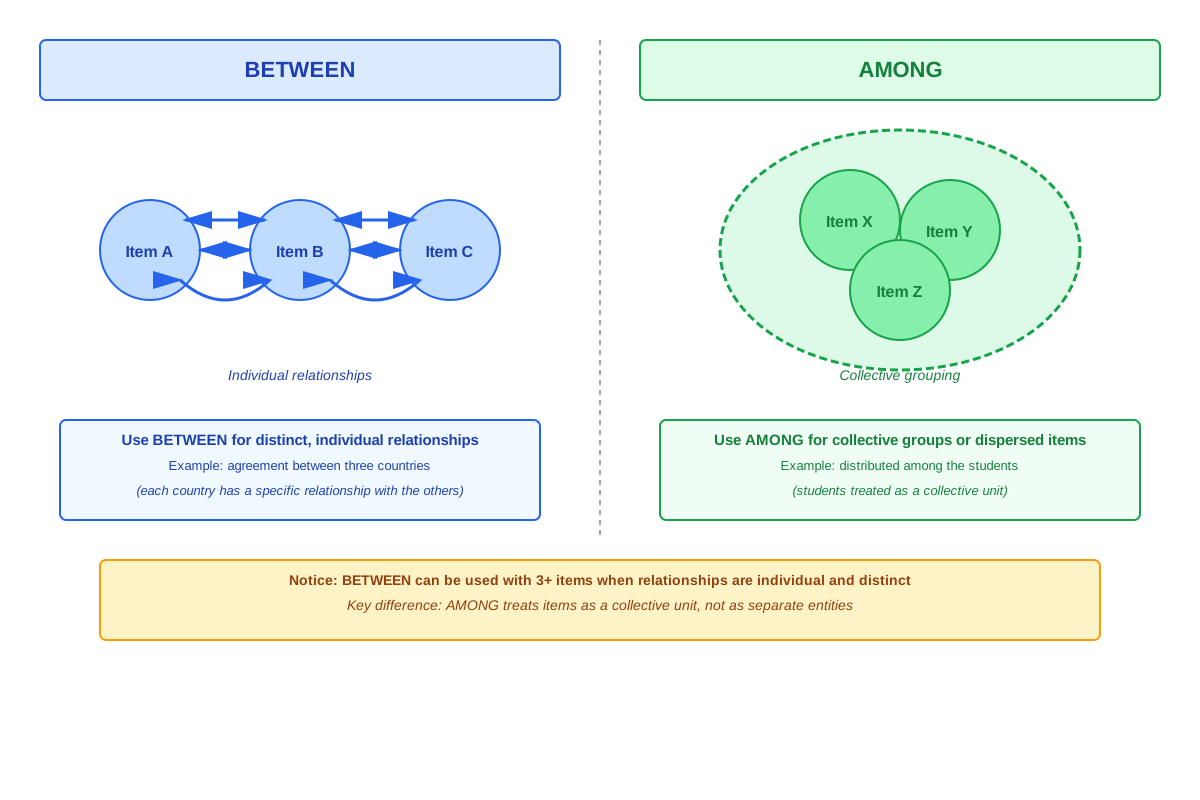
Between indicates relationships involving distinct, individual items where each item can be separately identified and considered in relation to the others. The key characteristic is that you can draw specific connections from one item to another. Even when more than two items are involved, if you're discussing individual, one-to-one relationships or distinguishing specific items from each other, "between" remains correct.
Among indicates relationships within a group where items are considered collectively rather than individually. This preposition suggests distribution, inclusion within a collective, or being surrounded by multiple items treated as a unified set. The emphasis is on the group as a whole rather than on specific pairwise connections.
The Number Guideline and Its Limitations
The traditional rule states: use "between" for two items and "among" for three or more. While this guideline works in many basic situations, it fails in numerous contexts that appear on the ACT.
| Situation | Correct Preposition | Reasoning |
|---|---|---|
| Two people sharing | Between | Two distinct items |
| Three countries negotiating a treaty | Between | Individual relationships among specific parties |
| Lost in a crowd | Among | Collective group, no individual distinctions |
| Choosing from multiple options | Between or Among | Depends on whether options are considered individually or as a set |
| Distributed throughout a population | Among | Collective distribution |
The ACT specifically tests whether students understand that "between" can correctly be used with three or more items when those items maintain distinct, individual relationships. For example: "The treaty was signed between France, Germany, and Italy" is correct because three specific nations are entering into defined relationships with each other.
Context Clues for Correct Usage
Several linguistic signals indicate which preposition is appropriate:
Signals for "between":
- Specific, named items (proper nouns or definite references)
- Verbs suggesting choice, distinction, or comparison (choose, distinguish, differentiate, divide)
- Phrases indicating spatial positioning with defined boundaries
- Expressions of reciprocal relationships or mutual actions
- References to specific connections or links
Signals for "among":
- General, unnamed groups or collective nouns
- Verbs suggesting distribution or inclusion (distribute, scatter, spread, popular)
- References to being surrounded or immersed
- Expressions indicating membership in a larger set
- Phrases suggesting shared characteristics across a group
Spatial Versus Abstract Relationships
The between/among distinction applies to both physical and abstract relationships, though the logic remains consistent.
For spatial relationships, "between" typically indicates a position bounded by specific points or objects: "The house stands between the oak tree and the river." "Among" suggests being surrounded by or within a collection: "The house is hidden among the trees."
For abstract relationships, "between" indicates connections involving specific entities: "The difference between capitalism, socialism, and communism." "Among" indicates inclusion within a group or distribution across members: "The idea gained popularity among economists."
Special Cases and Exceptions
Certain expressions have become idiomatic and don't follow the standard logic:
- "Between you and me" (always "between," never "among," even in a group conversation)
- "Few and far between" (idiomatic expression)
- "Between a rock and a hard place" (fixed idiom)
- "Among other things" (standard phrase for non-exhaustive lists)
The ACT rarely tests these idioms directly but may include them in passages where you must identify other errors, so recognizing them prevents false positives.
Concept Relationships
The between versus among distinction connects directly to several broader grammatical concepts. At its foundation, this topic relies on understanding prepositions as words that establish relationships between nouns or pronouns and other sentence elements. The choice between these two prepositions specifically relates to how we conceptualize those relationships—as individual connections or collective groupings.
This concept flows from number agreement principles: recognizing singular versus plural forms helps identify whether items are being treated as distinct entities or as members of a group. The distinction also connects to pronoun usage, particularly in phrases like "between you and me" versus "among ourselves," where the preposition choice affects which pronouns are appropriate.
The relationship map follows this pattern:
Preposition fundamentals → Between versus among distinction → Precision in expressing relationships → Advanced preposition usage (such as "in" versus "into," "on" versus "onto")
Understanding this topic also enhances comprehension of parallel structure because items connected by "between" or "among" must maintain grammatical parallelism. Additionally, it relates to logical comparison questions on the ACT, where precision in expressing relationships between items is crucial.
The concept bridges to rhetorical skills as well: choosing the correct preposition affects not just grammatical correctness but also clarity and precision of meaning, which are tested in the Strategy and Organization subscore areas.
High-Yield Facts
⭐ Between is used for relationships involving distinct, individual items regardless of whether there are two, three, or more items involved.
⭐ Among is used when items are considered collectively as a group rather than as separate entities with individual relationships.
⭐ The simplified "two versus three or more" rule fails in many ACT contexts and should not be relied upon exclusively.
⭐ Specific, named items (proper nouns) typically take "between" because they maintain distinct identities.
⭐ Verbs like "choose," "distinguish," and "differentiate" signal individual relationships and typically require "between."
- "Among" often appears with collective nouns, general groups, and unnamed populations.
- Verbs like "distribute," "scatter," and "spread" suggest collective treatment and typically require "among."
- The phrase "between you and me" is always correct; "among you and me" is never standard English.
- Spatial positioning with defined boundaries uses "between"; being surrounded by many items uses "among."
- When items can be connected by individual lines or relationships (like countries signing a treaty), use "between" even with three or more items.
- "Among" suggests immersion or inclusion within a larger set without emphasizing individual connections.
- The ACT tests this concept 1-3 times per exam, making it a high-yield topic for focused study.
Quick check — test yourself on Between versus among so far.
Try Flashcards →Common Misconceptions
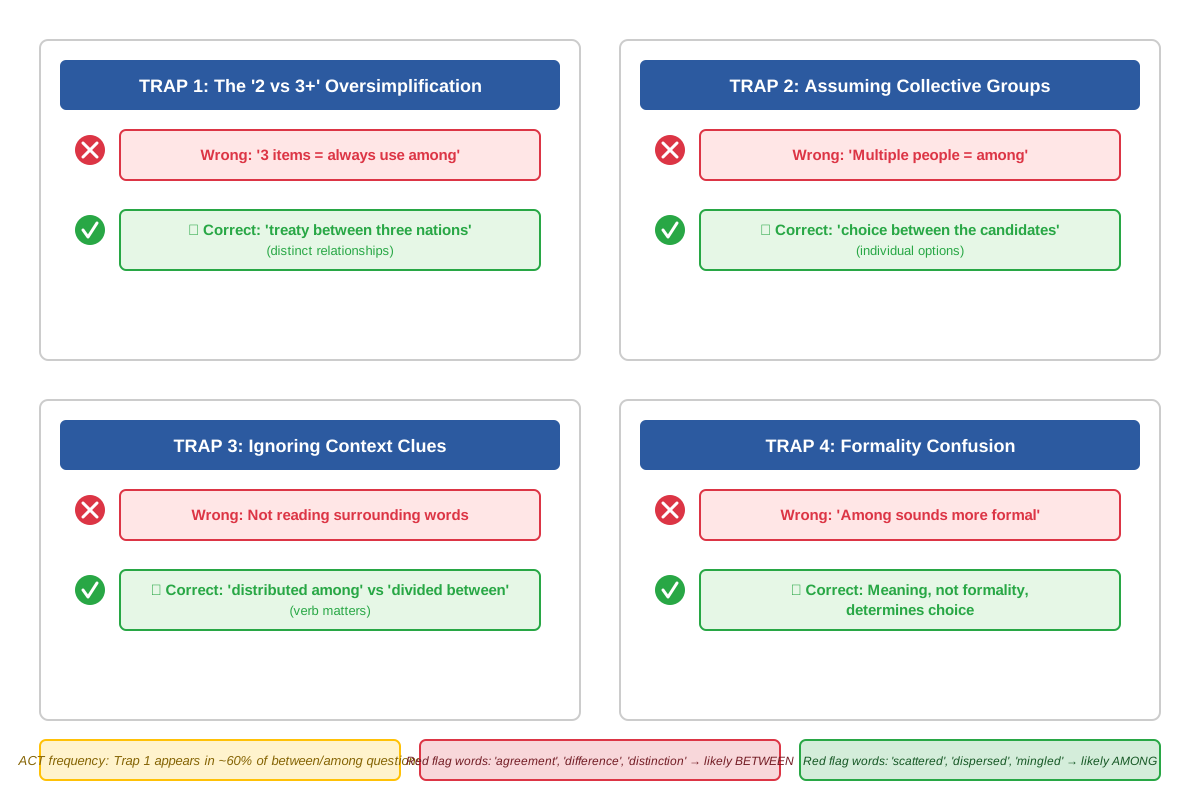
Misconception: "Between" can only be used with exactly two items. → Correction: "Between" is correct whenever items maintain distinct, individual relationships, even when three or more items are involved. "The negotiations between France, Germany, and Italy" is grammatically correct because three specific nations are entering defined relationships with each other.
Misconception: "Among" is always correct when three or more items are mentioned. → Correction: The number of items is less important than how they relate. "Choose among the three options" is incorrect if you're selecting one option from specific, distinct choices; "Choose between the three options" is correct because you're distinguishing among individually considered alternatives.
Misconception: "Between" and "among" are interchangeable in most contexts. → Correction: These prepositions convey different meanings. "The secret was shared between the three friends" suggests specific, mutual sharing among identified individuals. "The secret spread among the students" suggests general distribution throughout a collective group. The meanings are distinct.
Misconception: Collective nouns always require "among." → Correction: The determining factor is how the collective is being treated. "The agreement between the two teams" is correct when discussing two distinct groups entering a specific relationship. "The players among the team" would be correct when discussing individuals within a collective.
Misconception: You can determine the correct preposition by counting items in the sentence. → Correction: Context and relationship type matter more than quantity. "The difference between red, blue, and green" is correct despite three items because you're distinguishing specific, individual colors. "The most popular color among the options" treats the colors as a collective set.
Worked Examples
Example 1: Treaty Negotiation Context
Question: The trade agreement was negotiated (between/among) the United States, Canada, and Mexico over several months.
Step 1 - Identify the items: Three countries are mentioned: United States, Canada, and Mexico.
Step 2 - Analyze the relationship: The sentence discusses a treaty negotiation. Treaties involve specific, bilateral and multilateral relationships where each party enters into defined obligations with the other specific parties. Each country has individual relationships with each of the others.
Step 3 - Check for individual versus collective treatment: The countries are named specifically (proper nouns) and are entering into a formal agreement that involves distinct relationships between each pair of nations. This is not about being part of a general group but about specific entities forming defined connections.
Step 4 - Apply the rule: Despite three items being present, "between" is correct because the countries maintain distinct, individual relationships in the negotiation process.
Answer: "between" is correct.
Connection to learning objectives: This example demonstrates how to identify when the topic is being tested (Step 1), explains the core rule about individual versus collective relationships (Steps 2-3), and applies the concept to reach the correct answer (Step 4).
Example 2: Distribution Context
Question: The scholarship funds were distributed (between/among) the top students in the graduating class.
Step 1 - Identify the items: "The top students" represents a group, not specifically named individuals.
Step 2 - Analyze the relationship: The verb "distributed" suggests spreading something across multiple recipients. The phrase "in the graduating class" emphasizes membership in a larger collective.
Step 3 - Check for individual versus collective treatment: The students are not named individually, and the sentence emphasizes distribution across a group rather than specific allocations to identified individuals. The focus is on the collective set of "top students" rather than on individual relationships between specific people.
Step 4 - Evaluate context clues: "Distributed" is a key signal word for "among." The general reference to "students" rather than specific names reinforces collective treatment.
Step 5 - Apply the rule: The collective treatment and distribution across a group indicate "among" is correct.
Answer: "among" is correct.
Connection to learning objectives: This example shows how to recognize context clues (Step 4), distinguish between individual and collective relationships (Step 3), and accurately apply the rule to ACT-style questions (Step 5).
Exam Strategy
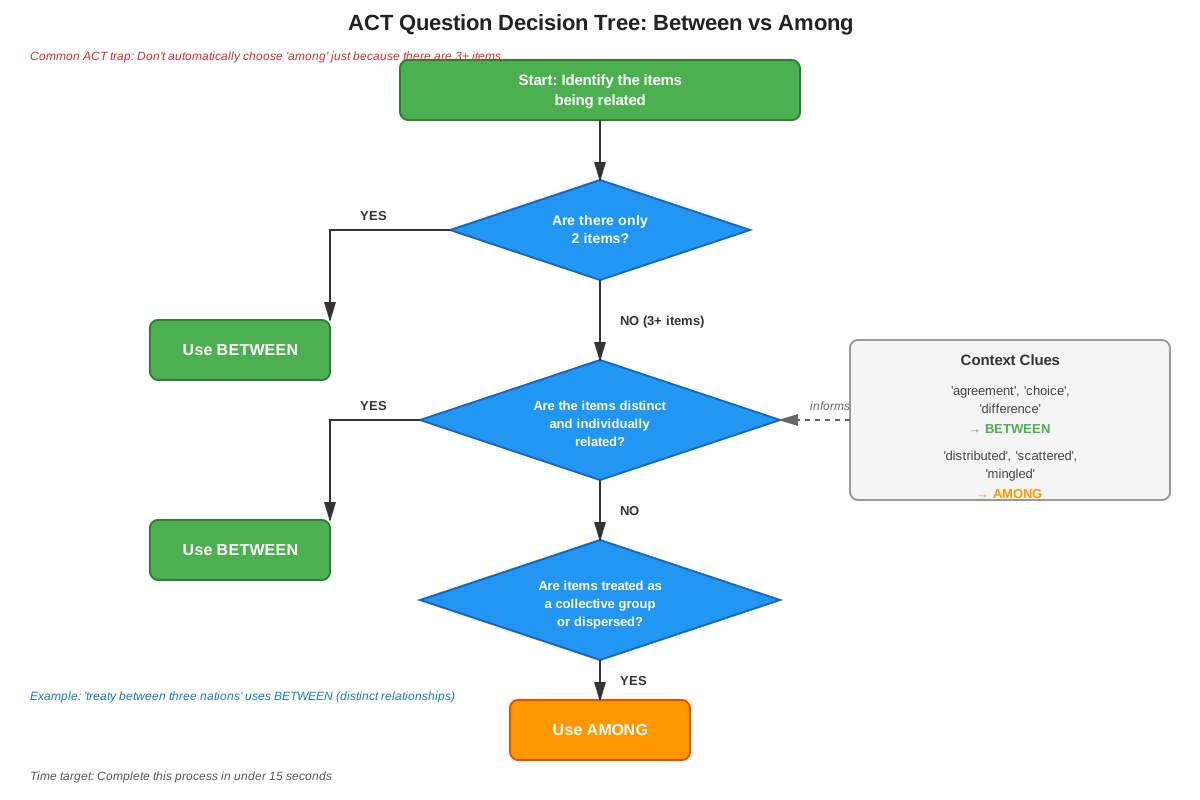
When approaching ACT between versus among questions, follow this systematic process:
Step 1 - Identify the question type: Look for answer choices that include "between" and "among" as options, or scan for these words in underlined portions of passages. These questions typically appear as substitution questions where you must choose the correct preposition.
Step 2 - Count and characterize the items: Quickly identify how many items are being related and whether they are specifically named (proper nouns, definite references) or general groups (collective nouns, plural common nouns without specific identification).
Step 3 - Analyze the verb and context: Pay special attention to the main verb in the sentence. Verbs like "choose," "distinguish," "negotiate," "divide," and "differentiate" signal individual relationships and typically require "between." Verbs like "distribute," "scatter," "spread," and "popular" signal collective treatment and typically require "among."
Step 4 - Apply the relationship test: Ask yourself: "Are these items being considered as distinct entities with individual connections to each other, or as members of a collective group?" If you can draw specific lines connecting each item to the others individually, use "between." If the items blend into a general group, use "among."
Exam Tip: When in doubt, check if you could replace the items with specific names. If "between John, Mary, and Susan" sounds correct, then "between" is likely right even with three items. If the sentence feels like it's discussing a crowd or general population, "among" is probably correct.
Time allocation: These questions should take no more than 15-20 seconds once you recognize the pattern. Spending more time usually indicates overthinking. Trust the relationship test and move forward.
Process of elimination: If you're stuck between answer choices, eliminate options that use "between" with clearly collective contexts (like "among the crowd" changed to "between the crowd"—this is always wrong). Similarly, eliminate "among" when specific, named items are entering defined relationships.
Trigger words to watch for:
- "Between" triggers: choose, distinguish, differentiate, divide, specific names, treaty, agreement, difference, comparison
- "Among" triggers: distribute, scatter, spread, popular, crowd, group, collective nouns, general references
Memory Techniques
Mnemonic for "Between": Between = Boundaries and Bilateral connections. Think of "between" as drawing lines between specific points.
Visualization for "Among": Picture yourself standing among a crowd at a concert—you're surrounded by many people who blend together as a group. You're not forming individual relationships with each person; you're immersed in the collective.
The "Name Test": If you can name each item specifically (France, Germany, Italy), lean toward "between." If items are unnamed or general (students, people, options), lean toward "among."
The "Line Drawing" technique: Mentally try to draw lines connecting each item to every other item. If you can draw distinct lines (A to B, B to C, A to C), use "between." If the items blur into a mass where individual connections don't make sense, use "among."
Acronym for context clues: DIVIDE signals "between"
- Distinguish
- Individual items
- Versus (comparisons)
- Identified specifically
- Differentiate
- Each item distinct
Acronym for "among" signals: GROUPS
- General references
- Random distribution
- One of many
- Unnamed items
- Popular within
- Scattered across
Summary
The between versus among distinction represents a high-yield ACT English topic that tests your understanding of how prepositions express relationships between items. The fundamental rule centers on whether items are treated as distinct entities with individual relationships (requiring "between") or as members of a collective group (requiring "among"). The oversimplified guideline that "between" is for two items and "among" is for three or more fails in many contexts that appear on the ACT. Instead, focus on analyzing whether items maintain distinct identities and specific connections to each other, regardless of quantity. Context clues like specific verbs (choose, distinguish, distribute, scatter), the presence of proper nouns versus collective nouns, and the overall meaning of the sentence guide correct usage. This topic appears 1-3 times per ACT exam, making it essential for achieving top scores. Mastering this distinction requires moving beyond memorized rules to understanding the logical relationships that these prepositions express, enabling you to confidently answer questions within 15 seconds and avoid common traps that target surface-level knowledge.
Key Takeaways
- Between indicates relationships involving distinct, individual items, regardless of whether two, three, or more items are present
- Among indicates collective treatment where items are considered as a group rather than as separate entities with individual connections
- The number of items matters less than how they relate: individual connections versus collective grouping
- Specific, named items (proper nouns) typically require "between"; general groups typically require "among"
- Verbs provide crucial context clues: "choose/distinguish/differentiate" signal "between," while "distribute/scatter/spread" signal "among"
- This topic appears 1-3 times per ACT exam, making it a high-yield focus area worth mastering
- Apply the "relationship test": if you can draw specific lines connecting each item individually, use "between"
Related Topics
Preposition usage patterns: Understanding "between versus among" provides a foundation for mastering other commonly confused preposition pairs like "in/into," "on/onto," and "to/toward," all of which appear on the ACT and follow similar logic about relationships and movement.
Parallel structure: Items connected by "between" or "among" must maintain grammatical parallelism, so mastering this topic enables better recognition of parallel structure errors, another high-yield ACT concept.
Logical comparisons: The precision required for "between versus among" directly transfers to identifying and correcting illogical comparison errors, where relationships between items must be clearly and correctly expressed.
Idiom recognition: Many idiomatic expressions use "between" or "among" in fixed ways, and understanding the standard usage helps identify when idioms are being tested versus when the general rule applies.
Practice CTA
Now that you've mastered the core concepts, context clues, and exam strategies for between versus among, it's time to cement your understanding through active practice. Attempt the practice questions to apply these principles to ACT-style scenarios, and use the flashcards to reinforce the key distinctions and trigger words. Remember: this topic appears on virtually every ACT exam, so the time you invest in practice now will directly translate to points on test day. Confidence comes from repetition—challenge yourself to identify and correct these errors in under 15 seconds per question, and you'll be fully prepared to handle any "between versus among" question the ACT presents!
Sign up free to keep reading
Create a free AnvayaPrep account to finish this ACT guide on Between versus among — plus flashcards and practice questions.