Overview
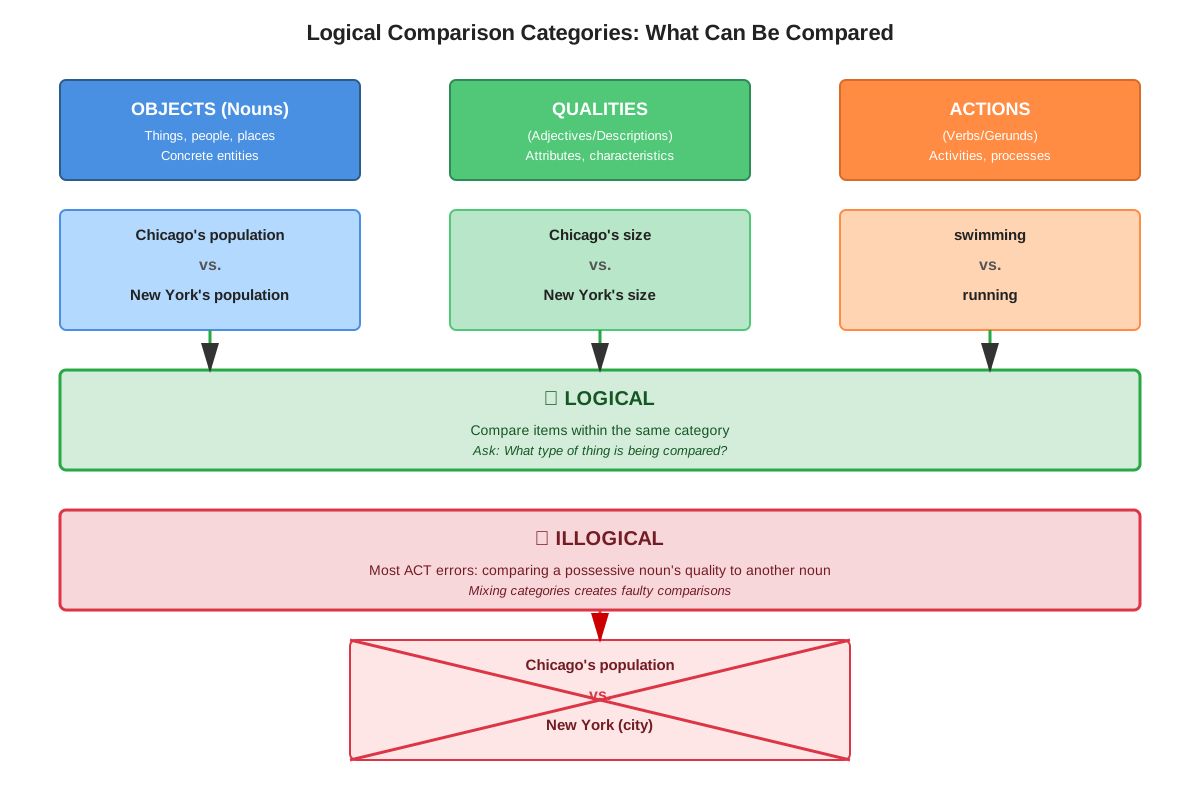
Logical comparisons represent one of the most frequently tested grammar concepts on the ACT English section, appearing in approximately 2-4 questions per test. This topic examines whether sentences compare items that are truly comparable—in other words, whether the comparison makes logical sense. The ACT tests whether students can identify when a sentence illogically compares apples to oranges, such as comparing "the population of Chicago" to "New York" (a city) rather than to "the population of New York."
Understanding ACT logical comparisons is essential because these errors often sound correct in casual speech but violate formal written English standards. Students must develop the ability to recognize when a sentence compares a thing to another thing, a quality to another quality, or an action to another action—and catch when these categories get mixed up. These questions typically appear as underlined portions within passages, requiring students to select the answer choice that creates the most logical comparison.
This topic connects directly to other grammar and usage concepts including pronoun clarity, parallel structure, and modifier placement. Mastering logical comparisons strengthens overall sentence analysis skills and improves the ability to identify structural errors that may initially seem acceptable. The principles learned here apply broadly across the English section and reinforce the importance of precision in written communication.
Learning Objectives
- [ ] Identify when Logical comparisons is being tested
- [ ] Explain the core rule or strategy behind Logical comparisons
- [ ] Apply Logical comparisons to ACT-style questions accurately
- [ ] Distinguish between comparisons of objects, qualities, and actions
- [ ] Recognize and correct illogical comparisons involving possessive nouns
- [ ] Evaluate whether comparison structures maintain parallel form
- [ ] Identify trigger words that signal comparison questions on the ACT
Prerequisites
- Basic sentence structure: Understanding subjects, verbs, and objects is necessary to identify what elements are being compared in a sentence
- Parts of speech: Recognizing nouns, adjectives, and verbs helps determine whether compared items belong to the same category
- Possessive forms: Knowing the difference between possessive nouns (Chicago's) and regular nouns (Chicago) is crucial for comparison questions
- Parallel structure basics: Familiarity with maintaining consistent grammatical forms aids in constructing logical comparisons
Why This Topic Matters
Logical comparison questions appear with remarkable consistency on every ACT English test, making them high-yield content for score improvement. These questions typically account for 3-5% of the English section, which translates to 2-4 questions per exam. Students who master this concept can quickly identify and correct these errors, gaining easy points that significantly impact their overall English score.
In real-world writing, logical comparisons ensure clarity and precision in communication. Professional writing, academic papers, and business correspondence all require accurate comparisons to convey meaning effectively. When comparisons are illogical, readers become confused about what is actually being compared, leading to misunderstandings and weakened arguments.
On the ACT, logical comparison errors most commonly appear in three contexts: (1) comparing a possessive noun's quality to another noun rather than to that noun's quality, (2) comparing an object to an action or quality, and (3) comparing singular items to plural items or vice versa. These questions often appear in passages discussing statistics, historical comparisons, or scientific data where precise language is essential. The test makers deliberately craft sentences that sound acceptable in spoken English but contain subtle logical flaws that violate written standards.
Core Concepts
The Fundamental Rule of Logical Comparisons
The core principle governing logical comparisons is straightforward: compare like to like. Every comparison must match items from the same category—objects to objects, qualities to qualities, actions to actions, people to people. When a sentence violates this principle, it creates an illogical comparison that confuses the reader about what is actually being evaluated.
Consider this example: "The speed of a cheetah is faster than a lion." This sentence illogically compares "speed" (a quality) to "a lion" (an animal). The logical correction would be: "The speed of a cheetah is faster than the speed of a lion" or "A cheetah is faster than a lion." Both corrections compare like items—either two speeds or two animals.
Possessive Noun Comparisons
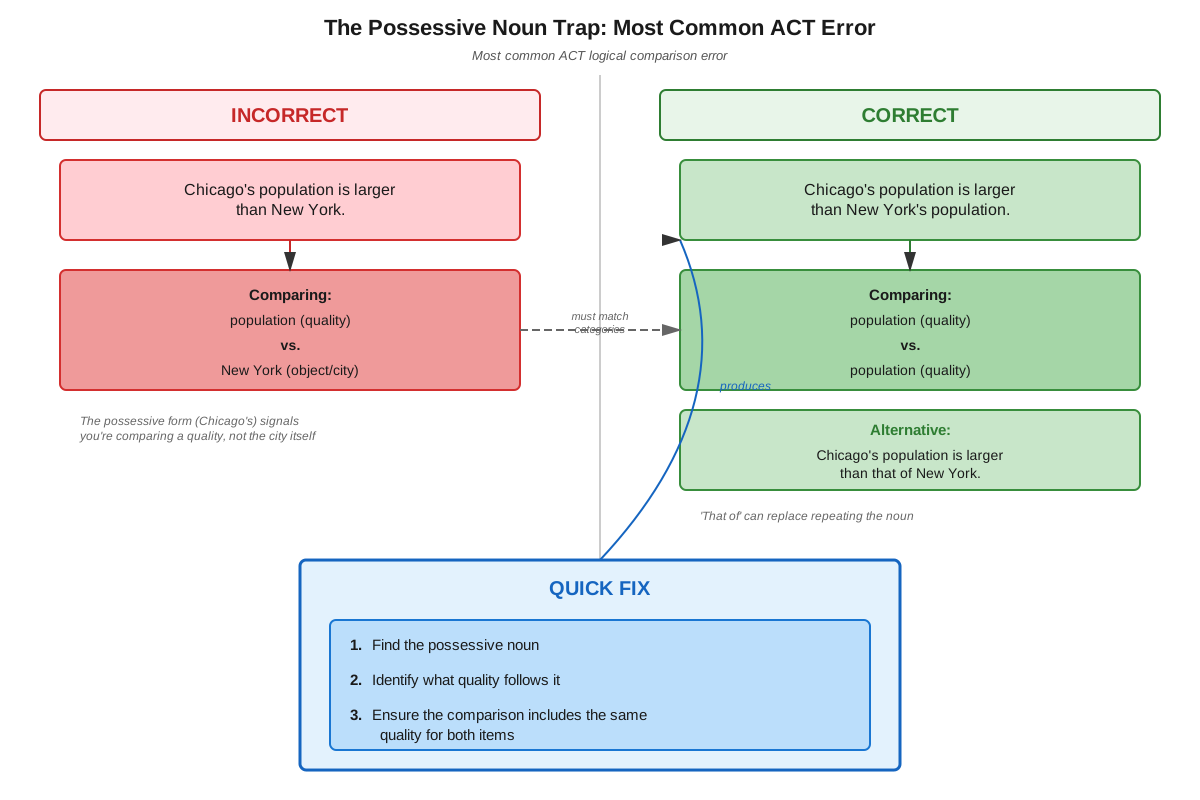
The most common logical comparison error on the ACT involves possessive nouns. When a sentence uses a possessive form (Chicago's, Maria's, the company's), it typically refers to something belonging to or associated with that noun. The comparison must then reference the same type of possession for the other item.
Incorrect: Chicago's population is larger than New York.
Correct: Chicago's population is larger than New York's (population).
In the incorrect version, the sentence compares "population" to "New York" (a city), which is illogical. The correct version compares "Chicago's population" to "New York's population," maintaining logical parallelism. The word "population" can be omitted after "New York's" because it's understood from context, but the possessive form must be present.
Object-to-Object Comparisons
When comparing concrete objects, both items in the comparison must be objects of the same type. This principle extends to comparing groups, collections, or categories.
Incorrect: The museum's collection of paintings is more extensive than the gallery.
Correct: The museum's collection of paintings is more extensive than the gallery's (collection).
The error occurs because "collection" is being compared to "gallery" rather than to another collection. Adding the possessive form "gallery's" creates a logical comparison between two collections.
Quality-to-Quality Comparisons
Adjectives and abstract qualities must be compared to other adjectives and abstract qualities, not to concrete objects or people.
Incorrect: The brightness of LED bulbs is superior to incandescent bulbs.
Correct: The brightness of LED bulbs is superior to the brightness of incandescent bulbs.
Also Correct: LED bulbs are brighter than incandescent bulbs.
The first correction maintains the quality-to-quality comparison by repeating "brightness." The second correction restructures the sentence to compare the bulbs themselves using an adjective, which is also logical.
Action-to-Action Comparisons
When comparing actions (verbs or gerunds), both elements must be actions of the same type.
Incorrect: Swimming in the ocean is more challenging than a pool.
Correct: Swimming in the ocean is more challenging than swimming in a pool.
The gerund "swimming" (an action) cannot logically be compared to "a pool" (an object). The correction compares two swimming actions in different locations.
Comparison Words and Structures
Several key words signal that a comparison is being made and should trigger careful analysis:
| Comparison Type | Signal Words | Example Structure |
|---|---|---|
| Inequality | more than, less than, -er than | "faster than," "more intelligent than" |
| Similarity | like, similar to, as...as | "as tall as," "similar to" |
| Difference | unlike, different from | "unlike her sister," "different from" |
| Superlative | most, least, -est | "the fastest," "most beautiful" |
The "Than" Test
When a sentence contains the word "than," apply this diagnostic test: identify what comes immediately before "than" and what comes immediately after it. These two elements must be logically comparable.
Before "than": [Item A] → After "than": [Item B] → Question: Can A and B be logically compared?
If the answer is no, the sentence contains a logical comparison error that must be corrected.
Implied Words in Comparisons
The ACT frequently tests whether students understand that certain words can be implied (omitted but understood) in comparisons, but only when the comparison remains logical.
Correct: "The temperature in Phoenix is higher than in Seattle."
This sentence is acceptable because "the temperature" is implied after "in Seattle." The full comparison would be "The temperature in Phoenix is higher than the temperature in Seattle," but the second "temperature" can be omitted without creating confusion.
Incorrect: "Phoenix's temperature is higher than Seattle."
This version is illogical because it compares "temperature" to "Seattle" (a city). The correction requires "Seattle's" to make the comparison logical.
Concept Relationships
The concepts within logical comparisons build upon each other in a hierarchical structure. The fundamental rule (compare like to like) serves as the foundation, from which all specific applications derive. Possessive noun comparisons represent the most common application of this rule on the ACT, followed by object-to-object and quality-to-quality comparisons.
Relationship Map:
Fundamental Rule (compare like to like) → Possessive Noun Comparisons → Object/Quality/Action Distinctions → Comparison Signal Words → Application to ACT Questions
This topic connects to parallel structure because both concepts require maintaining consistent grammatical forms. When constructing comparisons, the elements being compared must not only be logically similar but also grammatically parallel. For example, "She prefers reading to watch movies" violates both parallelism (reading vs. watch) and creates an awkward comparison structure.
Logical comparisons also relate to pronoun clarity because ambiguous pronouns can create unclear comparisons. Consider: "John's score was higher than him." This sentence confuses the possessive comparison (John's score) with an object pronoun (him), creating both a logical comparison error and a pronoun case error.
The connection to modifier placement becomes relevant when modifying phrases affect what is being compared. Misplaced modifiers can inadvertently change the items being compared, creating logical errors.
High-Yield Facts
- ⭐ Possessive noun comparisons are the most frequently tested logical comparison error on the ACT
- ⭐ The word "than" is the primary trigger word indicating a comparison question
- ⭐ When comparing possessive forms, both items must use possessive structure (Chicago's vs. New York's)
- ⭐ Objects can only be logically compared to other objects, not to qualities or actions
- ⭐ The item immediately before "than" must be the same type as the item immediately after "than"
- Qualities (adjectives and abstract nouns) must be compared to other qualities
- Actions (verbs and gerunds) must be compared to other actions
- The word "like" requires comparing similar items (people to people, things to things)
- Superlative comparisons (most, least, -est) must compare three or more items
- Comparative forms (more, less, -er) compare exactly two items
- Implied words in comparisons are acceptable only when the comparison remains clear and logical
- "Different from" is the correct idiom; "different than" is generally incorrect in formal writing
- Collective nouns (team, group, committee) are treated as singular for comparison purposes
- When comparing groups, ensure both sides of the comparison reference groups, not individuals
- Comparison errors often sound correct in casual speech but violate written English standards
Quick check — test yourself on Logical comparisons so far.
Try Flashcards →Common Misconceptions
Misconception: If a comparison sounds natural in spoken English, it must be correct on the ACT.
Correction: Many logical comparison errors are common in casual speech but violate formal written English standards. The ACT tests written conventions, which are more precise than conversational language. Always apply the "compare like to like" rule regardless of how natural a sentence sounds.
Misconception: Adding "that of" or "those of" always fixes comparison problems.
Correction: While "that of" and "those of" can help create logical comparisons in some contexts, they are not universal solutions. The key is ensuring both sides of the comparison reference the same type of item. Sometimes a possessive form, restructuring, or different wording is more appropriate than inserting "that of."
Misconception: Comparisons only involve the words "more" and "than."
Correction: Logical comparisons appear with many different signal words including "like," "unlike," "similar to," "different from," "as...as," and superlative forms ("-est," "most," "least"). Any sentence that evaluates relationships between two or more items requires logical comparison structure.
Misconception: If the second item in a comparison is implied or omitted, the comparison is automatically wrong.
Correction: Implied words are acceptable in comparisons when the meaning remains clear. "The temperature in Phoenix is higher than in Seattle" is correct because "the temperature" is clearly implied after "in Seattle." The error occurs when the implied word would create an illogical comparison.
Misconception: Comparing a city's characteristic to another city requires repeating the characteristic word.
Correction: When using possessive forms, the characteristic word can be omitted if it's clearly understood. "Chicago's population is larger than New York's" is correct and complete; adding "population" after "New York's" is optional. The crucial element is the possessive form "New York's," not the repetition of "population."
Misconception: All comparison questions have obvious errors that are easy to spot.
Correction: The ACT deliberately crafts comparison errors that are subtle and may initially appear correct. Many students miss these questions because they rely on what "sounds right" rather than systematically checking whether the compared items are logically parallel. Developing a consistent checking strategy is essential.
Worked Examples
Example 1: Possessive Noun Comparison
Question: Which of the following is the best version of the underlined portion?
"The average rainfall of Seattle is significantly higher than Phoenix."
A. NO CHANGE
B. than Phoenix's
C. than that of Phoenix
D. than Phoenix is
Step 1: Identify what is being compared.
The sentence compares "the average rainfall of Seattle" to something. We need to determine what comes after "than."
Step 2: Analyze the current structure.
Currently, the sentence compares "rainfall" (a measurement/quality) to "Phoenix" (a city). This is illogical—we cannot compare a measurement to a city.
Step 3: Evaluate each answer choice.
- Choice A (NO CHANGE): Compares "rainfall" to "Phoenix" → illogical
- Choice B (than Phoenix's): Compares "rainfall of Seattle" to "Phoenix's [rainfall]" → logical, with the second "rainfall" implied
- Choice C (than that of Phoenix): Compares "rainfall of Seattle" to "that [rainfall] of Phoenix" → logical, using "that" to refer to rainfall
- Choice D (than Phoenix is): Compares "rainfall" to "Phoenix is" → illogical and grammatically awkward
Step 4: Choose between B and C.
Both B and C create logical comparisons. On the ACT, both structures are acceptable, but B is more concise. The ACT generally prefers conciseness when meaning is preserved.
Answer: B
Connection to Learning Objectives: This example demonstrates how to identify when logical comparisons are being tested (the presence of "than" and a comparison structure), explains the core rule (compare like to like), and applies the concept to an ACT-style question.
Example 2: Object-to-Quality Comparison
Question: Which of the following is the best version of the underlined portion?
"Unlike the novels of Hemingway, Fitzgerald wrote with elaborate, ornate prose."
A. NO CHANGE
B. Fitzgerald's novels
C. Fitzgerald, who
D. the novels that Fitzgerald wrote
Step 1: Identify the comparison signal word.
"Unlike" signals a comparison. We need to identify what is being compared to what.
Step 2: Analyze the current structure.
The sentence begins with "Unlike the novels of Hemingway," which means whatever comes after the comma must be logically comparable to "novels." Currently, "Fitzgerald" (a person) comes after the comma, creating an illogical comparison between novels and a person.
Step 3: Evaluate each answer choice.
- Choice A (NO CHANGE): Compares "novels" to "Fitzgerald" (a person) → illogical
- Choice B (Fitzgerald's novels): Compares "novels of Hemingway" to "Fitzgerald's novels" → logical, comparing novels to novels
- Choice C (Fitzgerald, who): Still compares "novels" to "Fitzgerald" (a person) → illogical
- Choice D (the novels that Fitzgerald wrote): Compares "novels of Hemingway" to "novels that Fitzgerald wrote" → logical but wordy
Step 4: Choose between B and D.
Both create logical comparisons, but B is more concise and maintains parallel structure with "the novels of Hemingway."
Answer: B
Connection to Learning Objectives: This example shows how comparison signal words like "unlike" trigger logical comparison questions, demonstrates the importance of comparing objects to objects (novels to novels, not novels to people), and illustrates how to eliminate answer choices that maintain the logical error.
Exam Strategy
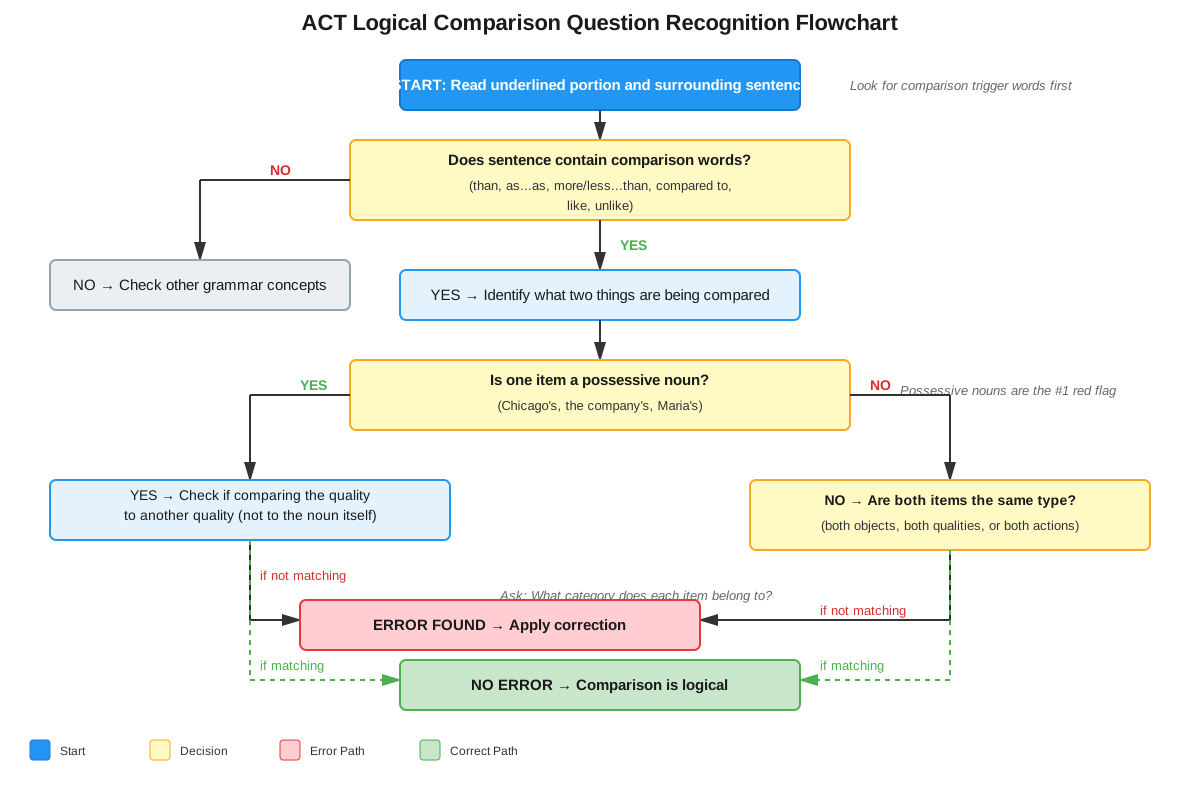
When approaching logical comparison questions on the ACT, implement this systematic strategy:
Step 1: Identify Comparison Trigger Words
Scan for words that signal comparisons: "than," "like," "unlike," "similar to," "different from," "as...as," "more," "less," "-er," "-est," "most," "least." These words indicate that logical comparison may be tested.
Step 2: Locate Both Items Being Compared
Determine exactly what two (or more) items the sentence is comparing. Write them down mentally or physically: "Item A vs. Item B."
Step 3: Apply the Category Test
Ask: Are both items in the same category? Are they both objects, both qualities, both actions, or both people? If the categories don't match, the comparison is illogical.
Step 4: Check Possessive Forms
If one item uses a possessive form (Chicago's, the company's), the other item must also use a possessive form or a substitute like "that of" or "those of."
Step 5: Evaluate Answer Choices Systematically
Eliminate choices that maintain illogical comparisons first. Then choose the most concise option among the remaining logical choices.
Exam Tip: When you see "than" in an underlined portion, immediately check what comes before and after it. This single strategy will help you catch most logical comparison errors.
Time Allocation: Logical comparison questions should take 20-30 seconds once you recognize them. If you're spending more than 45 seconds, you may be overthinking. Apply the systematic strategy and move forward.
Process of Elimination Tips:
- Eliminate any choice that compares different categories (object to quality, person to action, etc.)
- Eliminate choices that use possessive forms inconsistently
- Between two logical options, choose the more concise one
- Watch for answer choices that add unnecessary words like "that of" when a simple possessive would suffice
Common Trap Answers:
The ACT often includes answer choices that sound natural in speech but are technically illogical. Trust the systematic strategy over what "sounds right."
Memory Techniques
Mnemonic: COMPARE
- Categories must match (objects to objects, qualities to qualities)
- Observe possessive forms (both sides need them)
- Mark the word "than" (primary trigger)
- Parallel items only (like to like)
- Analyze both sides (before and after comparison words)
- Reject mixed types (no object-to-quality comparisons)
- Eliminate illogical choices first
Visualization Strategy: Picture a balance scale. For a comparison to be logical, both sides of the scale must hold the same type of item. If you place an apple on one side and a color on the other, the scale doesn't make sense—you can't weigh a physical object against an abstract quality. This mental image reinforces the "compare like to like" principle.
The Possessive Pair Rule: When you see a possessive form on one side of a comparison, mentally draw a line connecting it to the other side. That line must connect two possessive forms (or equivalents like "that of"). If the line connects a possessive to a non-possessive, the comparison is broken.
Acronym: THAN = Test How Alike Nouns
Whenever you see "than," remember to test whether the nouns (or noun phrases) on both sides are alike in category and structure.
Summary
Logical comparisons require that sentences compare items from the same category—objects to objects, qualities to qualities, actions to actions, and people to people. The most common error on the ACT involves possessive noun comparisons, where one side uses a possessive form (Chicago's population) but the other side doesn't (New York instead of New York's). To identify these questions, look for comparison trigger words like "than," "like," "unlike," and "as...as." Apply the systematic strategy of identifying both items being compared, checking whether they belong to the same category, and ensuring possessive forms are used consistently. The ACT tests this concept frequently because these errors sound acceptable in casual speech but violate formal written English standards. Mastering logical comparisons provides reliable points on every test and strengthens overall sentence analysis skills.
Key Takeaways
- Compare like to like: Objects to objects, qualities to qualities, actions to actions—never mix categories
- Possessive forms must match: If one side uses a possessive (Chicago's), the other must too (New York's)
- "Than" is the primary trigger word: When you see "than," immediately check what comes before and after it
- Trust the system over your ear: Many illogical comparisons sound fine in speech but are wrong in formal writing
- Eliminate illogical choices first: Remove any answer that compares different categories before evaluating other factors
- Conciseness wins among logical options: When multiple choices create logical comparisons, choose the shortest
- This topic appears 2-4 times per test: Mastering logical comparisons guarantees easy points on every ACT
Related Topics
Parallel Structure: Logical comparisons and parallel structure work together to create clear, balanced sentences. While logical comparisons ensure the right items are being compared, parallel structure ensures those items are expressed in grammatically consistent forms. Mastering logical comparisons provides a foundation for understanding more complex parallelism questions.
Pronoun Agreement and Clarity: Pronouns in comparison structures must clearly refer to appropriate antecedents and maintain logical relationships. Understanding logical comparisons helps identify when pronouns create unclear or illogical comparative relationships.
Idioms and Conventional Expressions: Certain comparison structures require specific prepositions and constructions (different from, not different than). Logical comparison mastery connects to broader idiom knowledge tested on the ACT.
Modifier Placement: Misplaced modifiers can inadvertently change what is being compared in a sentence, creating logical comparison errors. Understanding how modifiers affect sentence meaning enhances the ability to construct and evaluate comparisons.
Practice CTA
Now that you've mastered the core concepts of logical comparisons, it's time to reinforce your learning through active practice. Attempt the practice questions to apply these strategies to ACT-style problems and use the flashcards to memorize key trigger words and rules. Remember: logical comparison questions appear on every ACT, and with systematic practice, they become some of the easiest points to earn. Each practice question you complete strengthens your pattern recognition and builds the confidence needed to spot these errors quickly on test day. You've got this!
Sign up free to keep reading
Create a free AnvayaPrep account to finish this ACT guide on Logical comparisons — plus flashcards and practice questions.