Overview
The distinction between fewer versus less represents one of the most frequently tested grammar concepts on the ACT English section. This seemingly simple rule trips up countless test-takers because everyday spoken English often blurs the distinction, making the incorrect usage sound natural to many students' ears. However, the ACT consistently tests whether students can identify and correct errors involving these two words, making mastery of this topic essential for achieving a competitive score.
Understanding ACT fewer versus less goes beyond memorizing a simple rule—it requires recognizing the fundamental difference between countable and uncountable nouns, a grammatical concept that underlies numerous other usage questions on the exam. When students master this distinction, they develop a sharper eye for precision in language, which helps them tackle related questions about quantity expressions, subject-verb agreement with collective nouns, and other grammar topics that depend on understanding how nouns function in sentences.
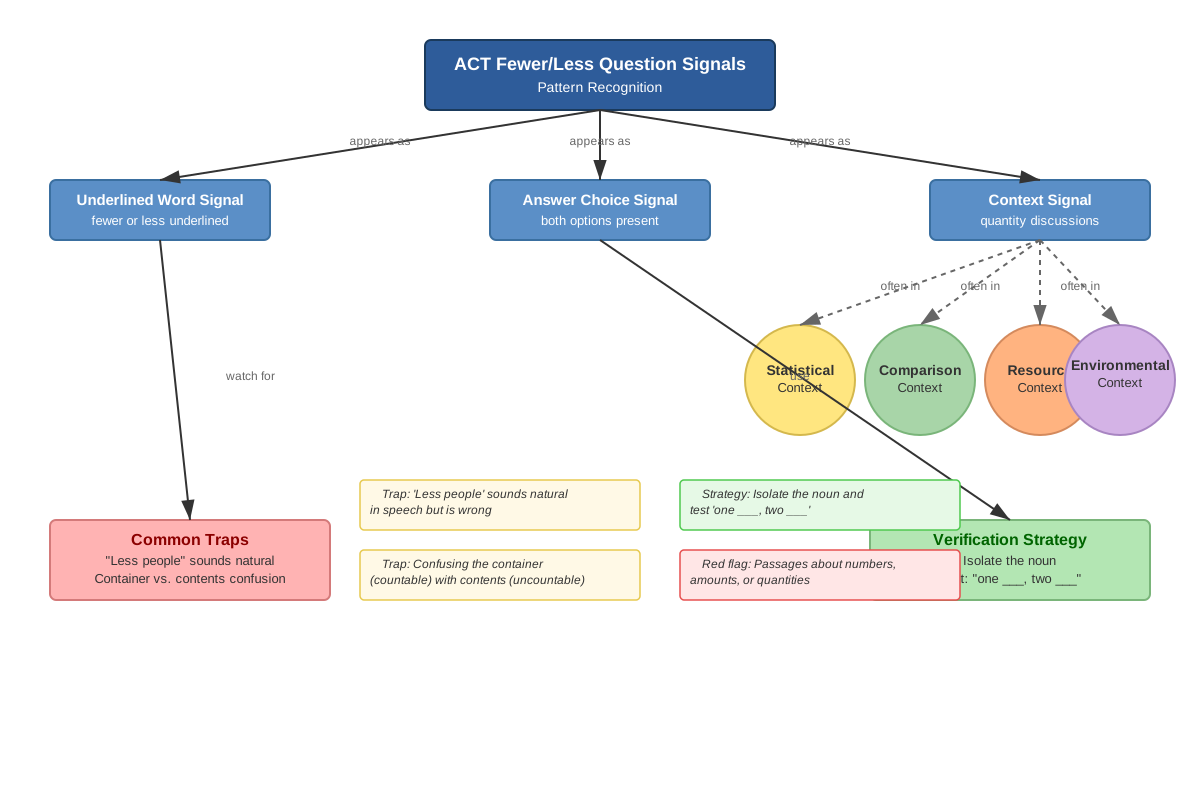
This topic appears with remarkable consistency across ACT administrations, typically showing up 1-2 times per test in various contexts. Questions may ask students to identify errors in underlined portions, choose the most appropriate word in context, or recognize when no change is needed. The ACT particularly favors testing this concept in passages discussing statistics, comparisons, or quantities, where the distinction between countable and uncountable items becomes crucial for maintaining grammatical precision and clarity.
Learning Objectives
- [ ] Identify when fewer versus less is being tested in ACT English passages
- [ ] Explain the core rule or strategy behind fewer versus less usage
- [ ] Apply fewer versus less to ACT-style questions accurately
- [ ] Distinguish between countable and uncountable nouns in context
- [ ] Recognize exceptions and special cases where the standard rule requires nuanced application
- [ ] Evaluate sentences containing quantity expressions to determine grammatical correctness
- [ ] Correct errors involving fewer/less in revision and editing tasks
Prerequisites
- Basic noun classification: Understanding what nouns are and how they function in sentences is essential because the fewer/less distinction depends entirely on noun type.
- Sentence structure fundamentals: Recognizing subjects, verbs, and objects helps students locate where quantity expressions appear and what they modify.
- Comparative and superlative forms: Familiarity with how English expresses comparisons provides context for understanding fewer and less as comparative forms of quantity.
Why This Topic Matters
In professional and academic writing, the correct use of fewer and less signals attention to detail and grammatical sophistication. Publications, academic journals, and formal communications maintain this distinction rigorously, making it a marker of educated writing. Students who master this concept demonstrate linguistic precision that extends beyond test-taking into college essays, research papers, and professional correspondence.
On the ACT specifically, fewer versus less questions appear with high frequency—approximately 1-2 questions per test, representing roughly 2-3% of the English section. These questions typically appear in the Usage/Mechanics subscore category, specifically under Grammar and Usage. The ACT test writers favor this topic because it has a clear right answer, tests genuine grammatical knowledge, and distinguishes students who have studied formal grammar from those relying solely on colloquial speech patterns.
Common manifestations in ACT passages include sentences comparing quantities ("The store had less items than expected" vs. "fewer items"), discussions of statistics or data ("Less people attended" vs. "Fewer people"), and contexts involving measurements or amounts ("Less water," which is correct, vs. "Less bottles," which is incorrect). The test often embeds these questions in passages about scientific studies, historical events with numerical data, or social trends involving countable populations, making the distinction between countable and uncountable nouns crucial for selecting the correct answer.
Core Concepts
The Fundamental Rule
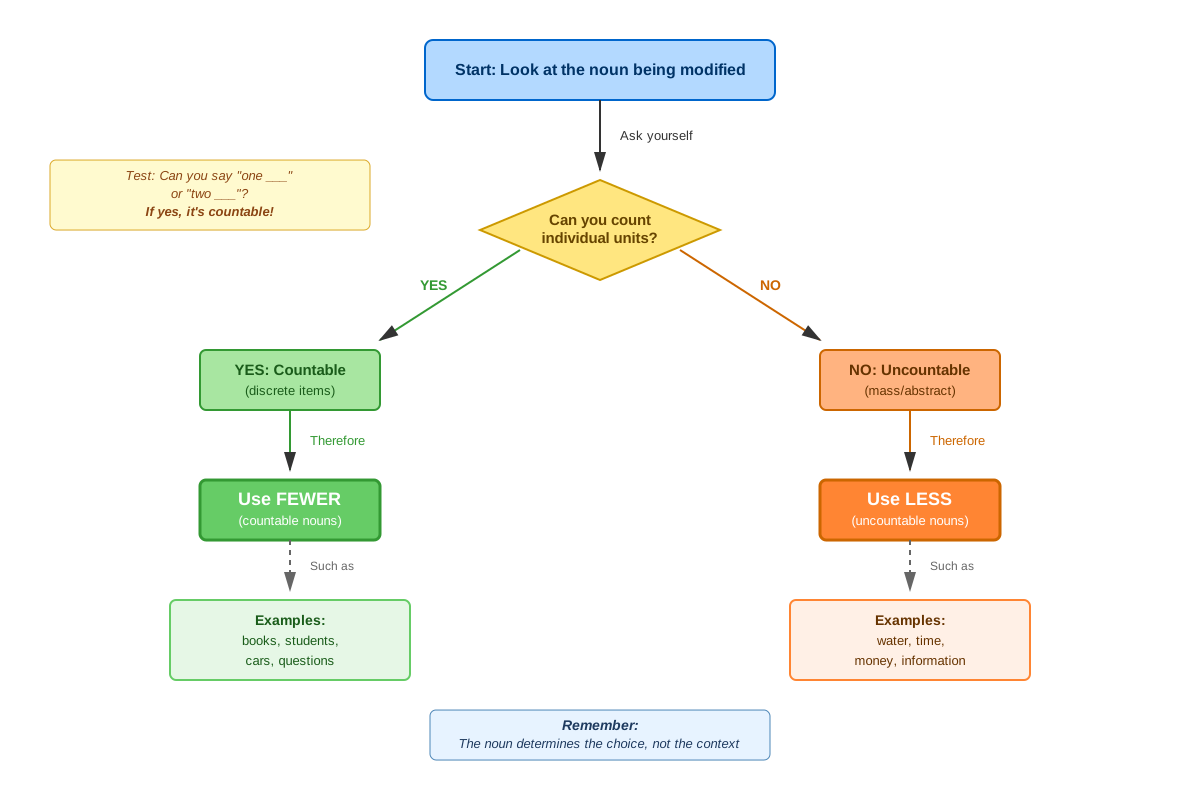
The core principle governing fewer versus less centers on whether the noun being modified is countable or uncountable. Fewer modifies countable nouns—items that can be enumerated individually (one, two, three, etc.). Less modifies uncountable nouns—substances, concepts, or quantities that cannot be separated into distinct units without changing their nature.
This distinction reflects a fundamental property of English nouns. Countable nouns have both singular and plural forms (book/books, student/students, idea/ideas), while uncountable nouns typically appear only in singular form (water, information, furniture). The fewer/less rule maintains logical consistency: if you can count individual units, use fewer; if you measure or quantify without counting discrete items, use less.
Countable Nouns and "Fewer"
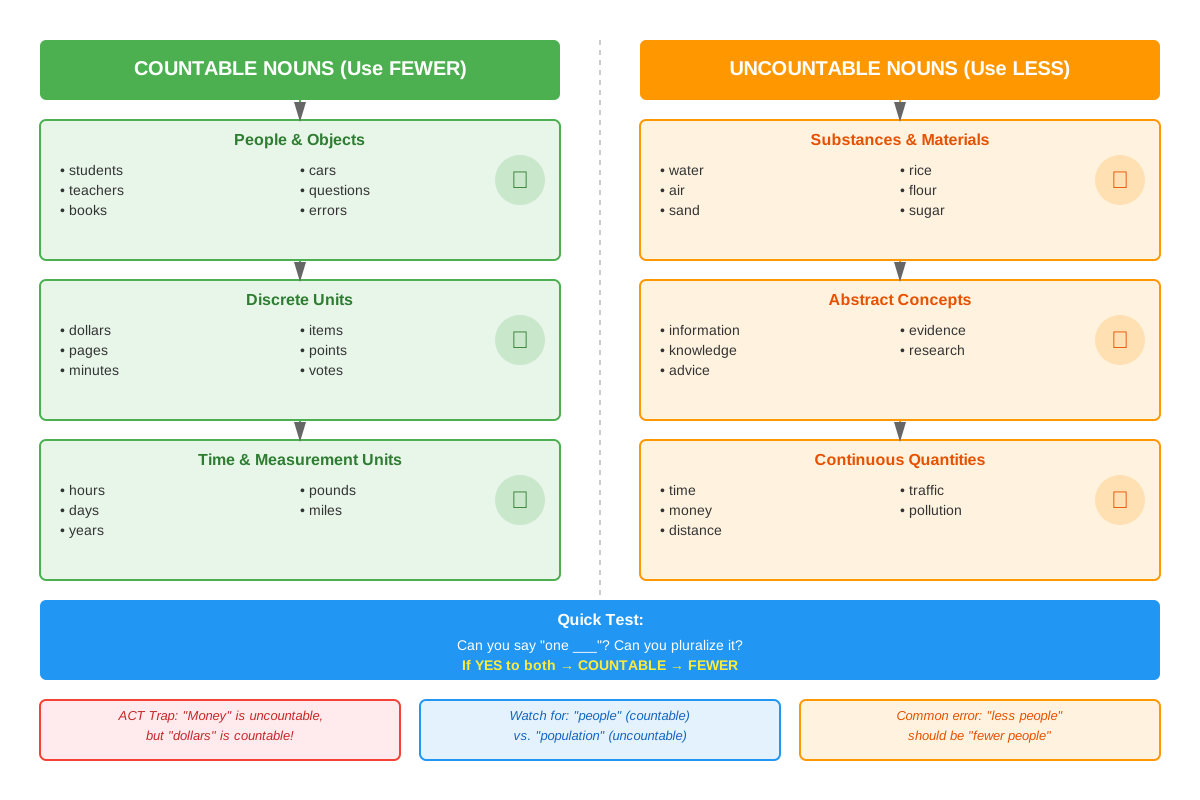
Countable nouns represent discrete, separable items that exist as individual units. Examples include:
- People, students, teachers, citizens
- Objects: books, cars, computers, chairs
- Animals: dogs, birds, insects
- Time units when counted individually: days, weeks, years, hours
- Abstract countables: ideas, problems, solutions, opportunities
When comparing quantities of these nouns, fewer is grammatically correct:
- "The library has fewer books than it did last year."
- "Fewer students enrolled in the advanced course."
- "The new policy created fewer problems than anticipated."
The key test: Can you place a number before the noun and have it make sense? If "five books," "twenty students," or "three problems" works grammatically, use fewer.
Uncountable Nouns and "Less"
Uncountable nouns (also called mass nouns or non-count nouns) represent substances, concepts, or qualities that cannot be divided into separate countable units without fundamentally changing what they are. Categories include:
- Liquids and gases: water, milk, air, oxygen
- Materials and substances: wood, metal, sand, rice
- Abstract concepts: information, knowledge, advice, evidence
- Qualities and states: happiness, anger, beauty, intelligence
- Activities and fields of study: homework, research, music, mathematics
For these nouns, less is the correct choice:
- "The tank contains less water than before."
- "Students have less homework this semester."
- "The experiment yielded less evidence than expected."
The diagnostic question: Does the noun have a plural form that's commonly used? If not, it's likely uncountable and requires less.
Special Cases and Exceptions
Several contexts require careful consideration because they involve quantities that might seem countable but follow the "less" rule:
Money: Although we can count individual dollars or coins, money as a concept is treated as uncountable when discussing amounts:
- Correct: "I have less money than my brother."
- Incorrect: "I have fewer money than my brother."
- But: "I have fewer dollars than my brother" (when counting individual currency units)
Time: When discussing duration or amount of time as a continuous quantity, use less:
- Correct: "The project took less time than expected."
- Incorrect: "The project took fewer time than expected."
- But: "Fewer hours were required" (when counting discrete time units)
Distance: Measurements of distance use less:
- Correct: "The shortcut is less than five miles."
- But: "Fewer miles separate the two cities" (when emphasizing countable units)
Percentages and proportions: Use less with percentages when they represent a portion of an uncountable whole:
- "Less than 50% of the water remained."
- But: "Fewer than 50% of the students passed" (students are countable)
Comparison Table
| Criterion | Fewer | Less |
|---|---|---|
| Noun Type | Countable | Uncountable |
| Plural Form | Noun has standard plural | Noun typically has no plural |
| Can Add Numbers | Yes (five books, ten people) | No (not "five waters" or "ten informations") |
| Question Form | "How many?" | "How much?" |
| Example Nouns | students, cars, problems, days | water, time, money, information |
| Example Sentence | "Fewer people attended the concert." | "Less attention was paid to details." |
Recognition Strategies for the ACT
When encountering a fewer/less question on the ACT, follow this decision tree:
- Identify the noun being modified by fewer or less
- Ask "How many?" or "How much?" about that noun
- If "How many?" sounds natural → use fewer
- If "How much?" sounds natural → use less
- Test for countability: Can you say "one [noun], two [nouns], three [nouns]"?
- Yes → use fewer
- No → use less
- Check for special cases: Is it money, time, or distance as a general amount?
- If yes, likely use less even if units could be counted
Concept Relationships
The fewer versus less distinction connects directly to the broader grammatical concept of noun classification, which underlies numerous other ACT English topics. Understanding countable versus uncountable nouns enables students to master subject-verb agreement (uncountable nouns take singular verbs), article usage (countable nouns can take "a/an," while uncountable nouns cannot), and quantifier selection (many/much, number/amount).
This topic also relates to comparative constructions in English grammar. Both "fewer" and "less" are comparative forms—fewer is the comparative of "few," and less is the comparative of "little." This connection helps students recognize that these words appear in contexts comparing two quantities, which is why ACT passages often test this concept in sentences containing "than" or discussing relative amounts.
The relationship map flows as follows:
Noun Classification → determines → Countable vs. Uncountable → dictates → Fewer vs. Less → influences → Related Quantifiers (many/much, number/amount, several/some)
Additionally, mastering this distinction strengthens performance on precision and clarity questions, where the ACT asks students to choose the most grammatically accurate expression. Students who understand fewer/less develop sensitivity to other precision issues in English usage, creating a foundation for recognizing subtle grammatical distinctions across multiple question types.
High-Yield Facts
⭐ Fewer is used with countable nouns that have plural forms (fewer students, fewer problems, fewer opportunities)
⭐ Less is used with uncountable nouns that represent masses or abstract concepts (less water, less information, less time)
⭐ The diagnostic question "How many?" suggests fewer, while "How much?" suggests less
⭐ Money, time (as duration), and distance (as measurement) typically take "less" even though their units can be counted
⭐ If you can place a specific number before the noun naturally (five books, ten people), use fewer
- Countable nouns can be made plural; uncountable nouns typically cannot
- "Fewer" is the comparative form of "few"; "less" is the comparative form of "little"
- The ACT tests this concept 1-2 times per exam, usually in passages with statistical or comparative information
- Colloquial speech often uses "less" incorrectly with countable nouns, making the wrong answer sound natural
- When in doubt, try substituting "many" or "much"—if "many" fits, use fewer; if "much" fits, use less
- Collective nouns (team, group, family) are treated as singular units and typically take "less" when referring to the collective as a whole
- The phrase "one less thing" is technically incorrect but idiomatically accepted; the ACT typically avoids testing this edge case
- Abstract nouns (happiness, freedom, knowledge) are uncountable and require "less"
- Containers or units of uncountable nouns become countable (fewer bottles of water, fewer pieces of information)
Quick check — test yourself on Fewer versus less so far.
Try Flashcards →Common Misconceptions
Misconception: "Less" can be used interchangeably with "fewer" in casual writing, so either is acceptable on the ACT.
Correction: The ACT tests formal, standard written English, which maintains a strict distinction between fewer (countable) and less (uncountable). Colloquial usage does not determine correctness on standardized tests.
Misconception: Time always takes "fewer" because you can count hours, minutes, and seconds.
Correction: When discussing time as a duration or amount (not counting specific units), use "less": "less time," "less than an hour." However, when counting discrete time units, use "fewer": "fewer hours," "fewer days."
Misconception: Money takes "fewer" because you can count dollars and cents.
Correction: Money as a general amount is uncountable and takes "less": "less money," "less than ten dollars." Only when specifically counting currency units do you use "fewer": "fewer dollars," "fewer coins."
Misconception: If a noun ends in "s," it's plural and countable, so it takes "fewer."
Correction: Some uncountable nouns end in "s" (news, mathematics, physics) but remain singular and uncountable, requiring "less." The plural form alone doesn't determine countability—the noun's inherent nature does.
Misconception: "Amount" and "number" can be used interchangeably, just like "fewer" and "less."
Correction: These pairs follow the same rule: "number" pairs with countable nouns and "fewer" (the number of students, fewer students), while "amount" pairs with uncountable nouns and "less" (the amount of water, less water). Mixing these creates grammatical errors the ACT will test.
Misconception: Abstract nouns like "problems" or "ideas" are uncountable because they're not physical objects.
Correction: Abstract nouns can be countable if they represent discrete, separable concepts. "Problems," "ideas," "solutions," and "opportunities" are all countable (one problem, two ideas) and take "fewer."
Misconception: The rule is just a preference, not a grammatical requirement.
Correction: In standard written English, the fewer/less distinction is a grammatical rule, not a stylistic preference. The ACT tests adherence to standard grammar rules, making this distinction mandatory for correct answers.
Worked Examples
Example 1: Scientific Study Context
ACT-Style Question:
"The research team discovered that the experimental group consumed less calories than the control group, leading to significant weight loss over the six-month period."
Which of the following alternatives to the underlined portion would be most appropriate?
A. NO CHANGE
B. fewer calories
C. lesser calories
D. a smaller amount of calories
Solution Process:
Step 1: Identify what "less" is modifying → "calories"
Step 2: Determine if "calories" is countable or uncountable
- Can we count calories individually? Yes (one calorie, two calories, 100 calories)
- Does "calories" have a plural form? Yes (calorie/calories)
- Which question sounds natural: "How many calories?" or "How much calories?"
- "How many calories?" sounds correct
Step 3: Apply the rule
- Since calories are countable, we need "fewer," not "less"
Step 4: Evaluate answer choices
- A. NO CHANGE: Incorrect—uses "less" with countable noun
- B. fewer calories: Correct—uses "fewer" with countable noun
- C. lesser calories: Incorrect—"lesser" is not used for quantity comparisons
- D. a smaller amount of calories: Awkward and unnecessarily wordy; "amount" is typically used with uncountable nouns
Answer: B. fewer calories
Connection to Learning Objectives: This example demonstrates identifying when fewer/less is tested (objective 1), applying the core rule about countable nouns (objective 2), and accurately answering an ACT-style question (objective 3).
Example 2: Historical Passage Context
ACT-Style Question:
"During the Great Depression, families had less opportunities for employment, and many struggled to find work that could support their basic needs."
Which of the following alternatives to the underlined portion would NOT be acceptable?
F. fewer opportunities
G. a reduced number of opportunities
H. a smaller amount of opportunities
J. not as many opportunities
Solution Process:
Step 1: Identify the noun → "opportunities"
Step 2: Test for countability
- Can we count opportunities? Yes (one opportunity, several opportunities)
- Plural form exists? Yes (opportunity/opportunities)
- "How many opportunities?" sounds natural
Step 3: Determine what's currently wrong
- "Less opportunities" is incorrect because "opportunities" is countable
Step 4: Evaluate each alternative
- F. fewer opportunities: Correct—proper use of "fewer" with countable noun
- G. a reduced number of opportunities: Correct—"number" is appropriate with countable nouns
- H. a smaller amount of opportunities: Incorrect—"amount" should be used with uncountable nouns, not countable ones like "opportunities"
- J. not as many opportunities: Correct—"many" is used with countable nouns
Step 5: Identify the NOT acceptable option
- The question asks which would NOT be acceptable, so we're looking for the incorrect option
Answer: H. a smaller amount of opportunities
Connection to Learning Objectives: This example shows how to identify fewer/less testing in context (objective 1), demonstrates the relationship between fewer/less and related quantity words like "number" and "amount" (objective 4), and practices ACT question formats that ask for the unacceptable option (objective 3).
Exam Strategy
Recognition Triggers
When reviewing ACT English passages, immediately flag sentences containing these trigger words and phrases:
- Fewer or less in underlined portions
- Amount or number (related quantity expressions)
- Many or much (parallel construction)
- Comparative contexts with than
- Statistical information or numerical data
- Phrases like "a smaller quantity of," "a reduced amount of," or "not as many"
Systematic Approach
Follow this four-step process for every fewer/less question:
- Locate and identify: Find the noun being modified
- Apply the countability test: Ask "How many?" or "How much?"
- Verify with the number test: Can you say "one [noun], two [nouns]"?
- Check for special cases: Is it money, time, or distance as a general amount?
Process of Elimination
When answer choices include both fewer and less:
- Immediately eliminate any choice using "less" with an obviously countable noun (people, books, students)
- Immediately eliminate any choice using "fewer" with an obviously uncountable noun (water, information, happiness)
- Be cautious with money, time, and distance—these often require "less" even when units could be counted
- Watch for unnecessarily wordy alternatives that might be grammatically correct but stylistically inferior
Time Management
Fewer versus less questions should take approximately 15-20 seconds to answer once you've mastered the concept. If you find yourself spending more than 30 seconds:
- You may be overthinking—return to the basic countable/uncountable distinction
- Apply the "How many?" vs. "How much?" test quickly
- Trust your preparation and make a decision
These questions are designed to have clear, definitive answers, so extended deliberation usually indicates confusion rather than genuine ambiguity.
Common Trap Patterns
The ACT frequently sets traps by:
- Using "less" with countable nouns in the original passage because it sounds natural in speech
- Placing the question in passages about statistics or data where multiple numbers appear, potentially confusing students
- Including answer choices with "amount" and "number" to test whether students understand the parallel relationship
- Testing special cases like money or time where the rule requires nuanced application
Memory Techniques
The COUNT Mnemonic
Can you Count it?
One, two, three?
Use fewer!
Not countable?
Then less!
The Question Method
Create a mental association:
- "How MANY?" → FEWER (both have five letters)
- "How MUCH?" → LESS (both are short words)
Visual Memory Aid
Imagine a grocery store:
- Fewer: Express checkout lane sign "10 items or fewer" (countable items)
- Less: Bulk bin with rice or flour (uncountable substance)
Picture yourself counting individual items in your cart (fewer) versus scooping unmeasured amounts from bins (less).
The Plural Test Rhyme
"If it has a plural that's commonly used,
Then 'fewer' is the word that should be enthused.
If plural forms sound awkward or wrong,
Then 'less' is the word that will get you along."
The Substitution Trick
Remember: FEWER = MANY and LESS = MUCH
When uncertain, substitute:
- "Many students" → "Fewer students" ✓
- "Much water" → "Less water" ✓
- "Much students" → "Less students" ✗
If the substitution sounds wrong, your fewer/less choice is wrong.
Summary
The fewer versus less distinction represents a fundamental grammatical rule that the ACT tests consistently and predictably. The core principle is straightforward: fewer modifies countable nouns (items you can enumerate individually), while less modifies uncountable nouns (substances or concepts measured as wholes). Mastery requires understanding the difference between countable nouns—which have plural forms and can be preceded by specific numbers—and uncountable nouns—which represent masses, substances, or abstract concepts that cannot be separated into discrete units. Special cases involving money, time as duration, and distance as measurement typically require "less" even though their component units can be counted. The ACT favors testing this concept in passages containing statistical information, comparisons, or numerical data, making recognition of the noun type crucial for selecting correct answers. Students who internalize the "How many?" (fewer) versus "How much?" (less) diagnostic question can quickly and accurately answer these high-yield questions, which appear 1-2 times per test and represent easily earned points for prepared test-takers.
Key Takeaways
- Fewer is used exclusively with countable nouns that can be enumerated individually and have standard plural forms
- Less is used with uncountable nouns representing substances, masses, or abstract concepts that cannot be separated into discrete units
- The diagnostic questions "How many?" (→ fewer) and "How much?" (→ less) provide the quickest path to correct answers
- Money, time as duration, and distance as measurement are special cases that typically take "less" despite having countable units
- The ACT tests this concept 1-2 times per exam, usually in passages with comparative or statistical information
- Related quantity expressions follow the same pattern: number/many/fewer for countable nouns; amount/much/less for uncountable nouns
- Colloquial speech often violates this rule, making incorrect usage sound natural—trust formal grammar rules over conversational patterns
Related Topics
Subject-Verb Agreement with Collective Nouns: Understanding countable versus uncountable nouns extends to determining whether collective nouns (team, group, committee) take singular or plural verbs, a related high-frequency ACT topic.
Quantifier Usage (Many/Much, Number/Amount): The same countable/uncountable distinction governs other quantity expressions, making this topic a natural extension of fewer/less mastery.
Article Usage (A/An versus The versus No Article): Countable nouns can take indefinite articles (a book, an idea), while uncountable nouns cannot (not "a water" or "an information"), representing another application of noun classification.
Pronoun-Antecedent Agreement: Recognizing whether nouns are countable or uncountable helps determine appropriate pronoun references (it versus they) in complex sentences.
Comparative and Superlative Forms: Since fewer and less are comparative forms, understanding their usage connects to broader questions about how English expresses comparisons across different word classes.
Practice CTA
Now that you've mastered the core concepts behind fewer versus less, it's time to cement your understanding through active practice. Complete the practice questions to test your ability to identify and correct these errors in ACT-style passages, and use the flashcards to reinforce the key distinctions between countable and uncountable nouns. Remember: this topic appears consistently on every ACT administration, making it one of the highest-yield grammar concepts you can master. Each practice question you complete builds the pattern recognition and automatic response that will save you valuable time on test day while securing easy points. You've got this!
Sign up free to keep reading
Create a free AnvayaPrep account to finish this ACT guide on Fewer versus less — plus flashcards and practice questions.