Overview
Superlative forms represent one of the most frequently tested grammatical concepts on the ACT English section, appearing in approximately 3-5 questions per exam. These forms express the highest or lowest degree of a quality among three or more items, people, or groups. Understanding superlative forms is essential because the ACT consistently tests whether students can distinguish between comparative forms (used for two items) and superlative forms (used for three or more items), as well as whether students recognize proper superlative construction using either "-est" endings or "most/least" modifiers.
The ACT tests superlative forms within the broader context of modifier usage and parallel structure. Questions typically present sentences where students must choose between comparative and superlative forms, identify incorrect double superlatives (such as "most fastest"), or recognize when a superlative is inappropriately used for only two items. These questions assess both grammatical knowledge and logical reasoning, as students must often count or infer the number of items being compared from context clues within the passage.
Mastering ACT superlative forms connects directly to other grammar concepts including adjective and adverb usage, logical comparison, and sentence structure. This topic builds upon foundational knowledge of parts of speech while preparing students for more complex concepts like parallel construction and modifier placement. Strong command of superlative forms also improves overall writing clarity, making this topic valuable beyond standardized testing.
Learning Objectives
- [ ] Identify when Superlative forms is being tested in ACT English passages
- [ ] Explain the core rule or strategy behind Superlative forms construction and usage
- [ ] Apply Superlative forms to ACT-style questions accurately
- [ ] Distinguish between situations requiring comparative versus superlative forms based on the number of items compared
- [ ] Recognize and correct double superlatives and other common superlative errors
- [ ] Evaluate whether a superlative form is logically appropriate within the context of a passage
Prerequisites
- Parts of speech (adjectives and adverbs): Superlatives modify nouns and verbs, so understanding which words function as adjectives versus adverbs is essential for proper superlative construction
- Basic sentence structure: Recognizing subjects, verbs, and modifiers helps identify what element is being compared and whether the superlative is positioned correctly
- Comparative forms: Understanding how comparatives work with two items provides the foundation for distinguishing when superlatives (three or more items) are appropriate
Why This Topic Matters
Superlative forms appear consistently on every ACT English test, making them a high-yield study topic. Research of recent ACT exams shows that 2-4% of all English questions directly test superlative usage, with additional questions incorporating superlatives within broader grammar concepts. These questions typically appear in the "Conventions of Standard English" category and are considered medium difficulty, meaning they separate average scorers from high scorers.
In real-world writing, superlatives help writers make precise comparisons and establish hierarchies of quality, importance, or degree. Professional writing, academic papers, and persuasive arguments all rely on accurate superlative usage to convey meaning clearly. Misusing superlatives can create logical errors that undermine credibility—claiming something is "the best" when only two options exist, for example, signals imprecise thinking.
On the ACT, superlative questions most commonly appear in three formats: (1) choosing between comparative and superlative forms based on context, (2) identifying and correcting double superlatives or irregular forms, and (3) evaluating whether a superlative is logically supported by the passage content. These questions often embed the tested concept within longer sentences, requiring students to parse context carefully while applying grammatical rules. The ACT particularly favors testing superlatives in passages about rankings, competitions, historical significance, or scientific comparisons where multiple items naturally invite comparison.
Core Concepts
Basic Superlative Formation
Superlatives express the extreme degree of a quality among three or more items. English forms superlatives through two primary methods, determined by the length and structure of the base adjective or adverb.
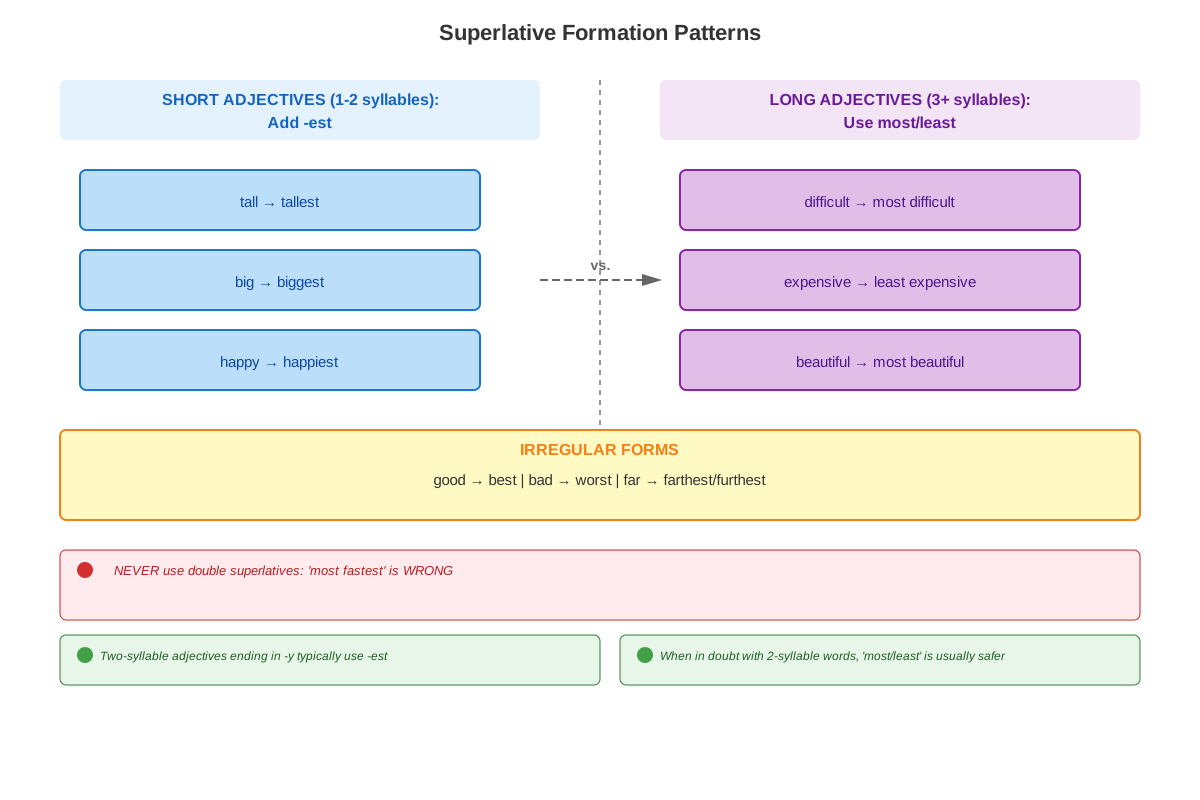
For one-syllable adjectives and adverbs, add -est to the base form:
- tall → tallest
- fast → fastest
- bright → brightest
For two-syllable adjectives ending in -y, change the -y to -i and add -est:
- happy → happiest
- busy → busiest
- early → earliest
For most adjectives of two or more syllables and most adverbs ending in -ly, use most or least before the base form:
- beautiful → most beautiful
- carefully → most carefully
- interesting → most interesting
- quickly → most quickly
Irregular Superlative Forms
Several common adjectives and adverbs have irregular superlative forms that must be memorized:
| Base Form | Comparative | Superlative |
|---|---|---|
| good | better | best |
| bad | worse | worst |
| much/many | more | most |
| little | less | least |
| far | farther/further | farthest/furthest |
These irregular forms appear frequently on the ACT because they test whether students have internalized exceptions to standard rules. The ACT particularly favors testing "good/better/best" and "bad/worse/worst" in context.
The Three-or-More Rule
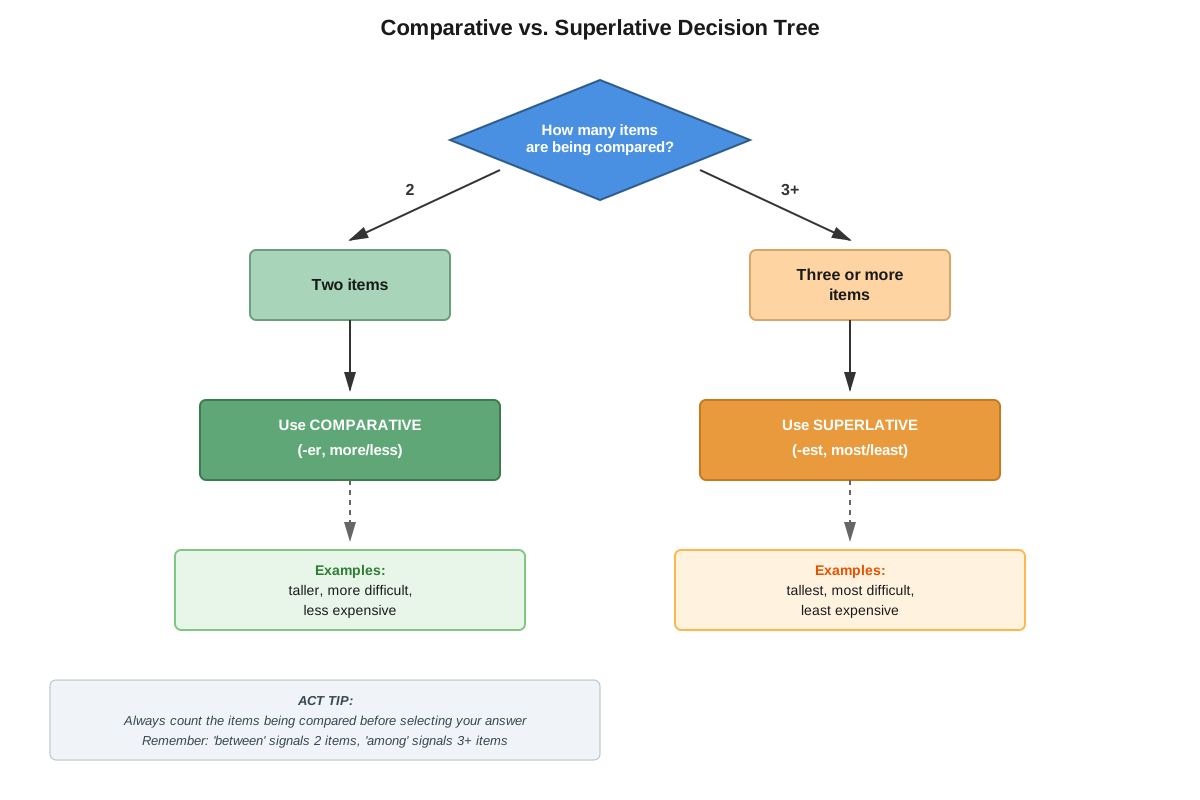
The fundamental principle governing superlative usage is the three-or-more rule: superlatives are appropriate only when comparing three or more items, while comparatives are used for exactly two items.
Correct superlative usage (three or more items):
- "Among the five candidates, Maria was the most qualified."
- "Of all the planets in our solar system, Jupiter is the largest."
- "This is the fastest of the three routes to downtown."
Incorrect superlative usage (only two items):
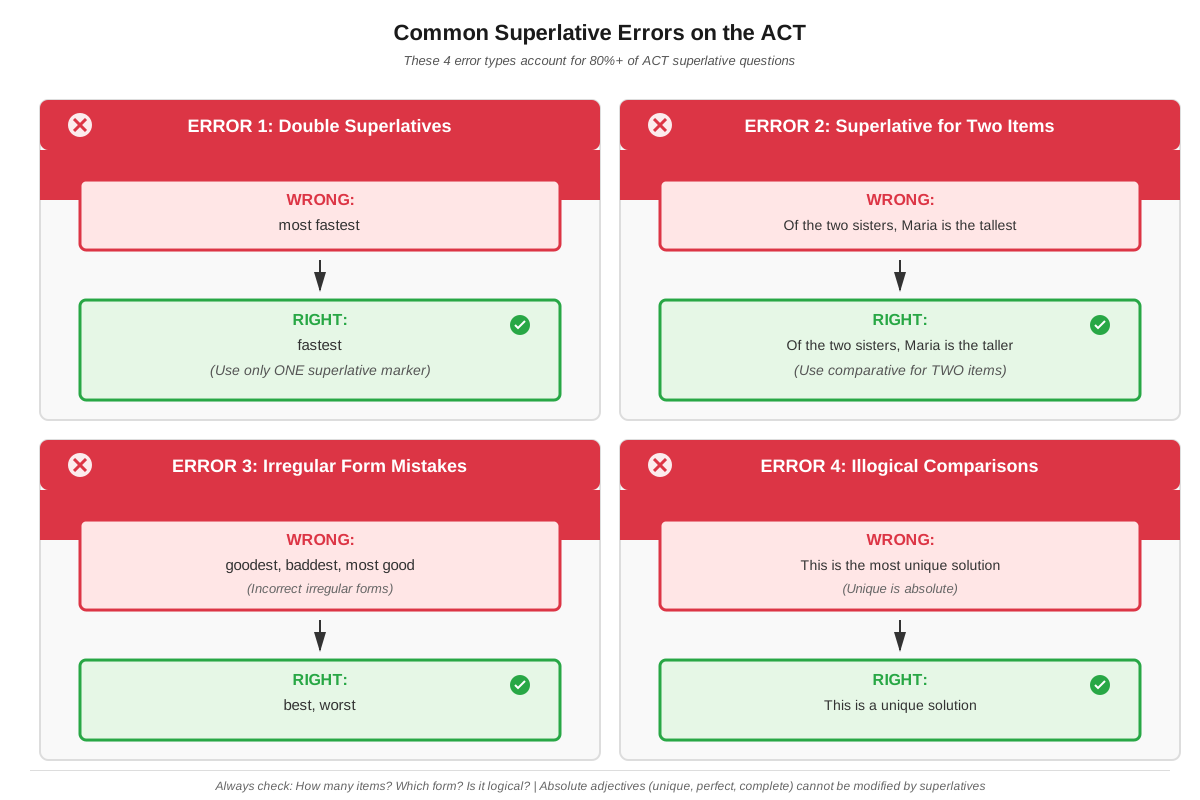
- ❌ "Between the two options, this is the best."
- ✓ "Between the two options, this is the better."
The ACT tests this rule by presenting sentences where students must count or infer the number of items being compared. Sometimes the number is explicit ("between two," "among five"), while other times students must use context clues to determine whether a superlative is appropriate.
Double Superlatives
A double superlative occurs when a writer incorrectly uses both "-est" and "most/least" with the same adjective or adverb. This construction is always wrong in standard English.
Incorrect double superlatives:
- ❌ "most fastest"
- ❌ "most happiest"
- ❌ "least smallest"
Correct forms:
- ✓ "fastest" OR "most fast" (though "fastest" is standard)
- ✓ "happiest"
- ✓ "smallest"
The ACT frequently includes double superlatives as incorrect answer choices, testing whether students recognize this redundancy error.
Absolute Adjectives and Superlatives
Certain adjectives describe absolute states that logically cannot be compared because they represent complete conditions. These absolute adjectives technically should not take superlative forms, though informal usage sometimes violates this rule.
Common absolute adjectives include:
- perfect
- unique
- complete
- impossible
- dead
- infinite
Technically incorrect: "most perfect," "most unique"
Preferred: "nearly perfect," "more nearly unique," or "most distinctive"
However, the ACT rarely tests absolute adjectives in superlative contexts, focusing instead on more straightforward superlative errors. When absolute adjectives do appear, the ACT typically accepts common usage patterns.
Context-Dependent Superlative Usage
The ACT often tests whether students can determine from context whether a superlative is appropriate. This requires careful reading to identify:
- How many items are being compared: Look for numerical indicators ("three," "several," "many") or contextual clues
- Whether the comparison is explicit or implied: Sometimes the items being compared aren't directly stated but are implied by the passage
- Whether the superlative is logically supported: The passage must establish that the comparison includes three or more items
Example: "The museum's collection includes works by Monet, Renoir, and Degas. Monet's Water Lilies is the most impressive painting."
This superlative is appropriate because the context establishes at least three items (works by three different artists), even though the exact number of paintings isn't specified.
Concept Relationships
Superlative forms connect directly to comparative forms, which express comparison between exactly two items. Understanding the comparative/superlative distinction is fundamental: comparatives use "-er" or "more/less" for two items, while superlatives use "-est" or "most/least" for three or more. This relationship forms the core of most ACT questions on this topic.
Superlatives also relate closely to adjective and adverb usage because superlatives function as modifiers. Students must identify whether a word modifies a noun (requiring an adjective superlative) or a verb (requiring an adverb superlative). For example, "She ran fastest" (adverb modifying "ran") versus "She is the fastest runner" (adjective modifying "runner").
The connection to logical comparison is essential: superlatives must make sense within the context of what's being compared. This links to the broader ACT concept of rhetorical skills, where students evaluate whether word choices are appropriate for the passage's meaning and logic.
Relationship map:
Parts of Speech → Adjectives/Adverbs → Comparative Forms (two items) → Superlative Forms (three+ items) → Logical Comparison → Parallel Structure
Mastering superlatives also supports understanding of parallel structure because lists involving superlatives must maintain consistent form, and it connects to modifier placement since superlatives must be positioned to clearly modify the intended word.
High-Yield Facts
⭐ Superlatives are used for three or more items; comparatives are used for exactly two items
⭐ One-syllable adjectives form superlatives by adding -est; longer adjectives use "most" or "least"
⭐ Double superlatives (most fastest, most happiest) are always incorrect
⭐ Irregular superlatives must be memorized: good→best, bad→worst, much→most, little→least
⭐ The ACT tests whether superlatives are logically appropriate based on passage context
- Two-syllable adjectives ending in -y form superlatives by changing -y to -i and adding -est (happy→happiest)
- Most adverbs ending in -ly form superlatives using "most" or "least" rather than -est
- The word "between" signals two items (use comparative), while "among" signals three or more (use superlative)
- Superlatives require the definite article "the" in most contexts ("the fastest," "the most beautiful")
- Context clues in the passage determine whether a superlative is appropriate, even when the exact number of items isn't stated
- Superlatives can modify both nouns (as adjectives) and verbs (as adverbs), and the form must match the function
Quick check — test yourself on Superlative forms so far.
Try Flashcards →Common Misconceptions
Misconception: Any comparison can use a superlative form if it sounds emphatic or impressive.
Correction: Superlatives are grammatically appropriate only when comparing three or more items. Using a superlative for two items is incorrect regardless of emphasis. "Between the two candidates, she is the better choice" is correct; "she is the best choice" is wrong.
Misconception: Adding "most" before any adjective creates a valid superlative.
Correction: Short adjectives (one syllable and two-syllable words ending in -y) use the -est suffix, not "most." "Most tall" is incorrect; "tallest" is correct. Using both "most" and "-est" creates a double superlative error.
Misconception: "More" and "most" are interchangeable in comparisons.
Correction: "More" creates comparatives (two items), while "most" creates superlatives (three or more items). These words signal different types of comparisons and cannot be substituted for each other.
Misconception: If a passage mentions multiple items, any superlative is automatically correct.
Correction: The superlative must logically compare items within the same category. A passage mentioning five different topics doesn't justify calling one topic "the most important" unless the passage actually compares their importance.
Misconception: Irregular superlatives like "best" and "worst" can be intensified with "most" for emphasis.
Correction: "Most best" and "most worst" are double superlatives and are always incorrect. "Best" and "worst" already express the superlative degree and cannot be modified further.
Misconception: Superlatives always require an explicit list of items being compared.
Correction: Context can imply the comparison group. "This is the oldest building in the city" is correct even without listing all buildings because "in the city" establishes a group of three or more.
Worked Examples
Example 1: Choosing Between Comparative and Superlative
Question: The museum features works by two renowned sculptors, Rodin and Michelangelo. Critics generally agree that Michelangelo's David is the (A) most impressive (B) more impressive (C) impressivest (D) most impressivest sculpture.
Step 1: Identify how many items are being compared.
The sentence explicitly states "two renowned sculptors," and the comparison involves works by these two artists. This is a comparison of two items.
Step 2: Determine the appropriate form.
For two items, use the comparative form, not the superlative. The comparative of "impressive" is "more impressive" (not "impressiver" because "impressive" is a multi-syllable adjective).
Step 3: Eliminate incorrect answers.
- (A) "most impressive" - Incorrect; this is superlative form, used for three or more items
- (B) "more impressive" - Correct; this is comparative form for two items
- (C) "impressivest" - Incorrect; not a valid English form
- (D) "most impressivest" - Incorrect; double superlative error
Answer: (B) more impressive
Connection to learning objectives: This example demonstrates identifying when superlatives are being tested (the comparison context), explaining the core rule (two items require comparative form), and applying the rule to select the correct answer.
Example 2: Context-Dependent Superlative Usage
Question: The research team analyzed data from hospitals in Chicago, Boston, and Seattle. They concluded that the Chicago hospital had the (F) better (G) best (H) most better (J) good outcomes for cardiac patients.
Step 1: Count or infer the number of items being compared.
The sentence explicitly mentions three cities/hospitals: Chicago, Boston, and Seattle. This is a comparison among three items.
Step 2: Determine whether comparative or superlative is appropriate.
Three or more items require superlative form. The base adjective is "good," which has an irregular superlative: "best."
Step 3: Evaluate each answer choice.
- (F) "better" - Incorrect; this is comparative form for two items
- (G) "best" - Correct; this is the irregular superlative form of "good" for three or more items
- (H) "most better" - Incorrect; double superlative error (combining "most" with comparative "better")
- (J) "good" - Incorrect; this is the base form with no comparison
Step 4: Verify logical appropriateness.
The passage establishes that data from three hospitals was analyzed, making the superlative logically appropriate for comparing outcomes across all three.
Answer: (G) best
Connection to learning objectives: This example shows how to identify superlative testing through context clues, apply the three-or-more rule, recognize irregular forms, and avoid double superlative errors.
Exam Strategy
When approaching ACT questions testing superlative forms, follow this systematic process:
Step 1: Identify the comparison trigger
Look for words and phrases that signal comparison: "between," "among," "of all," "in the group," or any context where items are being ranked or evaluated. These triggers indicate that the question tests comparative versus superlative usage.
Step 2: Count the items being compared
Determine whether the comparison involves exactly two items (requiring comparative) or three or more items (requiring superlative). Look for:
- Explicit numbers: "two candidates," "three options," "five methods"
- Implicit groups: "among the students" (implies three or more), "in the city" (implies many)
- Signal words: "between" (two items), "among" (three or more)
Step 3: Check for double superlatives
Scan answer choices for any combination of "most/least" with "-est" endings. These are always incorrect and can be eliminated immediately. Common wrong answers include "most fastest," "most happiest," and "least smallest."
Step 4: Verify irregular forms
If the comparison involves "good," "bad," "much," "many," "little," or "far," ensure the answer uses the correct irregular form rather than adding "-er/-est" or "more/most" to the base word.
Step 5: Apply the appropriate formation rule
- One-syllable adjectives: add -est
- Two-syllable adjectives ending in -y: change y to i, add -est
- Longer adjectives and -ly adverbs: use "most" or "least"
Exam Tip: The ACT often places the number of items being compared several sentences before the actual comparison. Read the full context, not just the sentence containing the underlined portion.
Time allocation: Superlative questions should take 20-30 seconds once you've identified the comparison context. If you're spending more than 45 seconds, make your best guess and move on—these questions test straightforward rules that either click immediately or require review after the exam.
Process of elimination strategy:
- First, eliminate any double superlatives
- Second, eliminate forms that don't match the number of items (comparative for three+ items, superlative for two items)
- Third, eliminate any non-standard formations ("goodest," "impressivest")
- Choose from remaining options based on context
Trigger words to watch for:
- "Between" → signals two items → use comparative
- "Among" → signals three or more → use superlative
- "Of all" → signals three or more → use superlative
- "The two" → explicitly two items → use comparative
- "Several," "many," "numerous" → signals three or more → use superlative
Memory Techniques
Mnemonic for comparative vs. superlative: "TWO gets -ER, THREE gets -EST"
This simple rhyme helps remember that two items take the comparative (-er/more) while three or more take the superlative (-est/most).
Irregular superlative acronym: "GBML" (Good, Bad, Much, Little)
These four common adjectives have irregular superlatives that must be memorized. When you see any of these base words in a comparison, immediately recall: good→best, bad→worst, much→most, little→least.
Visualization for double superlatives: Picture a "STOP" sign appearing whenever you see "most" + "-est" together. This visual cue helps catch double superlative errors instantly during the exam.
Syllable counting technique: Hold up fingers for each syllable in the adjective:
- One finger (one syllable) → add -est
- Two fingers ending in "y" sound → change to -iest
- Three or more fingers → use "most"
"Between/Among" memory trick: "Between has TWO 'e's" (between) → use for two items. This visual connection helps remember that "between" signals comparative usage.
The "THE" test: Superlatives almost always use the definite article "the" ("the fastest," "the most beautiful"). If you can naturally say "the" before the form, it's likely superlative; if "the" sounds wrong, it's likely comparative ("the more fast" sounds wrong, confirming "more fast" isn't correct anyway, but "faster" is comparative).
Summary
Superlative forms express the highest or lowest degree of a quality among three or more items and represent a high-yield topic on the ACT English section. The fundamental rule is straightforward: use superlatives (formed with -est or most/least) for three or more items, and use comparatives (formed with -er or more/less) for exactly two items. One-syllable adjectives and two-syllable adjectives ending in -y typically add -est, while longer adjectives and most adverbs use "most" or "least." Several common adjectives have irregular superlative forms that must be memorized, particularly good→best and bad→worst. The ACT tests whether students can distinguish between comparative and superlative contexts, recognize double superlative errors, apply correct formation rules, and evaluate whether superlatives are logically appropriate based on passage context. Success requires counting or inferring the number of items being compared, often using context clues from surrounding sentences. Mastering superlatives improves not only ACT scores but also overall writing precision and logical expression.
Key Takeaways
- Superlatives require three or more items; comparatives require exactly two items—this is the most frequently tested distinction
- One-syllable adjectives add -est; multi-syllable adjectives use "most/least"—formation rules determine correct superlative construction
- Double superlatives (most fastest, most happiest) are always incorrect and appear frequently as wrong answer choices
- Irregular forms (good→best, bad→worst, much→most, little→least) must be memorized and appear regularly on the ACT
- Context clues throughout the passage determine whether a superlative is appropriate, not just the immediate sentence
- Signal words like "between" (two items) and "among" (three or more) indicate which form is correct
- Superlative questions are high-yield and follow predictable patterns, making them excellent opportunities for quick, confident points
Related Topics
Comparative Forms: Understanding how to form and use comparatives (-er, more/less) for two-item comparisons provides the foundation for distinguishing when superlatives are appropriate. Mastering superlatives requires solid command of comparative usage.
Adjective and Adverb Usage: Since superlatives function as modifiers, deeper study of how adjectives modify nouns and adverbs modify verbs enhances ability to construct superlatives correctly and position them appropriately in sentences.
Logical Comparison: This advanced topic addresses whether comparisons are logically valid and complete, building on superlative knowledge to evaluate whether compared items are truly comparable and whether necessary elements are included.
Parallel Structure: When superlatives appear in lists or series, parallel structure rules apply. Understanding how to maintain consistent grammatical form across multiple superlatives extends superlative mastery.
Modifier Placement: Proper positioning of superlative modifiers ensures clarity and correctness. This topic explores where superlatives should be placed relative to the words they modify.
Practice CTA
Now that you've mastered the core concepts of superlative forms, it's time to reinforce your learning through active practice. Attempt the practice questions to apply these rules to ACT-style scenarios, and use the flashcards to drill the irregular forms and formation rules until they become automatic. Remember, superlative questions are high-yield opportunities—students who master this topic consistently pick up 3-5 additional points on the English section. Your investment in understanding these concepts will pay dividends not only on test day but in all your academic writing. You've got this!
Sign up free to keep reading
Create a free AnvayaPrep account to finish this ACT guide on Superlative forms — plus flashcards and practice questions.