Overview
Frequently confused words represent one of the most consistently tested areas on the ACT English section, appearing in approximately 10-15% of all grammar and usage questions. These are word pairs or groups that sound similar, look similar, or have related meanings but serve different grammatical functions or convey distinct meanings. The ACT deliberately tests these words because they reveal a student's command of precise language usage—a skill essential for college-level writing and communication.
Understanding ACT frequently confused words goes beyond simple memorization; it requires recognizing the grammatical role each word plays in a sentence and understanding the subtle meaning differences that distinguish one word from another. Common examples include affect/effect, their/there/they're, and its/it's. While these might seem like basic errors, they appear in sophisticated sentence structures on the ACT, often embedded within complex passages where context clues are subtle and distractors are carefully crafted to trap students who rely on "what sounds right" rather than grammatical rules.
This topic connects directly to other essential English concepts including parts of speech, sentence structure, and contextual meaning. Mastering frequently confused words strengthens overall grammar knowledge because it requires understanding whether a word functions as a noun, verb, adjective, or adverb—and whether the sentence requires a possessive form, contraction, or standalone word. Success with these questions demonstrates the precision and attention to detail that the ACT values and that college professors expect in academic writing.
Learning Objectives
- [ ] Identify when frequently confused words is being tested in ACT passages
- [ ] Explain the core rule or strategy behind frequently confused words
- [ ] Apply frequently confused words to ACT-style questions accurately
- [ ] Distinguish between homophones based on grammatical function and meaning
- [ ] Recognize context clues that signal which word in a confused pair is correct
- [ ] Evaluate answer choices by substituting definitions to verify word choice
- [ ] Demonstrate mastery by correctly answering 90% or more of practice questions involving confused words
Prerequisites
- Parts of speech identification: Understanding whether a word functions as a noun, verb, adjective, or adverb is essential because many confused words differ primarily in their grammatical role (e.g., "affect" as a verb vs. "effect" as a noun).
- Basic sentence structure: Recognizing subjects, verbs, and objects helps determine which word fits grammatically within a sentence's framework.
- Possessive vs. contraction formation: Many confused words involve distinguishing between possessive forms and contractions (e.g., "its" vs. "it's"), requiring knowledge of apostrophe rules.
- Context clue interpretation: The ability to derive meaning from surrounding words and phrases is necessary to select the word that conveys the intended meaning.
Why This Topic Matters
In real-world writing, using the wrong word from a confused pair can undermine credibility, create ambiguity, or completely change the intended meaning of a sentence. Professional communication, academic papers, and college applications all demand precise word choice. Employers and professors consistently cite poor word choice as a major weakness in student and employee writing, making this skill valuable far beyond test day.
On the ACT English section, frequently confused words questions appear with remarkable consistency—students can expect to encounter 4-6 such questions per test. These questions typically appear as underlined portions within passages where students must choose between the original word and three alternatives, with at least one option being a commonly confused counterpart. The ACT favors testing these words in contexts where both options might initially "sound right," requiring students to apply grammatical rules rather than rely on intuition.
These questions most commonly appear in narrative passages, persuasive essays, and informational texts. The ACT often embeds confused words in sentences with complex structures or sophisticated vocabulary to increase difficulty. For example, a question might test "principal/principle" within a sentence discussing educational philosophy, where both words seem contextually plausible. The test also frequently combines confused word questions with other grammar concepts, such as testing "their/there/they're" in a sentence that also involves subject-verb agreement, requiring students to evaluate multiple elements simultaneously.
Core Concepts
Understanding Homophones and Near-Homophones
Homophones are words that sound identical but have different spellings and meanings. The ACT heavily tests homophones because they represent a common source of error in student writing. Examples include to/too/two, hear/here, and brake/break. Near-homophones sound similar but not identical, such as accept/except or advice/advise. Both categories require students to distinguish words based on meaning and grammatical function rather than pronunciation.
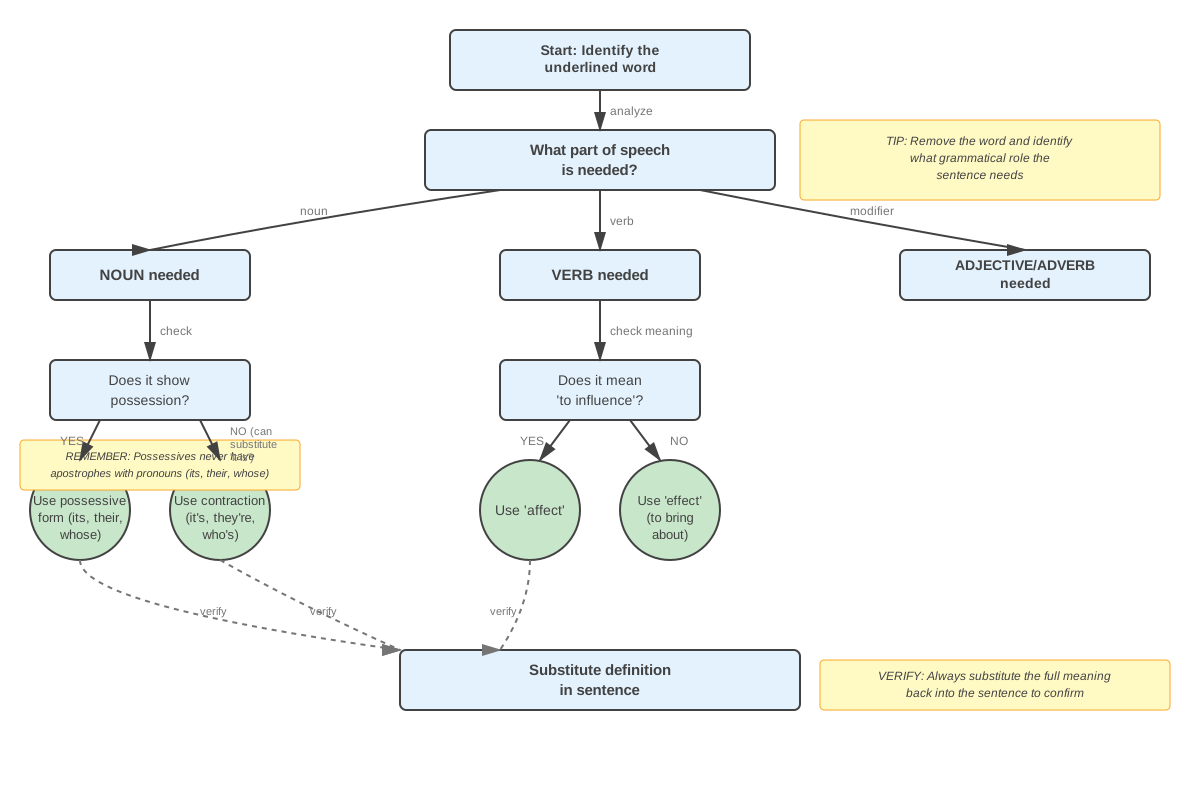
The key strategy for homophones is substitution: replace the word with its definition to verify it makes sense in context. For instance, if a sentence reads "Their going to the store," substitute "They are going to the store" to test whether "they're" (the contraction of "they are") is correct. This technique works because it forces evaluation of meaning rather than sound.
Possessives vs. Contractions
Many high-frequency confused words involve distinguishing between possessive forms and contractions. This distinction is critical because the ACT tests it repeatedly:
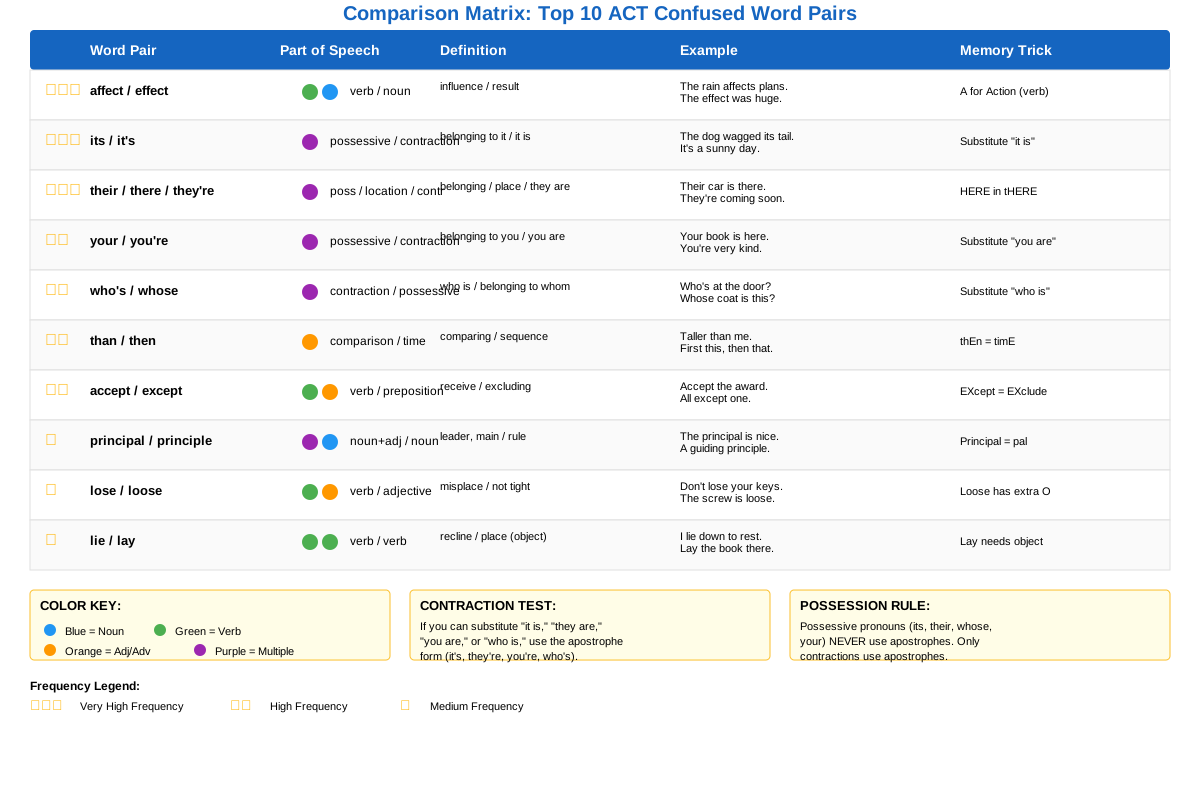
| Possessive | Contraction | Key Difference |
|---|---|---|
| its | it's | "Its" shows ownership; "it's" means "it is" or "it has" |
| your | you're | "Your" shows ownership; "you're" means "you are" |
| their | they're | "Their" shows ownership; "they're" means "they are" |
| whose | who's | "Whose" shows ownership; "who's" means "who is" or "who has" |
The rule is straightforward: contractions always contain apostrophes representing omitted letters, while possessive pronouns never use apostrophes. This differs from possessive nouns (like "the dog's bone"), which do use apostrophes, making it a common source of confusion. The ACT exploits this confusion by presenting sentences where both forms seem plausible.
Affect vs. Effect
This pair represents one of the most frequently tested confused words on the ACT. The primary distinction:
- Affect (verb): to influence or produce a change in something
- Example: "The weather will affect our travel plans."
- Effect (noun): a result or consequence
- Example: "The new policy had a positive effect on attendance."
However, both words have secondary, less common uses that the ACT occasionally tests:
- Affect (noun): emotional expression (psychology term, rarely tested)
- Effect (verb): to bring about or accomplish
- Example: "The committee will effect change in the organization."
The strategy: In 95% of ACT questions, "affect" is a verb and "effect" is a noun. Identify whether the sentence needs a verb (action word) or noun (thing/concept). If the word follows "an," "the," or "a," it's almost certainly "effect" (noun). If it follows a subject and describes what that subject does, it's "affect" (verb).
Accept vs. Except
- Accept (verb): to receive willingly or to agree to
- Example: "She will accept the award tomorrow."
- Except (preposition/conjunction): excluding or but
- Example: "Everyone attended except John."
The key distinction is grammatical function. "Accept" always functions as a verb, requiring a subject to perform the action. "Except" typically introduces an exception or exclusion, often appearing after words like "all," "everyone," or "everything." The ACT often tests this pair in sentences where both seem contextually reasonable, requiring students to identify which grammatical role the sentence demands.
Than vs. Then
- Than (conjunction): used in comparisons
- Example: "She is taller than her brother."
- Then (adverb): relating to time, meaning "at that time" or "next"
- Example: "We ate dinner, then watched a movie."
This pair tests understanding of comparison structures versus temporal sequences. The trigger word for "than" is any comparative adjective or adverb (taller, better, more quickly). The trigger for "then" is any indication of time sequence or consequence.
Lie vs. Lay
This pair is particularly challenging because it involves both meaning differences and irregular verb conjugations:
| Present | Past | Past Participle | Meaning |
|---|---|---|---|
| lie | lay | lain | to recline or rest (intransitive—no object) |
| lay | laid | laid | to put or place something (transitive—requires object) |
- Lie: The subject reclines itself (no object needed)
- Example: "I need to lie down." / "Yesterday, I lay down."
- Lay: The subject places an object somewhere (object required)
- Example: "Please lay the book on the table." / "Yesterday, I laid the book there."
The confusion intensifies because "lay" serves as both the present tense of "lay" and the past tense of "lie." The ACT tests this by presenting sentences in different tenses and requiring students to select the correct form based on whether an object follows the verb.
Principal vs. Principle
- Principal (noun/adjective): the head of a school, or main/most important
- Example: "The principal announced new rules." / "The principal reason for leaving was the weather."
- Principle (noun): a fundamental truth, law, or rule
- Example: "She refused to compromise her principles."
Memory aid: The principal is your "pal" (both end in -pal). A principle is a "rule" (both end in -le). The ACT often tests this pair in academic or formal contexts where both words seem contextually appropriate, requiring students to determine whether the sentence refers to a person/primary thing or to a fundamental concept.
Complement vs. Compliment
- Complement (noun/verb): something that completes or goes well with something else
- Example: "The wine complements the meal perfectly."
- Compliment (noun/verb): an expression of praise or admiration
- Example: "She received many compliments on her presentation."
The distinction centers on whether something completes/enhances (complement) or praises (compliment). The ACT typically tests this in descriptive passages where items, colors, or elements work together (complement) or where characters express approval (compliment).
Concept Relationships
The various categories of frequently confused words interconnect through shared underlying principles. Homophones and near-homophones form the broadest category, encompassing most other confused word pairs. Within this category, possessives vs. contractions represent a specific subset distinguished by apostrophe usage and grammatical function.
The relationship flows as follows: Understanding parts of speech → enables distinguishing grammatical function → which determines correct word choice in confused pairs. For example, recognizing that a sentence needs a verb (grammatical function) allows selection of "affect" over "effect" (confused pair), which requires knowing that "affect" typically functions as a verb (part of speech).
Context clues connect to all confused word categories because meaning determination requires analyzing surrounding words. This connects to reading comprehension skills, demonstrating how grammar and usage questions on the ACT integrate multiple English competencies. Similarly, verb tense consistency connects specifically to lie/lay confusion, as selecting the correct form requires identifying the sentence's tense.
The progression of mastery follows this path: Basic homophones (to/too/two) → Possessive/contraction pairs (its/it's) → Meaning-based distinctions (accept/except) → Complex verb pairs (lie/lay) → Subtle meaning differences (complement/compliment). Each level builds on the previous, requiring increasingly sophisticated analysis of grammatical function and contextual meaning.
Quick check — test yourself on Frequently confused words so far.
Try Flashcards →High-Yield Facts
⭐ Contractions always contain apostrophes; possessive pronouns (its, your, their, whose) never do.
⭐ "Affect" is almost always a verb meaning "to influence"; "effect" is almost always a noun meaning "result."
⭐ "Than" appears in comparisons; "then" relates to time or sequence.
⭐ "Lie" (recline) is intransitive and takes no object; "lay" (place) is transitive and requires an object.
⭐ "Accept" means to receive; "except" means excluding or but.
- "Principal" can be a noun (school leader) or adjective (main); "principle" is always a noun meaning fundamental rule.
- "Complement" means to complete or enhance; "compliment" means to praise.
- "Who's" means "who is" or "who has"; "whose" shows possession.
- "There" indicates location; "their" shows possession; "they're" means "they are."
- "Your" shows possession; "you're" means "you are."
- The past tense of "lie" (recline) is "lay," which is also the present tense of "lay" (place).
- "Advice" (noun) is what you give; "advise" (verb) is the act of giving it.
- "Lose" (verb) means to misplace or not win; "loose" (adjective) means not tight.
- "Ensure" means to make certain; "insure" means to protect with insurance.
- "Farther" refers to physical distance; "further" refers to figurative extent or degree.
Common Misconceptions
Misconception: Possessive pronouns like "its" need apostrophes just like possessive nouns like "dog's."
Correction: Possessive pronouns (its, your, their, whose) never use apostrophes. Only contractions (it's = it is, you're = you are) and possessive nouns use apostrophes. This is a fixed rule with no exceptions.
Misconception: "Effect" can never be used as a verb, so any verb form must be "affect."
Correction: While "effect" as a verb is rare, it does exist meaning "to bring about" or "to accomplish" (e.g., "to effect change"). However, in 95% of ACT questions, "affect" is the verb and "effect" is the noun. When "effect" appears as a verb on the ACT, it's usually in formal contexts discussing implementing or accomplishing something significant.
Misconception: "Lay" and "lie" are interchangeable in casual speech, so either is acceptable on the ACT.
Correction: The ACT tests standard written English, which maintains a strict distinction between these verbs. "Lie" (recline) never takes a direct object; "lay" (place) always requires one. The test will always provide context clues (presence or absence of an object) to determine the correct choice.
Misconception: If a word sounds right when reading the sentence aloud, it's probably correct.
Correction: The ACT specifically designs confused word questions to sound plausible with either option. Many students speak using non-standard forms (e.g., "their" for "they're"), making the ear an unreliable guide. Always apply grammatical rules and substitute definitions rather than relying on what "sounds right."
Misconception: "Then" and "than" are both acceptable in comparisons because they sound similar.
Correction: Only "than" is correct in comparisons. "Then" exclusively relates to time or sequence. These words are never interchangeable. The ACT will never accept "then" in a comparison structure or "than" in a temporal sequence.
Misconception: Memorizing definitions is sufficient for confused word questions.
Correction: While knowing definitions is necessary, it's not sufficient. Students must also understand grammatical function (noun vs. verb, transitive vs. intransitive) and recognize context clues that signal which word is needed. The ACT tests application of knowledge, not just recall.
Worked Examples
Example 1: Possessive vs. Contraction
Question: The committee announced (its/it's) decision to postpone the event until next month.
Step 1: Identify the confused word pair
The underlined portion tests "its" vs. "it's"—a possessive vs. contraction pair.
Step 2: Determine what the sentence needs
The sentence structure is: "The committee announced [something] decision." The word before "decision" must show that the decision belongs to the committee.
Step 3: Apply the substitution test
Replace "it's" with its full form: "The committee announced it is decision" or "The committee announced it has decision." Neither makes grammatical sense.
Step 4: Verify the possessive
"Its" shows possession without an apostrophe (possessive pronoun rule). "The committee announced its decision" means the decision belonging to the committee—this is correct.
Answer: "its" (possessive)
Connection to learning objectives: This example demonstrates identifying when confused words are tested (objective 1), applying the core rule that possessive pronouns lack apostrophes (objective 2), and accurately solving an ACT-style question (objective 3).
Example 2: Affect vs. Effect with Complex Context
Question: The new regulations will (affect/effect) significant changes in how companies report their earnings, and these modifications will have a lasting (affect/effect) on investor confidence.
Step 1: Analyze the first blank
The structure is: "regulations will [blank] significant changes." The word must describe what the regulations will do to changes. We need a verb here because it follows "will" (auxiliary verb).
Step 2: Consider both options for the first blank
- "Affect significant changes" = influence changes (doesn't quite fit—regulations don't influence changes, they create them)
- "Effect significant changes" = bring about/accomplish changes (this fits perfectly)
Step 3: Recognize the less common usage
This tests the rare verb form of "effect" meaning "to bring about." The phrase "effect changes" is a common collocation in formal writing.
Step 4: Analyze the second blank
The structure is: "have a lasting [blank] on investor confidence." The word follows "a lasting" (article + adjective), indicating we need a noun. "Effect" (noun) means result or consequence, which fits perfectly. "Affect" as a noun is a psychology term that doesn't fit this context.
Answer: First blank = "effect" (verb); Second blank = "effect" (noun)
Connection to learning objectives: This example shows how the ACT tests confused words in sophisticated contexts (objective 1), requires understanding of both common and uncommon usages (objective 2), and demands careful analysis of grammatical function in each instance (objective 3).
Exam Strategy
When approaching frequently confused words questions on the ACT, follow this systematic process:
Step 1: Identify the word pair being tested
Recognize which confused words appear in the answer choices. Common patterns include possessive/contraction pairs, affect/effect, accept/except, and than/then. Knowing the pair immediately activates the relevant rule.
Step 2: Determine grammatical function needed
Ask: Does this sentence need a noun, verb, adjective, or adverb? Does it need a possessive or a contraction? This narrows options immediately. For example, if the sentence needs a verb, eliminate noun options.
Step 3: Apply the substitution test
For contractions, expand them to their full form and reread the sentence. For other words, substitute the definition. If the sentence becomes nonsensical, that option is incorrect.
Step 4: Check for objects (for lie/lay questions)
If the question involves lie/lay, look immediately after the verb. If an object follows (lay the book, laid the foundation), use a form of "lay." If no object follows (lie down, lay down yesterday), use a form of "lie."
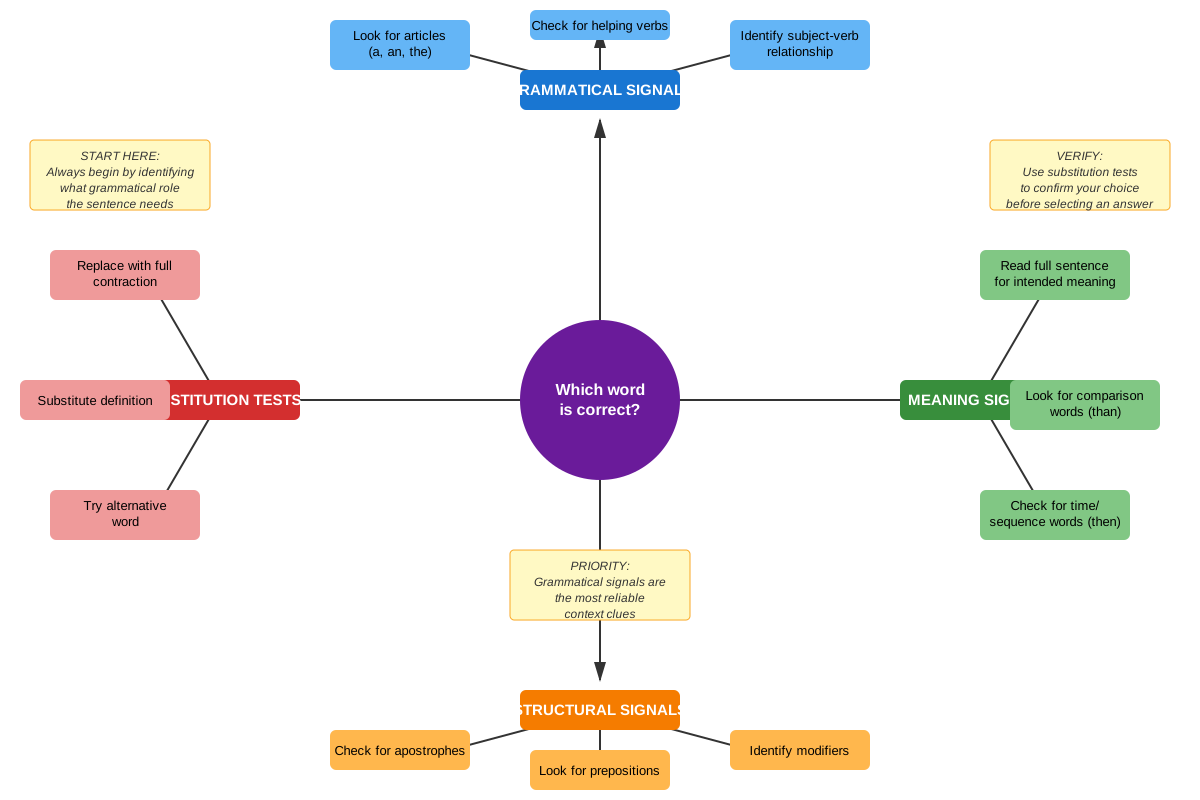
Trigger words and phrases to watch for:
- Comparisons: Words like "more," "less," "better," "worse," "-er" endings → signal "than"
- Time sequences: Words like "next," "after," "first," "subsequently" → signal "then"
- Articles before the blank: "a," "an," "the" → usually signal a noun is needed
- Auxiliary verbs before the blank: "will," "can," "should" → signal a verb is needed
- Prepositions after the blank: "on," "in," "to" → often signal a noun is needed
Process of elimination tips:
- Eliminate any option that creates a grammatical error (e.g., "it's" before a noun)
- Eliminate options that create meaning errors (e.g., "accept" when exclusion is discussed)
- Between remaining options, choose the one that follows standard written English rules, not casual speech patterns
Time allocation:
Confused word questions should take 15-20 seconds each. They're among the fastest question types because they test discrete, rule-based knowledge. If you find yourself spending more than 30 seconds, you likely don't know the rule—make your best guess and move on. These questions don't require rereading large portions of the passage; the sentence containing the underlined portion usually provides sufficient context.
Memory Techniques
For Its/It's and similar pairs:
"If you can say 'it is' or 'it has,' use the apostrophe (it's). If not, no apostrophe (its)."
Apply this same logic to your/you're, their/they're, whose/who's.
For Affect/Effect:
Affect = Action (verb)
Effect = End result (noun)
Visualize: "The action affects the end result, creating an effect."
For Principal/Principle:
"The principAL is your pAL."
"A principLE is a ruLE."
For Lie/Lay:
"You LIE down (no object—both words end in the same sound)."
"You LAY something down (object needed—'lay' sounds like 'place')."
Conjugation memory: "Today I lie down, yesterday I lay down, I have lain down."
"Today I lay it down, yesterday I laid it down, I have laid it down."
For Than/Then:
"ThAn for compArisons (both have 'a')."
"ThEn for timE (both have 'e')."
For Accept/Except:
"Accept means to receive (both have 'c' and 'e')."
"Except means excluding (both start with 'ex')."
For Complement/Compliment:
"CompLEment compLEtes something (both have 'le')."
"CompLIment is something nIce you say (both have 'i')."
Acronym for high-frequency pairs:
PLATE = Principal/Principle, Lie/Lay, Affect/Effect, Than/Then, Effect/Affect
This reminds you of the five most commonly tested pairs on the ACT.
Summary
Frequently confused words represent a high-yield, rule-based topic on the ACT English section that rewards systematic preparation. Success requires understanding three core principles: grammatical function (whether a word serves as a noun, verb, adjective, or adverb), meaning distinction (the subtle differences between similar words), and standard written English conventions (particularly regarding possessives and contractions). The most frequently tested pairs—its/it's, affect/effect, their/there/they're, than/then, and lie/lay—appear consistently across ACT administrations, making them essential to master. The key strategy involves substitution testing (expanding contractions or replacing words with definitions) rather than relying on what "sounds right," as the ACT deliberately creates contexts where both options seem plausible to the ear. Students who memorize the core rules for high-frequency pairs, practice identifying grammatical function, and apply systematic elimination strategies can expect to answer these questions quickly and accurately, typically achieving 90%+ accuracy with focused practice.
Key Takeaways
- Possessive pronouns (its, your, their, whose) never use apostrophes; only contractions do
- "Affect" is typically a verb meaning "to influence"; "effect" is typically a noun meaning "result"
- Substitution testing (expanding contractions or replacing words with definitions) is more reliable than trusting your ear
- Grammatical function determines correct word choice—identify whether the sentence needs a noun, verb, adjective, or adverb
- "Lie" (recline) takes no object; "lay" (place) requires an object—check what follows the verb
- "Than" appears in comparisons; "then" relates to time—look for comparative words or temporal sequences
- Confused word questions are among the fastest to answer (15-20 seconds) when you know the rules, making them high-value targets for score improvement
Related Topics
Subject-Verb Agreement: Mastering confused words strengthens your ability to identify subjects and verbs, which is essential for ensuring they agree in number. Many confused word questions appear in sentences that also test agreement.
Pronoun Usage and Agreement: Understanding possessive pronouns (its, your, their) connects directly to broader pronoun rules, including antecedent agreement and pronoun case.
Verb Tense and Consistency: The lie/lay distinction requires identifying verb tenses, which prepares you for questions testing whether verb tenses are used consistently throughout a passage.
Idioms and Diction: Confused words represent one category of diction (word choice) questions. Mastering this topic builds skills for recognizing proper idiomatic expressions and precise word usage.
Punctuation (Apostrophes): The possessive vs. contraction distinction directly involves apostrophe rules, connecting to broader punctuation concepts including possessive noun formation.
Practice CTA
Now that you've mastered the core concepts, rules, and strategies for frequently confused words, it's time to cement your knowledge through active practice. Attempt the practice questions to apply these concepts to ACT-style problems, and use the flashcards to reinforce the specific word pairs and rules you've learned. Remember: confused word questions are among the most predictable and rule-based on the ACT English section, meaning your preparation directly translates to points on test day. With focused practice, you can transform this topic from a potential weakness into a consistent source of correct answers. You've got this!
Sign up free to keep reading
Create a free AnvayaPrep account to finish this ACT guide on Frequently confused words — plus flashcards and practice questions.