Overview
The distinction between good versus well represents one of the most frequently tested grammar concepts on the ACT English section. This seemingly simple pair of words trips up countless test-takers because both words sound natural in everyday speech, yet only one is grammatically correct in specific contexts. Understanding when to use each word requires mastery of the fundamental difference between adjectives and adverbs—a cornerstone of English grammar that appears repeatedly throughout the exam.
The ACT good versus well distinction tests a student's ability to identify parts of speech and understand how modifiers function within sentences. This topic appears in approximately 1-3 questions per ACT English section, making it a high-yield area for score improvement. The questions typically present sentences where students must choose between "good" and "well" (or identify whether the current usage is correct), often in contexts involving linking verbs, action verbs, or health-related statements where both options might seem plausible to the untrained ear.
Mastering this topic connects directly to broader grammar concepts including adjective versus adverb usage, linking verb identification, and modifier placement. Students who thoroughly understand good versus well develop stronger instincts for recognizing other adjective-adverb pairs (such as bad/badly, real/really) and gain confidence in tackling the entire category of modifier questions that constitute roughly 15-20% of ACT English questions. This foundational knowledge creates a ripple effect, improving performance across multiple question types and strengthening overall grammatical intuition.
Learning Objectives
- [ ] Identify when Good versus well is being tested in ACT questions
- [ ] Explain the core rule or strategy behind Good versus well usage
- [ ] Apply Good versus well to ACT-style questions accurately
- [ ] Distinguish between linking verbs and action verbs to determine correct modifier choice
- [ ] Recognize the exception when "well" functions as an adjective meaning "healthy"
- [ ] Evaluate sentences containing sensory verbs (look, sound, feel, taste, smell) and select appropriate modifiers
- [ ] Analyze complex sentences with multiple verbs to identify which modifier applies to which verb
Prerequisites
- Parts of speech identification: Understanding the basic function of adjectives and adverbs is essential because "good" is an adjective while "well" is primarily an adverb, and choosing correctly depends on recognizing which part of speech the sentence requires.
- Subject-verb-complement sentence structure: Recognizing how linking verbs connect subjects to descriptive words helps determine when adjectives (like "good") are needed rather than adverbs.
- Basic verb classification: Distinguishing between action verbs and linking verbs forms the foundation for applying the good versus well rule correctly in different sentence contexts.
Why This Topic Matters
In professional and academic writing, the correct use of "good" and "well" signals grammatical competence and attention to detail. College professors, employers, and standardized test evaluators all recognize this distinction as a marker of educated writing. Misusing these words in college application essays, professional emails, or academic papers can undermine credibility and create an impression of carelessness, even when the content is otherwise strong.
On the ACT specifically, good versus well questions appear with remarkable consistency. Statistical analysis of released ACT exams shows that this concept appears in approximately 70-80% of all English sections, typically 1-2 times per test. These questions usually appear as "Identifying Errors" or "Improving Sentences" question types, where students must either recognize an error in the underlined portion or select the best revision from multiple options. The questions often embed the good/well choice within longer sentences to test whether students can maintain grammatical accuracy while processing complex information.
The ACT frequently presents this topic in several characteristic ways: sentences describing how someone performs an action ("She plays piano good/well"), sentences with linking verbs describing states of being ("The food tastes good/well"), health-related contexts ("I don't feel good/well"), and sentences where the modifier is separated from the word it modifies to increase difficulty. Understanding these patterns allows students to quickly recognize when this concept is being tested and apply the appropriate rule with confidence.
Core Concepts
The Fundamental Distinction: Adjective versus Adverb
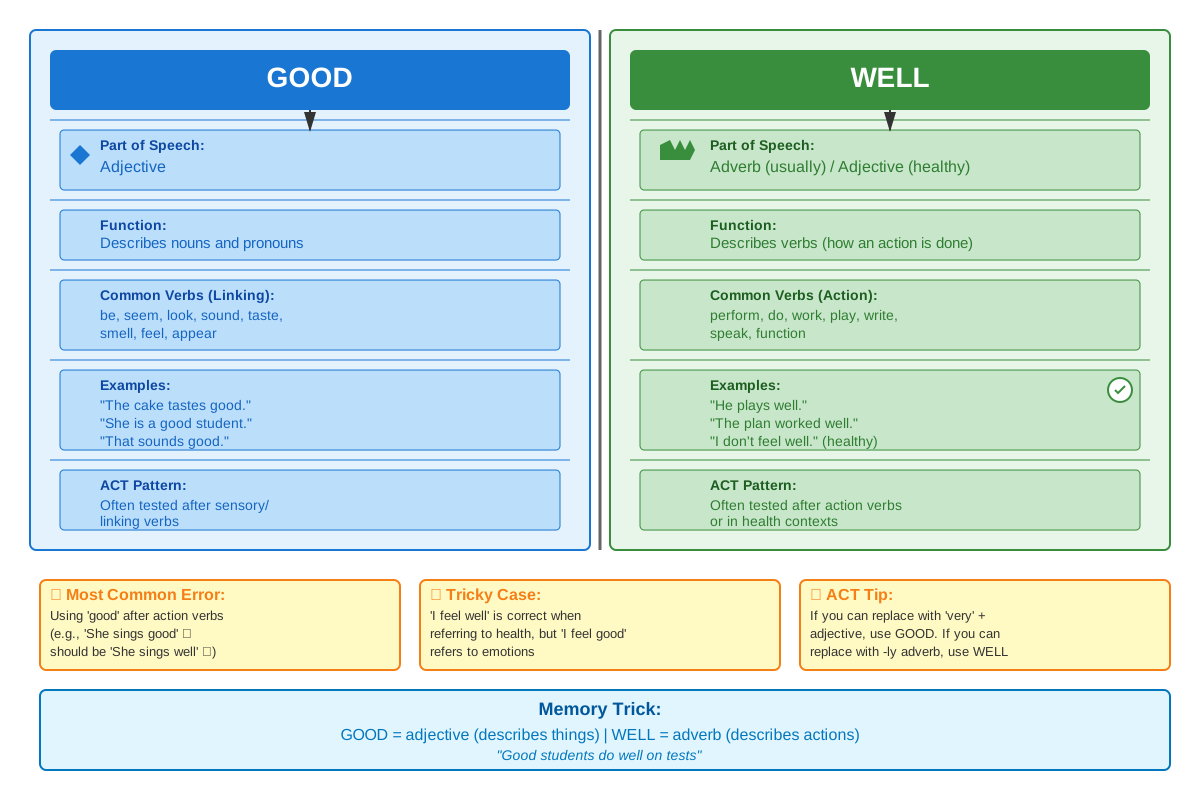
The core principle underlying good versus well usage centers on the grammatical function each word serves. Good is an adjective, meaning it modifies (describes) nouns and pronouns. Adjectives answer questions like "What kind?" or "Which one?" about the nouns they modify. In contrast, well primarily functions as an adverb, meaning it modifies verbs, adjectives, or other adverbs. Adverbs answer questions like "How?" "When?" "Where?" or "To what extent?" about the words they modify.
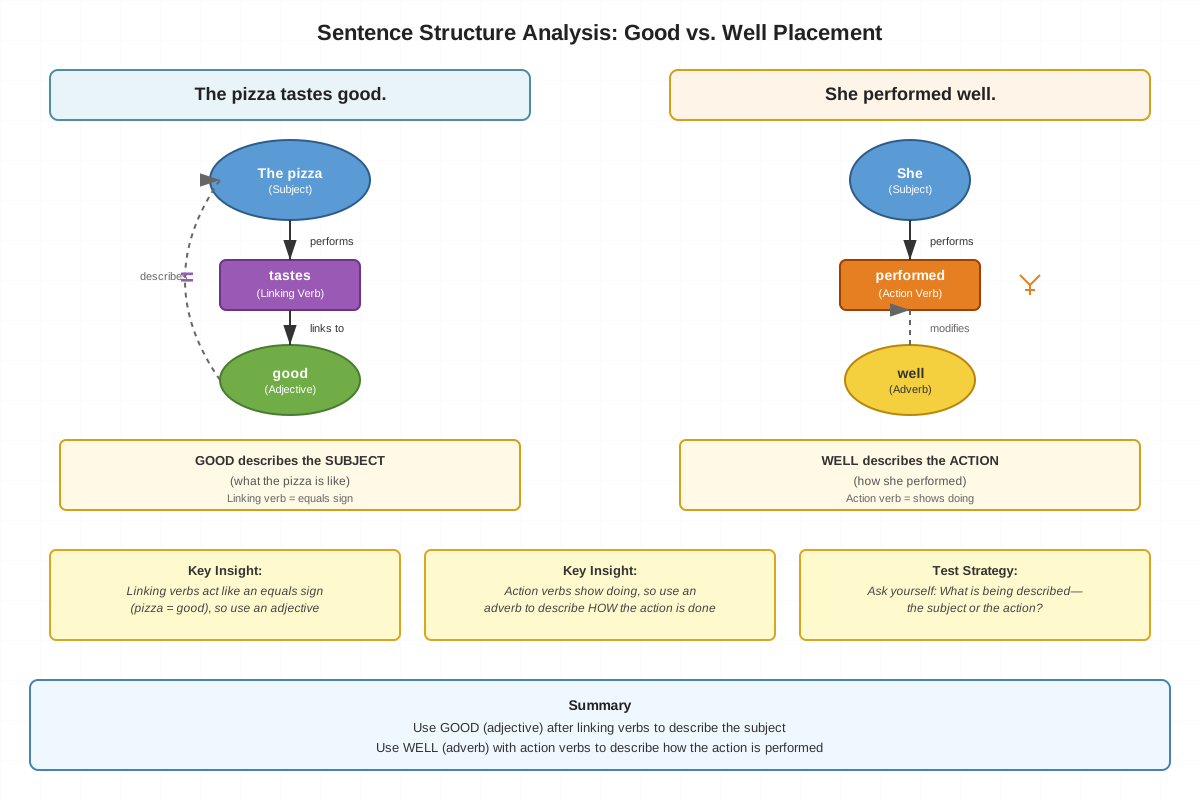
This distinction creates a straightforward rule: use "good" when describing a noun or pronoun, and use "well" when describing how an action is performed. For example, "She is a good singer" uses the adjective "good" to describe the noun "singer," while "She sings well" uses the adverb "well" to describe how she performs the action of singing.
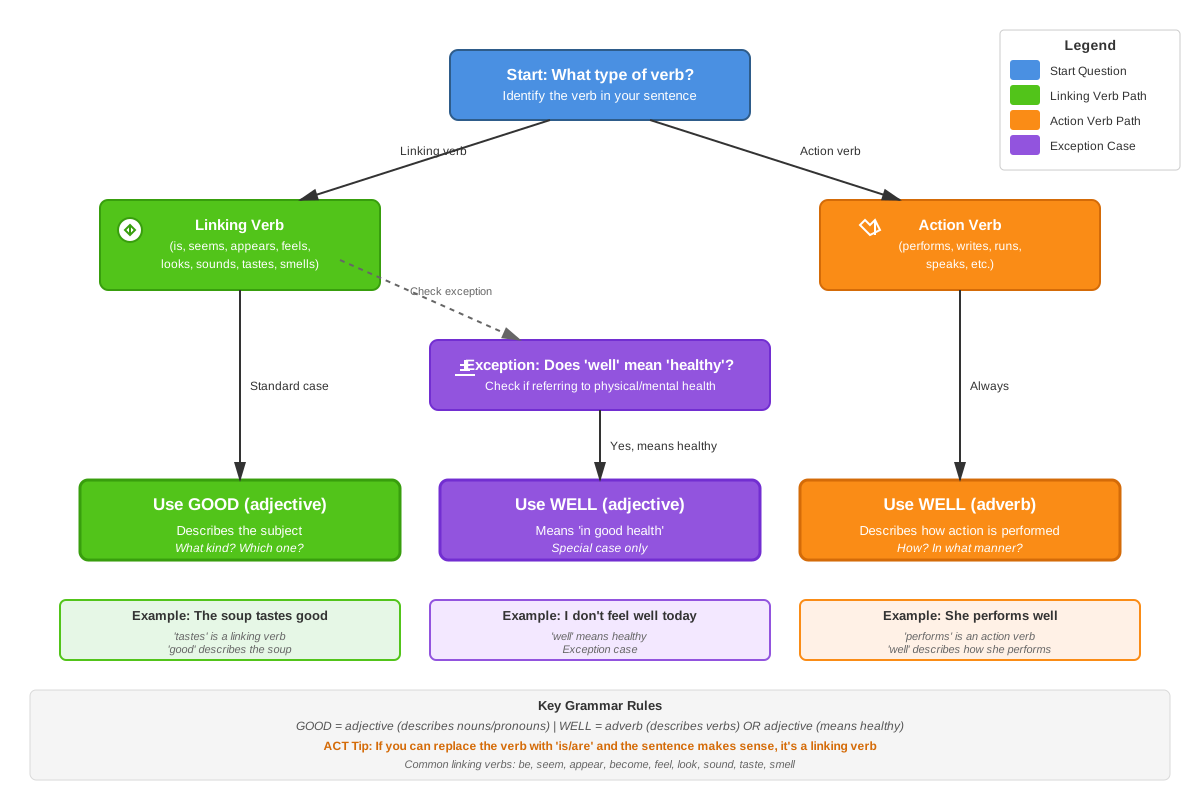
Linking Verbs and Predicate Adjectives
Understanding linking verbs is crucial for mastering good versus well. Linking verbs connect the subject of a sentence to a word that describes or renames it, rather than showing action. The most common linking verb is "to be" (am, is, are, was, were, been), but others include: seem, appear, become, remain, and the sensory verbs (look, sound, feel, taste, smell) when they describe a state rather than an action.
After linking verbs, use adjectives (including "good") rather than adverbs because the modifier describes the subject, not the verb. Consider: "The soup tastes good." Here, "tastes" is a linking verb connecting "soup" to the adjective "good," which describes the soup itself. The sentence tells us about the quality of the soup, not about how the soup performs the action of tasting.
| Sentence | Verb Type | Correct Choice | Explanation |
|---|---|---|---|
| The music sounds ___. | Linking | good | Describes the music (noun) |
| She plays music ___. | Action | well | Describes how she plays (verb) |
| The plan seems ___. | Linking | good | Describes the plan (noun) |
| The plan worked ___. | Action | well | Describes how it worked (verb) |
| He feels ___ today. | Linking | good | Describes his state/mood |
| He performs ___ under pressure. | Action | well | Describes how he performs |
Action Verbs Require Adverbs
When a sentence contains an action verb—a verb that shows what the subject does—use "well" to describe how that action is performed. Action verbs include: run, write, speak, perform, work, function, operate, and thousands of others that show physical or mental activity.
The test is simple: if you can visualize someone or something doing the action, you likely have an action verb that requires "well." For example: "He writes well" (you can picture someone writing), "The car runs well" (you can visualize a car running), "They communicate well" (you can imagine people communicating). In each case, "well" describes the manner in which the action occurs.
The Health Exception: "Well" as an Adjective
The most important exception to memorize is that "well" can function as an adjective meaning "healthy" or "in good health." When "well" means healthy, it follows linking verbs just like "good" does. This creates a crucial distinction in meaning:
- "I feel good" = I am in a positive emotional state; I am happy or pleased
- "I feel well" = I am healthy; I am not sick
Both sentences are grammatically correct, but they communicate different meanings. On the ACT, context clues will usually indicate which meaning is intended. If someone has been sick and is recovering, "I feel well" is appropriate. If someone is describing their emotional response to good news, "I feel good" is correct.
Sensory Verbs: The Tricky Middle Ground
The five sensory verbs—look, sound, feel, taste, and smell—can function as either linking verbs or action verbs, depending on context. This dual nature makes them frequent ACT targets for good versus well questions.
As linking verbs (describing a state): These verbs take "good"
- The cake tastes good. (The cake itself is good)
- You look good in that outfit. (You appear attractive/well-dressed)
- The proposal sounds good. (The proposal itself seems favorable)
As action verbs (describing an action being performed): These verbs take "well"
- She tastes food well despite her cold. (She performs the action of tasting effectively)
- He looks well for clues. (He performs the action of looking/searching effectively)
- The dog smells well even with allergies. (The dog performs the action of smelling effectively)
The key distinction: if the verb describes a quality or state of the subject, it's linking (use "good"). If the verb describes an action the subject actively performs, it's an action verb (use "well").
Compound and Complex Sentences
ACT questions often increase difficulty by embedding good versus well choices in longer, more complex sentences. In these cases, identify which word the modifier describes:
"Although the team practiced diligently, they didn't perform well in the championship, which was disappointing because their preparation had been good."
This sentence requires "well" (modifying the action verb "perform") and "good" (modifying the noun "preparation"). The complexity doesn't change the underlying rules; it simply requires more careful analysis to identify what each modifier describes.
Concept Relationships
The good versus well distinction sits at the intersection of several fundamental grammar concepts. At its foundation lies parts of speech identification → which determines whether a word functions as an adjective or adverb → which then dictates whether "good" or "well" is appropriate. This relationship extends to the broader category of adjective versus adverb usage, where good/well represents just one pair among many (bad/badly, real/really, quick/quickly).
Understanding linking verbs → enables recognition of when adjectives follow verbs → which explains why "good" appears after verbs like "is," "seems," and "tastes" in certain contexts. Conversely, identifying action verbs → signals the need for adverbs → which explains why "well" follows verbs like "performs," "works," and "functions."
The health exception creates a connection to context-dependent word meanings → demonstrating that "well" can shift from adverb to adjective → which requires analyzing sentence context to determine intended meaning. This connects to the broader ACT skill of using context clues to determine correct word choice.
Finally, the sensory verb complications link to verb classification → showing that some verbs function differently in different contexts → which requires analyzing the sentence structure to determine whether the verb shows action or links to a description. This analytical skill transfers to other grammar topics involving context-dependent rules.
Quick check — test yourself on Good versus well so far.
Try Flashcards →High-Yield Facts
⭐ "Good" is always an adjective and modifies nouns or pronouns, never verbs.
⭐ "Well" is primarily an adverb and modifies verbs, adjectives, or other adverbs.
⭐ After linking verbs (be, seem, appear, become), use "good" to describe the subject.
⭐ After action verbs, use "well" to describe how the action is performed.
⭐ "Well" can function as an adjective meaning "healthy," making "I feel well" correct when referring to health.
- The sensory verbs (look, sound, feel, taste, smell) can be either linking or action verbs depending on context.
- "Feel good" refers to emotional state or mood, while "feel well" refers to physical health.
- When a modifier is separated from the word it modifies, trace back to determine whether it describes a noun (use "good") or a verb (use "well").
- "Good" never ends in -ly, while many (but not all) adverbs do; however, "well" is an adverb without the -ly ending.
- In the phrase "do well," "well" is always correct because "do" is an action verb requiring an adverb.
- The phrase "all is well" uses "well" as a predicate adjective meaning everything is in a good state or condition.
- "Good" can follow any form of "to be" (is good, was good, has been good) because these are linking verbs.
Common Misconceptions
Misconception: "Well" always means "healthy," so "I feel well" is always about physical health. → Correction: While "well" can mean healthy (making it an adjective), it primarily functions as an adverb. "I feel well" specifically refers to health, but "well" in other contexts (like "she sings well") is an adverb describing how an action is performed, not a health reference.
Misconception: After any verb that involves the senses (feel, look, taste, etc.), always use "good" because these are linking verbs. → Correction: Sensory verbs can function as either linking verbs or action verbs. "The food tastes good" (linking) versus "She tastes the food well" (action). The determining factor is whether the verb describes a state/quality or an action being performed.
Misconception: "Good" and "well" are interchangeable in casual speech, so either is acceptable on the ACT. → Correction: While informal speech often uses "good" where "well" is grammatically correct ("You did good"), the ACT tests formal, standard written English. The distinction between good and well is strictly enforced on the exam, and choosing incorrectly will result in a wrong answer.
Misconception: If a sentence sounds right with "good," it must be correct. → Correction: Many native English speakers use "good" incorrectly in everyday speech (saying "I did good on the test" instead of "I did well"), so relying on what "sounds right" often leads to errors. The ACT requires applying grammatical rules, not following conversational patterns.
Misconception: "Well" is always the more formal or sophisticated choice, so when in doubt, choose "well." → Correction: Neither word is inherently more formal; they serve different grammatical functions. Choosing "well" after a linking verb ("The soup tastes well") is just as incorrect as choosing "good" after an action verb ("She sings good"). The correct choice depends on sentence structure, not formality level.
Misconception: In the phrase "feel good," "good" is wrong because it comes after a verb. → Correction: "Feel" is a linking verb when it describes a state or condition, so "feel good" (describing emotional state) is grammatically correct. The adjective "good" describes the subject's state, not the action of feeling. Only when "feel" means to physically touch something does it become an action verb requiring "well."
Worked Examples
Example 1: Identifying Verb Type
Question: The orchestra performed (good/well) at the concert, and the conductor felt (good/well) about their preparation.
Step 1: Analyze the first blank
Identify the verb: "performed"
Question: Is this a linking verb or action verb?
Answer: Action verb—the orchestra is doing something (performing)
Rule: Action verbs require adverbs
Conclusion: Use "well" (adverb describing how they performed)
Step 2: Analyze the second blank
Identify the verb: "felt"
Question: Is this a linking verb or action verb?
Answer: Linking verb—it describes the conductor's emotional state, not a physical action of touching
Rule: Linking verbs take adjectives that describe the subject
Conclusion: Use "good" (adjective describing the conductor's emotional state)
Step 3: Consider context for "felt"
The phrase "felt about their preparation" indicates an emotional response (satisfaction, confidence), not a health reference. Therefore, "good" (emotional state) is more appropriate than "well" (health).
Final Answer: The orchestra performed well at the concert, and the conductor felt good about their preparation.
Connection to Learning Objectives: This example demonstrates identifying when good versus well is tested (objective 1), applying the core rule about action versus linking verbs (objective 2), and accurately selecting the correct word in an ACT-style context (objective 3).
Example 2: Complex Sentence with Multiple Verbs
Question: Although Maria didn't feel (good/well) yesterday, she looks (good/well) today and is performing (good/well) in her classes.
Step 1: Analyze "didn't feel"
Context: "yesterday" and the contrast with "today" suggests this refers to health/physical condition
Verb type: "feel" as linking verb (describing state of health)
Health exception: When "well" means healthy, it functions as an adjective
Conclusion: Use "well" (adjective meaning healthy)
Step 2: Analyze "looks"
Identify what "looks" describes: her appearance/state today
Verb type: Linking verb (describing how she appears, not an action of looking at something)
Rule: Linking verbs take adjectives
Conclusion: Use "good" (adjective describing her appearance/state)
Step 3: Analyze "is performing"
Identify the verb: "performing" (action verb)
Question: What does the modifier describe?
Answer: How she performs the action of doing her classwork
Rule: Action verbs require adverbs
Conclusion: Use "well" (adverb describing how she performs)
Final Answer: Although Maria didn't feel well yesterday, she looks good today and is performing well in her classes.
Connection to Learning Objectives: This example demonstrates recognizing the health exception (objective 5), distinguishing between linking and action verbs (objective 4), and analyzing complex sentences with multiple verbs (objective 7).
Exam Strategy
When approaching ACT questions testing good versus well, implement this systematic process:
Step 1: Identify the verb that the modifier relates to. Underline or mentally note this verb, as it determines which choice is correct.
Step 2: Classify the verb as either linking or action. Ask yourself: "Does this verb show what the subject does (action) or describe what the subject is/seems like (linking)?" Remember the common linking verbs: be, seem, appear, become, remain, and the sensory verbs in descriptive contexts.
Step 3: Apply the rule: Linking verb → use "good" (adjective); Action verb → use "well" (adverb).
Step 4: Check for the health exception: If the sentence involves physical health or wellness, "well" can function as an adjective meaning healthy, making it correct after linking verbs in health contexts.
Exam Tip: Watch for these trigger phrases that signal good versus well is being tested: "feel ___," "did ___," "performed ___," "tastes ___," "sounds ___," "looks ___," and "seems ___."
Process of elimination strategy: If you're uncertain, eliminate choices based on what you know is definitely wrong. If the verb is clearly an action verb (like "performed," "worked," "functioned"), immediately eliminate "good." If the verb is clearly linking (like "is," "seems," "appears"), eliminate "well" unless health is mentioned.
Time allocation: Good versus well questions should take no more than 15-20 seconds once you've mastered the concept. If you find yourself spending more time, you likely haven't clearly identified the verb type. Make your best educated guess and move on rather than overthinking.
Common trap patterns: The ACT often places the modifier far from the verb it modifies, or embeds the choice in a complex sentence with multiple clauses. Don't be distracted by sentence length or complexity—focus solely on identifying the verb and its type.
Memory Techniques
The "GALA" Mnemonic:
- Good for Adjectives (describes nouns)
- Linking verbs take good
- Action verbs take well
The "Action = Adverb" Alliteration: When you see an action verb, remember "Action requires Adverb" (well). The alliteration helps cement the connection.
The Health Check Visualization: Picture a doctor's checkup. When someone asks "How do you feel?" at the doctor's office, visualize the word "WELL" on a health chart. This reinforces that "feel well" relates to health/physical condition.
The Linking Chain: Visualize linking verbs as chains that connect the subject to a description. Since chains link things together, and adjectives describe nouns, remember: linking verbs → adjectives → "good."
The Performance Stage: When you see action verbs like "perform," "play," "work," or "function," visualize someone on a stage performing. Ask yourself: "How did they perform?" The answer is "well" (adverb). This creates a mental association between action/performance and the adverb "well."
The Sensory Test: For sensory verbs, ask: "Am I describing what something IS like, or what someone DOES?" If describing what something IS like (The cake tastes delicious), use adjectives. If describing what someone DOES (She tastes food carefully), use adverbs.
Summary
The distinction between good and well represents a high-yield ACT English concept that tests understanding of adjectives versus adverbs. The fundamental rule is straightforward: "good" is an adjective that modifies nouns and pronouns, while "well" is primarily an adverb that modifies verbs, adjectives, or other adverbs. This creates a clear pattern: use "good" after linking verbs (be, seem, appear, become, and sensory verbs in descriptive contexts) because these verbs connect subjects to adjectives that describe them. Use "well" after action verbs because adverbs describe how actions are performed. The critical exception involves "well" functioning as an adjective meaning "healthy," making "I feel well" correct when referring to physical health rather than emotional state. Sensory verbs (look, sound, feel, taste, smell) require careful analysis because they can function as either linking or action verbs depending on whether they describe a state or an action being performed. Mastering this topic requires identifying verb types quickly and accurately, then applying the appropriate rule without being misled by informal speech patterns that often use "good" incorrectly.
Key Takeaways
- Good is always an adjective (modifies nouns/pronouns); well is primarily an adverb (modifies verbs/adjectives/adverbs)
- After linking verbs (be, seem, appear, become, sensory verbs describing states), use good
- After action verbs, use well to describe how the action is performed
- "Well" can mean "healthy" (adjective), making "I feel well" correct for physical health
- Sensory verbs (look, sound, feel, taste, smell) can be linking or action verbs—analyze context carefully
- Don't rely on what "sounds right" in casual speech; apply grammatical rules for ACT success
- Identify the verb type first, then apply the rule—this systematic approach prevents errors
Related Topics
Adjective versus Adverb Usage: Mastering good versus well provides the foundation for understanding other adjective-adverb pairs like bad/badly, real/really, and quick/quickly. These follow the same principles of modifying nouns versus verbs.
Linking Verb Identification: Deeper study of linking verbs expands beyond good versus well to include predicate nominatives, predicate adjectives, and the full range of verbs that can function as linking verbs in various contexts.
Modifier Placement: Understanding where modifiers should be placed in sentences builds on the good versus well foundation, addressing issues like misplaced modifiers and dangling modifiers that frequently appear on the ACT.
Comparative and Superlative Forms: The concepts of "better/best" (comparative and superlative forms of "good") and "better/best" (also used with "well") extend the good versus well distinction into more complex grammatical territory.
Practice CTA
Now that you've mastered the core concepts of good versus well, it's time to cement your understanding through active practice. Attempt the practice questions to test your ability to identify verb types quickly and apply the rules accurately under timed conditions. Use the flashcards to reinforce the key distinctions and exceptions until your responses become automatic. Remember: understanding the concept intellectually is just the first step—achieving mastery requires repeated application until you can confidently answer these questions in 15 seconds or less. Every practice question you complete builds the pattern recognition and grammatical intuition that will serve you throughout the entire ACT English section. You've got this!
Sign up free to keep reading
Create a free AnvayaPrep account to finish this ACT guide on Good versus well — plus flashcards and practice questions.