Overview
Indefinite pronoun agreement is a critical grammar concept tested frequently on the ACT English section. This topic examines whether pronouns that refer back to indefinite pronouns (words like "everyone," "somebody," "each," or "neither") match correctly in number and person. The ACT tests this concept because it reveals a student's understanding of formal written English conventions and their ability to maintain grammatical consistency throughout sentences and passages.
Mastering ACT indefinite pronoun agreement is essential because these questions appear in approximately 2-4 questions per test, making them high-yield content for score improvement. Unlike some grammar rules that feel arbitrary, indefinite pronoun agreement follows logical patterns once students understand which indefinite pronouns are singular, which are plural, and which depend on context. The challenge lies in the fact that many indefinite pronouns sound plural in everyday speech but are grammatically singular in formal writing—a distinction the ACT exploits regularly.
This topic connects directly to broader pronoun-antecedent agreement principles and subject-verb agreement rules. Understanding indefinite pronouns strengthens overall command of grammatical number and prepares students for related concepts including relative pronoun usage, possessive pronoun clarity, and maintaining consistency in verb tenses. Success with indefinite pronoun agreement demonstrates mastery of formal register and the ability to identify and correct subtle grammatical errors—skills that translate to higher scores across the entire English section.
Learning Objectives
- [ ] Identify when indefinite pronoun agreement is being tested in ACT passages
- [ ] Explain the core rule or strategy behind indefinite pronoun agreement
- [ ] Apply indefinite pronoun agreement to ACT-style questions accurately
- [ ] Categorize indefinite pronouns as singular, plural, or variable based on context
- [ ] Recognize and correct common indefinite pronoun agreement errors in complex sentences
- [ ] Distinguish between indefinite pronoun agreement and other pronoun-related errors
Prerequisites
- Basic pronoun types and functions: Understanding what pronouns are and how they replace nouns is fundamental to recognizing when agreement errors occur.
- Subject-verb agreement principles: The same logic governing singular/plural verb forms applies to pronoun agreement, making this foundational knowledge essential.
- Antecedent identification: Students must be able to locate the noun or pronoun that another pronoun refers back to in order to check agreement.
- Number distinction (singular vs. plural): Recognizing whether words are singular or plural is the core skill underlying all agreement rules.
Why This Topic Matters
Indefinite pronoun agreement appears consistently on every ACT English test, typically in 2-4 questions per exam. These questions test formal written English conventions that distinguish proficient writers from those who rely solely on conversational patterns. In real-world applications, mastering this concept ensures professional writing clarity in college essays, business communications, and academic papers where formal register is expected.
The ACT specifically targets indefinite pronoun agreement because it reveals whether students can identify subtle grammatical relationships across sentence boundaries. Questions typically appear in two formats: (1) underlined pronoun sections where students must choose the correct pronoun form, and (2) error identification where students must recognize when a pronoun doesn't agree with its indefinite pronoun antecedent. The test writers deliberately use indefinite pronouns that sound plural in speech (like "everyone" or "somebody") but require singular pronoun references in formal writing.
Common passage contexts include discussions of groups where individuals are referenced ("Each of the students must submit their/his or her application"), workplace scenarios ("Everyone should check their/his or her email"), and general statements about people ("If anyone calls, tell them/him or her I'm unavailable"). The ACT also tests this concept in longer passages where the indefinite pronoun appears several sentences before the referring pronoun, requiring students to track grammatical relationships across multiple clauses.
Core Concepts
Understanding Indefinite Pronouns
Indefinite pronouns are pronouns that refer to non-specific persons, places, or things. Unlike definite pronouns (he, she, it, they) that refer to specific antecedents, indefinite pronouns reference general or unspecified entities. The term "indefinite" means these pronouns don't point to a particular, identified noun. Examples include "everyone," "somebody," "anything," "few," and "several."
The critical challenge with indefinite pronouns is that they must agree in number with any pronouns that refer back to them. This agreement determines whether subsequent pronouns should be singular (he, she, it, his, her, its) or plural (they, them, their). The ACT tests whether students can maintain this agreement consistently, especially when the indefinite pronoun and its referring pronoun are separated by multiple words or clauses.
Singular Indefinite Pronouns
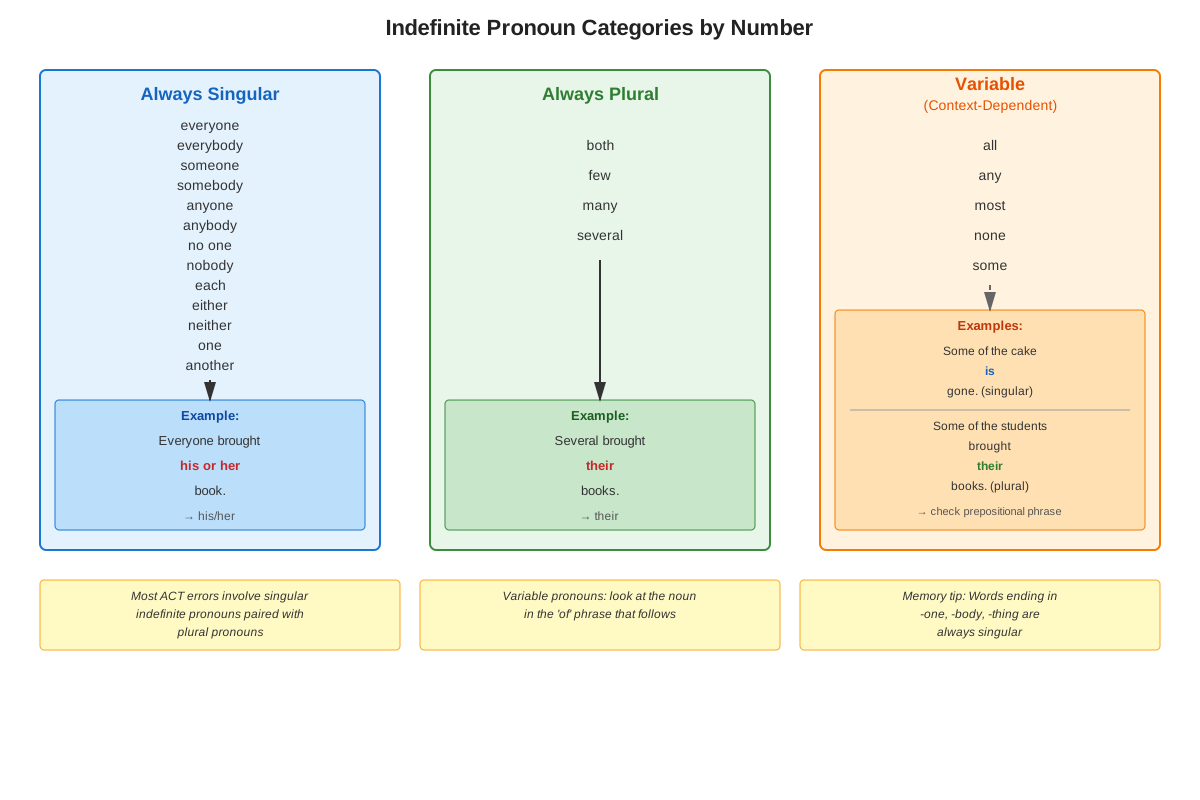
The following indefinite pronouns are always singular and require singular pronoun references:
| Indefinite Pronoun | Example Sentence |
|---|---|
| anyone, anybody, anything | Anyone can achieve his or her goals with dedication. |
| everyone, everybody, everything | Everyone must bring his or her own supplies. |
| someone, somebody, something | Somebody left his or her jacket in the classroom. |
| no one, nobody, nothing | No one should compromise his or her values. |
| each | Each of the players has his or her own locker. |
| either | Either of the candidates will present his or her platform. |
| neither | Neither of the students submitted his or her essay. |
| one | One must consider his or her options carefully. |
The key principle is that these pronouns emphasize individuality—they refer to single, separate entities even when discussing groups. The word "everyone," for example, means "every single one" (singular), not "all people together" (plural). This distinction is crucial for ACT success.
Plural Indefinite Pronouns
Certain indefinite pronouns are always plural and require plural pronoun references:
| Indefinite Pronoun | Example Sentence |
|---|---|
| both | Both of the teachers shared their lesson plans. |
| few | Few of the applicants submitted their portfolios early. |
| many | Many of the students completed their assignments. |
| several | Several of the participants voiced their concerns. |
| others | Others have expressed their opinions on the matter. |
These pronouns inherently reference multiple entities, making plural agreement straightforward and intuitive.
Variable Indefinite Pronouns
Some indefinite pronouns can be either singular or plural depending on the noun they refer to in the prepositional phrase that follows them:
| Indefinite Pronoun | Singular Example | Plural Example |
|---|---|---|
| all | All of the cake has lost its flavor. | All of the students raised their hands. |
| any | Any of the information could reveal its source. | Any of the players may voice their opinions. |
| more | More of the budget needs its allocation reviewed. | More of the employees submitted their forms. |
| most | Most of the presentation had its flaws. | Most of the teachers updated their curricula. |
| none | None of the evidence supports its claims. | None of the participants brought their materials. |
| some | Some of the water lost its purity. | Some of the workers expressed their concerns. |
The rule for these pronouns: look at the object of the preposition following the indefinite pronoun. If that object is singular, use singular pronouns; if plural, use plural pronouns. This context-dependent agreement is frequently tested on the ACT.
The "His or Her" vs. "Their" Debate
In formal written English—the standard the ACT follows—singular indefinite pronouns traditionally require singular pronoun references. This creates the somewhat awkward construction "his or her" when gender is unspecified:
- Correct (formal): Everyone should submit his or her application by Friday.
- Incorrect (formal): Everyone should submit their application by Friday.
While contemporary usage increasingly accepts "their" as a singular pronoun for inclusivity and simplicity, the ACT still tests the traditional formal standard. Students must recognize that "their" is technically plural and should not refer back to singular indefinite pronouns in ACT passages. The test consistently marks such usage as incorrect.
Agreement Across Sentence Boundaries
The ACT frequently tests indefinite pronoun agreement when the referring pronoun appears in a different clause or sentence from the indefinite pronoun antecedent:
- Each of the scientists presented findings at the conference. They [INCORRECT] / He or she [CORRECT] emphasized the need for further research.
Students must track the antecedent across multiple words, maintaining awareness of the original indefinite pronoun's number even when distance separates the two elements.
Concept Relationships
Indefinite pronoun agreement builds directly on subject-verb agreement principles—both require matching grammatical number between related sentence elements. The same logic that determines whether a verb should be singular or plural applies to determining whether a referring pronoun should be singular or plural.
This topic connects closely to pronoun-antecedent agreement more broadly, which encompasses all situations where pronouns must match their antecedents in number, person, and sometimes gender. Indefinite pronoun agreement is a specific application of this broader principle, focusing on the unique challenges posed by indefinite pronouns.
The relationship flows as follows:
Basic pronoun knowledge → Antecedent identification → General pronoun-antecedent agreement → Indefinite pronoun agreement → Complex sentence agreement tracking
Understanding indefinite pronoun agreement also supports mastery of pronoun clarity and reference, since students must accurately identify what each pronoun refers to. Additionally, this topic reinforces formal vs. informal register awareness, as the formal written standard differs from conversational usage.
The variable indefinite pronouns (all, any, most, some, none) create a bridge to prepositional phrase analysis, requiring students to identify the object of the preposition to determine correct agreement. This connection reinforces the importance of understanding sentence structure and grammatical relationships.
Quick check — test yourself on Indefinite pronoun agreement so far.
Try Flashcards →High-Yield Facts
⭐ Singular indefinite pronouns (everyone, someone, anyone, no one, each, either, neither) always require singular pronoun references (his or her, not their).
⭐ The ACT follows traditional formal grammar rules where "their" cannot refer back to singular indefinite pronouns, despite evolving contemporary usage.
⭐ Variable indefinite pronouns (all, any, most, some, none, more) take their number from the object of the preposition that follows them.
⭐ "Each" is always singular, even when followed by a prepositional phrase with a plural object (each of the students = singular).
⭐ "Both," "few," "many," "several," and "others" are always plural indefinite pronouns.
- The words "everyone" and "everybody" mean "every single one," emphasizing the singular nature despite seeming to reference groups.
- "Either" and "neither" are singular because they refer to one option from a set of two.
- Distance between the indefinite pronoun and the referring pronoun does not change agreement rules.
- Compound subjects joined by "and" with indefinite pronouns still follow the indefinite pronoun's number (each student and teacher = singular).
- The ACT will never accept "they/their/them" as correct when referring back to singular indefinite pronouns in underlined portions.
- Possessive forms follow the same rules: "everyone's" is singular, so any pronoun referring to it must be singular.
- When "one" is used as an indefinite pronoun, subsequent references should use "one" or "his or her," not "you" or "your."
- The phrase "one of the [plural noun]" takes a singular verb and singular pronoun reference because "one" is the subject.
- "None" can be singular or plural, but when it means "not one," it's singular; when it means "not any," it's plural.
- Collective nouns (team, group, committee) are different from indefinite pronouns and follow separate agreement rules.
Common Misconceptions
Misconception: "Everyone" is plural because it refers to multiple people. → Correction: "Everyone" is grammatically singular because it means "every single one," emphasizing each individual separately. It requires singular pronoun references (his or her, not their).
Misconception: Using "their" with singular indefinite pronouns is acceptable because it's common in speech. → Correction: While "their" as a singular pronoun is increasingly accepted in contemporary usage, the ACT tests formal written English where singular indefinite pronouns require singular pronoun references. The test will mark "their" as incorrect when referring to singular indefinite pronouns.
Misconception: "Each of the students" is plural because "students" is plural. → Correction: The subject is "each," which is always singular, regardless of the prepositional phrase that follows. The pronoun reference must be singular (his or her), not plural (their).
Misconception: "None" is always singular because it means "not one." → Correction: "None" is a variable indefinite pronoun that can be singular or plural depending on context. When it refers to a plural noun (none of the students), it's plural; when it refers to a singular noun (none of the cake), it's singular.
Misconception: If the indefinite pronoun and referring pronoun are in different sentences, agreement rules don't apply. → Correction: Agreement rules apply regardless of sentence boundaries. Students must track the antecedent across multiple sentences and maintain correct agreement throughout the passage.
Misconception: "Either" and "neither" can be plural when discussing two people. → Correction: "Either" and "neither" are always singular because they refer to one option from a set of two, not both options simultaneously. They require singular pronoun references.
Misconception: Compound indefinite pronouns (like "anyone else") change the agreement rules. → Correction: Adding words like "else" doesn't change the number of the indefinite pronoun. "Anyone else" is still singular and requires singular pronoun references.
Worked Examples
Example 1: Identifying and Correcting Agreement Errors
Passage: "Each of the committee members reviewed the proposal carefully. They submitted their recommendations by the deadline."
Analysis:
- Identify the indefinite pronoun: "Each" is the subject of the first sentence.
- Determine its number: "Each" is always singular, regardless of the prepositional phrase "of the committee members."
- Locate the referring pronouns: "They" and "their" in the second sentence refer back to "each."
- Check agreement: "They" and "their" are plural, but "each" is singular—this is an agreement error.
- Correct the error: Replace "They submitted their" with "He or she submitted his or her" or restructure to "Each member submitted his or her."
Corrected version: "Each of the committee members reviewed the proposal carefully. He or she submitted his or her recommendations by the deadline."
ACT Application: On the ACT, the second sentence would likely be underlined with answer choices:
- A. They submitted their (INCORRECT—plural pronouns with singular antecedent)
- B. He or she submitted his or her (CORRECT—maintains singular agreement)
- C. They submitted his or her (INCORRECT—mixed number)
- D. He or she submitted their (INCORRECT—mixed number)
This example demonstrates Learning Objective 3 (applying indefinite pronoun agreement accurately) by showing the complete process of identifying, analyzing, and correcting agreement errors.
Example 2: Variable Indefinite Pronouns
Passage: "Most of the evidence supports the theory, but some of the scientists question its validity. Most of the researchers have published their findings in peer-reviewed journals."
Analysis:
- Identify the variable indefinite pronouns: "Most" appears twice, and "some" appears once.
- Determine the object of each preposition:
- "Most of the evidence" → "evidence" is singular
- "some of the scientists" → "scientists" is plural
- "Most of the researchers" → "researchers" is plural
- Check pronoun agreement:
- First "most" refers to singular "evidence," so "its" (singular) is correct
- "Some" refers to plural "scientists," so the implied "they" is correct
- Second "most" refers to plural "researchers," so "their" (plural) is correct
- Verify all agreements are correct: Yes, all pronouns match the number of their antecedents.
ACT Application: The test might present this with an underlined portion:
"Most of the researchers have published _____ findings."
- A. their (CORRECT—plural pronoun for plural antecedent)
- B. his or her (INCORRECT—singular pronoun for plural antecedent)
- C. its (INCORRECT—wrong pronoun type)
- D. there (INCORRECT—wrong word entirely)
This example addresses Learning Objective 4 (categorizing indefinite pronouns based on context) by demonstrating how variable indefinite pronouns change number based on their prepositional phrase objects.
Exam Strategy
Recognition Triggers
Watch for these trigger words and phrases that signal indefinite pronoun agreement questions:
- Any sentence containing "everyone," "someone," "anyone," "no one," "each," "either," or "neither"
- Pronouns like "they," "their," or "them" appearing after singular indefinite pronouns
- The phrase "his or her" in answer choices (often signals the correct formal answer)
- Underlined pronouns that appear several words after an indefinite pronoun
- Questions asking about pronoun agreement or consistency
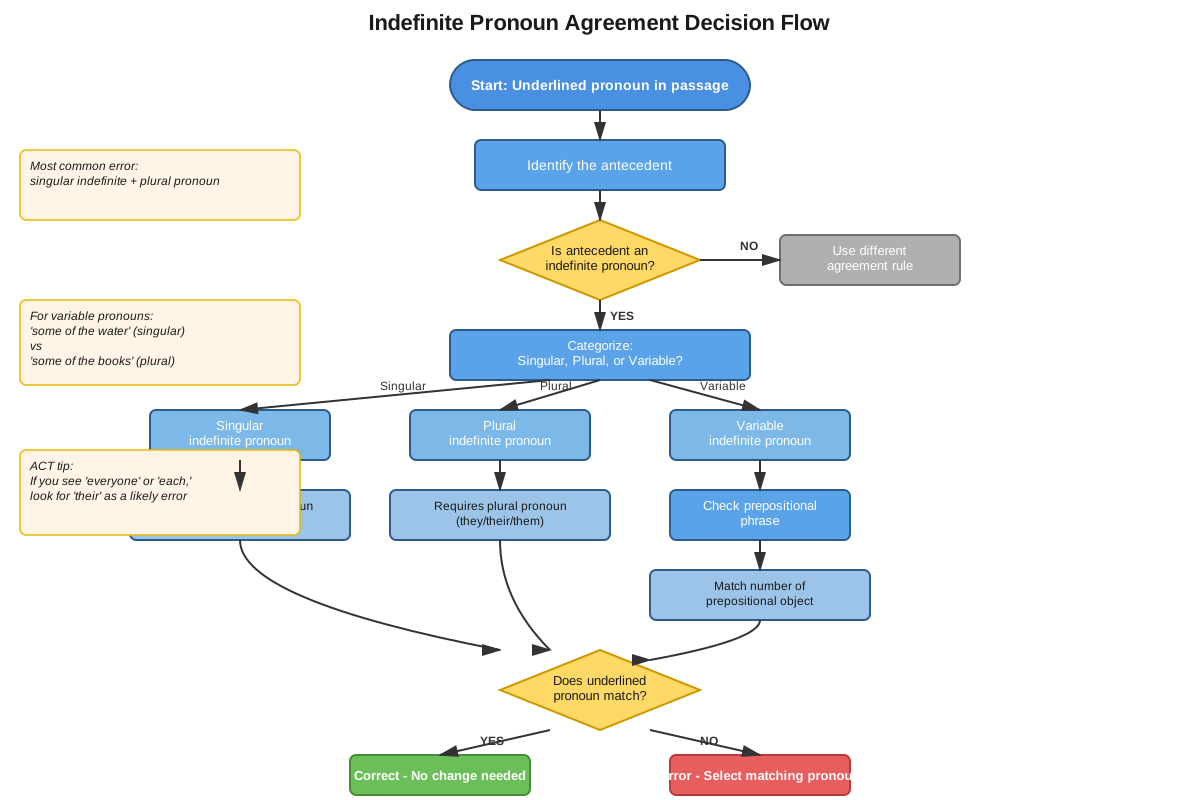
Systematic Approach
- Locate the pronoun: Identify the underlined or questioned pronoun.
- Find its antecedent: Work backward to find what noun or pronoun it refers to.
- Determine the antecedent's number: Is it singular, plural, or variable?
- Check agreement: Does the pronoun match in number?
- Verify with answer choices: Eliminate options that don't maintain agreement.
Process of Elimination
- Immediately eliminate any answer choice using "their/they/them" to refer back to singular indefinite pronouns like "everyone," "someone," "each," "either," or "neither."
- Be suspicious of answer choices that sound natural in conversation but violate formal grammar rules.
- Favor "his or her" constructions when the antecedent is a singular indefinite pronoun, even if they seem awkward.
- Check variable pronouns carefully: Don't assume "all," "some," "most," or "none" are always singular or always plural.
Time Management
Indefinite pronoun agreement questions should take 15-30 seconds each. They require identification and matching but not complex analysis. If a question takes longer than 45 seconds, mark it and return later. These questions are high-yield and should not be rushed, but they also shouldn't consume excessive time since the rules are straightforward once identified.
Exam Tip: When you see "everyone," "someone," or "each," immediately think "singular" and look for any pronouns that might incorrectly refer to them with plural forms. This mental trigger catches 80% of indefinite pronoun agreement errors.
Memory Techniques
The SANE Mnemonic
Someone, Anyone, No one, Everyone = Singular
All four of these common indefinite pronouns are always singular and require singular pronoun references.
The "Body-One-Thing" Rule
Any indefinite pronoun ending in -body, -one, or -thing is singular:
- anybody, somebody, everybody, nobody
- anyone, someone, everyone, no one
- anything, something, everything, nothing
The "Each is Alone" Visualization
Picture "each" as emphasizing individual separation. Even in a group, "each" focuses on one person at a time, standing alone. This mental image reinforces that "each" is always singular.
The Variable Pronoun Phrase
For variable indefinite pronouns, remember: "Look to the OF"
When you see all, any, most, some, or none, look to the object OF the preposition that follows to determine singular or plural agreement.
The Plural Pairs
"Both Few Many Several" (sounds like a law firm name)
These four indefinite pronouns are always plural—memorize them as a group.
Summary
Indefinite pronoun agreement is a high-yield ACT English topic that tests whether pronouns correctly match their indefinite pronoun antecedents in number. The core principle is straightforward: singular indefinite pronouns (everyone, someone, anyone, no one, each, either, neither) require singular pronoun references (his or her), while plural indefinite pronouns (both, few, many, several) require plural references (their). Variable indefinite pronouns (all, any, most, some, none) take their number from the object of the preposition that follows them. The ACT consistently tests formal written English standards, which means "their" cannot correctly refer to singular indefinite pronouns, despite contemporary usage trends. Success requires identifying the indefinite pronoun antecedent, determining its number, and verifying that all referring pronouns maintain correct agreement—even across sentence boundaries. Students who master the categorization of indefinite pronouns and apply systematic checking processes can quickly and accurately answer these questions, securing valuable points on every ACT English section.
Key Takeaways
- Singular indefinite pronouns (everyone, someone, anyone, no one, each, either, neither) always require singular pronoun references, never "their/they/them"
- The ACT follows traditional formal grammar where "his or her" is correct and "their" with singular antecedents is incorrect
- Variable indefinite pronouns (all, any, most, some, none) change number based on the object of the preposition following them
- Distance doesn't matter: agreement rules apply even when the pronoun and antecedent are separated by multiple words or sentences
- "Each" is always singular, regardless of any plural nouns in prepositional phrases that follow it
- Recognition is key: identifying indefinite pronouns quickly allows systematic checking of all referring pronouns
- Process of elimination works: immediately eliminate plural pronouns referring to singular indefinite pronouns
Related Topics
Pronoun-Antecedent Agreement (General): Mastering indefinite pronoun agreement provides the foundation for understanding all pronoun-antecedent relationships, including those with definite pronouns and noun antecedents.
Subject-Verb Agreement: The same principles of matching grammatical number apply to subjects and verbs, making these topics mutually reinforcing.
Pronoun Case: After ensuring pronouns agree in number, students must also verify they're in the correct case (subjective, objective, possessive), which is another high-yield ACT topic.
Pronoun Clarity and Reference: Beyond agreement, pronouns must have clear, unambiguous antecedents—a related skill that builds on the antecedent identification practiced in this topic.
Formal vs. Informal Register: Understanding when to apply formal grammar rules versus conversational patterns is essential for ACT success and extends beyond pronouns to many other grammar concepts.
Practice CTA
Now that you've mastered the core concepts of indefinite pronoun agreement, it's time to reinforce your learning through active practice. Complete the practice questions to test your ability to identify, analyze, and correct indefinite pronoun agreement errors under timed conditions. Use the flashcards to drill the categorization of indefinite pronouns until recognition becomes automatic. Remember: the difference between knowing the rules and scoring points is application. Every practice question you complete builds the pattern recognition and speed you need for test day success. You've got this!
Sign up free to keep reading
Create a free AnvayaPrep account to finish this ACT guide on Indefinite pronoun agreement — plus flashcards and practice questions.