Overview
Pronoun case is one of the most frequently tested grammar concepts on the ACT English section, appearing in approximately 10-15% of all grammar questions. Understanding pronoun case means knowing which form of a pronoun to use based on its function in a sentence—whether it acts as a subject, object, or possessive. The ACT tests this concept because proper pronoun usage is fundamental to clear, professional writing and because many native English speakers make case errors in everyday speech, making these questions effective discriminators of grammatical knowledge.
The concept of ACT pronoun case extends beyond simple memorization of pronoun forms. Students must recognize the grammatical role each pronoun plays within increasingly complex sentence structures, including compound subjects and objects, comparisons, and clauses with implied words. The ACT deliberately constructs questions that sound correct to the ear but are grammatically incorrect, or vice versa, testing whether students can apply formal grammar rules rather than relying on conversational patterns.
Mastering pronoun case connects directly to other essential grammar concepts tested on the ACT, including subject-verb agreement, sentence structure, and modifier placement. When students understand how pronouns function within sentences, they develop stronger overall sentence analysis skills that improve performance across multiple question types. This topic serves as a gateway to understanding grammatical relationships and sentence architecture, making it a high-yield area for focused study.
Learning Objectives
- [ ] Identify when Pronoun case is being tested in ACT questions
- [ ] Explain the core rule or strategy behind Pronoun case
- [ ] Apply Pronoun case to ACT-style questions accurately
- [ ] Distinguish between subjective, objective, and possessive pronoun forms in all contexts
- [ ] Recognize and correct pronoun case errors in compound structures and comparisons
- [ ] Evaluate pronoun case in complex sentences with multiple clauses and implied elements
Prerequisites
- Basic parts of speech: Understanding what pronouns are and how they replace nouns is essential for recognizing when case rules apply
- Subject and predicate identification: Knowing how to identify the subject and verb of a sentence enables determination of whether a pronoun functions as subject or object
- Sentence structure fundamentals: Recognizing independent and dependent clauses helps identify pronoun function in complex sentences
- Prepositions and prepositional phrases: Understanding that objects of prepositions require objective case pronouns is crucial for many ACT questions
Why This Topic Matters
Pronoun case errors represent one of the most common grammatical mistakes in both formal and informal writing. In professional contexts, these errors can undermine credibility and clarity, making mastery of this concept valuable beyond test preparation. The ability to use pronouns correctly demonstrates command of standard written English, a skill essential for college-level writing, business communication, and any career requiring written correspondence.
On the ACT English section, pronoun case questions appear with remarkable consistency, typically comprising 2-4 questions per test. These questions most commonly appear in formats that test compound subjects or objects ("My friend and I" versus "My friend and me"), pronouns in comparisons ("taller than I" versus "taller than me"), and pronouns following linking verbs. The ACT favors these constructions because they reveal whether students understand grammatical function versus conversational usage.
The exam frequently embeds pronoun case questions within longer passages where the error may sound natural when read quickly. Questions often present answer choices that differ only in pronoun case, making this a pure grammar test rather than a style or clarity question. Understanding pronoun case also helps students avoid related errors with reflexive pronouns (myself, himself) and relative pronouns (who versus whom), expanding the impact of this knowledge across multiple question types.
Core Concepts
The Three Pronoun Cases
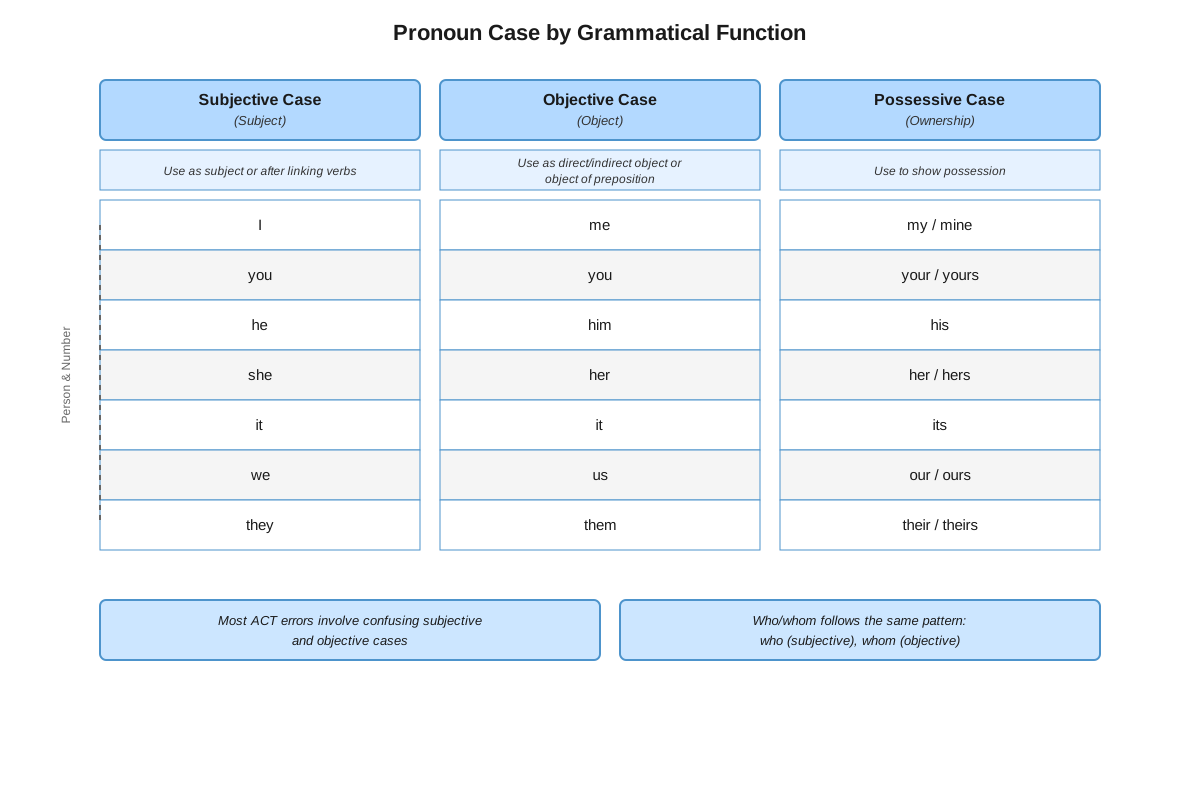
English pronouns change form based on their grammatical function within a sentence. The three pronoun cases are subjective (nominative), objective, and possessive. Each case serves a specific grammatical role, and using the wrong case creates an error that the ACT will test.
Subjective case pronouns function as the subject of a verb—the person or thing performing the action. The subjective pronouns are: I, you, he, she, it, we, they, who. These pronouns answer the question "Who or what is performing the action?"
Objective case pronouns receive the action of a verb or serve as objects of prepositions. The objective pronouns are: me, you, him, her, it, us, them, whom. These pronouns answer "To whom or what is the action done?"
Possessive case pronouns show ownership or relationship. The possessive pronouns are: my/mine, your/yours, his, her/hers, its, our/ours, their/theirs, whose. These pronouns answer "Belonging to whom?"
| Subjective | Objective | Possessive |
|---|---|---|
| I | me | my, mine |
| you | you | your, yours |
| he | him | his |
| she | her | her, hers |
| it | it | its |
| we | us | our, ours |
| they | them | their, theirs |
| who | whom | whose |
Compound Subjects and Objects
The most frequently tested pronoun case scenario on the ACT involves compound structures—when a pronoun appears alongside another noun or pronoun connected by "and" or "or." Many students choose the wrong case because they rely on what "sounds right" in casual speech rather than grammatical function.
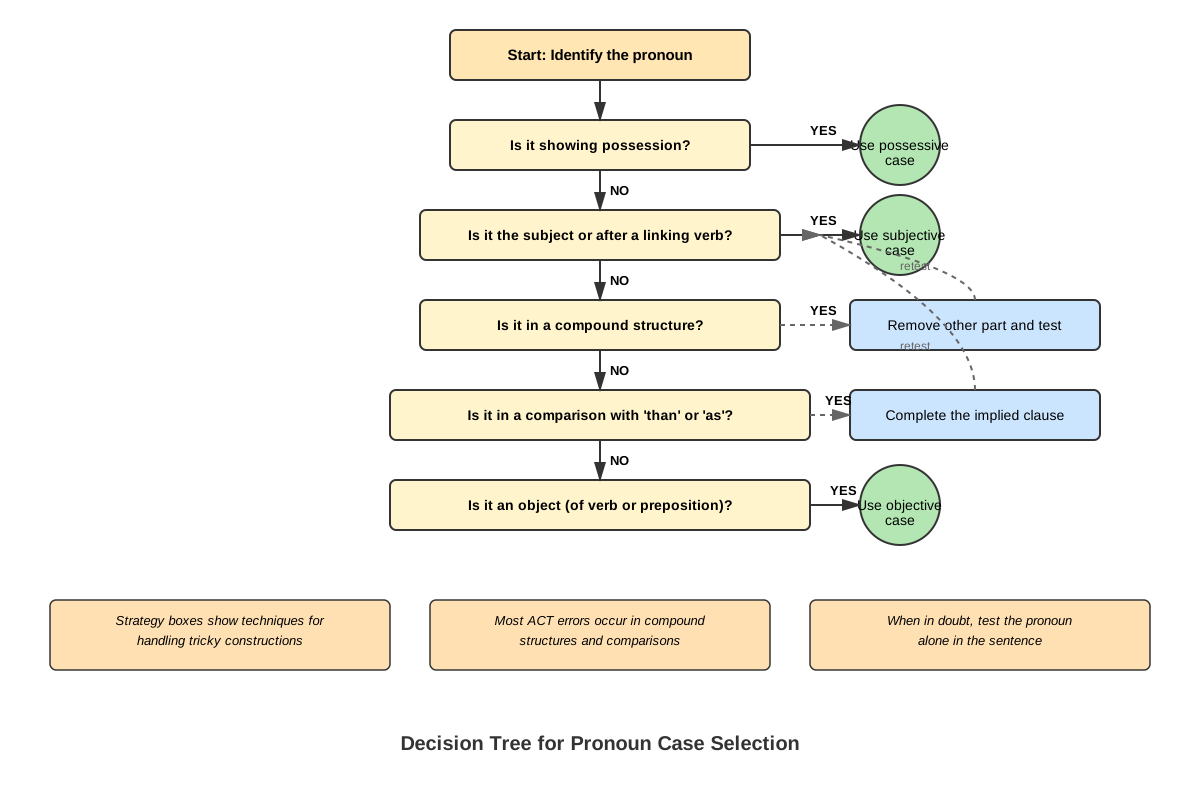
To determine correct pronoun case in compound structures:
- Identify whether the compound functions as subject or object
- Remove the other noun or pronoun temporarily
- Test the pronoun alone in the sentence
- Choose the case that works when the pronoun stands alone
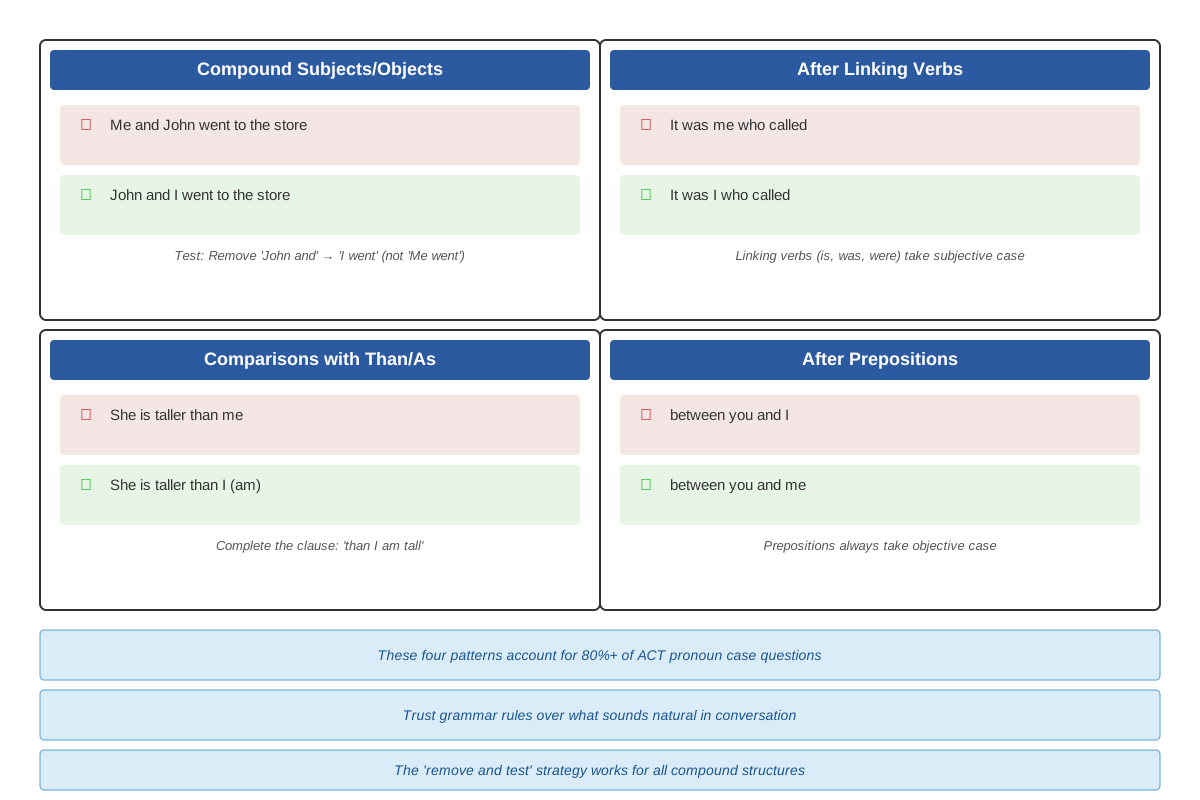
For example: "Sarah and (I/me) went to the store." Remove "Sarah and" to get "(I/me) went to the store." Since "I went" is correct but "me went" is not, the subjective case "I" is correct: "Sarah and I went to the store."
Conversely: "The teacher gave Sarah and (I/me) extra time." Remove "Sarah and" to get "The teacher gave (I/me) extra time." Since "gave me" is correct but "gave I" is not, the objective case "me" is correct: "The teacher gave Sarah and me extra time."
Pronouns After Linking Verbs
Linking verbs (forms of "to be," seem, appear, become) connect the subject to a word that renames or describes it. After linking verbs, use subjective case pronouns because the pronoun renames the subject rather than receiving action. This rule contradicts common conversational usage, making it a favorite ACT trap.
Correct: "It was she who called." (Not "It was her")
Correct: "The winner is he." (Not "The winner is him")
The logic: "She was it" works as a reversal, confirming subjective case. "Her was it" does not work, eliminating objective case.
Pronouns in Comparisons
Comparisons using "than" or "as" often have implied words that determine correct pronoun case. The ACT tests whether students can identify the complete thought to choose the appropriate case.
Consider: "She is taller than (I/me)."
The complete comparison is "She is taller than I am [tall]." The pronoun serves as the subject of the implied verb "am," requiring subjective case: "She is taller than I."
However, meaning can change based on case:
- "She likes him more than I [like him]" (I am doing the liking—subjective)
- "She likes him more than [she likes] me" (I am being liked—objective)
Pronouns as Objects of Prepositions
Any pronoun following a preposition (to, for, with, between, among, etc.) must be in objective case. This rule applies even in compound objects of prepositions, where errors frequently occur.
Correct: "between you and me" (Not "between you and I")
Correct: "for him and her" (Not "for he and she")
Correct: "with us students" (Not "with we students")
The phrase "between you and I" is one of the most common pronoun case errors in spoken English, making it a high-yield ACT trap. Students who rely on what sounds familiar will choose the incorrect subjective case.
Who Versus Whom
The pronouns who (subjective) and whom (objective) follow the same case rules as other pronouns but cause particular difficulty because "whom" is rarely used in conversation. The ACT tests this distinction regularly.
To choose between who and whom:
- Locate the clause containing the pronoun
- Determine if the pronoun is the subject or object within that clause
- Use "who" for subjects, "whom" for objects
Test by substituting he/him: if "he" works, use "who"; if "him" works, use "whom."
Example: "(Who/Whom) did you call?" → "You did call him" → Use "whom"
Example: "(Who/Whom) called you?" → "He called you" → Use "who"
Reflexive Pronouns
Reflexive pronouns (myself, yourself, himself, herself, itself, ourselves, themselves) should only be used when the subject and object are the same person or for emphasis. They cannot replace subjective or objective pronouns in standard usage.
Incorrect: "John and myself went to the game." (Should be "John and I")
Incorrect: "Give the report to Sarah or myself." (Should be "Sarah or me")
Correct: "I prepared the report myself." (Emphasis)
Correct: "She taught herself to code." (Subject and object are the same)
Concept Relationships
The three pronoun cases form the foundation of this topic, with each case determined by grammatical function rather than position in the sentence. Subjective case connects directly to subject identification and verb agreement, as subjects must agree with their verbs in number. Objective case relates to understanding sentence structure, particularly identifying direct objects, indirect objects, and objects of prepositions. Possessive case links to modifier concepts, as possessive pronouns function as adjectives describing nouns.
Compound structures build upon basic case knowledge by adding complexity through coordination. This concept connects to conjunction usage and parallel structure, as elements joined by coordinating conjunctions should maintain consistent grammatical form. The strategy of isolating pronouns in compounds reinforces the fundamental principle that grammatical function, not position or company, determines case.
Comparisons with implied words demonstrate how pronoun case connects to elliptical constructions and sentence completion. This concept requires students to mentally complete sentences, linking to broader skills in understanding sentence meaning and structure. The relationship flows: complete thought → grammatical function → correct case.
Who/whom distinctions represent the application of case rules to relative pronouns, connecting pronoun case to clause structure and the formation of questions. This concept bridges to understanding dependent clauses and how pronouns function within subordinate structures.
The progression of mastery follows this path: Basic case identification → Application in simple sentences → Recognition in compound structures → Analysis in complex sentences with multiple clauses → Evaluation of implied elements in comparisons and elliptical constructions.
Quick check — test yourself on Pronoun case so far.
Try Flashcards →High-Yield Facts
⭐ Subjective case pronouns (I, he, she, we, they, who) function as subjects of verbs or follow linking verbs
⭐ Objective case pronouns (me, him, her, us, them, whom) function as objects of verbs or prepositions
⭐ In compound structures, remove the other noun/pronoun to test which case works when the pronoun stands alone
⭐ After prepositions, always use objective case: "between you and me," never "between you and I"
⭐ In comparisons with than/as, determine case by completing the implied comparison: "taller than I [am]"
- Linking verbs (is, was, seems, appears) take subjective case pronouns: "It was she"
- Reflexive pronouns (myself, himself) cannot substitute for simple subjective or objective pronouns
- Who is subjective (replaces he/she/they); whom is objective (replaces him/her/them)
- Possessive pronouns never use apostrophes: its (not it's), whose (not who's), theirs (not their's)
- After "to be" verbs, the pronoun renames the subject and requires subjective case
- Appositives take the same case as the noun they rename: "We students" (subjective) versus "for us students" (objective)
- In formal writing, use "whom" as the object even though conversational English often substitutes "who"
Common Misconceptions
Misconception: "Between you and I" is correct because "I" sounds more formal and educated.
Correction: "Between" is a preposition, and all objects of prepositions require objective case. The correct form is always "between you and me." The subjective "I" cannot follow any preposition.
Misconception: In compound subjects, always use "I" rather than "me" because it sounds more proper.
Correction: Case depends on function, not position. "My friend and I went" uses subjective "I" because it's the subject, but "The teacher helped my friend and me" uses objective "me" because it's the object. Test by removing the other person.
Misconception: After "than" in comparisons, either case is acceptable because the sentence is incomplete.
Correction: The implied words determine the required case. "She is taller than I [am tall]" requires subjective case because "I" is the subject of the implied verb. The case is not optional—it changes meaning.
Misconception: "Myself" is a more polite or formal alternative to "I" or "me."
Correction: Reflexive pronouns like "myself" should only be used when the subject and object are identical ("I taught myself") or for emphasis ("I myself completed it"). Using "myself" to replace "I" or "me" is grammatically incorrect: say "John and I went," not "John and myself went."
Misconception: "Who" and "whom" are interchangeable in modern English, so either is acceptable on the ACT.
Correction: The ACT tests standard written English, which maintains the who/whom distinction. "Who" is subjective (subject of a verb), and "whom" is objective (object of a verb or preposition). The distinction is not optional on the exam.
Misconception: After linking verbs like "is" or "was," use objective case because the pronoun comes after the verb.
Correction: Linking verbs connect the subject to a word that renames it, requiring subjective case. "It was she" is correct because "she" renames "it" (the subject). Position after the verb doesn't determine case—grammatical function does.
Worked Examples
Example 1: Compound Object
Question: The college awarded scholarships to both my sister and (I/me/myself) for academic achievement.
Analysis:
Step 1: Identify the grammatical function. The pronoun follows the preposition "to," making it part of the object of the preposition.
Step 2: Apply the isolation test. Remove "my sister and" to get: "The college awarded scholarships to (I/me/myself)."
Step 3: Test each option alone:
- "to I" — Incorrect (subjective case cannot follow prepositions)
- "to me" — Correct (objective case follows prepositions)
- "to myself" — Incorrect (reflexive pronoun has no antecedent in subject position)
Step 4: Verify in the complete sentence. "The college awarded scholarships to both my sister and me" maintains parallel structure and correct case.
Answer: me
Connection to Learning Objectives: This example demonstrates identifying when pronoun case is tested (compound object of preposition), explaining the core rule (objective case after prepositions), and applying the strategy (isolation test) to ACT-style questions.
Example 2: Comparison with Implied Words
Question: The coach praised the team captain more than (I/me) after the championship game.
Analysis:
Step 1: Recognize this as a comparison with implied words. The sentence could mean two different things depending on what's implied.
Step 2: Complete both possible comparisons:
- Option A: "The coach praised the team captain more than [the coach praised] me"
- Option B: "The coach praised the team captain more than I [praised the team captain]"
Step 3: Determine the intended meaning from context. The phrase "after the championship game" and the structure suggest the coach is doing all the praising, making Option A the logical interpretation.
Step 4: Identify the grammatical function in the complete thought. In "the coach praised me," the pronoun is the direct object of "praised," requiring objective case.
Step 5: If the sentence intended meaning B, "I" would be correct as the subject of the implied verb "praised." However, meaning A requires "me" as the object of "praised."
Answer: me (for meaning A: the coach praised the captain more than the coach praised me)
Note: This example illustrates why context matters. The ACT typically makes the intended meaning clear through surrounding context, but students must complete the implied comparison to determine correct case.
Connection to Learning Objectives: This demonstrates applying pronoun case rules to complex structures, explaining the strategy of completing implied elements, and accurately selecting the correct form based on grammatical function within the complete thought.
Exam Strategy
When approaching ACT pronoun case questions, first identify whether the question tests case by scanning the answer choices. If the choices differ only in pronoun form (I/me, he/him, who/whom), you're dealing with a pure case question that requires grammatical analysis rather than style judgment.
Trigger phrases that signal pronoun case questions include:
- Compound structures: "_____ and I/me," "my friend and I/me"
- Comparisons: "than I/me," "as _____ as he/him"
- Prepositional phrases: "between," "to," "for," "with" followed by pronouns
- Question words: "who/whom" at the beginning of clauses
- Linking verbs: "is," "was," "seems" followed by pronouns
Process-of-elimination strategy:
- Eliminate reflexive pronouns (myself, himself) unless the subject and object are the same person or emphasis is clearly intended. The ACT rarely uses reflexive pronouns correctly, making them easy eliminations.
- Apply the isolation test for compounds. Cross out the other noun/pronoun and test each remaining option alone. Eliminate any that create obvious errors.
- Check for prepositions. If a preposition immediately precedes the pronoun (even with words in between), eliminate all subjective case options. "Between you and I" is always wrong.
- Complete implied comparisons. For "than" or "as" constructions, mentally add the implied verb. Eliminate cases that don't match the grammatical function in the complete thought.
- Test who/whom by substituting he/him. If "him" works, choose "whom"; if "he" works, choose "who." This substitution test works because both pairs follow the same case pattern.
Time allocation: Pronoun case questions should take 15-20 seconds once you recognize the pattern. If you're spending more time, you're likely overthinking. Trust the grammatical test (isolation, substitution, or completion) rather than what "sounds right."
Common trap: The ACT often places the correct answer in what sounds awkward to modern ears ("It was she," "taller than I"). Don't let conversational usage override grammatical rules. If your test confirms the case, trust it even if it sounds formal or unusual.
Memory Techniques
The "Remove and Test" Mnemonic: For compound structures, remember RAT:
- Remove the other person
- Analyze what remains
- Test if it works alone
The "He/Him = Who/Whom" Substitution: Both pairs end in "m" for objective case:
- him = whom (both objective)
- he = who (both subjective)
The "Preposition = Objective" Rule: Remember PO:
- Preposition
- Objective case always
Visualize a preposition as a bridge, and anything crossing the bridge (the object) must be in objective case.
The "Complete the Comparison" Technique: For "than/as" constructions, visualize the sentence as a text message with autocorrect that deleted words. Your job is to restore the complete message before choosing the pronoun.
The "Linking Verb = Equals Sign" Visualization: When you see "is," "was," "seems," or other linking verbs, replace them mentally with an equals sign (=). Whatever comes after equals the subject, so it needs the same case (subjective):
- "It was she" → "It = she" (both subjective)
- "The winner is he" → "The winner = he" (both subjective)
The "No Apostrophe Possessives" Reminder: Remember NAPP:
- No
- Apostrophes in
- Possessive
- Pronouns
Its, whose, theirs, yours, hers—none use apostrophes. If you see an apostrophe, it's a contraction (it's = it is), not a possessive.
Summary
Pronoun case is a high-frequency ACT English topic that tests whether students can identify and apply the correct pronoun form based on grammatical function. The three cases—subjective (I, he, she, we, they, who), objective (me, him, her, us, them, whom), and possessive (my, his, her, our, their, whose)—are determined by whether the pronoun functions as a subject, object, or possessive modifier. The ACT most commonly tests pronoun case in compound structures, after prepositions, in comparisons with implied words, and with who/whom distinctions. Success requires applying systematic strategies rather than relying on conversational usage, which often contradicts formal grammar rules. The isolation test for compounds, the substitution test for who/whom, and the completion strategy for comparisons provide reliable methods for determining correct case. Students must recognize that position in a sentence doesn't determine case—grammatical function does—and that formal written English maintains distinctions that casual speech often ignores.
Key Takeaways
- Pronoun case depends on grammatical function (subject, object, or possessive), not position in the sentence or what sounds natural in conversation
- Compound structures are tested most frequently; use the isolation test by removing the other noun/pronoun to determine which case works alone
- All objects of prepositions require objective case; "between you and I" is always incorrect because "between" is a preposition requiring "me"
- Comparisons with than/as require completing the implied words to determine whether the pronoun functions as subject or object in the full thought
- Who/whom follows the same pattern as he/him: subjective case for subjects (who/he), objective case for objects (whom/him)
- Linking verbs (is, was, seems) take subjective case pronouns because the pronoun renames the subject rather than receiving action
- Reflexive pronouns (myself, himself) cannot substitute for simple subjective or objective pronouns and should only be used when subject and object are identical or for emphasis
Related Topics
Subject-Verb Agreement: Mastering pronoun case strengthens understanding of subjects, which directly connects to ensuring verbs agree with their subjects in number. Pronoun case and subject-verb agreement often appear together in complex sentences.
Pronoun-Antecedent Agreement: After mastering case, students should study how pronouns must agree with their antecedents in number, gender, and person, another high-frequency ACT topic.
Modifier Placement: Understanding how possessive pronouns function as modifiers connects to broader concepts of modifier placement and clarity in sentence structure.
Parallel Structure: Compound structures that test pronoun case also involve parallel structure, as coordinated elements must maintain consistent grammatical form.
Sentence Structure and Clauses: Advanced pronoun case questions require identifying independent and dependent clauses, making clause structure the next logical progression for comprehensive grammar mastery.
Practice CTA
Now that you understand the core principles of pronoun case, it's time to cement your knowledge through active practice. The concepts you've learned—the isolation test, the substitution strategy, and the completion technique—become automatic only through repeated application. Challenge yourself with the practice questions to encounter the exact types of traps and patterns the ACT uses. Each question you work through strengthens your ability to spot case errors quickly and confidently. Use the flashcards to drill the high-yield facts until pronoun case becomes second nature. Remember: the ACT rewards systematic application of rules, not guessing based on what sounds right. You've built the foundation—now practice until these strategies become instinctive, and watch your accuracy on pronoun case questions soar!
Sign up free to keep reading
Create a free AnvayaPrep account to finish this ACT guide on Pronoun case — plus flashcards and practice questions.