Overview
Comma usage is one of the most frequently tested punctuation concepts on the ACT English section, appearing in approximately 10-15% of all punctuation questions. Mastering comma rules is essential because these questions are highly predictable and follow consistent patterns that, once learned, become reliable points on test day. Unlike more subjective grammar concepts, comma rules on the ACT follow specific, testable conventions that students can apply systematically to eliminate wrong answers and identify correct punctuation.
The ACT tests comma usage in specific, recurring contexts: separating independent clauses with coordinating conjunctions, setting off introductory elements, distinguishing between restrictive and nonrestrictive clauses, separating items in lists, and avoiding comma splices. Understanding these patterns allows students to quickly identify what the test is assessing and apply the appropriate rule. The test writers deliberately create answer choices that include common comma errors, making pattern recognition a powerful tool for achieving accuracy under time pressure.
ACT comma usage connects directly to broader concepts in sentence structure, including clause identification, sentence boundaries, and the relationship between sentence elements. Strong comma skills support understanding of semicolons, dashes, and other punctuation marks that often appear as alternative answer choices. Additionally, comma mastery reinforces comprehension of sentence flow and meaning, as proper comma placement clarifies relationships between ideas and prevents ambiguity in complex sentences.
Learning Objectives
- [ ] Identify when Comma usage is being tested
- [ ] Explain the core rule or strategy behind Comma usage
- [ ] Apply Comma usage to ACT-style questions accurately
- [ ] Distinguish between restrictive and nonrestrictive elements requiring comma separation
- [ ] Recognize and correct comma splices in compound sentences
- [ ] Evaluate whether introductory elements require comma separation based on length and clarity
- [ ] Apply the serial comma convention consistently in lists and series
Prerequisites
- Independent vs. dependent clauses: Understanding clause types is essential because comma rules differ dramatically based on whether clauses can stand alone as complete sentences
- Parts of speech identification: Recognizing conjunctions, adjectives, and adverbs helps determine when commas are necessary to separate or set off elements
- Basic sentence structure: Knowledge of subjects, verbs, and objects enables identification of where sentence elements begin and end, which determines comma placement
- Coordinating conjunctions (FANBOYS): Familiarity with for, and, nor, but, or, yet, so is critical for applying the compound sentence comma rule
Why This Topic Matters
In real-world writing, proper comma usage ensures clarity and prevents misreading. Consider the difference between "Let's eat, Grandma" and "Let's eat Grandma"—the comma literally saves lives (or at least Grandma's dignity). Professional writing, academic papers, and business communication all require precise comma usage to convey meaning accurately and maintain credibility. Readers expect standard comma conventions, and violations distract from content or create confusion about relationships between ideas.
On the ACT English section, comma questions appear with remarkable consistency. Students can expect 8-12 comma-related questions per test, making this topic one of the highest-yield areas for focused study. These questions typically appear in three formats: identifying unnecessary commas (overuse), recognizing missing commas (underuse), and choosing between commas and other punctuation marks. The predictability of comma questions makes them ideal targets for score improvement, as mastering five core rules addresses the vast majority of test items.
Comma questions on the ACT commonly appear in passages discussing science, social studies, or narrative topics. The test frequently embeds comma decisions within complex sentences containing multiple clauses, parenthetical information, or lists. Questions often present four answer choices with different punctuation marks or comma placements, requiring students to identify which option follows standard conventions. The ACT particularly favors testing the distinction between essential and nonessential information, comma usage with coordinating conjunctions, and the elimination of unnecessary commas that interrupt sentence flow.
Core Concepts
The Compound Sentence Rule
The most frequently tested comma rule on the ACT involves compound sentences—sentences containing two independent clauses joined by a coordinating conjunction (FANBOYS: for, and, nor, but, or, yet, so). When two complete sentences are connected with a coordinating conjunction, a comma must appear before the conjunction.
Rule: Independent Clause + , + Coordinating Conjunction + Independent Clause
Example: "The scientist completed her research, and she published the findings in a prestigious journal."
Both "The scientist completed her research" and "she published the findings in a prestigious journal" can stand alone as complete sentences. The comma before "and" is required.
Critical distinction: If the coordinating conjunction joins two verbs with the same subject (a compound predicate), no comma is used.
Example: "The scientist completed her research and published the findings." (Same subject "scientist" for both verbs—no comma needed)
Introductory Elements
Introductory elements are words, phrases, or clauses that appear before the main clause of a sentence. The ACT tests whether students recognize when these elements require comma separation.
Rule: When an introductory element provides context or transition before the main clause, use a comma to separate it.
Common introductory elements include:
- Transitional words: However, Therefore, Furthermore, Meanwhile
- Prepositional phrases (especially longer than four words): In the early morning hours, After the conclusion of the experiment
- Dependent clauses: When the results were analyzed, Although the hypothesis was controversial
- Participial phrases: Running through the data, Exhausted by the long process
Example: "After reviewing hundreds of applications, the committee selected three finalists."
ACT pattern: The test often presents sentences with short introductory prepositional phrases (3-4 words) where the comma is optional but acceptable. Answer choices will include both versions, and both are considered correct. However, longer introductory elements always require commas.
Nonrestrictive vs. Restrictive Elements
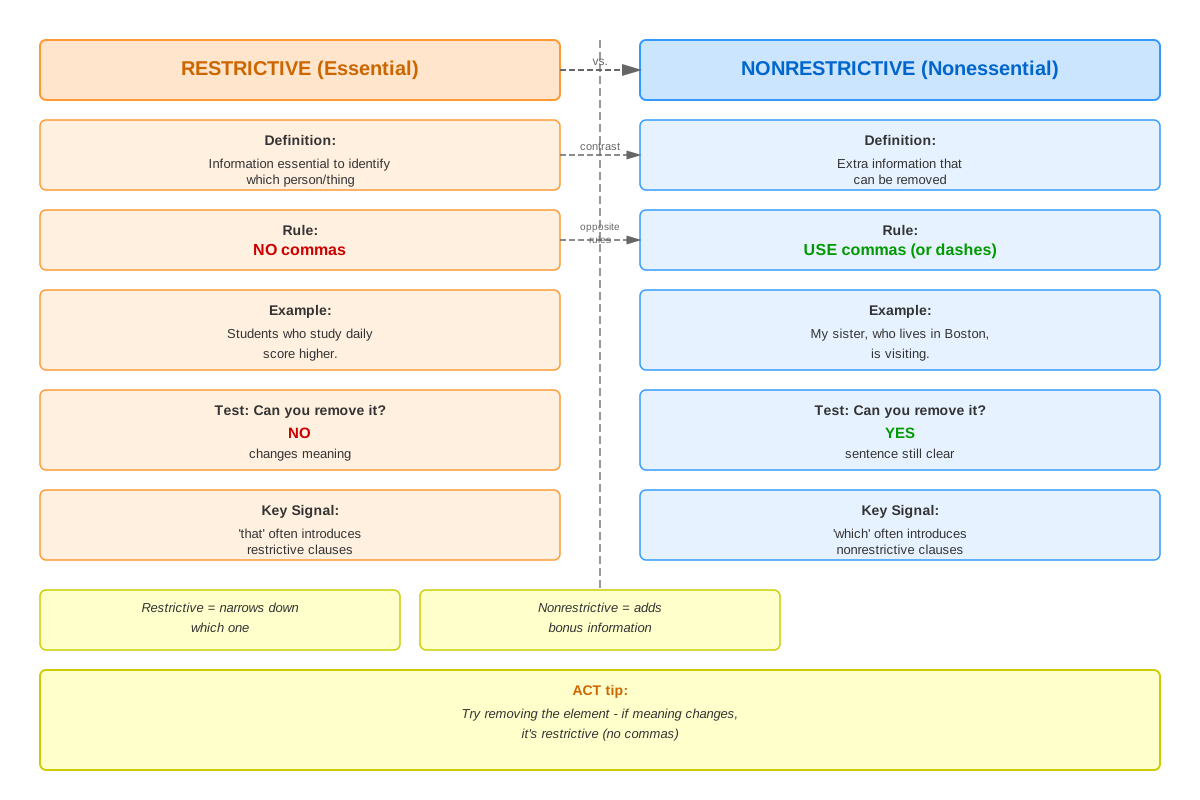
This distinction represents one of the most challenging comma concepts on the ACT. Nonrestrictive elements (also called nonessential elements) provide additional information that could be removed without changing the core meaning of the sentence. These elements require commas. Restrictive elements (essential elements) are necessary to identify what the sentence is discussing and should not be set off with commas.
| Element Type | Comma Usage | Function | Example |
|---|---|---|---|
| Nonrestrictive | Use commas | Adds bonus information | My sister, who lives in Boston, is visiting. |
| Restrictive | No commas | Identifies which one | My sister who lives in Boston is visiting. (implies multiple sisters) |
Test for nonrestrictive elements: If you can remove the element and the sentence still identifies the same specific thing, use commas.
Example: "Marie Curie, who won two Nobel Prizes, conducted groundbreaking research on radioactivity."
The clause "who won two Nobel Prizes" is nonrestrictive because "Marie Curie" already identifies a specific person. The additional information is interesting but not essential for identification.
Example: "Scientists who ignore ethical guidelines face serious consequences."
The clause "who ignore ethical guidelines" is restrictive because it specifies which scientists face consequences—not all scientists, only those who ignore guidelines. No commas are used.
Items in a Series
When listing three or more items, commas separate each element. The ACT consistently uses the serial comma (also called the Oxford comma)—the comma before the final conjunction in a list.
Rule: Item 1, Item 2, Item 3, and Item 4
Example: "The experiment required careful measurement, precise timing, controlled temperature, and detailed documentation."
The ACT always includes the comma before "and" in the final position. Answer choices without this comma are incorrect according to ACT conventions, even though some style guides consider it optional.
Complex series: When items in a series contain internal commas, semicolons replace commas as separators (though this is tested less frequently).
Comma Splices and Run-On Sentences
A comma splice occurs when two independent clauses are joined with only a comma, without a coordinating conjunction. This is always incorrect on the ACT.
Incorrect: "The data supported the hypothesis, the researchers were pleased."
Corrections:
- Add coordinating conjunction: "The data supported the hypothesis, so the researchers were pleased."
- Use semicolon: "The data supported the hypothesis; the researchers were pleased."
- Create two sentences: "The data supported the hypothesis. The researchers were pleased."
- Make one clause dependent: "Because the data supported the hypothesis, the researchers were pleased."
The ACT frequently includes comma splice errors in answer choices to test whether students recognize that commas alone cannot join independent clauses.
Interrupters and Parenthetical Elements
Parenthetical elements are words or phrases that interrupt the main sentence flow to add commentary, emphasis, or clarification. These elements must be set off with commas on both sides (or dashes/parentheses, which serve similar functions).
Rule: If an element can be removed and the sentence remains grammatically complete, it requires punctuation on both sides.
Example: "The results, surprisingly, contradicted previous findings."
Common interrupters:
- Transitional expressions: however, therefore, for example, in fact
- Contrasting phrases: not just the theory, unlike previous studies
- Appositives: Dr. Johnson, the lead researcher, presented the findings
Critical ACT pattern: The test often includes answer choices with only one comma around an interrupter. Both commas are required—having just one is incorrect.
Unnecessary Commas
The ACT frequently tests recognition of unnecessary commas that interrupt natural sentence flow. Several patterns appear repeatedly:
Between subject and verb: Never separate the subject from its verb with a single comma.
- Incorrect: "The scientist who conducted the research, published her findings."
- Correct: "The scientist who conducted the research published her findings."
Between verb and object: Never separate a verb from its direct object with a comma.
- Incorrect: "The committee selected, three finalists."
- Correct: "The committee selected three finalists."
Before prepositional phrases: Generally, no comma appears before prepositional phrases that are part of the main sentence structure.
- Incorrect: "The experiment was conducted, in a controlled environment."
- Correct: "The experiment was conducted in a controlled environment."
In compound elements: No comma separates two items joined by "and" (unless they're independent clauses).
- Incorrect: "The researcher analyzed the data, and wrote the report." (compound predicate)
- Correct: "The researcher analyzed the data and wrote the report."
Concept Relationships
The core comma concepts form an interconnected system where understanding one rule reinforces others. The compound sentence rule connects directly to comma splice recognition—both involve understanding when two independent clauses can be joined and what punctuation is required. Mastering clause identification (independent vs. dependent) serves as the foundation for both concepts.
Nonrestrictive elements relate closely to interrupters and parenthetical elements, as both involve information that could be removed from the sentence. The key difference is that nonrestrictive clauses specifically modify nouns, while parenthetical elements can interrupt at various points. Both require paired punctuation (commas on both sides).
Introductory elements connect to the broader concept of sentence structure and flow. Understanding where the main clause begins helps identify what comes before it and requires separation. This concept also relates to dependent clauses, as many introductory elements are dependent clauses that provide context before the main idea.
The items in a series rule stands somewhat independently but connects to parallel structure (tested elsewhere in ACT English), as items in a list must be grammatically parallel. Additionally, understanding series punctuation helps with recognizing when commas separate coordinate adjectives versus when no comma is needed.
Relationship map:
Clause Identification → Compound Sentence Rule → Comma Splice Recognition
Clause Identification → Restrictive vs. Nonrestrictive → Paired Punctuation
Sentence Structure → Introductory Elements → Comma Placement
List Structure → Items in a Series → Serial Comma Convention
Quick check — test yourself on Comma usage so far.
Try Flashcards →High-Yield Facts
⭐ Two independent clauses joined by a coordinating conjunction (FANBOYS) require a comma before the conjunction.
⭐ Nonrestrictive (nonessential) clauses and phrases must be set off with commas; restrictive (essential) elements take no commas.
⭐ A comma alone cannot join two independent clauses—this creates a comma splice, which is always incorrect.
⭐ Introductory dependent clauses and long introductory phrases require a comma after them before the main clause begins.
⭐ Parenthetical elements and interrupters require commas (or dashes/parentheses) on BOTH sides, not just one.
- The ACT consistently uses the serial comma (Oxford comma) before the final item in a list of three or more elements.
- Never place a single comma between a subject and its verb or between a verb and its object.
- Compound predicates (two verbs sharing the same subject) do not require a comma before the coordinating conjunction.
- Short introductory prepositional phrases (under 4 words) may optionally take a comma, so both versions may appear as correct answers.
- Appositives that rename or identify nouns require comma separation when they provide nonessential information.
- Transitional words like "however" and "therefore" require commas when they interrupt a sentence but may not when they begin a sentence (context-dependent).
- Coordinate adjectives (adjectives that equally modify a noun) require commas between them; cumulative adjectives do not.
Common Misconceptions
Misconception: Every sentence with the word "and" needs a comma before it.
Correction: Commas before "and" are only required when joining two independent clauses. Compound predicates, compound objects, and items in a two-item list do not require commas before "and."
Misconception: Long sentences always need commas to give readers a break.
Correction: Comma placement follows specific grammatical rules, not sentence length. A long sentence with a single independent clause and no introductory elements may need no commas at all, while a short compound sentence requires one.
Misconception: Commas go wherever you would pause when reading aloud.
Correction: While commas sometimes coincide with natural pauses, this is an unreliable guide. Many comma placements don't correspond to pauses, and many pauses don't require commas. Follow grammatical rules instead of intuition about pauses.
Misconception: "However" always requires commas around it.
Correction: When "however" interrupts a clause, it requires commas on both sides. When it begins a sentence, it typically takes a comma after it. When it means "in whatever way" or "to whatever extent," it may not require commas at all (e.g., "However you decide to proceed is fine").
Misconception: Restrictive vs. nonrestrictive is too complicated to learn, so guessing is equally effective.
Correction: This distinction follows a clear test: if removing the element changes which specific thing you're talking about, it's restrictive (no commas). If the element just adds extra information about something already identified, it's nonrestrictive (use commas). With practice, this becomes intuitive.
Misconception: If one comma is good, two are better—more commas make writing more formal.
Correction: Unnecessary commas are errors on the ACT. Each comma must have a specific grammatical justification. Overusing commas interrupts sentence flow and creates confusion about relationships between elements.
Misconception: The serial comma is optional, so answers with or without it are both correct.
Correction: The ACT consistently follows the convention of using the serial comma. In ACT questions, the version with the comma before the final "and" or "or" in a series is correct.
Worked Examples
Example 1: Compound Sentence vs. Compound Predicate
Question: Which version is correct?
A) The researchers collected data from three sites, and analyzed the results over six months.
B) The researchers collected data from three sites and analyzed the results over six months.
C) The researchers collected data from three sites and, analyzed the results over six months.
D) The researchers collected data from three sites; and analyzed the results over six months.
Solution Process:
Step 1: Identify what comes before and after "and."
- Before: "The researchers collected data from three sites"
- After: "analyzed the results over six months"
Step 2: Test whether both parts are independent clauses.
- Before "and": "The researchers collected data from three sites" = complete sentence ✓
- After "and": "analyzed the results over six months" = NOT a complete sentence (no subject) ✗
Step 3: Determine the structure.
This is a compound predicate—two verbs ("collected" and "analyzed") sharing the same subject ("The researchers"). Compound predicates do not require commas before the coordinating conjunction.
Step 4: Evaluate answer choices.
- A) Incorrect—comma before "and" in compound predicate
- B) Correct—no comma needed in compound predicate
- C) Incorrect—comma after "and" interrupts the verb phrase
- D) Incorrect—semicolon is only used between independent clauses
Answer: B
Connection to learning objectives: This example demonstrates identifying when comma usage is being tested (compound sentence vs. compound predicate) and applying the core rule that compound predicates don't require commas.
Example 2: Restrictive vs. Nonrestrictive Clause
Question: Which version is correct?
A) Students, who complete all assignments, typically perform well on exams.
B) Students who complete all assignments typically perform well on exams.
C) Students who complete all assignments, typically perform well on exams.
D) Students, who complete all assignments typically perform well on exams.
Solution Process:
Step 1: Identify the clause in question.
"who complete all assignments" modifies "Students"
Step 2: Apply the restrictive/nonrestrictive test.
Ask: Does this clause identify which specific students, or does it add extra information about all students?
The clause identifies a specific subset of students—not all students, only those who complete all assignments. This is essential information that restricts the meaning to a particular group.
Step 3: Determine comma usage.
Because the clause is restrictive (essential for identifying which students), no commas should set it off.
Step 4: Evaluate answer choices.
- A) Incorrect—commas incorrectly treat the clause as nonrestrictive
- B) Correct—no commas around the restrictive clause
- C) Incorrect—comma after the clause interrupts the sentence flow
- D) Incorrect—comma before but not after creates an error
Answer: B
Connection to learning objectives: This example shows how to identify restrictive vs. nonrestrictive elements and apply the rule that restrictive clauses take no commas, directly addressing the core strategy behind comma usage.
Exam Strategy
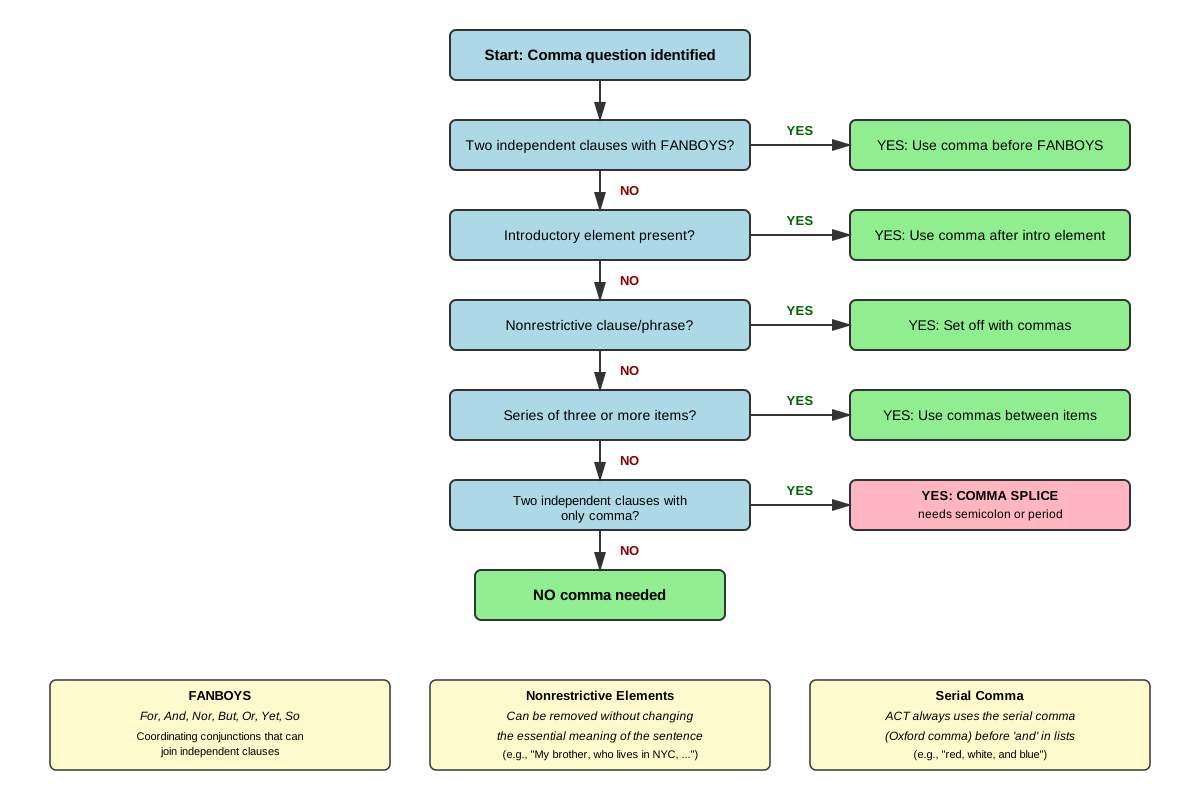
When approaching comma questions on the ACT, follow this systematic process:
Step 1: Identify the decision point. Look at what differs between answer choices. If commas appear in different positions or are present in some choices but not others, comma usage is being tested.
Step 2: Classify the sentence structure. Determine whether you're dealing with:
- Two independent clauses (compound sentence)
- An introductory element before the main clause
- A restrictive or nonrestrictive element
- Items in a series
- A potential comma splice
Step 3: Apply the specific rule. Once you've classified the structure, apply the corresponding comma rule. Don't rely on "what sounds right"—use the grammatical principle.
Step 4: Check for unnecessary commas. The ACT loves to include extra commas that interrupt natural sentence flow. If a comma appears between a subject and verb, verb and object, or before a simple prepositional phrase, it's likely incorrect.
Trigger words and phrases to watch for:
- FANBOYS (for, and, nor, but, or, yet, so): Check whether they join two independent clauses (comma needed) or create a compound predicate (no comma)
- "Which" and "who": Signal potential restrictive/nonrestrictive clauses—determine whether the information is essential
- Transitional words (however, therefore, moreover): Usually require commas when interrupting a sentence
- Introductory words (when, although, after, because): Signal dependent clauses that likely need comma separation from the main clause
Process of elimination tips:
- Eliminate any choice with a comma splice (two independent clauses joined by comma alone)
- Eliminate choices with only one comma around an interrupter (both sides need punctuation)
- Eliminate choices with commas between subject and verb or verb and object
- When choosing between comma and no comma, ask: "What grammatical rule requires this comma?" If you can't identify one, no comma is likely correct
Time allocation: Comma questions should take 15-20 seconds each. They're rule-based and don't require extensive reading. If you're spending more time, you may be overthinking—return to the basic rules.
Memory Techniques
FANBOYS mnemonic: For, And, Nor, But, Or, Yet, So—these are the only coordinating conjunctions that can join independent clauses with a comma.
The "Remove It" test for nonrestrictive elements: If you can remove the element and the sentence still identifies the same specific thing, use commas. Visualize physically lifting the words out—if the sentence still makes sense and refers to the same thing, those words need commas around them.
The "Two Sides" rule: Interrupters and parenthetical elements are like sandwiches—they need bread (commas) on both sides. Visualize the element as the filling that must be contained.
STOP for comma splices:
- Separate sentences (use a period)
- Transform one clause to dependent
- Or add a coordinating conjunction
- Place a semicolon between clauses
The "Complete Sentence" test: When you see a comma with FANBOYS, cover up everything before the conjunction. If what remains is a complete sentence, then check before the conjunction. If both sides are complete sentences, the comma is correct. If not, no comma is needed.
Acronym for comma uses - LINCS:
- Lists (items in a series)
- Introductory elements
- Nonrestrictive clauses
- Compound sentences (with FANBOYS)
- Separating interrupters
Summary
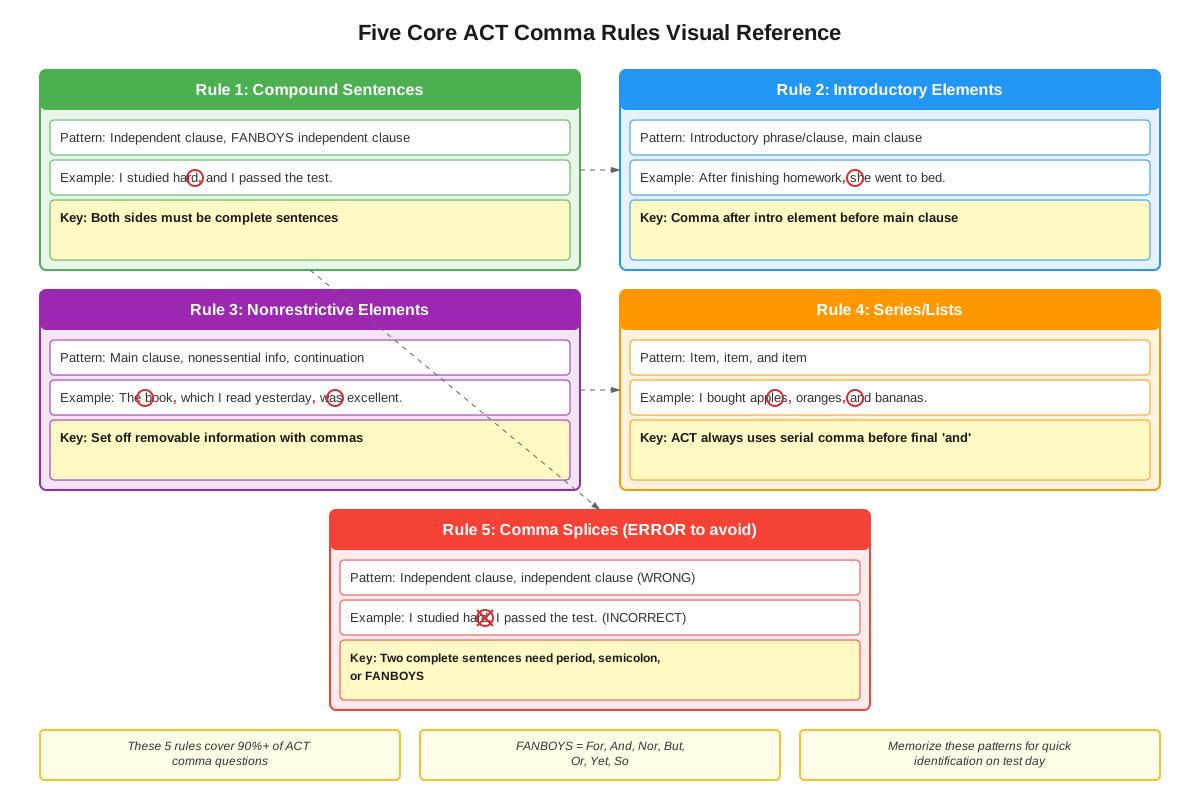
Comma usage on the ACT follows predictable, testable patterns that students can master through understanding five core rules. The compound sentence rule requires a comma before coordinating conjunctions joining two independent clauses, while compound predicates take no comma. Introductory elements—including dependent clauses, transitional words, and long prepositional phrases—require comma separation from the main clause. The distinction between restrictive and nonrestrictive elements determines whether commas set off modifying clauses and phrases: nonessential information requires commas, while essential identifying information does not. Items in a series of three or more require commas between each element, including the serial comma before the final conjunction. Finally, recognizing comma splices and unnecessary commas helps eliminate incorrect answer choices. Success on comma questions depends on identifying which rule is being tested, applying the specific grammatical principle rather than relying on intuition, and systematically checking for common errors like missing paired commas around interrupters or commas interrupting subject-verb or verb-object relationships.
Key Takeaways
- Two independent clauses joined by FANBOYS require a comma before the conjunction; compound predicates sharing a subject do not
- Nonrestrictive (nonessential) elements require commas on both sides; restrictive (essential) elements take no commas
- Comma splices (two independent clauses joined by comma alone) are always incorrect on the ACT
- Introductory elements, especially dependent clauses and long phrases, require comma separation from the main clause
- Parenthetical elements and interrupters must have commas on both sides, not just one
- The ACT consistently uses the serial comma before the final item in lists of three or more elements
- Unnecessary commas between subjects and verbs, verbs and objects, or before simple prepositional phrases are incorrect
Related Topics
Semicolon usage: Understanding when semicolons replace commas to join independent clauses or separate complex items in a series builds on comma mastery and provides alternative punctuation strategies.
Dash and parenthesis usage: These punctuation marks serve similar functions to commas for setting off nonrestrictive elements and interrupters, offering stylistic alternatives that the ACT tests in comparison to commas.
Sentence structure and clause types: Deeper exploration of independent and dependent clauses, subordination, and coordination strengthens the foundation for all punctuation decisions.
Modifier placement: Proper comma usage often depends on correct modifier placement, and understanding how modifying phrases and clauses function enhances comma decision-making.
Parallel structure: Items in a series must be grammatically parallel, connecting comma usage in lists to broader principles of sentence construction and balance.
Practice CTA
Now that you've mastered the core concepts of comma usage, it's time to cement your understanding through active practice. Attempt the practice questions to apply these rules to ACT-style scenarios, and use the flashcards to reinforce the key distinctions between comma rules. Remember: comma questions are among the most predictable on the ACT, making them reliable opportunities to boost your score. With focused practice, these points are yours for the taking!
Sign up free to keep reading
Create a free AnvayaPrep account to finish this ACT guide on Comma usage — plus flashcards and practice questions.