Overview
Wordiness is one of the most frequently tested concepts on the ACT English section, appearing in approximately 10-15% of all questions. This topic falls under the broader category of Rhetorical Skills and tests a student's ability to recognize and eliminate unnecessary words, phrases, and redundancies that clutter writing without adding meaning or clarity. The ACT consistently rewards concise, direct expression over verbose, repetitive language.
Understanding ACT wordiness is essential because it represents a fundamental principle of effective writing: economy of language. The test makers design questions that present multiple answer choices, often including options that are grammatically correct but unnecessarily wordy. Students must develop the skill to identify the most concise option that preserves the original meaning while eliminating redundancy. This skill extends beyond test-taking—clear, concise writing is valued in academic, professional, and personal communication contexts.
Wordiness questions connect closely to other ACT English concepts, particularly sentence structure, transitions, and style. While grammar questions focus on correctness, wordiness questions emphasize efficiency and clarity. Students who master this topic will find that their overall writing improves, as they develop an instinct for recognizing when words serve a purpose and when they merely occupy space. This awareness creates a foundation for understanding more complex rhetorical choices tested throughout the English section.
Learning Objectives
- [ ] Identify when Wordiness is being tested in ACT English questions
- [ ] Explain the core rule or strategy behind Wordiness elimination
- [ ] Apply Wordiness principles to ACT-style questions accurately
- [ ] Distinguish between necessary detail and redundant information
- [ ] Recognize common wordy phrases and their concise alternatives
- [ ] Evaluate answer choices for both grammatical correctness and conciseness
- [ ] Determine when "OMIT the underlined portion" is the correct answer
Prerequisites
- Basic sentence structure: Understanding subjects, verbs, and complete sentences helps identify which words are essential versus decorative
- Parts of speech: Recognizing nouns, verbs, adjectives, and adverbs enables students to spot redundant modifiers and unnecessary qualifiers
- Reading comprehension: The ability to understand passage meaning ensures that conciseness doesn't sacrifice clarity or important information
- Answer choice comparison: Experience evaluating multiple options helps students systematically eliminate verbose alternatives
Why This Topic Matters
Wordiness questions appear with remarkable consistency on every ACT English section, making this one of the highest-yield topics for score improvement. Students can expect to encounter 6-10 wordiness questions per test, distributed throughout all five passages. These questions typically appear as underlined portions with four answer choices, including "OMIT the underlined portion" as a frequent correct answer.
In real-world applications, concise writing is universally valued. College professors expect clear, direct prose in essays and research papers. Employers prioritize candidates who can communicate efficiently in emails, reports, and presentations. Legal documents, medical records, and technical manuals all demand precision without unnecessary verbiage. Mastering wordiness on the ACT develops a transferable skill that benefits students throughout their academic and professional careers.
The ACT tests wordiness in several predictable patterns: redundant pairs (e.g., "past history"), unnecessary qualifiers (e.g., "very unique"), wordy prepositional phrases (e.g., "in the event that" instead of "if"), and repetitive information already stated in the passage. Questions often appear when the passage discusses a concept and then unnecessarily restates it using different words. Recognition of these patterns enables rapid, confident answering.
Core Concepts
The Fundamental Principle of Conciseness
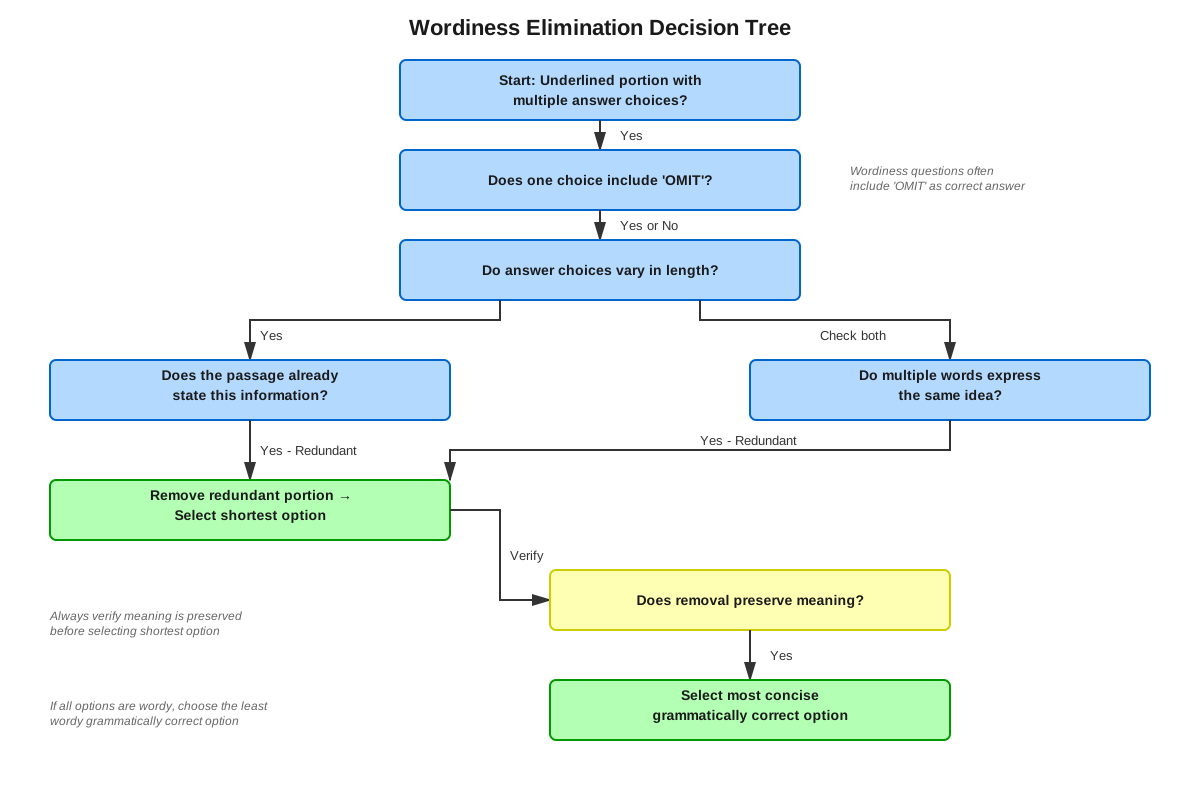
The core principle underlying all wordiness questions is simple: when two or more answer choices convey the same meaning, choose the shortest one. This rule applies consistently across the ACT English section. The test makers deliberately include longer options that are grammatically correct but unnecessarily verbose. Students must train themselves to recognize when additional words add meaning versus when they merely add length.
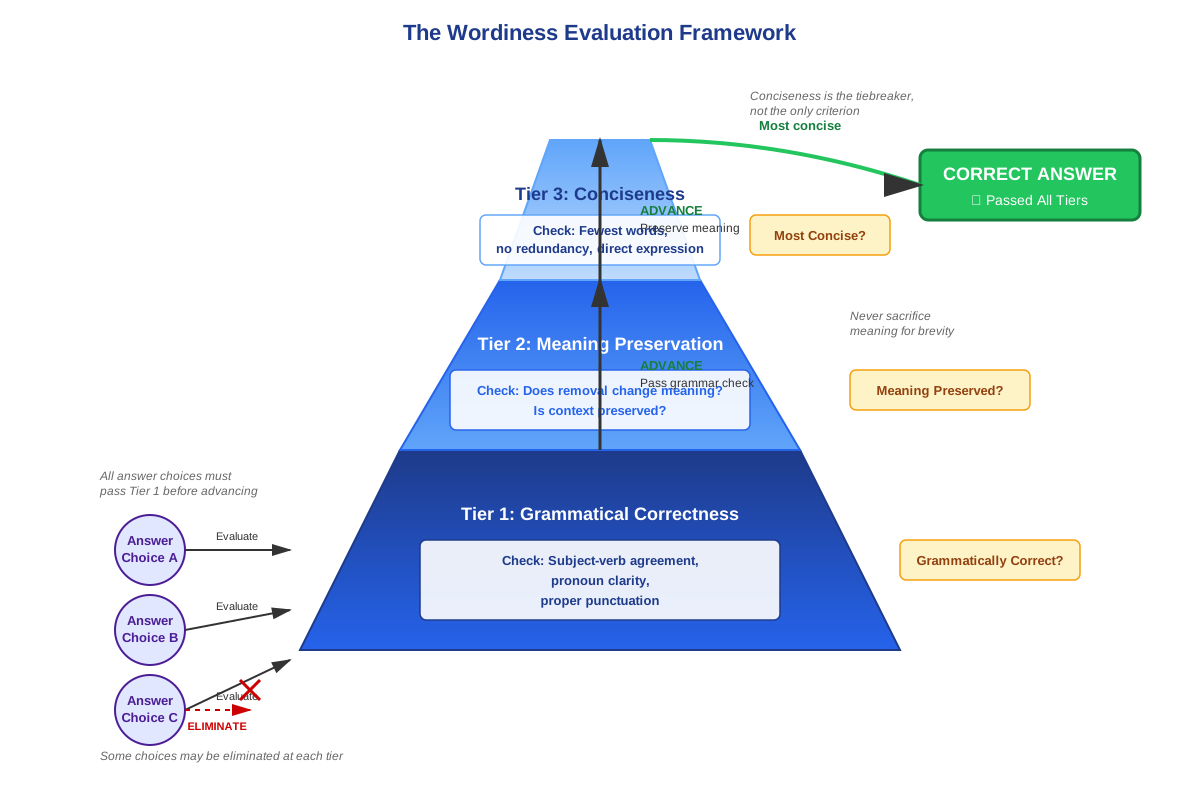
However, this principle includes an important caveat: conciseness never justifies sacrificing clarity, grammatical correctness, or essential meaning. If the shortest answer changes the intended meaning, creates a grammatical error, or removes necessary information, it is incorrect. The goal is maximum efficiency with complete accuracy.
Redundant Pairs and Phrases
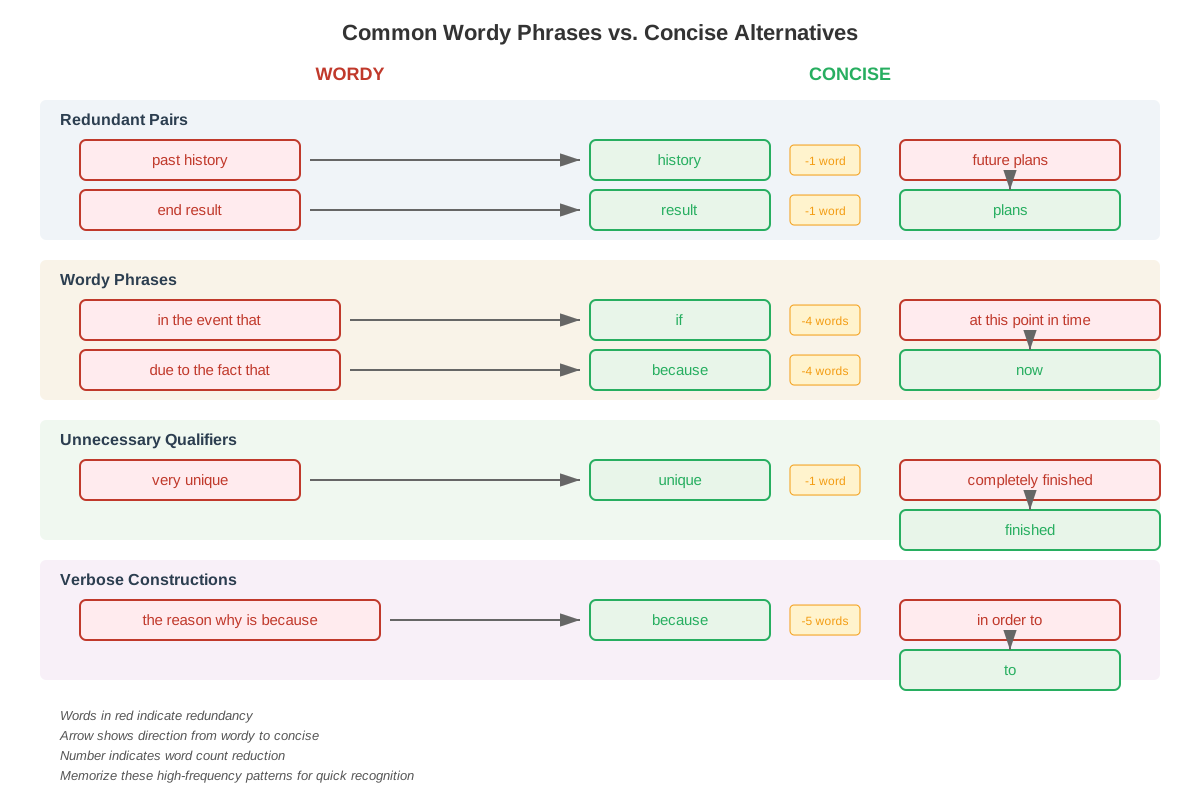
Redundancy occurs when words or phrases repeat the same idea unnecessarily. The ACT frequently tests common redundant pairs where both words express the same concept:
| Redundant Phrase | Concise Alternative | Why It's Redundant |
|---|---|---|
| past history | history | History is always about the past |
| future plans | plans | Plans are always about the future |
| end result | result | Results come at the end |
| advance planning | planning | Planning is always done in advance |
| completely eliminate | eliminate | Eliminate means to remove completely |
| close proximity | proximity | Proximity means closeness |
| each individual | each | Each already implies individual items |
| basic fundamentals | fundamentals | Fundamentals are basic by definition |
| unexpected surprise | surprise | Surprises are unexpected by nature |
| free gift | gift | Gifts are free by definition |
When encountering these phrases, students should immediately recognize that one word suffices. The ACT often presents the redundant version as the underlined portion, with the concise alternative as the correct answer choice.
Wordy Prepositional Phrases
Many wordy constructions involve prepositional phrases that can be replaced with single words or shorter alternatives:
| Wordy Phrase | Concise Alternative |
|---|---|
| in the event that | if |
| due to the fact that | because |
| at this point in time | now |
| in spite of the fact that | although/despite |
| for the purpose of | to/for |
| in order to | to |
| with regard to | regarding/about |
| in the process of | (often unnecessary) |
| on the occasion of | when |
| during the time that | while |
These phrases appear frequently in ACT passages, often in underlined portions. Students should memorize these common substitutions to quickly identify wordiness and select the concise alternative.
Unnecessary Qualifiers and Intensifiers
Qualifiers and intensifiers are words that modify adjectives or verbs but often add no meaningful information. The ACT tests whether students recognize when these words are superfluous:
- Very, really, quite, extremely: These intensifiers rarely add substance. "Very unique" is redundant because unique means one-of-a-kind—something cannot be more or less unique.
- Basically, actually, essentially, virtually: These qualifiers often serve as filler words that can be removed without changing meaning.
- Kind of, sort of, somewhat: These hedging words usually weaken writing without adding precision.
When evaluating answer choices, students should ask whether removing these qualifiers changes the essential meaning. If not, the version without them is preferable.
The "OMIT" Option
One of the most powerful tools for addressing wordiness is the "OMIT the underlined portion" answer choice, typically listed as choice F or J (depending on question numbering). This option appears when the underlined portion is entirely unnecessary—the sentence works better without it.
Students often hesitate to choose OMIT because it feels like deleting information. However, OMIT is correct when:
- The underlined portion repeats information already stated in the sentence or passage
- The underlined portion adds no new meaning or clarity
- Removing it creates a grammatically correct, complete sentence
- The remaining sentence maintains the passage's intended meaning
Approximately 15-20% of all ACT English questions include OMIT as an option, and it is correct roughly 25-30% of the time it appears—making it statistically more likely to be correct than random chance would suggest.
Context-Dependent Wordiness
Some wordiness is context-dependent, meaning whether words are necessary depends on what information appears elsewhere in the passage. Students must read the surrounding sentences to determine if information is being repeated:
For example, if a passage states "The scientist conducted her research in 2015," a later sentence saying "She performed her studies during that year in 2015" contains redundant information. The year has already been established, so repeating it is wordy.
This type of wordiness requires careful reading of the full context, not just the sentence containing the underlined portion. Students should always read at least one sentence before and after the question to check for repeated information.
Concept Relationships
The concepts within wordiness are hierarchical and interconnected. The fundamental principle of conciseness serves as the foundation, establishing that shorter is better when meaning remains constant. This principle manifests in specific patterns: redundant pairs represent the most obvious form of wordiness, where two words express one idea. Wordy prepositional phrases extend this concept to multi-word constructions that can be condensed. Unnecessary qualifiers represent subtle wordiness, where single words add length without substance.
The OMIT option represents the ultimate application of conciseness—eliminating entire phrases when they serve no purpose. Context-dependent wordiness requires synthesizing all previous concepts while incorporating reading comprehension skills to identify repetition across sentences.
Wordiness connects to prerequisite topics through sentence structure (understanding what makes a complete sentence helps determine what can be removed) and parts of speech (recognizing word functions enables identification of redundant modifiers). It relates to other ACT English topics including transitions (wordy transitional phrases), sentence structure (combining sentences to eliminate repetition), and style (choosing precise words over multiple vague ones).
The relationship map flows: Conciseness Principle → Redundant Pairs → Wordy Phrases → Unnecessary Qualifiers → OMIT Option → Context-Dependent Application
Quick check — test yourself on Wordiness so far.
Try Flashcards →High-Yield Facts
⭐ When multiple answer choices convey identical meaning, the shortest option is almost always correct
⭐ "OMIT the underlined portion" is correct approximately 25-30% of the time it appears as an option
⭐ Redundant pairs like "past history," "future plans," and "end result" always contain unnecessary words
⭐ The phrase "due to the fact that" should always be replaced with "because"
⭐ Words like "very," "really," and "quite" rarely add meaningful information and can usually be eliminated
- The phrase "in order to" can almost always be shortened to "to" without losing meaning
- Absolute adjectives like "unique," "perfect," "essential," and "impossible" cannot be modified by intensifiers
- If information appears in both the underlined portion and the surrounding context, the underlined portion is likely redundant
- Wordy prepositional phrases beginning with "in," "at," "for," or "with" often have one-word alternatives
- The ACT never penalizes choosing a concise option that maintains grammatical correctness and complete meaning
- Approximately 10-15% of all ACT English questions test wordiness directly
- Reading one sentence before and after the question helps identify context-dependent wordiness
- The phrase "at this point in time" always reduces to "now"
- When a sentence works perfectly without the underlined portion, OMIT is likely correct
- Wordiness questions never require choosing between two equally concise options—one will always be shorter
Common Misconceptions
Misconception: The shortest answer is always correct on wordiness questions.
Correction: The shortest answer is correct only when it preserves the original meaning, maintains grammatical correctness, and includes all necessary information. If the shortest option changes meaning or creates an error, a longer option may be correct.
Misconception: Choosing OMIT means admitting you don't know the answer.
Correction: OMIT is a legitimate answer choice that is correct when the underlined portion adds no value. It should be evaluated with the same rigor as other options. In fact, OMIT is correct more frequently than random probability would suggest.
Misconception: Descriptive writing requires more words, so longer options are sometimes better for style.
Correction: The ACT consistently rewards conciseness over verbosity. While descriptive writing uses specific, vivid words, it does not require redundancy or wordy phrases. Effective description uses precise language, not excessive words.
Misconception: If a phrase is grammatically correct, it cannot be considered wordy.
Correction: Grammatical correctness and conciseness are separate criteria. A phrase can be perfectly grammatical yet unnecessarily wordy. ACT wordiness questions often include multiple grammatically correct options, requiring students to choose the most concise.
Misconception: Technical or formal writing justifies using longer phrases like "due to the fact that" instead of "because."
Correction: Concise writing is valued in all contexts, including formal and technical writing. Professional writers and editors consistently prefer "because" over "due to the fact that." Wordiness does not equal formality.
Misconception: Words like "very" and "really" add emphasis that makes writing more effective.
Correction: These intensifiers usually weaken writing by substituting vague emphasis for precise word choice. Instead of "very big," effective writing uses "enormous," "massive," or "substantial." The ACT rewards precision over intensification.
Misconception: You need to read the entire passage to answer wordiness questions.
Correction: While reading surrounding sentences is important for context-dependent wordiness, reading the entire passage is unnecessary and wastes time. Focus on the sentence containing the question and 1-2 sentences before and after.
Worked Examples
Example 1: Redundant Pair
Passage excerpt: "The archaeologist discovered ancient artifacts that dated back to 3000 BCE in the past."
Question: Which of the following alternatives to the underlined portion would be LEAST acceptable?
- A) NO CHANGE
- B) that dated to 3000 BCE
- C) from 3000 BCE
- D) dating to 3000 BCE
Step 1: Identify what is being tested. The underlined portion contains "in the past," which may be redundant.
Step 2: Analyze the phrase "dated back to 3000 BCE in the past." The phrase "dated back" already indicates the past, and "3000 BCE" explicitly identifies a past time period. Adding "in the past" repeats information already conveyed.
Step 3: Evaluate each answer choice:
- A) NO CHANGE keeps the redundancy
- B) "that dated to 3000 BCE" removes "back" and "in the past," eliminating redundancy
- C) "from 3000 BCE" is concise and clear
- D) "dating to 3000 BCE" uses a participle but remains concise
Step 4: The question asks for the LEAST acceptable option (meaning the worst option). Choice A is least acceptable because it contains unnecessary redundancy. All other options eliminate the wordy phrase "in the past."
Answer: A
Connection to Learning Objectives: This example demonstrates identifying when wordiness is tested (redundant time references) and applying the principle that information should not be repeated unnecessarily.
Example 2: Wordy Phrase with OMIT Option
Passage excerpt: "The committee met for the purpose of discussing the budget proposal."
Question:
- F) NO CHANGE
- G) to discuss
- H) in order to discuss
- J) OMIT the underlined portion
Step 1: Identify the underlined portion: "for the purpose of discussing"
Step 2: Recognize this as a wordy prepositional phrase. "For the purpose of" can be replaced with "to."
Step 3: Evaluate each option:
- F) NO CHANGE: "for the purpose of discussing" (5 words)
- G) "to discuss" (2 words, conveys identical meaning)
- H) "in order to discuss" (4 words, still wordy—"in order to" = "to")
- J) OMIT would create: "The committee met discussing the budget proposal" (grammatically awkward)
Step 4: Compare G and H. Both are grammatically correct, but G is more concise. "In order to" is a wordy phrase that should be shortened to "to."
Step 5: Verify that OMIT doesn't work. Without any connecting phrase, "met discussing" is awkward and unclear.
Answer: G
Connection to Learning Objectives: This example shows how to recognize wordy prepositional phrases, apply the conciseness principle, and evaluate when OMIT is appropriate (in this case, it isn't because it creates grammatical awkwardness).
Exam Strategy
When approaching wordiness questions on the ACT, follow this systematic process:
Step 1: Identify the question type. Wordiness questions often ask "Which choice is most concise?" or present options of varying lengths. If you see "OMIT the underlined portion" as an option, wordiness is likely being tested.
Step 2: Read the surrounding context. Always read at least one sentence before and after the question to check for information repetition. Context-dependent wordiness cannot be identified from the sentence alone.
Step 3: Eliminate obviously wordy options. Look for redundant pairs, wordy prepositional phrases, and unnecessary qualifiers. Cross out any option containing these elements.
Step 4: Compare remaining options for meaning. Ensure that shorter options preserve the complete meaning of longer ones. If a concise option changes the meaning, it's incorrect regardless of length.
Step 5: Evaluate OMIT carefully. Read the sentence without the underlined portion. If it remains grammatically correct and complete, and no meaning is lost, OMIT is likely correct.
Trigger words and phrases that signal wordiness questions:
- "Most concise"
- "LEAST acceptable" (often the wordy option is least acceptable)
- "Without redundancy"
- Multiple options of significantly different lengths
- Presence of "OMIT the underlined portion"
Process of elimination tips:
- Immediately eliminate options with obvious redundant pairs
- Cross out options containing "due to the fact that," "in order to," "at this point in time," and similar wordy phrases
- If two options differ only by an intensifier like "very" or "really," choose the version without it
- When three options are similar and one is much longer, the longer one is usually incorrect
Time allocation: Wordiness questions should be among the fastest to answer—aim for 20-30 seconds per question. These questions test pattern recognition rather than complex analysis. If you find yourself spending more than 45 seconds, you may be overthinking. Trust the conciseness principle and move forward.
Memory Techniques
The "LESS IS MORE" Mnemonic:
- Look for redundant pairs
- Eliminate wordy phrases
- Shorten prepositional constructions
- Skip unnecessary qualifiers
- Identify context repetition
- Select the shortest option
- Maintain complete meaning
- OMIT when appropriate
- Read surrounding sentences
- Evaluate all choices
The "PAST FUTURE" Visualization: Picture a timeline. Words like "past history" and "future plans" place two markers at the same point—they're redundant. Visualize removing one marker because one is sufficient.
The "BECAUSE" Replacement Rule: Whenever you see "due to the fact that," "owing to the fact that," or "in light of the fact that," mentally replace it with "because." If the sentence works, the shorter version is correct.
The "OMIT Test" Technique: Cover the underlined portion with your finger. Read the sentence. If it sounds complete and correct, OMIT is likely the answer.
The "Redundancy Rhyme": "If it's said twice, it's not nice. Say it once, and you're done."
Acronym for Common Wordy Phrases - "PAID":
- Purpose of = for/to
- At this point in time = now
- In order to = to
- Due to the fact that = because
Summary
Wordiness is a high-yield ACT English topic that tests the fundamental principle of concise writing: when multiple options convey the same meaning, choose the shortest one. The test consistently includes 6-10 wordiness questions per exam, making this concept essential for score improvement. Students must recognize common patterns including redundant pairs (past history, future plans), wordy prepositional phrases (due to the fact that, in order to), and unnecessary qualifiers (very, really, quite). The OMIT option appears frequently and is correct when the underlined portion adds no value to the sentence. Context-dependent wordiness requires reading surrounding sentences to identify repeated information. Success on these questions depends on systematic evaluation: identify the question type, read context, eliminate obvious wordiness, verify meaning preservation, and evaluate OMIT. Mastering wordiness develops transferable writing skills valued in academic and professional contexts while providing quick, reliable points on the ACT.
Key Takeaways
- The shortest answer that preserves meaning and grammatical correctness is almost always correct on wordiness questions
- Redundant pairs like "past history" and "end result" always contain unnecessary words that should be eliminated
- Common wordy phrases have standard concise replacements: "due to the fact that" → "because," "in order to" → "to," "at this point in time" → "now"
- OMIT is correct approximately 25-30% of the time it appears and should be evaluated as seriously as other options
- Unnecessary qualifiers like "very," "really," and "quite" rarely add meaningful information and can usually be removed
- Context matters: always read surrounding sentences to identify information repetition across the passage
- Wordiness questions should be answered quickly (20-30 seconds) using pattern recognition rather than complex analysis
Related Topics
Sentence Structure and Combining Sentences: Mastering wordiness enables better understanding of how to combine sentences efficiently, eliminating repetition while maintaining clarity. This topic builds directly on conciseness principles.
Transitions and Logical Flow: Many transitional phrases are unnecessarily wordy. Understanding wordiness helps students choose concise transitions that maintain logical connections without adding bulk.
Style and Tone: Concise writing is a fundamental element of effective style. Wordiness mastery supports broader understanding of how word choice affects writing quality and reader engagement.
Precision and Word Choice: Eliminating wordiness often requires replacing vague, wordy constructions with precise, specific words. This topic extends conciseness principles to vocabulary selection.
Relevance and Supporting Details: Understanding when information is unnecessary (wordiness) connects to recognizing when entire sentences or details don't support the passage's main idea (relevance questions).
Practice CTA
Now that you've mastered the core concepts of wordiness, it's time to apply these principles to real ACT-style questions. Complete the practice questions to reinforce your ability to identify redundancy, eliminate wordy phrases, and choose concise alternatives. Use the flashcards to memorize common wordy phrases and their concise replacements—this pattern recognition will help you answer questions quickly and confidently on test day. Remember: every wordiness question you answer correctly is a quick, reliable point toward your target score. You've got this!
Sign up free to keep reading
Create a free AnvayaPrep account to finish this ACT guide on Wordiness — plus flashcards and practice questions.