Overview
Parallel comparisons represent one of the most frequently tested grammatical concepts on the ACT English section. This topic examines how elements being compared within a sentence must maintain consistent grammatical structure and form. When a sentence compares two or more items, actions, or ideas, those elements must be expressed using the same grammatical pattern—whether that involves matching verb forms, noun structures, prepositional phrases, or clause types. Mastering parallel comparisons is essential because these questions appear in approximately 3-5 questions per ACT English test, making them a high-yield area for score improvement.
The principle underlying parallel comparisons extends beyond simple grammar rules into the realm of logical clarity and effective communication. When comparisons lack parallelism, sentences become awkward, confusing, and grammatically incorrect. The ACT tests this concept because it reflects a fundamental writing skill: the ability to construct clear, balanced sentences that allow readers to process information efficiently. Students who master ACT parallel comparisons gain not only test-taking advantages but also improved writing skills applicable to college-level composition and professional communication.
This topic connects intimately with broader concepts in grammar and usage, particularly subject-verb agreement, verb tense consistency, and sentence structure. Parallel comparisons often appear alongside other tested concepts such as modifier placement and pronoun clarity, requiring students to evaluate multiple grammatical elements simultaneously. Understanding parallelism provides a foundation for recognizing sophisticated sentence construction patterns and prepares students for more complex rhetorical skills questions that assess overall passage organization and effectiveness.
Learning Objectives
- [ ] Identify when parallel comparisons is being tested in ACT English passages
- [ ] Explain the core rule or strategy behind parallel comparisons
- [ ] Apply parallel comparisons to ACT-style questions accurately
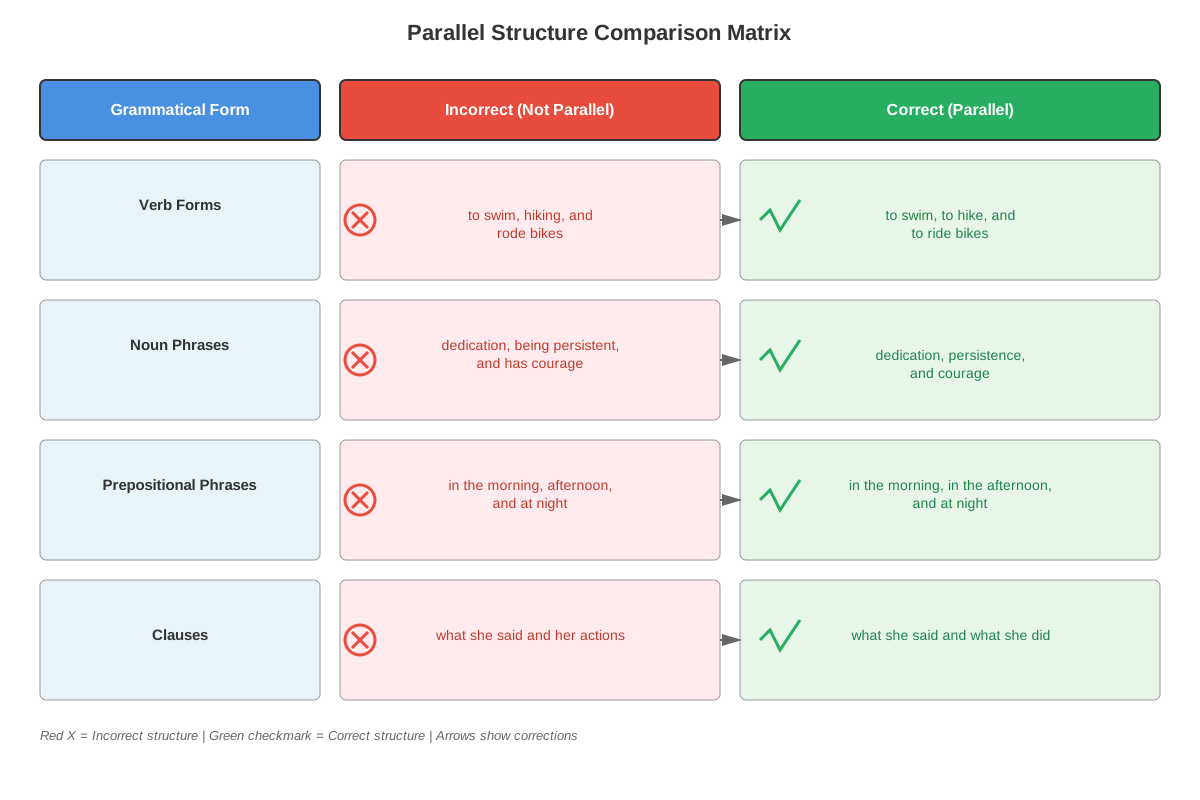
- [ ] Distinguish between correct and incorrect parallel structures across different grammatical forms (verbs, nouns, phrases, clauses)
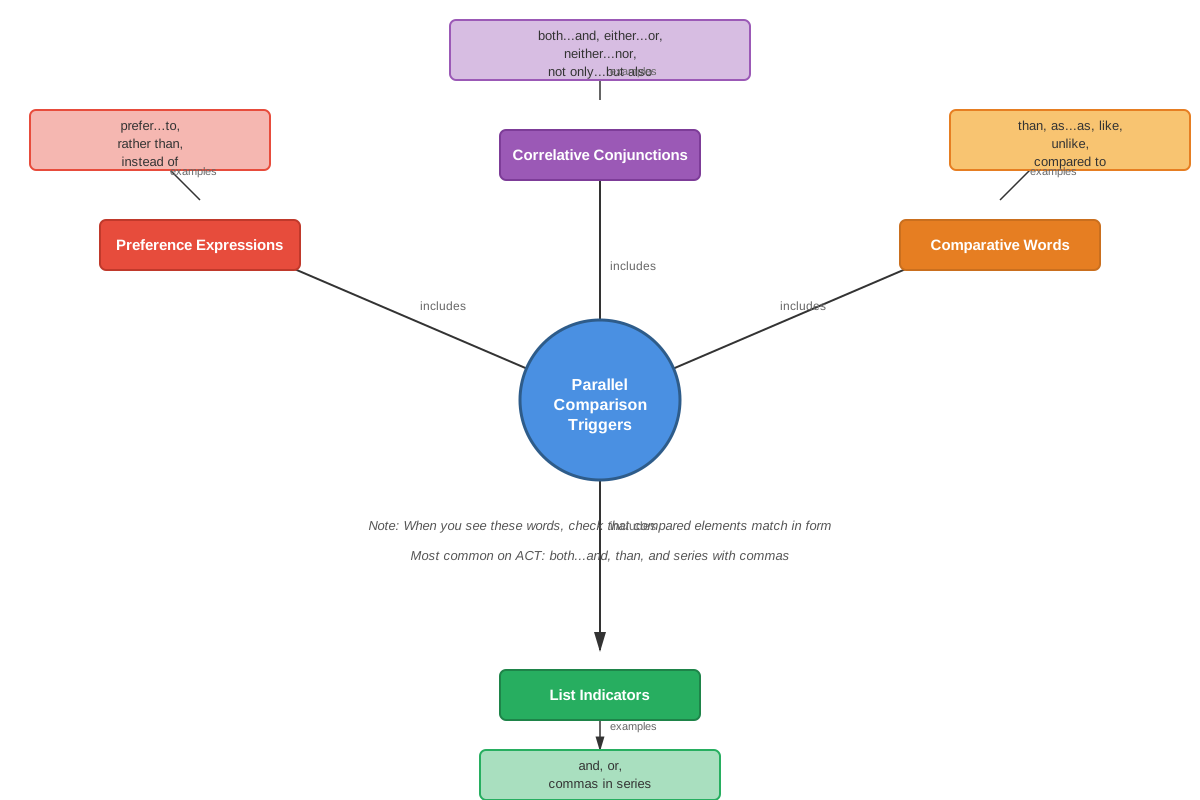
- [ ] Recognize common comparison signal words that trigger parallelism requirements
- [ ] Evaluate multiple answer choices to select the option that maintains proper parallel structure
Prerequisites
- Basic parts of speech identification: Students must recognize nouns, verbs, adjectives, adverbs, and prepositional phrases to identify which elements require parallel structure
- Understanding of verb forms: Knowledge of infinitives, gerunds, and participles is essential since these forms frequently appear in comparison structures
- Clause recognition: Distinguishing between independent and dependent clauses helps identify when entire clause structures must be parallel
- Sentence structure fundamentals: Understanding subjects, predicates, and modifiers provides the foundation for recognizing where parallelism breaks down
Why This Topic Matters
Parallel comparisons matter in real-world contexts because they form the backbone of clear, professional writing. Business proposals, academic essays, legal documents, and technical writing all rely on parallel structure to present options, compare alternatives, and list related items. When professionals write "The company aims to increase revenue, reduce costs, and improving customer satisfaction," the broken parallelism immediately signals careless writing and undermines credibility. Mastering this skill ensures that written communication appears polished and professional.
On the ACT English section, parallel comparison questions appear with remarkable consistency. Statistical analysis of released ACT tests reveals that 2-4% of all English questions directly test parallelism, with additional questions incorporating parallelism as a secondary consideration. These questions typically appear in the Grammar and Usage category, which comprises approximately 40% of the English section. The ACT favors testing parallelism in several specific contexts: lists of three or more items, comparisons using "than" or "as," correlative conjunctions (either/or, neither/nor, not only/but also), and compound sentence structures.
Common manifestations in ACT passages include sentences comparing two activities ("She prefers reading to watch television"), lists with inconsistent forms ("The job requires typing, filing, and to answer phones"), and correlative conjunction errors ("He is not only intelligent but also works hard"). The test writers deliberately create answer choices that sound plausible when read quickly, making this topic particularly challenging under timed conditions. Questions often embed parallelism errors within longer, complex sentences where multiple grammatical issues compete for attention, testing whether students can isolate and correct the specific parallelism problem.
Core Concepts
The Fundamental Rule of Parallel Structure
The core principle governing parallel comparisons states that elements joined by coordinating conjunctions (and, but, or, nor) or compared using comparative structures must share identical grammatical forms. This means matching nouns with nouns, verbs with verbs, phrases with phrases, and clauses with clauses. The human brain processes parallel structures more efficiently because the consistent pattern reduces cognitive load, allowing readers to focus on content rather than decoding grammatical relationships.
Consider this incorrect example: "The coach values dedication, teamwork, and players who show initiative." The first two elements are abstract nouns (dedication, teamwork), while the third is a noun phrase with a relative clause (players who show initiative). To achieve parallelism, all three must match: "The coach values dedication, teamwork, and initiative" (all abstract nouns) or "The coach values players who are dedicated, players who work as a team, and players who show initiative" (all noun phrases with relative clauses).
Parallel Structure in Lists
When sentences present three or more items in a series, each item must maintain the same grammatical structure. The ACT frequently tests this concept because lists appear commonly in both formal and informal writing. The key is identifying the grammatical form of the first item, then ensuring all subsequent items match exactly.
Correct parallel lists:
- Verb forms: "She enjoys swimming, hiking, and cycling" (all gerunds)
- Noun phrases: "The museum features ancient artifacts, modern sculptures, and interactive exhibits" (all noun phrases with adjective + noun)
- Infinitive phrases: "To succeed, to learn, and to grow are her primary goals" (all infinitive phrases)
Incorrect parallel lists:
- Mixed forms: "She enjoys swimming, to hike, and cycles" (gerund, infinitive, verb)
- Inconsistent phrases: "The museum features ancient artifacts, sculptures that are modern, and exhibits you can interact with" (simple noun phrase, noun phrase with relative clause, noun phrase with relative clause in different structure)
Comparisons Using "Than" and "As"
Comparison structures using "than" or "as...as" require strict parallelism between the elements being compared. The grammatical structure following "than" or the second "as" must mirror the structure preceding it. This rule applies whether comparing actions, qualities, objects, or ideas.
| Incorrect | Correct | Explanation |
|---|---|---|
| She likes reading more than to watch TV | She likes reading more than watching TV | Both must be gerunds |
| The new policy is as effective as what we had before | The new policy is as effective as the previous policy | Both must be noun phrases |
| He prefers working independently than in groups | He prefers working independently to working in groups | Both must be gerund phrases |
Correlative Conjunctions and Parallelism
Correlative conjunctions work in pairs to connect sentence elements: either/or, neither/nor, not only/but also, both/and, whether/or. These structures demand perfect parallelism because they explicitly signal a comparison or connection between two elements. The grammatical structure immediately following the first conjunction must match the structure following the second conjunction.
Correct usage:
- "Either you submit the report today or you submit it tomorrow" (both complete clauses)
- "She is not only intelligent but also creative" (both adjectives)
- "The program benefits both students and teachers" (both nouns)
Incorrect usage:
- "Either you submit the report today or tomorrow" (complete clause vs. single adverb)
- "She is not only intelligent but also works creatively" (adjective vs. verb phrase)
- "The program benefits both students and for teachers" (noun vs. prepositional phrase)
Parallel Structure with Verbs
Verb parallelism requires matching verb forms when multiple verbs share the same subject or appear in a list of actions. This includes matching tense, voice (active vs. passive), and form (infinitive, gerund, or conjugated verb). The ACT particularly favors testing whether students can maintain consistency across compound predicates.
When a sentence contains a compound predicate (multiple verbs with one subject), all verbs must maintain parallel structure: "The committee reviewed the proposal, identified potential problems, and recommended solutions" (all past tense verbs). An error would be: "The committee reviewed the proposal, identified potential problems, and will recommend solutions" (mixing past and future tense without justification).
Parallel Structure in Phrases and Clauses
Beyond individual words, parallelism extends to entire phrases and clauses. Prepositional phrases must parallel other prepositional phrases, infinitive phrases must match infinitive phrases, and dependent clauses must align with other dependent clauses of the same type.
Prepositional phrase parallelism:
- Correct: "The book is on the table, under the lamp, and beside the notebook"
- Incorrect: "The book is on the table, under the lamp, and the notebook is beside it"
Infinitive phrase parallelism:
- Correct: "To study effectively, to practice consistently, and to review thoroughly are keys to success"
- Incorrect: "To study effectively, practicing consistently, and thorough review are keys to success"
Concept Relationships
The concepts within parallel comparisons build upon each other in a hierarchical structure. Understanding the fundamental rule of matching grammatical forms → enables recognition of parallel structure in lists → which extends to comparisons using "than" and "as" → and culminates in mastering correlative conjunctions and complex phrase/clause parallelism. Each level increases in complexity while maintaining the same underlying principle.
Parallel comparisons connect directly to prerequisite knowledge of parts of speech and sentence structure. Students must first identify what grammatical form each element takes before determining whether parallelism exists. This topic also relates closely to verb tense consistency, as maintaining parallel verb forms often requires keeping tenses aligned. Additionally, parallel structure intersects with modifier placement because misplaced modifiers can create apparent parallelism errors or mask actual ones.
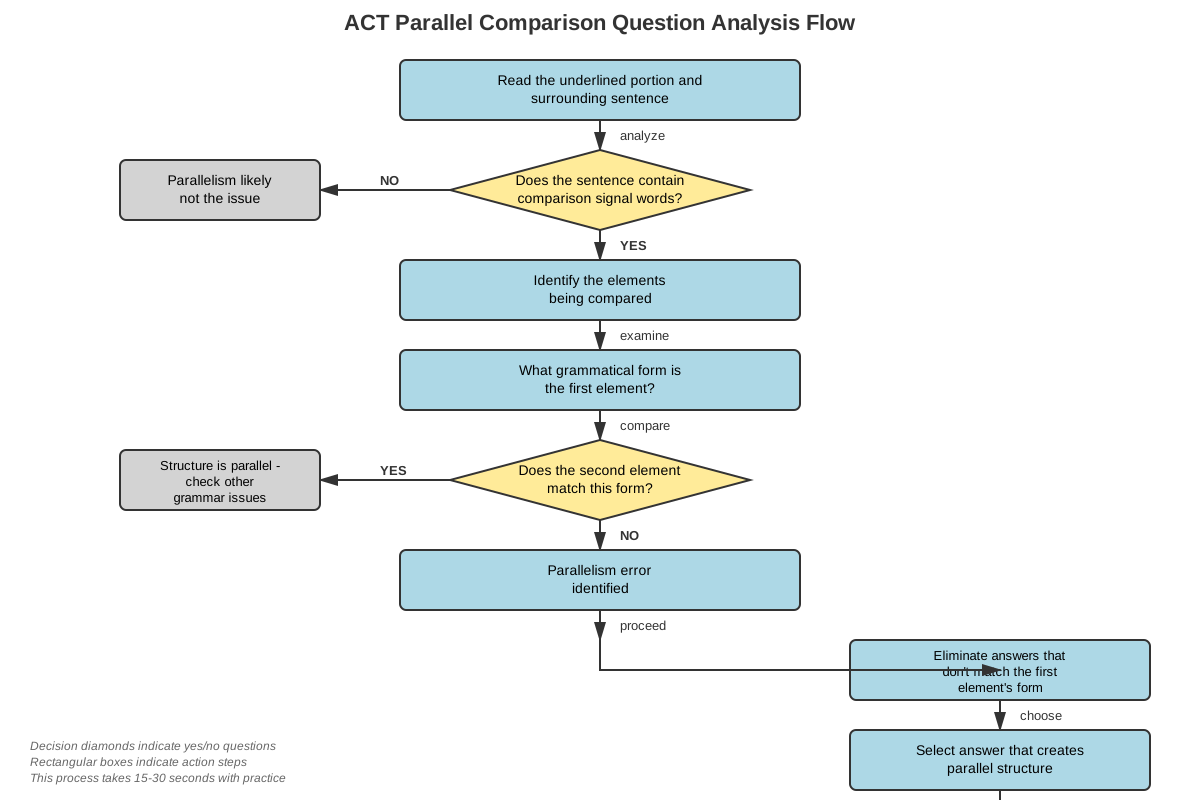
The relationship map flows as follows: Basic grammar knowledge → Recognition of grammatical forms → Identification of comparison structures → Application of parallelism rules → Evaluation of answer choices → Selection of correct parallel structure. This progression mirrors how students should approach ACT questions, moving from recognition to application to selection.
Quick check — test yourself on Parallel comparisons so far.
Try Flashcards →High-Yield Facts
⭐ Elements connected by "and," "but," or "or" must share the same grammatical form
⭐ In comparisons using "than" or "as," the structures on both sides must be parallel
⭐ Correlative conjunctions (either/or, neither/nor, not only/but also) require identical structures following each conjunction
⭐ Lists of three or more items must maintain consistent grammatical form throughout
⭐ Gerunds (-ing forms used as nouns) must parallel other gerunds, not infinitives or conjugated verbs
- Infinitive phrases (to + verb) must parallel other infinitive phrases in comparisons and lists
- Prepositional phrases must parallel other prepositional phrases when connected by conjunctions
- Compound predicates (multiple verbs with one subject) require all verbs to maintain the same tense and form
- Adjectives must parallel other adjectives, and adverbs must parallel other adverbs in series
- When comparing clauses, both clauses must have similar structure (both independent or both dependent with the same subordinating pattern)
Common Misconceptions
Misconception: Parallelism only matters in lists of three or more items → Correction: Parallelism applies to any comparison or connection between two or more elements, including simple two-part comparisons using "than" or "and"
Misconception: As long as the meaning is clear, the grammatical form doesn't need to match → Correction: The ACT tests standard written English, which requires strict grammatical parallelism regardless of whether meaning remains clear; clarity and correctness are separate standards
Misconception: Correlative conjunctions can connect different grammatical forms as long as they're related concepts → Correction: Correlative conjunctions demand exact grammatical parallelism; "not only intelligent but also works hard" is incorrect because "intelligent" (adjective) doesn't match "works hard" (verb phrase)
Misconception: Infinitives and gerunds are interchangeable in parallel structures because they both function as nouns → Correction: While both function as nouns, they are different grammatical forms and cannot be mixed in parallel structures; "She enjoys swimming and to hike" is incorrect
Misconception: Adding words between parallel elements breaks the parallelism requirement → Correction: Parallel elements can be separated by modifiers, phrases, or clauses without affecting the parallelism requirement; the grammatical forms must still match regardless of intervening words
Misconception: Passive and active voice can be mixed in parallel structures as long as the tense matches → Correction: Parallel structures should maintain consistent voice; mixing "The report was reviewed by the committee and identified several problems" creates awkward, non-parallel construction
Worked Examples
Example 1: List Parallelism
Question: The new employee training program teaches participants how to use the software, understanding company policies, and effective communication with clients.
A) NO CHANGE
B) understanding company policies, and to communicate effectively
C) to understand company policies, and to communicate effectively
D) to understand company policies, and effective communication
Solution Process:
Step 1: Identify the list structure. The sentence contains three items connected by commas and "and": (1) how to use the software, (2) understanding company policies, (3) effective communication with clients.
Step 2: Determine the grammatical form of the first item. "How to use the software" is an infinitive phrase (the "how to" construction functions as an infinitive phrase indicating method).
Step 3: Check whether subsequent items match. "Understanding company policies" is a gerund phrase (not parallel), and "effective communication with clients" is a noun phrase (not parallel).
Step 4: Evaluate answer choices for consistent parallelism. Choice C changes all three items to infinitive phrases: "how to use the software," "to understand company policies," and "to communicate effectively with clients." This creates perfect parallelism.
Step 5: Verify the correction. All three elements now follow the infinitive pattern, maintaining parallel structure throughout the list.
Answer: C - This choice establishes parallelism by converting all three items to infinitive phrases.
Connection to Learning Objectives: This example demonstrates how to identify when parallel comparisons is being tested (list structure with inconsistent forms), explains the core rule (matching grammatical forms in lists), and applies the concept to select the correct answer.
Example 2: Correlative Conjunction Parallelism
Question: The research study found that the new treatment was not only more effective than the standard therapy but also patients tolerated it better.
A) NO CHANGE
B) but also better tolerated by patients
C) but also was better tolerated by patients
D) but patients also tolerated it better
Solution Process:
Step 1: Identify the correlative conjunction structure. The sentence uses "not only...but also," which requires parallel elements following each conjunction.
Step 2: Isolate what follows "not only." After "not only" we have "more effective than the standard therapy," which is an adjective phrase (comparative adjective + prepositional phrase).
Step 3: Isolate what follows "but also." The original has "patients tolerated it better," which is a complete clause with subject and verb (not parallel to the adjective phrase).
Step 4: Determine what structure would create parallelism. To match the adjective phrase after "not only," we need another adjective phrase after "but also."
Step 5: Evaluate answer choices. Choice B provides "better tolerated by patients," which is an adjective phrase (comparative adjective + prepositional phrase), creating perfect parallelism with "more effective than the standard therapy."
Step 6: Verify the complete sentence. "The research study found that the new treatment was not only more effective than the standard therapy but also better tolerated by patients" maintains parallel adjective phrases after both conjunctions.
Answer: B - This choice creates parallelism by matching the adjective phrase structure after both "not only" and "but also."
Connection to Learning Objectives: This example shows how to recognize correlative conjunction structures that test parallelism, explains why the original lacks parallelism, and demonstrates the application of the parallelism rule to select the grammatically correct answer.
Exam Strategy
When approaching ACT parallel comparison questions, begin by identifying comparison signal words: "and," "or," "but," "than," "as," and correlative conjunctions. These words immediately signal that parallelism may be tested. Once identified, isolate the elements being connected or compared, writing down their grammatical forms if necessary. This systematic approach prevents the common error of relying on "what sounds right," which often fails under test pressure.
Trigger words and phrases to watch for:
- Coordinating conjunctions connecting multiple elements (and, but, or, nor)
- Comparison words (than, as...as, more...than, less...than)
- Correlative conjunctions (either/or, neither/nor, not only/but also, both/and, whether/or)
- Lists with commas separating three or more items
- Compound predicates (multiple verbs with one subject)
Process-of-elimination strategy:
First, eliminate answer choices that obviously break parallelism by mixing clearly different grammatical forms (infinitive with gerund, noun with clause). Second, eliminate choices that create new grammatical errors while fixing parallelism. Third, compare remaining choices to identify which maintains the most consistent and elegant parallel structure. When two choices both achieve parallelism, select the more concise option unless conciseness creates ambiguity.
Time allocation advice:
Parallel comparison questions typically require 20-30 seconds once students master recognition. Spend 5-10 seconds identifying the comparison structure and the grammatical forms involved, then 10-15 seconds evaluating answer choices. If a question requires more than 45 seconds, mark it for review and move forward. These questions reward systematic analysis rather than prolonged deliberation, so developing a quick recognition system pays dividends.
Exam Tip: Read the sentence starting from the first element in the comparison, then jump directly to each subsequent element without reading intervening words. This technique helps you hear whether the grammatical forms match without being distracted by other sentence content.
Memory Techniques
MATCH Mnemonic for checking parallelism:
- Mark the comparison words (and, or, than, as, correlative conjunctions)
- Analyze the first element's grammatical form
- Test whether subsequent elements match that form
- Check all elements in the series, not just the first two
- Hear the sentence with only the parallel elements to verify consistency
Visualization Strategy: Picture parallel elements as items on a balance scale. Each element must have the same "grammatical weight" (form) to keep the scale balanced. If one element is a gerund and another is an infinitive, the scale tips, signaling an error. This mental image helps students quickly assess whether parallelism exists.
The "Strip Down" Technique: When evaluating complex sentences, mentally strip away all modifiers and intervening phrases, leaving only the core parallel elements. For example, "She enjoys swimming in the ocean, hiking through mountains, and to bike along coastal roads" becomes "She enjoys swimming, hiking, and to bike"—making the parallelism error obvious.
Acronym for Correlative Conjunctions: Remember BENN to recall the most commonly tested correlative pairs:
- Both/and
- Either/or
- Neither/nor
- Not only/but also
Summary
Parallel comparisons represent a fundamental principle of clear, grammatically correct writing that the ACT tests consistently across multiple question types. The core rule requires that elements connected by coordinating conjunctions or compared using comparative structures must maintain identical grammatical forms—whether those elements are individual words, phrases, or entire clauses. Students must recognize comparison signal words (and, or, but, than, as, correlative conjunctions), identify the grammatical form of the first element in any comparison or list, and verify that all subsequent elements match that form exactly. Common testing contexts include lists of three or more items, comparisons using "than" or "as," correlative conjunction structures, and compound predicates. Mastery requires moving beyond "what sounds right" to systematic analysis of grammatical structure, enabling students to quickly identify and correct parallelism errors even in complex sentences with multiple potential issues.
Key Takeaways
- Elements connected by "and," "but," "or," or compared using "than"/"as" must share identical grammatical forms
- Lists require consistent structure throughout: all gerunds, all infinitives, all noun phrases, or all clauses of the same type
- Correlative conjunctions (either/or, neither/nor, not only/but also) demand perfect parallelism in the structures following each conjunction
- Identify the grammatical form of the first element, then verify all subsequent elements match exactly
- Common ACT parallelism errors include mixing infinitives with gerunds, mixing phrases with clauses, and inconsistent verb forms in compound predicates
- Systematic analysis beats intuition: mark comparison words, identify forms, and check for matches rather than relying on "what sounds right"
- Parallelism questions appear 2-4% of the time on ACT English, making them high-yield for score improvement
Related Topics
Subject-Verb Agreement: Mastering parallel comparisons builds skills in recognizing grammatical relationships between sentence elements, which directly supports identifying correct subject-verb pairings in complex sentences with multiple clauses.
Verb Tense Consistency: Parallel structure often requires maintaining consistent verb tenses, making this a natural progression from parallelism to broader tense usage rules.
Modifier Placement: Understanding how modifiers interact with parallel structures helps students recognize when modifiers create ambiguity or disrupt parallel relationships.
Sentence Structure and Variety: Advanced parallelism skills enable students to construct sophisticated sentences with multiple parallel elements, improving both test performance and overall writing quality.
Rhetorical Skills - Style: Parallel structure contributes to writing style and effectiveness, connecting grammar knowledge to higher-level rhetorical analysis questions on the ACT.
Practice CTA
Now that you've mastered the core concepts of parallel comparisons, it's time to cement your understanding through active practice. Attempt the practice questions designed specifically for this topic, focusing on applying the systematic approach outlined in the exam strategy section. Use the flashcards to reinforce recognition of comparison signal words and common parallelism patterns. Remember: parallelism questions are highly predictable once you develop pattern recognition, making them an excellent opportunity to secure quick, confident points on test day. Your investment in mastering this high-yield topic will pay dividends across multiple questions on every ACT English section you encounter.
Sign up free to keep reading
Create a free AnvayaPrep account to finish this ACT guide on Parallel comparisons — plus flashcards and practice questions.