Overview
Squinting modifiers represent one of the most subtle yet frequently tested grammatical errors on the ACT English section. A squinting modifier is a word or phrase—typically an adverb or adverbial phrase—that is positioned ambiguously between two elements in a sentence, making it unclear which element the modifier is meant to describe. The term "squinting" comes from the visual metaphor of the modifier looking in two directions at once, unable to commit to modifying either the preceding or following element. This ambiguity creates confusion for readers and violates the principle of clear, precise communication that the ACT consistently rewards.
Understanding squinting modifiers is essential for ACT success because these errors appear regularly in the English section, often disguised within otherwise grammatically correct sentences. The ACT test writers favor squinting modifier questions because they assess a student's ability to recognize subtle clarity issues rather than obvious grammatical violations. Students who can identify and correct these modifiers demonstrate sophisticated reading comprehension and editing skills—exactly what colleges seek in incoming freshmen. Mastering this concept typically translates to correctly answering 2-4 questions per test, which can significantly impact your composite English score.
ACT squinting modifiers connect to broader concepts in grammar and usage, particularly sentence structure, modifier placement, and clarity of expression. They relate closely to misplaced modifiers and dangling modifiers but require more nuanced analysis because squinting modifiers are technically adjacent to a word they could modify—they're just positioned so poorly that two interpretations become possible. This topic reinforces the fundamental principle that effective writing requires not just grammatical correctness but also unambiguous communication. Students who master squinting modifiers develop a sharper editorial eye that benefits them across all writing tasks, from identifying comma placement issues to recognizing pronoun ambiguity.
Learning Objectives
- [ ] Identify when squinting modifiers is being tested in ACT English passages
- [ ] Explain the core rule or strategy behind squinting modifiers and why they create ambiguity
- [ ] Apply squinting modifiers knowledge to ACT-style questions accurately
- [ ] Distinguish squinting modifiers from other types of modifier errors (misplaced and dangling)
- [ ] Rewrite sentences containing squinting modifiers to eliminate ambiguity
- [ ] Recognize the most common positions where squinting modifiers appear in sentences
- [ ] Evaluate multiple answer choices to select the revision that best clarifies modifier placement
Prerequisites
- Basic sentence structure: Understanding subjects, verbs, and objects is necessary to identify what elements a modifier could potentially describe
- Modifier function: Knowing that modifiers describe or limit other words helps recognize when modification relationships are unclear
- Adverb identification: Recognizing adverbs and adverbial phrases is crucial since these are the most common squinting modifiers
- Reading comprehension: The ability to detect multiple possible meanings in a sentence is fundamental to spotting squinting modifiers
Why This Topic Matters
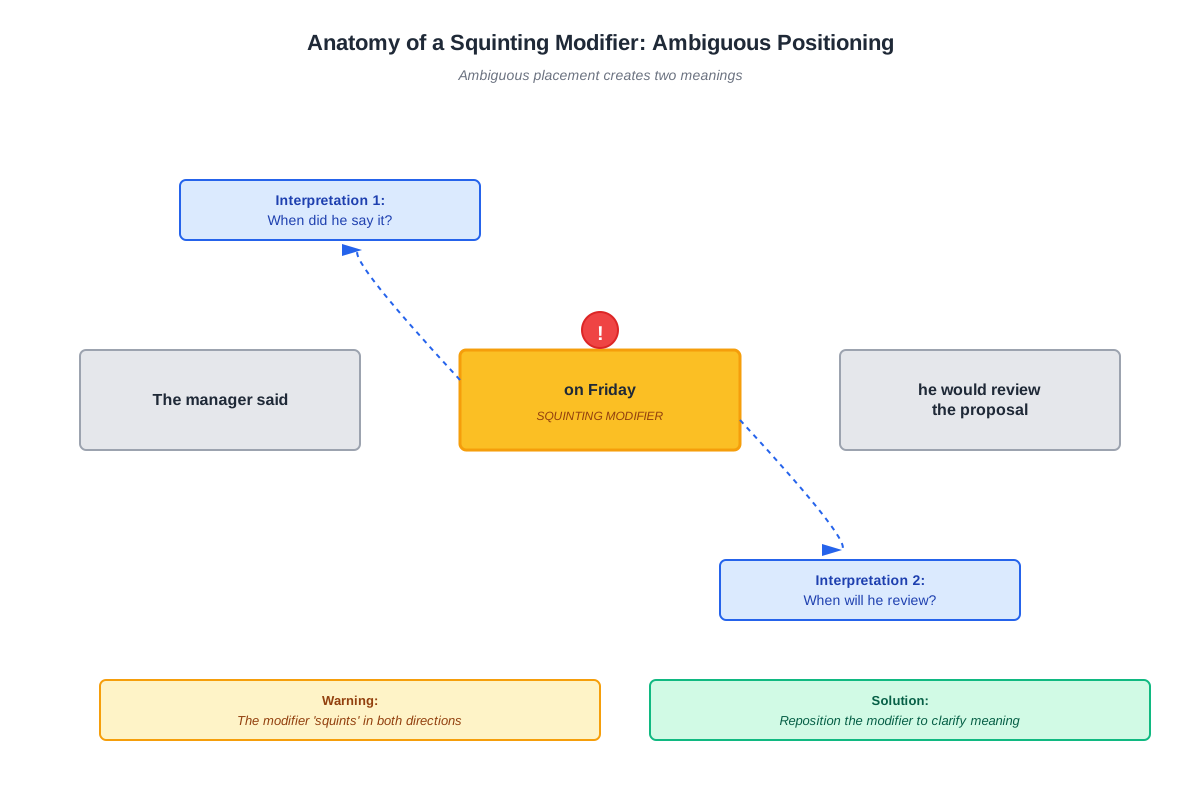
Squinting modifiers matter in real-world communication because ambiguous writing leads to misunderstandings, misinterpretations, and ineffective communication. In professional contexts—from legal documents to medical instructions to business emails—unclear modifier placement can have serious consequences. A sentence like "The manager said on Friday he would review the proposal" leaves readers uncertain whether the manager spoke on Friday or plans to review on Friday. This ambiguity wastes time, creates confusion, and undermines the writer's credibility.
On the ACT English section, squinting modifiers appear with notable frequency—typically 1-3 questions per test, though some exams feature more. These questions usually appear in the Rhetorical Skills subsection under "Strategy" or in the Usage/Mechanics subsection under "Sentence Structure." The ACT presents squinting modifiers in several characteristic ways: as underlined portions where students must choose the clearest revision, as questions asking which placement of a phrase is most effective, or as questions about whether a sentence accomplishes a stated goal (where ambiguity prevents clear communication).
Common manifestations in ACT passages include adverbs like "only," "just," "nearly," "almost," "frequently," and "often" placed between two verbs or verb phrases; time-related phrases positioned ambiguously; and frequency adverbs that could modify either preceding or following actions. The ACT particularly favors testing squinting modifiers in narrative passages where chronology matters and in informative passages where precise meaning is essential. Recognizing these patterns helps students quickly identify when squinting modifier issues are being tested.
Core Concepts
Definition and Mechanism
A squinting modifier is a word, phrase, or clause positioned in a sentence so that it could logically modify either the element before it or the element after it, creating ambiguity about the writer's intended meaning. The modifier "squints" because it appears to look both backward and forward simultaneously. This grammatical error differs from misplaced modifiers (which are simply in the wrong location) and dangling modifiers (which lack a clear word to modify) because squinting modifiers have two potential words or phrases they could modify—the problem is determining which one the writer intended.
The mechanism behind squinting modifiers involves sentence structure and word order. English relies heavily on proximity to establish modification relationships: modifiers typically appear next to the words they describe. When a modifier is equidistant from two possible targets, or when sentence structure allows two equally plausible interpretations, the modifier squints. This ambiguity violates the clarity principle that governs effective writing and that the ACT consistently tests.
Common Squinting Modifier Patterns
Several patterns appear repeatedly on the ACT:
Pattern 1: Adverb Between Two Verbs
The most frequent pattern places an adverb or adverbial phrase between two verb phrases:
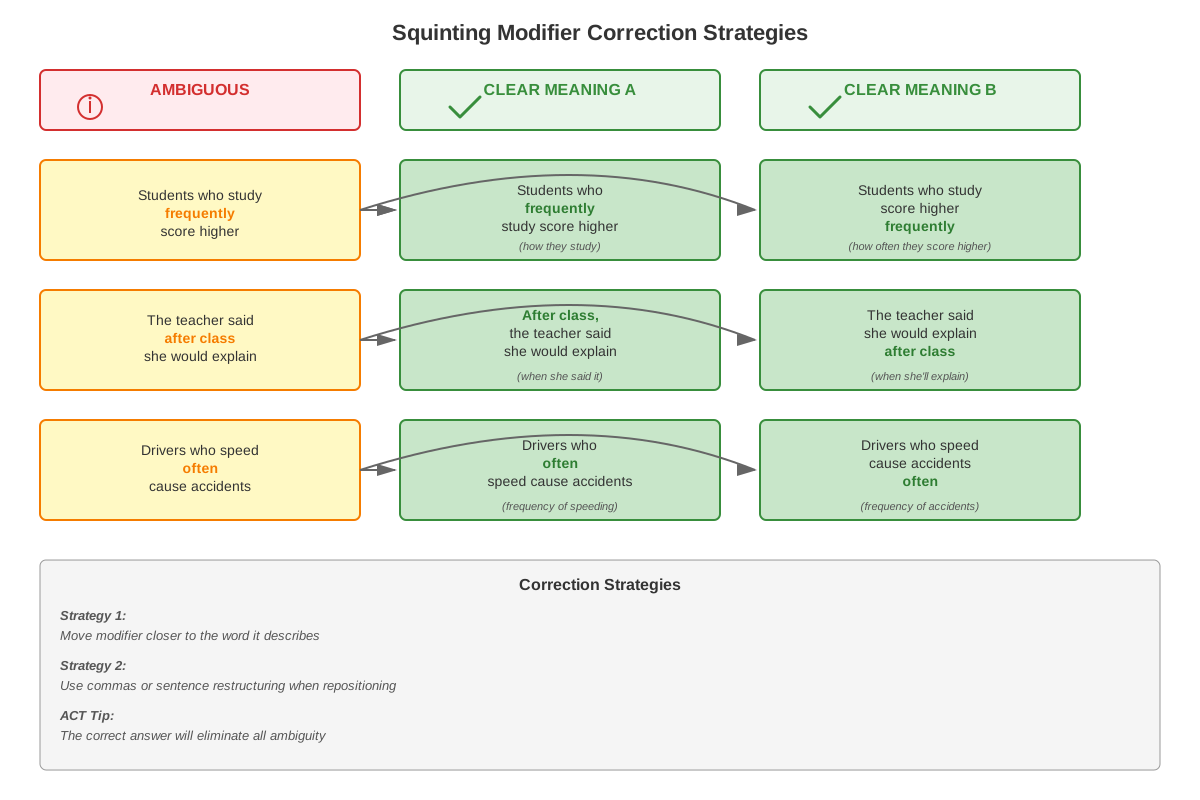
- "Students who study frequently score higher on tests."
- Does "frequently" modify "study" (students who study on a frequent basis) or "score" (frequently achieve higher scores)?
Pattern 2: Time Expressions
Time-related phrases positioned ambiguously:
- "The teacher announced after class she would post grades."
- Did the announcement occur after class, or will the grade posting happen after class?
Pattern 3: Limiting Adverbs
Words like "only," "just," "nearly," "almost" placed where they could modify different elements:
- "The coach said after practice he would only select five players."
- Does "only" modify "select" (the sole action) or "five" (exactly five, no more)?
Identifying Squinting Modifiers
To identify squinting modifiers, apply this systematic approach:
- Locate potential modifiers: Look for adverbs, adverbial phrases, and prepositional phrases, especially those indicating time, frequency, or manner
- Identify adjacent elements: Determine what words or phrases appear immediately before and after the modifier
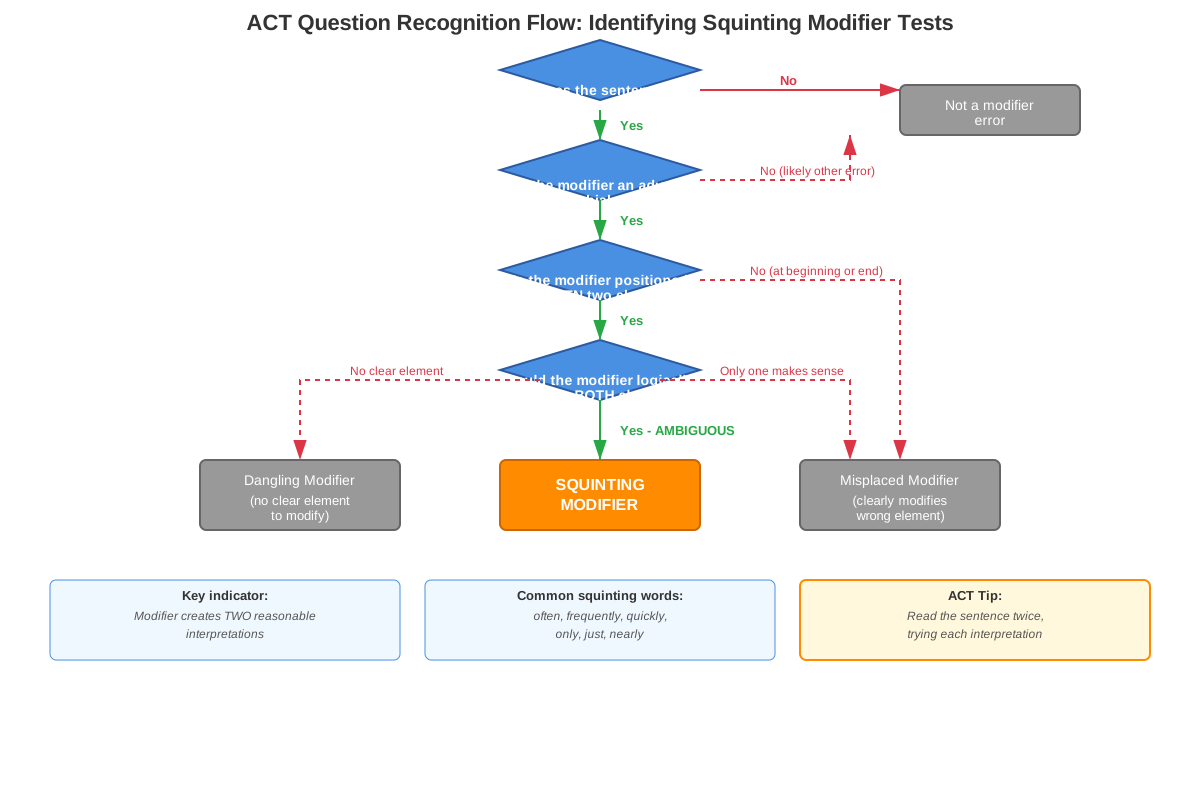
- Test both interpretations: Read the sentence twice, once with the modifier describing the preceding element and once with it describing the following element
- Assess plausibility: If both interpretations make logical sense, you've found a squinting modifier
- Check for ambiguity: Ask whether a reader could reasonably be confused about the intended meaning
Correcting Squinting Modifiers
The ACT expects students not only to identify squinting modifiers but also to select the best correction. Three primary strategies eliminate squinting modifier ambiguity:
| Strategy | Method | Example |
|---|---|---|
| Repositioning | Move the modifier next to the element it should modify | "Students who frequently study score higher" OR "Students who study score higher frequently" |
| Punctuation | Add commas to clarify modification relationships | "The teacher announced, after class, she would post grades" (announcement timing) |
| Restructuring | Rewrite the sentence to eliminate ambiguity | "After class, the teacher announced she would post grades" OR "The teacher announced she would post grades after class" |
The best correction depends on the intended meaning, which the ACT typically makes clear through context in the surrounding sentences.
Context Clues for Intended Meaning
When evaluating ACT answer choices, use these context clues to determine intended meaning:
- Surrounding sentences: Previous or following sentences often clarify timing, frequency, or other details
- Logical coherence: Consider which interpretation makes more sense given the passage's topic and purpose
- Parallel structure: Look for similar constructions elsewhere in the passage that might indicate the writer's pattern
- Passage tone: Formal passages typically require more precise modifier placement than casual narratives
Special Case: "Only" Placement
The word "only" deserves special attention because its placement dramatically changes sentence meaning, and the ACT frequently tests this:
- "Only Sarah called her mother yesterday" (Sarah alone, no one else)
- "Sarah only called her mother yesterday" (called, didn't visit or text)
- "Sarah called only her mother yesterday" (her mother, not anyone else)
- "Sarah called her mother only yesterday" (yesterday specifically, not earlier)
Each placement creates a different meaning. While some of these might technically be squinting modifiers depending on context, the key principle remains: "only" should appear immediately before the word or phrase it limits.
Concept Relationships
Squinting modifiers connect to several related grammatical concepts in a hierarchical relationship. At the broadest level, they fall under modifier errors, which also include misplaced modifiers and dangling modifiers. While all three involve incorrect modifier placement, squinting modifiers specifically create ambiguity between two possible interpretations, whereas misplaced modifiers are simply too far from their intended target, and dangling modifiers lack any appropriate target in the sentence.
The relationship flows as follows: Sentence clarity → requires → Proper modifier placement → includes avoiding → Squinting modifiers. This chain shows that squinting modifiers are one specific way that improper modifier placement undermines sentence clarity, which is a fundamental goal of effective writing that the ACT consistently tests.
Squinting modifiers also connect to word order and syntax, since English meaning depends heavily on the sequence of words. Understanding how word order affects meaning helps students recognize why a modifier's position creates ambiguity. Additionally, squinting modifiers relate to adverb usage because adverbs are the most common squinting modifiers, particularly adverbs of frequency, time, and degree.
The concept also links to rhetorical skills, specifically the ACT's emphasis on clear, effective expression. Questions about squinting modifiers often appear as "Strategy" questions asking which version best accomplishes a stated purpose—the squinting modifier version fails because ambiguity prevents clear communication.
Finally, mastering squinting modifiers prepares students for more advanced concepts like parallel structure and subordination, where precise placement of modifying elements becomes even more critical in complex sentences.
Quick check — test yourself on Squinting modifiers so far.
Try Flashcards →High-Yield Facts
⭐ A squinting modifier is positioned so it could logically modify either the element before it or after it, creating ambiguity
⭐ The most common squinting modifiers are adverbs of frequency (frequently, often, regularly) and time expressions (after class, on Monday, yesterday)
⭐ To identify a squinting modifier, test whether the sentence has two different plausible meanings depending on what the modifier describes
⭐ The three main correction strategies are repositioning the modifier, adding punctuation for clarity, or restructuring the entire sentence
⭐ Context from surrounding sentences usually reveals the intended meaning and guides correction choice
- Squinting modifiers differ from misplaced modifiers because they have two potential targets rather than being simply too far from their intended target
- The word "only" is particularly prone to creating squinting modifier issues and should be placed immediately before the word it limits
- Squinting modifiers typically appear in the middle of sentences, between two clauses or verb phrases
- The ACT tests squinting modifiers 1-3 times per test, often in both Usage/Mechanics and Rhetorical Skills questions
- Eliminating squinting modifiers improves writing clarity, which is a primary goal the ACT rewards across all question types
Common Misconceptions
Misconception: Any modifier in the middle of a sentence is a squinting modifier → Correction: A modifier only squints when it could plausibly modify two different elements, creating genuine ambiguity. Many modifiers appear in sentence middles without causing confusion because context makes the modification relationship clear.
Misconception: Squinting modifiers are the same as misplaced modifiers → Correction: While both involve modifier placement issues, squinting modifiers specifically create ambiguity between two interpretations, whereas misplaced modifiers are simply positioned too far from their intended target. A misplaced modifier has one clear target but is in the wrong location; a squinting modifier has two possible targets.
Misconception: The correct answer always moves the modifier to the beginning or end of the sentence → Correction: While repositioning often helps, the correct answer depends on intended meaning. Sometimes adding commas or restructuring the sentence entirely provides the clearest solution. The ACT rewards the revision that best matches the passage's context and intended meaning.
Misconception: If a sentence sounds okay when read aloud, it doesn't have a squinting modifier → Correction: Squinting modifiers often sound acceptable because readers unconsciously choose one interpretation. The error lies in the ambiguity itself—that two interpretations are possible—not in whether one interpretation sounds wrong. Careful analysis, not just reading aloud, is necessary to identify these errors.
Misconception: Squinting modifiers only involve single-word adverbs → Correction: While single-word adverbs like "only," "just," and "frequently" commonly create squinting modifier issues, phrases and clauses can also squint. Prepositional phrases indicating time ("after the meeting"), infinitive phrases ("to improve scores"), and other multi-word modifiers can all create ambiguity when poorly positioned.
Worked Examples
Example 1: Identifying and Correcting a Squinting Modifier
Original Sentence: "The principal announced during the assembly students would receive new laptops."
Step 1 - Identify the potential modifier: The phrase "during the assembly" is positioned between two elements: "announced" and "students would receive new laptops."
Step 2 - Test both interpretations:
- Interpretation A: The announcement occurred during the assembly (modifies "announced")
- Interpretation B: Students would receive laptops during the assembly (modifies "would receive")
Step 3 - Confirm ambiguity: Both interpretations are grammatically correct and logically plausible, confirming this is a squinting modifier.
Step 4 - Examine context: Suppose the previous sentence reads: "The principal had been planning this announcement for weeks." This suggests the announcement itself happened during the assembly, supporting Interpretation A.
Step 5 - Select the best correction: Based on context supporting Interpretation A, the best revision moves the modifier to clearly indicate when the announcement occurred:
- Correct revision: "During the assembly, the principal announced students would receive new laptops."
This revision eliminates ambiguity by placing "during the assembly" at the sentence beginning, clearly modifying "announced." Alternative corrections supporting Interpretation B would be: "The principal announced students would receive new laptops during the assembly" or "The principal announced that during the assembly, students would receive new laptops."
Connection to Learning Objectives: This example demonstrates how to identify squinting modifiers (Objective 1), apply the core rule about ambiguous positioning (Objective 2), and select appropriate corrections for ACT-style questions (Objective 3).
Example 2: ACT-Style Question with Multiple Answer Choices
Passage Context: "The research team had been collecting data for months. Scientists who analyzed the results carefully discovered several unexpected patterns. The findings would reshape their understanding of the phenomenon."
Question: Which of the following alternatives to the underlined portion would be LEAST acceptable?
Underlined portion: "Scientists who analyzed the results carefully discovered"
Answer Choices:
- A) Scientists who carefully analyzed the results discovered
- B) Scientists who analyzed carefully the results discovered
- C) Scientists, who analyzed the results carefully, discovered
- D) Scientists discovered after carefully analyzing the results
Step 1 - Identify the issue: The original placement of "carefully" creates a squinting modifier—it could modify "analyzed" (how they analyzed) or "discovered" (how they discovered).
Step 2 - Evaluate each choice:
- Choice A: Moves "carefully" to clearly modify "analyzed"—eliminates ambiguity. ACCEPTABLE.
- Choice B: Places "carefully" between "analyzed" and "results"—awkward and unclear. LEAST ACCEPTABLE.
- Choice C: Uses commas to set off the modifier clause, suggesting all scientists analyzed carefully—changes meaning slightly but eliminates squinting. ACCEPTABLE.
- Choice D: Restructures entirely, making "carefully" clearly modify "analyzing"—eliminates ambiguity. ACCEPTABLE.
Step 3 - Select the answer: Choice B is LEAST acceptable because it creates awkward phrasing and doesn't clearly resolve the ambiguity. The placement between verb and object is particularly problematic in English syntax.
Connection to Learning Objectives: This example shows how the ACT tests squinting modifiers through "LEAST acceptable" questions (Objective 1), requires understanding of why certain placements create ambiguity (Objective 2), and demands evaluation of multiple revision strategies (Objective 3 and 5).
Exam Strategy
When approaching ACT questions involving squinting modifiers, follow this systematic process:
Recognition Phase: Watch for these trigger signals that squinting modifiers are being tested:
- Questions asking which placement of a phrase is "most clear" or "most effective"
- Underlined portions containing adverbs (especially "only," "just," "frequently," "often") positioned between two verbs or verb phrases
- "LEAST acceptable alternative" questions where modifier placement varies among choices
- Sentences that feel slightly confusing or require re-reading to understand
Analysis Phase: When you suspect a squinting modifier:
- Identify the modifier and the two elements it could potentially describe
- Mentally read the sentence both ways to confirm two interpretations exist
- Check surrounding sentences for context clues about intended meaning
- Eliminate answer choices that maintain or worsen the ambiguity
Selection Phase: Choose the answer that:
- Places the modifier unambiguously next to what it describes
- Maintains the intended meaning suggested by context
- Preserves the sentence's original tone and style
- Creates the clearest, most direct expression
Exam Tip: If you're stuck between two answer choices that both seem to eliminate ambiguity, choose the one that requires fewer words and creates the most straightforward sentence structure. The ACT favors concision when clarity is equal.
Time Management: Squinting modifier questions typically require 30-45 seconds—slightly longer than simple grammar questions because you must analyze context and test multiple interpretations. Don't rush these questions; the extra seconds spent ensuring you understand the intended meaning will prevent careless errors.
Process of Elimination: Eliminate choices that:
- Maintain the original ambiguous placement
- Create new ambiguities or grammatical errors
- Change the intended meaning indicated by context
- Use awkward or unnatural phrasing
Memory Techniques
Mnemonic for Identification - "SQUINT":
- Spot the modifier (usually an adverb or phrase)
- Question what it modifies
- Understand both possible interpretations
- Inspect the context for clues
- Navigate to the clearest revision
- Test your choice by re-reading
Visualization Strategy: Picture the modifier as a person standing between two friends, unable to decide which one to face. Just as this creates social awkwardness, a squinting modifier creates grammatical awkwardness. The solution is to have the person (modifier) clearly face one friend (the word it modifies).
The "Only" Rule Rhyme: "Only goes before the word you want to stress; anywhere else creates a mess." This helps remember that "only" should immediately precede the element it limits.
The Two-Reading Test: Whenever you encounter a modifier between two elements, read the sentence twice—once emphasizing the modifier's connection to the preceding element, once emphasizing its connection to the following element. If both readings make sense, you've found a squinting modifier.
Context Compass: Think of surrounding sentences as a compass pointing toward the intended meaning. Just as a compass guides travelers, context guides you to the correct interpretation and revision.
Summary
Squinting modifiers represent a sophisticated grammatical concept that the ACT tests regularly to assess students' ability to recognize and correct ambiguous writing. These modifiers "squint" because they're positioned between two elements they could plausibly describe, creating confusion about the writer's intended meaning. The most common squinting modifiers are adverbs of frequency and time expressions placed between verb phrases, though limiting adverbs like "only" also frequently create ambiguity. Identifying squinting modifiers requires testing whether a sentence has two different reasonable interpretations based on what the modifier describes. Correcting these errors involves repositioning the modifier next to its intended target, adding punctuation for clarity, or restructuring the sentence entirely. Context from surrounding sentences typically reveals the intended meaning and guides correction choice. Mastering squinting modifiers improves overall editing skills and directly translates to correctly answering 2-4 questions per ACT test, making this a high-yield topic for score improvement.
Key Takeaways
- Squinting modifiers create ambiguity by being positioned where they could modify either the preceding or following element in a sentence
- The most frequently tested squinting modifiers are adverbs of frequency (frequently, often), time expressions (after class, on Monday), and limiting adverbs (only, just, nearly)
- Identify squinting modifiers by testing whether a sentence has two plausible interpretations depending on what the modifier describes
- Correct squinting modifiers by repositioning them next to their intended target, using punctuation to clarify relationships, or restructuring the sentence
- Context from surrounding sentences reveals intended meaning and guides selection of the best revision on ACT questions
- The ACT tests squinting modifiers 1-3 times per test through underlined portion questions, "LEAST acceptable" questions, and clarity-focused strategy questions
- Eliminating squinting modifiers improves writing clarity, which is a fundamental principle the ACT rewards across all English question types
Related Topics
Misplaced Modifiers: Understanding how modifiers positioned too far from their targets create confusion builds on squinting modifier knowledge and represents another common ACT error pattern. Mastering squinting modifiers provides the foundation for recognizing all modifier placement issues.
Dangling Modifiers: These modifiers lack any appropriate word to modify in the sentence, representing a more severe error than squinting modifiers. Students who understand squinting modifiers can more easily identify dangling modifiers by recognizing when no clear modification relationship exists.
Parallel Structure: Proper modifier placement becomes even more critical in parallel constructions, where consistency in grammatical form is essential. Squinting modifier mastery prepares students for the more complex analysis required in parallelism questions.
Comma Usage for Clarity: Many squinting modifier corrections involve strategic comma placement to clarify modification relationships, connecting this topic to broader punctuation principles the ACT tests extensively.
Sentence Restructuring: The most sophisticated squinting modifier corrections require complete sentence restructuring, a skill that applies across numerous ACT question types and improves overall writing ability.
Practice CTA
Now that you've mastered the concept of squinting modifiers, it's time to cement your understanding through active practice. Attempt the practice questions to apply these strategies to ACT-style scenarios, and use the flashcards to reinforce key definitions and patterns. Remember, recognizing squinting modifiers quickly and accurately can earn you several additional points on test day—points that could make the difference in reaching your target score. Each practice question you complete strengthens your editorial eye and builds the confidence you need to tackle any modifier question the ACT presents. You've got this!
Sign up free to keep reading
Create a free AnvayaPrep account to finish this ACT guide on Squinting modifiers — plus flashcards and practice questions.