Overview
The dash usage is one of the most versatile and frequently tested punctuation concepts on the ACT English section. Dashes serve multiple grammatical functions, including setting off parenthetical information, creating emphasis, and introducing explanations or lists. Understanding when and how to use dashes correctly is essential for achieving a high score on the ACT, as these questions appear regularly throughout the exam and often challenge students who haven't mastered the subtle distinctions between dashes and other punctuation marks like commas, parentheses, and colons.
On the ACT, dash usage questions typically appear in the context of sentence structure and punctuation problems, where students must choose between different punctuation marks or determine whether a dash is used correctly. The exam tests whether students can recognize appropriate dash placement, understand the relationship between dashes and the information they set off, and distinguish between situations that call for dashes versus other punctuation options. Mastering dash usage requires understanding both the technical rules governing their use and the stylistic considerations that make dashes effective in written communication.
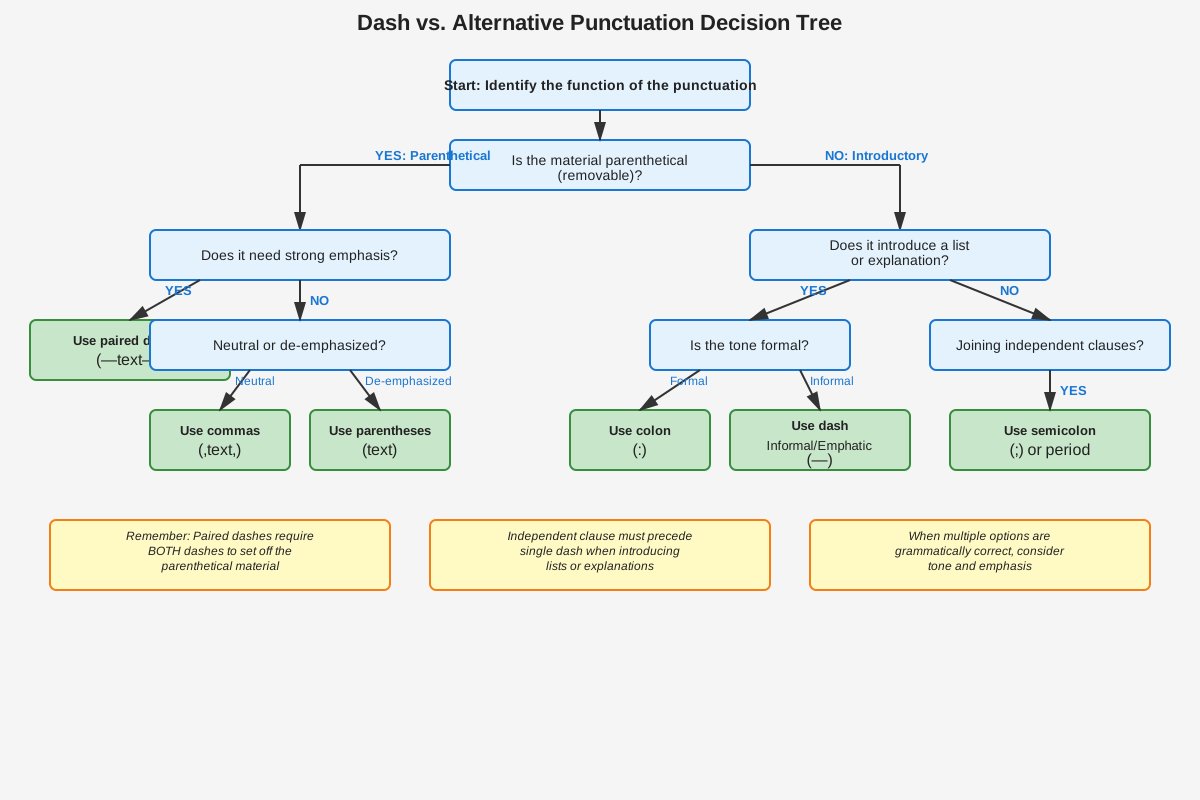
The concept of ACT dash usage connects directly to broader punctuation principles, including the use of commas for nonessential information, parentheses for asides, and colons for introductions. Dashes occupy a unique middle ground in the punctuation hierarchy—they're more emphatic than commas but less formal than parentheses, and they can introduce information like colons while maintaining a more conversational tone. Understanding these relationships helps students make informed decisions when multiple punctuation options appear grammatically correct but only one best fits the context and tone of the passage.
Learning Objectives
- [ ] Identify when Dash usage is being tested in ACT English questions
- [ ] Explain the core rule or strategy behind Dash usage
- [ ] Apply Dash usage to ACT-style questions accurately
- [ ] Distinguish between situations requiring single dashes versus paired dashes
- [ ] Evaluate when dashes are preferable to commas, parentheses, or colons
- [ ] Recognize common dash usage errors that appear on the ACT
- [ ] Demonstrate mastery by correctly answering 90% or more of dash-related practice questions
Prerequisites
- Basic comma usage: Understanding comma rules is essential because dashes often serve as stronger alternatives to commas when setting off nonessential information
- Sentence structure fundamentals: Recognizing independent and dependent clauses helps determine whether dash placement creates grammatically complete sentences
- Parenthetical elements: Knowing what constitutes parenthetical or nonessential information is crucial for understanding when dashes appropriately set off material
- Colon usage basics: Understanding how colons introduce information provides context for when dashes can serve similar functions with different stylistic effects
Why This Topic Matters
In real-world writing, dashes add variety, emphasis, and clarity to prose. Professional writers use dashes to create dramatic pauses, highlight important information, and maintain reader engagement through varied sentence structure. Journalists, essayists, and business communicators employ dashes to make their writing more dynamic and readable, particularly when they need to insert explanatory information without disrupting the flow of their main ideas.
On the ACT English section, dash usage questions appear with significant frequency—typically 2-4 questions per test. These questions account for approximately 3-7% of the total English section score, making them a high-yield topic for focused study. The ACT tests dash usage in several distinct ways: questions may ask students to choose between dashes and other punctuation marks, identify correct dash placement in sentences with parenthetical elements, or recognize when dashes are used incorrectly. Understanding dash rules can also help students answer questions about sentence structure and clarity, even when dashes aren't explicitly mentioned.
Common ACT passage contexts for dash usage include scientific explanations with technical terms requiring definition, historical narratives with dates or clarifying information, and personal essays with reflective asides. The exam frequently presents sentences where multiple punctuation options are grammatically acceptable, testing whether students can identify the most effective choice based on emphasis and tone. Questions often appear in passages discussing complex topics where additional information must be seamlessly integrated without confusing readers.
Core Concepts
The Two Types of Dashes
The em dash (—) is the standard dash used in most writing and the only dash type tested on the ACT. It's called an "em dash" because it's approximately the width of the letter M. The en dash (–), which is shorter and primarily used for ranges and connections, does not appear on the ACT English section. When discussing dash usage on the ACT, all references are to the em dash.
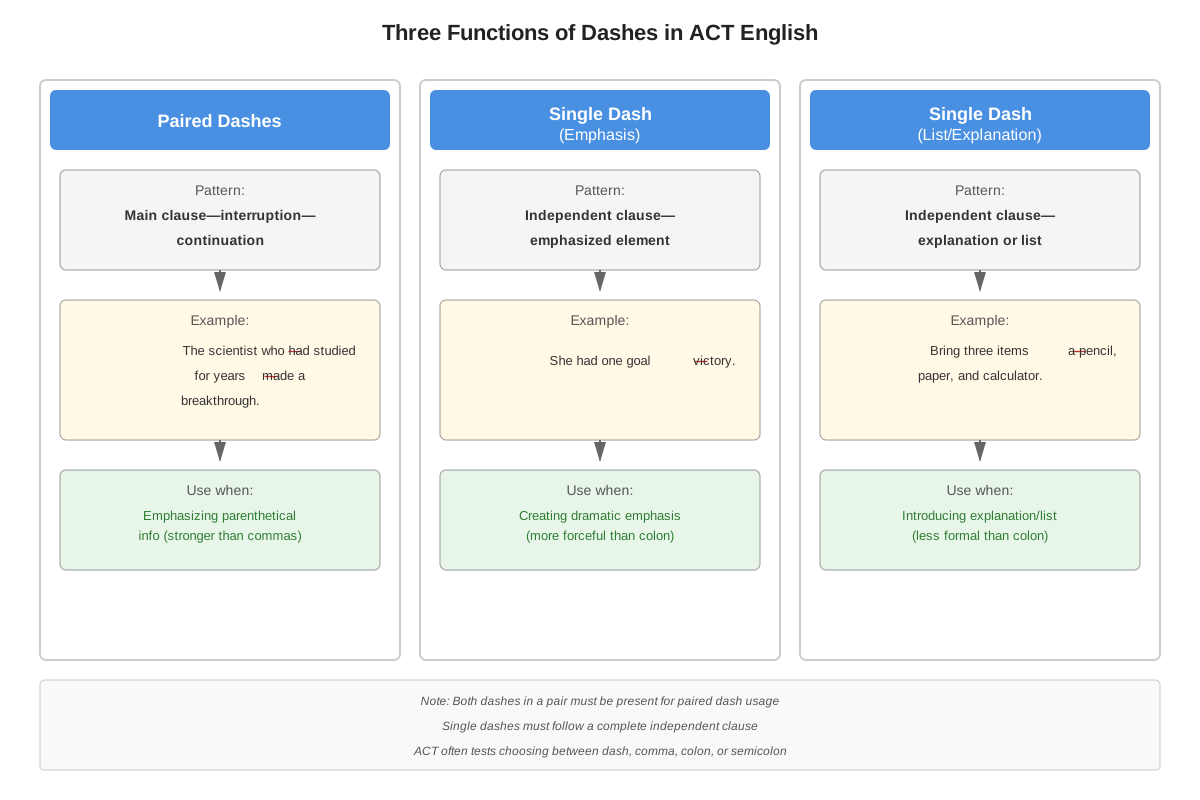
Single Dash Usage
A single dash introduces information that explains, expands upon, or emphasizes what comes before it. This function is similar to a colon but creates a more informal, conversational tone. Single dashes work particularly well when the introductory information builds anticipation or when the following information provides a surprising or emphatic conclusion.
Example: The committee reached a unanimous decision—they would postpone the vote until next month.
In this construction, the dash introduces the specific decision after the general statement. The information after the dash must be closely related to what precedes it, typically providing clarification, specification, or elaboration. Single dashes can also introduce lists, though colons are more common for this purpose in formal writing.
Example: The laboratory required three essential pieces of equipment—microscopes, centrifuges, and spectrophotometers.
Paired Dash Usage
Paired dashes function like parentheses or paired commas, setting off nonessential information within a sentence. This is the most frequently tested dash usage on the ACT. When dashes are used in pairs, they must both appear in the sentence—one before and one after the parenthetical element. The sentence must remain grammatically complete if the material between the dashes is removed.
Example: The scientist—who had spent twenty years researching the phenomenon—finally published her findings.
Test this by removing the dashed material: "The scientist finally published her findings." The sentence remains complete and grammatically correct. This is the key test for paired dashes on the ACT.
Dash vs. Comma Comparison
| Punctuation | Function | Emphasis Level | Formality | ACT Usage |
|---|---|---|---|---|
| Paired Dashes | Set off nonessential information | High emphasis | Informal/conversational | Use when information needs highlighting |
| Paired Commas | Set off nonessential information | Neutral emphasis | Standard formality | Default choice for nonessential elements |
| Parentheses | Set off nonessential information | De-emphasis/aside | Formal | Rarely tested; downplays information |
| Single Dash | Introduces/emphasizes | High emphasis | Informal | Use for dramatic introduction |
| Colon | Introduces formally | Moderate emphasis | Formal | Use for formal lists/explanations |
The Consistency Rule
When setting off parenthetical information, the ACT requires punctuation consistency. If a parenthetical element begins with a dash, it must end with a dash—not a comma or other punctuation mark. This is one of the most commonly tested aspects of dash usage.
Incorrect: The proposal—which included detailed budget projections, was approved unanimously.
Correct: The proposal—which included detailed budget projections—was approved unanimously.
Also Correct: The proposal, which included detailed budget projections, was approved unanimously.
Dash Placement Rules
Dashes must be placed immediately adjacent to the words they separate, with no additional spaces. On the ACT, this formatting is handled automatically, but understanding proper placement helps students recognize correct usage patterns.
When paired dashes set off information, they create a clear boundary around the parenthetical element. Everything between the dashes must be grammatically independent from the main sentence—meaning the sentence works without it. However, the parenthetical element itself doesn't need to be a complete sentence.
When to Choose Dashes Over Other Punctuation
The ACT often presents questions where multiple punctuation options are grammatically correct, requiring students to choose based on context and emphasis. Choose dashes when:
- The passage has an informal or conversational tone: Dashes fit naturally in personal narratives and casual explanations
- The information needs emphasis: Dashes draw attention to the material they set off or introduce
- The parenthetical element already contains commas: Dashes provide clarity when the set-off information includes internal punctuation
- The introduction needs dramatic effect: Single dashes create anticipation before revealing important information
Example with internal commas: The three cities—Paris, France; London, England; and Rome, Italy—were all on the itinerary.
Using commas instead of dashes would create confusion about which commas separate list items and which set off the entire list.
Concept Relationships
The concepts within dash usage form a hierarchical relationship. Understanding basic dash function (setting off or introducing information) leads to recognizing the two types of dash usage (single vs. paired). This recognition enables students to apply the consistency rule and make informed choices when comparing dashes to alternative punctuation. All these concepts converge in strategic dash selection on ACT questions.
Dash usage connects to prerequisite knowledge of comma usage because both can set off nonessential information, with dashes providing greater emphasis. The relationship to sentence structure is fundamental—students must identify complete sentences to determine whether paired dashes are used correctly. Understanding parenthetical elements from general grammar study directly applies to recognizing when information can be set off with dashes.
The progression flows: Comma mastery → Understanding nonessential elements → Recognizing emphasis needs → Applying dashes appropriately → Distinguishing dashes from colons and parentheses → Mastering ACT dash questions.
High-Yield Facts
- ⭐ Paired dashes must both appear: If a sentence begins a parenthetical element with a dash, it must end with a dash, not a comma or other punctuation
- ⭐ The sentence must work without the dashed material: Remove everything between paired dashes; if the sentence is incomplete or ungrammatical, the dashes are incorrect
- ⭐ Dashes create emphasis: When choosing between grammatically correct options, dashes emphasize information more than commas but less formally than parentheses
- ⭐ Single dashes introduce or explain: A single dash can introduce information that clarifies, specifies, or elaborates on what precedes it
- ⭐ Consistency is required: Don't mix punctuation types when setting off parenthetical information (no dash-comma combinations)
- Dashes work well when parenthetical elements contain internal commas, preventing confusion about punctuation hierarchy
- The ACT tests dash usage 2-4 times per exam, making it a high-yield punctuation topic
- Dashes are more informal than colons but serve similar introductory functions in casual writing
- Only the em dash appears on the ACT; en dashes and hyphens are not tested in dash usage questions
- When multiple punctuation options are grammatically correct, consider the passage's tone to determine whether dashes fit the style
Quick check — test yourself on Dash usage so far.
Try Flashcards →Common Misconceptions
Misconception: Dashes and hyphens are interchangeable.
Correction: Dashes (—) and hyphens (-) serve completely different functions. Hyphens connect words (well-known, twenty-five), while dashes set off or introduce information. The ACT tests only dash usage, not hyphenation.
Misconception: You can use a dash at the beginning of parenthetical information and a comma at the end.
Correction: Punctuation must be consistent when setting off parenthetical elements. If you begin with a dash, you must end with a dash. Mixing punctuation types (dash-comma or comma-dash) is always incorrect on the ACT.
Misconception: Dashes are always wrong because they're too informal for standardized tests.
Correction: Dashes are perfectly acceptable on the ACT when used correctly. The exam includes passages with various tones, and dashes are appropriate for conversational or emphatic contexts. The ACT tests correct dash usage, not whether dashes should ever be used.
Misconception: A single dash can appear anywhere in a sentence to create a pause.
Correction: Single dashes must introduce information that directly relates to what precedes them. They can't be used randomly for pauses or emphasis without a clear logical connection between the parts they separate.
Misconception: Information between dashes must be a complete sentence.
Correction: Parenthetical elements set off by paired dashes do not need to be complete sentences. They can be phrases, clauses, or even single words. However, the main sentence (without the dashed material) must be grammatically complete.
Misconception: Dashes and colons are always interchangeable when introducing information.
Correction: While both can introduce explanatory information, colons are more formal and typically introduce lists or formal explanations. Dashes are more conversational and create greater emphasis. Context and tone determine which is more appropriate.
Misconception: You should always choose commas over dashes when both are grammatically correct.
Correction: When multiple options are correct, the best choice depends on emphasis and tone. If the passage is informal or the information needs highlighting, dashes may be the better choice even though commas would also work grammatically.
Worked Examples
Example 1: Paired Dash Usage
Question: The archaeologist discovered several artifacts—pottery shards, ancient coins, and jewelry, during the excavation.
Which of the following alternatives to the underlined portion would be acceptable?
A. artifacts—pottery shards, ancient coins, and jewelry—during
B. artifacts, pottery shards, ancient coins, and jewelry—during
C. artifacts: pottery shards, ancient coins, and jewelry, during
D. artifacts; pottery shards, ancient coins, and jewelry, during
Solution Process:
Step 1: Identify what's being set off. The list "pottery shards, ancient coins, and jewelry" provides examples of the artifacts.
Step 2: Check if this is paired or single dash usage. The original has one dash before the list but no closing dash, suggesting either single dash usage or an error.
Step 3: Test whether the sentence works without the list: "The archaeologist discovered several artifacts during the excavation." This is complete and grammatical.
Step 4: Since the list is parenthetical (nonessential), it needs to be set off on both sides. The original is incorrect because it opens with a dash but doesn't close with one.
Step 5: Evaluate each option:
- Option A: Uses paired dashes correctly, setting off the entire list. The sentence works with or without the dashed material. ✓
- Option B: Uses a comma to open and a dash to close—inconsistent punctuation. ✗
- Option C: Uses a colon to introduce the list and a comma after it. Colons can introduce lists, but the comma after "jewelry" is incorrect because it separates the list from the essential phrase "during the excavation." ✗
- Option D: Uses a semicolon incorrectly; semicolons separate independent clauses, not lists from main clauses. ✗
Answer: A
Connection to Learning Objectives: This example demonstrates identifying when dash usage is being tested (paired dashes for parenthetical elements), explaining the core rule (consistency and completeness), and applying the rule to an ACT-style question.
Example 2: Dash vs. Other Punctuation
Question: The committee's decision, to postpone the vote until more information became available—surprised many observers.
F. NO CHANGE
G. decision—to postpone the vote until more information became available,
H. decision—to postpone the vote until more information became available—
J. decision, to postpone the vote until more information became available,
Solution Process:
Step 1: Identify the structure. The phrase "to postpone the vote until more information became available" explains what the decision was.
Step 2: Determine if this is essential or nonessential information. Remove it: "The committee's decision surprised many observers." This is grammatically complete but loses crucial meaning. However, the phrase could be considered nonessential if we're emphasizing that there was a decision, with the specifics being additional information.
Step 3: Check the original punctuation. It uses a comma before and a dash after—inconsistent punctuation. This is incorrect.
Step 4: Evaluate each option:
- Option F (NO CHANGE): Mixes comma and dash—incorrect. ✗
- Option G: Mixes dash and comma in reverse order—still inconsistent. ✗
- Option H: Uses paired dashes consistently. Tests: "The committee's decision surprised many observers" works. The dashes emphasize the decision's content. ✓
- Option J: Uses paired commas consistently. This also works grammatically and is less emphatic than dashes. ✓
Step 5: Choose between H and J. Both are grammatically correct. Consider context: the phrase "surprised many observers" suggests the decision's content is noteworthy and deserves emphasis. Dashes provide that emphasis better than commas.
Answer: H
Connection to Learning Objectives: This example shows how to distinguish between dashes and commas when both are grammatically acceptable, applying strategic thinking about emphasis and tone to ACT questions.
Exam Strategy
When approaching dash usage questions on the ACT, follow this systematic process:
Step 1: Identify the dash configuration. Determine whether the question involves a single dash (introducing information) or paired dashes (setting off parenthetical elements). Look for whether one or two dashes appear in the sentence.
Step 2: Apply the removal test. If paired dashes are involved, mentally remove everything between them. The remaining sentence must be grammatically complete and logical. If it's not, the dashes are incorrectly placed.
Step 3: Check for consistency. Verify that parenthetical elements use matching punctuation on both sides. Watch for answer choices that mix commas and dashes—these are always incorrect.
Step 4: Compare alternatives. When multiple options are grammatically correct, consider:
- The passage's overall tone (formal vs. conversational)
- Whether the information needs emphasis
- Whether the parenthetical element contains internal punctuation
Trigger words and phrases that signal dash usage questions:
- Questions asking about punctuation around "additional information" or "examples"
- Answer choices showing the same words with different punctuation marks
- Sentences with explanatory phrases or lists
- Passages with conversational or emphatic tone
Process-of-elimination tips:
- Immediately eliminate any option mixing punctuation types (dash-comma or comma-dash combinations)
- Eliminate options where removing dashed material leaves an incomplete sentence
- When stuck between commas and dashes, choose dashes if the passage is informal or the information needs emphasis
- Eliminate single dashes that don't introduce or explain something specific
Time allocation: Dash usage questions should take 20-30 seconds each. They're typically straightforward once you know the rules. If you're spending more than 45 seconds, apply the removal test and move on, marking the question for review if needed.
Exam Tip: The ACT loves testing consistency. If you see one dash in a sentence, immediately look for where the second dash should be. About 60% of dash questions test paired dash consistency.
Memory Techniques
The DASH Acronym:
- Determine if single or paired
- Apply the removal test
- Same punctuation on both sides
- Highlight or introduce information
The Sandwich Rule: Think of paired dashes as bread slices in a sandwich. The filling (parenthetical information) must have the same type of bread on both sides. You can't have a dash-slice on one side and a comma-slice on the other—the sandwich falls apart.
The Emphasis Spectrum Visualization: Picture punctuation on a scale from subtle to emphatic:
Parentheses ( ) ← Commas , , ← DASHES — — ← Exclamation !
(downplay)      (neutral)      (emphasize)    (very emphatic)
The "Lift-Out" Technique: Imagine physically lifting the words between dashes out of the sentence. If the sentence collapses or doesn't make sense, the dashes are wrong. If it stands strong, the dashes are correct.
The Introduction Rhyme: "When one dash appears, it introduces or explains—what follows makes clear what came before the line."
Summary
Dash usage on the ACT involves two primary functions: paired dashes that set off nonessential information (similar to commas or parentheses but more emphatic) and single dashes that introduce explanatory or emphatic information (similar to colons but more conversational). The most critical rule is consistency—paired dashes must both appear, and you cannot mix dashes with commas when setting off parenthetical elements. To verify correct paired dash usage, remove the material between the dashes; the remaining sentence must be grammatically complete. When choosing between grammatically correct punctuation options, consider the passage's tone and whether the information needs emphasis. Dashes are more emphatic than commas, more informal than colons, and more attention-grabbing than parentheses. Understanding these distinctions and applying the removal test will enable students to answer dash usage questions quickly and accurately, securing valuable points on this high-yield ACT English topic.
Key Takeaways
- Paired dashes must both appear in a sentence; mixing dashes with commas when setting off information is always incorrect
- Apply the removal test: sentences must remain grammatically complete when material between paired dashes is removed
- Single dashes introduce or emphasize information that explains or specifies what precedes them
- Dashes create more emphasis than commas but are less formal than colons or semicolons
- When multiple punctuation options are grammatically correct, choose based on the passage's tone and the emphasis needed
- Dash usage appears 2-4 times per ACT English section, making it a high-yield topic worth mastering
- The consistency rule is the most frequently tested aspect of dash usage on the ACT
Related Topics
Comma Usage for Nonessential Elements: Understanding how commas set off parenthetical information provides the foundation for recognizing when dashes serve the same function with different emphasis. Mastering dash usage builds on comma mastery.
Colon Usage: Colons and single dashes both introduce information, but colons are more formal. Understanding the distinction helps students make strategic punctuation choices on the ACT.
Parentheses in Formal Writing: While rarely tested on the ACT, understanding how parentheses de-emphasize information helps students appreciate the emphasis spectrum and choose appropriately between punctuation options.
Sentence Structure and Completeness: Dash usage questions often test whether students can identify grammatically complete sentences, making sentence structure knowledge essential for advanced punctuation mastery.
Punctuation for Clarity: Dash usage is part of the broader skill of using punctuation to enhance clarity and readability, which connects to questions about sentence effectiveness and style throughout the ACT English section.
Practice CTA
Now that you've mastered the core concepts of dash usage, it's time to reinforce your learning through practice. Attempt the practice questions to apply these rules to ACT-style scenarios, and use the flashcards to memorize the high-yield facts and common error patterns. Remember, dash usage questions are highly predictable once you know the rules—consistent practice will help you recognize these patterns instantly on test day, allowing you to answer confidently and move efficiently through the English section. You've got this!
Sign up free to keep reading
Create a free AnvayaPrep account to finish this ACT guide on Dash usage — plus flashcards and practice questions.