Overview
Clarity is one of the most fundamental and frequently tested concepts in ACT Writing, appearing in both the multiple-choice English section and as a critical evaluation criterion in the essay portion. At its core, clarity refers to the quality of writing that allows readers to understand the author's intended meaning immediately and without confusion. When writing possesses clarity, ideas flow logically, word choices are precise, sentence structures are straightforward, and the overall message is unmistakable.
On the ACT, ACT clarity questions assess whether students can identify and correct writing that is ambiguous, wordy, awkwardly constructed, or confusing. These questions often appear as revision tasks where students must choose the clearest way to express an idea from among several options. The test makers deliberately include answer choices that are grammatically correct but unclear, testing whether students can distinguish between technically accurate writing and truly effective communication. Clarity issues frequently overlap with other writing concepts such as conciseness, word choice, sentence structure, and logical organization, making it a cornerstone skill that supports performance across multiple question types.
Understanding clarity is essential because it represents the ultimate goal of all writing: successful communication. While grammar rules and punctuation conventions are important, they serve the larger purpose of making meaning clear. The ACT recognizes this hierarchy by consistently rewarding clear, direct expression over unnecessarily complex or ambiguous alternatives. Students who master clarity principles gain a significant advantage, as these skills apply to approximately 15-20% of English section questions and directly influence essay scores in the Language Use and Conventions domain.
Learning Objectives
- [ ] Identify when Clarity is being tested in ACT English questions
- [ ] Explain the core rule or strategy behind Clarity in effective writing
- [ ] Apply Clarity principles to ACT-style questions accurately
- [ ] Distinguish between grammatically correct but unclear writing and truly clear expression
- [ ] Recognize common clarity errors including ambiguous pronoun references, misplaced modifiers, and vague word choices
- [ ] Evaluate multiple revision options to select the clearest expression of an idea
- [ ] Apply clarity principles to improve essay writing and achieve higher Language Use scores
Prerequisites
- Basic sentence structure: Understanding subjects, verbs, and objects is essential because clarity often depends on proper relationships between sentence elements
- Parts of speech: Recognizing nouns, pronouns, adjectives, and adverbs helps identify when words are used imprecisely or ambiguously
- Pronoun-antecedent agreement: Clarity frequently involves ensuring pronouns clearly refer to specific nouns
- Modifier placement: Understanding how modifiers function enables recognition of misplaced or dangling modifiers that obscure meaning
- Basic punctuation: Commas, semicolons, and other punctuation marks contribute to clarity by organizing sentence elements
Why This Topic Matters
Clarity is the foundation of effective communication in academic, professional, and personal contexts. In college writing, unclear expression leads to misunderstandings, lower grades, and failed communication of complex ideas. Professional environments demand clear writing in emails, reports, proposals, and presentations—ambiguity costs time, money, and credibility. Even in everyday communication, clarity prevents conflicts and ensures messages are understood as intended.
On the ACT, clarity-related questions appear with remarkable frequency. Approximately 15-20% of English section questions directly test clarity principles, making it one of the highest-yield topics for score improvement. These questions appear in several formats: selecting the clearest revision of an underlined portion, identifying unclear pronoun references, correcting ambiguous modifiers, and choosing between wordy and concise expressions. Additionally, the ACT essay rubric explicitly evaluates clarity in the Language Use and Conventions domain, where scores of 4-6 (out of 6) require "clear" or "skillful" use of language.
Common manifestations of clarity testing on the ACT include passages with ambiguous pronoun references (where "it," "they," or "this" could refer to multiple nouns), sentences with misplaced modifiers that create unintended meanings, unnecessarily complex sentence structures that obscure simple ideas, and word choices that are imprecise or vague. The test consistently presents scenarios where one answer choice communicates an idea directly and clearly while others are grammatically acceptable but confusing or ambiguous.
Core Concepts
Definition of Clarity in Writing
Clarity in writing means that the reader can understand the writer's intended meaning immediately, without re-reading, guessing, or interpreting ambiguous language. Clear writing exhibits three essential characteristics: precision (exact word choices that convey specific meanings), directness (straightforward expression without unnecessary complexity), and logical structure (organized presentation where relationships between ideas are obvious). When writing lacks clarity, readers must work to extract meaning, which represents a failure of communication.
The ACT evaluates clarity by presenting revision scenarios where students must choose between options that vary in how directly and unambiguously they express an idea. The correct answer typically uses specific rather than vague language, places modifiers next to the words they modify, ensures pronouns have clear antecedents, and structures sentences so that relationships between ideas are immediately apparent.
Ambiguous Pronoun References
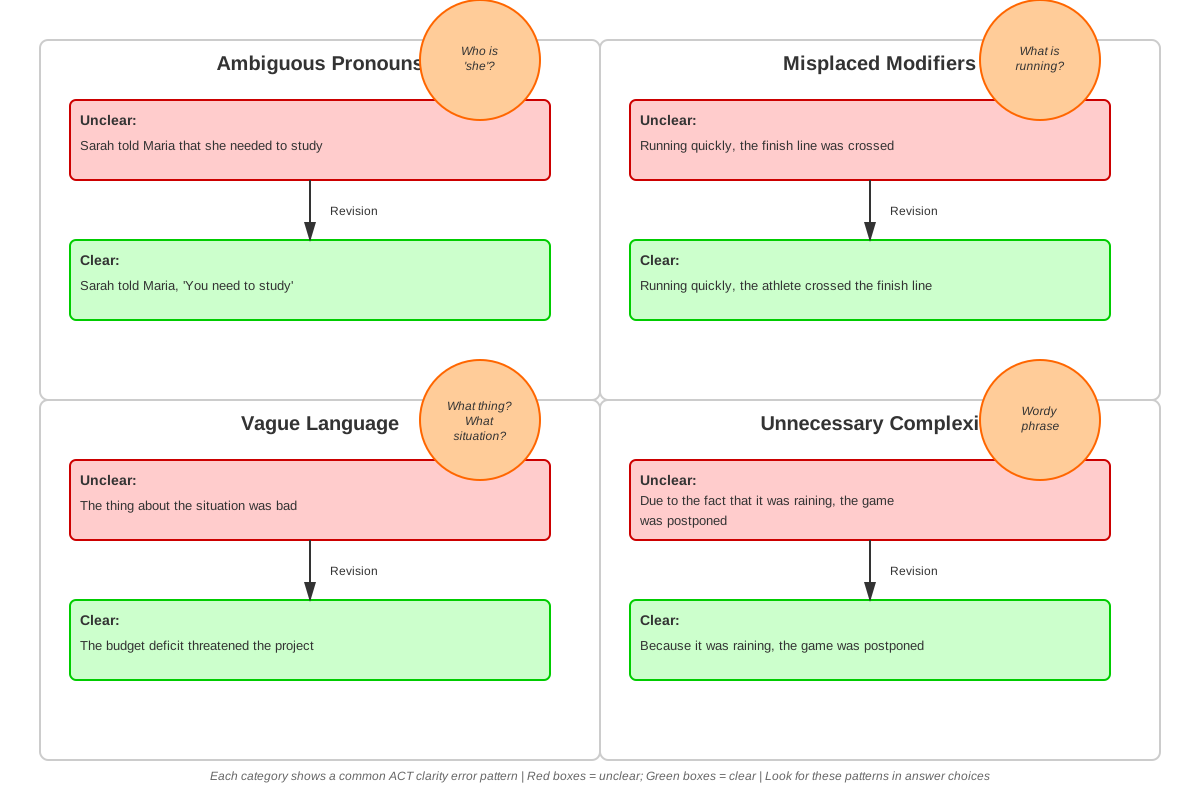
One of the most frequently tested clarity issues involves ambiguous pronoun references—situations where a pronoun (it, they, this, that, which, he, she) could logically refer to more than one noun in the sentence or preceding context. Consider this example: "Sarah told Jennifer that she needed to revise her essay." The pronouns "she" and "her" could refer to either Sarah or Jennifer, creating ambiguity about who needs to revise whose essay.
The ACT tests this concept by including answer choices with unclear pronoun references and expecting students to select revisions that either replace the pronoun with a specific noun or restructure the sentence to eliminate ambiguity. The key strategy is to identify every pronoun and verify that it has one clear, unambiguous antecedent. When multiple nouns could serve as the antecedent, the writing lacks clarity.
| Clear Writing | Unclear Writing |
|---|---|
| Sarah told Jennifer that Jennifer needed to revise her essay. | Sarah told Jennifer that she needed to revise her essay. |
| The committee approved the proposal, which surprised everyone. | The committee approved the proposal, and this surprised everyone. |
| After examining the data, the researchers concluded that the hypothesis was incorrect. | After examining the data, they concluded that it was incorrect. |
Misplaced and Dangling Modifiers
Modifiers are words or phrases that describe or provide additional information about other words. Clarity requires that modifiers be placed immediately next to the words they modify. When modifiers are misplaced or dangling, they create confusion or unintentionally humorous meanings.
A misplaced modifier is positioned too far from the word it modifies, creating ambiguity about what is being described: "The student submitted the essay to the teacher that was full of errors." Does this mean the teacher was full of errors, or the essay? Clear writing would state: "The student submitted the essay that was full of errors to the teacher."
A dangling modifier occurs when the word being modified is not actually present in the sentence: "Walking to school, the rain started falling." This sentence suggests the rain was walking to school. The clear version includes the actual subject: "Walking to school, I noticed the rain started falling" or "As I walked to school, the rain started falling."
The ACT frequently tests modifier placement by presenting sentences where modifiers are separated from their intended targets or where the logical subject of a modifying phrase is missing entirely. The correct answer repositions the modifier or adds the missing subject to restore clarity.
Vague and Imprecise Word Choice
Clarity demands precise word choice—selecting words that convey exact meanings rather than vague approximations. Words like "thing," "stuff," "good," "bad," "nice," and "interesting" are often too general to communicate specific ideas. Similarly, phrases like "a lot," "some," "many," and "various" lack precision compared to specific quantities or descriptions.
The ACT tests this by offering answer choices that range from vague to specific. For example, instead of "The experiment had good results," clear writing would specify: "The experiment increased efficiency by 23%." Instead of "There were many people at the event," precision requires: "Over 500 people attended the event."
Pronouns like "this," "that," "it," and "which" can also create vagueness when they refer to entire ideas or clauses rather than specific nouns. Clear writing either replaces these pronouns with specific nouns or restructures sentences to eliminate ambiguity.
Unnecessary Complexity and Wordiness
While not identical to clarity, conciseness strongly supports it. Unnecessarily complex sentence structures and wordy expressions obscure meaning by burying the main idea in excessive language. The ACT rewards straightforward expression that communicates ideas efficiently.
Common wordiness patterns that reduce clarity include:
- Redundant pairs: "past history," "future plans," "end result," "completely eliminate"
- Wordy phrases: "due to the fact that" (because), "in the event that" (if), "at this point in time" (now)
- Passive voice when active voice is clearer: "The ball was thrown by John" versus "John threw the ball"
- Unnecessary qualifiers: "really," "very," "quite," "somewhat," "rather"
The clearest answer choice typically expresses the idea in the fewest words without sacrificing meaning or grammatical correctness. However, clarity always takes precedence over brevity—if a slightly longer option is significantly clearer, it is the correct choice.
Logical Sentence Structure
Clarity requires that sentence structure reflects the logical relationships between ideas. Parallel structure, appropriate subordination, and clear cause-and-effect relationships all contribute to clarity by making the connections between ideas immediately apparent.
Parallel structure means that items in a list or comparison use the same grammatical form: "She enjoys reading, writing, and hiking" (all gerunds) rather than "She enjoys reading, to write, and hikes" (mixed forms). The ACT tests parallelism because violations create confusion about whether items are truly equivalent.
Appropriate subordination means using sentence structure to show which ideas are main points and which are supporting details. Clear writing uses independent clauses for main ideas and dependent clauses or phrases for subordinate information. When all ideas are presented as independent clauses connected by "and," the relationships between them become unclear.
Concept Relationships
Clarity serves as the overarching goal that connects multiple writing concepts tested on the ACT. Pronoun-antecedent agreement (prerequisite knowledge) directly supports clarity by ensuring pronouns refer unambiguously to their antecedents. When agreement is correct but the reference is still ambiguous (multiple possible antecedents), clarity principles guide the revision.
Modifier placement (prerequisite knowledge) becomes a clarity issue when modifiers are positioned incorrectly. The grammatical rule about modifier placement exists specifically to maintain clarity—modifiers must be next to what they modify so readers immediately understand the relationship.
Conciseness and clarity work together synergistically: concise writing is often clearer because it eliminates distracting wordiness, but clarity takes precedence when brevity would sacrifice meaning. The relationship flows: Conciseness → supports → Clarity → enables → Effective Communication.
Word choice and diction directly impact clarity through precision. Vague words reduce clarity; specific words enhance it. This relationship extends to tone and style, where appropriate formality and consistency contribute to overall clarity of communication.
Sentence structure and syntax provide the framework for clarity. Logical structure → clear relationships between ideas → enhanced clarity. Complex sentences can be clear if properly structured, while simple sentences can be unclear if poorly constructed.
The relationship map: Precise Word Choice + Unambiguous References + Logical Structure + Appropriate Modifiers → Clarity → Effective Communication → Higher ACT Scores
Quick check — test yourself on Clarity so far.
Try Flashcards →High-Yield Facts
⭐ Clarity questions account for approximately 15-20% of ACT English section questions, making them among the most frequently tested concepts
⭐ When a pronoun could refer to more than one noun, the writing lacks clarity and requires revision
⭐ Modifiers must be placed immediately next to the words they modify to maintain clarity
⭐ The clearest answer choice is typically the most direct and specific expression of the idea
⭐ Vague pronouns like "this," "that," and "it" often create clarity problems when they refer to entire ideas rather than specific nouns
- Dangling modifiers occur when the word being modified is not present in the sentence, creating confusion about what is being described
- Parallel structure enhances clarity by using consistent grammatical forms for equivalent ideas
- Passive voice often reduces clarity by obscuring who performed an action
- Redundant expressions and wordy phrases reduce clarity by burying the main idea in unnecessary language
- The ACT essay rubric explicitly rewards clarity in the Language Use and Conventions domain
- Clear writing allows readers to understand the intended meaning on first reading without confusion or ambiguity
- Specific nouns are clearer than vague pronouns; concrete details are clearer than general statements
- When multiple answer choices are grammatically correct, the clearest option is correct
Common Misconceptions
Misconception: Longer, more complex sentences are more sophisticated and therefore better for ACT Writing.
Correction: The ACT consistently rewards clear, direct expression over unnecessary complexity. While complex sentences are sometimes appropriate for expressing complex ideas, clarity always takes precedence. A simple, clear sentence is superior to a complex, confusing one.
Misconception: If a pronoun agrees with its antecedent in number and gender, the reference is automatically clear.
Correction: Agreement is necessary but not sufficient for clarity. A pronoun can agree grammatically with multiple possible antecedents, creating ambiguity. Clear writing requires that each pronoun have one unambiguous referent, even when multiple nouns match in number and gender.
Misconception: Using "this" or "that" to refer to a previous idea is always acceptable because readers can figure out the reference from context.
Correction: While readers may be able to infer the intended meaning, requiring them to do so represents a clarity failure. The ACT expects writing where meaning is immediately apparent, not writing that requires interpretation. Vague pronoun references should be replaced with specific nouns or restructured for clarity.
Misconception: The shortest answer choice is always correct on clarity questions.
Correction: While the ACT does reward conciseness, clarity is the primary goal. Sometimes a slightly longer answer choice is clearer because it includes necessary specificity or eliminates ambiguity. The correct answer is the clearest option, which is usually but not always the shortest.
Misconception: As long as the sentence is grammatically correct, clarity is not an issue.
Correction: Grammar and clarity are related but distinct concepts. A sentence can be grammatically perfect yet unclear due to ambiguous references, misplaced modifiers, vague word choices, or illogical structure. The ACT tests both grammar and clarity, and clarity questions specifically assess effective communication beyond mere grammatical correctness.
Misconception: Passive voice is always wrong and should never be used.
Correction: Passive voice is grammatically correct and sometimes appropriate, particularly when the actor is unknown or unimportant. However, passive voice often reduces clarity by obscuring who performed an action. The ACT expects students to recognize when active voice would be clearer and to choose it in those situations, not to eliminate passive voice entirely.
Worked Examples
Example 1: Ambiguous Pronoun Reference
Original Passage: "The museum curator met with the artist before the exhibition opened. She expressed concerns about the lighting in the gallery."
Question: Which revision of the underlined portion most clearly expresses who had concerns about the lighting?
A. NO CHANGE
B. The curator expressed
C. She, the curator, expressed
D. Having met, she expressed
Solution Process:
Step 1: Identify the clarity issue. The pronoun "She" could refer to either "the museum curator" or "the artist," creating ambiguity about who expressed concerns.
Step 2: Evaluate each answer choice for clarity.
- Choice A (NO CHANGE) maintains the ambiguous pronoun reference—unclear
- Choice B replaces the pronoun with the specific noun "The curator"—clear and direct
- Choice C attempts to clarify by adding an appositive, but the structure is awkward and still begins with the ambiguous pronoun
- Choice D introduces a dangling modifier and maintains the unclear pronoun
Step 3: Select the clearest option. Choice B eliminates ambiguity by replacing the pronoun with a specific noun, making it immediately clear who expressed concerns.
Correct Answer: B
Connection to Learning Objectives: This example demonstrates how to identify when clarity is being tested (ambiguous pronoun reference), explains the core strategy (replace ambiguous pronouns with specific nouns), and applies the principle to select the clearest revision.
Example 2: Misplaced Modifier
Original Passage: "The researcher presented findings about climate change to the committee that were groundbreaking."
Question: Which revision most clearly expresses the intended meaning?
F. NO CHANGE
G. The researcher presented groundbreaking findings about climate change to the committee.
H. The researcher presented findings to the committee about climate change that were groundbreaking.
J. To the committee, the researcher presented findings about climate change that were groundbreaking.
Solution Process:
Step 1: Identify the clarity issue. The phrase "that were groundbreaking" is positioned immediately after "the committee," suggesting the committee was groundbreaking rather than the findings. This is a misplaced modifier.
Step 2: Determine what the modifier should describe. The intended meaning is that the findings (not the committee) were groundbreaking.
Step 3: Evaluate each answer choice.
- Choice F (NO CHANGE) maintains the misplaced modifier—unclear
- Choice G repositions "groundbreaking" as an adjective directly before "findings," making the relationship immediately clear
- Choice H moves "that were groundbreaking" but still places it after "climate change," creating potential ambiguity about whether climate change or findings were groundbreaking
- Choice J maintains the same structural problem as the original, just with reordered elements
Step 4: Select the clearest option. Choice G places the modifier immediately next to what it modifies, eliminating all ambiguity.
Correct Answer: G
Connection to Learning Objectives: This example shows how to recognize clarity testing through modifier placement, explains the strategy of positioning modifiers next to what they modify, and demonstrates application to ACT-style questions.
Exam Strategy
Approaching Clarity Questions
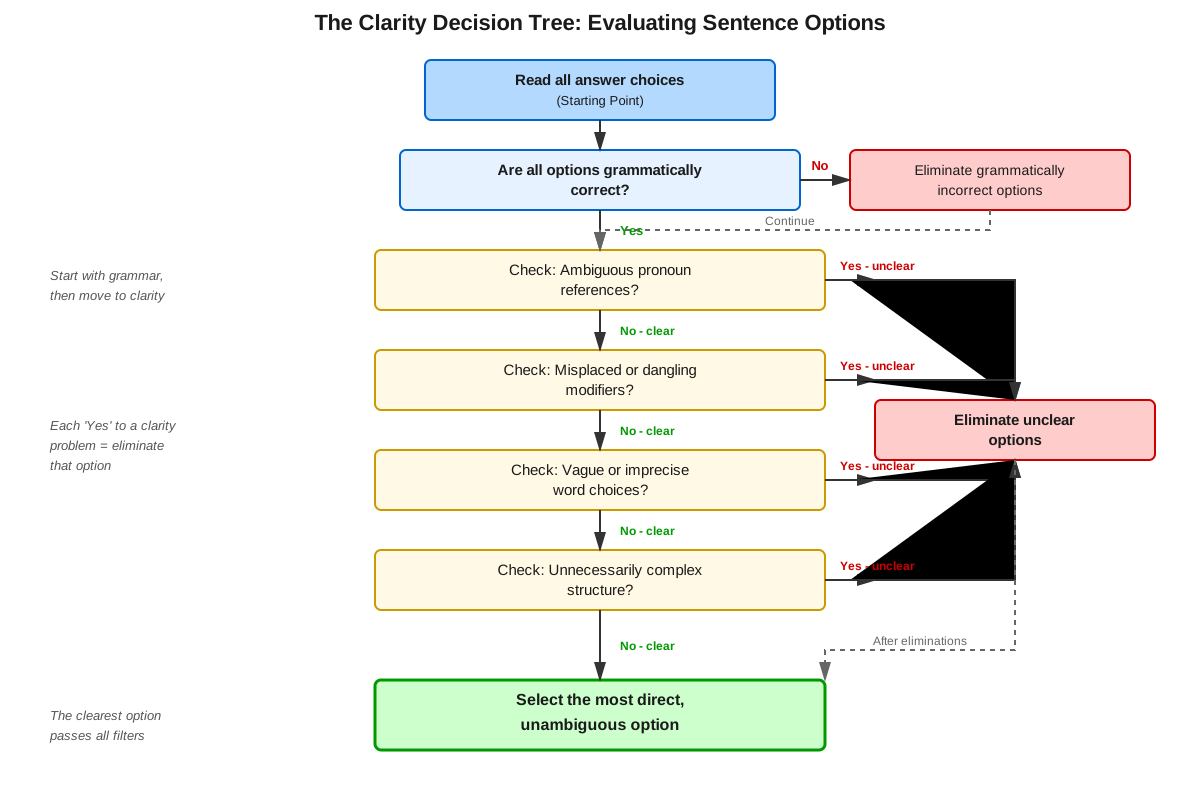
When encountering a potential clarity question on the ACT, follow this systematic approach:
- Read the sentence carefully and identify whether you understand the meaning immediately. If you need to re-read or pause to interpret, clarity is likely being tested.
- Look for trigger words and structures that commonly indicate clarity issues:
- Pronouns: it, they, this, that, which, he, she, their
- Modifying phrases at the beginning of sentences
- Passive voice constructions
- Vague words: thing, stuff, good, bad, nice, interesting
- Complex sentence structures with multiple clauses
- Identify the specific clarity problem:
- Can any pronoun refer to multiple nouns?
- Is any modifier separated from what it modifies?
- Are any words vague or imprecise?
- Is the sentence structure unnecessarily complex?
- Evaluate all answer choices by asking: "Which option makes the meaning immediately clear to a reader encountering this sentence for the first time?"
Process of Elimination Tips
- Eliminate choices with ambiguous pronoun references first. If a pronoun could refer to multiple nouns, that choice is incorrect.
- Eliminate choices with misplaced or dangling modifiers. If a modifying phrase doesn't clearly connect to the word it modifies, eliminate it.
- Eliminate unnecessarily wordy or complex options when a simpler choice expresses the same meaning clearly.
- Keep choices that use specific nouns instead of vague pronouns, concrete details instead of general statements, and active voice instead of passive voice (when appropriate).
- Between two grammatically correct options, choose the clearer one. The ACT rewards effective communication, not just grammatical accuracy.
Time Allocation
Clarity questions typically require 20-30 seconds each. Spend the first 10 seconds identifying the clarity issue, then 10-20 seconds evaluating answer choices. If you cannot identify a clear problem, the answer may be "NO CHANGE," but verify this by checking for subtle ambiguities. Don't rush—clarity questions reward careful reading and thoughtful evaluation.
Memory Techniques
CLEAR Acronym for Evaluating Clarity
Check pronouns for ambiguous references
Locate modifiers next to what they modify
Eliminate vague and imprecise words
Avoid unnecessary complexity and wordiness
Read to verify immediate understanding
Visualization Strategy
Picture yourself as a reader encountering the sentence for the first time with no context. Can you draw a clear mental picture of what's happening? If you have to guess or interpret, clarity is lacking. This "first-time reader test" helps identify ambiguity that familiarity might otherwise mask.
The "Point and Ask" Technique
For pronoun clarity, point to each pronoun and ask: "What specific noun does this refer to?" If you can point to only one noun, the reference is clear. If you could point to multiple nouns, the reference is ambiguous and requires revision.
Modifier Proximity Rule
Remember: "Modifiers are magnets—they stick to the nearest noun." If a modifier is next to the wrong noun, the meaning becomes confused. Visualize modifiers as magnetic words that must be positioned next to their intended targets.
Summary
Clarity represents the fundamental goal of all writing: communicating meaning so effectively that readers understand immediately without confusion, ambiguity, or need for interpretation. On the ACT, clarity is tested through questions involving ambiguous pronoun references, misplaced or dangling modifiers, vague word choices, unnecessary complexity, and illogical sentence structures. The test consistently rewards clear, direct, specific expression over grammatically correct but confusing alternatives. Mastering clarity requires developing the ability to identify when pronouns lack clear antecedents, when modifiers are separated from what they modify, when word choices are imprecise, and when sentence structures obscure rather than illuminate meaning. The core strategy involves reading as a first-time reader would, identifying specific clarity problems, and selecting revisions that make meaning immediately apparent through precise language, logical structure, and unambiguous references. Success on clarity questions translates directly to higher scores on both the English section and the essay, as clarity is explicitly evaluated in the Language Use and Conventions domain of the writing rubric.
Key Takeaways
- Clarity is tested in approximately 15-20% of ACT English questions and is explicitly evaluated in essay scoring
- Ambiguous pronoun references occur when a pronoun could refer to multiple nouns; replace pronouns with specific nouns to restore clarity
- Modifiers must be placed immediately next to the words they modify to prevent confusion about what is being described
- The clearest answer choice uses specific rather than vague language, direct rather than complex structures, and unambiguous rather than confusing references
- When multiple answer choices are grammatically correct, select the one that communicates meaning most clearly and directly
- Clarity takes precedence over brevity—a slightly longer option that eliminates ambiguity is superior to a shorter but unclear alternative
- Apply the "first-time reader test": if you need to re-read or interpret to understand meaning, clarity is lacking and revision is needed
Related Topics
Conciseness and Wordiness: While clarity focuses on unambiguous communication, conciseness addresses eliminating unnecessary words. These topics work together, as concise writing is often clearer, but mastering clarity provides the foundation for understanding when brevity enhances versus when it sacrifices meaning.
Pronoun-Antecedent Agreement: This grammatical concept ensures pronouns match their antecedents in number and gender, which is necessary but not sufficient for clarity. Mastering clarity builds on agreement knowledge by addressing ambiguous references even when agreement is correct.
Sentence Structure and Syntax: Understanding how to construct and revise complex sentences supports clarity by enabling recognition of when structure enhances versus obscures meaning. Clarity principles guide decisions about sentence construction.
Word Choice and Diction: Selecting precise, appropriate words directly impacts clarity. Mastering clarity provides the framework for evaluating word choices based on how effectively they communicate specific meanings.
Essay Organization and Development: Clear writing at the sentence level (this topic) supports clear organization at the paragraph and essay level, making progression to broader organizational concepts more effective.
Practice CTA
Now that you understand the principles of clarity and how they're tested on the ACT, it's time to apply this knowledge! Work through the practice questions to reinforce your ability to identify clarity issues, evaluate revision options, and select the clearest expression of ideas. Each practice question provides an opportunity to strengthen the skills that will earn you points on test day. Remember: clarity is one of the highest-yield topics on the ACT English section—mastering it will significantly improve your score. Review the flashcards to cement key concepts, then tackle the practice questions with confidence. You've got this!
Sign up free to keep reading
Create a free AnvayaPrep account to finish this ACT guide on Clarity — plus flashcards and practice questions.