Overview
Adding supporting details is a critical rhetorical skill tested extensively on the ACT English section. This concept evaluates a student's ability to recognize when a passage needs additional information to strengthen its argument, clarify a point, or provide necessary context for readers. Unlike grammar-focused questions, ACT adding supporting details questions assess whether students can identify what information would best enhance the effectiveness and coherence of a written passage.
On the ACT, these questions typically present a sentence or paragraph and ask whether additional information should be added, and if so, which option provides the most relevant and effective support. Students must evaluate whether proposed additions genuinely strengthen the passage or merely introduce tangential information that distracts from the main point. This skill reflects real-world writing demands where effective communication requires knowing not just what to say, but what additional evidence, examples, or explanations will make arguments more persuasive and ideas more accessible.
This topic connects directly to other rhetorical skills including organization, transitions, and purpose. Understanding when and how to add supporting details requires recognizing the passage's main idea, identifying gaps in logic or explanation, and evaluating relevance—skills that underpin effective writing across all contexts. Mastery of this concept significantly impacts ACT English scores, as these questions appear frequently and often challenge students who focus exclusively on grammar rules while neglecting rhetorical effectiveness.
Learning Objectives
- [ ] Identify when Adding supporting details is being tested
- [ ] Explain the core rule or strategy behind Adding supporting details
- [ ] Apply Adding supporting details to ACT-style questions accurately
- [ ] Evaluate whether proposed supporting details are relevant to the passage's main idea
- [ ] Distinguish between effective supporting details and tangential information
- [ ] Recognize the specific types of support (examples, evidence, explanations) that different passages require
- [ ] Determine the appropriate placement for supporting details within a passage
Prerequisites
- Understanding of main idea and topic sentences: Recognizing the central point of a paragraph is essential for determining what details would support it
- Basic paragraph structure knowledge: Familiarity with how paragraphs develop ideas helps identify where additional support is needed
- Reading comprehension skills: The ability to understand passage content and author's purpose is necessary for evaluating relevance
- Awareness of rhetorical purpose: Understanding why authors write (to inform, persuade, entertain) guides decisions about what details strengthen their goals
Why This Topic Matters
In real-world writing, the difference between a compelling argument and an unconvincing one often lies in the quality and relevance of supporting details. Professional writers, journalists, academics, and business communicators must constantly decide what information to include to make their points clear and persuasive. This skill translates directly to college writing, where professors expect students to support claims with appropriate evidence and examples.
On the ACT English section, adding supporting details questions appear in approximately 10-15% of all questions, making them one of the most frequently tested rhetorical skills. These questions typically appear 3-5 times per test, and they're often among the questions that separate high scorers from average performers. Students who excel at grammar rules but struggle with rhetorical skills frequently miss these questions, limiting their composite English scores.
These questions commonly appear in several formats: asking whether a sentence should be added at a specific point, requesting the best example to support a claim, or questioning whether additional information would strengthen a paragraph. The passages may be narrative, expository, or persuasive, and the supporting details might take the form of specific examples, statistical evidence, explanatory information, or illustrative anecdotes. Understanding this variety is crucial for consistent performance.
Core Concepts
What Are Supporting Details?
Supporting details are specific pieces of information that develop, illustrate, explain, or provide evidence for a main idea or claim. In effective writing, every paragraph contains a central point, and supporting details give that point substance and credibility. These details answer questions readers naturally ask: "What do you mean?" "Can you give an example?" "How do you know?" or "Why should I believe this?"
On the ACT, supporting details questions test whether students can recognize when a passage would benefit from additional information and identify which specific details would be most effective. The test distinguishes between details that genuinely support the passage's purpose and those that might be interesting but ultimately distract from the main point.
Types of Supporting Details
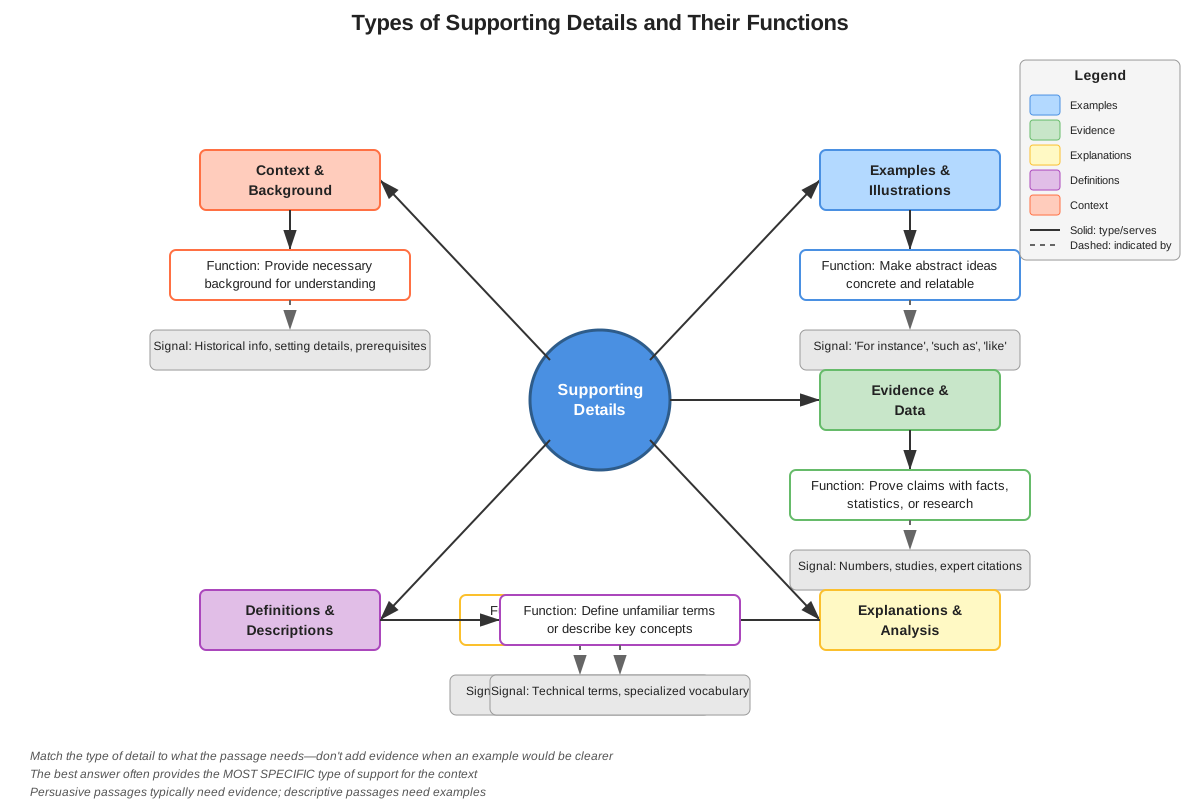
Different passages require different types of support, and recognizing these categories helps students select the most appropriate additions:
| Type of Support | Purpose | Best Used When | Example Context |
|---|---|---|---|
| Specific Examples | Illustrate abstract concepts with concrete instances | The passage makes general claims | "For instance, the 1969 moon landing demonstrated..." |
| Statistical Evidence | Provide quantifiable proof | The passage makes factual claims requiring verification | "Studies show that 73% of participants..." |
| Expert Testimony | Add credibility through authority | The passage discusses specialized topics | "According to Dr. Martinez, a leading climatologist..." |
| Explanatory Information | Clarify complex ideas | The passage introduces unfamiliar concepts | "Photosynthesis, the process by which plants convert light to energy..." |
| Anecdotal Details | Make ideas relatable through stories | The passage aims to connect emotionally with readers | "When Sarah first attempted the recipe..." |
| Comparative Information | Help readers understand through analogy | The passage introduces novel concepts | "Similar to how a thermostat regulates temperature..." |
The Relevance Test
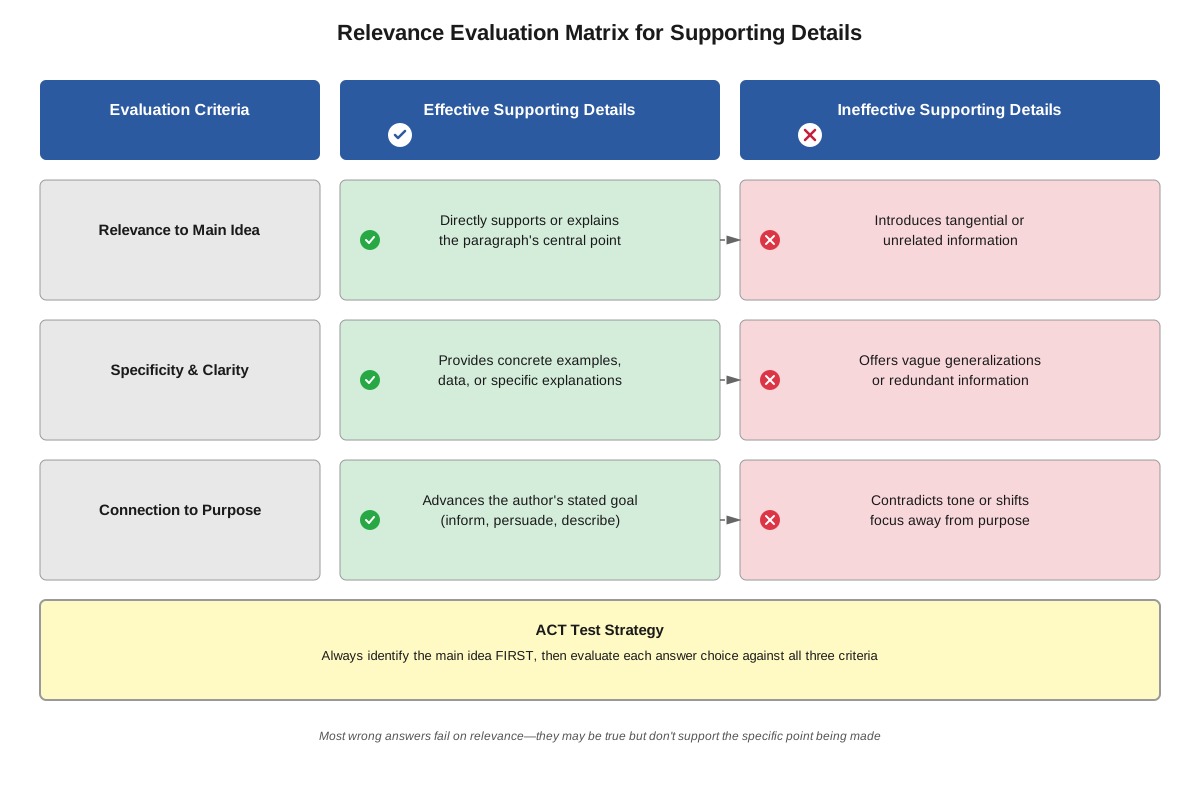
The most critical skill for adding supporting details questions is evaluating relevance. A detail is relevant only if it directly supports the specific point being made in that section of the passage. The ACT frequently includes wrong answer choices that contain accurate, interesting information that nonetheless fails the relevance test.
To evaluate relevance, students should ask:
- What is the main point of this paragraph or section?
- Does this detail directly support, explain, or illustrate that specific point?
- Would removing this detail leave a gap in understanding, or would the passage work just as well without it?
- Does this detail answer a question the reader would naturally have at this point?
When to Add vs. When to Omit
Not every question about adding details has "yes" as the correct answer. The ACT tests whether students can recognize when additional information would genuinely improve a passage versus when it would be redundant, tangential, or disruptive to the flow.
Add supporting details when:
- A claim is made without evidence or examples
- A technical term is introduced without explanation
- The passage makes a logical leap that needs bridging
- The main idea would be clearer with illustration
- The passage's purpose requires more persuasive support
Omit additional details when:
- The proposed detail repeats information already stated
- The detail relates to a different topic than the paragraph's focus
- The detail contradicts the passage's tone or purpose
- The information is too general to add meaningful support
- The detail disrupts the logical flow of ideas
Placement Considerations
Even when a supporting detail is relevant and valuable, its placement matters significantly. The ACT tests whether students recognize where in a passage a detail would be most effective. Generally, supporting details should appear:
- Immediately after the claim they support: This creates clear cause-and-effect relationships in readers' minds
- Before a conclusion: Evidence should precede the conclusions drawn from it
- Within the paragraph discussing the relevant topic: Details should not be separated from their context
- In logical sequence: When multiple details support a point, they should follow a coherent order (chronological, importance-based, or categorical)
Question Format Recognition
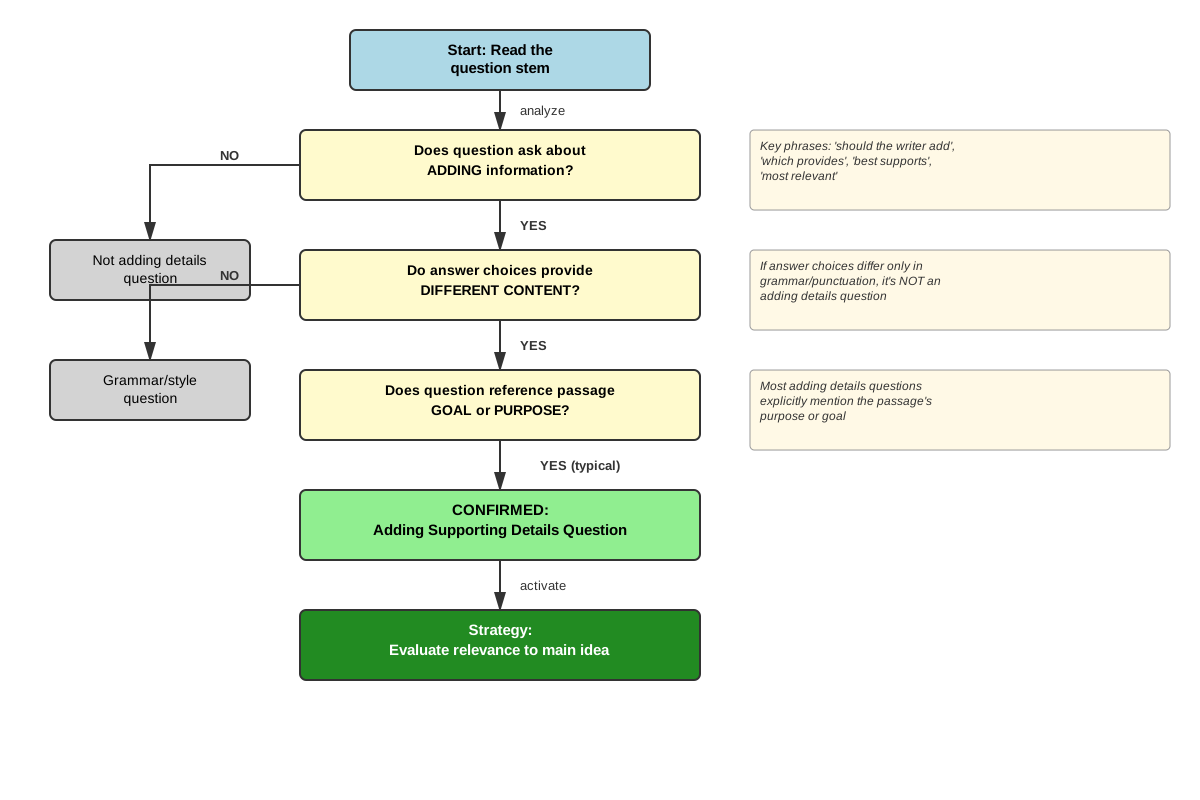
ACT adding supporting details questions typically follow predictable formats:
- "Should the writer add the following sentence?" followed by a proposed sentence and answer choices explaining why or why not
- "Which choice provides the most specific and relevant detail?" with four options of varying specificity and relevance
- "At this point, the writer is considering adding the following..." with yes/no options and justifications
- "Which choice best supports the statement made in the previous sentence?" requiring selection of appropriate evidence
Recognizing these formats helps students quickly identify what the question is testing and apply the appropriate evaluation strategy.
Concept Relationships
The skill of adding supporting details connects intimately with several other rhetorical and organizational concepts. Main idea identification serves as the foundation—students cannot evaluate whether a detail supports the main point without first recognizing what that point is. This relationship flows directly: Main Idea Recognition → Relevance Evaluation → Supporting Detail Selection.
Transitions and logical flow connect closely because supporting details must integrate smoothly into existing text. A perfectly relevant detail poorly placed disrupts coherence, making transition skills essential. The relationship works bidirectionally: effective supporting details often require transitional phrases, while good transitions help readers understand how details connect to main ideas.
Purpose and audience awareness determines what types of supporting details are appropriate. A passage written to persuade requires different support (evidence, expert testimony) than one written to entertain (anecdotes, vivid descriptions). This creates a hierarchical relationship: Purpose → Appropriate Detail Type → Specific Detail Selection.
Within the topic itself, concepts build progressively: Understanding Detail Types → Applying the Relevance Test → Evaluating Placement → Making Final Decisions. Each step depends on the previous one, creating a decision-making framework students can apply systematically to every question.
High-Yield Facts
⭐ Supporting details questions appear 3-5 times per ACT English test, making them high-frequency question types
⭐ The most common wrong answers are details that are factually accurate but irrelevant to the specific paragraph's focus
⭐ "Yes" and "No" answers appear with roughly equal frequency—don't assume adding information is always correct
⭐ Specific details (names, numbers, concrete examples) are almost always better than general statements
⭐ If a proposed detail repeats information already in the passage, it should not be added
- Supporting details must match the passage's tone and level of formality
- Questions often include answer choices that explain the correct decision—read these explanations carefully
- Details that introduce new topics unrelated to the paragraph's focus are always wrong
- The best supporting details answer questions readers would naturally have at that point in the passage
⭐ When evaluating placement, supporting details should appear in the same paragraph as the idea they support
- Statistical evidence and expert testimony are strongest for persuasive or informative passages
- Anecdotal details work best in narrative passages or when making abstract ideas relatable
- If you cannot identify what main idea a detail supports, it probably shouldn't be added
- The ACT values conciseness—details must add meaningful value, not just more words
- Supporting details should create logical bridges between ideas, not disrupt the flow
Quick check — test yourself on Adding supporting details so far.
Try Flashcards →Common Misconceptions
Misconception: More information is always better, so when asked whether to add a sentence, "yes" is usually correct.
Correction: The ACT tests discernment, not verbosity. Approximately half of adding details questions have "no" as the correct answer because the proposed detail is irrelevant, redundant, or disruptive. Quality and relevance matter far more than quantity.
Misconception: If a detail is factually accurate and interesting, it should be added to the passage.
Correction: Accuracy and interest are necessary but insufficient criteria. A detail must directly support the specific point being made in that section. A fascinating fact about a tangentially related topic will be a wrong answer choice.
Misconception: Supporting details should always be placed at the end of paragraphs as conclusions.
Correction: Supporting details should appear immediately after the claims they support, which might be at the beginning, middle, or end of a paragraph. Evidence precedes conclusions, and explanations follow the terms they clarify.
Misconception: General statements provide better support than specific examples because they're more comprehensive.
Correction: The ACT consistently favors specific, concrete details over general statements. "The program increased participation by 47%" is better support than "The program was very successful."
Misconception: If a proposed detail relates to the passage's overall topic, it's relevant enough to add.
Correction: Details must support the specific point of the particular paragraph or section, not just the general topic. A passage about climate change might have one paragraph about causes and another about effects—a detail about causes would be irrelevant in the effects paragraph, even though both relate to climate change.
Misconception: The longest, most detailed answer choice is usually correct for supporting detail questions.
Correction: Length doesn't equal quality. The ACT often includes verbose wrong answers that contain irrelevant information. The correct answer provides the most relevant support, which might be concise.
Misconception: Supporting details are only needed in persuasive writing, not narrative or descriptive passages.
Correction: All passage types benefit from appropriate supporting details. Narratives need specific details to create vivid scenes, descriptive passages need sensory details, and expository passages need explanatory information. The type of support varies, but the need for it doesn't.
Worked Examples
Example 1: Evaluating Whether to Add a Detail
Passage Context:
"The Mediterranean diet has gained popularity among health-conscious Americans. [1] This eating pattern emphasizes fruits, vegetables, whole grains, and olive oil while limiting red meat and processed foods."
Question:
At this point, the writer is considering adding the following sentence:
"The Mediterranean Sea borders several European and African countries, including Italy, Greece, and Morocco."
Should the writer make this addition here?
A. Yes, because it provides geographical context for understanding the diet's origins.
B. Yes, because it adds specific examples of countries.
C. No, because it distracts from the paragraph's focus on the diet's characteristics.
D. No, because the information contradicts the previous sentence.
Solution Process:
Step 1: Identify the paragraph's main idea.
The paragraph focuses on what the Mediterranean diet consists of—its characteristics and food components.
Step 2: Evaluate the proposed detail's relevance.
The proposed sentence provides geographical information about the Mediterranean Sea and surrounding countries. While this relates to the diet's name, it doesn't support the paragraph's focus on the diet's characteristics.
Step 3: Apply the relevance test.
Ask: "Does this detail help readers understand the diet's characteristics better?" No—knowing which countries border the Mediterranean Sea doesn't clarify what foods the diet includes or why it's popular.
Step 4: Eliminate wrong answers.
- A is incorrect because while the detail does provide geographical context, that context isn't relevant to this paragraph's purpose
- B is incorrect for the same reason—specificity doesn't equal relevance
- D is incorrect because the detail doesn't contradict anything; it's simply irrelevant
Correct Answer: C
The detail should not be added because it introduces geographical information that distracts from the paragraph's focus on the diet's food components and health benefits. This exemplifies how factually accurate, specific information can still be the wrong choice if it doesn't support the paragraph's specific point.
Example 2: Selecting the Best Supporting Detail
Passage Context:
"Urban gardens provide numerous benefits to city communities. They create green spaces in concrete environments, offer opportunities for physical activity, and foster social connections among neighbors. [2]"
Question:
Which choice provides the most specific and relevant supporting detail for the claims made in the previous sentence?
F. Many cities across the United States have embraced urban gardening initiatives.
G. For example, a Chicago community garden reported that 78% of participants met neighbors they hadn't known before joining.
H. Gardening has been a popular hobby for centuries in various cultures.
J. Plants require sunlight, water, and nutrients to grow successfully.
Solution Process:
Step 1: Identify what needs support.
The previous sentence makes three specific claims: gardens create green spaces, offer physical activity, and foster social connections. The best supporting detail should provide evidence or examples for one or more of these claims.
Step 2: Evaluate each option's relevance and specificity.
Option F: States that cities have embraced gardening but doesn't provide evidence for any of the three specific benefits mentioned. Too general.
Option G: Provides specific statistical evidence (78% of participants) and a concrete example (Chicago garden) that directly supports the claim about fostering social connections. Highly specific and directly relevant.
Option H: Discusses gardening's historical popularity, which doesn't support any of the three specific benefits mentioned. Tangentially related but irrelevant to the paragraph's focus.
Option J: Provides general information about plant care, which doesn't support the community benefits being discussed. Wrong topic entirely.
Step 3: Apply the specificity principle.
The ACT favors concrete, specific details over general statements. Option G provides both a specific percentage and a named location, while F remains vague.
Correct Answer: G
This option provides specific, quantifiable evidence that directly supports one of the claims made in the previous sentence. It demonstrates how effective supporting details combine relevance (addressing the specific claim about social connections) with specificity (providing a percentage and location).
Exam Strategy
Systematic Approach to Adding Details Questions
When encountering these questions, follow this four-step process:
- Read the surrounding context carefully (at least 2-3 sentences before and after the proposed addition)
- Identify the paragraph's main idea and specific focus
- Evaluate the proposed detail against the relevance test
- Read all answer explanations, as they often clarify why options are right or wrong
Trigger Words and Phrases
Watch for these question stems that signal adding supporting details questions:
- "Should the writer add the following sentence?"
- "Which choice provides the most specific detail?"
- "At this point, the writer is considering adding..."
- "Which choice best supports the statement?"
- "The writer wants to add a sentence that..."
- "Which choice most effectively establishes?"
When you see these phrases, immediately shift to evaluating relevance and specificity rather than grammar rules.
Process of Elimination Strategies
Eliminate details that:
- Repeat information already stated in the passage
- Introduce topics not discussed in the surrounding paragraphs
- Are vague or general when specific options are available
- Contradict the passage's tone or purpose
- Would be better placed in a different paragraph
Favor details that:
- Include specific names, numbers, or concrete examples
- Directly answer a question raised by the previous sentence
- Match the passage's level of formality and tone
- Create logical bridges between existing ideas
- Provide evidence for claims rather than making new claims
Time Management
Adding supporting details questions typically require more reading than pure grammar questions. Budget approximately 45-60 seconds per question to:
- Read sufficient context (15-20 seconds)
- Evaluate the detail's relevance (15-20 seconds)
- Review answer choices and explanations (15-20 seconds)
Don't rush these questions—they reward careful analysis. However, if you're genuinely stuck, use the specificity principle: when choosing between options that seem equally relevant, select the most specific, concrete detail.
Exam Tip: If the question asks whether to add a detail and you're unsure, check whether the detail answers a question you had while reading the passage. If it clarifies something confusing or supports something questionable, it probably should be added. If you didn't notice its absence, it probably isn't necessary.
Memory Techniques
The RACE Acronym
Use RACE to evaluate whether to add supporting details:
- Relevance: Does it relate directly to this paragraph's specific point?
- Accuracy: Is the information correct and appropriate?
- Clarity: Does it make the passage clearer or more confusing?
- Evidence: Does it provide support rather than making new claims?
If a proposed detail passes all four criteria, it should likely be added.
The Specificity Spectrum Visualization
Imagine a spectrum from "vague" to "specific":
VAGUE ←―――――――――――――――――――――――――→ SPECIFIC
"many"        "several"      "47%"
"successful"  "improved"     "increased by 23%"
"a city"      "an urban area" "Chicago"
The ACT consistently favors the right side of this spectrum. When evaluating answer choices, visualize where each falls on this spectrum and choose the most specific option that's still relevant.
The "So What?" Test
When evaluating a proposed detail, ask "So what?" If the detail makes you think, "So what does that have to do with the point being made?" it fails the relevance test. If it makes you think, "So that's why this matters!" or "So that's what that means!" it passes.
The Paragraph Focus Frame
Visualize each paragraph as having a frame around it that defines its specific focus. Any detail that fits within that frame should be added; any detail that extends beyond it should be omitted. This mental image helps distinguish between details that relate to the general topic (outside the frame) and details that support the specific paragraph's point (inside the frame).
Summary
Adding supporting details is a high-frequency rhetorical skill on the ACT English section that tests whether students can identify when passages need additional information and select the most relevant, specific details to strengthen them. Success requires understanding that not all accurate information is relevant—details must directly support the specific point being made in that section of the passage. The ACT distinguishes between students who can apply grammar rules and those who understand effective writing by testing whether they recognize that quality supporting details answer readers' natural questions, provide concrete evidence for claims, and enhance clarity without introducing tangential information. Mastery involves systematically evaluating proposed details against relevance criteria, favoring specific over general information, and recognizing when additional information would distract rather than strengthen a passage. These questions appear 3-5 times per test and often separate high scorers from average performers, making them essential for students targeting competitive English scores.
Key Takeaways
- Supporting details must be both accurate AND relevant to the specific paragraph's focus—accuracy alone is insufficient
- Specific, concrete details (names, numbers, examples) are almost always superior to general statements
- Approximately half of "should the writer add" questions have "no" as the correct answer—don't assume more information is always better
- The best supporting details answer questions readers would naturally have at that point in the passage
- Details that repeat existing information, introduce new topics, or relate only to the general subject (not the specific paragraph) should be omitted
- Apply the RACE criteria systematically: Relevance, Accuracy, Clarity, Evidence
- Read sufficient context before and after proposed additions to understand the paragraph's specific focus, not just its general topic
Related Topics
Deleting Information: The complementary skill to adding details—recognizing when information should be removed because it's redundant, irrelevant, or disruptive. Mastering adding details provides the foundation for understanding deletion.
Organization and Transitions: Once you know what details to include, these skills help you place them effectively and connect them smoothly to surrounding text. Adding details and organization work together to create coherent passages.
Purpose and Audience: Understanding why a passage was written and who it's written for guides decisions about what types of supporting details are appropriate. This higher-level skill builds on the foundation of adding details.
Main Idea and Topic Sentences: The prerequisite skill that enables all supporting detail decisions. Strengthening main idea identification directly improves performance on adding details questions.
Precision and Concision: Advanced rhetorical skills that refine word choice and sentence structure. After mastering what information to include, these skills help express it most effectively.
Practice CTA
Now that you understand the principles behind adding supporting details, it's time to apply this knowledge! Work through the practice questions to test your ability to identify relevant supporting details and distinguish them from tangential information. The flashcards will help you internalize the key criteria for evaluating whether details should be added. Remember: these questions reward careful analysis and systematic thinking. Each practice question you complete strengthens your ability to recognize patterns and make confident decisions on test day. You've built the foundation—now practice applying it until these strategies become automatic!
Sign up free to keep reading
Create a free AnvayaPrep account to finish this ACT guide on Adding supporting details — plus flashcards and practice questions.