Overview
Precision in ACT Writing refers to the ability to choose the most exact, specific, and appropriate word or phrase to convey meaning clearly and effectively. On the ACT English test, precision questions assess whether students can identify and select language that communicates ideas with accuracy, avoiding vagueness, redundancy, or inappropriate word choice. These questions frequently appear in the Rhetorical Skills portion of the exam, where students must evaluate whether a word, phrase, or sentence accomplishes a specific communicative goal.
Understanding ACT precision is essential because approximately 10-15% of ACT English questions directly test word choice and precision. These questions require students to distinguish between words that may seem similar but carry different connotations, levels of specificity, or contextual appropriateness. Mastering precision helps students not only answer these direct questions correctly but also improves their overall writing quality, which is crucial for the optional ACT Writing test essay.
Precision connects intimately with other Writing concepts such as conciseness, style, and tone. While conciseness focuses on eliminating unnecessary words, precision ensures that the words retained are exactly right for the context. Similarly, while style encompasses the overall voice and approach of a passage, precision operates at the micro level, ensuring each individual word choice supports the intended meaning and tone. Together, these concepts form the foundation of effective written communication that the ACT seeks to measure.
Learning Objectives
- [ ] Identify when Precision is being tested in ACT English questions
- [ ] Explain the core rule or strategy behind Precision in word choice
- [ ] Apply Precision to ACT-style questions accurately
- [ ] Distinguish between words with similar meanings but different connotations or levels of specificity
- [ ] Evaluate whether a word choice matches the tone and context of a passage
- [ ] Recognize and eliminate imprecise, vague, or redundant language
- [ ] Select the most appropriate word from multiple options based on contextual clues
Prerequisites
- Basic vocabulary knowledge: Understanding common English words and their definitions is essential for distinguishing between similar word choices
- Reading comprehension skills: Students must understand passage context to determine which word choice best fits the intended meaning
- Grammar fundamentals: Recognizing parts of speech helps identify when a word functions correctly in a sentence structure
- Understanding of connotation vs. denotation: Knowing that words carry emotional associations beyond their dictionary definitions is crucial for precision questions
Why This Topic Matters
Precision in language is fundamental to effective communication in academic, professional, and personal contexts. In college writing, professors expect students to choose words that convey exact meanings rather than approximate ones. In professional settings, imprecise language can lead to misunderstandings, errors, and lost opportunities. The ability to select the right word demonstrates sophisticated thinking and attention to detail.
On the ACT English test, precision questions appear with high frequency—typically 6-8 questions per test out of 75 total English questions. These questions appear in various formats: some ask students to choose between four word options (including "NO CHANGE"), while others require evaluating whether a particular word or phrase accomplishes a stated goal. Precision questions often overlap with questions testing style, tone, and word choice, making them multi-dimensional assessment points.
Common manifestations of precision testing on the ACT include: selecting between synonyms with different connotations (such as "childish" vs. "youthful"), choosing words with appropriate levels of specificity (such as "vehicle" vs. "sedan"), eliminating redundant expressions (such as "past history" or "future plans"), and matching vocabulary to the formality level of the passage. The ACT frequently embeds precision questions within passages about science, history, personal narratives, and social issues, requiring students to adapt their word choice to diverse contexts and audiences.
Core Concepts
Defining Precision in Writing
Precision means selecting words that convey exactly the intended meaning with appropriate specificity, connotation, and contextual fit. Precise language eliminates ambiguity and ensures readers understand exactly what the writer means. On the ACT, precision questions test whether students can identify when a word is too vague, too specific, carries the wrong connotation, or simply doesn't fit the context.
The foundation of precision rests on three pillars: specificity (how detailed or general a word is), connotation (the emotional or cultural associations a word carries), and contextual appropriateness (whether a word fits the tone, audience, and purpose of the passage). Each pillar plays a distinct role in determining whether a word choice is precise.
Specificity and Level of Detail
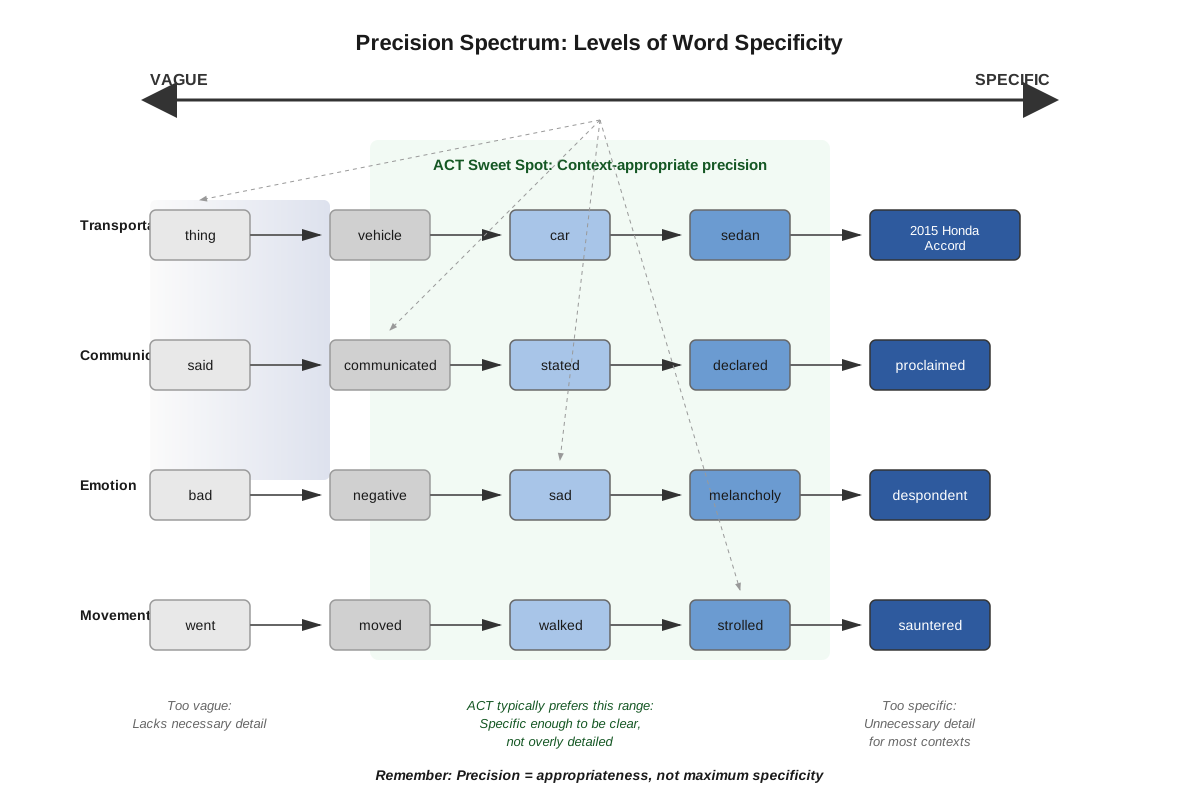
Specificity refers to how particular or general a word is. Consider the hierarchy: "thing" → "object" → "furniture" → "chair" → "recliner" → "La-Z-Boy recliner." Each word becomes more specific, narrowing the category. On the ACT, precision questions often test whether students can identify when a passage needs more or less specificity.
Too vague: "The scientist used equipment to conduct the experiment."
More precise: "The scientist used a spectrophotometer to conduct the experiment."
However, excessive specificity can also be problematic if it provides unnecessary detail that distracts from the main point. The ACT tests whether students can calibrate specificity to match the passage's purpose and context.
| Level of Specificity | Example | When to Use |
|---|---|---|
| Very General | "thing," "stuff," "nice" | Rarely appropriate in formal writing |
| General | "animal," "building," "good" | When category-level information suffices |
| Moderate | "dog," "house," "beneficial" | Most common in clear writing |
| Specific | "golden retriever," "Victorian mansion," "therapeutic" | When detail enhances understanding |
| Very Specific | "three-year-old golden retriever," "1890s Queen Anne Victorian" | When precise detail is essential to meaning |
Connotation and Emotional Tone
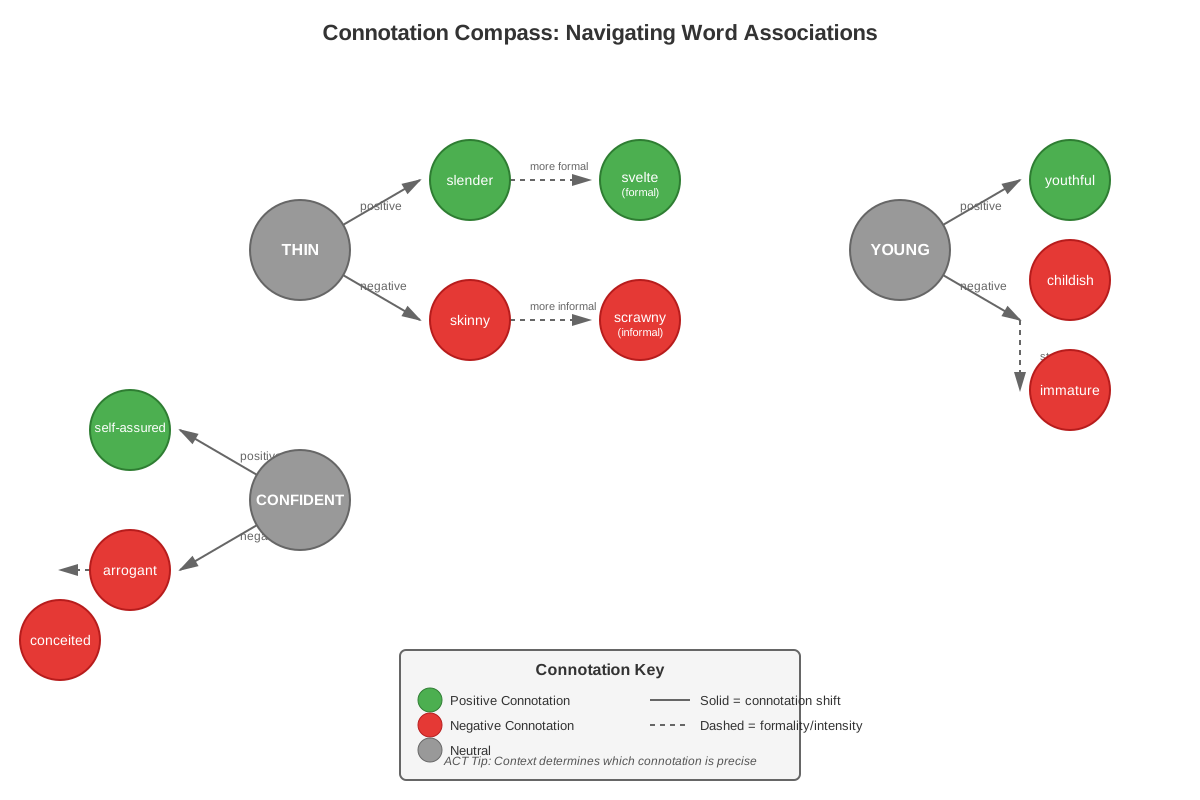
Connotation refers to the emotional, cultural, or associative meanings words carry beyond their dictionary definitions (denotations). Words with similar denotations can have vastly different connotations, making them appropriate or inappropriate depending on context.
Consider these near-synonyms with different connotations:
- Childish (negative: immature, petty) vs. Childlike (positive: innocent, wonder-filled) vs. Youthful (positive: energetic, fresh)
- Stubborn (negative: unreasonably inflexible) vs. Determined (positive: persistent, focused) vs. Resolute (positive: admirably firm)
- Cheap (negative: low quality, stingy) vs. Inexpensive (neutral: low cost) vs. Economical (positive: cost-effective)
The ACT frequently tests whether students recognize these connotative differences and can select words that match the passage's tone. A passage praising someone's persistence would use "determined" or "resolute," not "stubborn."
Contextual Appropriateness and Register
Register refers to the level of formality in language. The ACT includes passages ranging from formal academic writing to casual personal narratives, and precision requires matching word choice to the passage's register.
Formal register: "The committee convened to deliberate the proposal."
Informal register: "The group got together to talk about the idea."
Precision errors occur when formal words appear in informal contexts (creating a stilted, unnatural tone) or when informal words appear in formal contexts (creating an inappropriately casual tone). Students must read carefully to determine each passage's register before selecting word choices.
Redundancy and Wordiness
While technically a conciseness issue, redundancy relates to precision because redundant expressions use imprecise language that repeats meaning unnecessarily. Common redundant phrases tested on the ACT include:
- "Past history" (history is always past)
- "Future plans" (plans are always for the future)
- "Advance warning" (warnings are always in advance)
- "End result" (results come at the end)
- "Completely eliminate" (eliminate means to completely remove)
Precise writing eliminates these redundancies, using single words that capture the full meaning.
Idioms and Conventional Expressions
Idiomatic precision involves using conventional word combinations that native speakers recognize as correct. The ACT tests whether students can identify the precise preposition, verb, or phrase that completes an idiom correctly.
Examples of idiomatic precision:
- "Different from" (not "different than" in formal writing)
- "Comply with" (not "comply to")
- "Capable of" (not "capable to")
- "In accordance with" (not "in accordance to")
These conventions don't follow logical rules; they're simply the accepted forms in standard English.
Concept Relationships
The concepts within precision form an interconnected system where each element influences the others. Specificity provides the foundation—determining how detailed language should be—while connotation adds emotional dimension to word choice. These two elements must align with contextual appropriateness, which acts as the governing principle determining whether specific, connotative word choices fit the passage's purpose, audience, and tone.
Redundancy represents a failure of precision where writers use multiple words when one precise word would suffice. This connects back to specificity: redundant phrases are often vague or imprecise, requiring multiple words to approximate what a single precise word could convey. Idiomatic precision operates somewhat independently but connects to contextual appropriateness, as idioms represent the conventional, accepted forms within standard English contexts.
The relationship flows: Context → Determines appropriate register → Guides specificity level → Influences connotation selection → Eliminates redundancy → Ensures idiomatic correctness. Each decision point builds on the previous one, creating a cascade of precision choices.
Precision also connects to prerequisite knowledge: vocabulary breadth enables specificity choices, reading comprehension reveals context, and grammar knowledge ensures words function correctly in sentences. Looking forward, precision skills support advanced concepts like style analysis, rhetorical strategy, and persuasive writing, where precise word choice becomes a tool for achieving specific effects on readers.
Quick check — test yourself on Precision so far.
Try Flashcards →High-Yield Facts
⭐ Precision questions typically offer four word choices that are similar in meaning but differ in connotation, specificity, or contextual fit.
⭐ The correct answer in precision questions is always the word that best matches the passage's tone, context, and level of formality.
⭐ Words with negative connotations (like "stubborn" or "cheap") are incorrect when the passage has a positive or neutral tone.
⭐ Vague words like "thing," "stuff," "nice," and "good" are almost never the correct answer on precision questions.
⭐ Redundant expressions that repeat meaning (like "past history" or "end result") violate precision and are incorrect.
- Precision questions often appear with the prompt "Which choice most effectively accomplishes the goal?" or "Which word best maintains the tone?"
- Context clues in surrounding sentences reveal the appropriate level of specificity and connotation needed.
- Formal academic passages require formal vocabulary; personal narratives allow more informal word choices.
- Idiomatic expressions must use the conventional preposition or verb form, even if alternatives seem logical.
- When two words seem equally precise, the simpler, more common word is usually correct unless the passage requires technical vocabulary.
- Precision errors often involve choosing words that are technically correct but don't fit the specific context or tone.
- The ACT rarely tests obscure vocabulary; instead, it tests whether students can distinguish between common words with subtle differences.
Common Misconceptions
Misconception: All synonyms are interchangeable in any context.
Correction: Synonyms have different connotations, levels of formality, and contextual appropriateness. "Childish" and "youthful" are synonyms but convey opposite attitudes; using them interchangeably would create imprecision.
Misconception: More sophisticated or complex words are always better choices.
Correction: The best word is the one that most precisely fits the context, which is often a simple, common word. Using unnecessarily complex vocabulary creates pretentious, imprecise writing that obscures meaning.
Misconception: Precision only matters in formal writing.
Correction: Precision is essential in all writing contexts. Even informal passages require precise word choice to convey the intended casual tone and specific meanings; imprecision creates confusion regardless of formality level.
Misconception: If a word's denotation (dictionary definition) fits, it's correct.
Correction: Connotation matters as much as denotation. A word might technically mean the right thing but carry emotional associations that make it wrong for the context. "Cheap" and "economical" have similar denotations but very different connotations.
Misconception: Redundancy is acceptable for emphasis.
Correction: On the ACT, redundancy is always incorrect. Emphasis should come from precise word choice, sentence structure, or rhetorical devices, not from repeating meaning unnecessarily.
Misconception: Precision questions have subjective answers based on personal preference.
Correction: Precision questions have objectively correct answers based on context, tone, and standard English conventions. The passage provides all necessary information to determine which word choice is most precise.
Worked Examples
Example 1: Connotation and Tone
Passage Context: "Despite facing numerous setbacks, the entrepreneur remained [WORD] in her pursuit of success, refusing to abandon her vision even when investors withdrew their support."
Options:
A. NO CHANGE (stubborn)
B. determined
C. obstinate
D. headstrong
Analysis:
Step 1: Identify the passage tone. The context is positive—the entrepreneur is being praised for persistence despite challenges. Words like "vision" and the overall narrative frame her positively.
Step 2: Evaluate connotations of each option:
- "Stubborn" (A): Negative connotation suggesting unreasonable inflexibility
- "Determined" (B): Positive connotation suggesting admirable persistence
- "Obstinate" (C): Negative connotation suggesting unreasonable stubbornness
- "Headstrong" (D): Somewhat negative connotation suggesting reckless willfulness
Step 3: Match connotation to context. The positive context requires a word with positive connotation.
Answer: B. "Determined" is the most precise choice because it conveys persistence with a positive connotation that matches the passage's admiring tone toward the entrepreneur.
Example 2: Specificity and Context
Passage Context: "The museum's collection includes several [WORD] from the Renaissance period, including works by Leonardo da Vinci and Michelangelo."
Options:
A. NO CHANGE (things)
B. items
C. pieces
D. paintings
Analysis:
Step 1: Identify what level of specificity the context requires. The passage mentions "works by Leonardo da Vinci and Michelangelo," which could include paintings, sculptures, drawings, and other art forms.
Step 2: Evaluate specificity of each option:
- "Things" (A): Extremely vague and informal; inappropriate for museum context
- "Items" (B): Generic but slightly more formal than "things"; still vague
- "Pieces" (C): Appropriately general term for artworks; formal enough for museum context
- "Paintings" (D): Too specific—excludes sculptures and other art forms mentioned
Step 3: Determine which level of specificity fits. The context requires a word general enough to encompass various art forms but specific and formal enough for a museum setting.
Answer: C. "Pieces" provides the precise level of specificity needed—more specific than "things" or "items" but appropriately general to include all types of artwork, while maintaining formal register suitable for museum context.
Exam Strategy
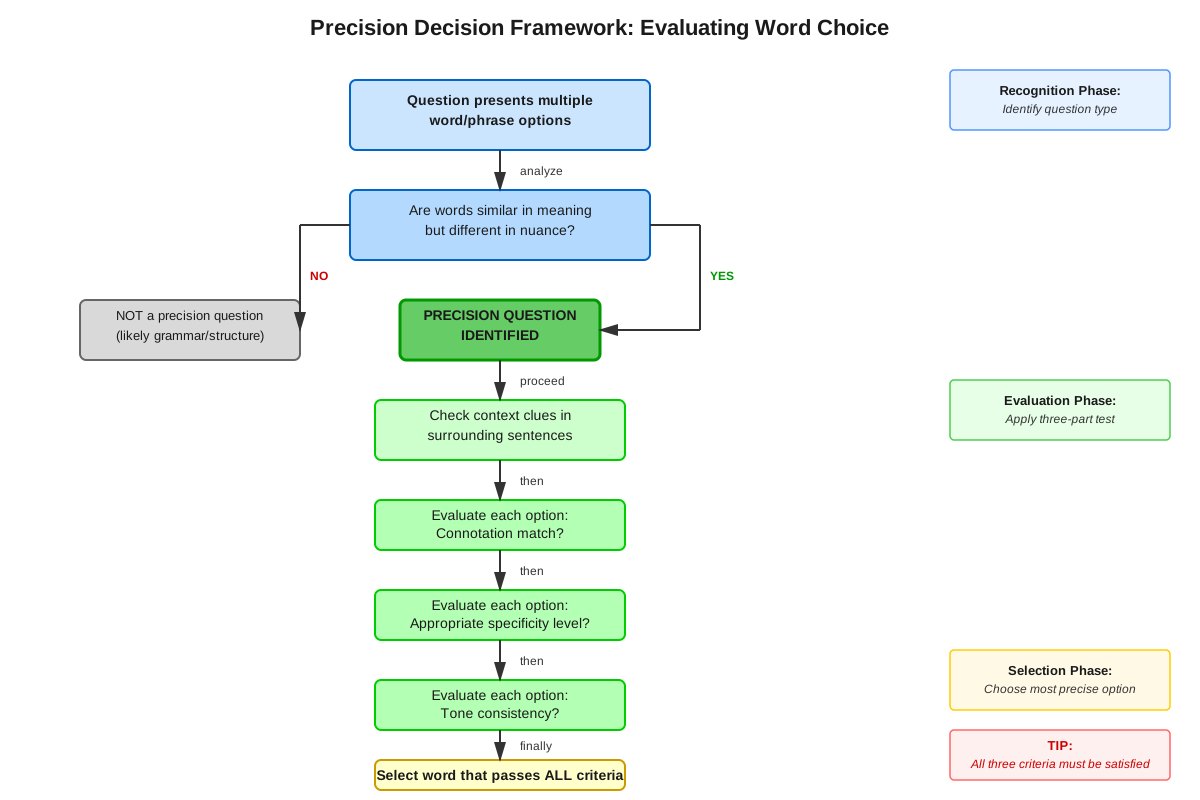
When approaching precision questions on the ACT, follow this systematic process:
Step 1: Read the entire sentence and surrounding context. Never evaluate word choices in isolation. The preceding and following sentences often provide crucial clues about tone, formality, and meaning.
Step 2: Identify what the question is testing. Look for trigger phrases like "most effectively," "best maintains the tone," "most specifically," or "most precisely." These signal that precision is being tested.
Step 3: Determine the passage's tone and register. Is it formal academic writing, casual narrative, technical explanation, or persuasive argument? This determines which words are contextually appropriate.
Step 4: Eliminate obviously wrong answers first. Remove choices that are clearly too vague (like "thing" or "stuff"), have wrong connotations for the context, or are redundant.
Step 5: Compare remaining options for subtle differences. Focus on connotation, specificity, and contextual fit. Often two choices will be close, but one will better match the passage's specific needs.
Exam Tip: When stuck between two similar words, check whether the passage has a positive, negative, or neutral tone. Connotation often determines the correct answer.
Trigger words and phrases to watch for:
- "Most effectively accomplishes"
- "Best maintains the tone"
- "Most precisely"
- "Most specifically"
- "Most appropriate"
- "Given the context"
Time allocation: Precision questions should take 20-30 seconds each. If you're spending more than 45 seconds, make your best choice and move on. These questions reward quick recognition of context and connotation rather than extended deliberation.
Process-of-elimination strategy: First eliminate words with wrong connotations, then eliminate words that are too vague or too specific, then eliminate redundant options. This typically leaves one clearly correct answer.
Memory Techniques
C-S-C Mnemonic for Precision Evaluation:
- Connotation: Does the word's emotional tone match the passage?
- Specificity: Is the word appropriately detailed or general?
- Context: Does the word fit the formality and purpose?
The "Goldilocks Principle": Like Goldilocks finding the porridge that's "just right," precision requires finding the word that's not too vague, not too specific, not too formal, not too casual—but just right for the context.
Connotation Visualization: Picture a spectrum from negative to positive. Place each word option on this spectrum, then match it to where the passage's tone falls. For example:
Negative ← stubborn | obstinate | persistent | determined | resolute → Positive
The Redundancy Red Flag: Memorize common redundant phrases by grouping them:
- Time redundancies: "past history," "future plans," "advance warning"
- Completion redundancies: "end result," "final outcome," "completely eliminate"
- Description redundancies: "small in size," "blue in color," "circular in shape"
Register Recognition Rhyme: "Formal for facts, casual for chats, match the tone where the passage is at."
Summary
Precision in ACT Writing requires selecting words that convey exactly the intended meaning with appropriate specificity, connotation, and contextual fit. Success on precision questions depends on understanding three core elements: specificity (how detailed or general a word is), connotation (the emotional associations a word carries), and contextual appropriateness (whether a word matches the passage's tone and formality). Students must read carefully to determine passage context, then evaluate word choices based on these criteria. Common precision errors include using words with wrong connotations for the context, choosing words that are too vague or unnecessarily specific, including redundant expressions, and mismatching formality levels. The ACT tests precision through questions asking which word "most effectively" or "most precisely" accomplishes a goal, requiring students to distinguish between similar words with subtle but important differences. Mastering precision improves not only test performance but also overall writing quality.
Key Takeaways
- Precision means choosing words that exactly match the intended meaning, tone, and context of a passage
- Connotation (emotional associations) matters as much as denotation (dictionary definition) in determining precise word choice
- The correct answer always matches the passage's level of formality, specificity, and tone
- Vague words and redundant expressions violate precision and are incorrect on the ACT
- Context clues in surrounding sentences reveal which word choice is most precise
- Precision questions reward careful reading of the entire passage, not just the sentence containing the blank
- Systematic evaluation using the C-S-C framework (Connotation, Specificity, Context) leads to correct answers
Related Topics
Conciseness: While precision focuses on choosing the right words, conciseness focuses on using the fewest words necessary. Together, these skills create clear, efficient writing. Mastering precision provides the foundation for conciseness by ensuring that each word carries maximum meaning.
Style and Tone: Precision operates at the word level to support broader style and tone goals. Understanding how individual word choices create overall tone helps students make more sophisticated precision decisions.
Rhetorical Strategy: Advanced precision skills enable students to recognize how authors use specific word choices to achieve persuasive effects, build credibility, or evoke emotional responses.
Transitions and Flow: Precise word choice includes selecting appropriate transition words and phrases that accurately convey logical relationships between ideas.
Practice CTA
Now that you understand the principles of precision in ACT Writing, it's time to apply these concepts to practice questions. The flashcards will help you internalize common precision distinctions and connotation differences, while the practice questions will challenge you to apply the C-S-C framework in realistic test scenarios. Remember: precision improves with practice. Each question you work through strengthens your ability to quickly recognize context, evaluate connotations, and select the most precise word choice. You've built a strong foundation—now reinforce it through deliberate practice!
Sign up free to keep reading
Create a free AnvayaPrep account to finish this ACT guide on Precision — plus flashcards and practice questions.