Overview
Cohesion is one of the most frequently tested rhetorical skills on the ACT English section, appearing in approximately 10-15% of all questions. Unlike grammar questions that focus on sentence-level correctness, cohesion questions assess a student's ability to recognize how ideas flow logically within and between sentences, paragraphs, and entire passages. These questions evaluate whether transitions are appropriate, whether sentences are arranged in the most logical order, and whether ideas connect smoothly to create a unified piece of writing.
Understanding ACT cohesion is essential because these questions require students to think beyond isolated sentences and consider the broader context of a passage. The ACT tests cohesion through various question types: selecting appropriate transitional words or phrases, determining the best placement for sentences within paragraphs, deciding whether to add or delete information based on relevance, and evaluating whether opening or closing sentences effectively introduce or conclude ideas. Mastering cohesion means developing the ability to recognize logical relationships between ideas and understanding how writers signal those relationships to readers.
Cohesion connects closely to other rhetorical skills tested on the ACT, including organization, style, and purpose. While organization questions focus on the macro-level structure of entire paragraphs or passages, cohesion questions zoom in on the micro-level connections between individual sentences and ideas. Together, these skills form the foundation of effective writing that the ACT measures. Students who excel at cohesion questions demonstrate sophisticated reading comprehension and an intuitive sense of how well-constructed prose should flow.
Learning Objectives
- [ ] Identify when Cohesion is being tested in ACT English questions
- [ ] Explain the core rule or strategy behind Cohesion
- [ ] Apply Cohesion to ACT-style questions accurately
- [ ] Distinguish between different types of logical transitions (contrast, cause-effect, addition, example)
- [ ] Evaluate whether a sentence fits logically within its surrounding context
- [ ] Determine the most effective placement for transitional elements within passages
- [ ] Recognize when information disrupts the cohesive flow of a paragraph
Prerequisites
- Basic sentence structure: Understanding subjects, predicates, and how complete sentences function is necessary to evaluate how sentences connect to one another
- Reading comprehension skills: The ability to understand main ideas and supporting details enables students to assess whether transitions and connections are logical
- Paragraph structure awareness: Knowing that paragraphs typically contain topic sentences and supporting details helps students evaluate whether sentences belong in specific locations
- Familiarity with common transitional words: Basic knowledge of words like "however," "therefore," and "additionally" provides the foundation for understanding more nuanced transitional relationships
Why This Topic Matters
Cohesion represents a critical skill that extends far beyond standardized testing. In academic writing, professional communication, and everyday expression, the ability to connect ideas smoothly determines whether writing is clear, persuasive, and easy to follow. Writers who master cohesion create prose that guides readers effortlessly from one idea to the next, while those who neglect it produce choppy, confusing text that frustrates readers and obscures meaning.
On the ACT English section, cohesion questions appear with remarkable consistency, typically comprising 6-8 questions per test. These questions manifest in several distinct formats: transition word selection (choosing between "however," "therefore," "for example," etc.), sentence placement (determining where a sentence best fits within a paragraph), relevance questions (deciding whether to add or delete information), and logical sequence questions (evaluating whether ideas are presented in the most effective order). The ACT frequently embeds cohesion questions within passages about science, history, personal narratives, and social issues, requiring students to quickly grasp context and apply logical reasoning.
Common question stems that signal cohesion testing include: "Which choice provides the most logical transition?", "The best placement for this sentence would be...", "Should the writer add this sentence here?", "Which choice most effectively connects this paragraph to the previous one?", and "Given that all choices are true, which provides the most relevant information?" Recognizing these patterns allows students to immediately activate their cohesion analysis skills and approach questions strategically.
Core Concepts
Understanding Cohesion Fundamentals
Cohesion refers to the quality of writing in which ideas connect logically and smoothly, creating a unified whole that readers can follow easily. In cohesive writing, each sentence relates clearly to the sentences around it, transitions guide readers through shifts in thought, and information appears in a sequence that makes sense. The ACT tests cohesion because it represents a sophisticated writing skill that distinguishes competent writers from excellent ones.
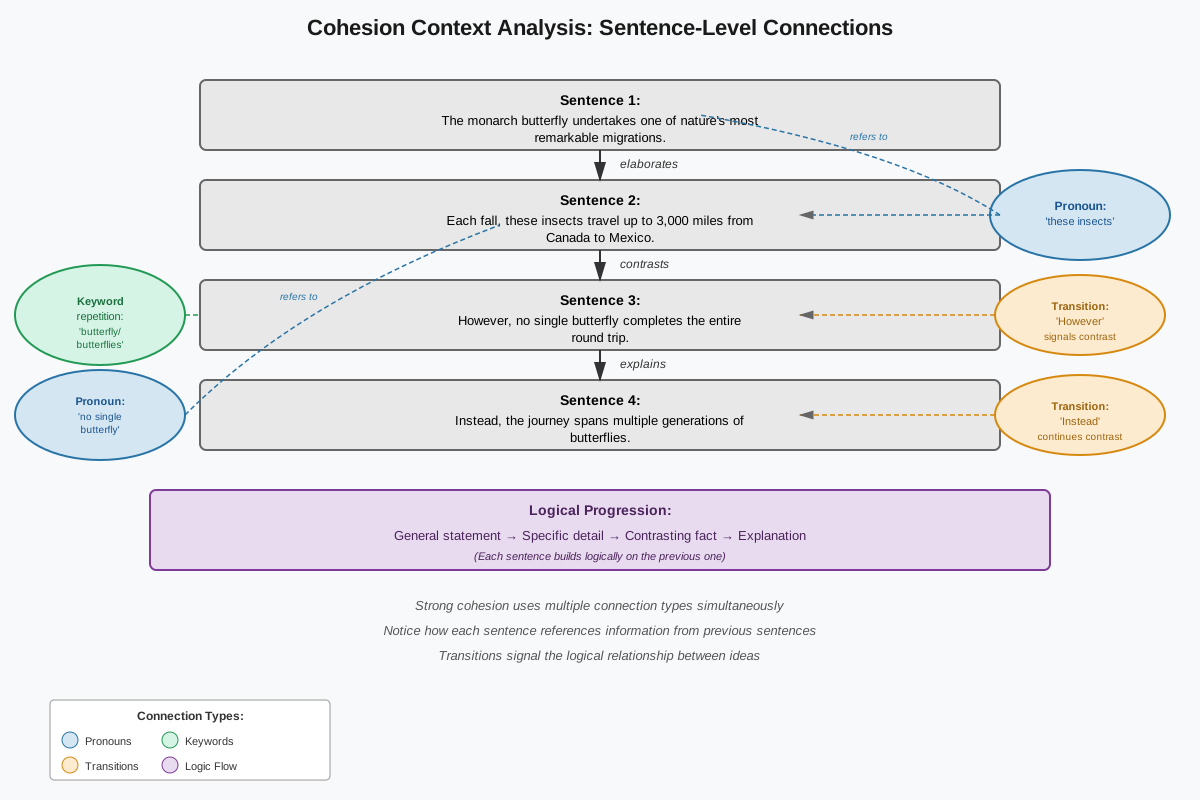
Cohesive writing relies on two primary mechanisms: explicit transitions (words and phrases that signal relationships between ideas) and implicit connections (logical relationships that exist even without transitional words). Explicit transitions include words like "furthermore," "in contrast," "consequently," and "for instance." Implicit connections depend on the logical flow of ideas themselves—when one sentence naturally follows from another based on content alone.
Types of Logical Relationships
The ACT tests students' ability to recognize and apply various logical relationships between ideas. Understanding these relationship types is fundamental to answering cohesion questions correctly.
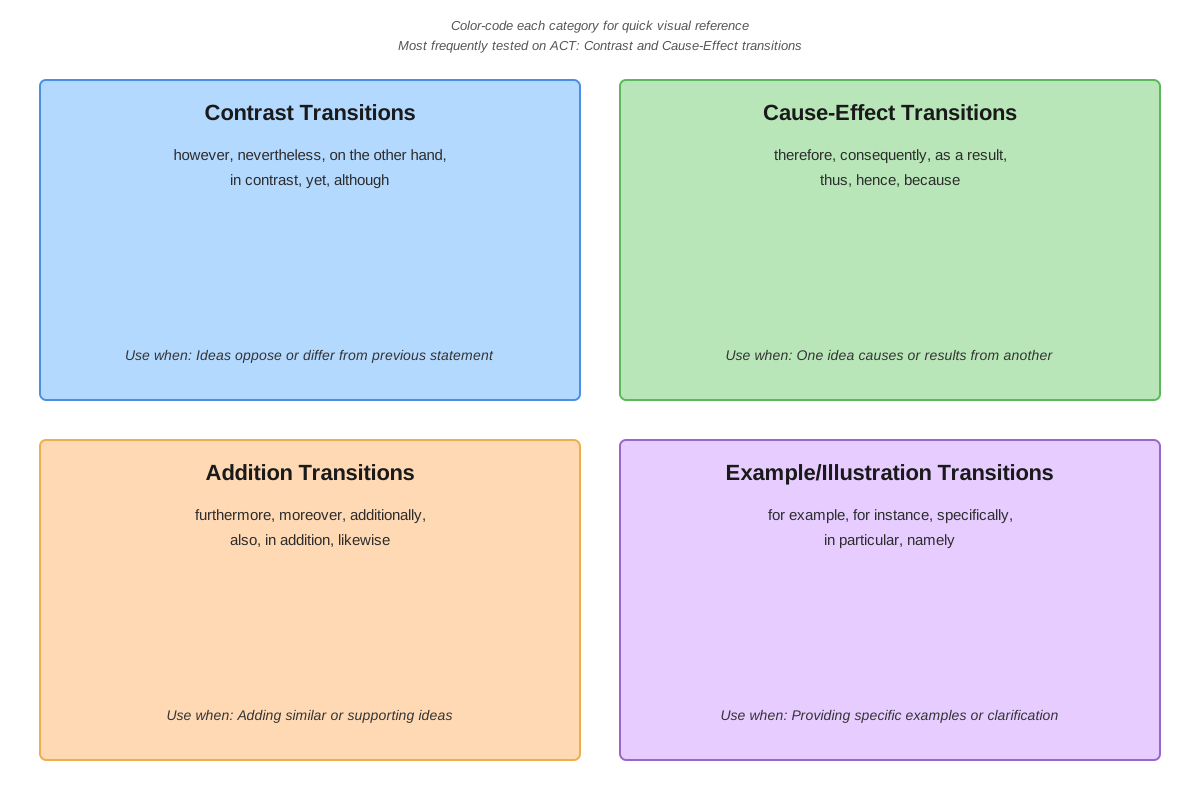
| Relationship Type | Purpose | Common Transitions | Example Context |
|---|---|---|---|
| Addition/Continuation | Adds similar or supporting information | furthermore, moreover, additionally, also, in addition | Building on a previous point with more evidence |
| Contrast/Opposition | Introduces conflicting or different information | however, nevertheless, on the other hand, in contrast, yet | Presenting an opposing viewpoint or unexpected outcome |
| Cause and Effect | Shows that one thing results from another | therefore, consequently, thus, as a result, because | Explaining why something happened or what resulted |
| Example/Illustration | Provides a specific instance of a general idea | for example, for instance, specifically, in particular | Clarifying an abstract concept with concrete details |
| Time/Sequence | Indicates chronological order or steps | first, next, then, finally, subsequently, meanwhile | Describing events in order or process steps |
| Emphasis | Stresses importance or significance | indeed, in fact, certainly, undoubtedly | Reinforcing a critical point |
Transition Word Selection
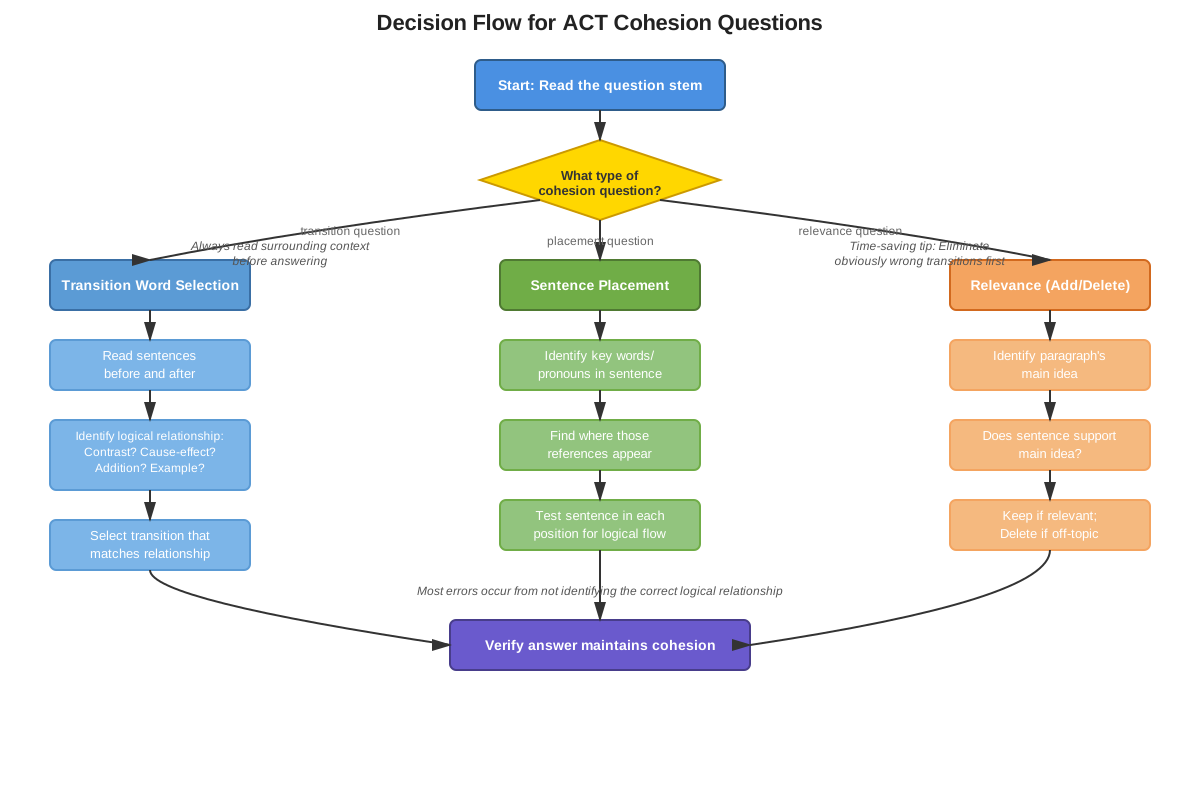
When the ACT presents transition word questions, students must analyze the logical relationship between the ideas being connected. The process involves three steps:
- Read the sentence before the transition to understand the first idea
- Read the sentence after the transition to understand the second idea
- Determine the relationship between these ideas (Are they similar? Opposite? Does one cause the other?)
Consider this example: "The experiment yielded unexpected results. _____, the researchers decided to replicate the study." The relationship here is cause-effect (unexpected results caused the decision to replicate), so "Therefore" or "Consequently" would be appropriate, while "However" or "For example" would be illogical.
Sentence Placement and Relevance
Sentence placement questions require students to determine where a sentence best fits within a paragraph. These questions test whether students can identify the logical flow of ideas and recognize where a new piece of information naturally belongs. The key strategy involves:
- Reading the entire paragraph to understand its main idea and structure
- Identifying what the sentence to be placed discusses
- Finding the location where that topic is already being discussed
- Checking that the sentence creates smooth transitions with surrounding sentences
Relevance questions ask whether information should be added or deleted based on whether it supports the paragraph's purpose. These questions often include the phrase "given that all choices are true" to emphasize that grammatical correctness isn't the issue—logical fit is what matters. Students must evaluate whether proposed additions stay on topic or whether existing sentences digress from the main point.
Paragraph-Level Cohesion
Beyond individual sentence connections, the ACT tests cohesion at the paragraph level. Well-constructed paragraphs follow predictable patterns:
- Topic sentence introduces the main idea
- Supporting sentences develop that idea with evidence, examples, or explanation
- Concluding or transitional sentence wraps up the idea or connects to the next paragraph
Questions about paragraph cohesion often ask students to evaluate opening or closing sentences, determine whether paragraphs are unified around a single idea, or assess whether information belongs in a different paragraph entirely.
Cross-Paragraph Transitions
The ACT also tests how well paragraphs connect to one another. Cross-paragraph transitions typically appear at the beginning of a new paragraph and reference ideas from the previous paragraph while introducing the new topic. For example: "While these challenges seemed insurmountable, the team discovered an innovative solution" connects the challenges discussed in the previous paragraph to the solution that will be explored in the new one.
Concept Relationships
Cohesion concepts build upon one another in a hierarchical structure. At the foundation lies the understanding of logical relationships between ideas (addition, contrast, cause-effect, etc.). This foundational knowledge enables students to select appropriate transition words that signal these relationships explicitly.
Transition word selection → leads to → sentence-level cohesion, where individual sentences connect smoothly to create flowing prose. This sentence-level cohesion → combines with → relevance evaluation (determining what information belongs) → to create → paragraph-level cohesion, where all sentences work together to develop a unified idea.
Paragraph-level cohesion → extends to → cross-paragraph transitions, which connect larger chunks of text into a coherent whole. All of these elements → ultimately produce → passage-level cohesion, the overall quality that makes an entire piece of writing feel unified and logical.
The relationship to prerequisite knowledge is equally important. Reading comprehension enables students to grasp the ideas being connected, while paragraph structure awareness provides the framework for understanding where ideas should appear. Basic grammar knowledge ensures students can distinguish cohesion issues from grammatical errors.
Cohesion also connects forward to other rhetorical skills. Strong cohesion supports effective organization (the macro-level arrangement of ideas), contributes to appropriate style (the tone and voice of writing), and helps achieve the writer's purpose (the intended effect on readers).
High-Yield Facts
⭐ Cohesion questions require reading beyond the underlined portion—always read at least one sentence before and after to understand context
⭐ "However" and "therefore" are the most commonly tested transition words because they represent opposite relationships (contrast vs. cause-effect)
⭐ When all answer choices are grammatically correct, the question is testing cohesion or style, not grammar rules
⭐ Sentence placement questions are best solved by reading the entire paragraph first to understand the logical flow of ideas
⭐ Relevance questions often include the phrase "given that all choices are true" to signal that logical fit, not accuracy, is being tested
- Transition words at the beginning of paragraphs typically connect to ideas in the previous paragraph, not just the previous sentence
- The ACT favors concise, direct transitions over wordy, elaborate ones when both are logically appropriate
- Questions asking whether to "add" or "delete" information test cohesion and relevance, not grammar
- Pronouns and repeated key terms create implicit cohesion by linking sentences without explicit transitions
- The most cohesive answer choice makes the relationship between ideas crystal clear to readers
- Time-sequence transitions (first, next, then) appear most frequently in process descriptions and narratives
- Contrast transitions are often tested when passages present both benefits and drawbacks of something
- Cause-effect transitions frequently appear in science and social science passages explaining phenomena
- Addition transitions are common when passages list multiple examples or pieces of evidence
- Effective cohesion often involves varying transition types rather than using the same type repeatedly
Quick check — test yourself on Cohesion so far.
Try Flashcards →Common Misconceptions
Misconception: Any transition word that makes grammatical sense is correct → Correction: Transition words must match the specific logical relationship between ideas. "However" is grammatically correct in many places where it's logically wrong because it signals contrast when the ideas actually show cause-effect or addition.
Misconception: Longer, more sophisticated-sounding transitions are better → Correction: The ACT favors clarity and conciseness. "But" is often better than "on the other hand" if both are logically appropriate, because it's more direct and efficient.
Misconception: Cohesion questions can be answered by reading only the sentence with the underlined portion → Correction: Cohesion inherently involves relationships between multiple sentences or ideas. Students must read surrounding context—typically at least one sentence before and after—to evaluate cohesion accurately.
Misconception: If information is true and interesting, it should be added to the passage → Correction: Information must be relevant to the specific paragraph's purpose and the passage's overall focus. True, interesting information that digresses from the main point disrupts cohesion and should not be added.
Misconception: Transition words should appear at the beginning of every sentence → Correction: Overusing explicit transitions creates choppy, mechanical writing. Many sentences connect through implicit logical relationships and don't need transition words. The ACT tests whether transitions are necessary and appropriate, not whether they're present everywhere.
Misconception: "Therefore" and "thus" can be used interchangeably with "for example" → Correction: These transitions signal completely different relationships. "Therefore" and "thus" indicate cause-effect (something happens as a result), while "for example" introduces a specific instance of a general idea. Using them interchangeably destroys logical cohesion.
Misconception: The best placement for a sentence is always where it currently appears → Correction: Sentence placement questions exist because the sentence is often in the wrong location. Students should actively evaluate whether the sentence fits better elsewhere rather than assuming the current placement is correct.
Worked Examples
Example 1: Transition Word Selection
Passage Context: "Urban gardens provide fresh produce to city residents who might otherwise lack access to healthy food. _____, these gardens create community gathering spaces where neighbors can connect and collaborate."
Question: Which choice provides the most effective transition?
A) Therefore,
B) However,
C) For example,
D) Additionally,
Solution Process:
Step 1: Identify the first idea—urban gardens provide fresh produce and food access.
Step 2: Identify the second idea—urban gardens create community gathering spaces.
Step 3: Determine the relationship. Both ideas are benefits of urban gardens; the second idea adds another positive aspect rather than contrasting, providing an example, or showing a result.
Step 4: Evaluate each choice:
- A) "Therefore" suggests the community spaces result from the food access—illogical
- B) "However" suggests the community spaces contrast with food access—illogical
- C) "For example" suggests community spaces are a specific instance of food access—illogical
- D) "Additionally" correctly signals that this is another benefit being added to the first
Answer: D) Additionally,
Connection to Learning Objectives: This example demonstrates how to identify cohesion testing (multiple grammatically correct options requiring logical analysis), explains the core strategy (analyzing the relationship between ideas), and applies it to an ACT-style question.
Example 2: Sentence Placement
Passage: [1] The invention of the printing press revolutionized information sharing in 15th-century Europe. [2] Johannes Gutenberg developed movable type that could be rearranged and reused efficiently. [3] Books that once took months to copy by hand could now be produced in weeks. [4] This democratization of knowledge contributed to the Renaissance and Reformation movements.
Question: The following sentence would most logically be placed: "The technology spread rapidly from Germany to other European countries."
A) After sentence 1
B) After sentence 2
C) After sentence 3
D) After sentence 4
Solution Process:
Step 1: Read the entire paragraph to understand its structure. It discusses the printing press's impact, Gutenberg's invention, the speed improvement, and the broader historical effects.
Step 2: Analyze what the sentence to be placed discusses—the geographical spread of the technology.
Step 3: Determine where geographical spread fits logically. The sentence discusses what happened after the invention was developed, so it should come after Gutenberg's development is mentioned but before or after the discussion of effects.
Step 4: Evaluate each placement:
- After sentence 1: Too early—we haven't learned about Gutenberg's specific invention yet
- After sentence 2: Possible—the invention has been introduced
- After sentence 3: Strong—the invention and its immediate impact (speed) have been explained, and now we can discuss how it spread
- After sentence 4: Too late—this would separate the spread from the invention and place it after the historical consequences
Step 5: Choose between B and C. Sentence 3 discusses the immediate practical impact (speed), and the spread of technology logically follows from this practical advantage. The spread also logically precedes the discussion of Renaissance and Reformation impacts, as the technology needed to spread before it could have those broad effects.
Answer: C) After sentence 3
Connection to Learning Objectives: This example shows how to identify sentence placement questions, apply the strategy of reading the full paragraph and finding where the topic is discussed, and evaluate logical flow to determine the best placement.
Exam Strategy
Recognizing Cohesion Questions
Cohesion questions have distinctive characteristics that allow quick identification:
- Multiple grammatically correct answer choices: If all options are grammatically acceptable, the question tests cohesion or style
- Transition words in answer choices: Questions offering different transition words (however, therefore, for example) test logical relationships
- Numbered sentences with placement questions: Questions asking "where should this sentence be placed" with options like "after sentence 2" test cohesion
- "Should the writer add/delete" questions: These test relevance and cohesion, not grammar
- Phrases like "most logical," "most effective," or "best": These signal rhetorical skills rather than grammar rules
Systematic Approach to Transition Questions
- Cover the answer choices initially to avoid being influenced by them
- Read the sentence before the transition to understand the first idea
- Read the sentence after the transition to understand the second idea
- Determine the relationship in your own words (same direction? opposite? cause-effect? example?)
- Predict the type of transition needed before looking at choices
- Eliminate choices that signal the wrong relationship
- Choose the most concise option among logically correct choices
Trigger Words and Phrases
Watch for these question stems that signal cohesion testing:
- "Which choice provides the most logical transition?"
- "Which choice most effectively connects this sentence to the previous paragraph?"
- "The best placement for this sentence would be..."
- "Given that all choices are true, which provides the most relevant information?"
- "Should the writer add this sentence here?"
- "Should the writer delete the underlined portion?"
- "Which choice best introduces this paragraph?"
- "Which choice provides the most effective conclusion?"
Process of Elimination Tips
For transition questions:
- Eliminate transitions that signal relationships opposite to what the context requires
- Eliminate wordy transitions when concise ones are available and equally logical
- Eliminate "DELETE" options only after confirming the transition is unnecessary
For sentence placement questions:
- Eliminate placements where the sentence's topic isn't being discussed
- Eliminate placements that create awkward pronoun references or unclear connections
- Eliminate placements that disrupt chronological order in narrative or process passages
For relevance questions:
- Eliminate "add" options when the information digresses from the paragraph's focus
- Eliminate "delete" options when the information directly supports the main idea
- Focus on the specific reason given in the answer choice, not just "yes" or "no"
Time Allocation
Cohesion questions typically require 30-45 seconds each—slightly more than grammar questions because they demand reading surrounding context. Budget time accordingly:
- Quick scan (5 seconds): Identify the question type
- Context reading (15-20 seconds): Read surrounding sentences or full paragraph
- Analysis (10-15 seconds): Determine logical relationships or placement
- Answer selection (5-10 seconds): Choose and verify the answer
Don't rush cohesion questions. The time invested in reading context prevents careless errors and actually saves time by avoiding the need to reread.
Memory Techniques
RACE Mnemonic for Transition Selection
Read before and after
Analyze the relationship
Consider all options
Eliminate illogical choices
Transition Type Categories: "CACET"
Contrast (however, nevertheless, yet)
Addition (furthermore, moreover, also)
Cause-effect (therefore, consequently, thus)
Example (for instance, specifically)
Time (next, then, finally)
Visualization Strategy for Sentence Placement
Imagine the paragraph as a train of thought. Each sentence is a train car that must connect smoothly to the cars before and after it. When placing a new sentence, visualize where it couples most naturally with the existing cars. Does it discuss the same topic as the surrounding cars? Does it create a smooth connection, or does it jolt the train off track?
The "Bridge" Metaphor
Think of transitions as bridges between islands of ideas. The bridge must match the distance and direction between islands. A contrast bridge (however) only works when the islands face opposite directions. A cause-effect bridge (therefore) only works when one island leads to another. Using the wrong bridge type leaves readers stranded.
Relevance Check: "STOP"
Stays on topic?
Ties to main idea?
Offers support?
Purpose matches paragraph?
If the answer to any question is "no," the information likely disrupts cohesion and should be deleted or not added.
Summary
Cohesion represents the logical flow and connection of ideas within and between sentences, paragraphs, and passages. The ACT tests cohesion through transition word selection, sentence placement, and relevance questions, requiring students to analyze relationships between ideas rather than simply applying grammar rules. Mastering cohesion demands understanding the major types of logical relationships (addition, contrast, cause-effect, example, and time sequence) and recognizing which transitions signal each relationship. Success on cohesion questions requires reading beyond the immediate sentence to grasp context, determining what relationship exists between ideas, and selecting the answer that makes that relationship clearest to readers. Students must distinguish between grammatically correct options by evaluating logical fit, relevance to the paragraph's purpose, and effectiveness in creating smooth flow. The key to cohesion mastery is recognizing that writing is not just a collection of correct sentences but a unified whole where each part connects meaningfully to create a coherent message that guides readers effortlessly from beginning to end.
Key Takeaways
- Cohesion questions require context—always read surrounding sentences to understand the relationship between ideas before selecting an answer
- Logical relationships drive transition selection—match the transition type (contrast, addition, cause-effect, example, time) to the actual relationship between ideas
- All grammatically correct options signal a cohesion question—shift focus from grammar rules to logical flow and effectiveness
- Sentence placement depends on topic continuity—place sentences where their topic is already being discussed and where they create smooth connections
- Relevance trumps truth—information can be accurate and interesting but still disrupt cohesion if it doesn't support the paragraph's specific purpose
- Conciseness matters when logic is equal—the ACT favors direct, efficient transitions over wordy ones when both are logically appropriate
- Read entire paragraphs for placement questions—understanding the full flow of ideas is essential to determining where a sentence best fits
Related Topics
Organization: While cohesion focuses on sentence-level and paragraph-level connections, organization addresses the macro-level structure of entire passages, including paragraph order and overall arrangement of ideas. Mastering cohesion provides the foundation for understanding effective organization.
Style and Tone: Cohesion intersects with style in questions about word choice and sentence structure that affect how smoothly ideas flow. Understanding cohesion helps students recognize when stylistic choices enhance or disrupt the logical progression of ideas.
Purpose and Audience: Cohesion serves the writer's purpose by ensuring readers can follow the intended message. Questions about adding or deleting information often combine cohesion with purpose, asking whether information helps achieve the writer's goal.
Precision and Concision: These rhetorical skills complement cohesion by ensuring that not only do ideas connect logically, but they do so efficiently without unnecessary words or redundancy.
Practice CTA
Now that you understand the principles of cohesion and how the ACT tests this critical skill, it's time to apply your knowledge! Work through the practice questions to reinforce your ability to identify logical relationships, select appropriate transitions, and evaluate sentence placement. The flashcards will help you internalize the different types of transitions and their uses. Remember, cohesion mastery comes from practice—the more passages you analyze with a focus on how ideas connect, the more intuitive these questions will become. You're building a sophisticated skill that will serve you not just on test day, but in all your future writing. Keep practicing, and watch your confidence and accuracy soar!
Sign up free to keep reading
Create a free AnvayaPrep account to finish this ACT guide on Cohesion — plus flashcards and practice questions.