Overview
Effective verbs represent one of the most powerful tools in a writer's arsenal and a frequently tested concept on the ACT English section. This topic falls under the broader category of Rhetorical Skills, specifically addressing how writers can make their prose more vivid, precise, and engaging through strategic verb choice. The ACT tests whether students can identify when a verb choice weakens a sentence and recognize when a more specific, active, or dynamic verb would strengthen the writing.
Understanding ACT effective verbs goes beyond simple grammar correctness—it requires developing an ear for writing quality and recognizing the difference between adequate and excellent word choice. The ACT English section regularly presents questions where all answer choices are grammatically correct, but only one choice uses the most effective verb for the context. These questions assess rhetorical skills rather than mechanical correctness, testing whether students understand how verb choice impacts clarity, tone, and reader engagement.
This topic connects intimately with other rhetorical skills concepts including concision, style, and tone. Effective verb usage often overlaps with eliminating wordiness (choosing "sprinted" instead of "ran very quickly"), maintaining consistent style throughout a passage, and ensuring that verb choices match the formality level and purpose of the writing. Mastering effective verbs also reinforces understanding of active versus passive voice, verb tense consistency, and the relationship between subjects and their actions—all fundamental components of strong writing that appear throughout the ACT English test.
Learning Objectives
- [ ] Identify when Effective verbs is being tested on the ACT English section
- [ ] Explain the core rule or strategy behind Effective verbs and why certain verb choices strengthen writing
- [ ] Apply Effective verbs principles to ACT-style questions accurately and efficiently
- [ ] Distinguish between weak, generic verbs and strong, specific verbs in context
- [ ] Evaluate multiple grammatically correct verb options to select the most effective choice
- [ ] Recognize how verb choice impacts tone, clarity, and reader engagement in passages
Prerequisites
- Basic verb identification and function: Understanding what verbs are and how they function in sentences is essential because effective verb questions require recognizing the verb being tested and its role in conveying action or state of being.
- Active versus passive voice: Familiarity with voice helps students recognize when passive constructions weaken writing and when active verbs would be more effective.
- Context clues and reading comprehension: The ability to understand passage context is crucial because determining the "most effective" verb depends entirely on what the surrounding text communicates.
- Basic vocabulary knowledge: A working vocabulary enables students to distinguish between similar verbs and understand nuances in meaning that make one choice more effective than another.
Why This Topic Matters
In real-world writing, verb choice determines whether prose feels flat and bureaucratic or vivid and engaging. Professional writers, journalists, and content creators constantly refine their verb choices to create maximum impact with minimum words. College-level writing demands precision and sophistication in verb usage, making this skill essential for academic success beyond the ACT.
On the ACT English section, effective verb questions appear with high frequency—typically 2-4 questions per test. These questions fall under the Rhetorical Skills category, which comprises approximately 35% of the English test. Effective verb questions specifically test "Style" and "Word Choice," accounting for roughly 15-20% of rhetorical skills questions. This translates to a significant portion of your overall English score, making this topic high-yield for test preparation.
Common manifestations of this topic on the ACT include questions asking students to choose between a generic verb and more specific alternatives, questions testing whether to use active or passive constructions, and questions evaluating whether a verb matches the tone and style of the surrounding passage. The ACT often presents these questions with the stem "Which choice most effectively..." or "Which choice provides the most specific information..." signaling that all options may be grammatically correct but differ in rhetorical effectiveness.
Core Concepts
What Makes a Verb "Effective"
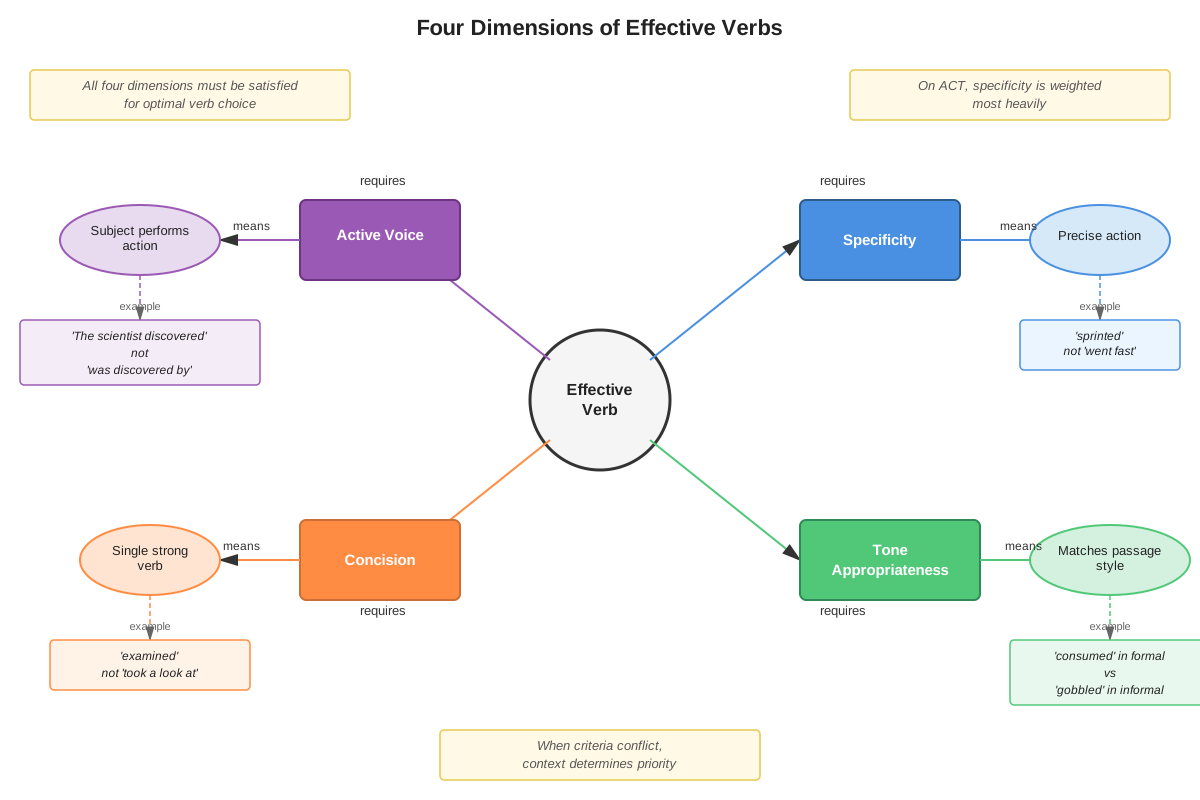
An effective verb is one that communicates action or state of being with maximum precision, clarity, and impact while fitting seamlessly into the passage's context and tone. Effectiveness in verb choice encompasses several dimensions: specificity (how precisely the verb conveys the intended action), vividness (how clearly the verb helps readers visualize or understand the action), concision (whether the verb eliminates the need for additional modifiers), and appropriateness (whether the verb matches the passage's formality level and purpose).
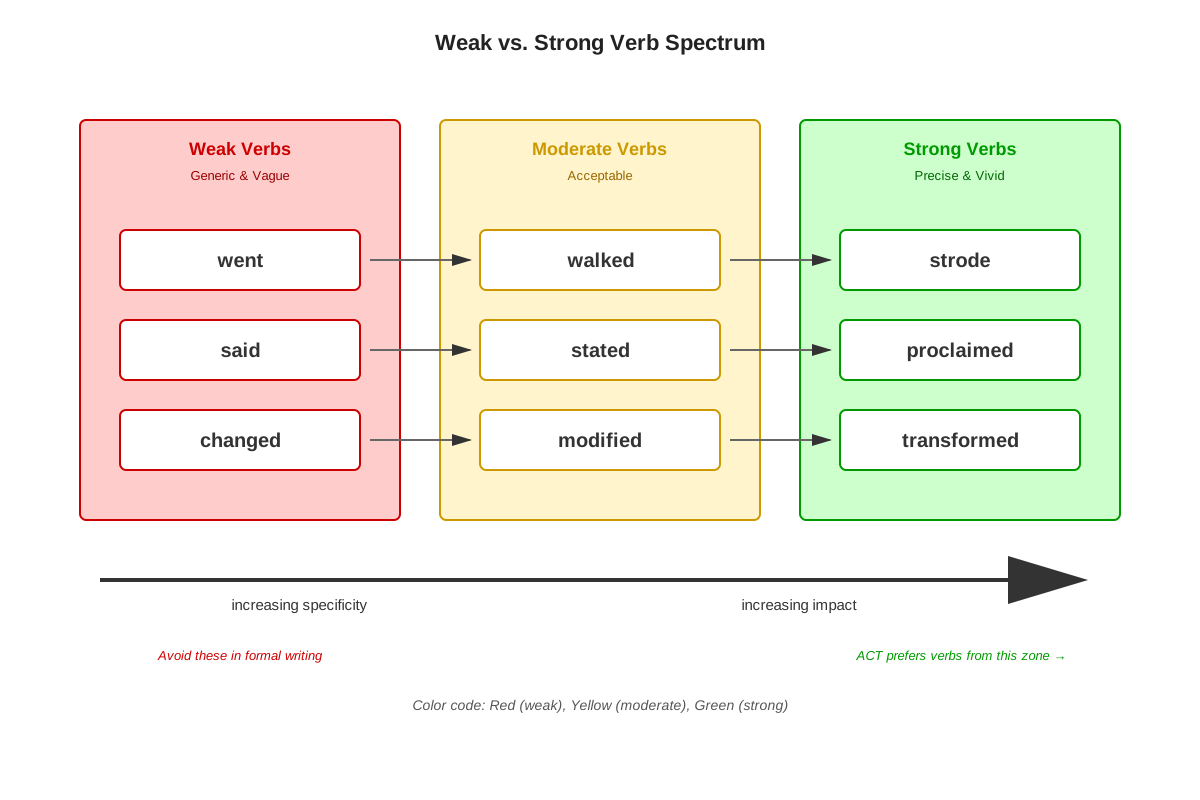
The ACT evaluates verb effectiveness by presenting answer choices that range from weak, generic verbs to strong, specific alternatives. Generic verbs like "go," "make," "do," "have," "get," and "be" often signal opportunities for more effective choices. While these verbs are grammatically correct and sometimes appropriate, they frequently lack the precision that stronger alternatives provide. For example, "The athlete went across the finish line" is less effective than "The athlete sprinted across the finish line" or "The athlete stumbled across the finish line"—each specific verb conveys different information about how the crossing occurred.
Specificity and Precision
Specific verbs eliminate ambiguity and reduce the need for additional words. When a verb precisely captures an action, writers can often eliminate adverbs and prepositional phrases that would otherwise be necessary. Consider the difference between "walked slowly and carefully" versus "tiptoed" or "crept"—the specific verb conveys the manner of walking without requiring modifiers.
The ACT frequently tests this principle by offering one answer choice with a generic verb plus modifiers and another with a single specific verb. The more concise, specific option is typically correct. This principle connects directly to the ACT's emphasis on eliminating wordiness while maintaining or enhancing meaning.
| Generic Verb + Modifiers | Effective Specific Verb |
|---|---|
| looked at quickly | glanced |
| said in a loud voice | shouted, yelled, bellowed |
| walked in a tired way | trudged, plodded, dragged |
| ate very quickly | devoured, gobbled |
| thought about carefully | pondered, contemplated |
Active Voice and Dynamic Verbs
Effective verbs typically employ active voice, where the subject performs the action rather than receiving it. Active constructions create more direct, engaging prose and clearly establish who or what is performing actions. The ACT favors active voice in most contexts, though passive voice has legitimate uses when the action's recipient is more important than the actor or when the actor is unknown.
Beyond active versus passive, dynamic verbs—those that convey action rather than state of being—generally create more effective prose. Verbs like "is," "was," "seems," and "appears" often signal opportunities for stronger alternatives. Instead of "The scientist was the discoverer of a new species," the more effective construction uses a dynamic verb: "The scientist discovered a new species."
Context-Appropriate Verb Choice
Effectiveness depends entirely on context. A verb that works perfectly in one passage might be inappropriate in another due to differences in tone, formality, or purpose. The ACT tests whether students can recognize when a verb's connotation or formality level mismatches the surrounding text.
For example, in a formal scientific passage, "demonstrated" or "revealed" would be more appropriate than "showed," while in a casual narrative, "showed" might be perfectly effective. Similarly, verbs carry connotations beyond their denotative meanings—"strolled" suggests leisure while "marched" suggests purpose and determination, even though both mean "walked."
Verb Choice and Tone
Verbs significantly influence a passage's tone and emotional impact. The ACT tests whether students recognize when a verb's emotional weight or connotation fits the passage's overall tone. A passage describing a joyful event should use verbs with positive connotations, while one describing a somber situation requires verbs that match that mood.
Consider how verb choice changes tone in this sentence: "The committee [decided/decreed/determined/concluded] to implement new policies." Each verb is grammatically correct, but "decreed" sounds authoritarian, "determined" sounds analytical, "concluded" sounds deliberative, and "decided" is neutral. The most effective choice depends on how the passage characterizes the committee and its decision-making process.
Eliminating Weak Verb Constructions
Certain verb constructions consistently weaken writing and appear frequently in ACT questions. These include:
- "To be" + adjective constructions: "The presentation was informative" is weaker than "The presentation informed the audience"
- Verb + preposition combinations: "Bring about" can often become "cause"; "make use of" can become "use"
- Nominalized verbs: "Made a decision" should become "decided"; "gave consideration to" should become "considered"
- Passive constructions without purpose: "The experiment was conducted by the researchers" should become "The researchers conducted the experiment"
The ACT regularly tests whether students can identify these weak constructions and select more direct, effective alternatives.
Concept Relationships
The concepts within effective verb usage form an interconnected system where each principle reinforces the others. Specificity and precision lead naturally to concision, as specific verbs eliminate the need for modifiers. Active voice typically produces more dynamic verbs, which in turn create more engaging prose. Context-appropriate choices depend on understanding tone, which is influenced by verb connotations and formality levels.
This topic connects directly to prerequisite knowledge of active versus passive voice—understanding voice enables students to recognize when passive constructions weaken writing. The relationship flows: Voice recognition → Identifying weak passive constructions → Selecting active alternatives → Achieving more effective verb usage.
Effective verbs also relate closely to other rhetorical skills topics. The principle connects to Concision (specific verbs eliminate unnecessary words), Style and Tone (verb choice establishes and maintains tone), and Word Choice (verbs are the most impactful word category for strengthening prose). The relationship map looks like this:
Effective Verbs → Enables → Concise Writing → Contributes to → Overall Style
Effective Verbs → Influences → Tone → Affects → Reader Engagement
Effective Verbs → Requires → Context Understanding → Depends on → Reading Comprehension
High-Yield Facts
⭐ The ACT favors specific, precise verbs over generic verbs plus modifiers in most contexts.
⭐ Active voice constructions are typically more effective than passive voice unless the action's recipient is more important than the actor.
⭐ When all answer choices are grammatically correct, the question is testing rhetorical effectiveness, not mechanical correctness.
⭐ Effective verb questions often include the phrase "most effectively" or "most specifically" in the question stem.
⭐ Generic verbs like "make," "do," "have," "get," and forms of "be" often signal opportunities for more effective alternatives.
- Verb choice significantly impacts a passage's tone and should match the formality level of surrounding text.
- Specific verbs that eliminate the need for adverbs or prepositional phrases are generally more effective than generic verbs with modifiers.
- Dynamic action verbs create more engaging prose than static state-of-being verbs in most contexts.
- Nominalized verb constructions (turning verbs into nouns) consistently weaken writing and should be avoided.
- The most effective verb choice depends entirely on the passage's context, purpose, and tone—no verb is universally "best."
- Effective verb questions typically appear 2-4 times per ACT English test, making them high-yield for score improvement.
- Connotation matters as much as denotation—verbs with similar dictionary definitions can have very different emotional impacts.
Quick check — test yourself on Effective verbs so far.
Try Flashcards →Common Misconceptions
Misconception: The longest or most sophisticated-sounding verb is always the most effective choice.
Correction: Effectiveness depends on context and appropriateness, not complexity. A simple, precise verb often outperforms a complex one. "Used" might be more effective than "utilized" in many contexts despite being simpler.
Misconception: Passive voice is always wrong and should never be used.
Correction: While active voice is generally more effective, passive voice has legitimate uses when the action's recipient is more important than the actor, when the actor is unknown, or when maintaining focus on a particular subject across sentences. The ACT tests appropriate use, not absolute rules.
Misconception: Any specific verb is better than any generic verb, regardless of context.
Correction: Specificity must match the passage's needs. If a passage intentionally maintains a general, broad perspective, an overly specific verb might introduce inappropriate detail or shift the focus incorrectly.
Misconception: Effective verb questions are testing vocabulary knowledge primarily.
Correction: While vocabulary helps, these questions primarily test rhetorical judgment—the ability to evaluate which verb best serves the passage's purpose and tone. Students with moderate vocabularies can excel by focusing on context clues.
Misconception: The correct answer will always be the shortest option.
Correction: While effective verbs often enable concision, the shortest answer isn't automatically correct. Sometimes a slightly longer construction better matches the passage's style or provides necessary nuance. Effectiveness, not brevity alone, determines the correct answer.
Misconception: Formal writing always requires formal-sounding verbs.
Correction: Formal writing requires appropriate, precise verbs, but "formal-sounding" doesn't mean unnecessarily complex. Clear, direct verbs are effective in formal contexts. "Use" is often more effective than "utilize" even in formal writing.
Worked Examples
Example 1: Specificity and Concision
Passage Context: A biographical passage describes a scientist's reaction to discovering an important finding.
Question: The scientist looked at the data with great excitement and interest.
Answer Choices:
- A) NO CHANGE
- B) looked at the data excitedly
- C) examined the data with great excitement and interest
- D) scrutinized the data
Step 1: Identify what's being tested
The question presents multiple ways to express how the scientist viewed the data. All options are grammatically correct, signaling this tests effectiveness rather than correctness. The phrase "looked at" is generic, suggesting the question tests whether a more specific verb would be more effective.
Step 2: Evaluate each option for specificity and concision
- Option A uses the generic "looked at" plus two modifiers ("with great excitement and interest"), making it wordy
- Option B improves slightly by reducing modifiers but retains the generic "looked at"
- Option C actually adds words ("examined" is better than "looked at" but keeps all the modifiers)
- Option D uses the specific verb "scrutinized," which inherently conveys careful, detailed examination without requiring modifiers
Step 3: Consider context and tone
The passage describes a scientist working with data, suggesting a professional, focused context. "Scrutinized" fits this context perfectly—it's specific to careful examination and matches the professional tone. The excitement mentioned in other options might be conveyed elsewhere in the passage.
Step 4: Apply the principle
The most effective verb eliminates unnecessary modifiers while precisely conveying the action. "Scrutinized" accomplishes both goals.
Answer: D - This choice demonstrates the core principle that specific verbs eliminate the need for modifiers while enhancing precision.
Example 2: Context and Tone Matching
Passage Context: A casual, first-person narrative about a family gathering describes the narrator's grandmother arriving.
Question: Grandmother ascended the front steps and entered our home.
Answer Choices:
- A) NO CHANGE
- B) walked up the front steps and came into our home
- C) climbed the front steps and walked into our home
- D) mounted the front steps and proceeded into our home
Step 1: Identify what's being tested
All options are grammatically correct and convey similar actions, indicating this tests which verb choice best matches the passage's tone and style.
Step 2: Evaluate tone and formality
The passage is described as casual and first-person, suggesting informal, natural language. Let's evaluate each option's formality:
- Option A: "Ascended" and "entered" are formal, almost ceremonial
- Option B: "Walked up" and "came into" are casual and natural
- Option C: "Climbed" and "walked into" are casual but "climbed" might suggest difficulty
- Option D: "Mounted" and "proceeded" are very formal, almost military
Step 3: Consider connotation
"Ascended" suggests rising to something important or grand. "Mounted" suggests climbing onto something (like a horse) or a formal approach. These connotations don't fit a casual family gathering. "Walked up" and "came into" are neutral and natural for the context.
Step 4: Apply the principle
The most effective verbs match the passage's established tone. In casual writing, natural, everyday verbs are more effective than formal alternatives.
Answer: B - This choice demonstrates that effectiveness depends on context—simpler verbs can be more effective than sophisticated ones when they better match the passage's tone.
Exam Strategy
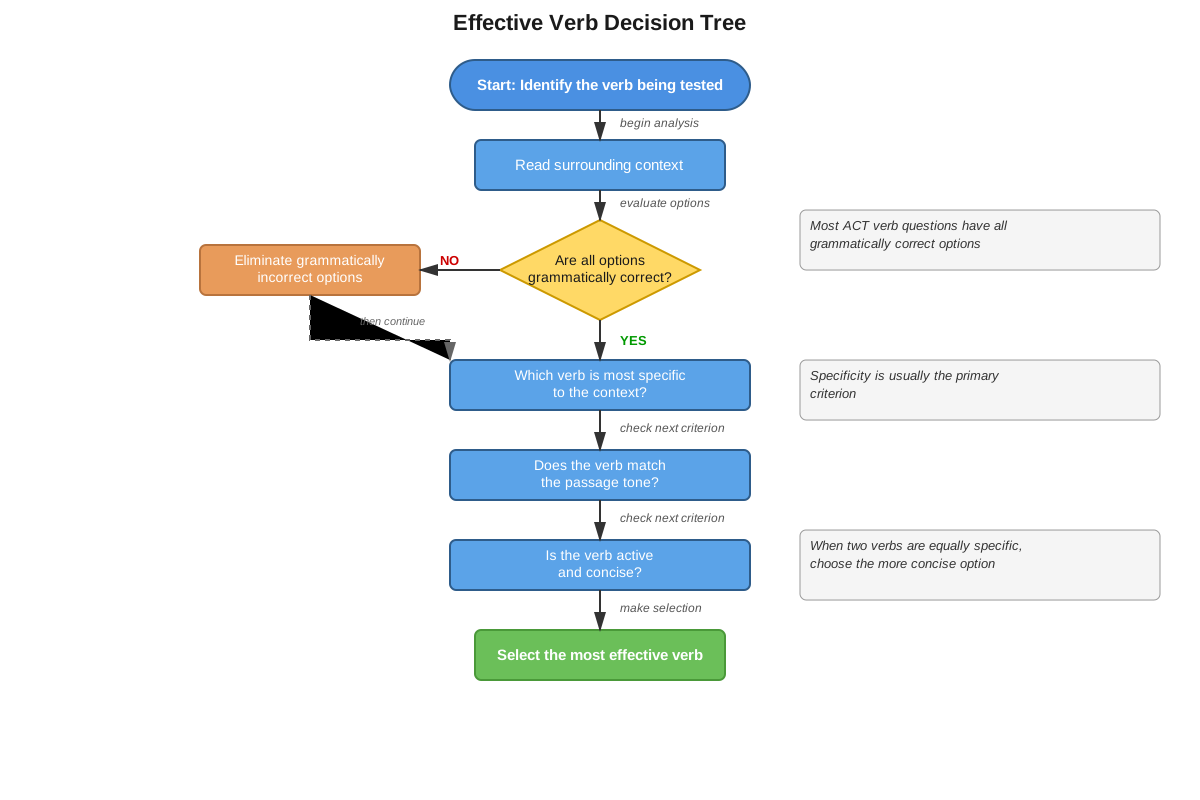
When approaching effective verb questions on the ACT, follow this systematic process:
Step 1: Identify the question type
Look for question stems containing phrases like "most effectively," "most specifically," "most precisely," or "best accomplishes the writer's goal." These signal rhetorical effectiveness questions rather than grammar questions. If all answer choices are grammatically correct, you're definitely dealing with an effectiveness question.
Step 2: Read for context
Before evaluating answer choices, read at least one sentence before and after the underlined portion. Understanding the passage's tone, purpose, and style is essential for determining which verb is most effective. Note whether the passage is formal or casual, technical or narrative, serious or lighthearted.
Step 3: Identify the current verb's weakness
Ask yourself: Is the current verb generic? Does it require multiple modifiers? Is it passive when active would be clearer? Does it mismatch the passage's tone? Identifying the specific weakness helps you recognize what improvement to look for.
Step 4: Evaluate answer choices systematically
Use these criteria in order:
- Eliminate options that mismatch tone or context (wrong formality level, inappropriate connotation)
- Eliminate unnecessarily wordy options (generic verb plus multiple modifiers when a specific verb exists)
- Prefer active over passive (unless context specifically requires passive)
- Choose the most specific, precise option among remaining choices
Trigger words and phrases to watch for:
- Generic verbs: "make," "do," "have," "get," "go," "be," "seem," "appear"
- Passive constructions: "was [verb]ed by," "were [verb]ed by"
- Nominalized verbs: "made a decision," "gave consideration," "took action"
- Verb + preposition: "bring about," "make use of," "put forth"
Time allocation advice:
Effective verb questions should take 20-30 seconds each. If you find yourself spending more than 45 seconds, you're likely overthinking. Trust your ear for natural, appropriate language—if an option sounds awkward or overly formal for the context, it's probably not the most effective choice.
Process-of-elimination tips:
- Immediately eliminate any option that clearly mismatches the passage's tone
- Cross out the wordiest option unless all others have clear problems
- If two options seem equally good, reread the surrounding sentences to catch subtle context clues about formality or style
- When stuck between two choices, the more specific verb is usually correct unless it introduces inappropriate detail
Memory Techniques
ACTIVE Mnemonic for Evaluating Verb Effectiveness:
- Appropriate for context and tone
- Concise (eliminates unnecessary modifiers)
- Tone-matched (fits formality level)
- Impactful (creates clear mental image)
- Vivid and specific (not generic)
- Engaging (dynamic rather than static)
The "Generic Five" to Avoid:
Remember these five verb categories that often signal opportunities for more effective choices: "Make, Do, Have, Get, Go" (plus forms of "be"). When you see these verbs, ask whether a more specific alternative exists.
Visualization Strategy:
When evaluating verb choices, visualize the action being described. If you can picture the action clearly and specifically with one verb but only vaguely with another, the verb that creates the clearer mental image is typically more effective.
The Formality Spectrum:
Visualize a formality spectrum from casual to formal:
Casual → Neutral → Professional → Formal → Ceremonial
Place each verb option on this spectrum, then match it to where the passage falls. This helps you quickly eliminate mismatched options.
The "Modifier Test":
If a verb requires multiple modifiers (adverbs or prepositional phrases) to convey the intended meaning, a more specific verb probably exists. Remember: Specific verb > Generic verb + modifiers
Summary
Effective verbs represent a high-yield topic on the ACT English section, testing students' ability to recognize and select verb choices that maximize precision, clarity, and impact while matching passage context and tone. The core principle is that effective verbs are specific rather than generic, active rather than passive (in most contexts), concise (eliminating the need for multiple modifiers), and appropriate for the passage's formality level and purpose. The ACT presents these questions by offering multiple grammatically correct options that differ in rhetorical effectiveness, requiring students to evaluate which verb best serves the passage's goals. Success requires reading for context, understanding tone and formality, recognizing weak verb constructions (generic verbs, passive voice, nominalized verbs), and systematically evaluating options based on specificity, appropriateness, and concision. Mastering this topic improves not only ACT scores but also overall writing quality, as verb choice fundamentally determines whether prose feels flat or engaging, vague or precise, awkward or natural.
Key Takeaways
- Effective verb questions test rhetorical judgment, not grammar rules—all options are typically grammatically correct, requiring evaluation of which choice best serves the passage's purpose and tone.
- Specific verbs that eliminate the need for modifiers are generally more effective than generic verbs plus adverbs or prepositional phrases, demonstrating both precision and concision.
- Context determines effectiveness—the "best" verb depends entirely on the passage's tone, formality level, and purpose; no verb is universally superior.
- Active voice constructions typically create more effective, engaging prose than passive voice, though passive has legitimate uses when the action's recipient is more important than the actor.
- Generic verbs like "make," "do," "have," "get," and "go" often signal opportunities for more effective alternatives and should trigger careful evaluation of answer choices.
- Tone-matching is crucial—verbs must fit the passage's established formality level, whether casual, professional, or formal, and mismatched formality is a common wrong answer trap.
- The systematic approach (identify question type → read for context → identify weakness → evaluate options) enables efficient, accurate answering of effective verb questions within appropriate time limits.
Related Topics
Concision and Wordiness: Mastering effective verbs directly supports eliminating wordiness, as specific verb choices often allow writers to delete unnecessary modifiers and prepositional phrases while maintaining or enhancing meaning.
Style and Tone: Verb choice is one of the primary tools writers use to establish and maintain consistent tone throughout a passage, making effective verb mastery essential for understanding broader style questions.
Active and Passive Voice: Deeper exploration of when passive voice is appropriate and how voice affects sentence emphasis builds on the effective verb foundation and appears in more complex rhetorical skills questions.
Word Choice and Diction: Effective verbs represent one category within the broader topic of word choice, which includes selecting effective nouns, adjectives, and other parts of speech to strengthen writing.
Transitions and Flow: Understanding how verb choice affects sentence rhythm and flow connects to transition questions and helps students recognize how individual word choices contribute to overall passage coherence.
Practice CTA
Now that you've mastered the principles of effective verb usage, it's time to apply this knowledge to ACT-style practice questions. The concepts you've learned—specificity, context-matching, active voice preference, and systematic evaluation—will become automatic with practice. Challenge yourself with the practice questions and flashcards to reinforce these high-yield principles. Remember, effective verb questions appear multiple times on every ACT English test, making your investment in this topic directly translatable to score improvement. Each practice question you complete strengthens your ability to quickly identify weak verb constructions and select the most effective alternatives. You've got this!
Sign up free to keep reading
Create a free AnvayaPrep account to finish this ACT guide on Effective verbs — plus flashcards and practice questions.