Overview
Passive voice is one of the most frequently tested grammar concepts on the ACT English section, appearing in approximately 3-5 questions per test. Understanding passive voice is crucial not only for identifying grammatical errors but also for recognizing when the ACT is testing your ability to choose the most clear, direct, and effective sentence construction. The ACT consistently favors active voice over passive voice unless there is a compelling rhetorical reason for the passive construction.
The distinction between active and passive voice fundamentally affects how sentences communicate action and agency. In active voice, the subject performs the action; in passive voice, the subject receives the action. While passive voice is grammatically correct, the ACT generally considers it less effective because it can make writing wordy, vague, or unnecessarily complex. Questions testing ACT passive voice typically ask students to identify the clearest or most concise way to express an idea, making this topic essential for achieving a high score on the English section.
This topic connects directly to broader concepts of sentence structure, verb usage, and rhetorical skills. Mastering passive voice recognition helps students understand subject-verb relationships, improve their ability to identify wordiness, and develop a stronger sense of effective writing style—all critical competencies for the ACT English section. Additionally, understanding passive voice enhances performance on questions about parallelism, verb tense consistency, and sentence clarity.
Learning Objectives
- [ ] Identify when Passive voice is being tested on the ACT
- [ ] Explain the core rule or strategy behind Passive voice
- [ ] Apply Passive voice to ACT-style questions accurately
- [ ] Distinguish between appropriate and inappropriate uses of passive voice in context
- [ ] Convert passive voice constructions to active voice and vice versa
- [ ] Recognize the structural components that signal passive voice (forms of "to be" + past participle)
- [ ] Evaluate whether passive voice serves a legitimate rhetorical purpose in a given sentence
Prerequisites
- Subject-verb agreement: Understanding how subjects and verbs must match in number and person is essential for recognizing when a subject is performing versus receiving an action
- Verb tenses and forms: Familiarity with past participles and helping verbs (forms of "to be") is necessary to identify passive voice constructions
- Basic sentence structure: Knowledge of subjects, verbs, and objects helps students understand how passive voice rearranges these elements
- Parts of speech: Recognizing verbs, nouns, and their functions within sentences enables accurate identification of who or what is performing actions
Why This Topic Matters
In real-world writing, understanding passive voice helps create clearer, more engaging prose. Professional writers, journalists, and business communicators must know when passive voice obscures responsibility or weakens their message. Scientific writing sometimes requires passive voice to emphasize results over researchers, but even in technical fields, the trend favors active constructions for clarity.
On the ACT English section, passive voice appears in 15-20% of grammar and usage questions, making it one of the highest-yield topics to master. These questions typically appear in two formats: (1) identifying unnecessarily passive constructions that should be made active, and (2) recognizing when passive voice is actually appropriate because the actor is unknown, unimportant, or when the focus should be on the action's recipient.
The ACT commonly embeds passive voice questions within longer passages where students must choose between four versions of a sentence or phrase. The test makers often include one passive option among three active alternatives, or vice versa. Questions may directly ask for "the most clear and concise" option, or they may simply present alternatives without explicit instructions, expecting students to recognize that active voice is generally preferable. Passive voice also appears in questions about wordiness, as passive constructions typically require more words than their active equivalents.
Core Concepts
Defining Active and Passive Voice
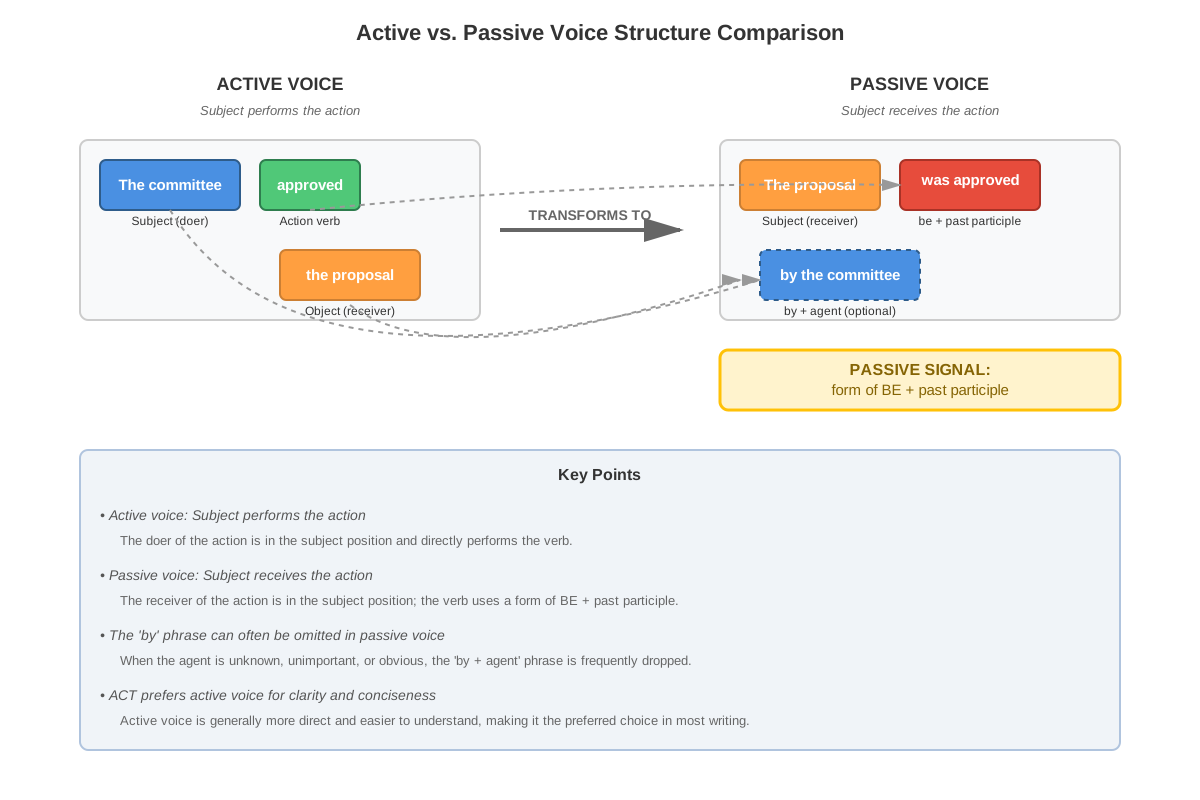
Active voice occurs when the subject of a sentence performs the action expressed by the verb. The basic structure follows the pattern: Subject → Verb → Object. For example: "The student completed the exam." Here, "the student" (subject) performs the action of completing.
Passive voice occurs when the subject receives the action rather than performing it. The basic structure follows: Subject → Form of "to be" + Past Participle (+ by + Agent). For example: "The exam was completed by the student." Here, "the exam" (subject) receives the action, and the actual performer appears in a prepositional phrase or may be omitted entirely.
Structural Components of Passive Voice
Passive voice constructions always contain two essential elements:
- A form of the verb "to be": am, is, are, was, were, be, being, been
- A past participle: the verb form typically ending in -ed, -en, -t, or irregular forms
| Active Voice | Passive Voice | Form of "to be" | Past Participle |
|---|---|---|---|
| The committee approved the proposal | The proposal was approved by the committee | was | approved |
| Scientists discovered the element | The element was discovered by scientists | was | discovered |
| The teacher will grade the essays | The essays will be graded by the teacher | will be | graded |
| The storm damaged the building | The building was damaged by the storm | was | damaged |
When Passive Voice Is Acceptable
While the ACT generally prefers active voice, passive voice is appropriate and sometimes necessary in specific situations:
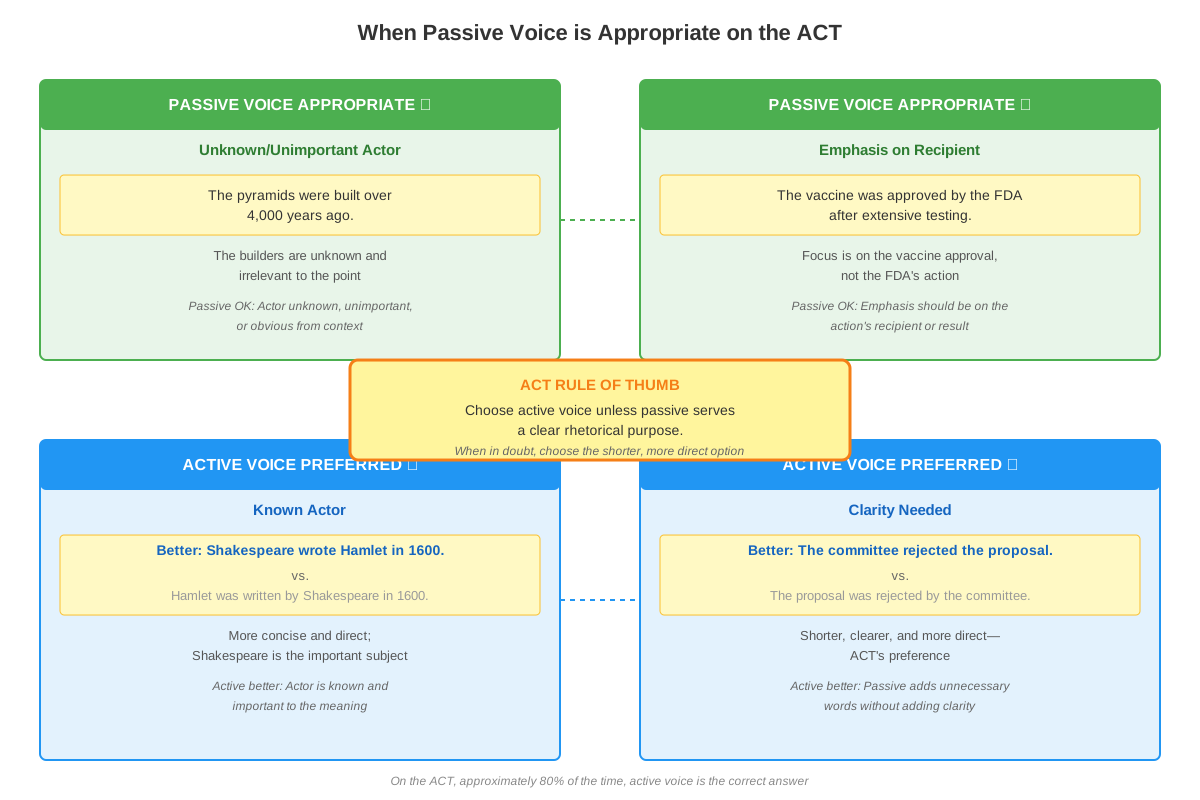
1. When the actor is unknown or unimportant: "The window was broken last night." (We don't know who broke it, and that's the point.)
2. When emphasizing the recipient of the action: "The Declaration of Independence was signed in 1776." (The document itself is more important than listing all signers.)
3. When avoiding blame or maintaining objectivity: "An error was made in the calculations." (Common in formal or diplomatic contexts.)
4. When the actor is obvious from context: "The suspect was arrested yesterday." (Clearly by police; stating this would be redundant.)
Converting Between Active and Passive Voice
To convert passive voice to active voice, follow these steps:
- Identify the agent (the performer of the action), usually found after "by" or implied by context
- Make the agent the subject of the sentence
- Change the verb from "to be" + past participle to the appropriate active form
- Move the original subject to the object position
Example: "The novel was written by Toni Morrison" → "Toni Morrison wrote the novel"
To convert active voice to passive voice (rarely needed on the ACT):
- Move the object to the subject position
- Add the appropriate form of "to be" before the main verb
- Change the main verb to its past participle form
- Move the original subject after "by" (or omit it)
Recognizing Passive Voice Red Flags
On the ACT, certain constructions signal that passive voice may be present:
- "Was/were/is/are + past participle": The most common passive indicator
- "Has/have/had been + past participle": Perfect tense passive constructions
- "Will/would/can/could be + past participle": Modal verb passive constructions
- Sentences lacking a clear actor: When you can't easily identify who performed the action
- Prepositional phrases with "by": Often indicates the true agent in a passive sentence
The Wordiness Problem
Passive voice typically requires more words than active voice to express the same idea. The ACT heavily penalizes wordiness, making passive constructions doubly problematic when they add unnecessary length.
Passive (wordy): "The decision was made by the board to approve the budget." (11 words)
Active (concise): "The board decided to approve the budget." (8 words)
This connection between passive voice and wordiness means that questions testing conciseness often involve identifying and eliminating passive constructions.
Concept Relationships
The concepts within passive voice form a logical progression: understanding the structural components (forms of "to be" + past participle) enables identification of passive constructions, which then allows students to evaluate appropriateness based on context, and finally to convert between voices when necessary.
Passive voice connects to prerequisite topics in several ways. Strong knowledge of verb forms is essential because recognizing past participles is the key to identifying passive voice. Understanding subject-verb agreement helps students track which noun is actually performing the action versus which is receiving it. Sentence structure knowledge enables students to see how passive voice rearranges the typical subject-verb-object pattern.
Passive voice also relates to other ACT English topics. Wordiness and redundancy questions often involve passive constructions because they typically use more words. Parallelism questions may test whether a series of items consistently uses active or passive voice. Verb tense questions sometimes combine with passive voice, requiring students to identify both the correct tense and the appropriate voice.
Relationship Map:
Verb Forms → Enables Recognition of Past Participles → Leads to Identification of Passive Voice → Connects to Evaluation of Appropriateness → Results in Conversion to Active Voice → Improves Conciseness → Enhances Overall Sentence Effectiveness
High-Yield Facts
⭐ The ACT prefers active voice over passive voice in approximately 90% of cases where both are grammatically correct
⭐ Passive voice always contains a form of "to be" (am, is, are, was, were, be, being, been) plus a past participle
⭐ When the actor is unknown, unimportant, or obvious, passive voice may be the correct answer
⭐ Passive constructions typically use more words than active constructions, making them vulnerable to wordiness questions
⭐ The agent (performer of the action) in passive voice appears after "by" or is omitted entirely
- Passive voice is grammatically correct but often stylistically weak on the ACT
- Converting passive to active voice usually involves making the agent (after "by") the subject
- Questions asking for "clear," "concise," or "direct" writing typically favor active voice
- Scientific or formal contexts may justify passive voice when emphasizing results over researchers
- Multiple passive constructions in a row create particularly weak, unclear writing that the ACT will penalize
Quick check — test yourself on Passive voice so far.
Try Flashcards →Common Misconceptions
Misconception: All passive voice is grammatically incorrect and should always be eliminated. → Correction: Passive voice is grammatically correct; the ACT tests whether it's the most effective choice in context. Some situations genuinely call for passive voice, particularly when the actor is unknown or when emphasis should fall on the action's recipient.
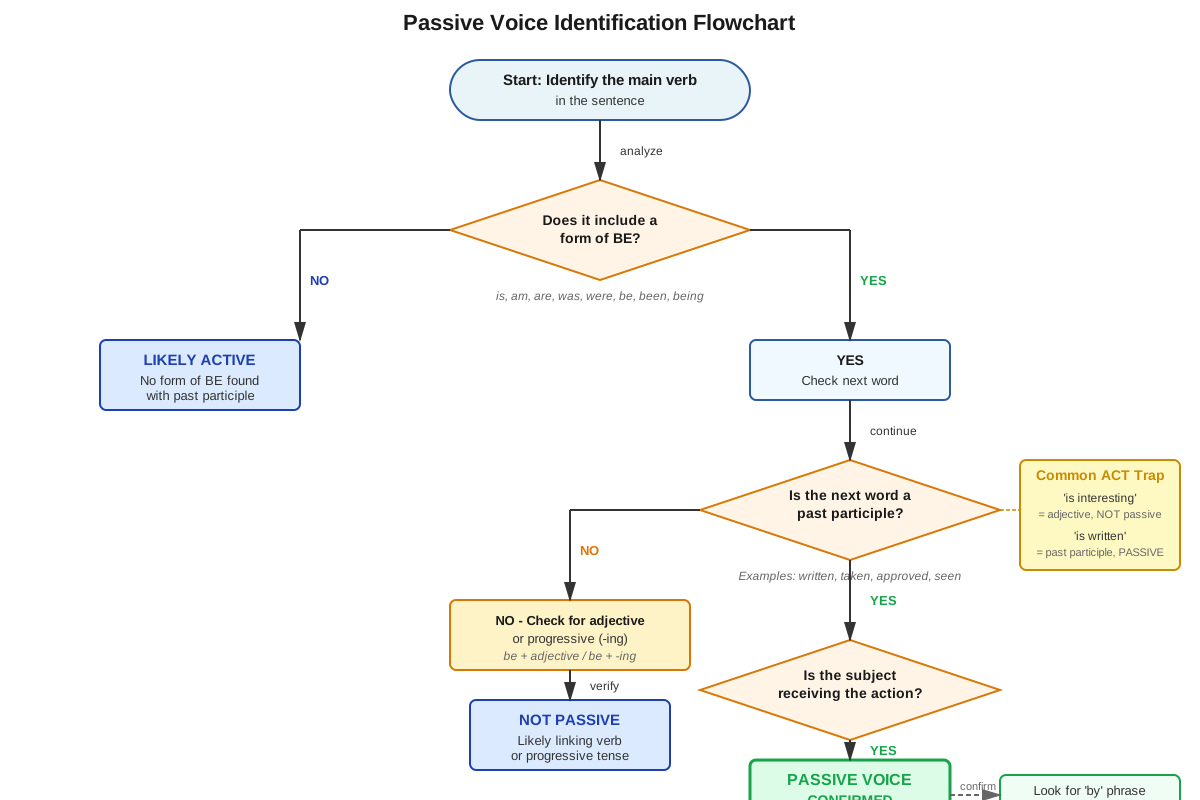
Misconception: Any sentence with a form of "to be" is passive voice. → Correction: Passive voice requires both a form of "to be" AND a past participle. Sentences like "She is happy" or "They were at the store" use "to be" as a linking verb or helping verb, not to create passive voice.
Misconception: The word "by" always signals passive voice. → Correction: While "by" often introduces the agent in passive constructions, it appears in many other contexts (e.g., "by the river," "by noon"). Only "by" followed by the performer of an action indicates passive voice.
Misconception: Passive voice and past tense are the same thing. → Correction: Passive voice is about who performs the action (subject receives vs. performs), while past tense is about when the action occurred. You can have passive voice in any tense: "The book is read" (present passive), "The book was read" (past passive), "The book will be read" (future passive).
Misconception: If a sentence doesn't mention who performed the action, it must be passive. → Correction: Active voice sentences can omit objects or other information. "The dog barked" is active voice even though it doesn't mention what the dog barked at. Passive voice specifically requires the subject to receive the action, not perform it.
Misconception: Longer sentences are always passive voice. → Correction: While passive constructions tend to be wordier, length alone doesn't determine voice. A long sentence with multiple clauses can still be entirely in active voice, and a short sentence can be passive: "It was done."
Worked Examples
Example 1: Identifying and Correcting Unnecessary Passive Voice
ACT-Style Question:
The archaeological site was excavated by researchers from the university, and several important artifacts were discovered by them during the dig.
Which of the following alternatives to the underlined portion would be LEAST acceptable?
A. NO CHANGE
B. researchers from the university excavated the archaeological site and discovered several important artifacts during the dig.
C. the archaeological site was excavated by university researchers, who discovered several important artifacts during the dig.
D. researchers from the university excavated the archaeological site, discovering several important artifacts during the dig.
Step 1: Identify the voice in the original sentence. The underlined portion contains two passive constructions: "was excavated by researchers" and "were discovered by them." Both use forms of "to be" (was, were) plus past participles (excavated, discovered), with the agents appearing after "by."
Step 2: Evaluate each alternative. The question asks for the LEAST acceptable option, meaning we're looking for the worst choice.
- Option A (NO CHANGE): Maintains both passive constructions, making the sentence wordy and less direct. This is weak but grammatically correct.
- Option B: Converts both passives to active voice: "researchers excavated" and "[researchers] discovered." This is concise, clear, and direct—a strong choice.
- Option C: Keeps the first passive ("was excavated") but converts the second to active with a relative clause ("who discovered"). This is a mixed approach that's acceptable but less concise than B.
- Option D: Converts both to active voice and uses a participial phrase ("discovering") to combine ideas efficiently. This is concise and effective.
Step 3: Determine the LEAST acceptable option. Option A is the least acceptable because it maintains unnecessary passive voice in both clauses, making the sentence wordier and less direct than the alternatives. The ACT consistently penalizes this type of construction when clearer alternatives exist.
Answer: A
Connection to Learning Objectives: This example demonstrates how to identify passive voice (forms of "to be" + past participle), recognize when it's being tested (question about acceptable alternatives), and apply the core strategy (prefer active voice for clarity and conciseness).
Example 2: Recognizing Appropriate Passive Voice
ACT-Style Question:
The Mona Lisa was painted in the early 16th century and has been displayed at the Louvre Museum in Paris since 1797.
F. NO CHANGE
G. Leonardo da Vinci painted the Mona Lisa in the early 16th century, and it has been displayed at the Louvre Museum in Paris since 1797.
H. In the early 16th century, the Mona Lisa was painted, and the Louvre Museum in Paris has displayed it since 1797.
J. The painting of the Mona Lisa occurred in the early 16th century, and its display has been at the Louvre Museum in Paris since 1797.
Step 1: Analyze the original sentence. It contains two passive constructions: "was painted" and "has been displayed." The agents (Leonardo da Vinci for painting, the Louvre for displaying) are either omitted or implied.
Step 2: Consider the context and emphasis. The sentence focuses on the painting itself (the Mona Lisa) rather than the artist or museum. The painting is the subject of both clauses, creating parallel structure and maintaining focus on the artwork.
Step 3: Evaluate each alternative:
- Option F (NO CHANGE): Maintains passive voice in both clauses, keeping focus on the painting. The parallel structure ("was painted...has been displayed") is elegant and appropriate.
- Option G: Shifts to active voice in the first clause ("Leonardo da Vinci painted") but keeps passive in the second ("has been displayed"). This breaks parallel structure and shifts focus awkwardly from artist to painting.
- Option H: Keeps both passives but adds unnecessary words ("In the early 16th century" at the beginning creates awkward structure) and changes the second clause to active voice ("the Louvre Museum...has displayed"), breaking parallelism.
- Option J: Converts both to awkward noun phrases ("the painting of" and "its display has been"), creating wordier, less natural constructions than the original.
Step 4: Select the best option. Option F (NO CHANGE) is correct because the passive voice appropriately emphasizes the painting rather than the agents, maintains parallel structure, and is concise. This is a case where passive voice serves a legitimate rhetorical purpose.
Answer: F
Connection to Learning Objectives: This example shows that passive voice isn't always wrong on the ACT. Students must evaluate whether passive voice serves a purpose (here, maintaining focus and parallelism) rather than automatically converting to active voice.
Exam Strategy
When approaching ACT questions involving passive voice, follow this systematic process:
Step 1: Identify the voice by looking for forms of "to be" + past participle. If you spot this combination, you've found passive voice.
Step 2: Locate the agent (who or what performs the action). In passive sentences, the agent appears after "by" or is omitted. In active sentences, the agent is the subject.
Step 3: Evaluate appropriateness by asking:
- Is the agent unknown, unimportant, or obvious?
- Does passive voice serve a rhetorical purpose (emphasis, parallelism)?
- Would active voice be clearer and more concise?
Step 4: Apply the ACT's preference for active voice unless passive serves a clear purpose.
Exam Tip: When a question asks for the "clearest," "most concise," or "most effective" option, immediately check for passive voice. Converting passive to active often creates the correct answer.
Trigger words and phrases to watch for:
- "Clear," "concise," "direct," "effective" in question stems → likely testing passive voice
- "Was/were/is/are + past participle" in answer choices → passive voice present
- "By [agent]" in sentences → signals passive construction
- Questions about wordiness → often involve eliminating passive voice
Process-of-elimination tips:
- Eliminate options that use passive voice when active alternatives are clearer
- Keep options with passive voice only when the agent is unknown/unimportant or when passive serves parallelism
- Eliminate options that mix active and passive voice awkwardly, breaking parallel structure
- Choose the most concise option when multiple grammatically correct choices exist
Time allocation advice:
Passive voice questions should take 20-30 seconds each. If you can quickly identify passive constructions and apply the "active voice preference" rule, you'll answer efficiently. Don't overthink—the ACT rarely includes trick questions where passive voice is subtly better than active voice. When in doubt, choose active voice.
Memory Techniques
Mnemonic for identifying passive voice: "BAPP"
- Be (form of "to be")
- And
- Past
- Participle
If you see a form of "be" AND a past participle together, you've found passive voice.
Visualization strategy: Picture a baseball game. In active voice, the batter (subject) hits (verb) the ball (object)—the subject performs the action. In passive voice, the ball (subject) is hit (verb) by the batter—the subject receives the action. This concrete image helps distinguish between voices.
Acronym for when passive is acceptable: "UUOE"
- Unknown actor
- Unimportant actor
- Obvious actor
- Emphasis on recipient
If any of these conditions apply, passive voice might be the correct choice.
Memory phrase: "Active actors act; passive patients are acted upon." This emphasizes that active voice has subjects that perform actions, while passive voice has subjects that receive actions (like patients receiving treatment).
Summary
Passive voice is a high-yield ACT English topic that tests students' ability to recognize sentence constructions where the subject receives rather than performs the action. Passive voice always contains a form of "to be" plus a past participle, and typically includes the agent after "by" or omits it entirely. The ACT strongly prefers active voice because it creates clearer, more concise, and more direct writing. However, passive voice is acceptable when the actor is unknown, unimportant, or obvious, or when emphasis should fall on the action's recipient rather than the performer. Questions testing passive voice often ask for the "clearest" or "most concise" option, making it essential to quickly identify passive constructions and evaluate whether they serve a legitimate purpose. Converting passive to active voice usually involves making the agent the subject and changing the verb form, resulting in more efficient expression. Mastering this topic requires understanding both the structural components of passive voice and the rhetorical principles that govern when each voice is most effective.
Key Takeaways
- Passive voice consists of a form of "to be" + past participle, with the subject receiving rather than performing the action
- The ACT prefers active voice in approximately 90% of cases because it's clearer, more concise, and more direct
- Passive voice is acceptable when the actor is unknown, unimportant, obvious, or when emphasis should be on the recipient
- Questions asking for "clear," "concise," or "effective" writing typically test passive voice recognition
- Converting passive to active voice eliminates wordiness and strengthens writing
- Always identify the agent (performer of the action) to determine whether passive voice is justified
- Passive voice questions appear in 15-20% of ACT English grammar questions, making this a high-yield topic
Related Topics
Wordiness and Redundancy: Passive voice often creates unnecessarily wordy constructions, so mastering passive voice directly improves performance on conciseness questions. Understanding how to eliminate passive constructions is a key strategy for reducing word count.
Parallelism: When a sentence contains a series of actions or clauses, maintaining consistent voice (all active or all passive) creates parallel structure. Mastering passive voice helps identify when shifts in voice break parallelism.
Verb Tense and Consistency: Passive voice can appear in any tense, so understanding how tense and voice interact helps students tackle complex verb questions that test both concepts simultaneously.
Subject-Verb Agreement: Identifying the true subject in passive constructions (the recipient of the action) is essential for ensuring verbs agree in number and person, connecting passive voice mastery to agreement questions.
Sentence Structure and Clarity: Understanding passive voice deepens comprehension of how sentence elements can be rearranged for different effects, building skills for more advanced rhetorical questions about sentence effectiveness.
Practice CTA
Now that you've mastered the core concepts of passive voice, it's time to put your knowledge into action! Complete the practice questions to reinforce your ability to identify passive constructions, evaluate their appropriateness, and convert between voices. Use the flashcards to drill the key structural components and trigger words that signal passive voice on the ACT. Remember: recognizing passive voice quickly and applying the "active voice preference" rule will help you answer these high-yield questions efficiently and accurately. With focused practice, you'll develop the instinct to spot passive constructions instantly and choose the clearest, most effective option every time. You've got this!
Sign up free to keep reading
Create a free AnvayaPrep account to finish this ACT guide on Passive voice — plus flashcards and practice questions.