Overview
Informal style refers to a casual, conversational tone in writing that uses colloquialisms, slang, contractions, and relaxed grammar structures. On the ACT English test, questions about ACT informal style assess whether students can identify when writing becomes inappropriately casual for its context and purpose. The ACT consistently tests students' ability to recognize when informal language undermines the effectiveness of academic, professional, or formal writing passages.
Understanding informal style is essential for the ACT because approximately 15-20% of Rhetorical Skills questions involve tone, style, and register appropriateness. The test frequently presents passages where one sentence or phrase clashes with the overall formality level, and students must identify and correct these inconsistencies. These questions test not just grammar knowledge but also rhetorical awareness—the ability to match language choices to audience, purpose, and context.
This topic connects directly to broader concepts of audience awareness, purpose-driven writing, and rhetorical effectiveness. While grammar rules govern sentence structure and mechanics, style considerations govern word choice and tone. Mastering informal style recognition helps students understand that effective writing requires consistency in register and appropriateness for the intended audience. This skill bridges mechanical correctness (tested in Usage/Mechanics questions) and rhetorical sophistication (tested in Rhetorical Skills questions), making it a crucial component of achieving a high English subscore.
Learning Objectives
- [ ] Identify when Informal style is being tested in ACT English passages
- [ ] Explain the core rule or strategy behind Informal style appropriateness
- [ ] Apply Informal style principles to ACT-style questions accurately
- [ ] Distinguish between appropriate and inappropriate levels of formality in various contexts
- [ ] Recognize specific markers of informal language (slang, colloquialisms, casual expressions)
- [ ] Evaluate whether a passage's tone remains consistent throughout
- [ ] Select the most contextually appropriate alternative when informal language appears
Prerequisites
- Basic understanding of audience and purpose: Recognizing that different writing situations require different approaches is fundamental to evaluating style appropriateness
- Familiarity with standard written English conventions: Students must know formal grammar rules to recognize when writing deviates from them intentionally
- Vocabulary knowledge: Distinguishing between formal and informal word choices requires understanding connotations and register differences
- Reading comprehension skills: Students must grasp the overall tone and purpose of a passage to identify style inconsistencies
Why This Topic Matters
In real-world writing, matching style to context determines whether communication succeeds or fails. A job application letter written in casual language may result in rejection, while an overly formal text message to a friend seems awkward and distant. Professional writers, journalists, academics, and business communicators must constantly calibrate their language register to suit their audience and purpose. The ability to recognize and adjust formality levels is a practical skill that extends far beyond standardized testing.
On the ACT English test, informal style questions appear in approximately 3-5 questions per test, making them a high-yield topic for score improvement. These questions typically appear as part of the Rhetorical Skills subsection, specifically under "Style" questions. The ACT presents passages from various genres—academic essays, personal narratives, scientific explanations, and historical accounts—each with its own appropriate formality level. Students must identify when a word, phrase, or sentence disrupts the established tone.
Common manifestations include: a slang term appearing in an academic passage about scientific research, a casual colloquialism in a historical analysis, an overly conversational phrase in a formal argument, or inconsistent use of contractions. The test often underlines a phrase and asks whether it should be kept or replaced, with answer choices ranging from very informal to very formal. Success requires recognizing the passage's overall register and selecting the option that maintains consistency.
Core Concepts
Defining Informal Style
Informal style encompasses language choices that create a casual, conversational, or relaxed tone in writing. This style mimics spoken language and includes several distinctive features: contractions (can't, won't, shouldn't), colloquial expressions (a lot, kind of, sort of), slang terms (cool, awesome, freaked out), casual pronouns (you, we in contexts where they're inappropriate), and simplified sentence structures. Informal writing often addresses readers directly and uses everyday vocabulary rather than precise academic terminology.
The key distinction lies not in whether informal style is "wrong" but whether it's appropriate for the context. Informal writing works perfectly in personal emails, text messages, casual blog posts, and friendly correspondence. However, it becomes problematic in academic essays, research reports, professional communications, and formal arguments—precisely the types of passages the ACT typically presents.
Markers of Informal Language
Understanding specific informal markers helps students quickly identify style issues:
| Informal Marker | Example | Formal Alternative |
|---|---|---|
| Contractions | "The experiment didn't work" | "The experiment did not work" |
| Slang | "The results were pretty cool" | "The results were remarkable" |
| Colloquialisms | "a lot of data" | "substantial data" or "considerable data" |
| Vague intensifiers | "really important," "very big" | "significant," "substantial" |
| Casual phrases | "kind of interesting" | "somewhat intriguing" |
| Direct address | "You can see that..." | "One can observe that..." or "The evidence shows..." |
| Conversational fillers | "Well, basically..." | [Remove or use precise transition] |
Context and Appropriateness
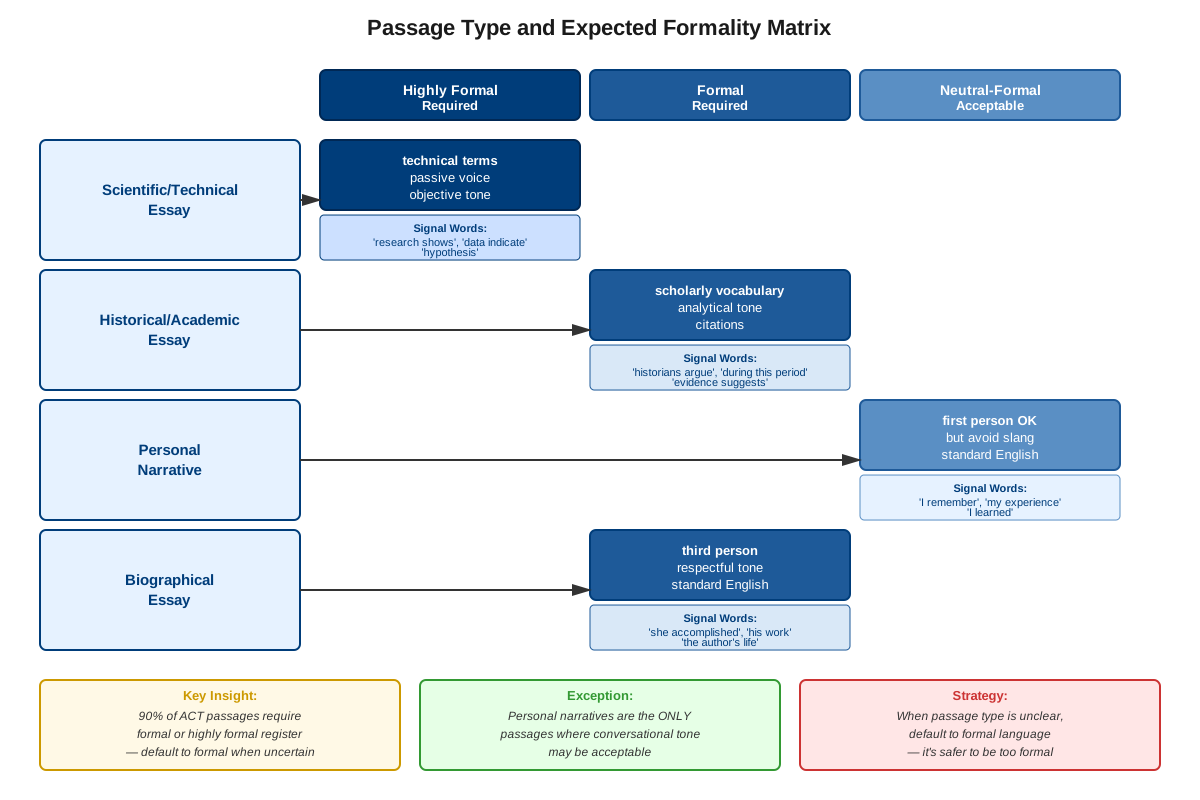
The ACT tests whether students understand that context determines appropriateness. A passage about quantum physics requires formal, precise language. A personal narrative about a childhood memory might accommodate moderate informality. However, the ACT rarely presents truly casual contexts; most passages maintain at least a semi-formal register.
Three factors determine appropriate formality level:
- Subject matter: Scientific, historical, and academic topics demand formal language; personal experiences may allow moderate informality
- Audience: Academic or professional audiences require formal style; general audiences may accept semi-formal approaches
- Purpose: Persuasive arguments, informative explanations, and analytical essays require formality; personal reflections may be less formal
Consistency in Register
Beyond individual word choices, the ACT tests register consistency—maintaining the same formality level throughout a passage. A passage that begins formally should remain formal. When one sentence suddenly shifts to casual language, it creates a jarring effect that undermines credibility and coherence.
Consider this example: "The Renaissance period witnessed unprecedented artistic innovation. Masters like Leonardo da Vinci and Michelangelo totally revolutionized painting and sculpture. Their techniques influenced generations of subsequent artists." The phrase "totally revolutionized" disrupts the formal academic tone established by the surrounding sentences.
Common Informal Constructions on the ACT
Several specific constructions appear repeatedly in ACT informal style questions:
- "A lot": This colloquial phrase should be replaced with "many," "much," "numerous," "substantial," or "considerable"
- "Pretty" or "really" as intensifiers: Replace with "quite," "very," "particularly," or "especially" (or remove entirely)
- "Kind of" or "sort of": Replace with "somewhat," "rather," or more precise language
- "Get" in casual usage: "Get to see" becomes "observe" or "witness"; "get the idea" becomes "understand"
- "Thing" or "stuff": Replace with specific nouns
- Rhetorical questions in formal contexts: "Why does this matter?" should become declarative statements
- Exclamation points in academic writing: These signal inappropriate enthusiasm or casualness
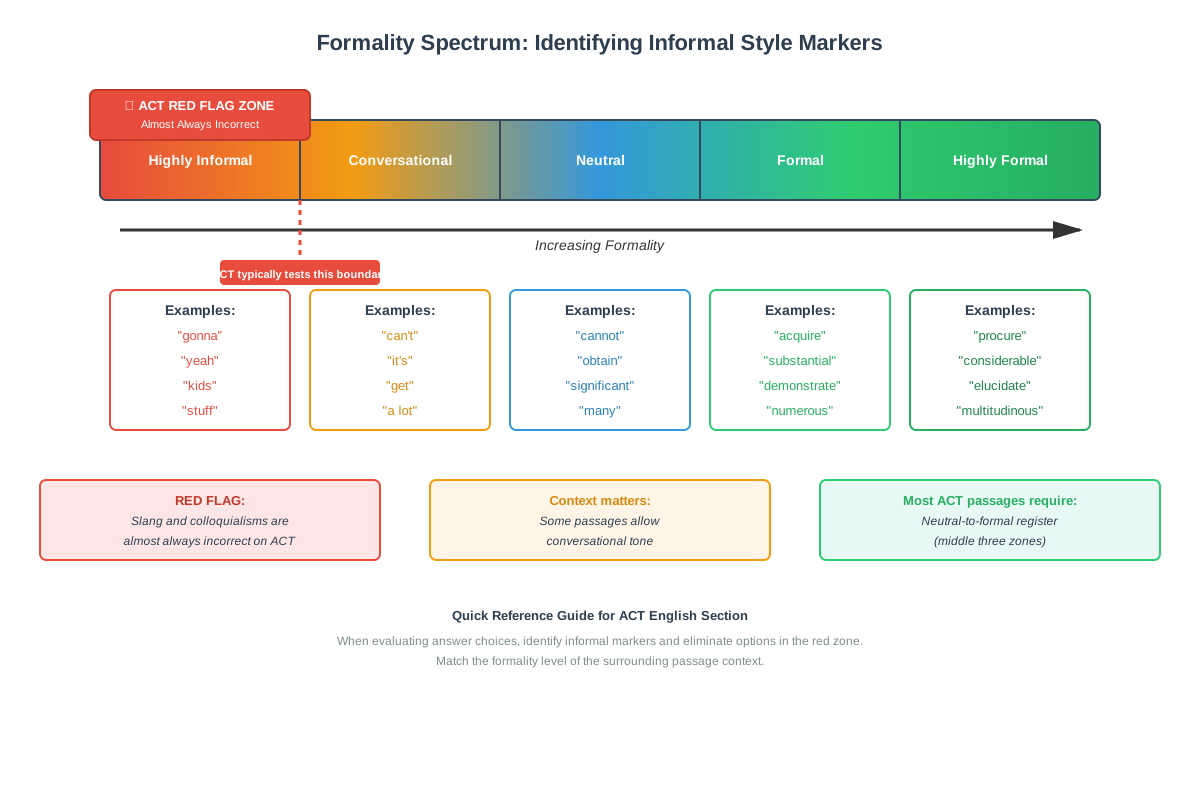
The Spectrum of Formality
Formality exists on a spectrum rather than as a binary choice:
Very Formal → Formal → Semi-formal → Informal → Very Informal
Most ACT passages occupy the "formal" to "semi-formal" range. The test rarely presents extremely formal academic prose or very casual writing. Students must recognize when language dips into the "informal" or "very informal" range inappropriately.
Concept Relationships
Informal style connects directly to several other ACT English concepts. Tone and style questions often overlap with informal style issues, as both assess whether language choices match the passage's purpose. Word choice questions may test informal style when asking students to select the most appropriate vocabulary for context. Redundancy sometimes intersects with informal style, as casual writing often includes unnecessary intensifiers or fillers.
The relationship flows as follows: Audience awareness → determines → Appropriate formality level → guides → Specific word choices → creates → Consistent tone → results in → Effective communication. When any link breaks—particularly when informal language appears in formal contexts—the passage loses effectiveness.
Informal style also connects to rhetorical effectiveness more broadly. Just as transitions must connect ideas logically and sentences must be placed strategically, style must align with purpose. All these elements work together to create coherent, persuasive, and appropriate writing. Understanding informal style thus reinforces the larger principle that effective writing requires matching all elements—grammar, structure, word choice, and tone—to the rhetorical situation.
High-Yield Facts
⭐ Informal style questions test appropriateness, not correctness—informal language isn't grammatically wrong, just contextually inappropriate
⭐ Contractions are the most common marker of informal style on the ACT and are generally inappropriate in formal academic passages
⭐ The phrase "a lot" appears frequently in ACT questions and should almost always be replaced with more formal alternatives
⭐ Slang and colloquialisms are always inappropriate in formal academic or scientific passages
⭐ Consistency matters as much as individual word choices—one informal phrase can disrupt an otherwise formal passage
- Casual intensifiers like "really," "pretty," and "totally" signal inappropriate informality in academic contexts
- Direct address using "you" is often too informal for academic passages unless the passage consistently uses second person
- Vague language like "thing," "stuff," and "get" typically indicates informal style that needs revision
- The ACT typically presents passages in formal or semi-formal registers, rarely truly casual contexts
- When answer choices range from very informal to very formal, the correct answer usually falls in the formal or semi-formal range
- Exclamation points in academic writing signal inappropriate enthusiasm and informal tone
- Rhetorical questions are generally too informal for academic passages and should be converted to declarative statements
Quick check — test yourself on Informal style so far.
Try Flashcards →Common Misconceptions
Misconception: All contractions are grammatically incorrect → Correction: Contractions are grammatically correct but stylistically inappropriate in formal writing contexts. They're perfectly acceptable in casual writing but clash with academic or professional registers.
Misconception: Informal style questions have objectively "wrong" answers → Correction: These questions test contextual appropriateness, not grammatical correctness. The "wrong" answers are inappropriate for the specific passage's tone and purpose, but might be correct in different contexts.
Misconception: More complex or longer words are always better → Correction: Formal writing requires precise, appropriate vocabulary, not unnecessarily complex language. "Utilize" isn't automatically better than "use"—context determines the best choice.
Misconception: Personal narratives can use any level of informality → Correction: Even personal narratives on the ACT maintain at least a semi-formal register. While they may be slightly less formal than scientific passages, they still avoid slang and extreme casualness.
Misconception: If one sentence in a passage is informal, the whole passage is informal → Correction: The ACT often tests whether students can identify a single informal phrase that disrupts an otherwise formal passage. One informal element doesn't change the overall register—it creates an inconsistency that needs correction.
Misconception: "A lot" is acceptable because it's commonly used → Correction: Frequency of use in casual speech doesn't determine appropriateness in formal writing. "A lot" is a colloquialism that should be replaced with more precise, formal alternatives in academic contexts.
Worked Examples
Example 1: Scientific Passage
Passage excerpt: "Marine biologists have discovered that coral reefs are pretty important to ocean ecosystems. These underwater structures provide habitat for thousands of species and protect coastlines from erosion."
Question: Which of the following alternatives to the underlined portion would be LEAST acceptable?
A. remarkably important
B. significantly important
C. crucially important
D. super important
Analysis:
Step 1: Identify the passage's register. This is a scientific passage about marine biology, requiring formal academic language.
Step 2: Evaluate the original phrase. "Pretty important" uses "pretty" as a casual intensifier, which is too informal for this context.
Step 3: Examine each alternative:
- Choice A ("remarkably important") uses a formal adverb appropriate for academic writing
- Choice B ("significantly important") uses precise, formal language suitable for scientific contexts
- Choice C ("crucially important") employs formal vocabulary appropriate for the passage
- Choice D ("super important") uses "super" as a slang intensifier, even more informal than "pretty"
Step 4: The question asks for the LEAST acceptable alternative. Choice D is the least acceptable because it maintains or increases the informality problem.
Answer: D
Connection to learning objectives: This example demonstrates how to identify informal style markers (casual intensifiers) and apply appropriateness principles to select contextually suitable alternatives.
Example 2: Historical Passage
Passage excerpt: "The Industrial Revolution transformed European society during the 18th and 19th centuries. You could see major changes in manufacturing, agriculture, and transportation. These developments fundamentally altered economic structures and social relationships."
Question:
F. NO CHANGE
G. One could observe
H. Major changes occurred in
J. There were a lot of changes in
Analysis:
Step 1: Identify the issue. The phrase "You could see" uses direct address with the second-person pronoun "you," which is too informal and conversational for a historical analysis.
Step 2: Evaluate the passage's register. This is a formal historical passage requiring academic language and third-person perspective.
Step 3: Examine alternatives:
- Choice F (NO CHANGE) keeps the informal direct address
- Choice G ("One could observe") maintains the observational meaning but uses formal third-person construction
- Choice H ("Major changes occurred in") provides a formal, direct statement appropriate for academic writing
- Choice J ("There were a lot of changes in") uses the colloquialism "a lot," which is informal
Step 4: Both G and H are acceptable, but H is more direct and concise while maintaining formality. Choice G, while formal, is slightly wordy. However, both are vastly superior to F and J.
Answer: H (or G, depending on the specific question format—both are acceptable formal alternatives)
Connection to learning objectives: This example shows how to identify inappropriate direct address, recognize colloquialisms, and select alternatives that match the passage's formal academic register.
Exam Strategy
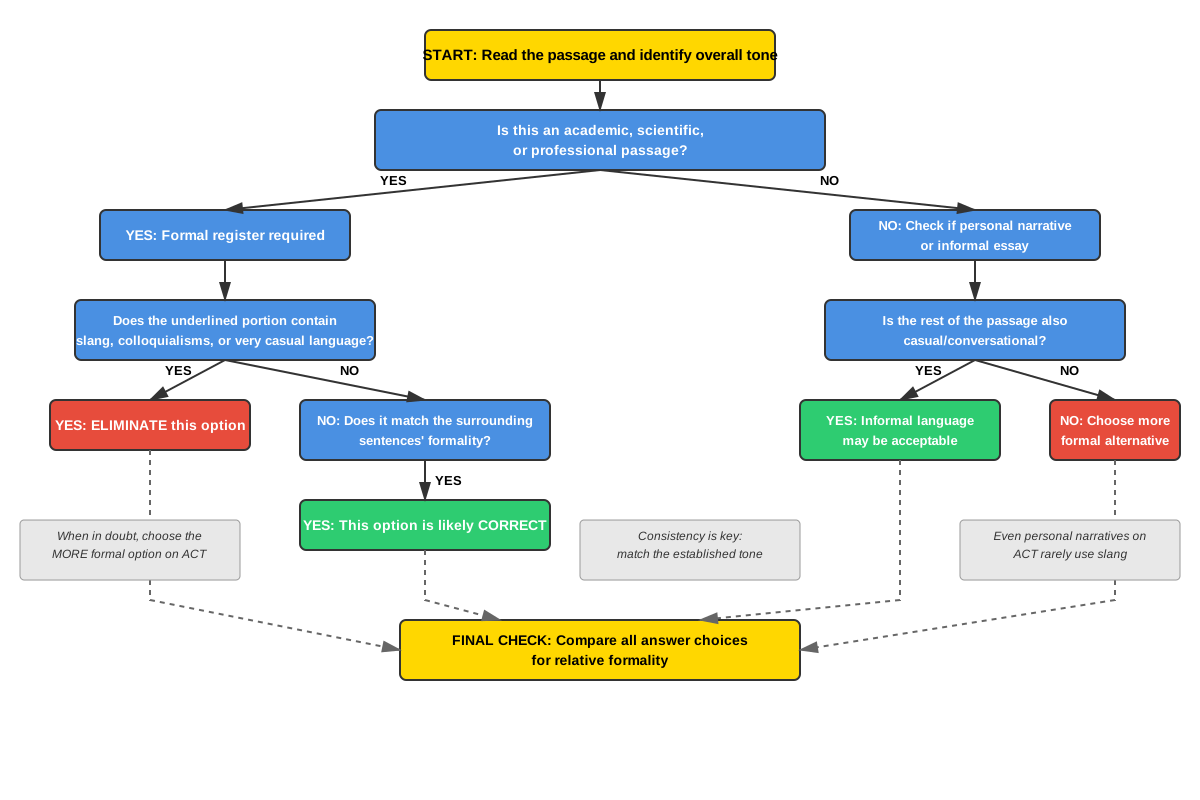
When approaching informal style questions on the ACT, follow this systematic process:
Step 1: Quickly assess the passage's overall register. Read the first few sentences to determine whether the passage is formal academic writing, semi-formal explanation, or (rarely) casual narrative. This establishes the baseline for appropriateness.
Step 2: Identify trigger words and phrases. Watch for these red flags that signal potential informal style issues:
- Contractions (can't, won't, shouldn't)
- "A lot," "kind of," "sort of"
- "Pretty," "really," "totally," "super" as intensifiers
- "You" in academic contexts
- "Thing," "stuff," "get" used casually
- Slang or colloquial expressions
Step 3: Compare the underlined portion to surrounding sentences. Does it match the tone? If the passage is formal and the underlined portion is casual, you've identified an inconsistency.
Step 4: Eliminate answers systematically. When answer choices range from informal to formal:
- Eliminate the most informal options first (slang, contractions, colloquialisms)
- Eliminate overly complex or pretentious options that seem forced
- Choose the option that matches the passage's established register
Step 5: Trust consistency over individual preferences. Your personal writing style doesn't matter—match the passage's style. If the passage uses formal language throughout, select formal alternatives even if they seem stiff.
Exam Tip: If you're unsure whether something is too informal, ask yourself: "Would this appear in a textbook or academic journal?" If not, it's probably too informal for most ACT passages.
Time allocation: Informal style questions should take 20-30 seconds each. They don't require complex grammatical analysis—just quick recognition of register mismatches. If you're spending more than 30 seconds, make your best judgment and move on.
Process of elimination advantage: These questions often include one obviously informal option (with slang or extreme casualness) and one overly formal or awkward option. Eliminate these extremes first, then choose between the remaining moderate options based on context.
Memory Techniques
The CASUAL acronym helps remember common informal markers to avoid:
- Contractions (can't, won't, shouldn't)
- A lot (replace with "many," "much," "substantial")
- Slang and colloquialisms (cool, awesome, freaked out)
- Unnecessary intensifiers (really, pretty, totally)
- Addressing readers directly (you, we in formal contexts)
- Loose language (thing, stuff, get)
The Formality Test: Visualize reading the sentence aloud in a college lecture or presenting it in a research paper. If it sounds out of place, it's probably too informal.
The Textbook Rule: Ask yourself, "Would this exact phrase appear in my history or science textbook?" If the answer is no, the language is likely too informal for the ACT passage.
The Substitution Strategy: When you spot "a lot," automatically think "many/much/substantial." When you see "pretty" or "really," think "quite/particularly/especially" or consider removing the intensifier entirely.
Summary
Informal style on the ACT English test assesses whether students can recognize when casual, conversational language inappropriately appears in formal or academic writing contexts. The test presents passages with established registers—typically formal or semi-formal—and asks students to identify and correct phrases that disrupt the consistent tone. Success requires recognizing specific markers of informality (contractions, colloquialisms, slang, casual intensifiers, direct address) and understanding that appropriateness depends on context, audience, and purpose. While informal language isn't grammatically incorrect, it becomes problematic when it clashes with a passage's formal register. Students must evaluate whether word choices match the surrounding tone and select alternatives that maintain consistency. The key principle is that effective writing requires matching style to rhetorical situation—academic and professional contexts demand formal language, while casual contexts permit informal approaches. On the ACT, most passages require formal or semi-formal language, making informal constructions inappropriate and requiring revision to more contextually suitable alternatives.
Key Takeaways
- Informal style questions test contextual appropriateness, not grammatical correctness—casual language is wrong only when it clashes with formal contexts
- Common informal markers include contractions, "a lot," casual intensifiers (pretty, really, totally), slang, colloquialisms, and direct address with "you"
- Consistency in register is crucial—one informal phrase can disrupt an otherwise formal passage and signal an error
- Most ACT passages maintain formal or semi-formal registers, requiring academic language rather than conversational expressions
- The correct answer typically matches the passage's established tone, falling in the formal to semi-formal range
- Eliminate extreme options first (very informal or overly pretentious), then select the alternative that best matches context
- When in doubt, choose the more formal option for academic, scientific, or historical passages
Related Topics
Tone and Diction: Understanding how word choice creates emotional effects and attitudes extends informal style knowledge to broader rhetorical considerations. Mastering informal style provides the foundation for analyzing how specific vocabulary choices shape reader perception.
Audience Awareness: Recognizing appropriate formality levels depends on understanding audience expectations. Further study of audience analysis deepens the ability to calibrate language for different readers and purposes.
Rhetorical Effectiveness: Informal style is one component of overall rhetorical success. Exploring how all elements—organization, transitions, word choice, and style—work together creates comprehensive writing competence.
Word Choice and Precision: Moving beyond formality to precision in vocabulary selection builds on informal style mastery. Understanding connotation, specificity, and contextual appropriateness represents the next level of word choice sophistication.
Practice CTA
Now that you've mastered the principles of informal style recognition and correction, it's time to apply this knowledge to practice questions. The concepts you've learned—identifying informal markers, assessing contextual appropriateness, and maintaining register consistency—will become automatic with practice. Work through the practice questions carefully, analyzing why each answer is correct or incorrect based on the passage's established tone. Use the flashcards to reinforce recognition of common informal constructions and their formal alternatives. Remember: every practice question you complete strengthens your ability to quickly spot and correct style inconsistencies on test day. You've built the foundation—now solidify it through application!
Sign up free to keep reading
Create a free AnvayaPrep account to finish this ACT guide on Informal style — plus flashcards and practice questions.