Overview
Paragraph placement questions represent one of the most strategic question types on the ACT English test. These questions ask students to determine the most logical position for a paragraph within a passage, testing the ability to recognize organizational patterns, transitional logic, and the flow of ideas across multiple paragraphs. Unlike sentence-level questions that focus on grammar or punctuation, paragraph placement questions require students to step back and analyze the passage's overall structure and argumentative progression.
Understanding ACT paragraph placement is essential because these questions appear consistently on every ACT English test, typically 1-2 times per exam. They carry the same point value as any other question, yet many students struggle with them because they require a different skill set than grammar-focused items. Success on paragraph placement questions demonstrates reading comprehension, logical reasoning, and the ability to identify how writers organize information to achieve specific rhetorical purposes. These questions often appear at the end of a passage and are marked by a question number in a box, signaling that they test passage-level understanding rather than a specific underlined portion.
Paragraph placement connects directly to broader rhetorical skills tested throughout the ACT English section, including organization, transitions, and the logical development of ideas. Mastering this topic strengthens overall passage comprehension and helps students recognize how effective writing builds coherent arguments through strategic sequencing. The skills developed here transfer directly to the ACT Reading section and to college-level writing tasks where organizational clarity determines communication effectiveness.
Learning Objectives
- [ ] Identify when paragraph placement is being tested
- [ ] Explain the core rule or strategy behind paragraph placement
- [ ] Apply paragraph placement to ACT-style questions accurately
- [ ] Analyze transitional clues and chronological markers that signal paragraph order
- [ ] Evaluate the logical progression of ideas across multiple paragraphs
- [ ] Distinguish between effective and ineffective paragraph sequences based on rhetorical purpose
Prerequisites
- Basic paragraph structure: Understanding topic sentences, supporting details, and concluding sentences helps identify each paragraph's main purpose and how it contributes to the overall passage
- Transitional words and phrases: Familiarity with transitions (however, furthermore, for example, in contrast) enables recognition of logical connections between paragraphs
- Main idea identification: The ability to quickly determine what each paragraph is primarily about forms the foundation for determining optimal placement
- Chronological and logical sequencing: Understanding how events, arguments, and explanations typically progress helps predict natural paragraph order
Why This Topic Matters
Paragraph placement questions assess organizational skills that extend far beyond standardized testing. In academic writing, professional communication, and everyday information processing, the ability to recognize logical structure and effective sequencing determines whether messages are understood or ignored. Writers who master organizational principles create clearer arguments, more persuasive essays, and more accessible explanations. Readers who understand these principles can better comprehend complex texts and identify when information is poorly organized.
On the ACT English test, paragraph placement questions typically appear 1-2 times per exam, usually as the final question in a passage. These questions are worth the same single point as grammar questions but often take longer to answer because they require reading and analyzing the entire passage rather than focusing on a single sentence. According to ACT data, these questions have a slightly lower average accuracy rate than many grammar questions, making them high-yield targets for score improvement. Students who develop systematic approaches to these questions can gain competitive advantages.
Paragraph placement questions most commonly appear in passages that present narratives with chronological elements, explanatory essays with logical progressions, or argumentative pieces where evidence must support claims in a specific order. The ACT frequently tests whether students can recognize when a paragraph containing background information should precede specific examples, when a transitional paragraph bridges two distinct ideas, or when a concluding paragraph should appear at the end rather than in the middle of a passage.
Core Concepts
Understanding Paragraph Placement Questions
Paragraph placement questions ask students to determine where a specific paragraph should be positioned within a passage to create the most logical and coherent organization. These questions are distinctive in format: they typically appear as the last question for a passage and present a paragraph marked with a number in brackets, such as [1], [2], [3], or [4]. The question then asks whether this paragraph should remain where it currently is or be moved to another position.
The fundamental principle underlying all paragraph placement questions is logical flow: ideas must progress in an order that makes sense to readers. This means earlier paragraphs should establish context, introduce concepts, or present claims before later paragraphs provide examples, develop arguments, or draw conclusions. Effective organization follows patterns that readers expect based on the passage's purpose and genre.
Key Organizational Patterns
Different passage types follow predictable organizational structures that guide paragraph placement decisions:
| Pattern Type | Typical Sequence | Common in |
|---|---|---|
| Chronological | Events ordered by time (earliest to latest) | Narratives, historical accounts, process descriptions |
| General to Specific | Broad claim → supporting details → specific examples | Argumentative and explanatory essays |
| Problem-Solution | Issue identification → analysis → proposed solutions | Persuasive writing |
| Cause-Effect | Causes → resulting effects OR effect → underlying causes | Scientific and analytical passages |
| Comparison-Contrast | Subject A → Subject B → similarities/differences | Analytical essays |
Understanding which pattern a passage follows helps predict where paragraphs logically belong. A paragraph introducing a person or concept must precede paragraphs that discuss that person or concept in detail. A paragraph presenting a solution must follow the paragraph that identifies the problem.
Transitional Clues and Reference Markers
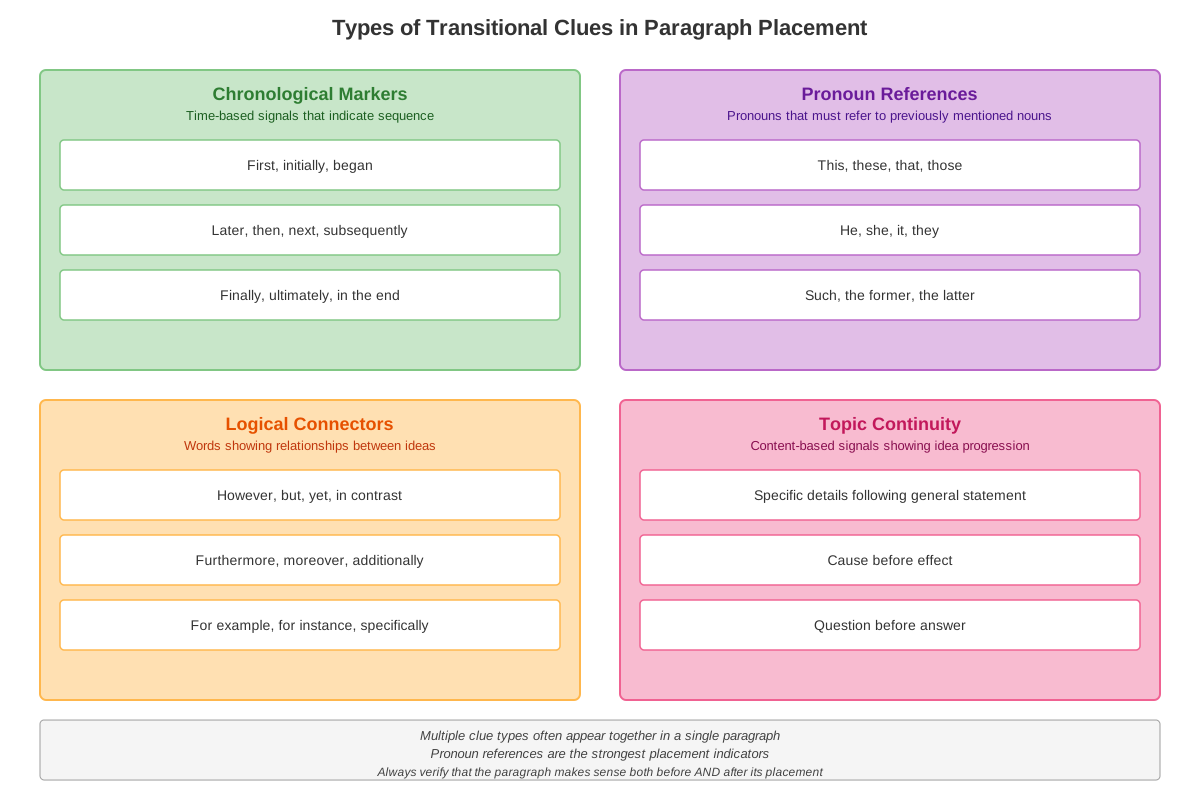
Paragraphs contain explicit signals that indicate their logical position within a passage. Transitional expressions at the beginning of paragraphs reveal relationships to preceding content:
- Additive transitions (furthermore, additionally, moreover) indicate the paragraph continues or expands the previous discussion
- Contrastive transitions (however, nevertheless, on the other hand) signal a shift or opposing viewpoint
- Sequential transitions (first, next, finally) mark steps in a process or stages in development
- Illustrative transitions (for example, for instance, specifically) introduce supporting evidence for prior claims
- Conclusive transitions (therefore, thus, in conclusion) indicate summary or final thoughts
Pronoun references and demonstrative adjectives (this, that, these, those) create cohesion by referring to nouns in previous paragraphs. A paragraph beginning with "This discovery" must follow a paragraph that describes a discovery. A paragraph using "he" or "she" must follow a paragraph that introduces the person being referenced.
Specific references to previously mentioned concepts, events, or examples also signal paragraph order. If Paragraph 3 mentions "the experiment described earlier," it must follow the paragraph describing that experiment.
The Systematic Approach to Paragraph Placement
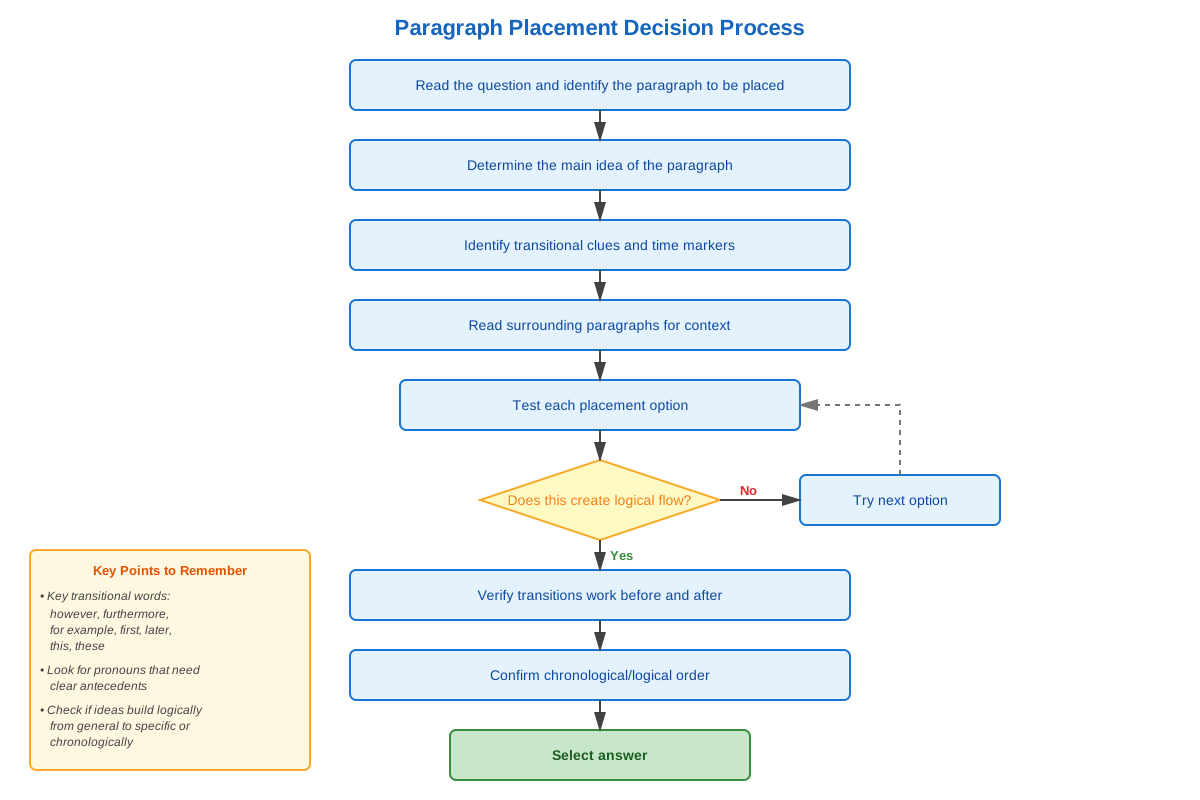
Answering paragraph placement questions requires a methodical process:
- Read the entire passage first: Understand the overall topic, purpose, and argument before attempting to reorganize
- Identify each paragraph's main idea: Summarize what each paragraph primarily accomplishes in one sentence
- Note transitional clues: Mark transitions, pronouns, and specific references that indicate relationships between paragraphs
- Determine the organizational pattern: Recognize whether the passage follows chronological, logical, or another predictable structure
- Test the current placement: Evaluate whether the paragraph in question flows logically where it currently sits
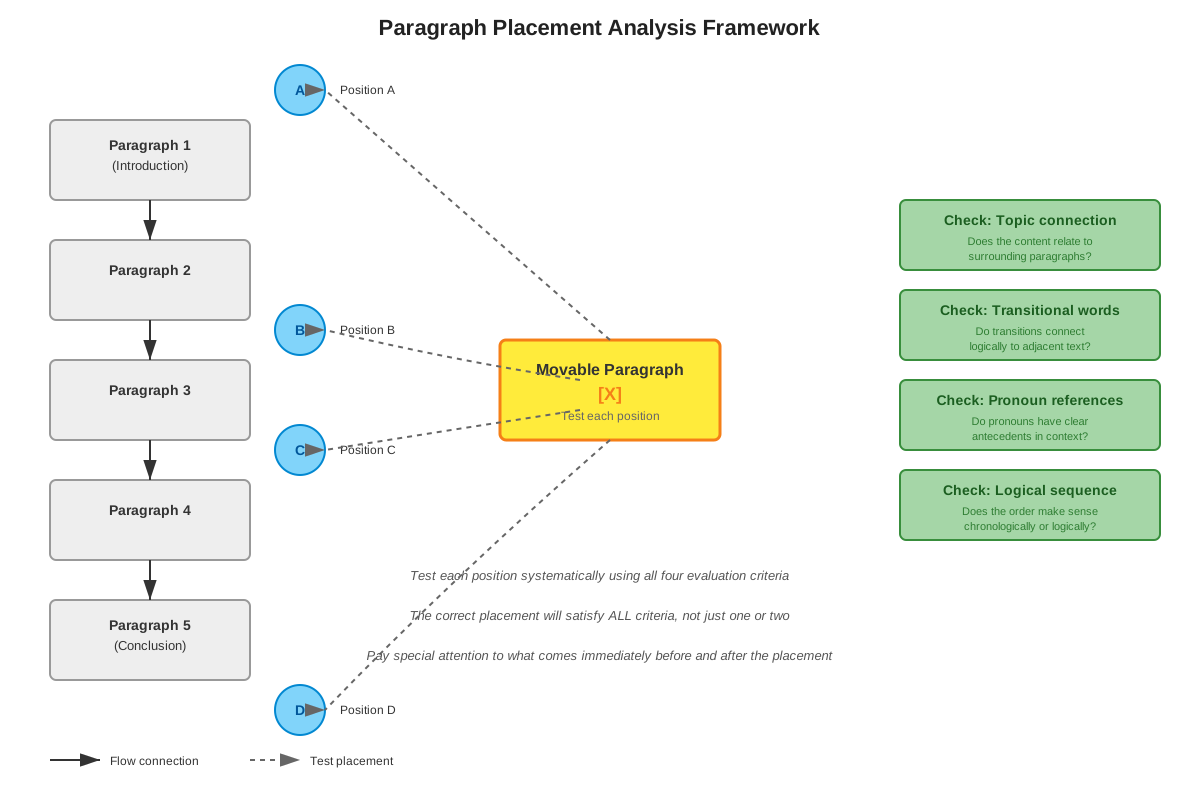
- Test alternative placements: For each suggested position, check whether transitions and references make sense
- Verify the final choice: Ensure the selected placement creates smooth transitions both before and after the moved paragraph
Common Paragraph Functions
Recognizing what role a paragraph plays helps determine its optimal position:
- Introductory paragraphs establish context, present the main topic, or provide necessary background information
- Transitional paragraphs bridge two distinct sections or shift focus from one aspect to another
- Supporting paragraphs provide evidence, examples, or detailed explanations for claims made earlier
- Concluding paragraphs summarize main points, reflect on implications, or provide closure
A paragraph that introduces a new character or concept cannot appear after paragraphs that already discuss that character or concept. A paragraph that summarizes findings cannot appear before the paragraphs presenting those findings.
Concept Relationships
The concepts within paragraph placement are hierarchically connected. At the foundation lies logical flow—the overarching principle that ideas must progress coherently. This principle manifests through organizational patterns (chronological, general-to-specific, etc.), which provide the structural framework for paragraph order. Within these patterns, transitional clues and reference markers serve as the concrete textual evidence that confirms or contradicts potential placements.
The relationship flows: Logical Flow → determines → Organizational Pattern → creates expectations for → Paragraph Functions → revealed through → Transitional Clues and References → guide → Systematic Approach → produces → Correct Placement Decision.
Paragraph placement connects to prerequisite knowledge of transitions and main ideas, which provide the tools for analyzing paragraph relationships. It also relates to other rhetorical skills questions on the ACT, particularly those asking about sentence placement within paragraphs (a micro-level version of the same skill), questions about adding or deleting sentences (which require understanding paragraph focus), and questions about the purpose or effect of specific paragraphs (which test similar analytical skills).
Mastering paragraph placement enhances performance on organization questions throughout the English test and improves reading comprehension by training students to recognize how writers structure arguments and narratives. The analytical skills developed here—identifying main ideas, recognizing transitions, and evaluating logical sequences—transfer directly to the Reading section's questions about passage structure and author's purpose.
High-Yield Facts
⭐ Paragraph placement questions typically appear once or twice per ACT English test, usually as the final question in a passage
⭐ The correct placement creates logical flow both before and after the paragraph in question—check transitions in both directions
⭐ Pronouns and demonstrative adjectives (this, that, these, those) must have clear antecedents in preceding paragraphs
⭐ Introductory or background information must precede specific examples or detailed discussions of that information
⭐ Chronological narratives require events to appear in time order unless the passage explicitly uses flashback structure
- Transitional words at paragraph beginnings provide crucial clues about logical relationships to surrounding paragraphs
- A paragraph containing a conclusion or summary statement typically belongs at or near the end of the passage
- Specific references to "the aforementioned," "this example," or "that approach" indicate the paragraph must follow the referenced content
- General claims or thesis statements precede the evidence and examples that support them
- When testing placement options, read the sentences immediately before and after each potential position to check for smooth transitions
Quick check — test yourself on Paragraph placement so far.
Try Flashcards →Common Misconceptions
Misconception: Paragraph placement questions can be answered by reading only the paragraph in question without understanding the full passage context.
Correction: Effective paragraph placement requires understanding the entire passage's organizational structure, main argument, and how each paragraph contributes to the overall purpose. The paragraph in question must fit logically within the complete sequence of ideas.
Misconception: The longest paragraph should always come first to establish context, or the shortest paragraph should always conclude the passage.
Correction: Paragraph length has no bearing on optimal placement. Position depends entirely on logical flow, transitional connections, and the role each paragraph plays in developing the passage's ideas. Short paragraphs can introduce topics, and long paragraphs can conclude discussions.
Misconception: If a paragraph contains a transitional word like "however" or "furthermore," it can be placed anywhere because transitions create connections.
Correction: Transitional words indicate specific logical relationships that only work when the paragraph is positioned correctly relative to the content it references. "However" requires preceding content to contrast with, and "furthermore" requires preceding content to build upon.
Misconception: Paragraph placement questions always have one obviously wrong answer that can be eliminated immediately.
Correction: ACT paragraph placement questions often feature multiple positions that might seem plausible at first glance. Careful analysis of transitions, references, and logical progression is necessary to identify the single best placement.
Misconception: The current position of the paragraph is usually wrong since the question wouldn't be asked otherwise.
Correction: The correct answer to paragraph placement questions is frequently "where it is now." The ACT tests whether students can recognize effective organization, not just identify problems. Approximately 25-30% of paragraph placement questions have "NO CHANGE" as the correct answer.
Worked Examples
Example 1: Chronological Narrative
Passage Context: A passage describes the development of a community garden project.
Paragraph [2]: "By the following spring, the garden had produced its first harvest. Volunteers distributed fresh vegetables to neighborhood families, and the local newspaper featured the project in a front-page story."
Current Position: This paragraph currently appears as the second paragraph in the passage.
Other Paragraphs:
- Paragraph 1: Introduces the neighborhood and explains why residents wanted a community garden
- Paragraph 3: Describes how volunteers cleared the lot, built raised beds, and planted seeds
- Paragraph 4: Reflects on the garden's ongoing success and plans for expansion
Question: For the sake of logic and coherence, Paragraph 2 should be placed:
A. where it is now
B. after Paragraph 3
C. after Paragraph 4
D. before Paragraph 1
Analysis:
Step 1: Identify the main idea of Paragraph 2. This paragraph describes the harvest and recognition—the results of the garden project.
Step 2: Note transitional clues. "By the following spring" indicates time has passed. "The garden had produced" refers to an established garden that must have been planted earlier.
Step 3: Determine the organizational pattern. This is clearly chronological: the passage should move from initial idea → preparation/planting → harvest/results → future plans.
Step 4: Test current placement (after Paragraph 1). If Paragraph 2 stays where it is, the passage jumps from wanting a garden directly to harvesting vegetables, skipping the actual creation of the garden. This violates chronological order.
Step 5: Test alternative placements. After Paragraph 3 makes sense: Paragraph 3 describes planting, then Paragraph 2 describes the harvest that resulted. After Paragraph 4 would place results after reflection on ongoing success—illogical. Before Paragraph 1 would present results before introducing the project—impossible.
Answer: B. After Paragraph 3 creates proper chronological sequence: introduction → preparation and planting → harvest and recognition → future plans.
Example 2: General-to-Specific Argument
Passage Context: An essay argues that learning musical instruments benefits cognitive development.
Paragraph [3]: "For instance, a longitudinal study at Northwestern University tracked students who began piano lessons in elementary school. Researchers found these students demonstrated significantly stronger spatial reasoning skills in high school compared to peers without musical training."
Current Position: Third paragraph in the passage.
Other Paragraphs:
- Paragraph 1: Introduces the topic and states the thesis that musical training enhances cognitive abilities
- Paragraph 2: Explains the general mechanisms by which music training affects brain development, mentioning improved spatial reasoning, memory, and language processing
- Paragraph 4: Discusses additional benefits of musical training for emotional development and social skills
Question: Should Paragraph 3 be placed where it is now?
A. Yes, because it provides a specific example supporting the general claim in Paragraph 2
B. Yes, because it introduces the main argument of the essay
C. No, it should be placed before Paragraph 2 to establish evidence before making claims
D. No, it should be placed after Paragraph 4 to conclude with concrete evidence
Analysis:
Step 1: Identify Paragraph 3's function. It provides a specific research example supporting claims about spatial reasoning benefits.
Step 2: Note transitional clues. "For instance" explicitly signals that this paragraph provides an example of something mentioned previously.
Step 3: Examine the logical progression. Paragraph 2 makes a general claim about spatial reasoning improvements. Paragraph 3 provides specific research evidence for that exact claim. This follows the general-to-specific pattern common in argumentative essays.
Step 4: Test the current placement. The transition "For instance" works perfectly after Paragraph 2's general discussion of spatial reasoning. The specific example directly supports the preceding general claim.
Step 5: Evaluate alternatives. Placing it before Paragraph 2 would present specific evidence before the general claim it supports—backwards logic. Placing it after Paragraph 4 would separate the spatial reasoning example from the paragraph discussing spatial reasoning—poor organization.
Answer: A. The current placement is correct because it follows the effective organizational pattern of general claim followed by specific supporting evidence, and the transition "For instance" explicitly connects to the preceding paragraph.
Exam Strategy
When approaching paragraph placement questions on the ACT, implement this strategic process:
Step 1: Recognize the question type immediately. Paragraph placement questions are visually distinctive—they reference a paragraph number in brackets and ask about placement. Don't confuse them with sentence placement questions, which reference specific sentences within a paragraph.
Step 2: If you haven't already read the entire passage, do so now. Unlike grammar questions that can sometimes be answered by reading only the surrounding sentences, paragraph placement requires full passage comprehension. Understand the passage's overall purpose, main argument, and organizational structure before attempting to answer.
Step 3: Create a mental outline. Quickly summarize each paragraph's main point in 3-5 words. This creates a roadmap: "Intro problem → Background info → First solution → Second solution → Conclusion."
Trigger words and phrases to watch for:
- Time markers: "first," "then," "later," "by the following year," "initially," "eventually" signal chronological organization
- Demonstrative pronouns: "this," "that," "these," "those" require antecedents in previous paragraphs
- Explicit references: "the aforementioned study," "this example," "such approaches" indicate the paragraph must follow specific content
- Logical transitions: "however," "furthermore," "in contrast," "for example" reveal relationships to surrounding paragraphs
- Concluding language: "ultimately," "in conclusion," "thus," "therefore" suggest the paragraph belongs near the end
Process of elimination tips:
- Eliminate any placement that would put specific examples before the general concepts they illustrate
- Eliminate any placement that would separate a pronoun from its antecedent or create unclear references
- Eliminate any placement that violates chronological order in narrative passages
- Eliminate any placement that would put a conclusion before the evidence it summarizes
Time allocation: Paragraph placement questions typically require 60-90 seconds—longer than most grammar questions. Budget this time by working efficiently on easier grammar questions, creating a time cushion for these more complex organizational questions.
When stuck between two options: Read the sentences immediately before and after each potential position. The correct placement will create smooth, logical transitions in both directions. Check whether transitional words make sense with the new surrounding content.
Memory Techniques
PLACE mnemonic for the systematic approach:
- Purpose: Identify each paragraph's main purpose
- Logic: Determine the passage's organizational logic (chronological, general-to-specific, etc.)
- Antecedents: Check that pronouns and references have clear antecedents
- Connections: Verify transitional words create logical connections
- Evaluate: Test the placement by reading transitions before and after
The "Sandwich Check" visualization: Imagine the paragraph in question as the filling in a sandwich. The bread slices above and below (the surrounding paragraphs) must complement the filling. If you put the filling between the wrong bread slices, the sandwich doesn't work. Read the "bread" (surrounding content) to ensure the "filling" (paragraph in question) fits logically.
Chronological passages: Visualize a timeline. Each paragraph represents a point on that timeline. The paragraph in question must fit at the correct chronological position—you can't put "harvest" before "planting" on a timeline.
General-to-Specific passages: Picture an inverted pyramid. The wide top represents general claims and broad concepts. As you move down, the pyramid narrows to specific examples and detailed evidence. Paragraphs must follow this top-to-bottom progression.
The "This/That Test": When a paragraph begins with "this" or "that," point backward in the passage and ask, "This WHAT?" The answer must appear in the preceding paragraph. If it doesn't, the placement is wrong.
Summary
Paragraph placement questions test the ability to recognize logical organization and coherent flow across an entire passage. Success requires understanding common organizational patterns (chronological, general-to-specific, problem-solution), identifying transitional clues and reference markers that signal paragraph relationships, and systematically evaluating how paragraphs function within the passage's overall structure. The core principle is logical flow: ideas must progress in an order that makes sense to readers, with background information preceding specific examples, general claims preceding supporting evidence, and causes preceding effects. Students must read the entire passage, identify each paragraph's main purpose, note transitional expressions and pronoun references, and test whether the paragraph in question creates smooth logical connections both before and after its placement. Approximately 25-30% of these questions have "where it is now" as the correct answer, so students should not assume the current position is wrong. Mastering paragraph placement requires practice recognizing organizational patterns and carefully analyzing how transitional language creates cohesion across multiple paragraphs.
Key Takeaways
- Paragraph placement questions appear 1-2 times per ACT English test and require reading the entire passage to understand organizational structure
- The correct placement creates logical flow in both directions—check transitions before and after the paragraph in question
- Transitional words, pronouns, and specific references provide crucial clues about where paragraphs logically belong
- Common organizational patterns include chronological order, general-to-specific progression, and problem-solution structure
- Background information and general claims must precede specific examples and supporting evidence
- "Where it is now" is correct approximately 25-30% of the time—don't assume the current position is wrong
- Systematic analysis of each paragraph's purpose and the passage's overall logic leads to correct answers more reliably than intuition alone
Related Topics
Sentence Placement Within Paragraphs: This micro-level version of paragraph placement tests the same logical sequencing skills but focuses on where individual sentences belong within a single paragraph. Mastering paragraph placement provides the analytical framework for sentence placement questions.
Adding and Deleting Sentences: These questions require understanding paragraph focus and unity—skills closely related to recognizing how paragraphs function within passages. Students who understand paragraph placement can better evaluate whether sentences belong in specific paragraphs.
Transitions and Logical Relationships: Deep knowledge of transitional words and phrases enhances paragraph placement skills by making the logical connections between paragraphs more visible and analyzable.
Main Ideas and Supporting Details: The ability to quickly identify what each paragraph is primarily about—a prerequisite for paragraph placement—transfers directly to Reading section questions about paragraph purpose and passage structure.
Organization and Purpose Questions: These rhetorical skills questions ask about the effectiveness of organizational choices, building on the same analytical skills developed through paragraph placement practice.
Practice CTA
Now that you understand the principles and strategies behind paragraph placement, it's time to apply this knowledge to ACT-style questions. The practice questions and flashcards will reinforce your ability to recognize organizational patterns, identify transitional clues, and systematically evaluate paragraph positions. Each practice question you complete strengthens your analytical skills and builds the confidence needed to approach these questions efficiently on test day. Remember: paragraph placement questions are highly learnable—consistent practice with the systematic approach outlined in this guide will transform them from challenging obstacles into reliable scoring opportunities. Start practicing now to master this high-yield topic!
Sign up free to keep reading
Create a free AnvayaPrep account to finish this ACT guide on Paragraph placement — plus flashcards and practice questions.