Overview
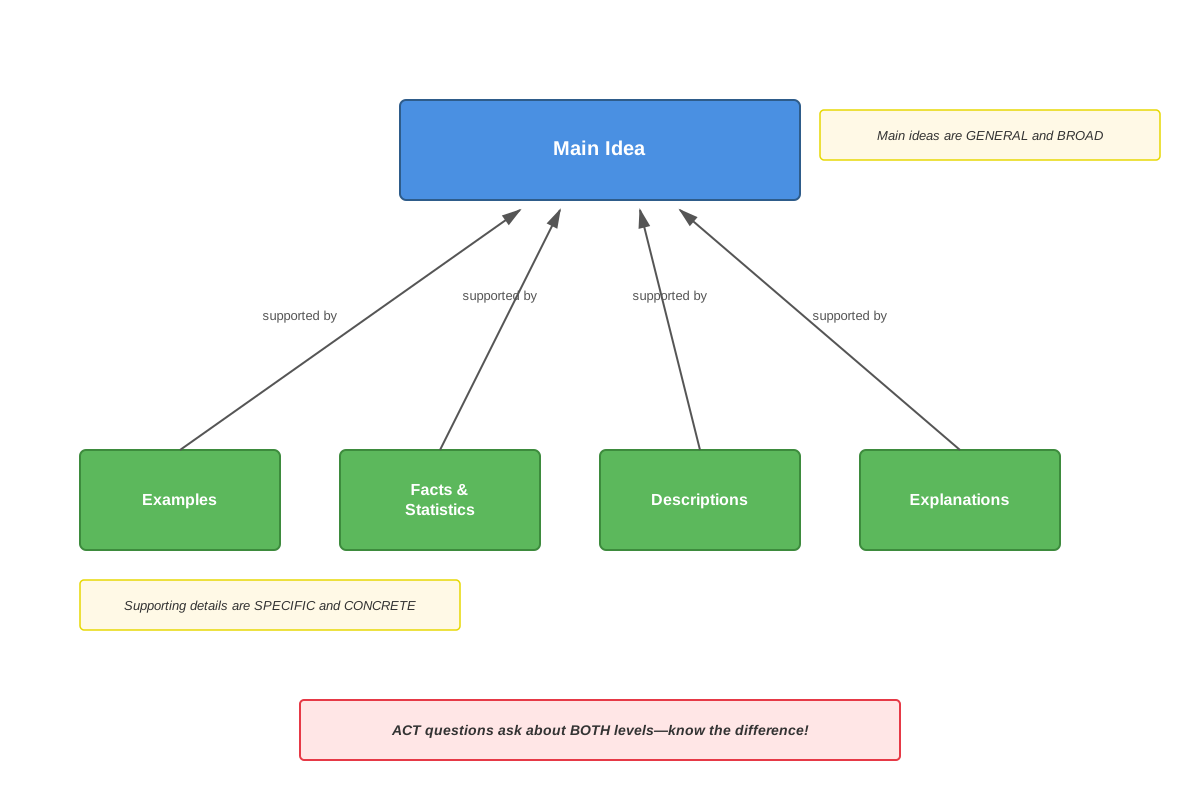
Supporting details are the specific pieces of evidence, examples, facts, descriptions, and explanations that authors use to develop, illustrate, and reinforce their main ideas throughout a passage. On the ACT Reading test, questions about supporting details constitute one of the most frequently tested question types, appearing in approximately 30-40% of all questions across the four passages. These questions assess a student's ability to locate, comprehend, and interpret specific information that the author provides to build their argument, develop characters, explain processes, or describe settings.
Understanding how to identify and work with supporting details is fundamental to ACT Reading success because these questions serve as the foundation for more complex analytical tasks. While main idea questions ask students to synthesize information, and inference questions require reading between the lines, ACT supporting details questions test the essential skill of careful, accurate reading comprehension. Students must demonstrate they can distinguish between what the passage explicitly states versus what they might assume, remember precise details rather than general impressions, and locate specific information efficiently within a 750-900 word passage under strict time constraints.
The relationship between supporting details and other Reading concepts is hierarchical and interconnected. Supporting details provide the evidence base for main ideas, supply the textual foundation for making valid inferences, and offer the specific information needed to understand author's purpose and tone. Mastering supporting details creates a solid foundation for tackling every other question type on the ACT Reading test, making this a high-priority topic for focused study and practice.
Learning Objectives
- [ ] Identify when Supporting details is being tested in ACT Reading questions
- [ ] Explain the core rule or strategy behind Supporting details questions
- [ ] Apply Supporting details strategies to ACT-style questions accurately
- [ ] Distinguish between main ideas and supporting details within passages
- [ ] Locate specific supporting details efficiently using line references and paragraph markers
- [ ] Recognize paraphrased supporting details in answer choices
- [ ] Eliminate answer choices that introduce information not present in the passage
Prerequisites
- Basic reading comprehension skills: The ability to understand literal meaning in written text is essential for identifying what the passage explicitly states versus what it implies.
- Familiarity with ACT passage types: Understanding the four passage types (Literary Narrative/Prose Fiction, Social Science, Humanities, Natural Science) helps students anticipate where supporting details typically appear.
- Skimming and scanning techniques: These foundational skills enable efficient location of specific information within time constraints.
- Understanding of main idea concepts: Recognizing the difference between central claims and supporting evidence is crucial for distinguishing detail questions from synthesis questions.
Why This Topic Matters
Supporting details questions represent the most straightforward path to earning points on the ACT Reading test. Unlike inference or synthesis questions that require multiple cognitive steps, detail questions reward careful reading and accurate information retrieval. For students aiming to improve their Reading scores quickly, mastering supporting details provides immediate, measurable gains because these questions have objectively correct answers directly stated in the passage.
On the ACT Reading test, supporting details questions appear with remarkable consistency. Students can expect 12-16 detail-based questions across the four passages in a typical test administration. These questions appear in several recognizable formats: "According to the passage," "The author states that," "The passage indicates," and "Which of the following does the passage mention." Each passage type features supporting details questions, though they manifest differently—Literary Narrative passages often ask about character actions and descriptions, Social Science passages focus on research findings and data, Humanities passages emphasize biographical facts and historical context, and Natural Science passages test understanding of processes and scientific observations.
The practical significance extends beyond test performance. The ability to identify and evaluate supporting details is fundamental to academic success across disciplines, professional research, critical media consumption, and informed decision-making. Students who excel at distinguishing between claims and evidence, recognizing relevant versus irrelevant information, and accurately recalling specific details develop skills that serve them throughout their educational and professional careers.
Core Concepts
What Are Supporting Details?
Supporting details are specific pieces of information that authors use to develop, explain, illustrate, or prove their main ideas. These details function as the building blocks of effective writing, providing the concrete evidence that makes abstract claims credible and comprehensible. In ACT passages, supporting details take multiple forms: factual statements, statistical data, quotations, examples, descriptions, anecdotes, definitions, comparisons, and explanations of cause-and-effect relationships.
The relationship between main ideas and supporting details follows a hierarchical structure. Main ideas represent the author's primary claims or central points, while supporting details provide the "proof" or elaboration that makes those claims meaningful. For instance, if a passage's main idea is "Urban gardens provide multiple benefits to communities," the supporting details might include specific examples like "reduced food costs for low-income families," "increased property values in surrounding neighborhoods," and "improved mental health outcomes for participants."
Types of Supporting Details on the ACT
The ACT Reading test features several distinct categories of supporting details, each requiring slightly different identification strategies:
Factual Details: These are objective statements about events, dates, names, places, or circumstances. Example: "The experiment was conducted in 1952 at the University of Chicago." These details often appear in Social Science and Natural Science passages and are typically straightforward to locate using key terms.
Descriptive Details: These provide sensory information, physical characteristics, or atmospheric qualities. Example: "The laboratory was cramped and poorly ventilated, with yellowing papers stacked precariously on every surface." Literary Narrative and Humanities passages frequently employ descriptive details to establish setting and mood.
Examples and Illustrations: Authors use specific instances to clarify abstract concepts. Example: "Biomimicry has inspired numerous innovations; for instance, Velcro was developed after observing how burrs stuck to dog fur." These details help readers understand broader principles through concrete cases.
Statistical and Numerical Data: Quantitative information that supports claims. Example: "Participation increased by 47% over the three-year period." These details are common in Social Science and Natural Science passages and often appear in questions testing precise recall.
Quotations and Attributions: Direct statements from individuals mentioned in the passage. Example: "As the researcher noted, 'The results exceeded our most optimistic projections.'" These details are particularly important in Humanities passages discussing historical figures or in Social Science passages presenting research.
Recognizing Supporting Details Questions
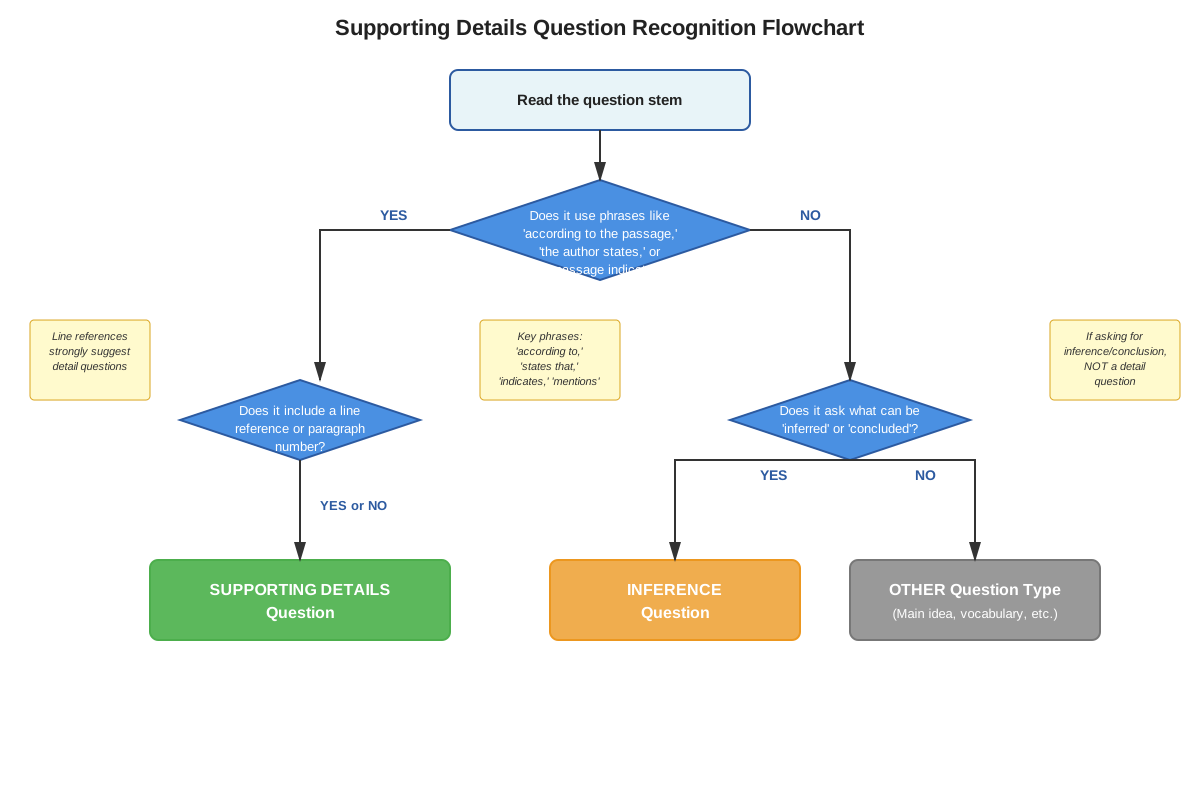
ACT supporting details questions use predictable language patterns that signal what the question is testing. Recognizing these patterns allows students to immediately activate the appropriate strategy. Common question stems include:
| Question Type | Example Phrasing | What It's Testing |
|---|---|---|
| Direct Statement | "According to the passage..." | Literal comprehension of explicitly stated information |
| Specific Mention | "The passage indicates that..." | Identification of particular facts or claims |
| Author Statement | "The author states that..." | Recognition of the author's explicit assertions |
| Detail Verification | "Which of the following does the passage mention?" | Ability to distinguish stated from unstated information |
| Negative Detail | "The passage does NOT state..." | Careful reading to identify what is absent |
These question stems differ markedly from inference questions ("The passage suggests," "It can be reasonably inferred") or synthesis questions ("The main purpose," "The primary function"). The key distinguishing feature is that supporting details questions ask about information explicitly present in the passage, not information that must be deduced or synthesized.
The Paraphrase Principle
A critical concept for ACT supporting details questions is understanding that correct answers rarely use the exact wording from the passage. Instead, the ACT tests whether students comprehend the meaning of supporting details by paraphrasing them in answer choices. This approach distinguishes students who truly understand what they read from those who merely match words.
For example, if a passage states: "The architect's innovative use of natural light transformed the building's interior spaces, creating an atmosphere of openness and tranquility," a correct answer choice might read: "The designer's creative approach to illumination produced a sense of spaciousness and calm." The meaning remains identical, but the vocabulary changes: "innovative use" becomes "creative approach," "natural light" becomes "illumination," "transformed" becomes "produced," and "openness and tranquility" becomes "spaciousness and calm."
Understanding this principle prevents students from falling into the trap of selecting answer choices that use passage vocabulary but distort the meaning. Wrong answers often contain words lifted directly from the passage but arranged in ways that create false statements.
Location Strategies for Supporting Details
Efficient location of supporting details is essential for time management on the ACT Reading test. Students have approximately 8-9 minutes per passage, including time to read and answer 10 questions. Spending excessive time searching for details can derail pacing.
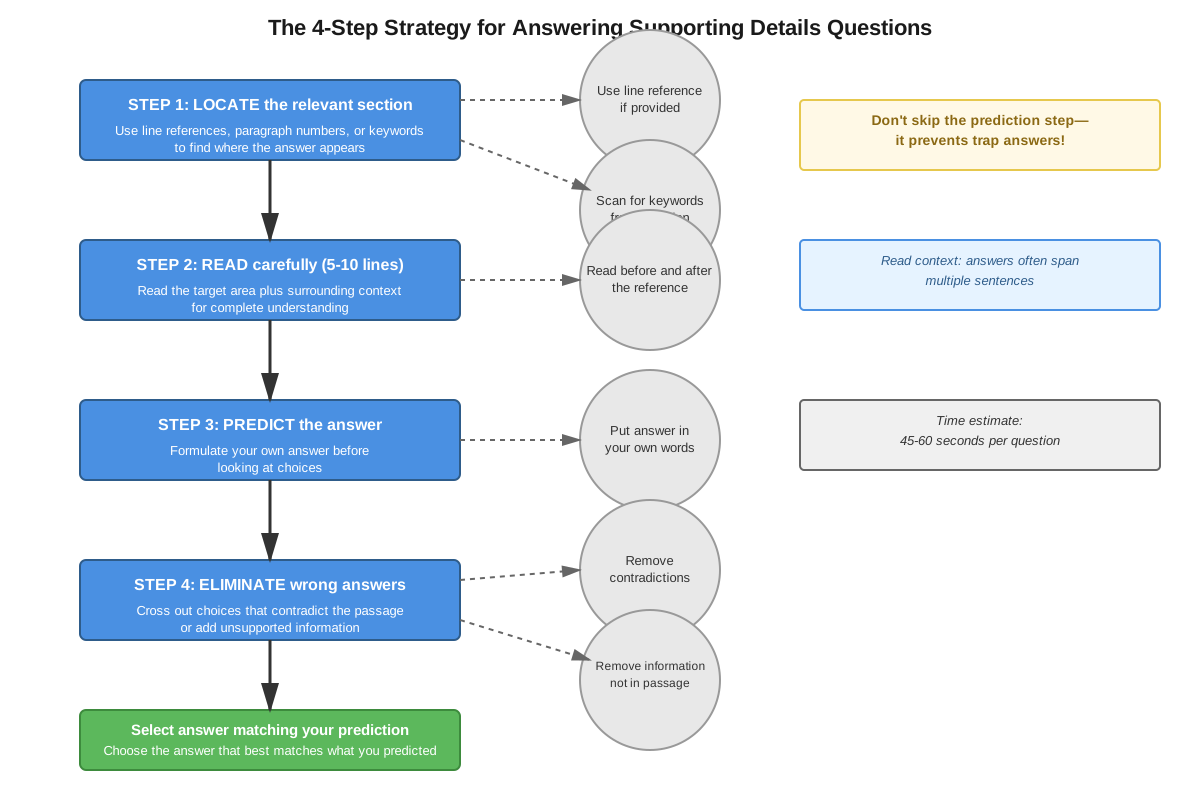
Line Reference Strategy: When questions provide line numbers or paragraph references, students should read 2-3 lines before and after the reference point. Context surrounding the detail often clarifies its meaning and helps eliminate trap answers.
Keyword Scanning Strategy: For questions without line references, identify 2-3 unique keywords from the question stem and scan the passage for those terms or their synonyms. Proper nouns, dates, unusual vocabulary, and technical terms make excellent scanning targets.
Structural Navigation Strategy: Understanding passage organization helps predict where certain details appear. Introductory paragraphs typically present main ideas, body paragraphs develop supporting details, and concluding paragraphs synthesize information. Chronological passages place details in time order, while compare-contrast passages group details by category.
Concept Relationships
Supporting details function as the foundational layer in a hierarchical relationship with other reading comprehension concepts. At the base level, supporting details provide the raw information from which all other understanding derives. These details → combine to form → main ideas, which represent the synthesis of multiple supporting points. Main ideas → enable → understanding of author's purpose, as the pattern of what an author chooses to emphasize reveals their intentions. Supporting details → also provide the evidence base for → valid inferences, since logical deductions must be grounded in textual evidence rather than speculation.
The relationship between supporting details and prerequisite skills is reciprocal. Basic reading comprehension enables identification of supporting details, while practice with supporting details strengthens overall comprehension. Skimming and scanning techniques facilitate efficient detail location, while repeated detail-finding exercises improve scanning speed and accuracy.
Within the topic of supporting details itself, several concepts interconnect. Understanding the types of supporting details (factual, descriptive, statistical, etc.) → informs → recognition of question types, since different passage types emphasize different detail categories. Recognition of question stems → activates → appropriate location strategies, as questions with line references require different approaches than those without. Mastery of the paraphrase principle → enhances → answer choice evaluation, enabling students to recognize correct answers despite vocabulary changes.
High-Yield Facts
⭐ Supporting details questions constitute approximately 30-40% of all ACT Reading questions, making them the most frequently tested question type.
⭐ Correct answers to supporting details questions are ALWAYS explicitly stated in the passage, never requiring inference or synthesis.
⭐ The ACT consistently paraphrases supporting details in correct answer choices rather than using exact passage wording.
⭐ Question stems containing "according to," "states," "indicates," or "mentions" signal supporting details questions.
⭐ Wrong answers to supporting details questions often contain passage vocabulary but distort the meaning or combine information from different sections.
- Supporting details questions appear in all four passage types but manifest differently based on subject matter and genre.
- Line references in questions should prompt reading 2-3 lines before and after the specified location for full context.
- Negative detail questions ("The passage does NOT state") require checking all four answer choices against the passage.
- Proper nouns, dates, and technical terms serve as the most efficient keywords for scanning passages to locate details.
- Time spent carefully reading the passage initially reduces time needed to locate supporting details later.
⭐ Descriptive details appear most frequently in Literary Narrative passages, while statistical details dominate Social Science and Natural Science passages.
- Supporting details questions are typically easier and faster to answer than inference or synthesis questions, making them strategic targets for time management.
- Answer choices that make absolute statements ("always," "never," "only") are frequently incorrect unless the passage uses equally absolute language.
Quick check — test yourself on Supporting details so far.
Try Flashcards →Common Misconceptions
Misconception: Supporting details questions can be answered from memory without returning to the passage.
Correction: Even strong readers should verify their answers by locating the relevant passage section. Memory is unreliable under test pressure, and the ACT deliberately includes trap answers that "sound right" but contradict the passage. Always confirm your answer against the text.
Misconception: The correct answer will use the same words as the passage.
Correction: The ACT consistently paraphrases information in correct answer choices. Students must focus on matching meaning rather than matching vocabulary. This tests true comprehension rather than simple word recognition.
Misconception: If an answer choice contains words from the passage, it must be correct.
Correction: Wrong answers frequently incorporate passage vocabulary to appear credible while actually distorting the meaning. This is one of the ACT's most common trap answer strategies. Always evaluate whether the complete statement accurately reflects the passage's meaning.
Misconception: Supporting details questions are just about memorizing facts from the passage.
Correction: These questions test reading comprehension, not memorization. They assess whether students can locate information efficiently, understand its meaning in context, and recognize accurate paraphrases. The skill being tested is strategic reading, not rote memory.
Misconception: All information in the passage is equally likely to be tested in supporting details questions.
Correction: The ACT preferentially tests details that relate to main ideas, illustrate key concepts, or represent turning points in narratives. Peripheral information and minor tangents are rarely the focus of questions. Understanding this helps students prioritize what to focus on during reading.
Misconception: Longer answer choices are more likely to be correct because they contain more information.
Correction: Answer choice length has no correlation with correctness on the ACT. Both correct and incorrect answers appear in various lengths. Some students fall into the trap of selecting longer answers because they seem more "complete," but this is not a valid strategy.
Misconception: If you can't find the answer quickly, you should guess and move on.
Correction: Supporting details questions have objectively correct answers that can be located in the passage. While time management matters, investing 30-45 seconds to find the relevant passage section is worthwhile for these high-probability questions. Random guessing should be a last resort, not a first response.
Worked Examples
Example 1: Literary Narrative Passage
Passage Excerpt:
"Margaret had always been drawn to the ocean, but her fascination intensified after her grandmother's death. She found herself driving to the coast every weekend, sometimes sitting for hours on the weathered pier where they had spent countless summer afternoons. The rhythmic sound of waves against the pilings brought a sense of peace she couldn't find elsewhere. Her friends worried about her isolation, but Margaret felt more connected to her grandmother in those solitary moments than she had at any of the crowded memorial services."
Question: According to the passage, Margaret visits the coast frequently because:
A) her friends encourage her to spend time near the ocean
B) she wants to avoid attending memorial services
C) the location provides her with a feeling of tranquility
D) her grandmother had requested she continue the tradition
Step 1: Identify the question type
The phrase "According to the passage" signals a supporting details question. The answer will be explicitly stated in the text.
Step 2: Locate the relevant information
The question asks WHY Margaret visits the coast. Scanning for "coast" or "ocean," we find the key sentence: "The rhythmic sound of waves against the pilings brought a sense of peace she couldn't find elsewhere."
Step 3: Evaluate each answer choice
A) INCORRECT - The passage states her friends "worried about her isolation," suggesting they did NOT encourage these visits.
B) INCORRECT - While Margaret found the memorial services "crowded," the passage doesn't state she visits the coast to avoid them. This is a distortion that combines information incorrectly.
C) CORRECT - "A sense of peace" is paraphrased as "a feeling of tranquility." This directly matches the passage's explanation.
D) INCORRECT - The passage never mentions any request from the grandmother. This introduces information not present in the text.
Answer: C
Key Takeaway: Notice how the correct answer paraphrases the passage ("peace" → "tranquility") while wrong answers either contradict the text (A), distort relationships between ideas (B), or introduce unsupported information (D).
Example 2: Natural Science Passage
Passage Excerpt:
"Photosynthesis occurs in two distinct stages: the light-dependent reactions and the light-independent reactions, also known as the Calvin cycle. During the light-dependent reactions, which take place in the thylakoid membranes, chlorophyll molecules absorb photons and convert light energy into chemical energy in the form of ATP and NADPH. These energy-rich molecules then fuel the Calvin cycle, which occurs in the stroma and uses carbon dioxide from the atmosphere to synthesize glucose. The entire process is remarkably efficient, with plants converting approximately 3-6% of available light energy into stored chemical energy."
Question: The passage indicates that the light-dependent reactions:
F) produce glucose molecules that plants use for energy
G) occur in the same location as the Calvin cycle
H) convert light energy into ATP and NADPH
J) utilize carbon dioxide absorbed from the air
Step 1: Identify the question type
"The passage indicates" signals a supporting details question requiring location of explicitly stated information.
Step 2: Locate relevant information
Scanning for "light-dependent reactions," we find: "During the light-dependent reactions, which take place in the thylakoid membranes, chlorophyll molecules absorb photons and convert light energy into chemical energy in the form of ATP and NADPH."
Step 3: Evaluate each answer choice
F) INCORRECT - Glucose synthesis is attributed to the Calvin cycle, not the light-dependent reactions. This confuses the two stages.
G) INCORRECT - The passage explicitly states light-dependent reactions occur in "thylakoid membranes" while the Calvin cycle occurs in "the stroma"—different locations.
H) CORRECT - This directly matches the passage statement about converting "light energy into chemical energy in the form of ATP and NADPH."
J) INCORRECT - Carbon dioxide utilization is attributed to the Calvin cycle, not the light-dependent reactions. Another stage confusion error.
Answer: H
Key Takeaway: Science passages often test whether students can distinguish between different stages of processes. Wrong answers frequently attribute characteristics of one stage to another, testing careful reading and attention to detail.
Exam Strategy
The Four-Step Supporting Details Method
Step 1: Recognize the Question Type (5 seconds)
Identify trigger phrases: "according to," "states," "indicates," "mentions," "the passage says." These signal that the answer is explicitly in the text, not inferred.
Step 2: Identify Keywords and Location Clues (5-10 seconds)
Extract 2-3 specific, searchable terms from the question. Prioritize proper nouns, dates, technical terms, or unusual vocabulary. Note any line references or paragraph indicators.
Step 3: Locate and Read in Context (20-30 seconds)
Scan the passage for your keywords. When found, read the complete sentence plus 1-2 sentences before and after. Context prevents misinterpretation and reveals the full meaning.
Step 4: Evaluate Answer Choices Against the Passage (20-30 seconds)
Compare each answer choice to what the passage actually states. Eliminate choices that introduce new information, contradict the text, or distort relationships between ideas. Select the choice that matches the passage's meaning, even if vocabulary differs.
Trigger Words and Phrases
Questions testing supporting details consistently use specific language patterns. Recognizing these patterns allows immediate strategy activation:
Definite Supporting Details Triggers: "According to the passage," "The passage states," "The author mentions," "The passage indicates," "As stated in the passage," "The passage says"
Likely Supporting Details Triggers: "Which of the following does the passage mention," "The passage provides information about," "The passage describes," "In the passage, the author notes"
NOT Supporting Details Triggers: "The passage suggests" (inference), "It can be reasonably inferred" (inference), "The main purpose" (synthesis), "The author's primary concern" (synthesis), "The passage implies" (inference)
Process of Elimination Strategies
Eliminate answers that introduce information not in the passage: If you cannot locate the information in the text, the answer is wrong. The ACT never requires outside knowledge for supporting details questions.
Eliminate answers that use passage vocabulary but distort meaning: Read carefully to ensure the relationship between ideas matches the passage, not just that familiar words appear.
Eliminate answers with extreme language unless the passage is equally extreme: Words like "always," "never," "only," "impossible," or "must" are red flags unless the passage uses similarly absolute language.
Eliminate answers that confuse cause and effect: The ACT often includes wrong answers that reverse causal relationships or attribute effects to wrong causes.
Time Allocation Advice
Supporting details questions should consume approximately 45-60 seconds each, making them among the fastest question types. Allocate time as follows:
- Initial passage reading: 3-4 minutes (annotate potential detail-heavy sections)
- Per supporting details question: 45-60 seconds
- If struggling to locate information: Set a 90-second maximum, then make your best educated guess and flag for review
Exam Tip: Answer supporting details questions before tackling inference or synthesis questions. These "easier" questions build confidence, secure quick points, and deepen your understanding of the passage, which helps with harder questions later.
Memory Techniques
The LOCATE Acronym
Look for trigger words in the question stem
Observe line references and paragraph clues
Choose 2-3 keywords to scan for
Access the relevant passage section
Track context (read surrounding sentences)
Evaluate answers against passage meaning
The Paraphrase Recognition Strategy
Create a mental "synonym bank" for common ACT vocabulary transformations:
- Increase/Decrease: rise/fall, grow/shrink, expand/contract, enhance/diminish
- Cause/Effect: lead to/result from, produce/stem from, generate/arise from
- Positive/Negative: beneficial/harmful, advantage/disadvantage, improve/worsen
- Agreement/Disagreement: support/oppose, confirm/contradict, align with/conflict with
Visualization for Question Types
Picture supporting details questions as a treasure hunt: the answer is definitely hidden somewhere in the passage, and your job is to follow the clues (keywords) to find the exact location. This contrasts with inference questions, which are like detective work (piecing together clues to reach conclusions), and main idea questions, which are like aerial photography (seeing the big picture from above).
The "Three Cs" for Wrong Answer Elimination
Contradicts: Does the answer choice directly contradict passage information?
Combines: Does the answer choice incorrectly combine information from different sections?
Creates: Does the answer choice create new information not present in the passage?
If any answer triggers a "yes" to these questions, eliminate it immediately.
Summary
Supporting details questions represent the most frequently tested and most straightforward question type on the ACT Reading test, comprising 30-40% of all questions. These questions assess whether students can locate, comprehend, and recognize accurate paraphrases of explicitly stated information. Success requires understanding that correct answers are always present in the passage text, recognizing the predictable question stems that signal detail questions, efficiently locating relevant information using keywords and structural clues, and evaluating answer choices based on meaning rather than vocabulary matching. The ACT consistently paraphrases correct answers while creating wrong answers that use passage vocabulary but distort meaning, introduce unsupported information, or confuse relationships between ideas. Mastering supporting details provides both immediate score improvement and a foundation for tackling more complex inference and synthesis questions, making this a high-priority topic for focused practice and strategic application during the exam.
Key Takeaways
- Supporting details questions are the most common ACT Reading question type and offer the most direct path to earning points quickly
- Correct answers are ALWAYS explicitly stated in the passage—never inferred or synthesized from multiple sources
- The ACT paraphrases information in correct answer choices, testing comprehension of meaning rather than vocabulary recognition
- Question stems containing "according to," "states," "indicates," or "mentions" reliably signal supporting details questions
- Efficient location strategies (keyword scanning, line reference utilization, structural navigation) are essential for time management
- Wrong answers frequently use passage vocabulary while distorting meaning, introducing new information, or confusing cause-effect relationships
- Investing 45-60 seconds per supporting details question, including time to verify answers against the passage, maximizes accuracy
Related Topics
Main Idea and Theme: Understanding how supporting details combine to form central claims enables progression from detail-level to synthesis-level comprehension. Mastery of supporting details provides the foundation for identifying which details are most important to the author's overall message.
Making Inferences: Valid inferences must be grounded in supporting details from the passage. Students who excel at identifying supporting details develop the evidence-based reasoning skills necessary for inference questions.
Author's Purpose and Tone: The pattern of which supporting details an author chooses to include, emphasize, or omit reveals their purpose and attitude. Analyzing supporting details critically enables deeper understanding of authorial intent.
Vocabulary in Context: Many supporting details questions require understanding how specific words function within their surrounding context. The skills developed for locating and interpreting supporting details transfer directly to vocabulary questions.
Comparative Relationships: Advanced ACT questions may ask students to compare supporting details across different sections of a passage or between paired passages, building on foundational detail-identification skills.
Practice CTA
Now that you understand the strategies and concepts behind supporting details questions, it's time to apply this knowledge through deliberate practice. Complete the practice questions for this topic, focusing on implementing the LOCATE method and recognizing paraphrased information in answer choices. Use the flashcards to reinforce your recognition of question stems and common wrong answer patterns. Remember: supporting details questions offer the highest return on practice investment because they're frequent, predictable, and directly improvable through strategic application. Each practice question you complete strengthens your pattern recognition and builds the confidence you need to excel on test day. You've got this!
Sign up free to keep reading
Create a free AnvayaPrep account to finish this ACT guide on Supporting details — plus flashcards and practice questions.