Overview
The relevance of information is one of the most frequently tested rhetorical skills on the ACT English section. This concept evaluates a student's ability to determine whether a sentence, phrase, or detail belongs in a passage based on the author's purpose, the paragraph's focus, and the overall coherence of the text. Unlike grammar questions that test mechanical correctness, relevance questions assess reading comprehension and critical thinking skills within the context of writing effectiveness.
On the ACT, approximately 10-15% of English questions directly test relevance, making it a high-yield topic that can significantly impact your score. These questions typically ask whether a proposed addition should be made, whether an existing sentence should be deleted, or whether information accomplishes a specific rhetorical goal. Understanding ACT relevance of information questions requires students to think like editors, constantly evaluating whether each piece of information serves the passage's main purpose and maintains logical flow.
Mastering relevance connects directly to other rhetorical skills including organization, transitions, and purpose. When you can identify irrelevant information, you're simultaneously strengthening your understanding of main ideas, supporting details, and paragraph unity—skills that extend beyond the ACT into college-level writing and professional communication.
Learning Objectives
- [ ] Identify when Relevance of information is being tested
- [ ] Explain the core rule or strategy behind Relevance of information
- [ ] Apply Relevance of information to ACT-style questions accurately
- [ ] Distinguish between relevant supporting details and tangential information
- [ ] Evaluate whether proposed additions accomplish stated rhetorical goals
- [ ] Recognize common distractor patterns in relevance questions
Prerequisites
- Main idea identification: Understanding the central point of a paragraph or passage is essential because relevance is always determined relative to the main idea
- Paragraph structure: Knowledge of topic sentences, supporting details, and concluding sentences helps identify where information fits or doesn't fit
- Reading comprehension: The ability to understand author's purpose and intended audience is necessary to evaluate whether information serves the passage's goals
- Transition words: Familiarity with logical connectors helps determine whether information flows naturally within the context
Why This Topic Matters
In real-world writing, relevance determines whether communication is clear and effective or confusing and unfocused. Professional emails, academic essays, and business reports all require writers to include only information that serves their purpose and audience. The ability to identify and eliminate irrelevant information is a hallmark of strong writing across all contexts.
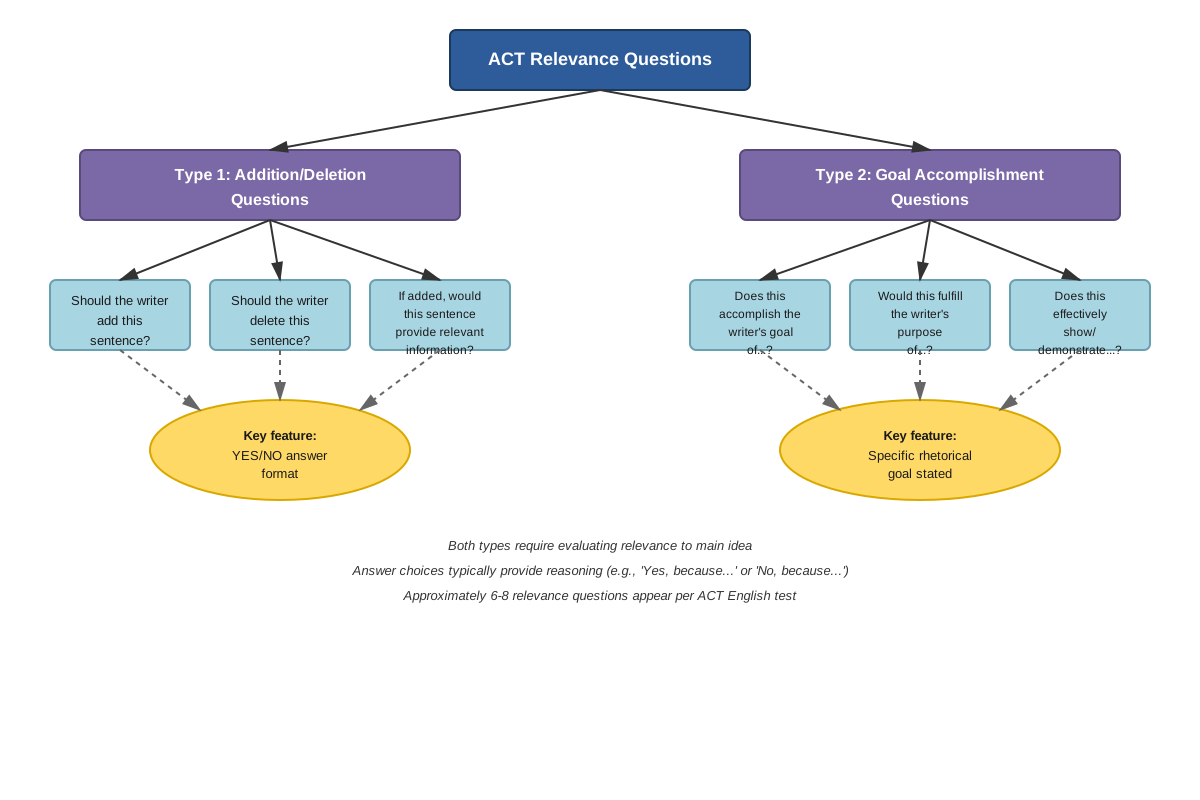
On the ACT English section, relevance questions appear in approximately 6-8 questions per test, making them one of the most common question types within the Rhetorical Skills category. These questions typically account for 12-15% of the total English section score. They appear in two primary formats: "Should the writer add/delete this sentence?" questions and "Does this accomplish the writer's goal?" questions. Both formats require students to evaluate information against specific criteria.
Relevance questions commonly appear at paragraph boundaries, after descriptive passages, and in narrative or informative essays where tangential details might seem interesting but don't advance the main purpose. The ACT frequently tests whether students can distinguish between information that is factually accurate but contextually irrelevant versus information that directly supports the passage's thesis or purpose.
Core Concepts
Defining Relevance in ACT Context
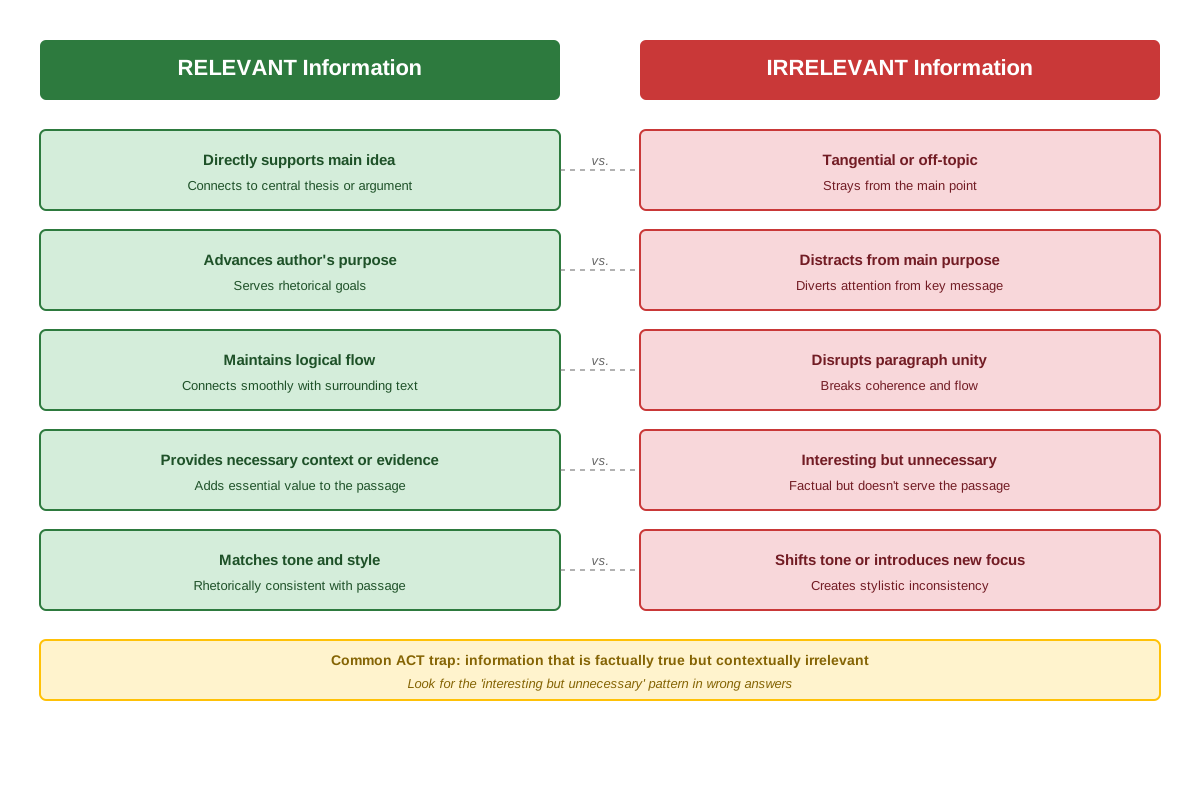
Relevance of information refers to whether a piece of text—a word, phrase, sentence, or paragraph—directly supports the main idea, purpose, or focus of the passage or paragraph in which it appears. Information is relevant when it advances the author's argument, provides necessary context, supports a claim, or contributes to the overall coherence of the text. Conversely, information is irrelevant when it distracts from the main point, introduces unrelated topics, or fails to serve the passage's rhetorical purpose.
The ACT tests relevance by presenting passages where certain sentences or details may be factually interesting or grammatically correct but don't belong in the specific context. Students must evaluate information not in isolation but relative to the surrounding text and the passage's overall goals.
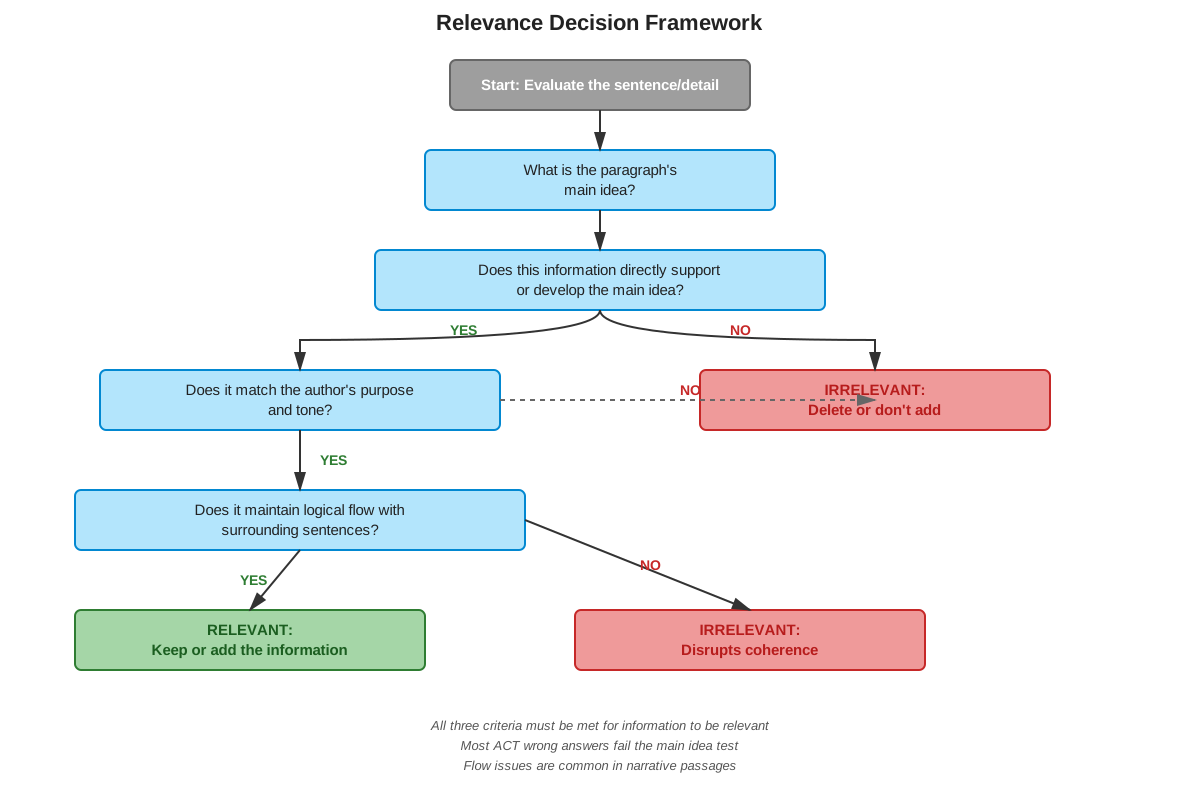
The Three-Part Relevance Test
To determine whether information is relevant, apply this systematic three-part test:
- Identify the paragraph's main idea: What is the primary focus of this specific paragraph? Read the topic sentence and surrounding sentences to establish the controlling idea.
- Evaluate the questioned information: Does the sentence or detail directly relate to, support, or develop the main idea? Does it provide necessary context or evidence?
- Consider the passage's overall purpose: Even if information relates to the paragraph topic, does it serve the broader purpose of the entire passage? Does it maintain the appropriate tone and scope?
Information must pass all three levels to be considered truly relevant. A sentence might relate to the general topic but still be irrelevant if it doesn't support the specific point being made in that paragraph.
Addition Questions
Addition questions present a proposed sentence and ask whether the writer should add it to the passage. These questions follow a consistent format:
Question structure: "The writer is considering adding the following sentence [location]. Should the writer make this addition?"
The answer choices typically include:
- Two "Yes" options with different reasons
- Two "No" options with different reasons
| Answer Type | What It Means | When to Choose |
|---|---|---|
| Yes, because it provides... | The addition is relevant and serves a specific purpose | The sentence directly supports the paragraph's focus and the reason accurately describes its function |
| Yes, because it adds... | The addition is relevant for a different reason | The sentence belongs but for a different purpose than the first "Yes" option |
| No, because it distracts... | The addition is irrelevant | The sentence introduces unrelated information or shifts focus away from the main idea |
| No, because it contradicts... | The addition creates logical problems | The sentence conflicts with information already in the passage |
The key strategy is to first determine whether the addition belongs (Yes or No), then evaluate which reason accurately explains why.
Deletion Questions
Deletion questions ask whether an existing sentence should be removed from the passage. These questions test whether students recognize that information currently in the passage doesn't belong.
Question structure: "The writer is considering deleting the preceding sentence. Should the sentence be kept or deleted?"
The answer choices follow a similar pattern:
- Two "Kept" options with different reasons
- Two "Deleted" options with different reasons
To answer deletion questions effectively:
- Assume the sentence is there for a reason: The ACT typically includes sentences that seem relevant at first glance
- Identify what the sentence contributes: Does it provide essential context, support a claim, or create necessary transitions?
- Evaluate the passage without it: Would removing the sentence create gaps in logic or leave claims unsupported?
- Check the reasons carefully: Even if you correctly determine kept/deleted, you must select the reason that accurately describes the sentence's function or problem
Goal-Accomplishment Questions
These questions present a specific rhetorical goal and ask whether the passage or paragraph accomplishes it. They test whether students can evaluate writing against explicit criteria.
Question structure: "Suppose the writer's goal was to [specific purpose]. Would this essay accomplish that goal?"
Common goals include:
- Explaining a scientific process
- Describing a personal experience
- Arguing for a particular position
- Providing historical context
- Comparing two concepts
To answer these questions:
- Identify the stated goal precisely: What specific purpose is mentioned?
- Survey the entire passage: What does the passage actually focus on?
- Match goal to content: Does the passage's primary focus align with the stated goal?
- Evaluate comprehensiveness: Even if the passage mentions the goal topic, does it develop it sufficiently to accomplish the goal?
Context Clues for Relevance
Several textual features signal whether information is relevant:
Supporting relevance:
- The sentence uses pronouns or references that connect to previous sentences
- The information provides specific examples of a general claim just made
- The detail answers a question raised in the previous sentence
- The sentence develops or extends the topic sentence's main idea
Signaling irrelevance:
- The sentence introduces a completely new topic without transition
- The information shifts time period, location, or subject abruptly
- The detail provides background information about something not central to the passage
- The sentence breaks the logical flow between surrounding sentences
Concept Relationships
Relevance of information serves as the foundation for several interconnected rhetorical skills. Understanding relevance directly enhances your ability to evaluate organization because relevant information must also be properly ordered. When information is relevant but poorly placed, it creates organizational problems; when information is irrelevant, no amount of reorganization will make it belong.
The relationship flows as follows: Main Idea Identification → Relevance Evaluation → Organization Assessment → Transition Selection. You must first understand what the passage is about (main idea) before you can determine whether information belongs (relevance). Once you've established that information is relevant, you can evaluate whether it's in the right location (organization) and whether appropriate transitions connect it to surrounding text.
Relevance also connects to purpose and audience considerations. Information that might be relevant for one audience could be irrelevant for another. For example, technical jargon might be relevant in a scientific paper but irrelevant in a general-interest article on the same topic. The ACT tests this by presenting passages with specific purposes and asking whether information serves those purposes.
Within the topic itself, the three question types (addition, deletion, and goal-accomplishment) represent different perspectives on the same core concept. Addition questions test whether new information would be relevant; deletion questions test whether existing information is relevant; goal-accomplishment questions test whether the entire passage's information collectively serves a stated purpose.
High-Yield Facts
⭐ Relevance is always determined relative to the specific paragraph's focus, not just the general passage topic
⭐ In addition/deletion questions, first decide Yes/No or Kept/Deleted, then select the reason that accurately describes why
⭐ Information can be factually accurate and interesting but still be irrelevant if it doesn't serve the passage's purpose
⭐ The correct reason in relevance questions must accurately describe what the sentence does or doesn't do—not just sound good
⭐ Goal-accomplishment questions require evaluating the entire passage against a specific stated purpose
- Relevance questions typically appear 6-8 times per ACT English section
- Sentences that introduce new topics without connection to the main idea are usually irrelevant
- Supporting details must directly develop or illustrate the paragraph's controlling idea to be relevant
- Tangential information about related topics is a common wrong answer trap
- The ACT often presents interesting historical background or biographical details that don't serve the passage's immediate purpose
- Relevant information maintains consistent scope—don't shift from specific to overly general or vice versa
- Transition words alone don't make irrelevant information relevant
- In deletion questions, if removing a sentence creates no gap in logic or understanding, it's likely irrelevant
Quick check — test yourself on Relevance of information so far.
Try Flashcards →Common Misconceptions
Misconception: If information relates to the general topic of the passage, it's relevant.
Correction: Information must relate specifically to the paragraph's main idea and serve the passage's purpose. A passage about jazz music might have a paragraph focused on Louis Armstrong's trumpet technique; a sentence about his childhood, while related to the general topic, would be irrelevant to that specific paragraph's focus.
Misconception: Longer, more detailed information is more relevant than brief statements.
Correction: Relevance is about connection to the main idea, not length or detail level. A single concise sentence that directly supports the topic sentence is more relevant than three detailed sentences about a tangential subject.
Misconception: If a sentence is grammatically correct and well-written, it should be kept.
Correction: Grammar and relevance are separate issues. The ACT frequently includes perfectly written sentences that don't belong in the passage. Mechanical correctness doesn't determine relevance.
Misconception: The reason in the answer choice doesn't matter as much as getting Yes/No or Kept/Deleted correct.
Correction: Both parts must be correct to earn credit. The ACT specifically tests whether you understand why information is or isn't relevant, not just whether you have a general sense that something doesn't fit.
Misconception: Information that appears in the introduction or conclusion is always relevant because those are important positions.
Correction: Position in the passage doesn't guarantee relevance. The ACT tests whether information belongs in those positions based on whether it serves the appropriate function (introducing the topic, summarizing main points, etc.).
Misconception: If information is interesting or surprising, it should be included to engage readers.
Correction: While engaging writing is valuable, relevance to the main purpose takes priority. The ACT tests academic and professional writing standards where focus and coherence matter more than entertainment value.
Worked Examples
Example 1: Addition Question
Passage Context: The paragraph discusses how urban gardens provide fresh produce to city residents and reduce food transportation costs.
Proposed Addition: "Many cities also struggle with air pollution from vehicle emissions."
Question: The writer is considering adding the preceding sentence. Should the writer make this addition?
A. Yes, because it provides relevant information about urban environmental challenges.
B. Yes, because it explains why urban gardens are necessary.
C. No, because it shifts focus away from the paragraph's discussion of urban gardens' benefits.
D. No, because it contradicts the passage's positive tone about cities.
Step-by-step solution:
- Identify the paragraph's main idea: The paragraph focuses specifically on how urban gardens benefit cities by providing fresh produce and reducing transportation costs.
- Evaluate the proposed addition: The sentence about air pollution from vehicles is related to urban environmental issues but doesn't connect to urban gardens, fresh produce, or food transportation.
- Determine Yes or No: The sentence doesn't support the paragraph's focus on urban gardens' benefits, so the answer is No.
- Evaluate the reasons:
- Choice C accurately describes the problem: the sentence shifts focus to a different environmental issue (air pollution) that isn't connected to the paragraph's discussion of urban gardens
- Choice D is incorrect because the issue isn't about tone or contradiction—the sentence could be true and maintain a neutral tone, but it still doesn't belong
Correct Answer: C
Connection to learning objectives: This example demonstrates how to identify relevance questions (objective 1), apply the three-part relevance test (objective 2), and distinguish between information related to the general topic versus information that supports the specific paragraph focus (objective 4).
Example 2: Deletion Question
Passage Context: The passage describes Marie Curie's groundbreaking research on radioactivity. The paragraph in question discusses her discovery of radium and polonium in 1898.
Sentence in question: "Curie's daughter Irène would later win her own Nobel Prize in Chemistry in 1935."
Question: Should the sentence be kept or deleted?
A. Kept, because it provides important context about the Curie family's scientific legacy.
B. Kept, because it demonstrates the long-term impact of Marie Curie's work.
C. Deleted, because it distracts from the paragraph's focus on Marie Curie's 1898 discoveries.
D. Deleted, because it contradicts the passage's chronological organization.
Step-by-step solution:
- Identify what the sentence contributes: The sentence provides factual information about Curie's daughter's later achievement.
- Check the paragraph's focus: The paragraph specifically discusses Marie Curie's 1898 discoveries of radium and polonium—the methods she used, the challenges she faced, and the significance of these specific elements.
- Evaluate whether the sentence supports this focus: While the information about Irène Curie is interesting and related to the Curie family, it doesn't develop or support the discussion of Marie Curie's 1898 discoveries. It jumps forward 37 years to a different person's achievement.
- Determine Kept or Deleted: The sentence should be deleted because it interrupts the paragraph's focused discussion of Marie Curie's specific discoveries.
- Evaluate the reasons:
- Choice C accurately identifies the problem: the sentence shifts attention away from the paragraph's specific focus
- Choice D is incorrect because the issue isn't about chronological organization of the passage—it's about maintaining paragraph focus
Correct Answer: C
Connection to learning objectives: This example shows how to apply relevance principles to deletion questions (objective 3), recognize when information is tangential despite being related to the general topic (objective 4), and identify the accurate reason among distractors (objective 6).
Exam Strategy
Approaching Relevance Questions
When you encounter a relevance question, follow this systematic approach:
- Identify the question type immediately: Look for key phrases like "considering adding," "should be kept or deleted," or "accomplish the goal"
- Read the entire paragraph: Don't evaluate the sentence in isolation. Understand the paragraph's main idea and how sentences flow together.
- Make your Yes/No or Kept/Deleted decision first: Before looking at the reasons, determine whether the information belongs. Cover the reasons with your hand if necessary.
- Eliminate two answer choices: Once you've decided Yes or No, you can immediately eliminate the two choices with the opposite decision.
- Evaluate the remaining reasons carefully: Read both reasons completely. The correct reason must accurately describe what the sentence does or doesn't do.
Trigger Words and Phrases
Watch for these phrases that signal relevance questions:
- "The writer is considering adding..."
- "Should the writer make this addition?"
- "Should the sentence be kept or deleted?"
- "Suppose the writer's goal was to..."
- "Would this essay accomplish that goal?"
- "Does this provide relevant information..."
- "At this point, the writer is considering..."
When you see these phrases, immediately shift into relevance-evaluation mode. These questions require different thinking than grammar questions—you're evaluating purpose and fit, not correctness.
Process of Elimination Tips
For Addition/Deletion questions:
- Eliminate based on Yes/No or Kept/Deleted first—this removes 50% of options immediately
- Watch for reasons that sound good but don't accurately describe the sentence's function
- Be suspicious of reasons that use extreme language ("completely contradicts," "absolutely essential") unless clearly justified
- The correct reason should specifically address what the sentence does, not make vague claims about "adding detail" or "providing information"
For Goal-Accomplishment questions:
- Eliminate answers that mischaracterize what the passage actually focuses on
- Watch for goals that are mentioned briefly but not developed as the main focus
- The correct answer must address both whether the goal is accomplished AND provide an accurate reason why or why not
Time Allocation
Relevance questions typically require more time than grammar questions because they demand careful reading of context. Allocate approximately:
- 45-60 seconds for addition/deletion questions (including time to read surrounding sentences)
- 60-75 seconds for goal-accomplishment questions (which may require reviewing the entire passage)
Don't rush these questions. The time invested in careful reading pays off in accuracy. However, if you're stuck between two reasons after determining Yes/No, make your best choice and move on rather than spending more than 90 seconds on any single question.
Memory Techniques
The MAIN Acronym
Use MAIN to remember the four key questions for evaluating relevance:
- Main idea: What is this paragraph's main idea?
- Advance: Does this sentence advance that main idea?
- Interrupt: Does this sentence interrupt the flow or shift focus?
- Necessary: Is this sentence necessary for understanding or supporting the point?
If a sentence advances the main idea without interrupting flow and provides necessary support, it's relevant. If it fails any of these tests, it's likely irrelevant.
The "Delete and Check" Visualization
For deletion questions, visualize physically removing the sentence and reading the paragraph without it. Ask yourself:
- Does the paragraph still make complete sense?
- Is any important information missing?
- Do the surrounding sentences still connect logically?
If the answer to all three is yes, the sentence is probably irrelevant and should be deleted.
The Purpose Spotlight
Imagine a spotlight shining on the passage's main purpose. Relevant information stays in the spotlight; irrelevant information wanders outside it. When evaluating a sentence, visualize whether it stays illuminated by the purpose spotlight or drifts into darkness.
The "So What?" Test
After reading a potentially irrelevant sentence, ask "So what? How does this help the paragraph accomplish its goal?" If you can't articulate a clear connection, the information is likely irrelevant.
Summary
Relevance of information is a critical rhetorical skill that tests whether students can identify information that belongs in a passage based on the author's purpose and the paragraph's focus. The ACT presents relevance questions in three main formats: addition questions (should new information be added?), deletion questions (should existing information be removed?), and goal-accomplishment questions (does the passage achieve a stated purpose?). To answer these questions successfully, students must identify the paragraph's main idea, evaluate whether the questioned information directly supports that idea, and select the answer choice with both the correct decision (Yes/No or Kept/Deleted) and an accurate reason. Information can be factually correct, well-written, and related to the general topic but still be irrelevant if it doesn't serve the specific paragraph's focus or the passage's overall purpose. Mastering relevance requires thinking like an editor, constantly evaluating whether each piece of information advances the author's goal and maintains coherent focus.
Key Takeaways
- Relevance is always determined relative to the specific paragraph's main idea, not just the general passage topic
- In addition/deletion questions, decide Yes/No or Kept/Deleted first, then select the accurate reason
- Information must directly support, develop, or illustrate the paragraph's focus to be relevant
- Factually accurate and interesting information can still be irrelevant if it doesn't serve the passage's purpose
- The correct reason must accurately describe what the sentence does or doesn't do, not just sound plausible
- Goal-accomplishment questions require evaluating whether the entire passage's primary focus matches the stated goal
- Eliminate answer choices systematically: first by Yes/No or Kept/Deleted, then by evaluating which reason is accurate
Related Topics
Organization and Transitions: After mastering relevance, students should study how relevant information should be ordered within paragraphs and passages, and how transitions connect ideas logically.
Purpose and Audience: Understanding how writing purpose and intended audience affect what information is relevant deepens comprehension of rhetorical effectiveness.
Main Ideas and Supporting Details: This foundational reading comprehension skill directly supports relevance evaluation by helping students identify what information counts as support versus distraction.
Conciseness and Wordiness: While relevance focuses on whether information belongs, conciseness addresses whether relevant information is expressed efficiently—both contribute to effective writing.
Practice CTA
Now that you understand the principles of relevance of information, it's time to apply these strategies to actual ACT-style questions. Complete the practice questions to reinforce your ability to identify relevant versus irrelevant information, and use the flashcards to memorize key concepts and trigger phrases. Remember: relevance questions reward careful reading and systematic evaluation. With practice, you'll develop the editorial judgment needed to confidently answer these high-yield questions and boost your ACT English score.
Sign up free to keep reading
Create a free AnvayaPrep account to finish this ACT guide on Relevance of information — plus flashcards and practice questions.