Overview
Conciseness is one of the most frequently tested concepts on the ACT Writing section, appearing in approximately 15-20% of all English questions. This fundamental principle requires students to identify and eliminate redundant, wordy, or unnecessarily complex expressions while preserving the original meaning and clarity of a sentence. The ACT consistently rewards writers who can express ideas efficiently, making conciseness a high-yield topic that directly impacts test scores.
Understanding ACT conciseness goes beyond simply choosing shorter answers. The test evaluates whether students can distinguish between necessary detail and superfluous language, recognize when additional words add no meaningful information, and select the most direct expression of an idea. This skill reflects real-world writing demands where clear, efficient communication is valued across academic, professional, and personal contexts. Mastering conciseness often means the difference between a score in the mid-20s and a score approaching 36.
Within the broader framework of Essay Organization and Style, conciseness works in tandem with other writing principles such as clarity, precision, and tone. While clarity ensures ideas are understandable, conciseness ensures they're expressed without waste. This topic intersects with sentence structure, word choice, and rhetorical skills, making it a cornerstone of effective writing that supports nearly every other concept tested in the ACT English section.
Learning Objectives
- [ ] Identify when Conciseness is being tested in ACT English questions
- [ ] Explain the core rule or strategy behind Conciseness
- [ ] Apply Conciseness to ACT-style questions accurately
- [ ] Distinguish between concise writing and writing that lacks necessary detail
- [ ] Recognize common redundancy patterns that appear on the ACT
- [ ] Evaluate answer choices to determine which maintains meaning while eliminating wordiness
- [ ] Apply the "shortest answer rule" appropriately while avoiding oversimplification
Prerequisites
- Basic sentence structure: Understanding subjects, verbs, and objects helps identify which words are essential versus decorative
- Parts of speech recognition: Knowing adjectives, adverbs, and modifiers enables identification of redundant descriptors
- Reading comprehension: Determining whether meaning is preserved requires understanding what sentences communicate
- Grammar fundamentals: Recognizing complete sentences ensures that eliminating words doesn't create fragments
Why This Topic Matters
In professional and academic writing, conciseness demonstrates respect for the reader's time and enhances message clarity. Employers, professors, and editors consistently value writers who can convey complex ideas efficiently. The ability to eliminate verbal clutter while maintaining substance is a hallmark of sophisticated communication that extends far beyond standardized testing.
On the ACT specifically, conciseness questions appear with remarkable frequency—typically 5-7 questions per test. These questions often present four answer choices where one option is significantly shorter than the others, though not always. The test makers design these questions to assess whether students can identify redundancy in various forms: repeated ideas, unnecessary modifiers, wordy phrases that could be replaced with single words, and expressions that state the obvious.
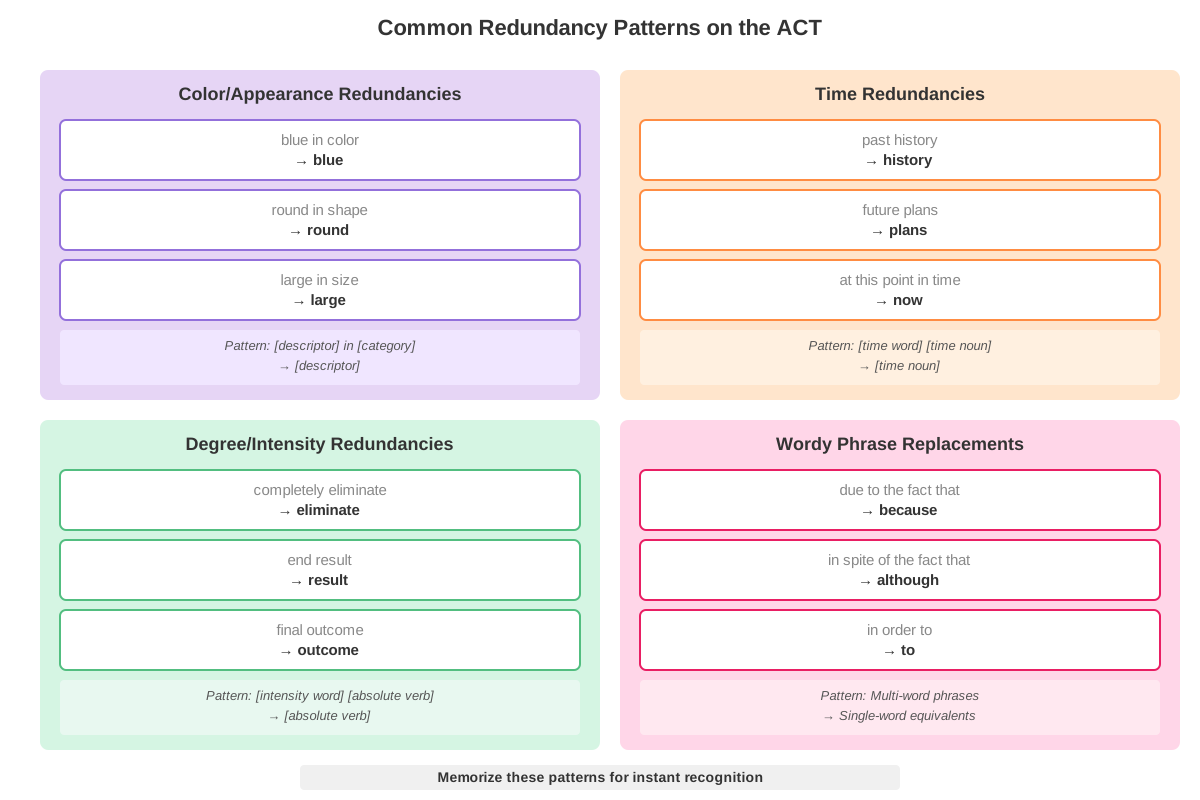
Common manifestations in ACT passages include phrases like "blue in color" (redundant because blue already indicates color), "completely eliminate" (eliminate already means complete removal), "past history" (history is inherently past), and "end result" (results come at the end). The test also features wordy constructions like "due to the fact that" (replaceable with "because"), "in spite of the fact that" (replaceable with "although"), and "at this point in time" (replaceable with "now"). Recognizing these patterns enables rapid, confident answering.
Core Concepts
The Fundamental Principle of Conciseness
The core principle of conciseness is straightforward: express ideas using the fewest words necessary to convey complete, accurate meaning. This doesn't mean choosing the shortest answer automatically—it means eliminating words that contribute nothing to meaning, clarity, or style. Every word should earn its place in the sentence by adding information, nuance, or necessary grammatical structure.
The ACT tests this principle by presenting sentences with various forms of wordiness, then offering answer choices that range from extremely wordy to appropriately concise. The correct answer preserves all essential meaning while removing redundancy. Understanding this principle requires recognizing that more words don't equal better writing; precision and efficiency do.
Types of Redundancy
Semantic redundancy occurs when words repeat the same meaning. This is the most common form tested on the ACT. Examples include:
| Redundant Phrase | Concise Alternative | Why It's Redundant |
|---|---|---|
| advance planning | planning | planning is inherently done in advance |
| basic fundamentals | fundamentals | fundamentals are basic by definition |
| close proximity | proximity | proximity means closeness |
| end result | result | results occur at the end |
| free gift | gift | gifts are free by nature |
| past memories | memories | memories are of the past |
| repeat again | repeat | repeat means to do again |
| return back | return | return means to go back |
Syntactic redundancy involves unnecessary grammatical structures or phrases that could be simplified:
- "In spite of the fact that" → "Although"
- "Due to the fact that" → "Because"
- "At this point in time" → "Now"
- "In the event that" → "If"
- "For the purpose of" → "To"
- "In order to" → "To"
- "Has the ability to" → "Can"
Categorical redundancy occurs when a modifier describes a quality already inherent in the word it modifies:
- "Blue in color" (blue is a color)
- "Large in size" (large describes size)
- "Circular in shape" (circular describes shape)
- "Expensive in price" (expensive relates to price)
The Shortest Answer Strategy
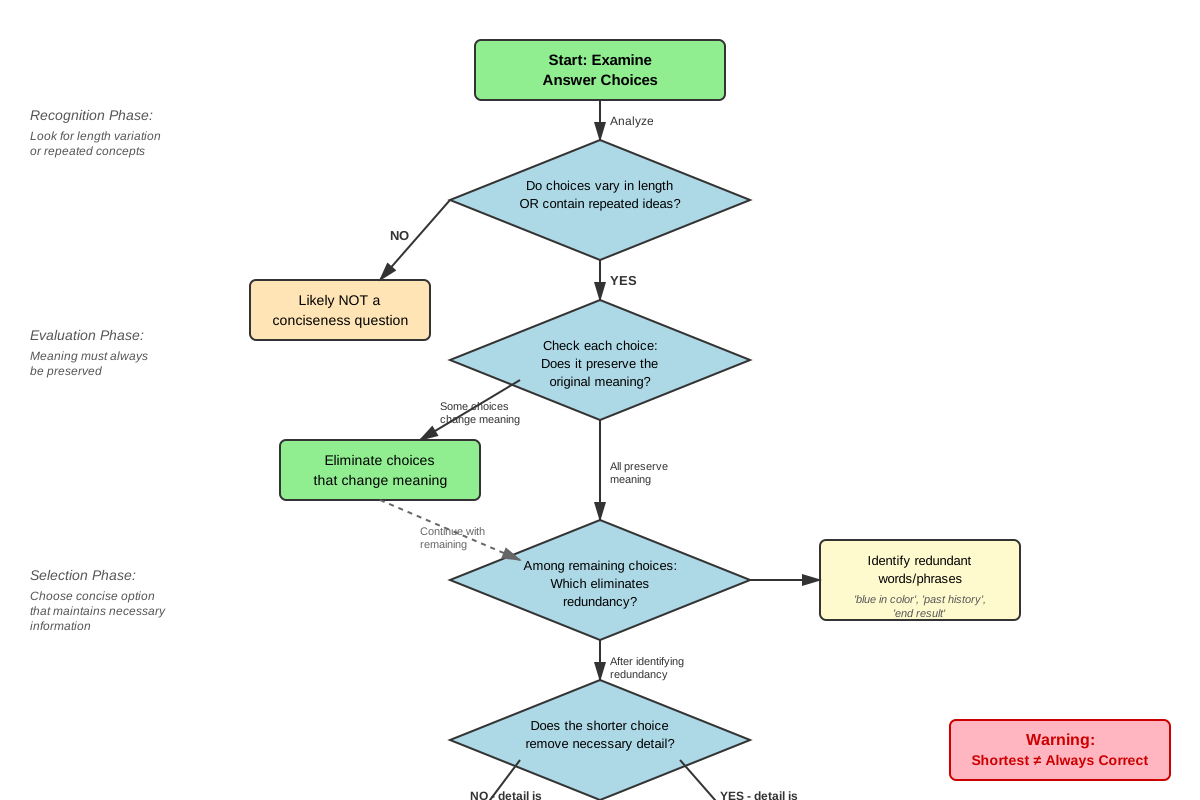
A powerful ACT strategy is recognizing that when one answer choice is significantly shorter than the others and maintains complete meaning, it's often correct. However, this rule has important limitations. The shortest answer is correct when:
- It preserves all essential meaning from the original
- It maintains grammatical correctness
- It doesn't sacrifice necessary detail or clarity
- It fits the tone and style of the passage
The shortest answer is NOT correct when:
- It creates a sentence fragment
- It changes the intended meaning
- It removes necessary information
- It creates ambiguity
Necessary Detail vs. Wordiness
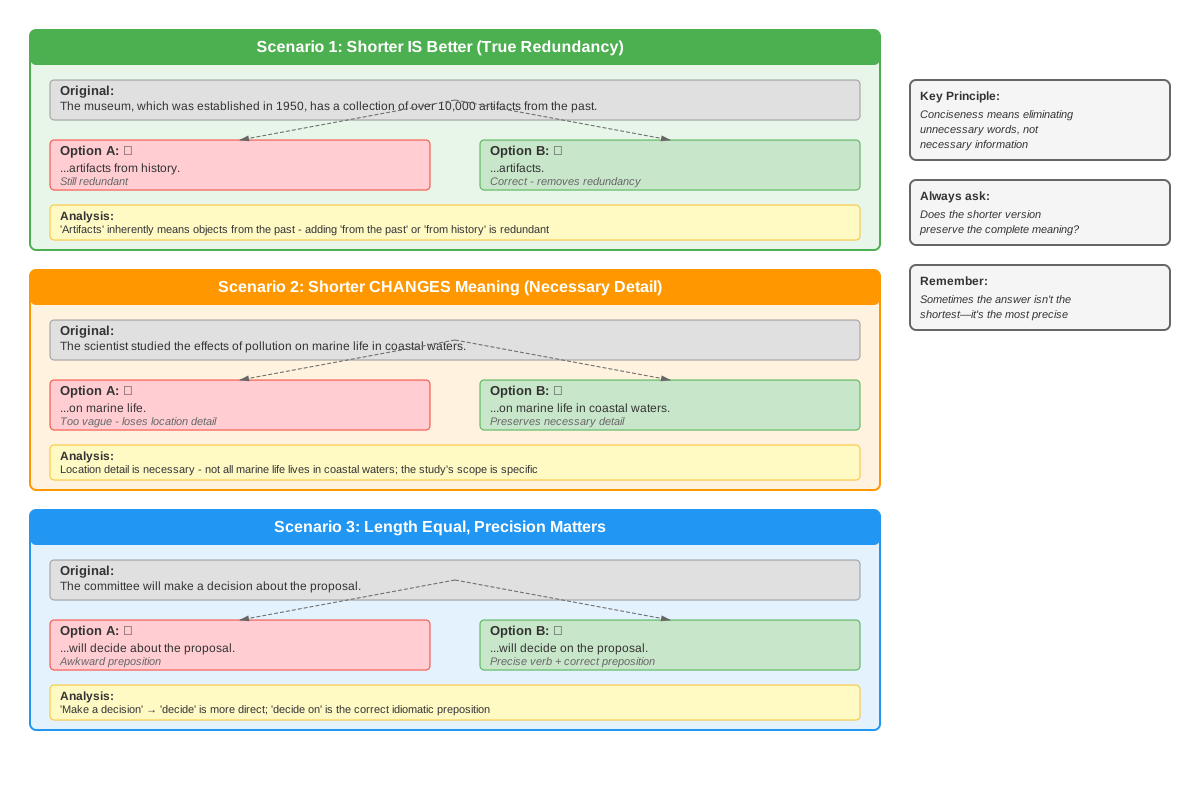
Distinguishing between helpful elaboration and unnecessary wordiness is crucial. Necessary detail adds information that enhances understanding, provides important context, or clarifies meaning. Wordiness repeats information already conveyed or adds words without adding meaning.
Consider: "The ancient, centuries-old manuscript was discovered in a forgotten library."
- "Ancient" and "centuries-old" are redundant—both convey age
- Better: "The ancient manuscript was discovered in a forgotten library."
However: "The 12th-century manuscript was discovered in a forgotten monastery library in Tibet."
- Here, "12th-century," "monastery," and "Tibet" each add distinct, valuable information
- This is necessary detail, not wordiness
Context-Dependent Conciseness
Some phrases that seem redundant in isolation serve valid purposes in context. "Completely destroyed" might seem redundant (destroyed means complete destruction), but in contexts discussing partial versus total damage, "completely" adds meaningful distinction. The ACT rarely tests these nuanced cases, but awareness prevents over-application of conciseness rules.
Concept Relationships
Conciseness connects directly to clarity—removing unnecessary words often makes meaning clearer by eliminating distractions. When sentences contain redundant phrases, readers must process extra information that doesn't contribute to understanding, potentially obscuring the main point. By achieving conciseness, writers simultaneously enhance clarity.
The relationship flows: Redundancy identification → Word elimination → Concise expression → Enhanced clarity
Conciseness also relates to sentence structure because wordy constructions often involve unnecessarily complex grammatical patterns. Simplifying these structures (converting "due to the fact that" to "because") creates both conciseness and improved sentence flow. This connection means that students strong in sentence structure often excel at conciseness questions.
Additionally, conciseness intersects with word choice and diction. Selecting precise vocabulary enables concise expression—using "demolished" instead of "completely destroyed" or "now" instead of "at this point in time" demonstrates sophisticated word choice that naturally produces conciseness.
The prerequisite knowledge of parts of speech enables conciseness mastery because recognizing that adjectives modify nouns helps identify when two adjectives convey the same information (redundancy). Understanding sentence structure allows students to see when phrases can be replaced with single words without creating fragments.
High-Yield Facts
⭐ The ACT includes 5-7 conciseness questions per test, making it one of the most frequently tested concepts
⭐ When answer choices vary significantly in length and the shortest maintains complete meaning, it's usually correct
⭐ Redundancy is the primary form of wordiness tested—look for phrases where words repeat the same meaning
⭐ Common redundant phrases include "past history," "end result," "advance planning," and "close proximity"
⭐ Wordy prepositional phrases like "due to the fact that" can almost always be replaced with single words like "because"
- Phrases ending in "in color," "in size," or "in shape" are typically redundant
- The word "that" is often unnecessary and can be eliminated without changing meaning
- "In order to" can almost always be shortened to "to"
- Adverbs that repeat verb meanings are redundant (e.g., "whispered quietly")
- The ACT never requires you to choose an answer that changes the original meaning to achieve conciseness
- Conciseness questions often appear with "DELETE the underlined portion" as an option
- Phrases like "at this point in time" and "in this day and age" are always unnecessarily wordy
- The construction "has the ability to" should be replaced with "can"
- Double negatives create wordiness and should be converted to positive statements
- Conciseness applies to entire phrases, not just individual words—evaluate the whole expression
Quick check — test yourself on Conciseness so far.
Try Flashcards →Common Misconceptions
Misconception: Always choose the shortest answer on the ACT English section.
Correction: Choose the shortest answer only when it preserves complete meaning, maintains grammatical correctness, and doesn't sacrifice necessary detail. Sometimes longer answers provide essential information or clarity that shorter versions lack.
Misconception: Concise writing means simple writing with basic vocabulary.
Correction: Conciseness means efficient writing that eliminates unnecessary words while potentially using sophisticated vocabulary. "Demolished" is both more concise and more advanced than "completely destroyed."
Misconception: Descriptive details are always wordiness that should be eliminated.
Correction: Descriptive details that add new information or enhance understanding are valuable. Only eliminate descriptions that repeat information already conveyed or add nothing meaningful.
Misconception: If two words mean similar things, using both adds emphasis.
Correction: On the ACT, using two words with the same meaning is redundancy, not emphasis. Effective emphasis comes from word choice, sentence structure, or rhetorical devices, not repetition.
Misconception: Formal writing requires longer, more complex phrases.
Correction: Formal writing values precision and clarity, which conciseness enhances. Phrases like "due to the fact that" don't make writing more formal—they make it wordy. "Because" is both concise and appropriately formal.
Misconception: Eliminating words always improves a sentence.
Correction: Eliminating words improves sentences only when those words are unnecessary. Removing words that provide essential information, maintain grammatical structure, or ensure clarity damages the sentence.
Worked Examples
Example 1: Identifying and Eliminating Redundancy
Original sentence with underlined portion:
"The final outcome of the experiment was surprising and unexpected to the researchers."
Answer choices:
- A) NO CHANGE
- B) outcome of the experiment was surprising
- C) outcome was surprising and unexpected
- D) end outcome was surprising
Step 1: Identify potential redundancy
- "Final outcome" - outcomes are inherently final (redundant)
- "Surprising and unexpected" - these words mean essentially the same thing (redundant)
Step 2: Evaluate each answer choice
- A) Contains both redundancies identified above
- B) Eliminates "surprising and unexpected" redundancy but keeps "final outcome"—wait, this actually eliminates "final" by saying just "outcome." Let me reconsider. This keeps "outcome of the experiment was surprising" which eliminates both "final" and "unexpected"
- C) Keeps "outcome" (good) but maintains "surprising and unexpected" (redundant)
- D) "End outcome" is redundant (outcomes are end results)
Step 3: Select the most concise option that preserves meaning
Choice B eliminates both redundancies while preserving all essential meaning. The sentence communicates that the experiment's outcome surprised researchers without unnecessary repetition.
Correct answer: B
Connection to learning objectives: This example demonstrates identifying when conciseness is tested (redundant modifiers), applying the core strategy (eliminating words that repeat meaning), and accurately selecting the concise answer.
Example 2: Distinguishing Necessary Detail from Wordiness
Original sentence with underlined portion:
"In spite of the fact that the weather was cold, the athletes continued their training regimen."
Answer choices:
- A) NO CHANGE
- B) Despite the fact that the weather was cold,
- C) Although the weather was cold,
- D) The weather being cold,
Step 1: Identify the wordy construction
"In spite of the fact that" is a wordy prepositional phrase that can be replaced with a single conjunction.
Step 2: Evaluate each answer choice
- A) Contains the wordy phrase (7 words to express what could be said in 1)
- B) "Despite the fact that" is slightly shorter but still wordy (5 words)
- C) "Although" conveys the same meaning in one word—this is concise
- D) "The weather being cold" creates a participial phrase that changes the sentence structure and sounds awkward
Step 3: Verify meaning preservation
Does "Although the weather was cold, the athletes continued their training regimen" preserve the original meaning? Yes—it maintains the contrast between cold weather and continued training.
Step 4: Check for grammatical correctness
"Although" properly introduces a dependent clause, and the sentence structure is correct.
Correct answer: C
Connection to learning objectives: This example shows how to recognize common wordy phrases tested on the ACT, apply the strategy of replacing multi-word phrases with single words, and verify that conciseness doesn't sacrifice meaning or grammar.
Exam Strategy
Recognition Triggers
When approaching ACT English questions, certain patterns signal conciseness is being tested:
- Answer choices vary significantly in length (one option has 3 words, another has 10)
- "DELETE the underlined portion" appears as an option
- Multiple answer choices seem to say the same thing but with different word counts
- The underlined portion contains phrases like "in order to," "due to the fact that," "at this point in time"
- Adjectives or adverbs appear before words they inherently describe ("blue in color," "whispered softly")
Exam Tip: When you see significant length variation among answer choices, immediately check whether the shortest option preserves complete meaning. If it does, it's likely correct.
Systematic Approach
- Read the sentence with the underlined portion to understand the complete meaning
- Identify any redundancy by asking: "Do any words repeat information already conveyed?"
- Check for wordy phrases that could be replaced with shorter alternatives
- Evaluate the shortest answer first to see if it maintains meaning and grammar
- Eliminate answers with clear redundancy even if they're not the longest
- Verify your choice by reading the complete sentence with your selected answer
Process of Elimination
Eliminate answer choices that:
- Contain obvious redundant pairs ("past history," "end result")
- Use wordy prepositional phrases when simpler options exist
- Include categorical redundancy ("blue in color")
- Add words without adding meaning
- Repeat the same idea using different words
Keep answer choices that:
- Express the idea most directly
- Preserve all essential information
- Maintain grammatical correctness
- Fit the passage's tone and style
Time Management
Conciseness questions should be among your fastest to answer—aim for 20-30 seconds per question. The patterns are highly recognizable, and once you identify redundancy, the correct answer becomes obvious. Don't overthink these questions. If an answer is clearly more concise while preserving meaning, select it confidently and move forward.
Exam Tip: If you're spending more than 45 seconds on a conciseness question, you're likely overcomplicating it. Trust the fundamental principle: eliminate unnecessary words while preserving meaning.
Memory Techniques
The TRIM Acronym
Test for redundancy
Remove unnecessary words
Identify wordy phrases
Maintain complete meaning
Use TRIM to remember the systematic approach to conciseness questions.
The "Color, Size, Shape" Rule
Whenever you see phrases ending in "in color," "in size," or "in shape," they're redundant. Visualize a traffic light: RED means STOP and eliminate these phrases.
The "Because" Family
Remember that these wordy phrases all mean "because":
- Due to the fact that
- On account of the fact that
- For the reason that
- In light of the fact that
Acronym: DOFI (sounds like "dough-fee")—whenever you see DOFI phrases, replace with "because."
The "Two-Word Test"
When you see two adjectives or two adverbs together, ask: "Could these mean the same thing?" If yes, eliminate one. Visualize two identical twins—you only need one to get the message across.
Visualization Strategy
Picture your writing as a backpack for a hike. Every unnecessary word is an extra pound. Would you carry two identical water bottles? No—that's redundant weight. Pack only what you need, and your writing (like your hike) becomes more efficient and effective.
Summary
Conciseness is a high-yield ACT concept that tests the ability to eliminate redundancy and wordiness while preserving complete meaning. The fundamental principle is straightforward: express ideas using the fewest words necessary without sacrificing clarity, grammatical correctness, or essential information. The ACT primarily tests three types of redundancy: semantic (words that repeat meaning), syntactic (unnecessarily complex phrases), and categorical (modifiers describing inherent qualities). Success requires recognizing common redundant patterns like "past history" and "end result," identifying wordy phrases like "due to the fact that" that can be replaced with single words, and applying the shortest-answer strategy appropriately. However, students must distinguish between wordiness and necessary detail—not all longer answers are wrong. The key is evaluating whether each word contributes meaningful information. With 5-7 questions per test, mastering conciseness significantly impacts overall scores and represents an efficient use of study time given the recognizable patterns and straightforward application.
Key Takeaways
- Conciseness appears in 5-7 questions per ACT test, making it one of the highest-yield topics to master
- The shortest answer that preserves complete meaning and grammatical correctness is usually correct when answer choices vary significantly in length
- Redundancy takes three main forms: semantic (repeated meanings), syntactic (wordy phrases), and categorical (unnecessary modifiers)
- Common redundant phrases include "past history," "end result," "advance planning," and phrases with "in color/size/shape"
- Wordy prepositional phrases like "due to the fact that" and "in spite of the fact that" should be replaced with "because" and "although"
- Necessary detail adds new information; wordiness repeats information already conveyed—learn to distinguish between them
- Apply the TRIM method: Test for redundancy, Remove unnecessary words, Identify wordy phrases, Maintain complete meaning
Related Topics
Clarity and Precision: Building on conciseness, this topic explores how word choice affects meaning accuracy. Mastering conciseness provides the foundation for understanding how precise language enhances communication efficiency.
Sentence Structure and Variety: Concise writing often involves restructuring sentences to eliminate wordiness. Understanding sentence patterns enables more sophisticated application of conciseness principles.
Transitions and Flow: While conciseness eliminates unnecessary words, effective transitions add necessary words that connect ideas. Learning when to add versus remove words develops advanced writing judgment.
Rhetorical Skills: Conciseness is one component of broader rhetorical effectiveness. After mastering conciseness, students can explore how word economy contributes to persuasive and engaging writing.
Style and Tone: Understanding conciseness helps students recognize how word choice and sentence length contribute to a passage's overall style, enabling more nuanced analysis of author's craft.
Practice CTA
Now that you've mastered the principles of conciseness, it's time to apply this knowledge! Work through the practice questions to reinforce your ability to identify redundancy, eliminate wordiness, and select the most concise answer choices. Each practice question is designed to mirror actual ACT patterns, building your confidence and speed. Remember, conciseness questions should be among your fastest to answer—use the practice to develop that efficiency. Review the flashcards to cement the common redundant phrases and wordy constructions in your memory. With consistent practice, recognizing and eliminating wordiness will become automatic, giving you a significant advantage on test day. You've got this!
Sign up free to keep reading
Create a free AnvayaPrep account to finish this ACT guide on Conciseness — plus flashcards and practice questions.